Welcome to another installment of Starting Hex, a series about Warhammer Underworlds. This entry is going to consist of my musings about those high payoff objectives that some Rivals decks come with. You know the ones – big, juicy rewards of three or more glory for doing something special that's centered around the deck's theme. These are usually pretty difficult to pull off, making them high risk cards that offer high rewards in return.
How Useful Are These Cards?
There's a bell curve in how useful these cards are that has to do with opposing player skill and familiarity. They tend to score reliably against players who aren't expecting them and aren't actively playing around them. This feels kind of obvious because the downside of these high scoring objectives is that they can be relatively easily denied, but if there's no attempt to deny them then they're basically printing free glory for you.
Once your opponents' skill level and familiarity with the game starts to increase, they are now aware of these cards and actively try to deny you from scoring them. Whether this is standing on a treasure token to deny Strip the Realm or simply not charging with all of their fighters to deny Unrelenting Massacre, players at this level have realized that making a sacrifice to their own game plan can brick a very high scoring objective in their opponent's hand and be worthwhile.
What gets interesting comes after this point. If you can expect that your opponents are going to be aware of and actively denying you scoring these objectives, are they still worth including?
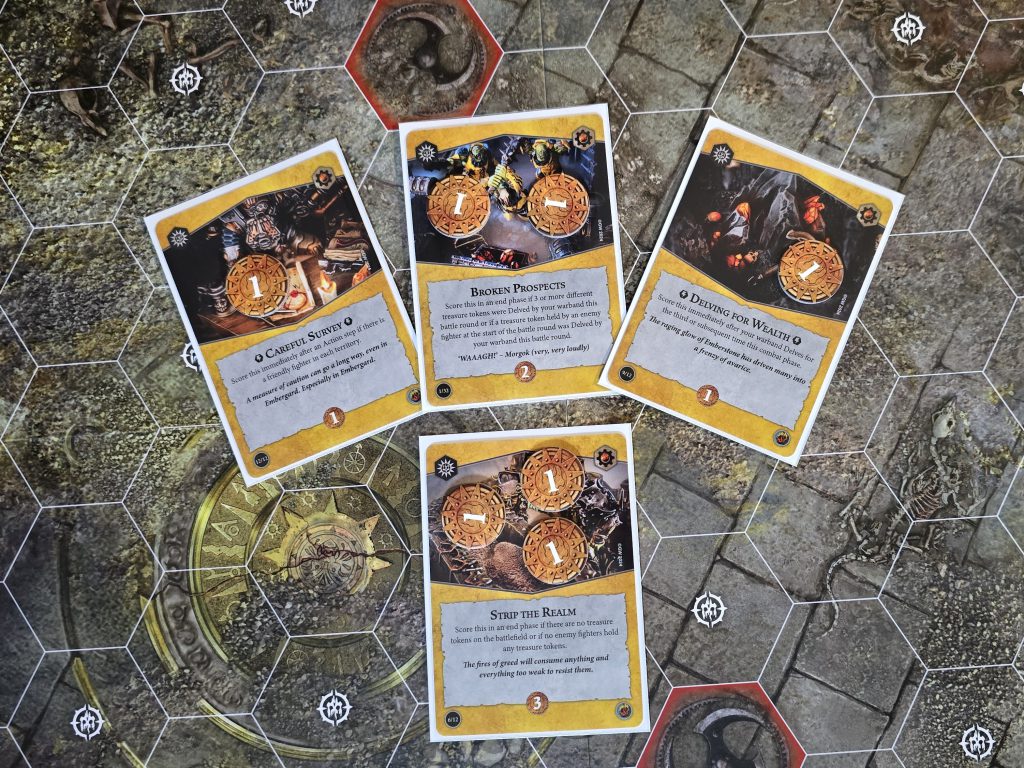 Photo credit: Jake Bennington
One way of looking at it is that you're gambling on the opponent forgetting about it or making a mistake that you can exploit to still score these objectives. Looking at Strip the Realm, for instance, if your opponent was holding only a single treasure token in an effort to deny your scoring, you could fire off a well timed Confusion or Lure of Battle to push them off and get that three glory. In this case, the objectives are still valued for their scoring potential but you'll have to both work a little harder to score them and/or rely on your opponent slipping up.
Another approach is instead of focusing on the glory as the payoff for these objectives, you can look at the fact that you're restraining your opponent's options as the payoff. Against an elite aggro opponent, forcing them to always be on a treasure somewhere because they're trying to stop you from scoring three glory with Strip is not a trivial restriction. If you're able to leverage this restriction, you can force your opponent to make a difficult decision of keeping a threatening fighter out of combat or giving you a bucket load of glory.
There's also an interesting choice that can be made in deck building. For instance, if you're expecting your opponents to do their best to always end a round on at least one treasure token, do you even bother including Strip the Realm? You could instead replace it with another objective that's easier to score while leaving your opponent to think you still
potentially have it in your deck. They can't know for sure unless you get through your entire objective deck
and they are paying close attention to all the cards they've seen over the course of your games.
Of course, if the general accepted practice of the meta is that you stop including these cards because your opponents are going to be denying them, then common practice will also shift so people
aren't spending effort on denying them… which leaves the meta open to be exploited by someone who does bring them!
You can go back and forth at this point, but it comes down to making a call about the types of players you expect to play against and your own comfort with being able to "force" through scoring some of these despite opponents actively trying to deny you.
 Credit: Games Workshop
As a fun exercise, let's take a look at what the players who attended the World Championships of Warhammer last week decided to take. I'll be looking at Nemesis pairings where the pilot took the big payoff card from the following decks and give them a rating on three scales – ease of scoring without the opponent trying to deny, ease of scoring when the opponent is trying to deny, and the impact it has on the opponent when they try to actively deny it. These ratings are mostly vibes based and I'd love to hear from anyone who has different opinions.
Blazing Assault: Annihilation
Emberstone Sentinels: Supremacy
Pillage & Plunder: Strip the Realm
Reckless Fury: Unrelenting Massacre
Edge of the Knife: Trial of the Tempered
Raging Slayers: Unrelenting Massacre
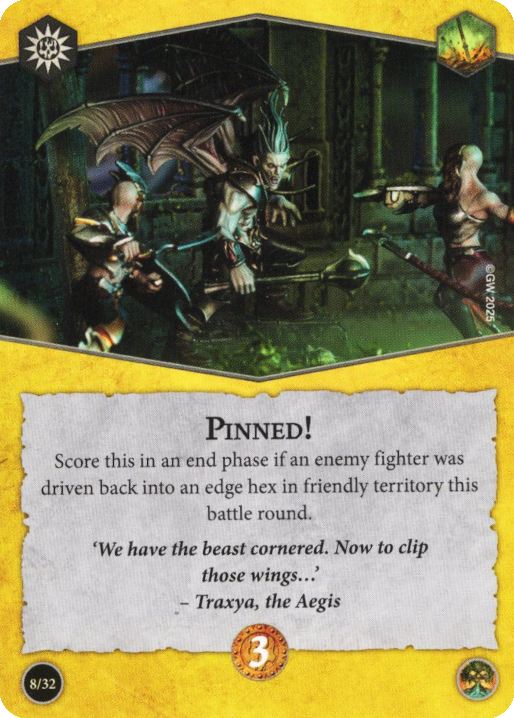
Hunting Grounds: Pinned!
 Credit: UnderworldsDB.com
Annihilation
Credit: UnderworldsDB.com
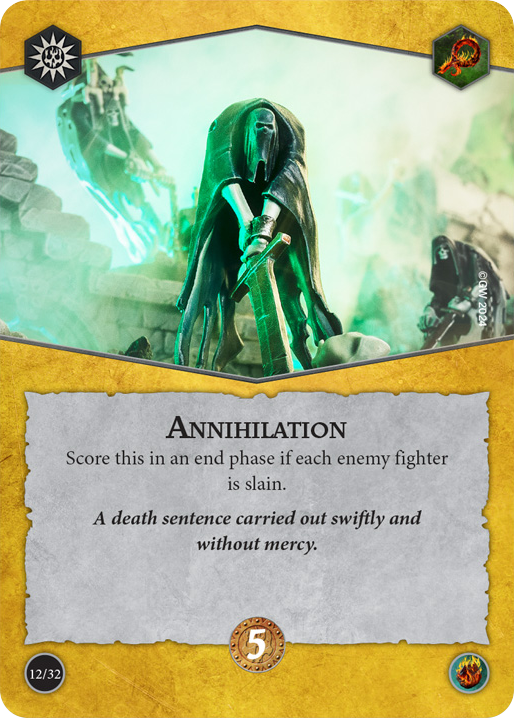
Annihilation appeared in only 3 of 27 Nemesis pairings that used Blazing Assault. Annihilation has been an interesting card from what I've been able to tell. I've rarely encountered it in games I've played – it's usually a surprising reveal when my opponent mentions it's in their deck – but from what I can gather it's a little more common in other metas. Of all of the high risk, high reward objectives this is the largest in both directions. No other objective in the game can match the five bounty awarded by Annihilation, but it's also one of the hardest to score
even if your opponent isn't playing around it. It's not uncommon for an aggressive warband with two aggressive decks to make 12 attacks in a game and still not table the opponent. Can it happen? Of course. It does require finesse and a bit of luck, but the reward is pretty massive. If the opponent knows it is in your deck, they are highly incentivized to do everything in their power to run away. That can interfere with their game plan, but at the point where Annihilation is on the table, their game plan is typically in a rough spot anyway.
Ease of scoring with no denial: 3/5
Ease of scoring with active denial: 2/5
Impact of active denial: 1/5
 Credit: UnderworldsDB.com
Supremacy
Credit: UnderworldsDB.com
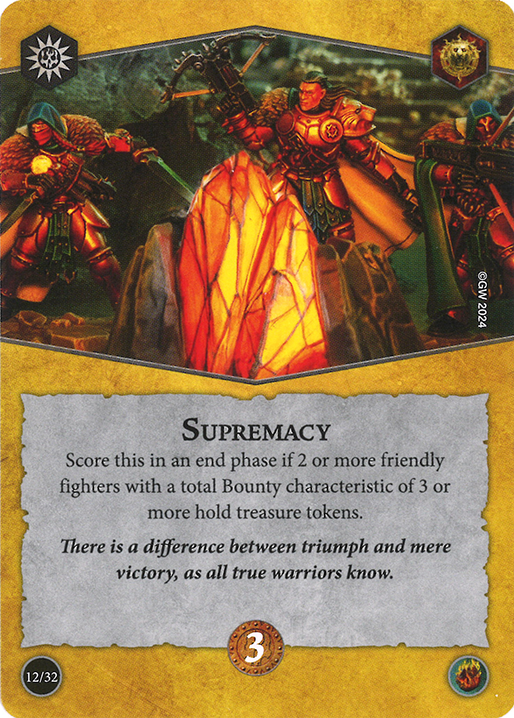
Supremacy showed up in 13 out of 16 decks at Worlds. This is interesting because Supremacy is the only one of these cards that is on the Restricted list, so it's directly competing with other potent cards like Spread Havoc and the surges from Pillage & Plunder and yet it was still overwhelmingly chosen. I feel like Supremacy also happens to have the most overlap with the other objectives in its deck, so scoring it is almost incidental to scoring a decent number of other Emberstone Sentinels objectives. The downside is this means disrupting Supremacy also disrupts a lot of other ES scoring and "attack fighters standing on tokens" is a very effective way to both disrupt ES scoring and enable most other plans to score.
Ease of scoring with no denial: 4/5
Ease of scoring with active denial: 3/5
Impact of active denial: 0/5
 Credit: UnderworldsDB.com
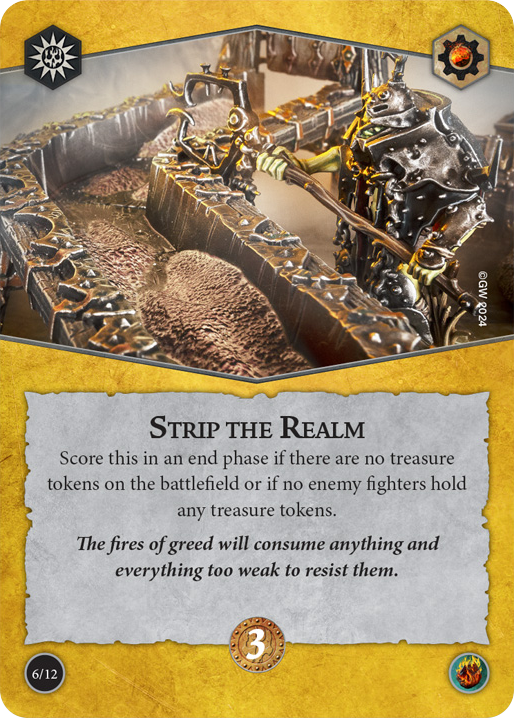
Strip the Realm
Credit: UnderworldsDB.com
Strip the Realm is quite the boogeyman and showed up in a staggering (it's a delve pun, get it?) 24 of 28 decks. Strip is an objective that is wholly dependent on your opponent
not doing something. Unless your opponent's gameplan is to stand on treasure tokens or they make a conscious effort to deny it, you can just score this objective automatically in some games. On the flip side, it's also one of the more easily deniable big objectives because it simply requires the opponent to park a fighter onto a token. The cost of doing this varies – elite warbands find it harder to spare a fighter to babysit a treasure while horde warbands often don't have the durability to reliably park a single fighter on a token and ensure it survives. Even if they're not planting a fighter in an out-of-the-way token, making your opponent more restricted in where they can land their fighters after charges can help you manipulate the battlefield quite nicely.
Ease of scoring with no denial: 5/5
Ease of scoring with active denial: 3/5
Impact of active denial: 4/5
 Credit: UnderworldsDB.com
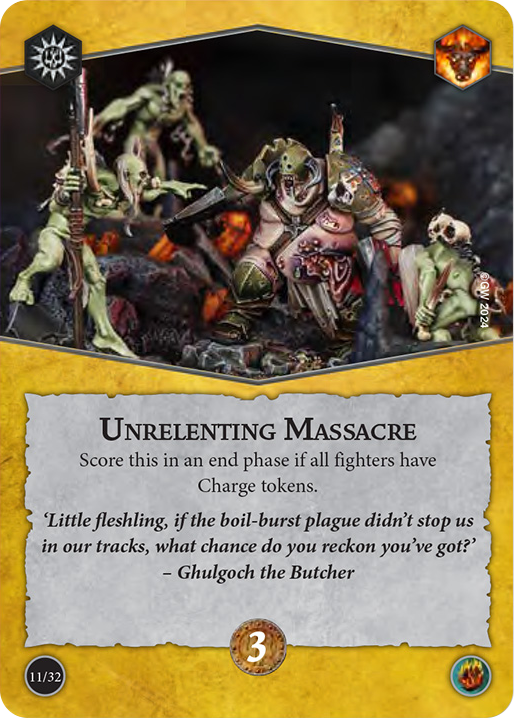
Unrelenting Massacre
Credit: UnderworldsDB.com
Unrelenting Massacre is next, and we're starting with the version in Reckless Fury. It showed up in 6 of 7 players' decks at Worlds. The ease of scoring and the impact of the opponent denying it will vary wildly based on what you are facing. More passive plans like ES/PP pairings can get away with denying this without any impact to their own scoring, while opposing aggro plans will have to sacrifice potentially 25% of their optimal activations (assuming they want to make a charge on every activation). It can be especially disruptive to other aggro decks that need to have fighters with charge tokens for their own objectives. Reckless Fury does have a solid suite of tools that can help force charge tokens out on unwilling opponents, though – between Catch Weapon, Reckless Attitudes, and Over to You, there are multiple ways to sneak that charge token over to ensure that sweet 3 glory even if the opponent is playing around it.
Ease of scoring with no denial: 4/5
Ease of scoring with active denial: 3/5
Impact of active denial: 3/5
 Credit: UnderworldsDB.com
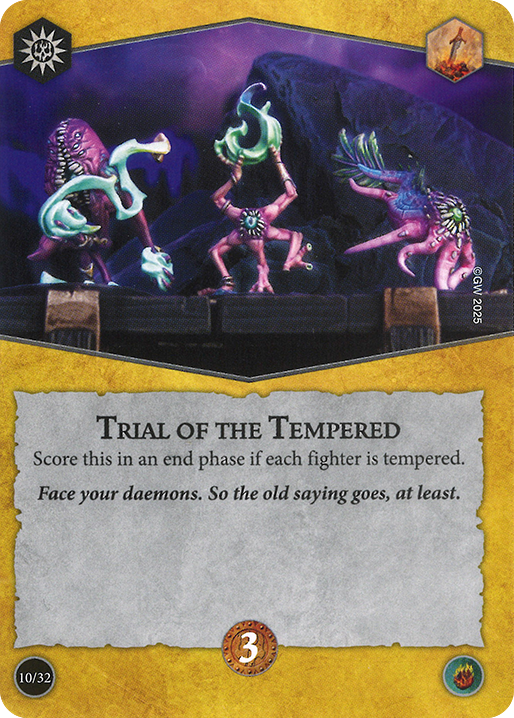
Trial of the Tempered
Credit: UnderworldsDB.com
Trial of the Tempered was in 4 of 6 decks. Trial is yet another polarizing objective on this list in terms of how easy to score it will be. Against a horde of pre-tempered fighters like the Grymwatch or Thorns of the Briar Queen, it's going to be fairly straightforward. Against a warband with high health fighters like Morgok or the Emberwatch, it will require spreading out damage across multiple fighters which often isn't ideal. Sigmar help you if you're up against something with multiple non-tempered fighters
and strong healing like Mollog or the Grandfather's Gardeners – that's quite an uphill battle. Fortunately it's a bit harder to deny this objective because the only way to avoid tempering a fighter is to either keep them from any harm or to heal them; the former is difficult to impossible and the latter is a pretty rare ability in the game as it exists now.
Ease of scoring with no denial: 2/5 to 4/5 (depending on opponent's warband composition)
Ease of scoring with active denial: 2/5 to 4/5 (depending on opponent's warband composition)
Impact of active denial: 2/5
 Credit: UnderworldsDB.com
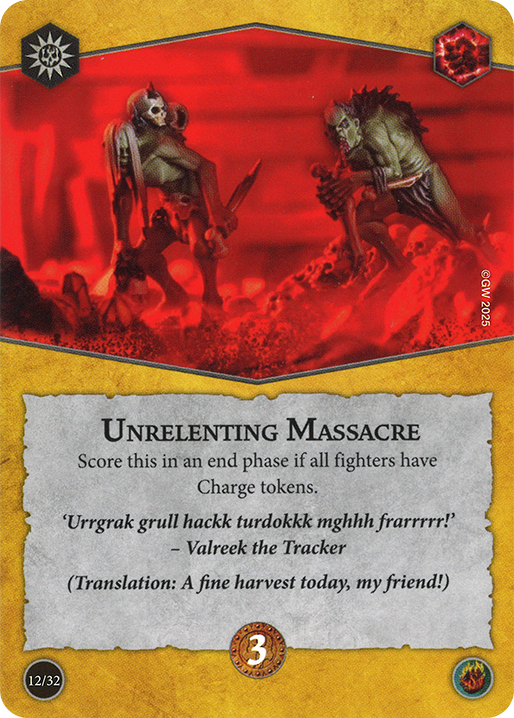
Unrelenting Massacre
Credit: UnderworldsDB.com
Unrelenting Massacre returns again, but this time it's the version in Raging Slayers. It showed up in 4 of the 5 Raging Slayers decks at this event. A lot of what was said about this objective earlier applies here, but the biggest thing to note is that Raging Slayers does not have any of the tools that Reckless Fury does in forcing charge tokens onto the opponent's fighters. If your opponent chooses to not charge, you can't make them. The best Raging Slayers can do is just kill anything that hasn't charged and/or hope the opponent chooses to gamble and makes the charges anyway. To be clear, this
can work and it's always a gamble when playing against a Raging Slayers player on whether they're packing this objective or not.
Ease of scoring with no denial: 4/5
Ease of scoring with active denial: 1/5
Impact of active denial: 3/5
 Credit: UnderworldsDB.com
Pinned!
Credit: UnderworldsDB.com
Pinned! is the latest addition to these three glory end phase objectives. It showed up in both of the Hunting Grounds decks that showed up at Worlds – a 100% inclusion rate, although the sample size is quite small. This one is a right pain to set up in my experience, which is
also happens to be a rather small sample size of two. That said, if your opponent wants to be on your side of the board for any reason (e.g. any of the multiple objectives that require it, treasure tokens in your territory, your Aqua Ghyranis token) then it does a surprisingly good job at restricting the "safe" areas they can be. Your opponent has to stay out of all the edge hexes as well as the hexes adjacent to edge hexes if they don't want to give you this for low effort. There are 40 friendly territory hexes when the board is oriented in 5s; 38 when it's oriented in 9s. This is actually quite a substantial reduction in the number of "safe" hexes they can stand on in your territory – 14 in 5s orientation and 13 in 9s. There are ploys and upgrades that can help this score – one of which is already in the same deck – but it does require more setup than some of these other objectives.
Ease of scoring with no denial: 3/5
Ease of scoring with active denial: 1/5
Impact of active denial: 3/5
Closing Thoughts
My personal journey as a player has seen my evaluation of these objectives fluctuate pretty strongly. I started out thinking they were mandatory because of the large amount of glory they offered. I then felt like they were impossible to score against good players, so why waste slots in my deck with them? I've currently settled on thinking they're good again and they have a place in most of my decks that I build with their respective Rivals decks, but I'm also appreciating the play restrictions they place onto my opponents instead of just seeing them as potential glory for myself.
Plus it's always fun to watch your opponent trip over themselves to deny cards that aren't even in your deck.
Have any questions or feedback? Drop us a note in the comments below or email us at contact@goonhammer.com. Want articles like this linked in your inbox every Monday morning? Sign up for our newsletter. And don’t forget that you can support us on Patreon for backer rewards like early video content, Administratum access, an ad-free experience on our website, and more.Thank you for being a friend.
 This website uses cookies. Learn more.


 Goonhammer App and Patron Updates: April, 2026
 Kill Team Tournament Report: Engage, Party, Repeat's March Madness 2026
 Goonhammer Reviews: Tribal Conquest