If you were alive and more or less capable of touching a computer in 1998, you can probably remember the golden age of real time strategy games. It's the year StarCraft released, for one (just barely, dropping a few days before Christmas). But the first true 3D RTS made its debut as well; Populous: The Beginning, or Populous 3, for the fans of the series. Still available today on various online platforms for not a lot of money, it was set in an alternate universe where you, as the shaman of a tribe, were supposed to conquer various worlds which were actual little planets you could spin around. It was a neat concept and escaped the traditional sci-fi and fantasy trappings that defined a lot of games of the time. Rather than running through the standard clichés of the day, you were catapulted into a primordial stone age, rife with magic and a suitable new age-y soundtrack.
Tribal Conquest by Nervosa Games is inspired by that setting, and translates various elements from the RTS to your tabletop. I’m sure we’re all aware that there’s a plethora of Kickstarter indie skirmish games at the moment (and with AI's involvement I suspect we’ll see a surge of even more), but Nervosa Games doesn’t work like that. They’ve developed a little gem that on the surface works great as a beer and pretzel game, but also shines in proper tactical gameplay. There is a depth to the seemingly simple rules. But let’s rein in the horses and start with the basics.
Credit: Jackie Daytona
What’s in the Box
Since the starter box is an excellent bit of kit to get everything you need, let’s start with that. You get your rulebook, a quick reference sheet, a couple of rulers, dice (D6 and D12) and of course, models. Two equal forces are presented, for a total of 24 models. It's a nice selection of stuff to get you started and could do well for a fair few games if you're starting out.
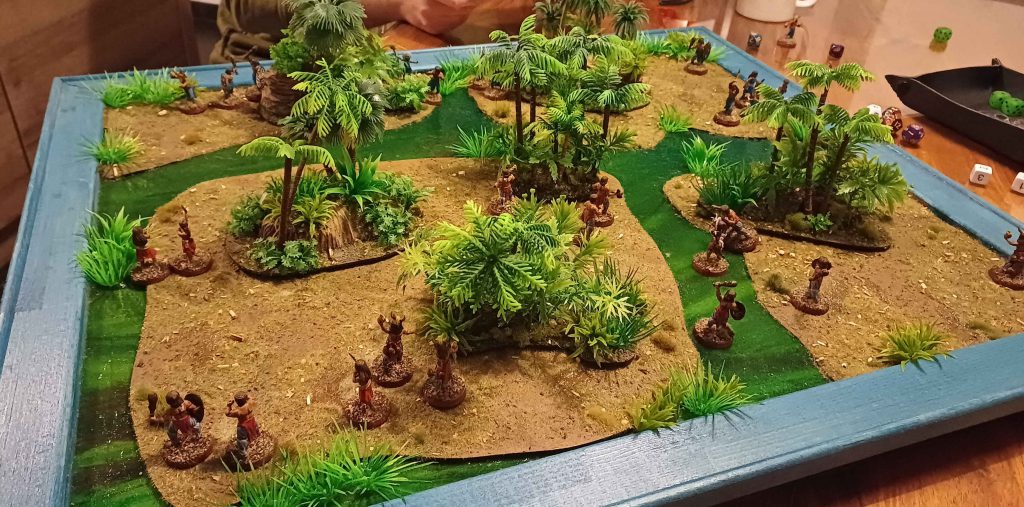
List building is easy enough. Standard warband size is 20 models, and no more than half of that can be the same type of model. You’ll always need one (and only one!) Shaman as the leader. At that size of warband your playing surface will be a sensible 24x24 inches, making it an ideal kitchen table game. If you want to go with more models, you’ll need a bit more space at 36x36 inches. What you will need is lots of scenery to block lines of sight and cover about 50% of that play area. In this stone age fantasy you’re battling it out in jungles and other wild places. There are no roads or nicely cultivated fields. Luckily trees and woods are to be found in most wargamer's collections, and are fairly easy to make.
The models themselves are nice indeed. All 3d prints, the detail is excellent and while you can see the Populous inspiration, it’s very much its own thing. The sculpts need a little bit of clean up here and there, but you don't have to break them out of the supports. They’re simple enough to paint and with the recommended bright colours to keep your tribes apart it makes for a great looking little game. There are various expansion packs available as well, to spice up your tribe and truly make it your own.
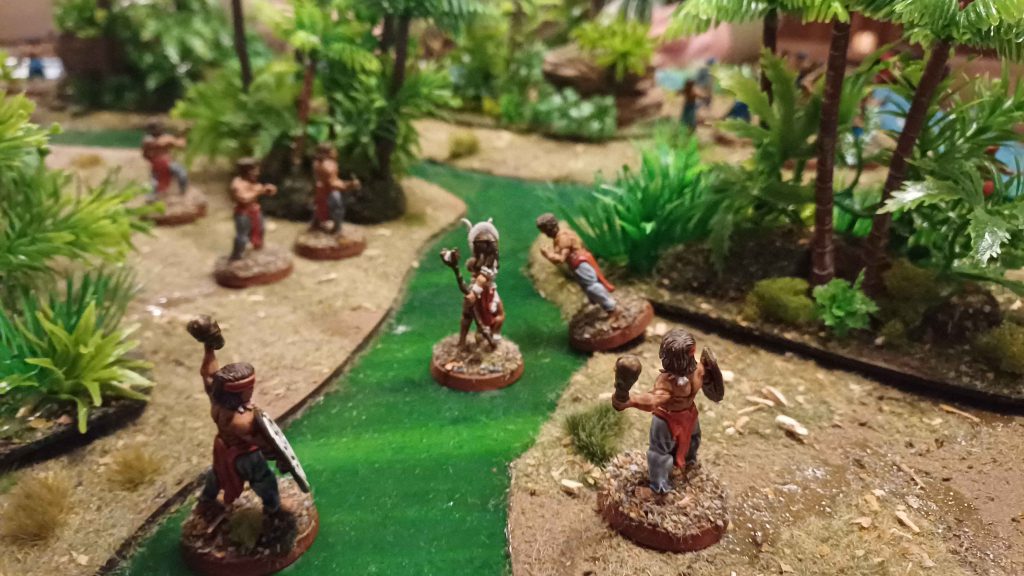
A blue tribe Credit: Jackie Daytona
Gameplay and Battling It Out
The setting is fantasy but the population is human, so of course your tribe has to win and beat the other ones senseless. Tribal Conquest lets you do that with some interesting activation mechanics. You see, every class of model in your tribe has an Activation Stat (AS), which dictates when they can move or take an action. A simple Brave has an AS 2, while a warrior with an axe comes charging in at AS 1. The player who has won initiative either by a dice off or by having the least models in their tribe, activates their models first. So all models with the same AS are activated, followed by the opponent's models. There are three tiers, with shield warriors coming in last at AS3. This means that you can shove your models forward and start smashing or make sure you time their movement and placement. Beer and pretzels versus tactical thinking. I want you to understand something about this game: it is extremely deadly. Most games we didn’t get to the six turn limit. When and how you move is very important.
Every class of model in your tribe also has a special rule, or several. There is no separate shooting phase, but your hunter for example, can shoot after moving. If you come into base contact with another model, they’re locked in close combat which is a separate phase after all models have activated. You both roll off, and the winner has a chance to deal damage to the loser. Depending on how good you are at combat, it’s easier or harder to remove your opponent’s models.
This all sounds reasonably abstract but it all slots nicely into place. This is visually clear as well. If you see a member of the opposing tribe with a handweapon, you can be certain that they’re good in melee. All information is open as well and while there is a good selection in the make-up of your tribe, it’s not so much that it gets confusing or overwhelming. After a while you won’t need the quick reference either, as it’s all pretty easy to memorise. You might want to hold on to it for the spells though!
A handy barrier at the right time can keep your tribe safe Credit: Jackie Daytona
Shamans and Magic
The true powerhouse of your tribe is your shaman. It’s the only model that can perform magic, as well as come back from the dead. If you lose your shaman in combat or through shooting, it can reincarnate once per turn and it’s a good thing as well, since magic can win or lose games.
At the start of every turn, you collect mana from your tribe. Every five models provide one point, and you need enough to buy the dice needed to cast the spells. Every spell has a casting value that you want to exceed or match with a dice roll. The more difficult a spell, the higher the casting value and the more dice you’ll probably want to contribute to the roll. A single point of mana buys you a D6, two points lets you roll a D12. You have a lot of choice when it comes to choosing a spells as well. There are four types to choose from. A Bane is your standard offensive spell, ranging from lightning bolts to curses. Blessings are your buffs, making you impossible to hit for a turn, or turn you invisible. Destructive spells are the WMDs that target all the models in an area of effect and they don’t discriminate between you and your opponent, as a Bane will do. lastly; Terraforming, which is a bit more niche but lets you move terrain or destroy it. Rock in the way? Lower the terrain. You have several different timings to actually cast these spells, regardless of the AS of your shaman. After every Activation Phase you get a chance to cast something.
So let’s recap a bit and explore those phases. In the Priority Phase you determine priority, depending on model count or a dice roll. Mana is collected for the turn, and every shaman has a chance to cast a spell. You only get to cast every spell once a turn, even if it fails. So you can’t retry in another phase, you’ll have to wait and can’t spam lightning bolt three times in a turn. In the Activation Phase you get another chance to cast after every activation step, so after you've moved and activated the special abilities of your models, from AS1 to AS3. You can’t cast in the final Combat Phase as the models that were locked in combat during previous activations duke it out, and it effectively ends the turn.
Red tribe on the move Credit: Jackie Daytona
So there are plenty of opportunities to cast spells and outmaneuver your opponent. All the spells are shared, so you know exactly what to expect as well. Not everything will always go according to plan of course. If you get a double on the casting roll, it’s a miscast! The effects of your spell go through, but there will be a downside or outright damage to your shaman. So a powerful spell is balanced in that the more dice you pump into it the make it go off, the chances for a miscast increase as well.
Balancing It Out
Standard games last 6 turns or until you reach the win condition imposed by the scenario. You determine the scenario randomly, so list building should be done with that in mind. You’ll need to compose a fairly balanced mix of ranged, melee and mana supply. Your braves count double when determining how much mana you generate, and are the only class you can take more than 50% in total of your warband. They're crap in melee and don’t have any shooting attack though, so you'll have to aggressively cast to counter that if you want to roll that way and go "oops all braves." It's a bit like chess, every model has its own strengths and weaknesses, and you need to play to them to maximize your chances of winning. Preachers for example, have a 3” bubble where enemy models can be converted to the other tribe, and can effectively block off sections of the board if positioned correctly. A savvy shaman will take classes that can deal with that possibility.
Overall, the gameplay is fast and fluid and easy to get the hang of. Shooting attacks and melee are simple enough; rounds go fast, and as mentioned, are pretty deadly. Games usually last 90 minutes to two hours if you’re really taking your time. I bet experienced players will barely break the 90 minute mark, so you can easily fit a game or two in your club night.
Red tribe shaman facing trouble Credit: Jackie Daytona
I would compare the actual gameplay feel to Saga. Clear concise rules, abstracted, but difficult to master. For a surface level beer and pretzels game it has a lot more depth than you’d expect. Timing your moves, magic, placement of your models is very important. It can be unforgiving and models may perish sooner than you’d like, but you’re not left with a bitter taste as games are fast. I would say it’s a bit too fresh and new to have a main game vibe like Saga does, but the potential is definitely there. There are probably ways to break the list building, but I don’t really see that as a problem in the near future as the community is still growing. There’s a supplement coming out which lets you play in a campaign and I certainly do see it shining there. Games are fast enough to do a small campaign in a day.
Thoughts and Nitpicks
That’s all well and nice, but it’s 2026, and we can’t go without a bit of a whinge and polarizing pub thought of course. Fortunately there’s little to go over. You only get one quick reference sheet in a two player set? The classes are not sorted by activation sequence? Nitpicking really, which can be easily sorted. When I picked up this starter, I wasn’t expecting much to be honest, in the sense that there’s a ton of skirmish games hitting the market, all with a gimmick or a bit that can get old real fast. It was more of a weird nostalgia fix for me that got me enthused for the setting. But I am very pleasantly surprised with the gameplay. It's one of the most interesting games I've come across in a while, and I can see it picking up at my club.
Besides the nitpicks there’s very little to criticize. I will make a mention of the price point of the starter that at £67,50 feels a bit much. I get where it comes from. For once no Kickstarter, but proper indie DIY games design and development. There’s a bit less leeway to knock a tenner of that since margins are tighter for the small developer. And on the other hand, you can get two full tribes for you and a friend for under £120, which is very good indeed.
With the upcoming campaign rules, it certainly feels like a complete package. At the end of the day I can only recommend Tribal Conquest. It’s tight, fun, fast and has more to offer than just a cool gimmick. I genuinely look forward to expansions, and Nervosa Games is a new studio to watch.
Have any questions or feedback? Drop us a note in the comments below or email us at contact@goonhammer.com. Want articles like this linked in your inbox every Monday morning? Sign up for our newsletter. And don’t forget that you can support us on Patreon for backer rewards like early video content, Administratum access, an ad-free experience on our website, and subscriber-only content covering competitive Warhammer 40K!
 This website uses cookies. Learn more.

 Credit: Jackie Daytona
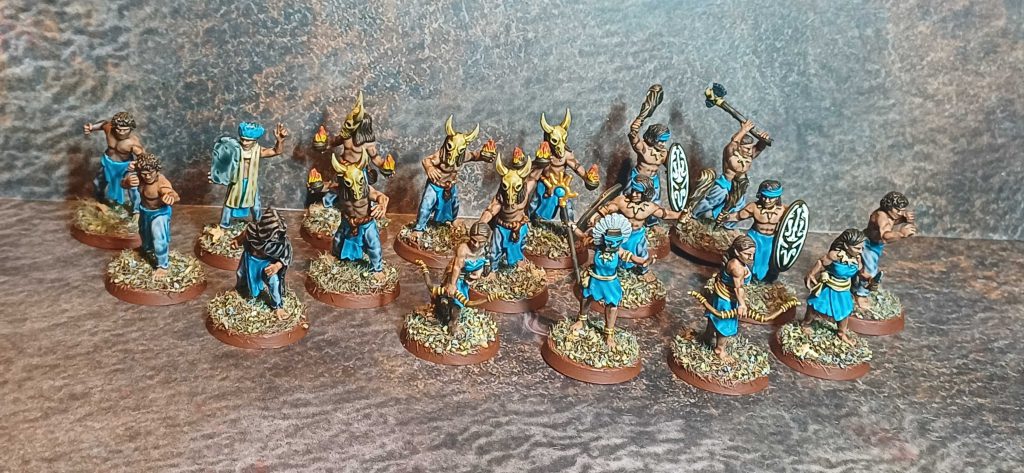 A blue tribe Credit: Jackie Daytona
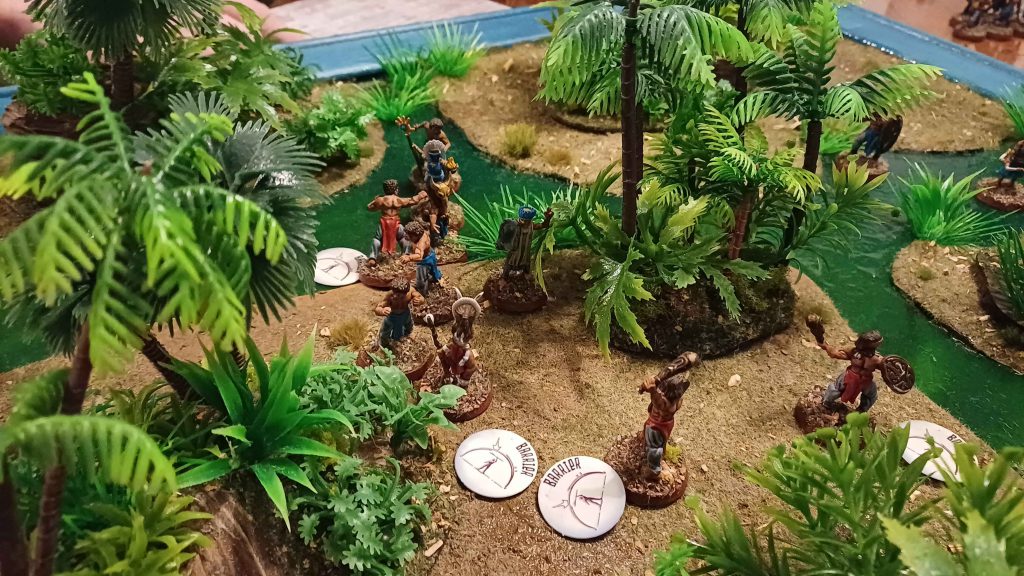 A handy barrier at the right time can keep your tribe safe Credit: Jackie Daytona
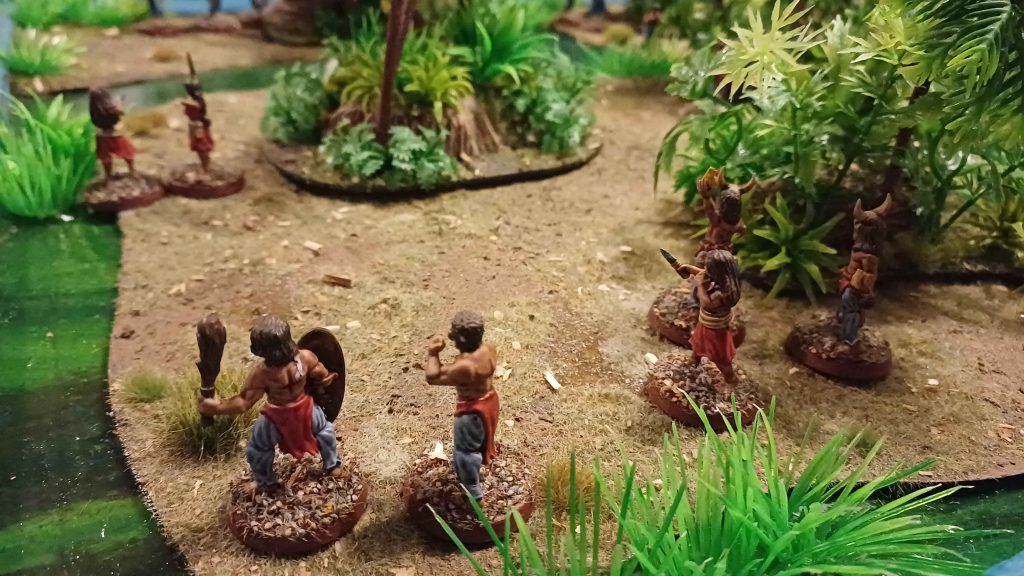 Red tribe on the move Credit: Jackie Daytona
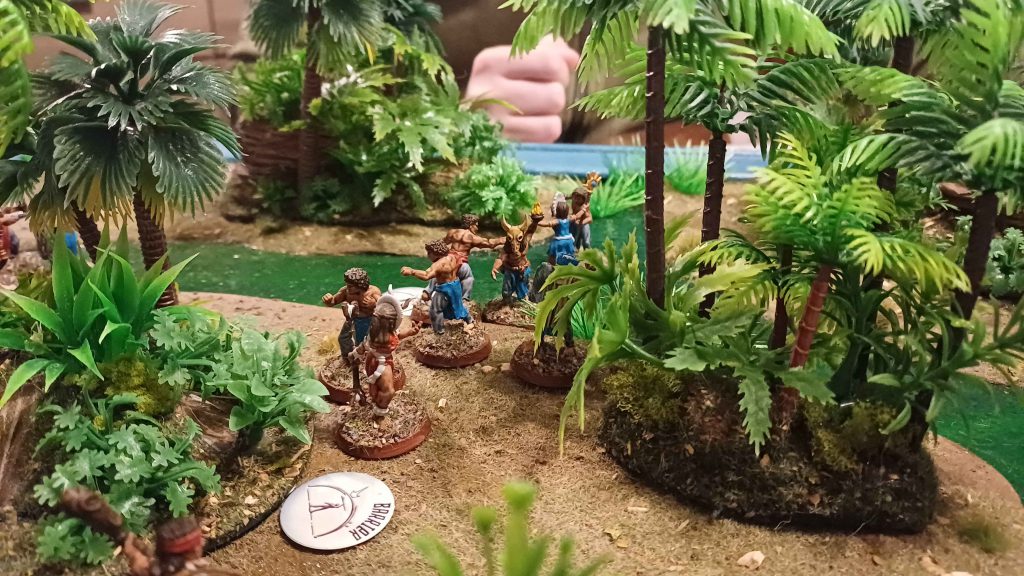 Red tribe shaman facing trouble Credit: Jackie Daytona
 Credit: Jackie Daytona

 Goonhammer Hobby Round-Up: March 2026
 Goonhammer Reviews: Tribal Conquest
 Conquest: Weaver Courts Gemred Knights and Scaile Dancers Model Review