Lionel Purseglove, decked out in blood-stained morris dancing kit complete with bells and handkerchiefs, didn’t often feel like the least conspicuous person in a room, but when facing Gunter Aisler and his assembled band of curiosities he felt the very epitome of conformity.
“So, let me get this straight” Purseglove began, leaning across what was left of the tavern table and pointing at the young, red-headed woman opposite. “You’re actually a century-old man.” He felt a little sick at the thought that he had been trying to seduce her only moments before. He also knew that, despite knowing the truth about the illusionist’s true identify, he would try again if he had enough ale in him. “And this ancient hag,” he pointed to the shriveled old woman sitting next to the illusionist, “is your grandson?”
“And you,” Purseglove nodded to the young lad nearby, who looked to be around six years of age, “are the legendary knight, Sir Calgon. I thought you were dead.”
The boy spoke, barely able to see over the table. “It was necessary to disappear for a while, but I can assure you I am very much alive – which is more than you'll be if you don’t take that smirk off your face.” The boy placed his hand on the hilt of a wooden toy sword tucked into his breaches. “I remind you, this magic is illusionary, it doesn’t make my blade any less sharp.”
“Alright, alright,” the Morris dancer threw his hands up, “don’t throw your toys out of the pram. And what’s your deal?” he said, turning to one of the man-sized hands standing to his side. The hand didn’t have a face, but Purseglove could still sense it staring at him with distaste. “I get that the boy,” he said, pointing back to Sir Calgon, “was disguised in that way to help catch child snatchers or something, but what’s with the hands?” There were another half a dozen other man-sized hands stood about the tavern.
“The master didn’t like looking at his household staff…” began a voice behind the Morris Dancer. Purseglove turned to see a brightly dressed figure with a neck like a python and a duck’s bill for a mouth.
“Good lord!” Purseglove jumped. “What the fuck are you?”
The duck-billed figure continued, ignoring Purseglove’s insult, “…so whenever his servants were on duty he would disguise them in the form you see before you; giant hands. Unfortunately, they are stuck that way now, just like the rest of us.”
“And what’s your story?” Purseglove asked the duck-billed man.
The figure’s neck slinked around so he could fix the illusionist with a hateful stare. “The master also has a penchant for cruel and unusual punishments if any servants stepped out of line.”
“Illusionists!” Purseglove spat. “You lot give me the willies.” The Moris Dancer looked at the assembled freaks before him, and then at the illusionist, Gunter Aisler, the wizard responsible for it all - now trapped in the form of a young woman. “You’re a real piece of work!” He took a large swig from a tankard he found on the splintered table, scowled at the taste, spat it out in disgust, and then drank the rest of it. “So, you’re all stuck this way? And now you want to go into the frozen city to find a cure? And you want to hire me and the boys to come with you?”
“Your thuggery is legendary,” Gunther Aisler replied with his soft, feminine voice, looking about the wrecked tavern, which was littered with blood, teeth, unconscious morris dancers, glass, whores and wrecked furniture. “I can pay well.”
“It sounds like a dangerous, violent and futile journey,” said Purseglove.
“Oh yes. Only the very insane would even attempt it. Us lot don’t really have much of a choice in the matter,” he said, indicating the band of misfits stood around him. “But you’d have to be utterly mad to join us.”
“Righteo,” said Purseglove, “give us half a day to sober up and we’ll be right with you.”
In the last article I built my wizard, the illusionist Gunter Aisler, and his apprentice Tomas. I gave them a backstory and equipped them with spells. Now I need to decide what unfortunate souls will be accompanying them into the frozen city.
Building Your Warband
When building a warband, aside from your two spellcasters, you have a total of eight personnel slots to fill, and a budget to spend on different types of companions. There are two lists of solider types in the main rulebook to draw upon:
standard and
specialist. There’s no limit to the number of slots you can fill with standard soldiers, but can only fill four slots with specialists.
I already mentioned
last article that I would be taking two
apothecaries from the standard soldier lists. (One of which being the duck-billed guy from above, a model I had lying around and wanted an excuse to use.) Each apothecary can bring along a free healing potion to each game. In the early game I plan to be attempting some pretty high casting value spells, so may need to take quite a lot of health damage in order to
push the spells to get them over the line – so some healing will be pretty handy.
Also from the standard list, I have taken a couple of
warhounds in my warband. These are the fastest soldiers available to you. My strategy is all about movement and teleporting around the board, so they’ll come in very handy. I bought a sprue of poodles, pugs and sausage dogs to represent these, figuring the illusionist would disguise his fearsome war hounds as harmless lapdogs.
I’ve also taken two
thieves (the man-sized hands from above) and a
thug (from the gang of hooligan morris dancers Aisler recruited.) These are free to recruit, so are generally what you’re going to be filling your roster with once you’ve spent your budget. Thieves are faster than thugs, but weaker. They’re the ones who are going to be grabbing your treasures. Thugs are your basic chaff.
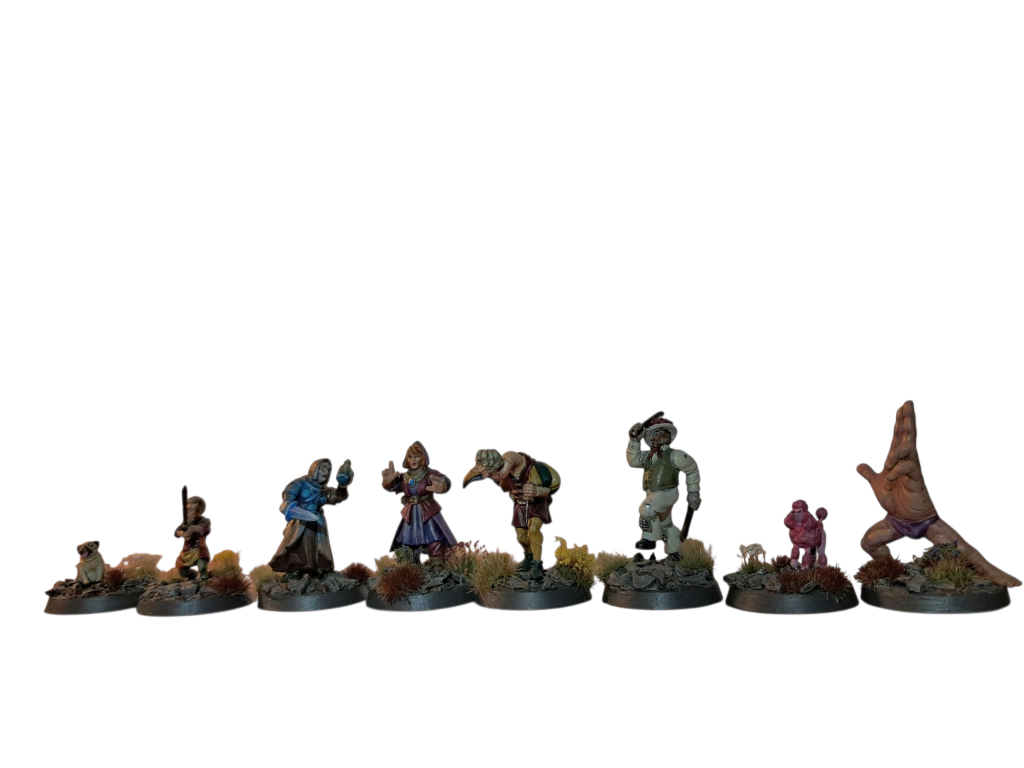 Some of the models I found in strange corners of Etsy to be my warband.
Also on the standard soldier list are
men-at-arms and
infantrymen, who are a bit better than a thug in a punch-up (men-at-arms dealing more damage in a fight, while infantry men are equipped with shields, making them hardier.) As my whole game plan is to try to avoid getting into a scrap, I chose not to take either of these.
However, fights are inevitable, so I felt I would need just a little bit of punch, which is why I took a
templar from the specialist list. That’s where Sir Calgon, the legendary knight, trapped in a child’s form following an undercover mission to stop a gang of child catchers, comes into the story. Templars and
knights are the two big punchy soldiers on the list, with templars being harder hitters and knights being more defensive. There are also
barbarians, who hit hard, and are faster than knights and templars, but are also more naked, so easier to take down.
If you wanted ranged attacks there are
crossbowmen, archers and
marksmen available on the specialist list too, each with slightly different stats and costs - but I was too fed up of always missing to bother taking any in my list this time. (Although, with a lucky roll, I’ve seen archers do insane damage before!)
Then there are
treasure hunters, who are elite versions of thieves, being quick, but also better in a fight. And if you just can’t choose whether you want to lean into ranged attacks or mele, why not go for a
tracker or a
ranger, which do a bit of everything.
Generally speaking, it is good to have diversity in your warband so that you have options, but my strategy is a very specific one based around misdirection and sneakiness, so I built my band accordingly. I may regret that later on, but I can always recruit more troops during the campaign. Indeed, as it says in the book, don’t get too attached to your warband members, they’re not likely to last.
Game One
So, with my band assembled, it was time to go and get some treasure! The basic goal of Frostgrave is to loot the city’s long-lost valuables. A standard game will have five
treasure tokens around the board: a central treasure, which is potentially worth more, two that are quite close to each player’s deployment area (participation trophies, if you like) and two elsewhere on the board. Each mission will have different spins on this though.
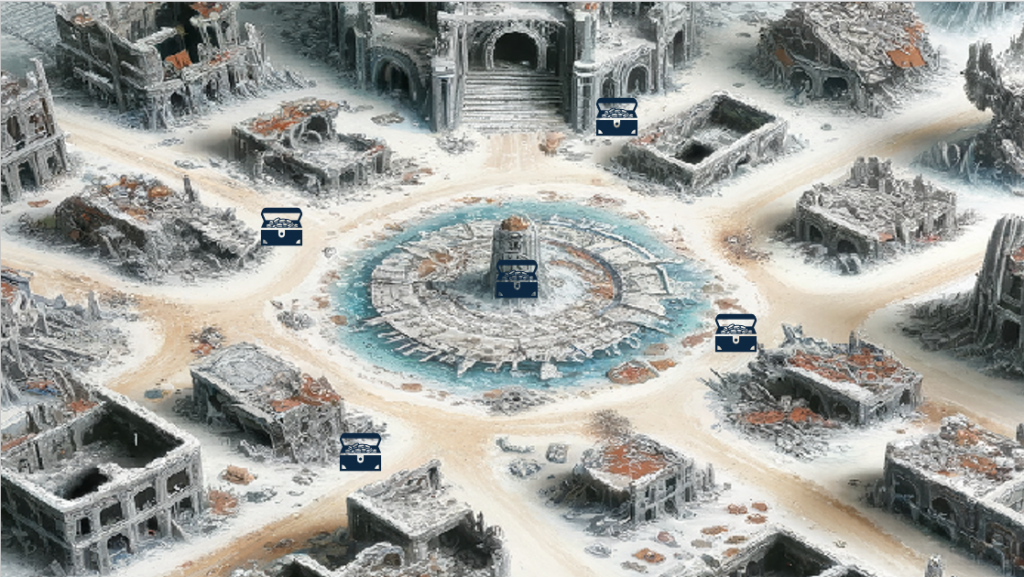
My campaign features nine players from my local club, and it kick started with eight of us playing four games. I drew my first game against a
necromancer. The necromancer spell set is mostly about raising or controlling the dead, giving them extra bodies on the board, or dealing direct damage to (or even straight-out-killing) the targets of their spell.
Before the game, my opponent used a
pre-game spell to summon a
zombie, which would be handy for carrying treasure around etc. (It’s a spell that many non-necromancers will often take, because its so useful.) I got pretty lucky with my pre-game spells. I entered the game with
an illusionary soldier (which, like the zombie would be part of my warband for the game ahead, but, unlike a zombie, won’t be able to carry treasure - I chose an illusionary war hound) but I also got lucky with my
Animal Companion spell, and got myself a
snow leopard for my troubles. This, unlike the zombie and illusionary soldier, would become a permanent member of my warband. I also successfully got
Write Scroll off, which meant I would have at least one guaranteed cast of
Time Walk in-game. (You can read about the spells I chose and why in
the last article.)
This is now the point where I would ordinarily give you a blow-by-blow account of our game. However, not a massive amount happened (as is often the case in a warband's first few games of Frostgrave.) As the game progresses there are numerous ways of reducing the casting values of your spells, but at the start of the campaign it’s usually the case that your spells are going to fail more often than not, so the air will hardly be fizzing with magic in game one.
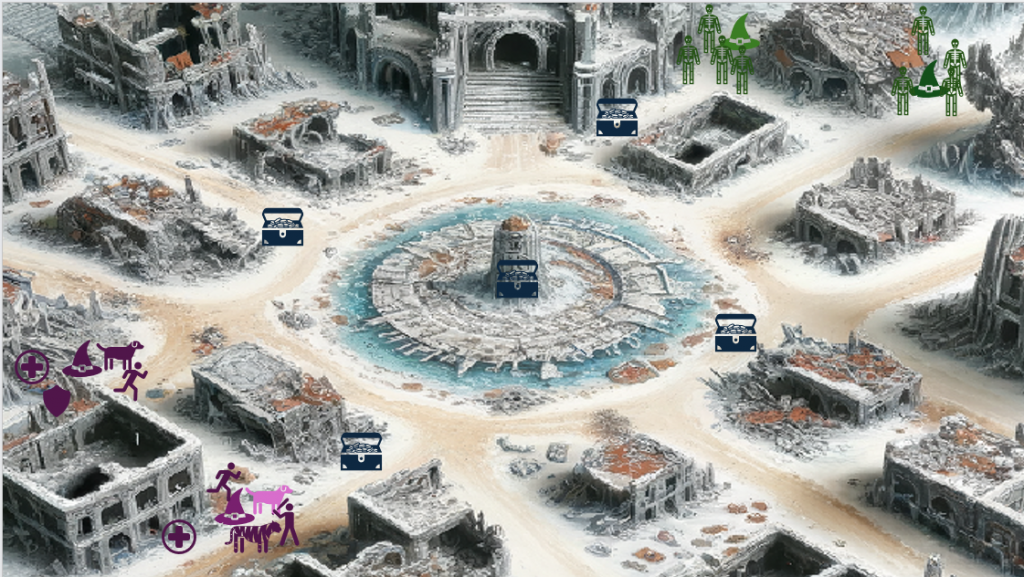
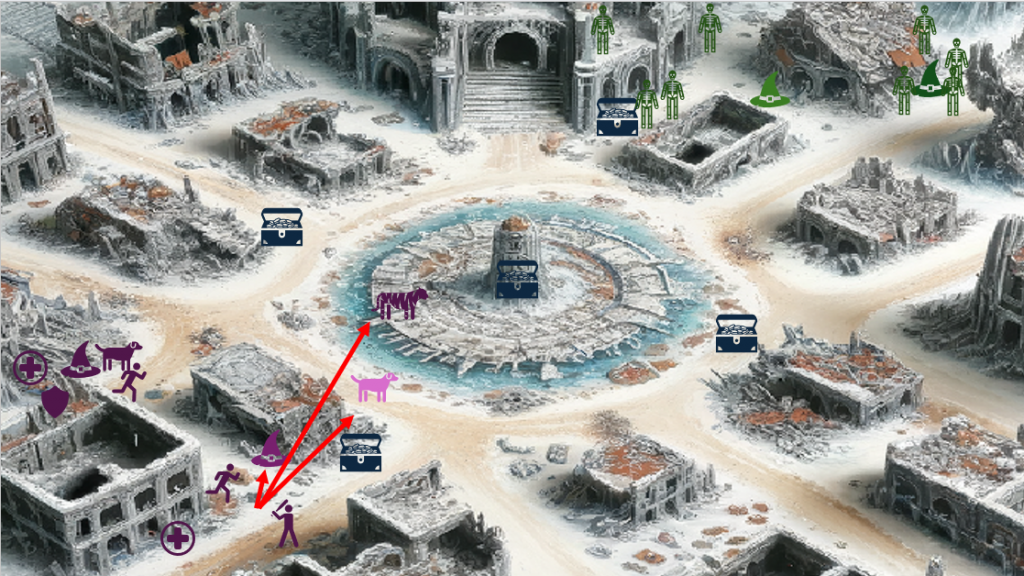
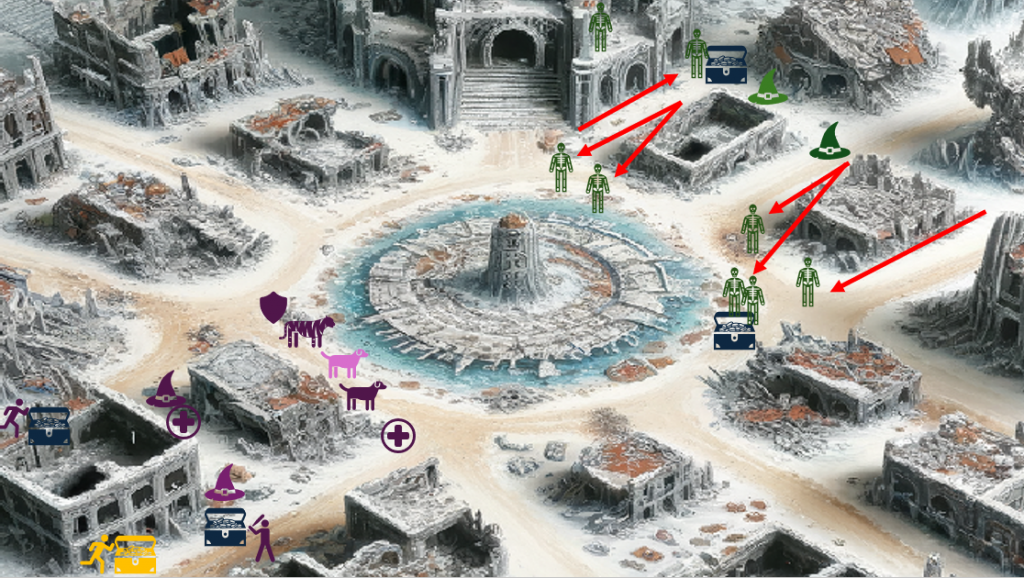
However, unbelievably, my strategy actually worked. So whilst I won't reproduce the entirety of the game here for you, I will map out the first turn so you can see my game-plan in action. My guys are the purple crowd, above, my opponents' the green. The game is usually played on a 3ft x 3ft board, scattered with a lot of terrain, and warbands set up within 3" of one board edge, and 6" away from the other board edges.
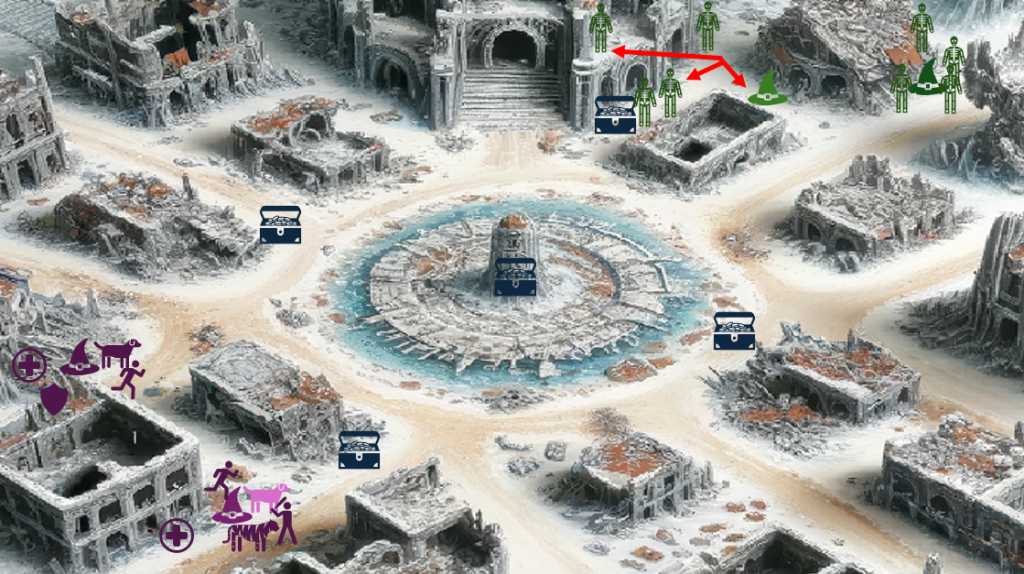
My opponent won priority, and so went first.
A turn in Frostgrave is split into three phases. The first phase is the
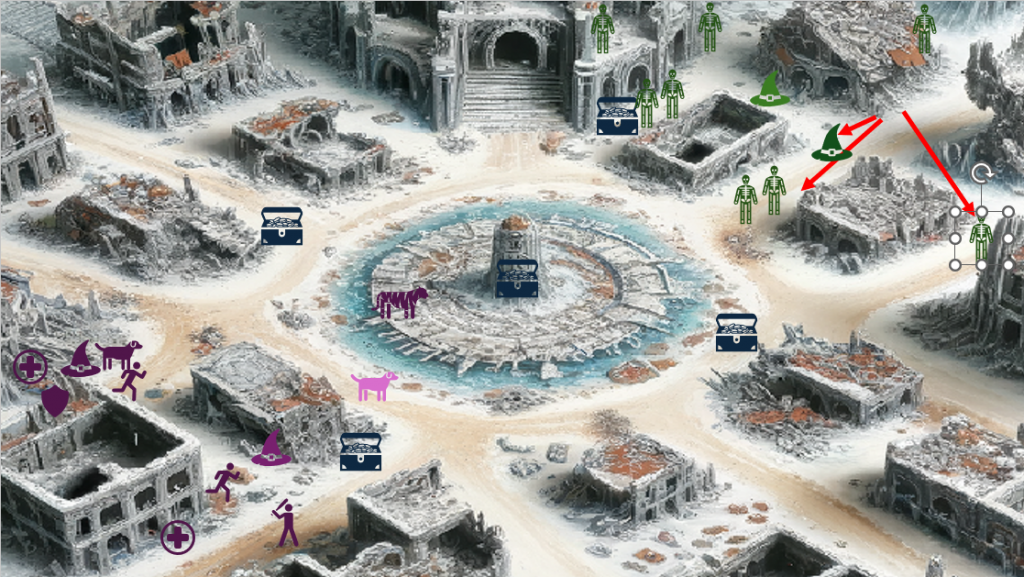
wizard phase. One player activates his wizard (and up to three soldiers within 3”) and then the next player does theirs. My opponent moved his wizard (green wizard hat above) and cast a buff spell on one of his soldiers, and then moved a few more of his figures into more advantageous positions. This was a pretty standard first turn in Frostgrave; buff up your people and get in position.
However, for my strategy, the first couple of turns are when I’m going to have to be most active. Once the enemy starts getting too close to me, I’m in trouble, as my warband folds quickly in a fight.
In my wizard phase, I activated with my snow leopard and illusionary war hound, who were both within 3" of my wizard (purple wizard's hat above.) When a figure activates, it can make two actions, one of which has to be a move action. I moved my wizard behind some light cover, and then cast
time walk. Unsurprisingly, with a target roll of 18, I failed (with a roll of 8.) Luckily, I had written a scroll for it before the game, a kind of insurance policy, so the spell went off. This now meant I would also be able to activate my wizard in the apprentice phase and the soldier phase also.
I then activated my snow leopard and my war hound in turn. You are allowed to use both of a figure's actions to move; however, your second movement action will be at half your movement characteristic. Having said that, leopards and war hounds have a movement of 8", meaning they can travel 12" in one activation. On a 3 ft board, that's pretty quick. I ran my snow leopard as close to the central treasure as I could get it, and my illusionary war hound to be 12" away from the central treasure (I'll tell you why in a bit.)
Next comes the
apprentice phase, and my opponent moved his apprentice and three models within 3" into better positions, attempting to cast a spell with his apprentice but failing.
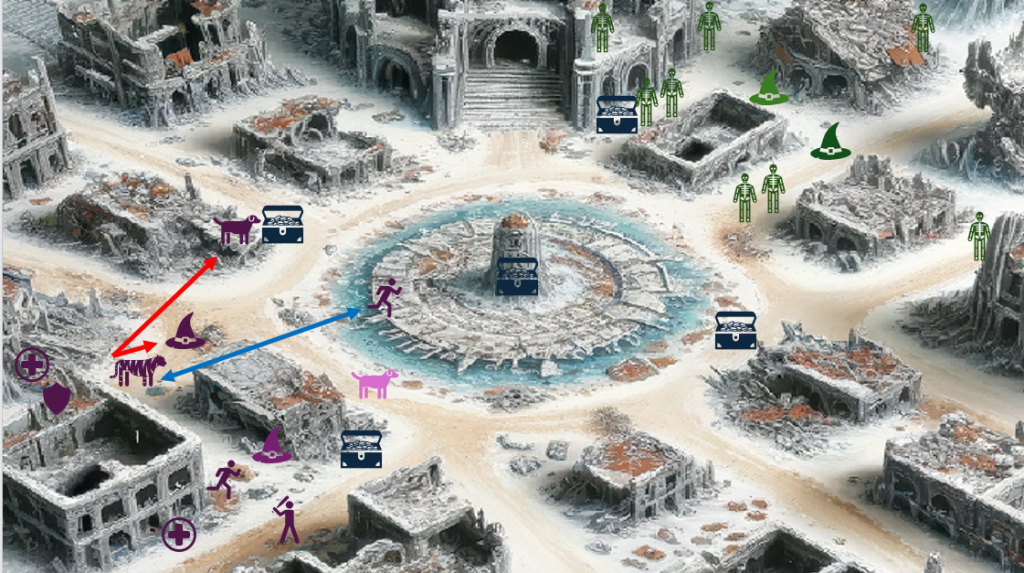
During my apprentice phase I activated with my apprentice, and a war hound and a thief who were within 3". First off I double moved the war hound to stand right next to another treasure - this time it's 12" movement was enough to get it right next to the treasure. I then moved my apprentice behind some light cover and cast
transpose. To my rapturous joy it went off, allowing me to switch the snow leopard near the centre, who had moved in the wizard phase, with the thief I had just declared I would be activating this phase.
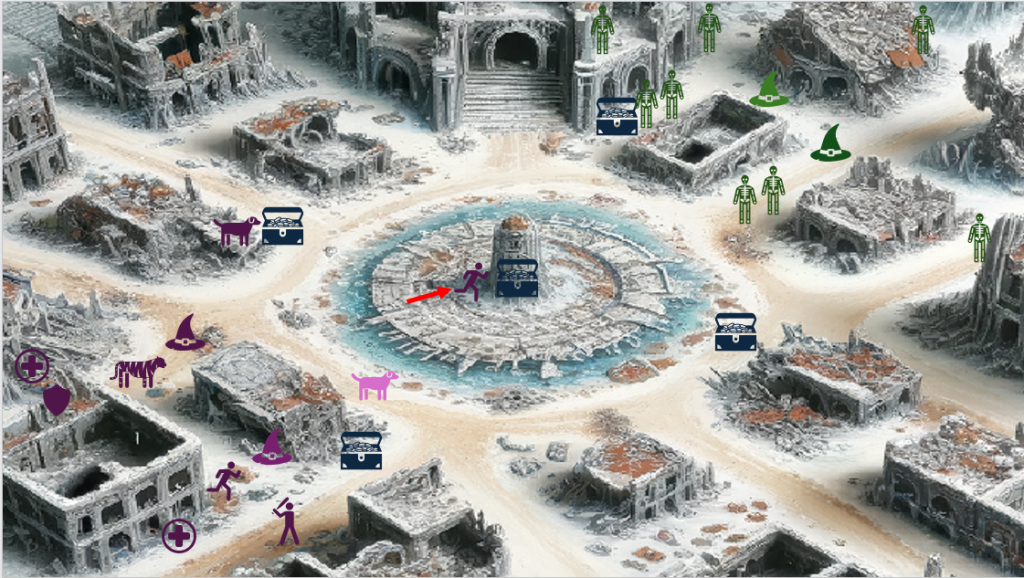
Having now been transposed nearer to the central treasure, I was able to move the thief the last few inches with his first action, and then
pick up the treasure with his second action. But that wasn't the end of my apprentice phase...
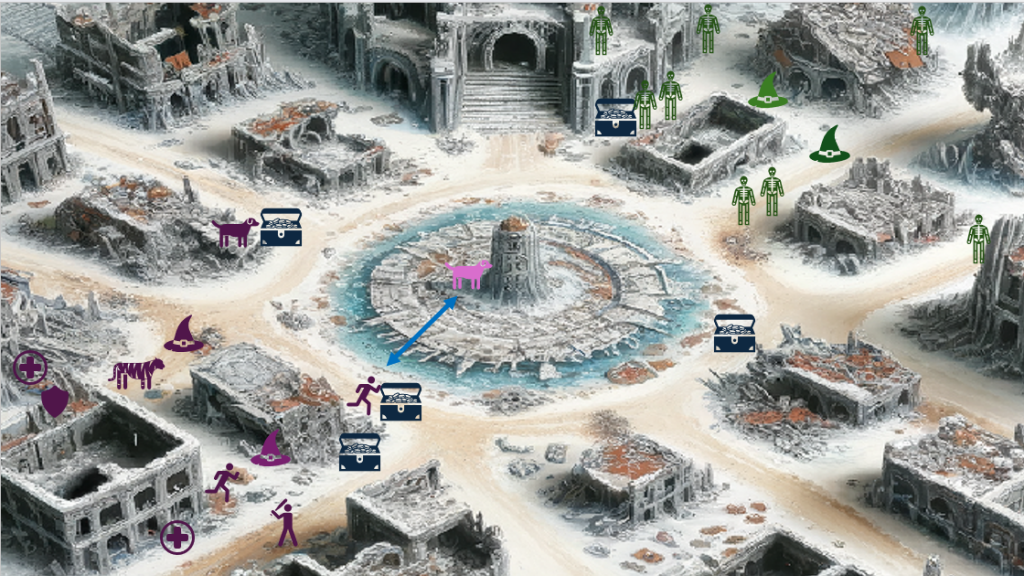
Casting Time Walk meant I could activate my wizard in the apprentice phase. I casted transpose once again, although failed, rolling a six instead of the twelve I needed. However, in Frostgrave, providing you don't roll a one, you are allowed to push a spell by losing one point of health for every increment you push it. I needed a twelve so lost six health in order to get it off. Now that the spell was successful, I was able to transpose the thief in the middle (holding the treasure) with the illusionary war hound I had so carefully placed within 12" during the wizard phase.
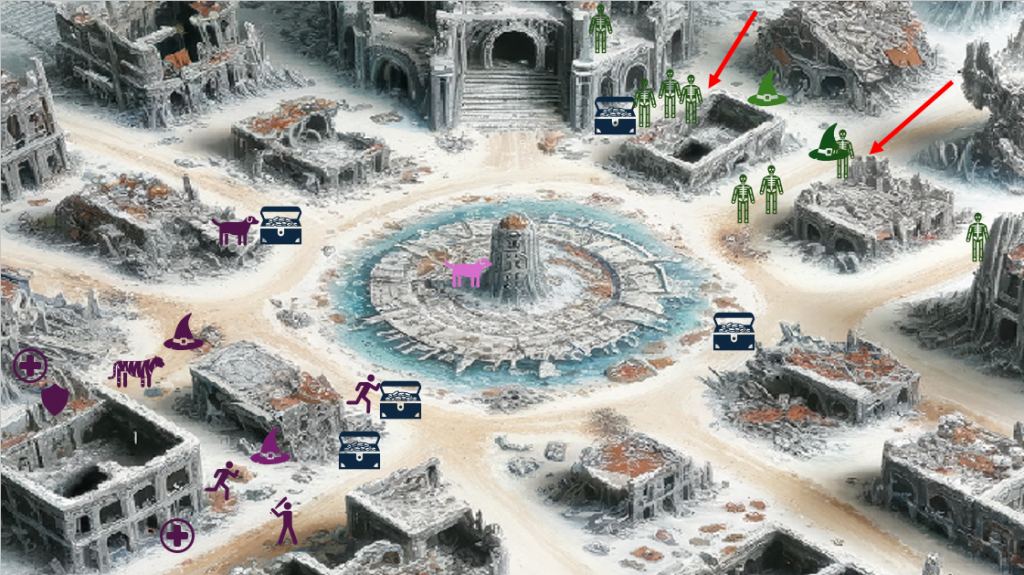
The third phase of Frostgrave is the
soldier phase. My opponent used his to move his remaining soldiers into advantageous positions, either heading for treasure, moving to engage my warband, or lining up shots.
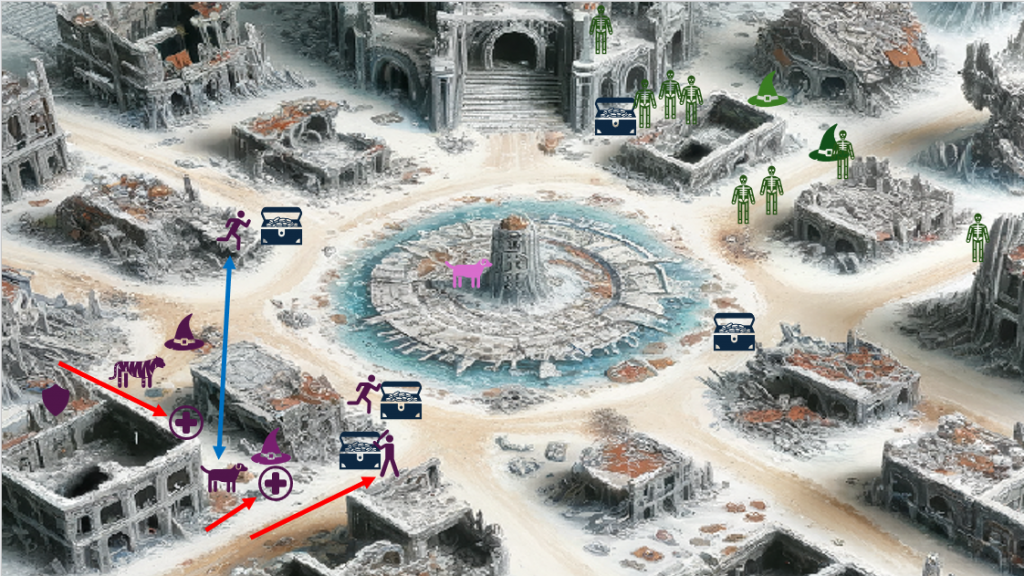
During my soldier phase I was able, once again, to activate my wizard (due to Time Walk) so I attempted transpose one more time, this time with my remaining thief, who hadn't yet activated, and the war hound I had ran to one of the treasures during my apprentice phase. Once again the spell failed, and I had to push it pretty aggressively to get it off, leaving my Wizard quite low on health.
I then moved both apothecaries towards my wizard, one of whom could get there within one move, enabling him to give my wizard a healing potion with his second action. The other just moved and moved again in order to give the wizard the potion next turn.
I also double-moved the thug to the closest of the treasures (the participation prize) but didn't have enough movement to pick it up.
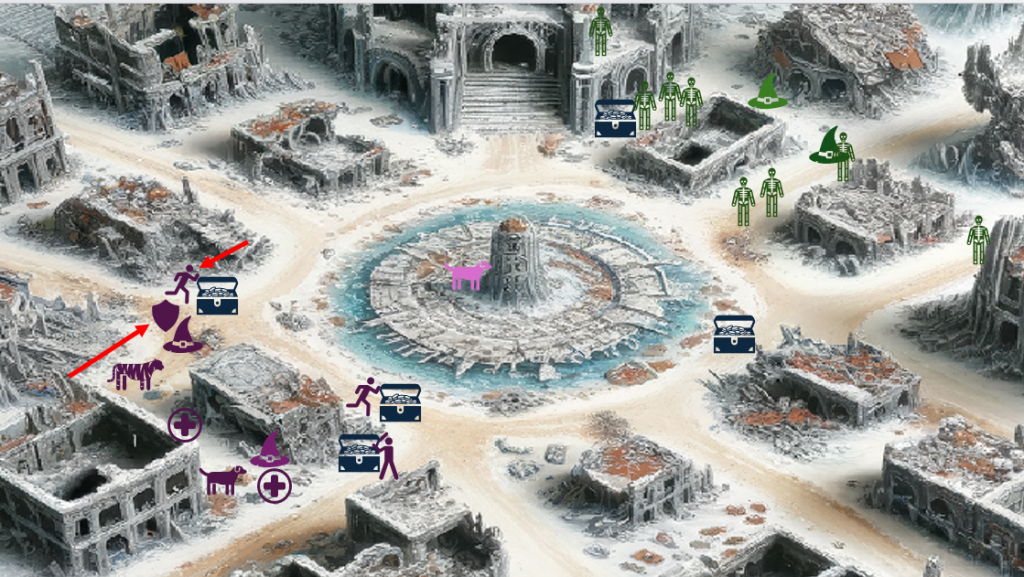
Finally, to complete my soldier phase, I activated the thief my wizard had just transposed at the start of the phase. He picked up the treasure, and started running back to safety. Once a character is carrying treasure it moves at half speed - so a thief with movement 7" is only moving at 3.5" when carrying treasure. I then started to run my templar up the board to help protect the retreating thieves.
By the end of turn one I had managed to get my hands on three of the treasures, however I was not in the clear yet. Whilst the only member of my warband who was really exposed was the illusionary war hound, and none of the enemy soldiers would be able to get to me in the coming turn, there was still the chance that a lucky shot from one of his archers, or from a ranged spell, could take out one of my thieves carrying treasure - so I would still have to work hard to secure the treasure in turn two.
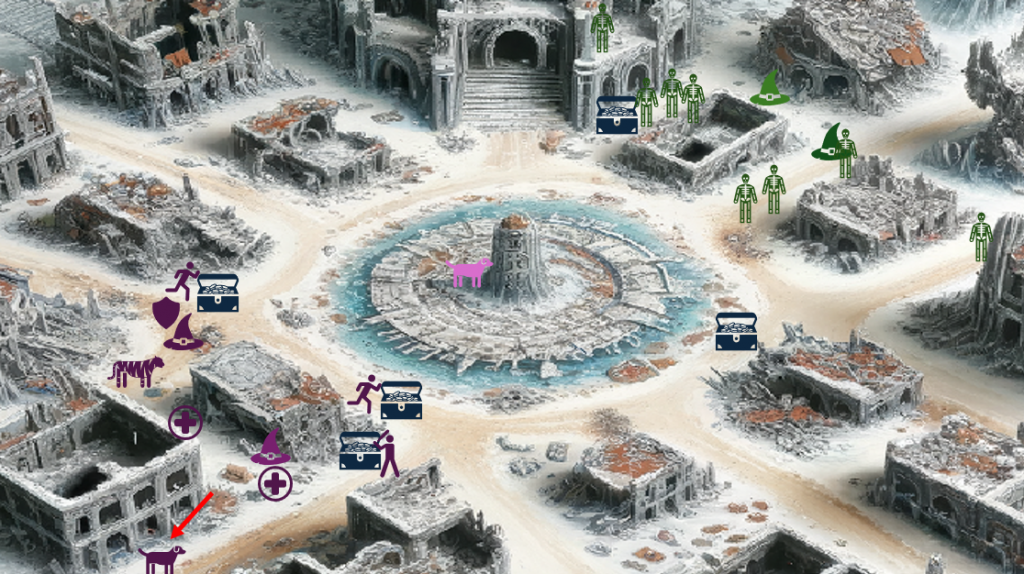
Thankfully, this time I won priority. I activated with my wizard, and with a war hound within 3". Firstly, my war hound moved right to the edge of the board...
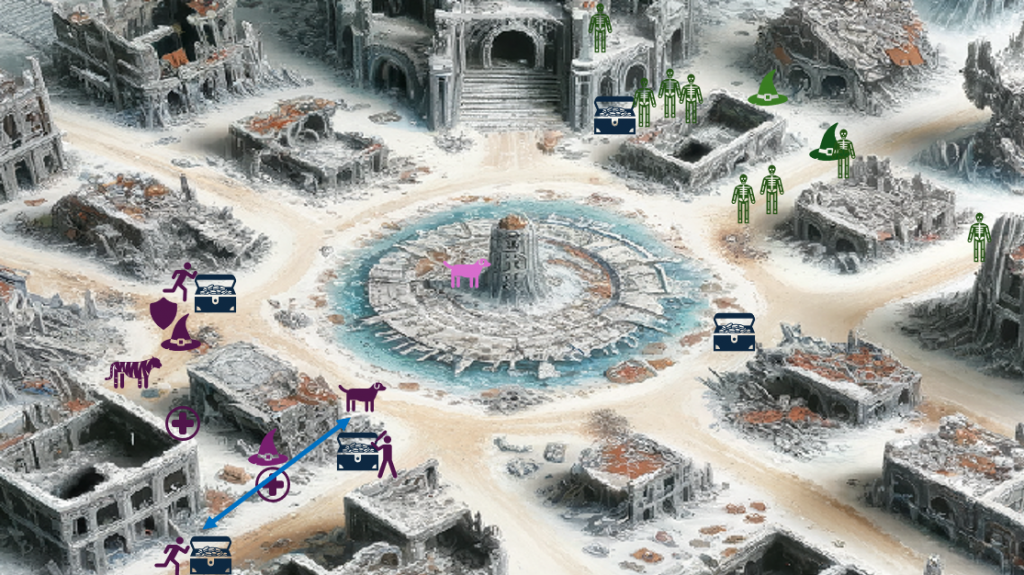
...and then my wizard cast, you guessed it, transpose, switching the war hound I had just moved for the thief with the central treasure, putting the thief right at the edge of the board. My opponent then activated his wizard to cast
heal in order to heal up some of the wounds he'd taken through miscasts earlier.
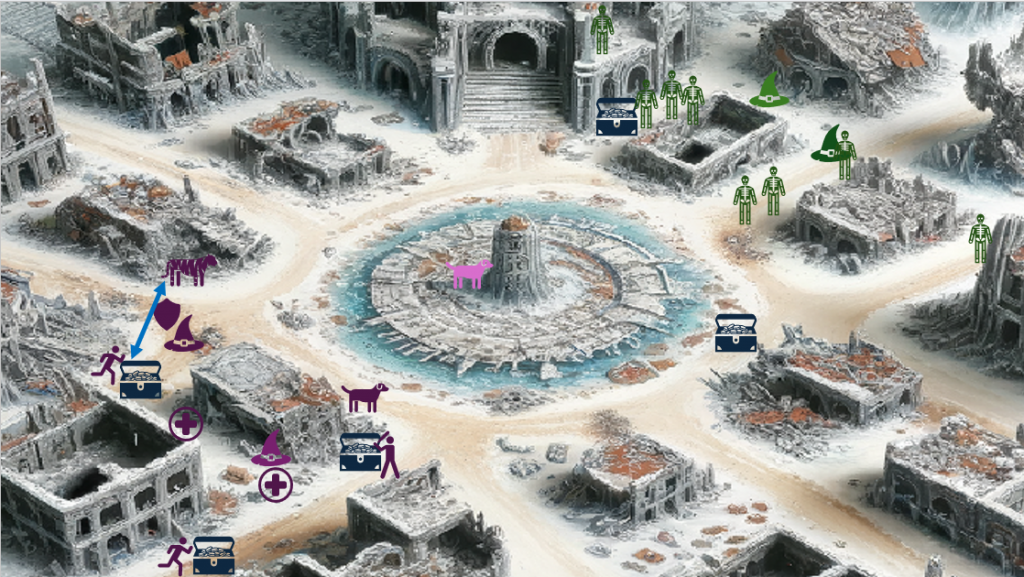
In my apprentice phase I transposed the thief with the other treasure with the snow leopard, again positioning it closer to the edge, and out of harms way. My opponent's apprentice tried to shoot my illusionary war hound with a
bone dart spell, but missed.
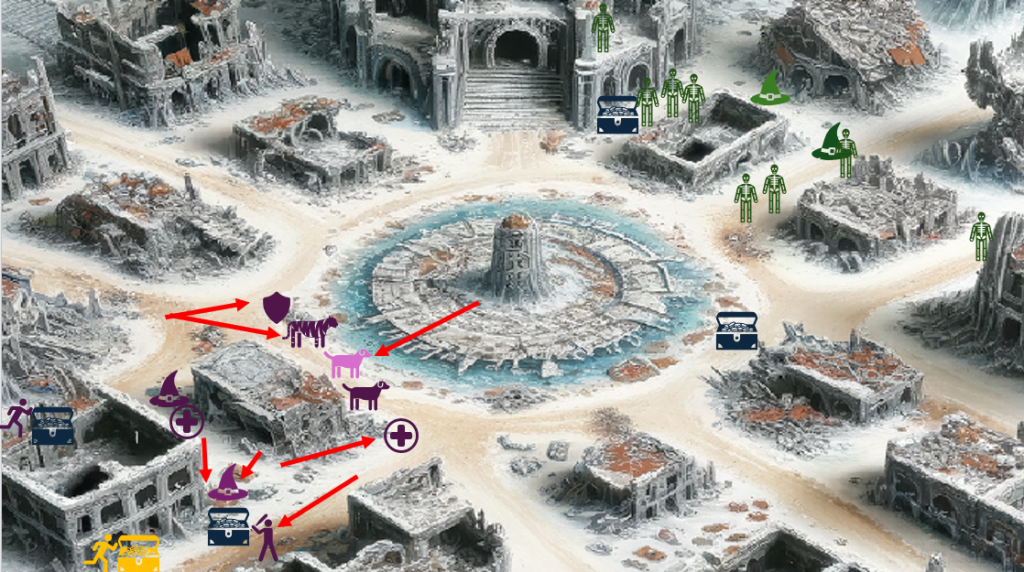
All that was left to do in my soldier phase was just to start running away with my three treasures, and then start creating a protective barrier with my other soldiers to cover the retreat and protect my wizards.
My opponent then moved the rest of his soldiers and positioned them to give himself good control over the board. But that was fine with me, as I'd already got what I wanted. The treasures would all leave the board in the next one or two turns, and my wizards were hidden away behind terrain. Next turn I would be able to cast
wizards eye on a piece of scenery, which would allow me to cast spells from that piece of scenery, instead of from my casters, allowing them to stay hidden and safe. That way I could just mess about with my opponent from a safe distance, transposing his people around or casting debuff spells to mess with him being able to get the remaining treasures.
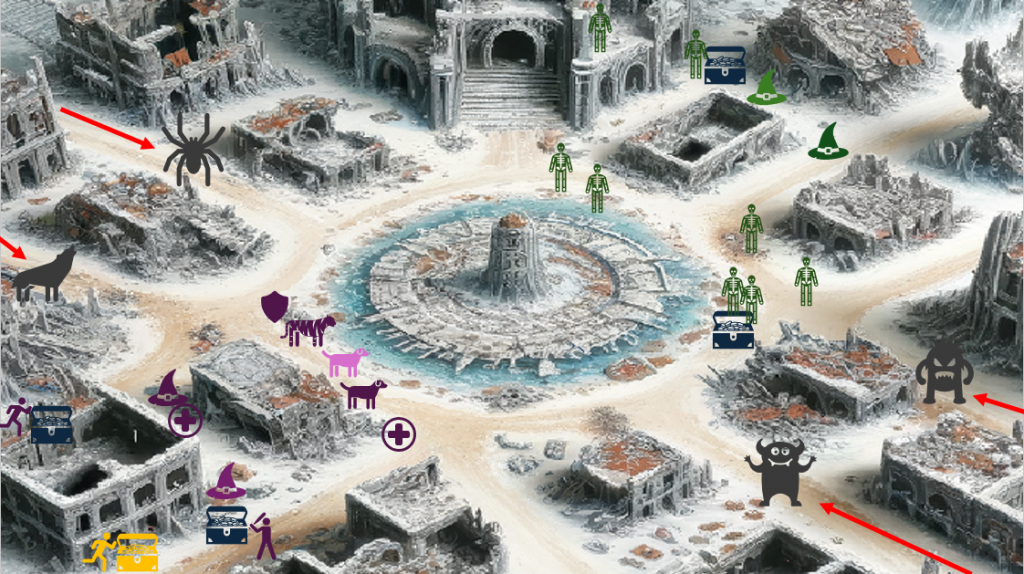
One thing that would make this particularly fun was that in our campaign we use the
Random Encounters optional rule, meaning that every time someone picks up a treasure chest, a random uncontrolled creature enters the board, and heads for the first person they can see. That meant there were now several nasties all bearing down on the centre of the board, making my opponent's life more difficult.
As it happens, I miscast most of the spells I was trying to annoy my opponent with, and through all of the pushing and miscasts my wizards were starting to lose a lot of health, so eventually I retreated. My opponent managed to fight off the creatures long enough to get two treasures off the board. And that was that. I'll cover the post-game sequence another time!
Overall I was pretty chuffed that my strategy paid off. It does involve having to put a lot of thinking into deployment and movement, making sure your models are all within transpose range etc. But I think it just goes to show what a varied game Frostgrave is, and how accommodating it is to a variety of different play styles. I'll look forward to annoying many different opponents in the future with this warband!
Have any questions or feedback? Drop us a note in the comments below or email us at contact@goonhammer.com. Want articles like this linked in your inbox every Monday morning? Sign up for our newsletter. And don't forget that you can support us on Patreon for backer rewards like early video content, Administratum access, an ad-free experience on our website and more.
Thank you for being a friend.
 This website uses cookies. Learn more.


 Goonhammer App and Patron Updates: April, 2026
 Kill Team Tournament Report: Engage, Party, Repeat's March Madness 2026
 Goonhammer Reviews: Tribal Conquest