In our Lore Explainer series we take a deep look at the lore of various games, settings, and factions. In this article we're looking at the lore behind the Ultramarines, the XIII legion of space marines and the ostensible poster boys of the Warhammer 40,000 universe.
Welcome back to our ongoing series on the lore of the Ultramarines.
In Part 1 we looked at the lore of the chapter.
In Part 2 we took a trip back into their past and examined their history during the Horus Heresy as the XIII legion. In this article we're going to be exploring the lore of the chapter's Primarch in detail.
Like so much of Guilliman's life history, the truth of his death was shrouded in the embellishment of repeated telling; he had found no less than twenty-six divergent versions of the event in the Ultramarines libraria alone.
The Scattering
The Emperor's Space Marine project started with the creation of twentyish Primarchs, superhuman warriors made from his own genetic material who would each become the genetic sire of their own legion of space marines. The plan was that each of these genetic super warriors would grow up in under the care and tutelage of the Emperor on Terra, then take command of their legions and reconquer the galaxy.
Of course, that didn't happen. The chaos gods - potentially with a little inside help from geneticists and/or time travelers - intervened during the development of the Primarchs. This may have been because of their role in the creation of said Primarchs - the Emperor is said to have bartered for secrets with the Chaos gods and betrayed them - or it may have just been because they were afraid of the Emperor and his plan, or just because the Chaos Gods are a bunch of weird, evil dicks. Either way, the Geller field around the Primarch lab was compromised, a warp rift was opened, and twenty or so birthing caskets holding the Primarchs were swept up in the warp and scattered across the galaxy.
As you might imagine, the Emperor was not chuffed about this development but was resolved to kick off his Great Crusade anyways. What he might not have known (clairvoyance and future sight are tricky), is that his sons would survive and eventually be rediscovered as the Great Crusade spread across the galaxy and reconquered worlds.
The story of the Primarchs is very much one of nature-vs-nurture: While each of these genetic super-warriors was created with superhuman intelligence, stamina, strength, and endurance, able to achieve great feats and understand the technology of war intuitively, they were also children, raised on very different planets. Some would be cast into slavery and forced to fight in the combat pits of barbaric worlds and mutilated, others would grow up alone on worlds untouched by sunlight.
Roboute Guilliman, Primarch of the Ultramarines, landed on the planet Macragge.

Macragge
Macragge is a rocky, bleak planet located on the galaxy's Eastern Fringe. Most of the planet's surface is covered in rocky mountains and the rest is covered in vibrant oceans. Macragge was part of the stellar empire built by mankind during the Dark Age of Technology and managed to survive the Age of Strife with most of its industries intact. As a result, Macragge also maintained contact with nearby systems and planets, and regular lines of shipping and travel were maintained between those worlds.
Macragge was ruled by two kings - called Consuls, whose word was law - and functioned as a kind of meritocracy where "honest toil" was rewarded with advancement and positions of power. The planet's people were disciplined and stoic, living simple lives and spurning opulence and luxury as the seeds of immoral behavior. Its children were sent to military academies at an early age to build stamina and discipline, learn to fight, and learn how to survive the planet's harsh conditioning. Only the very best survived this eight-year regiment to become upstanding citizens of
SpartaMacragge. At that point they'd join the military, then at thirty they were free to leave and start families of their own.
Under this system Macragge produced a population of highly skilled warriors, able to repel xenos invaders and defend its population. Its elite citizens were capable warriors who thought of the greater good, supported by each other and uh, a lot of slave labor. So yeah, basically just like Sparta.
Guilliman's Arrival
Guilliman's backstory is much better documented than that of the other Primarchs, in part because Macragge was a civilized planet with great literacy rates and recordkeeping, and in part because Guilliman is the kind of guy who'd write his autobiography at the age of twenty. His name - Roboute - literally means "Great One."
As a child, Guilliman was discovered by Konor, one of the two Consuls of Macragge, in the Valley of Loponis, supposedly after having a dream in which the Emperor bade him protect a small, golden-haired child surrounded by dark monsters. When Konor led his forces to the spot in his dream, they found a little golden-haired baby and named him Roboute.
Roboute grew and learned quickly, enrolling in military service at age six and quickly mastering the art of war. He was smarter than anyone alive at history, philosophy, and science, and quickly gained renown as a military mastermind. By the time he was eight, he was already the greatest warrior on the planet so he graduated early and joined the military. His dad, Konor, was pretty proud. But even before Roboute enlisted in the military service, he was disgusted with the leadership of Macragge.
"The greatest statesmen of the greatest city were idiots, blind to the most important resource on the planet - their own, needlessly oppressed people. They were fools and tyrants and even aged five, I wanted to tear down the whole hidebound edifice. My father felt the same, I knew he did."
Why Do We Have Two Kings, Though?
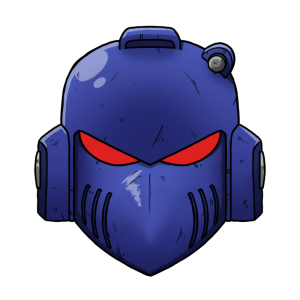
You know who wasn't proud? Gallan. You know how we mentioned Macragge had two kinglike Consuls? One of those was Konor Guilliman, who was a great warrior, well liked, smart, affable, and incredibly handsome. Konor Guilliman believed in the rights of the people, and sought to inspire them through patriotism and shared sacrifice. The other was Gallan, a greedy, jealous little shit who plotted against Konor all the time. Gallan and the wealthy elites who supported him had grown tired of Konor's reforms, which included things like "more humane treatment and living accommodations for the planet's slaves." They weren't fans of paying taxes, either. Gallan was sick of being a Consul. He wanted to be a king.
The Death of Konor
Roboute was a threat to Gallan's plans - he couldn't make his big move while Roboute was in the capital so he paid a bunch of bandit tribes to launch bloody raids against northern settlements. He then told Konor something along the lines of, "Hey, you know who would be great at stopping these jerks? Roboute. That kid has battle glory and upper management written all over him." Konor readily agreed and sent Roboute up north to fight those bandits. What happened next is a matter of some dispute with some implications for Guilliman's character, and there are multiple, different versions of the tale of Konor's death.
Although well documented in the annals of Macragge history, there's also a lot of mythologizing and hyping up Guilliman in those records, so it's hard to tell which of these is the canon verison of events.
The Index Astartes Version
As you might expect, this went well for Roboute and poorly for Konor. Under Roboute's command, the northern forces quickly crushed the bandit tribes, earning their respect in the process. Roboute even became a blood brother to Bardylis, the head honcho of the strongest barbarian tribe after he spared his life in battle and converted the tribes to swear fealty to him. And Bardylis did Roboute a solid by telling him that actually, funny story, they were paid by Gallan to cause the ruckus Roboute was up here to stop. And despite Bardylis making Roboute promise not to be mad if he told him, Roboute was in fact, very mad when he found out.
Roboute high-tailed it back to the capital city of Macragge only to find the place in anarchy, being actively looted by Gallan's forces. He marched to the Senate house and butchered his way through Gallan's paid soldiers and found Konor dying on the floor, having been stabbed by an assassin's poisoned blade. Roboute took command of Konor's loyal forces and immediately went to work, tracking down Gallan - who had fled off-planet - and bringing him back in chains to personally behead him with Konor's sword. He then assumed control of the planet as its sole Battle-King (by popular demand, we're told), and set to restoring order and making Macragge a shining beacon of prosperity and wonder.
The Black Book V: Betrayal Version
In Black Book V: Betrayal, we have a second tale of the Death of Konor.
Gallan, along with several other Macraggian nobility of the old agrarian sort who disagreed with Konor (and his industrialist constituency), were scared of Konor's preternaturally precocious foster child and launched a coup. Roboute had finished his Illyrium campaign when he saw Macragge Civitas in turmoil. Upon his arrival, Roboute learned that Gallan's private army had attacked the senate house. A drunken mob instigated by Gallan but now out of everyone's control was rampaging through the city. Roboute had his troops deal with the drunks, while he went to try and save Konor. It turns out that the uprising was set off when someone tried to assassinate Konor on the senate floor. Konor passed away when Roboute found him, "apocryphally saying that as he gasped out his last breath, Konor detailed the extent of Gallan's betrayal to his beloved foster son and named those whose hands were stained with his blood."
Roboute was not jazzed about this. His army and the people of Macragge Civitas crushed the aristocrats, hanged the rioters from Macragge's most noble lampposts, and restored order. Thousands of citizens rushed to the Senate and ensured Roboute assumed the mantle of the sole and now all-powerful Counsl of Macragge. Guilliman had the ringleaders of the coup executed, the rest of the aristocrats sentenced to destructive labor (rebuilding the stone of Macragge Civitas by hand!). Guilliman elevated soldiery and citizens, creating a ruthless meritocracy.
Black Book V's version is similar in broad strokes to the Index Astartes version, but takes the tale in a more democratic direction. There we are told the citizens rallied to Roboute Guilliman's banner, whereas the Index Astartes version has him clearly as a battle king.
The Black Library: The Sinew of War Version
In 2019, Black Library released the "Scions of the Emperor" anthology. One story in this anthology was Darius Hinks' "The Sinew of War," which tells the Macragge rebellion, the Death of Konor, and the ascension of Roboute from Guilliman's perspective. In this version, Roboute and his army returned from the Illyria suppression only to find Macragge Magna Civitas in flames. He quickly figured that whomever was behind the Illyria suppression was responsible for the Macragge Magna Civitas revolt, but he did not know precisely
who was behind it. Scything his way through a bunch of drunken, riotous soldiers (Roboute declared them traitors, because, "True sons of Macragge would never behave so poorly"), Roboute reached the Consul House when he encountered Consul Gallan. "I loved Gallan but he was as strange as all of Macragge's nobles. He had just passed all those dead men, but it took a ruined tapestry to make him angry."
Gallan told Roboute who revolted: "The very people it will hurt the most. The people your father's reforms were intended to help. The idiots took matters into their own hands." Going forward into Consul House, they were attacked by the Household Guard who had torn the emblems from their uniforms and turned the building into a charnel house. Roboute proceeded to mow down everyone between him and his father's stateroom. There, Roboute found his dying father, his throat slit by a poisoned blade. Unable to speak, Konor handed Roboute a single coin and died.
Roboute was absolutely furious! His beloved father had been murdered! But Gallan appealed to Roboute's sense of civic duty. The Senate must be informed of Konor's death, and Gallan also prods Roboute: "They have also risked the stability of the entire planet. There are too many factions vying for power. If there's a consular election now there will be mayhem." Roboute agrees, being a thirteen year old who just saw his father die from being murdered and not having slept for several weeks.
After reaching the Senate, where the calls have grown for Gallan to take the role as sole Counsul, Gallan suggests to Roboute that he go take a shower and change because he is bloody and gross before they announce Gallan as sole Consul. One of the serfs assigned to help Roboute change his clothes tries to assassinate him. Roboute, smelling the poison used on Konor (and used by the Illyrian rebels), defeats the assassin and looks at the coin his father had given him. He then goes to the Senate to have a word with Gallan. Gallan, meanwhile, is giving a speech denouncing both dead Guillimans. Konor is blamed for burning down Consul House, while Roboute was blamed for trying to overthrow the Senate but don't worry, Gallan killed him. Then Guilliman shows up behind Gallan, and calmly explains that Gallan killed Konor. Because saying that you have killed someone who is quite obviously standing behind you does wonders for your credibility, the outraged Lords of Macragge are perfectly content with Guilliman turning Gallan into paste. Guilliman refuses to kill Gallan, because, "It is not the job of a single man to pass judgment. It is the job of the Senate. Macragge is greater than any of us. Gallan killed my father, but I would rather see him go free than tear this council apart."
The Macragge Senate agrees, and Gallan is carted off for trial and execution. The Senators all declare Guilliman king, because, "You put the needs of the senate before your own pain. You are an example." That's right, in The Sinew of War Guilliman becomes King of Macragge by insisting upon due process of law.
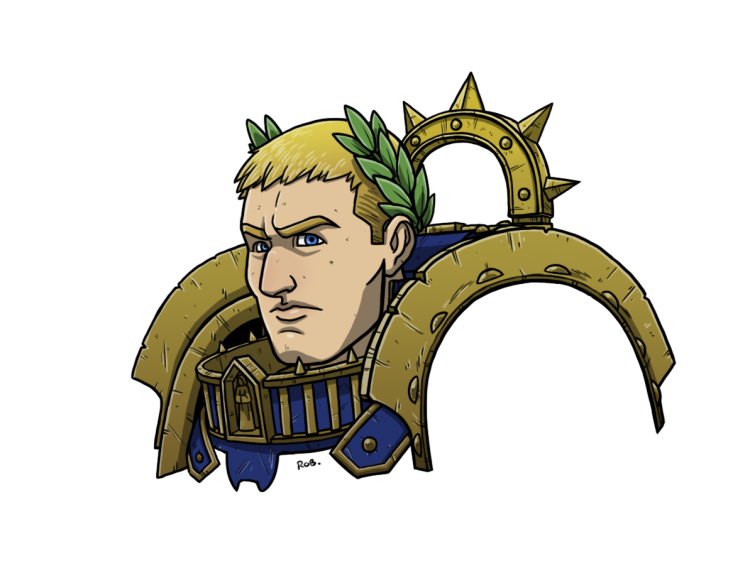
The Black Library story is pretty different than the Index Astartes and Betrayal versions. The way to reconcile them is that the versions in Index Astartes and Betrayal are propaganda produced for different versions of Ultramar and the Imperium: The Black Books are Horus Heresy/Scouring era propaganda, in which Guilliman is merely the top dog trying to unify the Imperium. There we see Roboute Guilliman as a champion of democracy and meritocracy (how Ultramar was organized in the Heresy era), sharing the spoils of technology and industry with everyone against greedy nobles. By Index Astartes, Guilliman is a figure of distant myth and the Imperium is a thoroughly corrupt authoritarian institution and so Guilliman's ascension is designed to reflect and support the authoritarianism with him as the sole arbiter of justice. By contrast, The Sinew of War showcases Guilliman as a kid who had not slept for several weeks and had just lost his dad and thus completely *missed* the "I AM A BAD GUY" Neon Sign floating above Gallan's head.
 Credit: Robert "TheChirurgeon" Jones
The Prodigal Father and the Eagle of the East
Under Guilliman's rule, Macragge and the nearby worlds prospered. They built towering structures of marble, steel, and glass. Disciplined, well-equipped armies and police forces (the Vigil Operati) kept the peace. Starships traveled openly between neighboring systems. Macragge become a perfect model of modern human society and Roboute ruled for five years before the Emperor's arrival.
When the Emperor learned of this wondrous system and Consul Konor's prodigy son, He immediately suspected He'd found one of His lost Primarchs. However on his way to the planet the Emperor's forces were caught up in Warp Storms which spit them out off course and five years late. By the time He arrived at Macragge, Roboute was already king and the planet was thriving.
The first meeting between the two is supposedly recorded in great detail and across many sources and lots of those historians love to suggest that the Emperor deliberately sent Guilliman to Macragge. Guilliman recognized the Emperor as the figure in his father's dream and as his true father. For His part, the Emperor was as impressed as a stoic detached absentee father can be with the state of the world and its neighboring systems and welcomed Roboute as an equal, giving him command of the
XIII legion, the War-born. Macragge was immediately assigned to be their forward base of operations and they built a fortress high in the Laponis valley, near the spot where Guilliman was discovered as a baby.
Guilliman assimilated quickly into the Imperial fold, leading the Ultramarines to victory after victory expanding the Emperor's realm. His approach was one of discipline, working to spare the lives and resources of his legion and avoid collateral damage, bringing peace and prosperity to the worlds they conquered. As a result, the Ultramarines retained numbers far beyond those of the other legions and the words they liberated became among the most prosperous and well maintained in the Imperium. Guilliman also demonstrated a strong focus on managing his Legion, in which he directed personnel assignments in order to ensure his Terran-born sons learned to believe in his Macraggian philosophy. Guilliman started with his First Captain Marius Gage, who often served as the Watson to Guilliman's Sherlock.
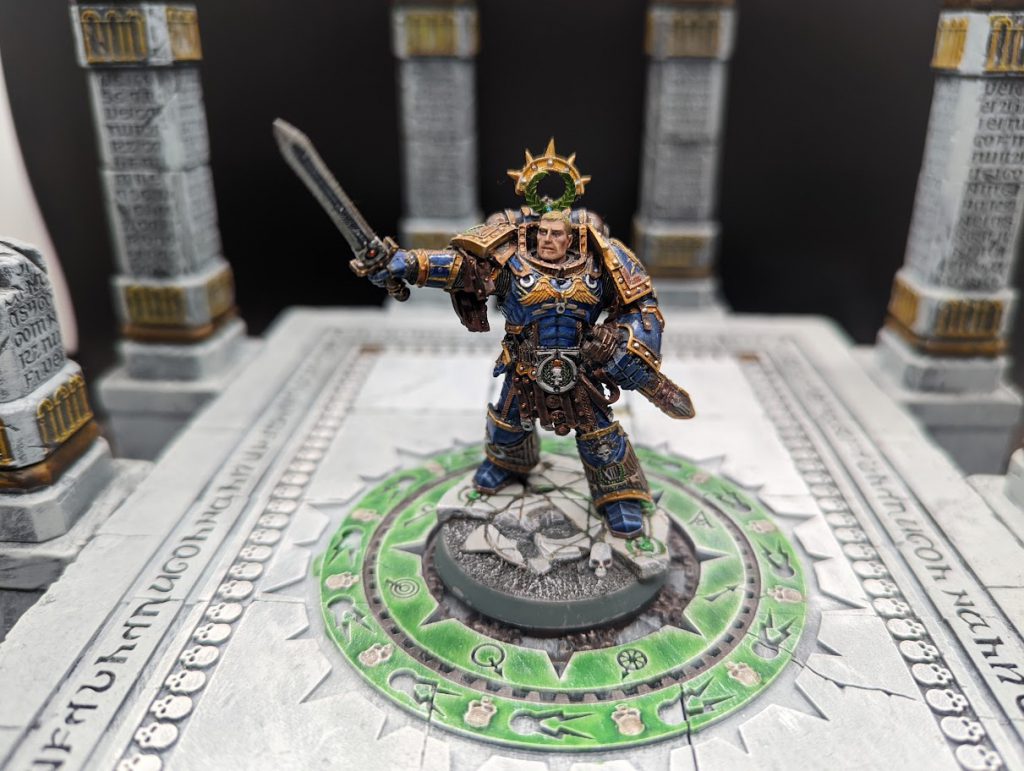
Guilliman in this era was a self-consciously optimistic leader, leaving behind organized, secular, and centralized societies. Corvus Corax noted that Guilliman's private chambers were covered in stacks of books he's reading in order to help build a better empire. When Corvus admitted a desire to write a treatise on good government alongside Guilliman's writings on generalship, Guilliman was encouraging. Thoughts on winning the peace were as necessary as winning the war. The dark side of Guilliman's optimism was reflected in his decisions to destroy examples of human societies that did not reflect this level of optimism and unity (for example, the ruins on Thaos). It is this optimism and belief in the Imperial Truth that left Guilliman blind to the treachery of Horus, Lorgar, and the Great Heresy.
The Avenging Son and Imperium Secundus
Outwardly, Guilliman regrouped and recovered from the Battle of Calth. Inwardly, the newly-christened Avenging Son was shattered. Everything he believed in appeared to be ashes. He had no clue whether any of his loyal brothers survived, or whether his father still ruled. All Guilliman had was himself and his values and the tattered fragments of optimism and civilization. For example, Guilliman assigned Drakus Gorod (the head of the Invictarus Suzerains) the responsibility of reading Hamlet in order to have a literary reference for the Ruinstorm. Regardless of whether his brothers and the Imperium survived, the duties of empire remained, and Guilliman and his Legion was going to fulfill them.
So Guilliman created a plan for his backup Imperium, the Imperium Secondus (also known as the Unremembered Empire). Consisting of the worlds on the Galactic Eastern Fringe, the Imperium Secondus would center around Ultramar and continue on with the work of uniting humanity. All it needed was a ruler - its Lord Regent. Guilliman was always an empire-building sort but he was no fool - if he created a separate Imperium and named himself rule, people might get the wrong (or right) idea about his intentions. He'd rule if he had to, but what he really needed was someone else to name Lord Regent so it wouldn't seem like he was just trying to claim power.
When The Lion and the First Legion finally fought their way through the Ruinstorm and arrived at Macragge, Guilliman was overjoyed: he welcomed The Dark Angels with a full military parade and gave the powered-armoured The Lion a big hug, in public. While the Lion wasn't his first choice for Lord Regent, he'd certainly do in a pinch.
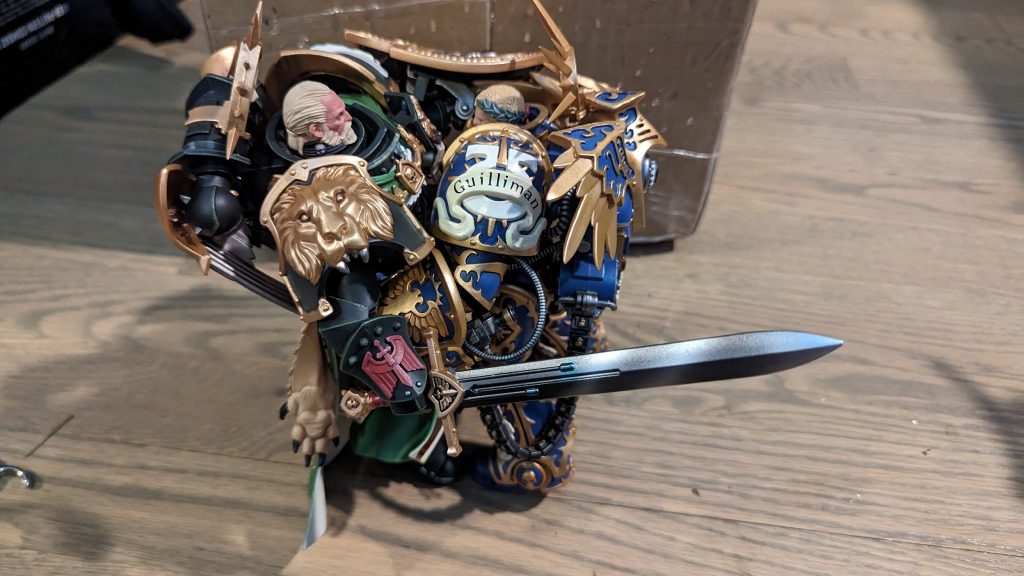 Dramatization of Guilliman hugging The Lion. Credit: Kevin Stillman
The Lion was not particularly thrilled with Guilliman's backup Imperium plan - something about "hey I'm so glad you're alive now listen run this new empire I made so I won't look bad" didn't sit well with him - and resisted being named "Emperor". This discussion gives us pretty deep insight into Guilliman's 30K character by means of its setting: The Lion and Guilliman debate and discuss within Guilliman's fortress, in the Council Chamber representing the center of his ultimate ambitions and optimism. This chamber has 21 giant seats, 19 of which have the banners of The Emperor and his brothers. Yes, Guilliman even hoped Angron and Lorgar would sit and debate at this table at some point, and had reserved seats for the two missing Primarchs.
"You still believe in a day when all of us, all of us, can sit at a table with our father, as equals, and talk at the matters of empire."
Two banners were bleached, undyed cloth.
"Two will never come."
"Yet their absence must be marked. Places must be left for them. That is simply honour."
In addition to not being receptive to the idea of ruling, the Lion also accidentally allowed Konrad Curze to get loose on Macragge, while at the same time Guilliman was dealing with various other silliness involving Vulkan and Perpetuals. Ultimately they'd end up badgering Sanguinius into serving as Lord Regent/Emperor of the Imperium Secundus.
Bit by bit, the pressures of running Imperium Secundus while not knowing if the true Imperium survived wore on Guilliman. At first it was understandable security measures: The Crimson Fist(s) believed that Macragge's security was dogshit, and so Guilliman allowed them to reinforce it to satisfy the preferences of senior captains of both the Imperial Fists and Iron Warriors. Then the Lion, in order to hunt Curze, unleashed his Deathwing Terminators on Macragge and bombed several cities with weapons of mass destruction. Between the constant defeats and constant waiting, Guilliman's optimism in the future slowly began to wane.
On Davin, the ruinous powers of Chaos confronted Guilliman with himself, just as they had Horus and just as they would also do with Sanguinius and The Lion. Here Guilliman had come into possession of a number of Chaos Athames, special daggers able to cut holes in reality and had to make a decision on whether to use or destroy them. He ultimately settled on destroying them along with the entire armory vault they were stored in.
After the destruction of Davin, Guilliman, the Lion, and Sanguinius were faced with difficult choices in order to reach Terra to relieve The Emperor. Guilliman chooses to take his fleet to tie up the Traitor fleets holding the warp routes to Terra. This in turn enabled Sanguinius to reach the Throneworld. Guilliman viewed this course of action as a punishment for his hubris.
Guilliman is currently PRETTY EMBARASSED about that time he jumped the gun on assuming everyone was dead and made his own, better Imperium and has sealed off all records of his little stunt in the present day. He promises that at some point he'll unseal those records. Honest.
Diavanos and Carchera
One such incident that crystalized the horrors of the Heresy was the Battle of the Diavanos system. This star system had been inducted into the Imperium without incident by the Ultramarines, and it had survived the Age of Strife intact, prosperous, and gorgeous. But as it was between Ultramar and Terra, the World Eaters had garrisoned the planet. Guilliman brought his fleet to battle against the World Eaters and defeated them... but not without great cost: The World Eaters Centurion was able to scuttle his flagship and severely damage the world of Diavanos, destroying a large number of their wonders and cultural artefacts. Its people would survive, but diminished.
Mere survival means decline. This will become a place of darkness and ignorance, unless we kindle a new fire.
At the Carchera system, Guilliman and his fleet were confronted by the Iron Warriors. This holding action was the final battle for the Ultramarines during the Heresy, and was enough to stop them from reaching Terra before the Siege began. The battle also saw the destruction of one of Guilliman's keepsakes, an ancient clock that his father had bequeathed to him.
The Scouring and the Codex Astartes
Guilliman and the Ultramarines spent the Siege of Terra stuck outside the Sol System, as the Astronomicon had been disabled and a Warp Singularity forming that would drag the galaxy into a hell without exit or end. After the Astronomicon was reignited by Euphrati Keeler, Sigismund, and the Dark Angels, Guilliman ordered his fleet to make for Terran space immediately. However they were ultimately kept from the final battle on Terra, and would serve more to clear a path for the Blood Angels.
The upside to all of this is that the Ultramarines had a large number of fresh troops following the Heresy, giving them the tools they needed to reclaim the worlds of the Imperium. But however sorry a state the Imperium may have been in, Roboute's brother marines and primarchs were worse off. The Blood Angels had recovered from the Black Rage, but reorganizing with the death of Sanguinius. The Khan was still recovering from his mortal wounds. The Lion and Russ were consumed with sorrow and anger. Rogal Dorn and his Legion survived, but their spirits were shattered from Holding the Line. Guilliman takes it upon himself to rally his brothers and the Imperium in the face of The Emperor's ascension. And doing so comes with significant costs.
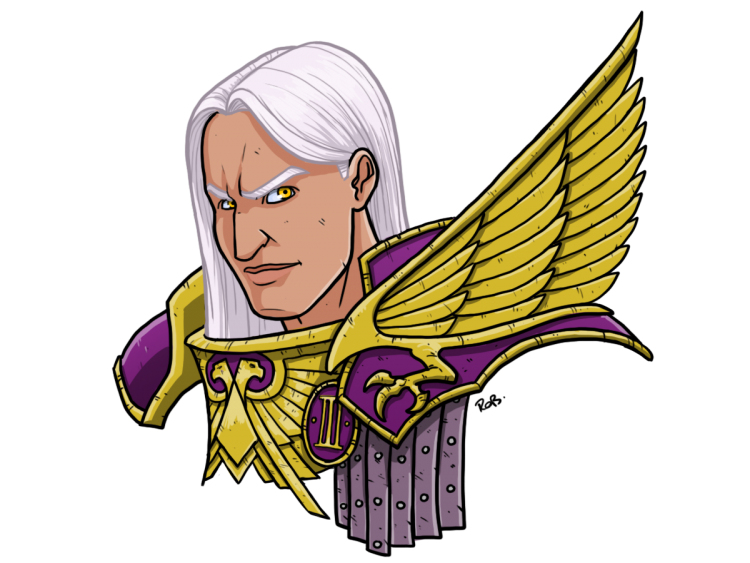 Credit: Robert "TheChirurgeon" Jones
Death at Fulgrim's Hands
There were so few of his original Legion left alive, and their replacements were born of a different, less certain era. Guilliman remembered when his warriors had been less reverent. They had been better times.
Over the world of Thessala, Fulgrim successfully lured the exhausted Guilliman into a trap. In a desperate attempt to escape, Guilliman and 100 Ultramarines (50 from the First Company, and 50 from the Second Company, led by now Second Company Aeonid Thiel), alongside elements from the Novamarines, Aurora Chapter, Doom Eagles, and a few others, boarded Fulgrim's flagship, the
Pride of the Emperor.
The Ultramarines made their way to the center of the ship. The Phoenician, in his debauched and desecrated Throne Room, was waiting for his brother. Fulgrim taunted Guilliman about all of his various failings as a Primarch and leader, and Guilliman responded by attacking. But even on a good day, Guilliman wasn't a match for Fulgrim's swordsmanship, and being exhausted against a foe empowered by the Warp didn't help.
You are staying? No dramatic teleportation? No strategic withdrawal? You actually want to fight someone you cannot hope to beat? Well, well, well, you are beginning to surprise me, Roboute. I never thought you had it in you. Perhaps you are not so boring as I thought.
Guilliman called for reinforcements and so did Fulgrim. The two battled, with Guilliman managing to land a blow on Fulgrim with The Emperor's Sword. That's when Fulgrim leaned forward in his chair and decided to play For Reals, throwing all of his demonic power at Guilliman, slashing his throat with a poisoned knife. Guilliman was spirited away by Aeonid Thiel as pieces of the
Pride of The Emperor were struck by other void weapons, teleported away just in time. Chapter apothecaries were able to use arcane emergency science to place Guilliman into stasis, moments from death, as a means of preserving him. And thus Guilliman was moved to sit within the Temple of Correction on Macragge, watching over his Sons for Ten Thousand Years.
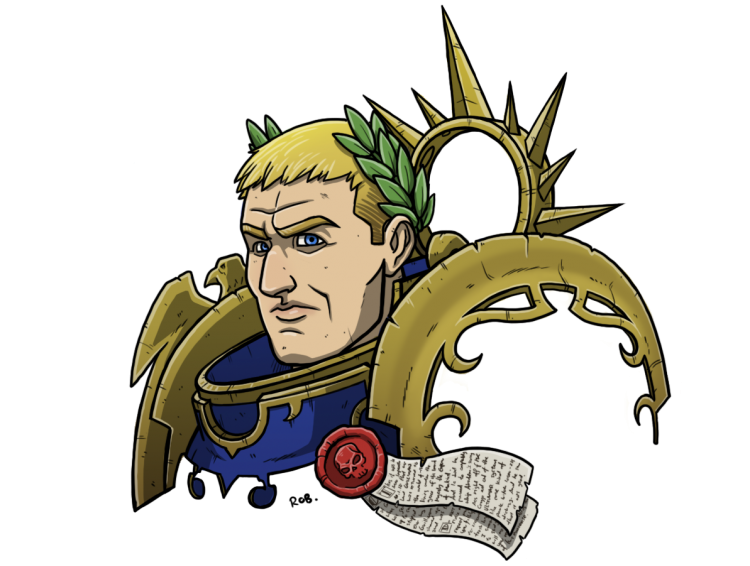 Credit; Robert "TheChirurgeon" Jones
The Gathering Storm
As the Thirteenth Black Crusade reached its apex, the Imperium was at its lowest point in millennia, with traitors overrunning the Cadian Gate and Abaddon destroying the planet with a Blackstone Fortress. It was at this point that an unlikely alliance between Inquisitor Greyfax, Belisarius Cawl, and Yvraine of the nascent Ynnari took place. Working together with the Cadian Guard and Space Marine forces, they fought bravely and helped evacuate troops. In particular, they traveled via webway from the Cadian Gate to Macragge. When they reached Macragge, the situation was dire: a full Chaos invasion had begun, and even Marneus Calgar was hard-pressed to stop the onslaught.
What Abaddon had not sent at Cadia he seemed to be sending to Macragge. So it was a very big shock when Cawl revealed why he'd wanted to go to Macragge: to revive Roboute Guilliman. This didn't go over well with Calgar, but Chief Librarian Tigurius voiced for him and they were led to the Temple of Correction to begin their preparations. This was a delicate procedure, requiring a mix of Cawl's technological wizardry and Yvraine's actual wizardry and it was made harder by a captured Thunderhawk crashing through the ceiling and unloading a bunch of Black Legionaries into the Temple. Calgar's forces kept them at bay as the group realized that their process wasn't working.
The reason it wasn't working was because they needed Guilliman to actually be dead, and as he was stuck in stasis, he was only
mostly dead, kept alive a second from death. Yvraine and the Visarch realized this first and pointed out that Guilliman would have to die. This again did not go over well but Tigurius seems to be one of the more trusting characters in the setting and so eventually went with it and gave them permission. Calgar was not so inclined but he was elbow deep in Heretics at that moment and so largely went ignored.
Everything seemed lost.
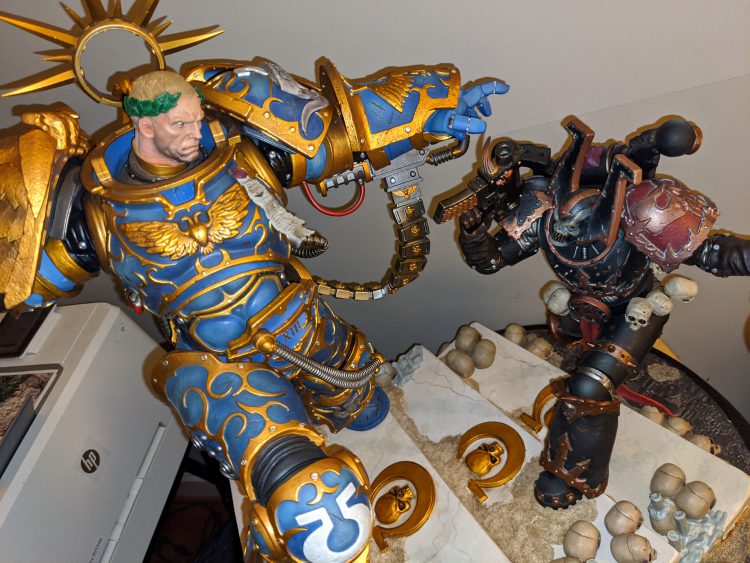
And then it wasn't.
The most desperate fight in Ultramarines history, the Defense of the Temple of Correction, changed instantly with a loud, clear,
ding! Esoteric tech-arcana, enigmatic Aeldari, and the desperate wisdom and hope of Chief Librarian Tigurius had united to light Ultramar's darkest hour and restore Roboute Guilliman to life. He immediately stood up and whupped a bunch of traitor ass, taking operational command of the Ultramarines' forces after Calgar swore fealty to his Primarch. Then he led his forces to purge Macragge of traitors before sitting down and realizing how screwed he was.
Times had changed in the Imperium while Guilliman had been dead, and not for the better. Sure, many of the men before him wore the cobalt and gold of the Ultramarines and while they were pretty dang good Space Marines, everything else was a mad, degenerate nightmare of what he believed. The Imperium was no longer a centralized, organized, secularized model of prosperity. Instead it was a superstitious, impoverished, gaudy ruin, devolved into the worship of the Emperor as a god. The Consul House where he and Konor lived was gone, replaced by "ugly agglomerations of buttressing and gun batteries".
We failed, father. Did Horus not say that you sought godhood? He built a rebellion upon that claim. How he would gloat, to see the Imperium now.
But Guilliman, confronted with the truth of Horus' depthless cynicism, still held onto the flame of his secular idealism. He saw how hard his sons fought. He saw how much care the work gangs put into their world.
Moreover, he knew what fruits Cawl's labours had borne beneath the surface of Mars...
Guilliman spent some time clearing out Macragge, then its star system, and then decided to cleanse Ultramar. Guilliman revoked the dissolution of the 500 Worlds and began operations with elements from several Space Marine chapters and other Imperium war elements: Dark Angels, Iron Hands, and Titan Legions fought alongside the Ultramarines and their successors. It was only when fighting a Nurgle plague that Guilliman realized he had fallen into the same trap that beguiled him during the Heresy: Focusing too much on Ultramar. Guilliman thus realized he needed to go to Terra. Placing Cato Sicarius in charge of his newly formed Victrix Guard and gathering all the various Imperium models released during the Gathering Storm campaign (1), they headed off to Terra via the Maelstrom.
This kicked off a whirlwind tour of the galaxy where Guilliman more or less fought everyone in the back half of the Gathering Storm III book. In the Maelstrom Kairos Fateweaver promptly bogged them down and alongside the Red Corsairs successfully captured both Guilliman and his flagship, the
Macragge's Honour. Guilliman and his Space Marines, Battle Sister, and Skitarii allies were thrown into space prison aboard Huron's deactivated Black Fortress. But no sooner were they dropped into the prison than Skarbrand showed up to claim this was his fight. Skarbrand and Kairos fought for a while and during the kerfuffle Guilliman and his forces were liberated by Cypher an da crew of Harlequins, who took them to the moon via a secret webway passage.
On the Moon, Guilliman was challenged by Magnus the Red and the Thousand Sons Traitor Legion. Guilliman and his forces were tired, depleted, and probably would have been defeated if not for the timely arrival of the Custodes, Sisters of Silence, Grey Knights, and Imperial Fists. They managed to defeat Magnus working together and following the battle the Custodes immediately took Guilliman to Terra itself and the Imperial palace. It was there that Guilliman finally had his audience with the Emperor.
We don't initially find out how this goes or what is said, if anything. It's not until Guilliman is dying of the Godblight later that we see their conversation via flashback. Well, maybe. It's unclear how much of it actually happened and what was actually said vs. imagined vs. conocted by a brain addled full of Nurgle's choicest plagues. Mostly it just involves the Emperor calling Guilliman a tool.
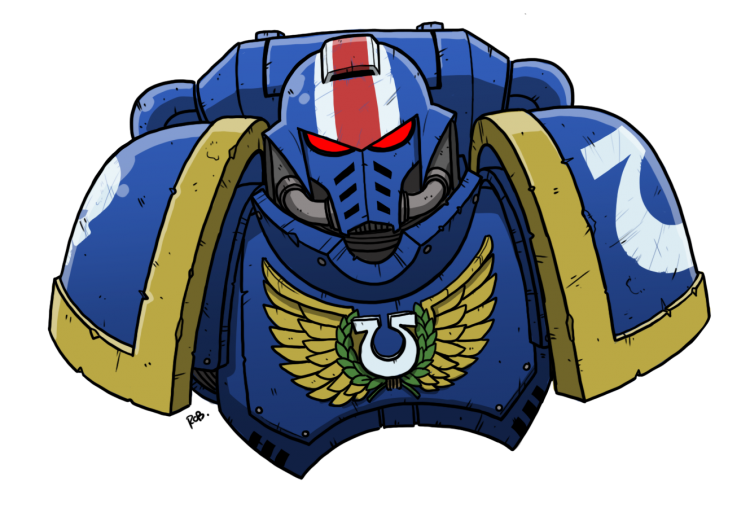 Credit: Robert "TheChirurgeon" Jones
Era Indomitus
There were but a handful alive now who remembered the Great Heresy War. The teeming multitudes of the Imperium had no inkling of the dream Horus' betrayal had killed. Few beings that lived that would have noted the changes the Avenging Son of Ultramar had undergone.
Guilliman, at that point in time, was the only living loyalist Primarch left (as far as he knew). Guilliman knows his father still lives, but is now something distant and alien. Guilliman is still loyal to The Emperor, but likewise horrified as to what He has become. But despite the fact that the Imperium is a superstitious, horrific ruin that is a cruel farce of the noble Imperial Truth that Guilliman had championed in an earlier life, the only thing Guilliman can do is go on. And so he does. He assumed the mantle of Regent, and provides Bellisarius Cawl the political cover needed in order to launch the Ultima Founding and reveal the Primaris Space Marines. Guilliman may be heartbroken, but he is a creature of duty and he is going to fulfill that duty.
It took Guilliman time to get used to actually living in the 41st Millennium. At the launch of the Indomitus Crusade, he had no way to remove the Armour of Fate. Part of this was because he was told by Yvraine that if he ever did, he'd die horribly. Of course, this seemed cooler conceptually than in execution as Black Library writers immediately realized that someone who can't hold a pencil or a fork or poop outside of his suit is kind of hilarious and sad. So eventually he took it off and nothing happened. Disaster averted/retconned.
More difficult was the transition to living in and with the modern Imperium, a backwards, superstitious empire run by zealots. Even Guilliman's own sons weren't exempt, seeing him only as an icon. Over the course of the Plague Wars Guilliman would grapple with the Imperial Faith and its implications, struggling to understand whether the Emperor was actually a god and, even if he wasn't, whether that even mattered if the end result was the same.
Final Thoughts
Contemptor Kevin: Roboute Guilliman is my favorite Warhammer 40,000 character. His story in the Heresy was what enticed me into the world of Warhammer, and the release of his model in 2017 was what convinced me to learn to build and paint Warhammer models. As of the time of this writing (immediately before Adepticon), I am in the middle of building and painting a Guilliman model because it's been several years since I built and painted him and my skills and style have improved considerably in the past six years. Even though it's not the best 40K model. or even the best Roboute Guilliman model.
I find Guilliman fascinating as one of the main characters of the Warhammer franchise: The 40K setting is a self-consciously, despotic hellhole where everything is geared towards war and armaments production. The Imperium is a gaudy, grim culture dedicated to the worship of an undying figurehead god who never wanted any of it. But despite ten thousand years of betrayal, disappointment, being murdered, and spending centuries fighting unending galactic wars, Roboute Guilliman still fights for a better future and good government. Even in the Era Indomitus, he still asks his Space Marines to design public works projects for Macragge in order to improve the infrastructure to make the lives of citizens better. He gathers renegade and proscribed scholars to become historians to try and make sense of 40K's insane timeline. He strives for a human connection with his sons and the other people, despite being an exhausted demigod. Guilliman struggles (and does not always succeed) in keeping the flame of hope and reason alive, and that makes him a fascinating 40K character.
(1) Guilliman asked two of the Aeldari models, Yvraine and the Visarch, to join him on the Terran Crusade. They declined saying they had Aeldari stuff to do, but that they'd fight alongside him again eventually.
TheChirurgeon: Guilliman is more interesting to me as a bridge between the Heresy and the "modern" Imperium of Warhammer 40k. But there he's very much a "less is more" character - the more you throw his logistical prowess and idealism against the modern Imperium, the more you risk showing how stupid some of the setting is when it comes to solving tis problems. The good news is that there's an easy solution: The modern Imperium is much larger and logistically challenging than the Heresy-era Realm of Ultramar, and problems have become orders of magnitude harder to solve, particularly with the advent of xenos threats everywhere.
Also the Guilliman model is fine. The studio paintjob is just not great on his face.
Have any questions or feedback? Drop us a note in the comments below or email us at contact@goonhammer.com. Want articles like this linked in your inbox every Monday morning? Sign up for our newsletter. And don’t forget that you can support us on Patreon for backer rewards like early video content, Administratum access, an ad-free experience on our website and more.
Thank you for being a friend.
 This website uses cookies. Learn more.


 Goonhammer App and Patron Updates: April, 2026
 Kill Team Tournament Report: Engage, Party, Repeat's March Madness 2026
 Goonhammer Reviews: Tribal Conquest