This week, Archon Studio went live with the preorder for the new StarCraft Tabletop Miniatures game and it’s hard to remember a game in recent memory that’s had this kind of hype around it. The new Founders Edition sets give players a first taste of the new game and its three factions and while we’ve previously talked about the game and given our first impressions, now that we’ve had the Beta rules and the ability to get in a few test games we felt it was time to sit down and talk about the game proper - how it plays, what we like and don’t like, and how we feel about it.
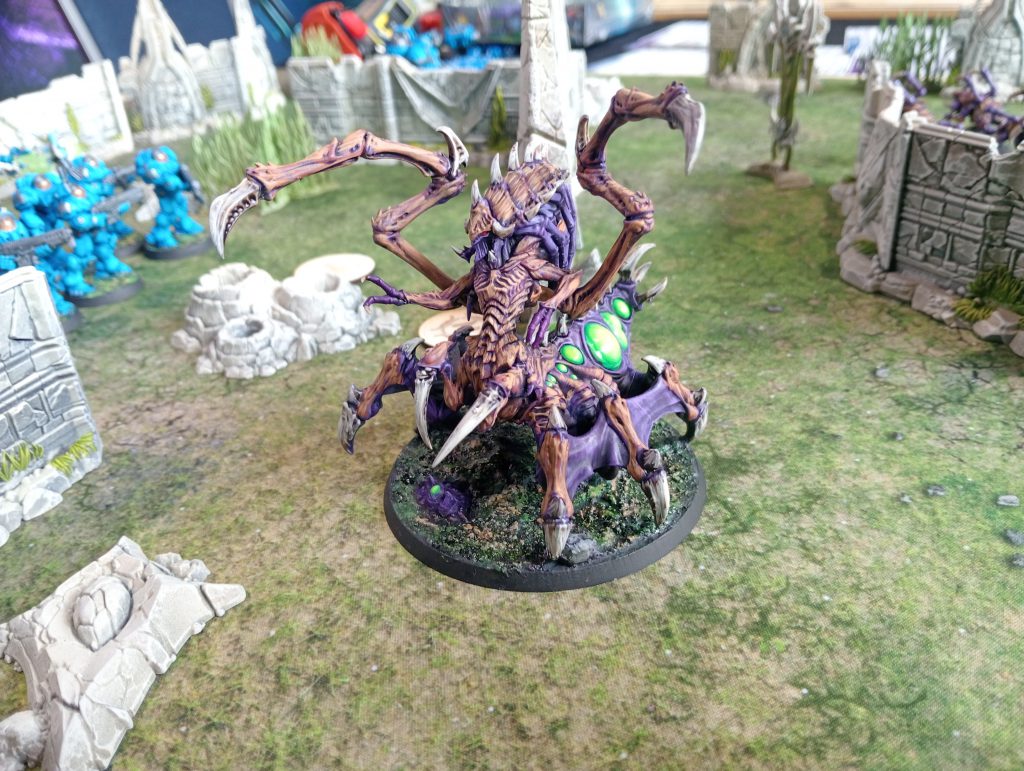
Zerg Queen (looking mighty fine)
How It Plays
This is going to look familiar to people who have played Warhammer 40K, Kill Team, and Legion. The game uses shared turns, split into four phases in which players alternate activating units and spending resources. These are:
The Movement phase, in which you deploy units, move, disengage (fall back), or stand still.
The Assault phase, in which units shoot, run, or charge at an enemy.
The Combat phase, in which units pile in and fight.
The Scoring and Cleanup phase, in which you determine control over objective markers, score VP, and remove tokens and markers.
This tends to split the difference between full alternating activations and “I go, you go” by having players alternate over phases - a player who finishes their activations in a phase first automatically gets priority in the next phase.
There’s nothing particularly game changing about how players will interact with the game, most missions are standing on circles or killing each other and a lot of standard wargaming fair is present, but what’s notable is just how many "best of" mechanics from other games are present along with a few fun tweaks on the standard formula.
What is notable though is just how much this game feels like you’re playing StarCraft. Medics are healing Marines to allow them to freely use stims, Zerg players are spreading creep tumors across the map, and there are plenty of nods to popular competitive strategies like “Six Pool” or “Proxy Barracks” which will be instantly recognizable to folks who are familiar with the StarCraft competitive scene. This game oozes love for the source material, with unit and card abilities often being barks you’d get from clicking on the relevant unit, and all the models behaving largely as you’d expect if you’re a long time StarCraft fan.
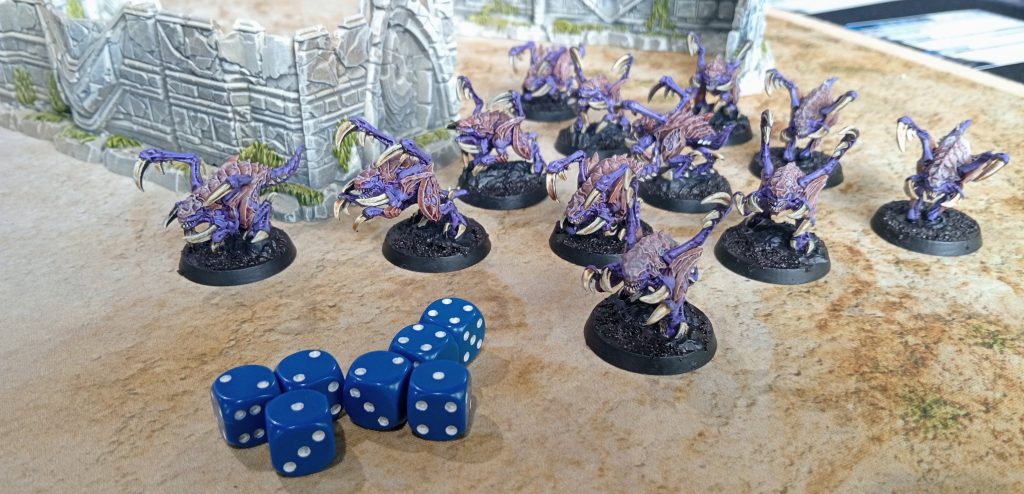
StarCraft Tabletop Miniatures Game
Game Setup
StarCraft is a skirmish game, and 2,000 minerals (points) is generally considered “standard” size, requiring a 36”x54” surface to play on. Anyone accustomed to playing Warhammer or Legion will have this, and the thinner width is surprisingly forgiving when it comes to standard table sizes.
Curie: Before we talk about list building, let’s do a quick review of how units are defined in this game. As mentioned above, this game is going to feel very similar to anyone who’s played tabletop wargames (at either the full battle or skirmish scale). Overall I quite like how the rules and units are presented - it’s very clear on how you build your list, though it can feel a little restrictive because of the Supply system.
We’ll start with army composition and how to get ready for a game. Every miniature in the game represents a model, and units are made up of models. Unit cards define how many models are in a unit, as well as the rest of the characteristics of the models in that unit. Units always move within coherency rules (more on this later), and activate together whether moving, fighting, or dying.
Here’s where it gets interesting (and I personally love this part of things). Bases are what define pretty much everything for a model - every model is on a base, and this is what’s used to determine line of sight, measure distances, and check for things like cover. Fundamentally, they function very similarly to most other wargames - with the distinction from Warhammer 40k (yes I’m going to make a lot of comparisons here because that’s my obsession) that you don’t have to worry about what’s actually on the base - the game encourages you to express yourself and take some liberties in how you beautify your base. As is fairly typical, bases can never overlap - this means some areas can be made impassable by bases blocking movement.
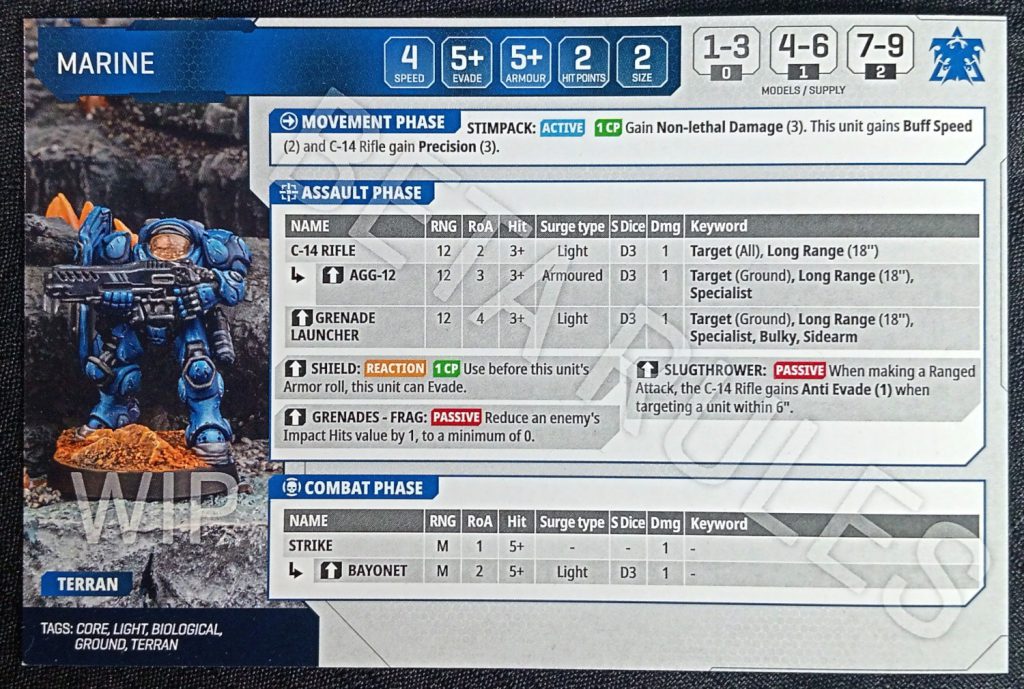
Now let’s talk about the unit cards - this will list the faction tags, abilities, and its characteristics. Faction tags restrict what units can go in what armies - there are three top-level faction tags - Zerg, Protoss, and Terran - and several other sub-faction tags like Kerrigan’s Brood, Raynor’s Raiders. Abilities are going to be familiar to anyone who’s played any kind of wargame before - and they have specific categories to let you know when and how they interact with the rest of the game. The ability types are Active Abilities, Passive Abilities, and Reaction Abilities.
As suggested by the name, Active Abilities require the unit bearing them to be Activated, and have to be used either immediately before declaring an Action or immediately after resolving that Action. Active Abilities cannot be used in the middle of an Action, and they cannot be used on units in Reserves unless the card explicitly says it can. In a similar vein, each named Active Ability can only be used once per Round by a specific unit, unless it has the Repeatable keyword.
Passive Abilities are always on - think of aura’s in Warhammer 40k. Similar to Active Abilities, they are not present when a unit is in Reserves - unless explicitly stated otherwise.
That brings us to Reactive Abilities - these are made available by specific triggers, and allow players to interrupt the normal flow of an activation sequence. Reactive Abilities must be used as soon as the trigger happens, and you cannot use more than one Reaction per Activation. Similarly to Active Abilities, these are restricted to once per Round for a specific unit. As these Abilities may have multiple triggers, you will have to be careful in choosing when to use them as you cannot use a different trigger to use that Reactive Ability that Round. Note that if both players want to react to the same trigger, the Active Player resolves their Reactive Ability first.
StarCraft Stat Card
That covers abilities - now let’s move on to unit characteristics. These define the core stats for the unit, and are made up of Speed, Evade, Armour, Hit Points (HP), Size, Supply Profile, Weapon Profiles, Combat Tags, and Faction Tag(s). Speed tells you how fast your unit is in inches and tells you how far the Leading Model can move in a standard Move Action. This may have a split value (e.g. 4”/7”) where the second value is used only when the Unit is reduced to a single remaining model or if the Unit started with a single model. Evade tells you how agile a Unit is, and is used whenever a rule or condition asks for an Evade Roll. Armour is exactly what you think it is - you have to meet or beat this value on a d6 to cancel a hit. HP is how much damage a single model can take before it is removed. Shields can also affect this - while this value is not Null (-), they have the Shielded status. This is a second pool of health - the first time a model has suffered an amount of damage equal to or above its Shield value, it loses the Shielded status and you remove the damage equal to the Shield value. Size is used in determining Line of Sight, and is probably the best way I’ve seen to handle a 3D environment without punishing folks for expressing their creativity in the hobby. We’ll talk about this in greater detail when we discuss the battlefield.
Supply Profile gives us a relationship between the number of models remaining in the unit and your Current Supply - this gets updated immediately upon the number of models in a unit changing. Supply is used for Deployment, objective (Mission Marker) control, and Disengage checks.
Weapon Profiles and Abilities are divided into Phase Boxes which tell you when a specific profile or ability can be used. Weapons are used either in the Assault Phase or the CombatPhase and each of them will have:
RNG or Range in inches - if this is E then the weapon can only be used in Engagement Range. Template weapons will have either FT or BT for the template they use
Target - some weapons can target GROUND, others are restricted to FLYING, and the most versatile ones can target ALL
RoA or Rate of Attack is how many dice you roll per model when using the weapon
Hit is what’s required on a d6 to hit
Surge Type links Combat Tags to the weapon’s surge efficiency while S Dice is the type of die rolled to determine the surge result (can be either a d3 or a d6)
DMG or Damage is how many HP each die in the Damage Pool does to the target
Keywords will apply special rules to the weapon
The last thing you’ll find on the unit card is a list of optional upgrades for the unit on the back, as well as the units Army Slot, Combat Role, and most crucially its Base Size. Units are purchased with minerals (you will always require more!), and they can be further upgraded with these options. Some of these will upgrade existing equipment, others will replace baseline equipment for a better option.
List Building
Now let’s talk about List Building, which has two components to it - Minerals and Vespene. Minerals are your equivalent to points in this game, and are used to purchase Units and Unit Upgrades. Vespene is set to 10% of the Mineral limit and is used to purchase Tactical Cards. As mentioned previously, a Standard size game is played with up to 2000 minerals per player, and the recommended battlefield size is 36” by 54”. There are also two other recommended scales - Skirmish which is played with up to 1000 minerals on a 36” by 36” battlefield, and the daunting Grand Offensive played with more than 2000 minerals on a 36” by 72” battlefield.
Tactical Cards are to StarCraft TMG as Stratagems are to Warhammer 40k - they give you abilities that can be used to turn the tide of battle - or simply used to generate resources for your army. Each Tactical Card will have:
A Unique tag if you are restricted to a single copy in your army
Faction Tag(s) limiting who can use them
Resource Type and Value - the amount of a specific faction resource that is generated when the card is Exhausted. Cards have two states - Ready (represented by a card being face-up) and Exhausted (card face-down). Readied cards are exhausted by either using one of the Abilities on the card or by Exhausting the card to generate a faction resource. Faction resources are required to activate other abilities.
Army Slots tell you additional supply slots are unlocked by purchasing this card. For example, the Orbital Command card provides 1x Core of Supply.
Any Special Abilities the card may have - these are used in the same way as unit abilities are and are similarly Active, Passive, or Reactive
Lastly we have Faction Cards - you will have exactly one of these in your army and it will define what your army’s Faction Tag is as well as your Starting Army Slots. Similar to Tactical Cards, Faction Cards will also have abilities and faction resource values and can be Exhausted in the same way.
Now that we have all of that out of the way let’s walk through building a Skirmish scale Zerg army. We’re going to use the Army Builder available at sc.starcraft-tmg.com - it’s the official army builder and is very easy to use.
Let’s start by Selecting Zerg as our faction, with 1000 minerals as our battle size. This gives us 100 Vespene to spend on Tactical Cards.
We’ll choose the Zerg Swarmas our Faction Card. This gives us 1 biomass (BM - just like every 6-pool expert) as well as access to Rapid Burrowing, Brood Instinct, and Zerg Creep abilities. It also provides us with 1 Support, 1 Elite, and 3 Core supply.
For our Vespene spend, we’re going to buy:
Accelerating Creep [0 Vespene], a Unique card giving us access to Speed on Creep, Living Glob of Tissue, and Creep Removal.
Spawning Pool (Six Pool) [40 Vespene], anotherUnique card which gives us 2x Core supply, the Feral Rage and Timing Push abilities, and the option to instead exhaust the card for 2BM.
Evolution Chamber [30 Vespene] garnering ourselves another 1 Core supply, the Extended Claws and Carapace abilities or the option to exhaust the card for 1BM.
Hatchery [30 Vespene] our last Tactical Card giving us 1x Support supply, the Lie in Wait and Creep Spread abilities, and again the option to exhaust the card for 1BM.
Now we are going to spend our minerals on as many Zerglings as we can fit in our available supply (which is 6 Core, 1 Elite, and 2 Support).
The only support we have available to us are Queens; we’ll take two of these, each of them with Creep Speed and Domineering Presence to help them keep up with the Zergling horde and amp up the Zergling’s ability to control mission markers. This will set us back 150+10+10 for 340 for the two of them
Conveniently enough we can take 3 Large units of Zerglings with our remaining 660 minerals; each of these take up 2 Core Supply and have 18 models in them, giving us 54 Zerglings to swarm our enemy with!
Now let’s do our mission set up and play a game!
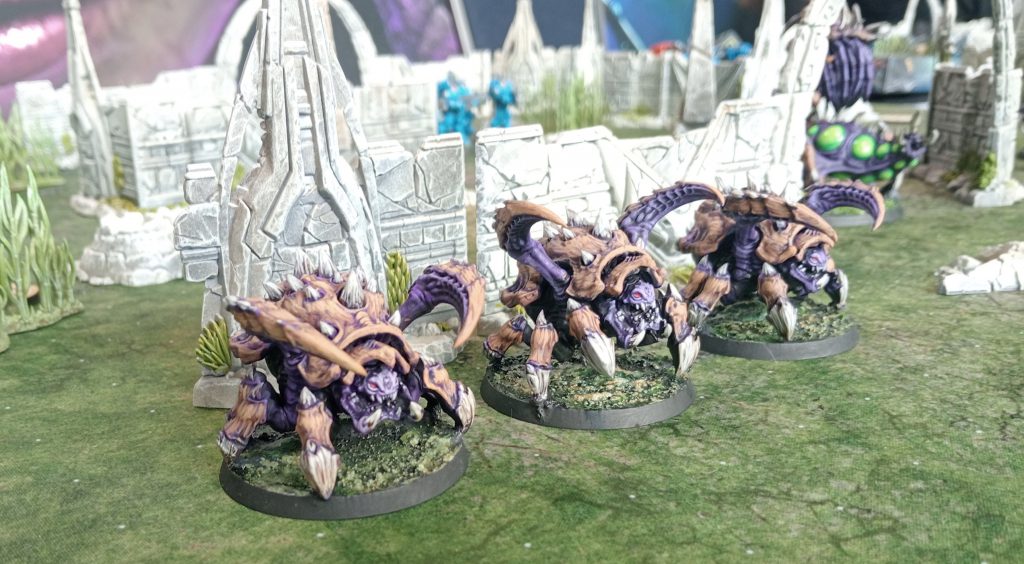
Zerg Roaches
Playing The Game
Okay. You’ve built your list and now it's time to slam it on the table. First thing you’ll need to do is bring 2 Mission Cards and 2 Deployment Cards with you to the table. StarCraft uses a Draft System to determine what mission you’re going to play and how you’ll be deploying. Players roll off and the winner gets to decide if they want the Red or Blue deployment and if they want “Control” of either the deployment cards or the missions. Then the player without Control of the Mission cards picks two missions to veto and the Controlling Player picks which of the remaining two to play, then repeats this process with deployment.
Norman: This is a good time to point out maybe my biggest issue with this ruleset (which isn’t saying a lot because it's a minor gripe): Whenever a roll off occurs in StarCraft, you do so with 2d6 instead of 1d6. As far as we could tell, there are no in-game benefits to this and all it really does is increase the likelihood of you and your opponent rolling a 7, meaning you’ll have to roll again. Its possible we missed something here, but it seems like a bit of a baffling decision.
EDIT: Hey guys Norman here and just wanted to say I may in fact be the dumbest man on the planet and am very bad at math, you're actually less likely to roll the same number on 2D6. See you guys later, gonna walk into the sea.
All that said, I like this format for missions, it adds a lot of tactical depth to list building and helps you not get messed up due to a bad set up for yourself. What I don’t love is that since this and terrain set up all happen during the game, you have to factor that set up into your playtime. Where this’ll be a larger issue is at events, where folks will have to go through the set up process table by table.
Once you have all your mission and deployment picked out, it's time to set up the table. This follows a similar set up to other games with player placed terrain that I won’t dissect here, but there are solid guidelines here to help you create dense and playable tables. This is a good time to talk about terrain and Line of Sight though. Each unit has a size category as does every piece of terrain. If a unit’s size category is greater than that off a piece of terrain between it and another unit, those units can see each other. This is a fantastic way to handle this. All measurements happen base to base so there’s no arbitration of whether a model can or can’t be seen. There’s some extra rules in here like if a model is directly underneath a ledge another model is on or if they’re in an inch of a piece of cover as tall of them, but this system is dead simple to grasp and very welcome.
We should also talk about High Ground here, which is when a unit is on Size 3 terrain, which lets you take an evade roll against all ranged attacks coming at you from a lower elevation. This combined with the fact that terrain’s size category adds to the model’s, makes the high ground on tables a very desirable position.
TheChirurgeon: I like these rules a lot. They feel like a lot of work has gone into them and they’ve covered all the important bases. I’m a big fan of leader movement and removing true line of sight.
Swiftblade: Those terrain rules remind me of Warmachine, in the best and worst ways. Having clear cut size categories for models and terrain makes things very clear cut for what does and does not block LoS, as well as making checking range and LoS a strictly horizontal measurement affair. My size 2 dork is behind this size 3 terrain, it does not matter that he is on a foot tall hero rock, you can’t see him, end of story.
It does, however, make me worry about one of Warmachine’s most infamous sins coming to StarCraft TMG: 2D terrain. When your terrain rules for LoS are as cut and dry as the rules featured here, you can go and print a wall template and put it on a table and it has the same gameplay effect as a proper wall model. Which, honestly, is great for kitchen table games! But then you see it at the game store or at big events and it really diminishes the game’s curb appeal.
I’m probably being a little alarmist here. Heck, it honestly even kind of makes sense for terrain to be thought of in two dimensions for a StarCraft miniatures game when you think about the computer game. Especially in SC1, since that game was, you know, in 2D. Still, I think most tabletop players will try and simplify terrain as much as they can get away with, and if you give gamers the ability to simplify your terrain features to something they can print out on a computer, they’ll take it.
TheChirurgeon: I see where you’re coming from with the 2D terrain but I honestly only think it’s a problem if you let it be for your community. The abstraction system is a huge improvement over Warhammer’s true line of sight and ultimately you can avoid that with solid terrain kits and a commitment to not putting up with that shit as a player. Warmachine had that problem because it wanted to, and cultivated a player base for whom terrain just wasn’t a key part of the game in that regard. I think it’s easier to avoid these days, now that we live in an area of cheap and readily available 3D terrain and 3D printing.
Contemptor Kevin: I thought these rules were laid out in a straightforward manner, having made some definitive choices (re “It’s the base sizes that matter, not the actual model”) that gave the rules a fair amount of punch. Likewise if StarCraft offers terrain kits that are designed to (easily) work with these rules, I think most of the questions I had upon reading the rules re: line of sight and movement will get resolved in an easy manner.
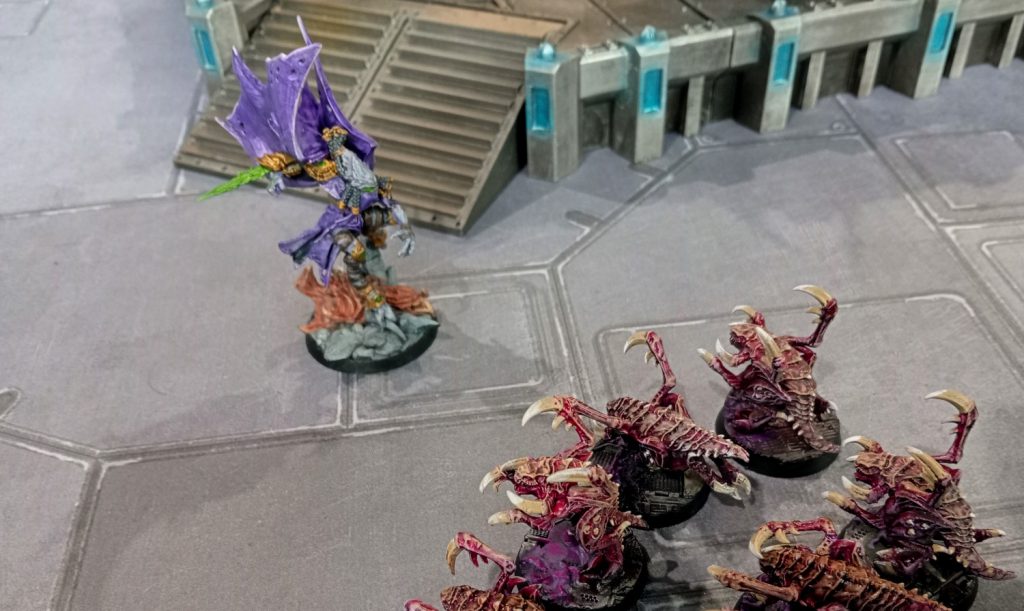
Zeratul facing off against some Zerglings
The Turn
Alright you’re ready to start playing the game! Now you may be saying “well wait, what about deployment”? To which I’ll say you didn’t read our initial impressions article huh? That's fine, we can go through it here. Each deployment zone has an “Entry Edge” units walk in from. You simply activate a unit off the table, make sure putting it on the table wouldn’t put you over your supply limit (as dictated by the mission) and measure movement from the edge. This is a really neat way to both replicate the skirmishes you’d see in the StarCraft video game as well as making sure the table is never too clogged with stuff.
By default, players will know everything their opponent is bringing as you’d expect, but there is another, optional and recommended game mode here where you hide your models and only reveal them as you deploy them from your Entry Edge. This is neat in theory but in practice we feel it's a bit too clunky to work out well at the table. Where am I putting my army? Do I have to put a drape over my case so my opponent can’t see what's in there when I grab my next unit? How does this work in a tournament setting? There is certainly merit to this format, it makes for very interesting decision making at the table with what you want to deploy, but we just don’t think it’s gonna catch on when rubber hits the road without some improvements.
The game itself works on an alternating activation system, where each player activates one unit at a time and passes control to their opponent when they’re done. Each unit can do a few different things in each phase but if you’ve played Kill Team or 40k this is very familiar.
What may not be familiar to veterans of those systems is how movement works. The active player picks a Leading Model to move, moves it, and then sets up the rest of the unit in coherency of that model. This means that you can get some extra movement by just setting up models ahead of your Leading Model. This is factored into the game though, with units having different speeds if there is just a single model left in the unit. This will be familiar to folks who have played games like Legion or Warmachine, and those people will tell you this kind of movement significantly cuts down on time spent measuring for each model.
Swiftblade: Commenting here on the movement system, I’ve played a few games of Warmachine with this style of movement system, and yeah, it does let you slingshot your models in a cheeky way, it makes moving big blobs of models a much quicker endeavor. Getting the most out of who you elect as your leader and moving your models accordingly is going to be an important skill in competitive play for sure.
Contemptor Kevin: One thing that I liked was the “Tactical Mass” rule. This is a fun anti-tarpit mechanic. When trying to disengage from an enemy, normally the unit that disengages will be unable to shoot or charge. However, if the unit falling back has a higher supply than the combined supply amount of the units engaging the falling back unit, the falling back unit is free to shoot or charge. The idea is that a single bug cannot and should not be able to completely shut down a Siege Tank. StarCraft wants you to use those big expensive units, and not allow a game mechanic to necessarily stop you from using them.
As you may have guessed, after movement comes combat. Combat works as you might expect, your roll to hit, your opponent rolls save, damage is allocated to the unit. There are a plethora of keywords that interact with this system like Precision converting misses to hits, or Tough converting failed saves to successes. Where this is interesting is the Surge mechanic. Each weapon has a target type it wants to go into. Machine guns will do better into lightly armored targets but missiles will do better into heavier ones. Each of these weapons has whats called a Surge Dice, usually a D3, which lets you convert that many successful hits into automatic unsaved damage. This is a really neat way to make your list variety feel important while not adding a whole extra step to dice rolling.
Once the dust settles players check their objective control (using the supply characteristic of the unit) and tally up scores. Once that’s done you go into another round and repeat the process. This is a really smooth gameplay loop and once you learn the game you can get through a game real fast.
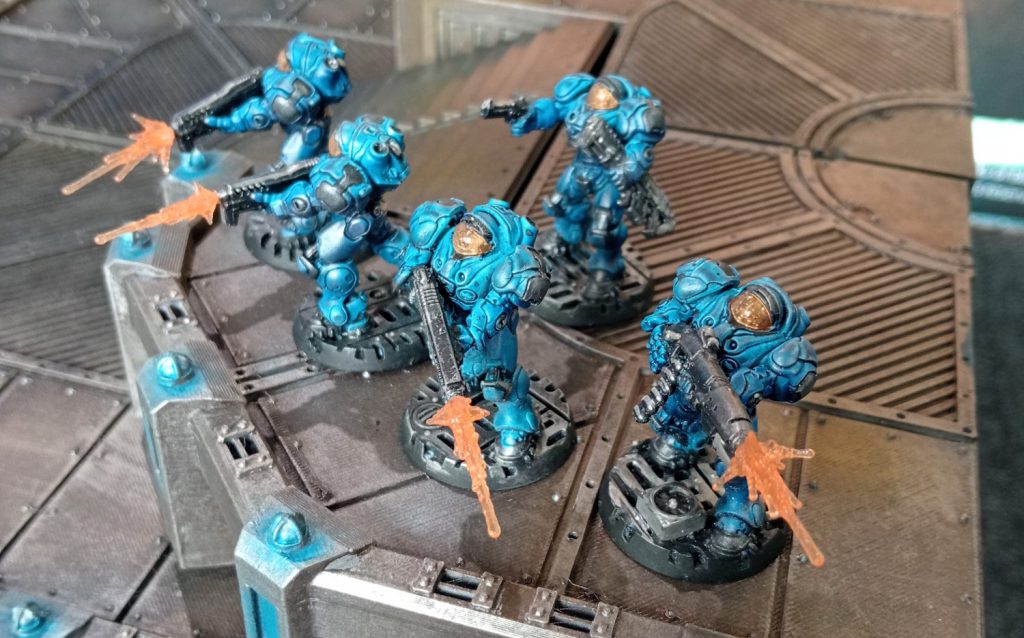
Terran Marines laying down suppressing fire.
How Do The Factions Play?
As we mentioned earlier, there’s a lot of variety in how these three factions play - not just between them, but also in how you want to run each faction, specifically.
Zerg
Fans of The Swarm will feel right at home with a tricky and fast playstyle that has been fantastically translated from the RTS we all know and love, into StarCraft: The Miniatures Game. Mechanics like Burrow make an appearance, allowing your units to go underground and be hidden from your opponent and hopefully move undetected. There are Tactics Cards that can mess with the Burrowing sequencing, so the Zerg player can burrow a unit, move them around, then un-burrow in a different location so they can shoot/fight etc.
Making sure you’re keeping up with your Creep Spread is just as important on the table as it is in the video game! There are a large array of options in order to do this between your Tactics Cards and Queens. Creep Tumors are tokens that are placed on the battlefield, and the creep is spread 6” around the token. When making your list, you can pick what bonuses you can get while your units are on your creep – such as increased movement speed and PRECISION. The Omega Network, also known as the Nydus Worm, also creates an aura of creep around it, as well as being able to make its best subway impression and teleport your units across the map!
The Tactic Cards really add a ton of depth and fun flavor to each of the races. Zerg Rush and Spawning Pool (Six Pool) can juice up your Zerglings to be a massive headache for your opponent, making them annoying to kill while also pumping out some decent damage. The Roach Warren allows the aforementioned un-burrowing shenanigans, allowing for some ‘hippity hoppity, you got bugs on yo property’ stuff to happen.
Whether Kerrigan is your favorite girly pop, The Heart of the Swarm really speaks to you, or you like to spread your bug goo all over the floor to use as a slip and slide, Zerg certainly has what one would hope for in this game.
Protoss
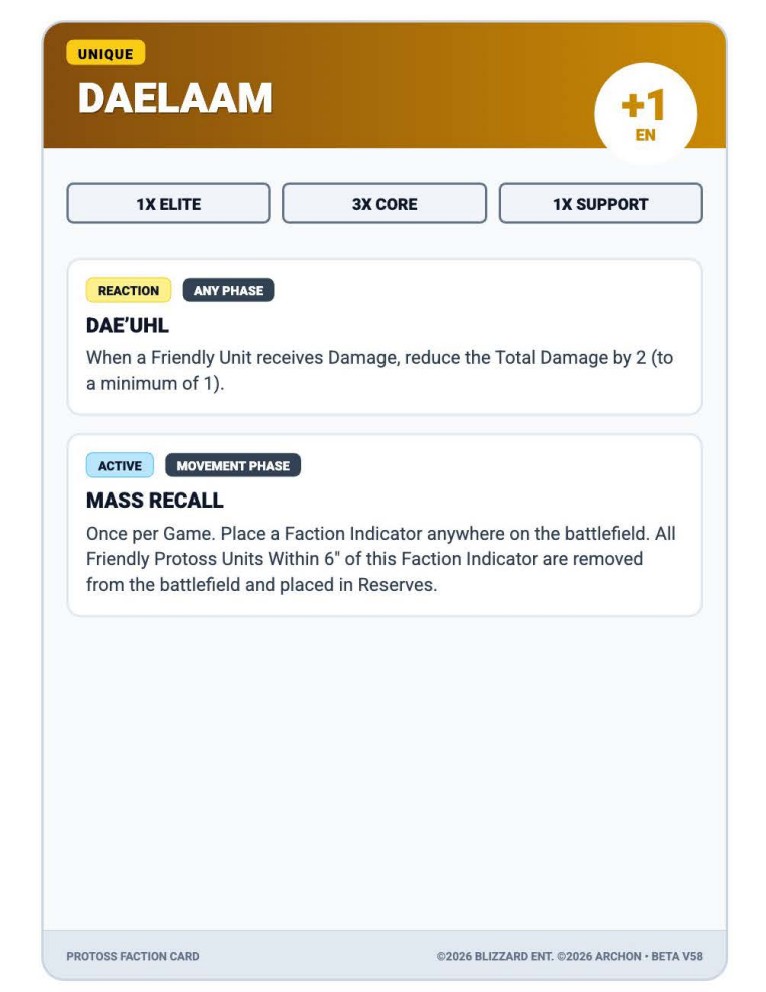
The Protoss specialize in teleporting units onto the battlefield, with key movement tricks regardless of whether you’re playing the Daelaam or the Khalai. The Khalai have the ability to teleport Pylons onto the table using Pylon Warp-in during the Movement phase, while the Daelaam can use Mass Recall once per game to drop a faction indicator anywhere on the table and pull all of their units within 6” of that indicator back into reserves. You can double up on these recall effects with additional Tactics cards - The Nexus and Overcharged Nexus have the Strategic Recall ability to bring an active, unengaged ground unit back into Reserves in place of doing an action. This helps the Protoss player avoid overextending - they’re able to pull back when they need to and consolidate their forces, albeit closer to home.
This is where Pylons, the Warp Gate and Warp Prism come in, with abilities that let you deploy on any table edge or anywhere more than 10” away from an enemy unit, respectively. If you’re a 40k player, this is basically the equivalent of an army having “uppy-downy” and if you’re not, just know that the ability to redeploy units multiple times over the course of a game is very strong.
As a faction, Protoss units are pretty beefy, with shields and more HP per model and abilities that require Psionic Energy. Running the army well will depend on placing Pylons on the table, which reduce the Psionic Energy of abilities on nearby units and allow for friendly GROUND units to be deployed using the Pylon’s base as an entry edge. That’s handy when combined with your ability to pull said ground units back into reserves.
The Protoss have a ton of nasty movement tricks and ways to boost their units with psionic energy, and that makes them a dangerous army to go up against. I have a feeling they’ll be a top choice for players who like tricks and redeploys.
Terran
Whether you’re jacked up and good to go or in rear with the gear, there’s a lot of flexibility in the Terran roster. Marines, just like in the video game, are the only unit that can target both air and ground targets and all of your infantry can trade some health for a speed boost with Stimpacks. Most of your cards focus around giving units different keywords during fighting, but there’s a lot here to help you make these guys play the way you want.
There’s not a ton to manage here like the Zerg creep mechanic or Protoss recall and shields, but everything acts somewhat independently and doesn’t really need a ton of support. That said, there’s some neat combos to work with. Medics can negate damage done to units, and just happen to negate the exact amount of damage Stimpacks do. Marauders meanwhile in addition to being a massive pile of health and armor to throw on an objective, can help suppress charges and keep your units free and clear for shooting.
What the army does lack though is melee units (at least for now). Luckily you can shoot at a unit you’re in combat with in StarCraft, but it's definitely not a place you want to be. What the army does have however is (currently) the game’s only single model unit that isn’t a hero in the Goliath. This guy is super customizable and can do everything from long range indirect fighting to heavy target hunting.
The faction cards offer you quite a few ways to play around with your stuff. The Academy struck me as the most interesting, letting you use an ability without spending a command point, but it sticks you with a bunch of support slots where I wanted more stuff instead of medics. There’s also the Barracks (Proxy) which lets you deploy from another edge other than your entry edge, and the Orbital Command which lets you see those pesky cloaked or burrowed enemies.
Ol’ Jimmy Raynor is also here, with a super straight forward but powerful set of rules. He passively buffs nearby units’ supply for determining control and comes with a solid set of weaponry, but the real juice comes from his ability Orders. For a command point he can give a nearby unit Critical Hit (2) or let them Disengage without penalty and for two command points he removes an Activation Marker from a unit, letting them double activate in the movement phase. This in combination with Stims means you can catapult models up the board at wild speeds or get your freshly deployed troops to the fight as fast as possible.
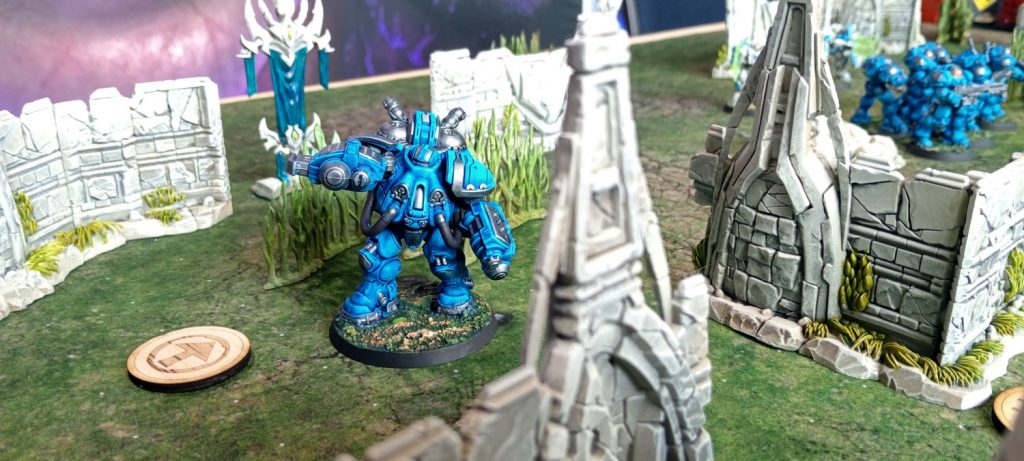
Terran Marauder
Overall Thoughts
TheChirurgeon: I can’t remember the last time I thought a game had a real shot at becoming the Pathfinder to GW’s Dungeons and Dragons, but StarCraft may have a shot. The game isn’t without its warts - the rules are pretty complicated and that can be daunting for a new player - but there’s a lot to like here, from abstracted terrain to leader-based movement that help streamline the game a great deal once you actually get playing. And I’ve been very impressed so far with how they can make three factions feel more diverse by adding subfaction nods to things like Kerrigan’s Brood.
Swiftblade: The first thing that strikes me about the StarCraft TMG beta ruleset is boy, there are a whole lot of rules here. Anyone who was worried this would be a shallow cash grab can take a sigh of relief: Archon’s clearly put some serious thought and effort into the ruleset. 77 pages of thought, in fact. That’s the same number of pages in the current Warmachine rulebook, a game known for being pretty complex, and way longer than the current Warhammer 40k rules.
This is an odd thing to harp on, I know, but the density of the rules here is pretty daunting for someone who might just want to push Zerglings around a table and relive the glory days. I think some good formatting and clever page layouts will hugely alleviate this problem with the full release, and I do appreciate Archon’s commitment to clear language on topics that tend to start table arguments (stuff like directly towards immediately comes to mind).
TheChirurgeon: I’ll say this: These are a lot less dense than the 40k rules and The Warahmmer 40k rules are not actually 60 pages. Yes, you can download a 60 page booklet to start playing over on WarCom. But to actually play the game you need another 35 pages of updates and commentary that haven’t been folded in and includes things like “how do you handle pivoting vehicles” and “how out-of-phase rules work” which are crucial to playing the game. And that’s not to mention the additional 5-10 pages of mission rules you need to cover things like Actions, which are inexplicably not in the Core Rules but only in the rules for missions.
Swiftblade: This was a wild way to learn the Warcom download for the 40k rules is 60 pages long.
Ryan: Archon has done an absolutely fantastic job of integrating the flavor and identity of each StarCraft race, in using both the rich story as well as the meaty history of competitive play from the last 30 years. What makes this game really special is that it not only feels like fan service for wargamers that have been ingesting StarCraft over the years, but the mechanics of the game itself feel fresh, exciting, and tight. I know iNcontrol, who was also an avid Warhammer player, would have absolutely loved this game.
Contemptor Kevin: I haven’t really played a lot of StarCraft versus a bunch of the others here. I played it at my Uncle’s place 30 years ago and so I have a lot of fond memories of the Terran units and I like to fight evil space bugs. But these rules look like they’re a blast to play: the tempo of the game is to encourage you to “build” units and unleash your bigger and badder units later on, so that the game gets more intense as you move through various rounds. This is a direct change from 40K’s “the entire army is on the table so Turns 1-2 have all the models, while by later turns the game is petering out as units run out” While I have not yet had the chance to play this to see how it flows in realtime, I am excited to try this out.
Have any questions or feedback? Drop us a note in the comments below or email us at contact@goonhammer.com. Want articles like this linked in your inbox every Monday morning? Sign up for our newsletter. And don't forget that you can support us on Patreon for backer rewards like early video content, Administratum access, an ad-free experience on our website, and subscriber-only content covering competitive Warhammer 40K!
 This website uses cookies. Learn more.

 Zerg Queen (looking mighty fine)
 StarCraft Tabletop Miniatures Game
 StarCraft Stat Card
 Zerg Roaches
 Zeratul facing off against some Zerglings
 Terran Marines laying down suppressing fire.
 Terran Marauder

 Goonhammer App and Patron Updates: April, 2026
 Kill Team Tournament Report: Engage, Party, Repeat's March Madness 2026
 Goonhammer Reviews: Tribal Conquest