We’ve written a ton about competitive terrain layouts but in this short series we’re looking at how to make good layouts for narrative play – layouts which go above and beyond the paintball arenas and bare MDF often presented in competitive formats. Last time around, I answered some questions from readers I've gotten over the past few weeks. If you’ve missed our previous articles in this series, you can find them here:
Something I touched on last time around is the idea that 40k isn't really set up for trench warfare - it's just not how 40k armies are engaging with each other, and it's not the type of battle you're modeling with the rules. We have a few military guys on hand here at Goonhammer, and this was something I discussed with Scott Horras "Heresy" - what kinds of battles are you getting in 40k - and this was his feedback, which I liked enough to put wholesale into the article:
Scott: 40k games are what we'd typically call "meeting engagements" in military history. In real life these tend to happen when two forces aren't planning on running into each other, but they end up meeting and getting pulled into an even battle. This usually happens when they're both moving from one place to another, but not planning a deliberate attack or defense of a position. Very rarely one force could be reacting to another to keep it from moving elsewhere for a "spoiling" or "fixing" attack, but in those circumstances you're generally just trying to maintain contact with the force to disrupt further maneuvers while avoiding really any losses yourself.
This all aligns with the general parameters of a game - symmetrical forces, a focus on holding ground, and changing objectives during an evolving battle. On the other hand planned attacks won't go this route - if you know the enemy position, you're going to mass your forces and attempt to tilt the odds in your favor, ideally with a 3:1 ratio or better. Fortifications are used to try and make that ratio worse by trading mobility for survivability in a single point.
They're also not necessarily meant to be somewhere you die - we discussed this in last week's article, but trenches - especially the first line of trenches - are meant to be abandoned as forces fall back to regroup and consolidate before pushing back. Missions with fortifications should focus less on to-the-man battles and more on defenders trying to hold out for a number of turns before reinforcements arrive or they're able to successfully retreat.
Finally, fortifications almost exclusively require an attacker/defender set up, as the idea that you'd build large fortifications within range of each other is ludicrous. Put all of this together and you have one rather unfortunate truth: Making good use of Fortifications in 40k means building missions around their use. And we have tragically had very little guidance on the matter up to this point, especially in tenth edition.
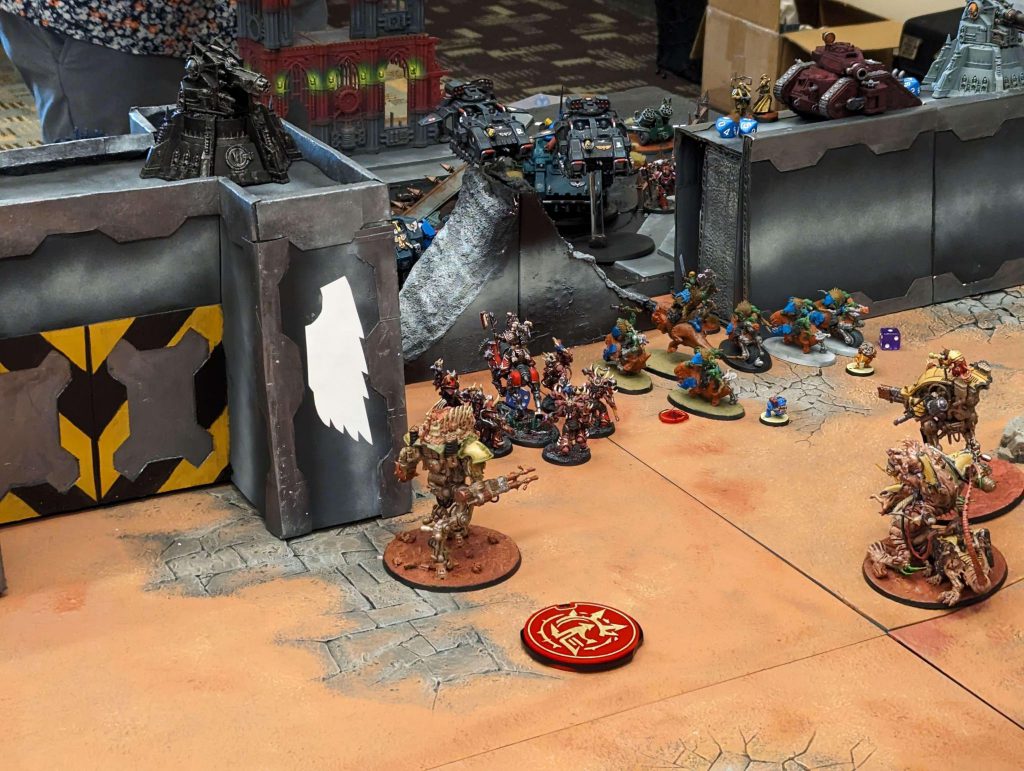
Designing a Scenario for Using Fortifications
If we go by our initial read on how fortifications are used in battle, we end up with a general directive: One side gets more points than the other side. Practically, you can implement this as either one side just has fewer points and has to hold out to the game's end when reinforcements arrive, or you can have them put the majority of their army in reserves, to arrive later in the game. Either way, fortifications should generally make up for the difference in points between the two armies, so you aren't in a situation where the Defender's army is just completely wiped out before their reinforcements can arrive. This should certainly be
possible, but it shouldn't be guaranteed by any means - a good version of these missions will still put the odds of success around 50% for the Attacker.
The other thing about Fortifications is that they take up a lot of space, and that's space where you might want your own models to go. This is something we need to take into account as well. In designing a fortifications mission, this is generally the type of layout I start with:
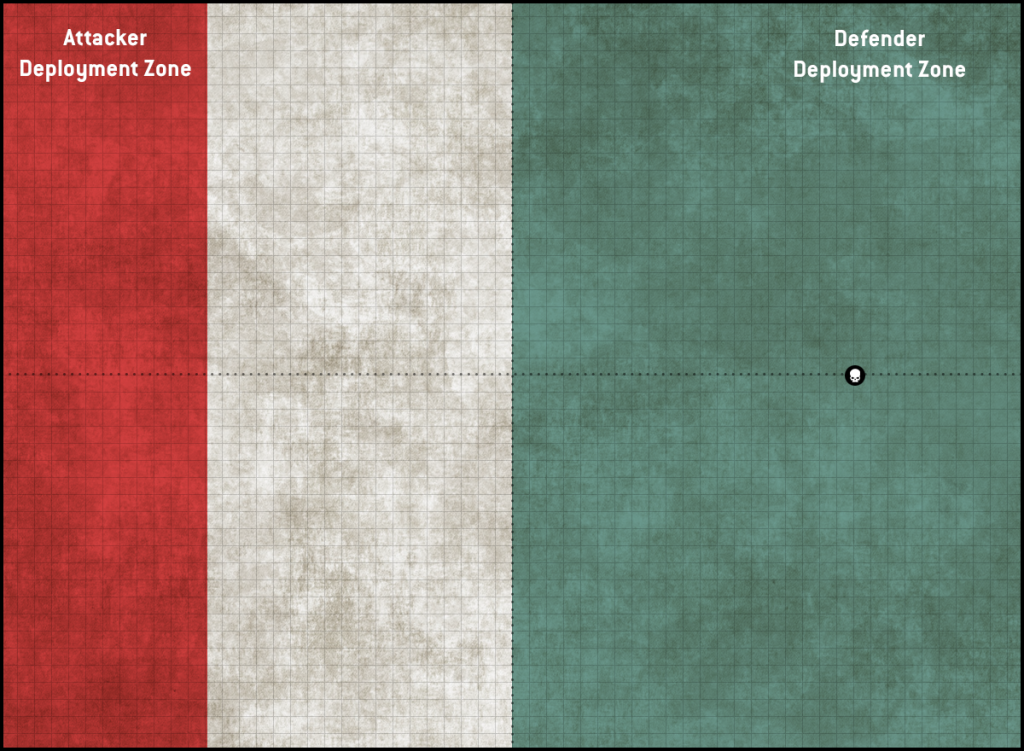
The asymmetric mission layouts in the Chapter Approved 2025-26 deck aren't terrible starting points either but you need to make sure what you're doing gives your Attacker something to do. In the above layout the general idea is that the Attacker needs to get
past the fortifications to claim the objective - the buildings are important for the Defenders, but they aren't the goal.
Here the mission objective is something like "The Attackers score by holding the objective in the Defender's deployment zone," and I'd probably look at something like "they win if they hold it at the end of the game." Here there's only 18" between the Deployment Zones, but the Defender can pull back farther if they prefer, and my notion is to a line of defensive fortifications up there across the middle of the table which the Defenders can use.
In this mission I'd also ideally give the Defenders half the points of the Attackers - 1,000 to the Attackers' 2,000 - with little or no reinforcements. The Defenders must hold the point until help arrives, which won't happen until after the end of the game. Here's how I'd lay it out:
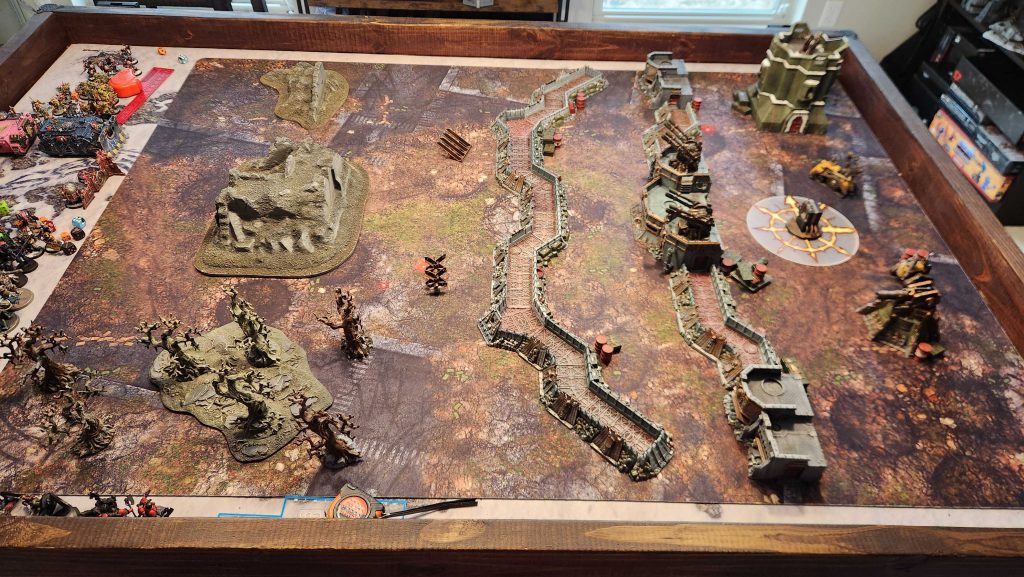
I'd likely have the Attackers going first here, and the Defenders can choose which of the two lines (or both) they want to populate, with the bastion in the back acting as a second fortification. The forest and two ruin bases give slower units somewhere to hide before they try and cross the middle of the table, but the general idea is that the Attacker has more to work with and
will cross the table, forcing the Defender to take drastic action late game to protect the objective.
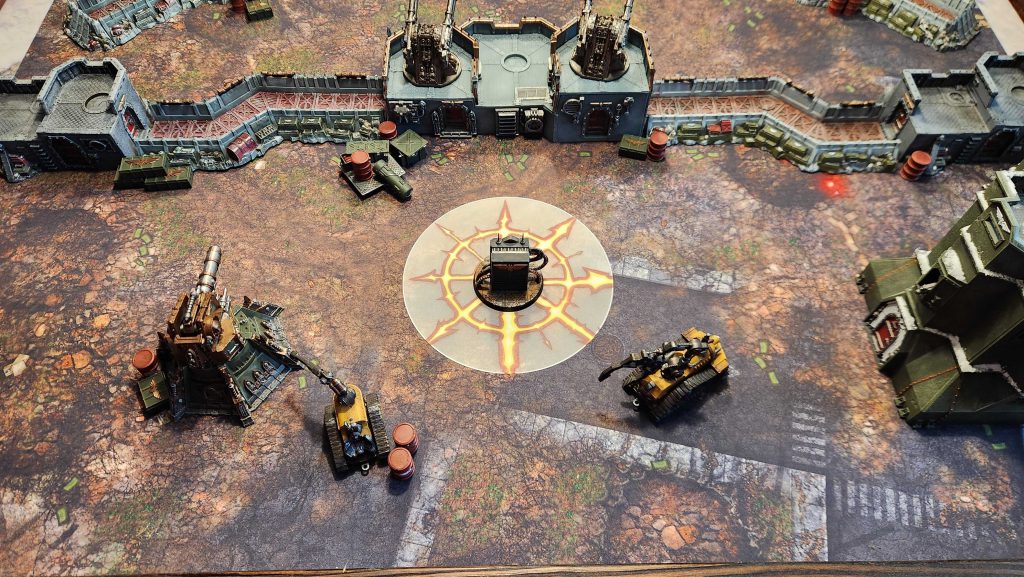
Here's the thing though: Fortifications just don't have working rules in 40k tenth edition, and even the rules they have need some kind of houserule/adjustment. In particular, tanks have to be able to just roll over those fortification lines. And we need those fortifications to be more or less worth 1,000 points. Let's see what we can do.
Updating the Fortifications Datasheets with House Rules
These are hard to find now that they've reworked the datasheets and FAQs into faction packs, but you can still find them hosted on WarCom,
if you go to this url.
But here's the thing: They're bad. You can find points for these at the end of the Munitorum Field Manual, and a bastion will run you 275 points, the Firestorm Redoubt in the middle is 260, the Bunkers are each 180, the Vengeance Weapon Battery is 140, and the Wall of Martyrs is 140. In total that'd make this 1,175 points and I think you'd be hard-pressed to find anyone who felt that was a good way to spend nearly 1200 points.
Why is that? Well to start, let's look at that 260 point Firestorm Redoubt. It's a T13, 2+ save fortification with 18 wounds and Ld 7+. It comes with two guns, and let's say those are Quad Lascannons, which have two twin-linked shots that hit on a 5+ and it has Firing Deck 10. It has a capacity of 15 infantry models and it can't hold non-character models with 4+ wounds. Comparatively that's much less value than a Land Raider, and those can move, hit on 3+, come with additional guns, and the ability to use a faction's Stratagems.
Similarly, those Bunkers have T13 and 10 wounds and can have a single weapon. Though they reduce incoming damage by 1, which is interesting. The Bastion is just a worse Redoubt with four heavy bolters, and the trench line oddly has a wounds characteristic of its own.
These aren't good, and we need to fix them to make these playable. Generally speaking part of the issue is that any army which can kill knights - and that's most armies, particularly when you're throwing a full 2,000-point force at a single target - are more than capable of destroying a knight in a single turn, and those have many more wounds and an invulnerable save. We generally need these fortifications to be tougher, shoot more, and act as truly fearsome bastions to hold out against a tougher army - but one that cannot move or protect you well when an enemy is at the gates.
So for my mission, here are the rules I'm considering for each fortification:
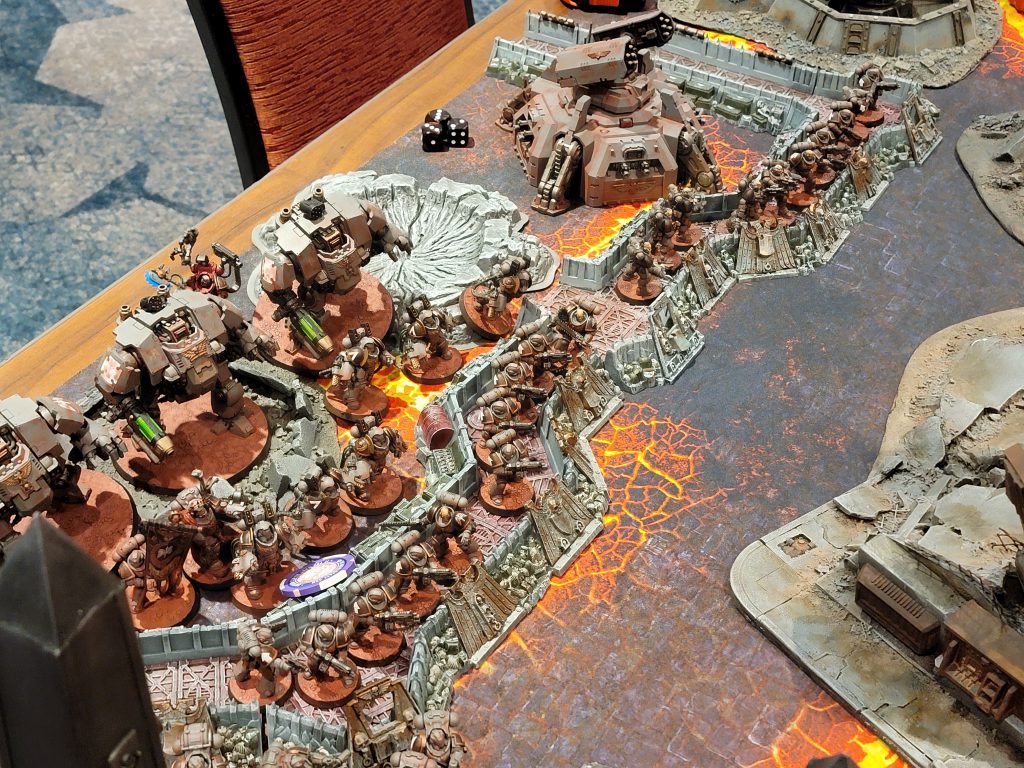 (Impenetrable Wall of Martyrs Credit: SmearierHades3)
The Wall of Martyrs
These need to provide more than just cover or invulnerable saves. Otherwise, your unit is still just going to be killed on the first turn. So I'd suggest the following:
- Take Cover (Action) - A unit may perform this action at the end of the Movement phase if it is wholly within this terrain feature. If it does so, it is considered to be taking cover until the start of your next Command phase. A unit taking cover cannot shoot and is not considered visible to an attacking model unless its base is visible to that model or the model's unit is within engagement range of that enemy unit. A unit deployed in this terrain feature may start the game taking cover.
- Prepared Positions - While a unit is wholly within this terrain feature (excluding Battle-Shocked units and units taking cover), each time it is declared as the target of a charge by an enemy unit, if it was not already within Engagement range of an enemy unit, it gains the Fights First ability until the end of the turn.
- Trench lines - This fortification is treated like a hill, in that it can't be destroyed and can be occupied by any model. Additionally, models are considered to be within Engagement Range of an enemy unit inside the Wall of Martyrs if they are within 2" of that model.
This makes it possible for a unit to be hidden in the trench lines until they're ready to shoot, but it costs them something - they can't get the fights first benefit and you can potentially get them out of it by battle-shocking them or hitting them with indirect fire (or both).
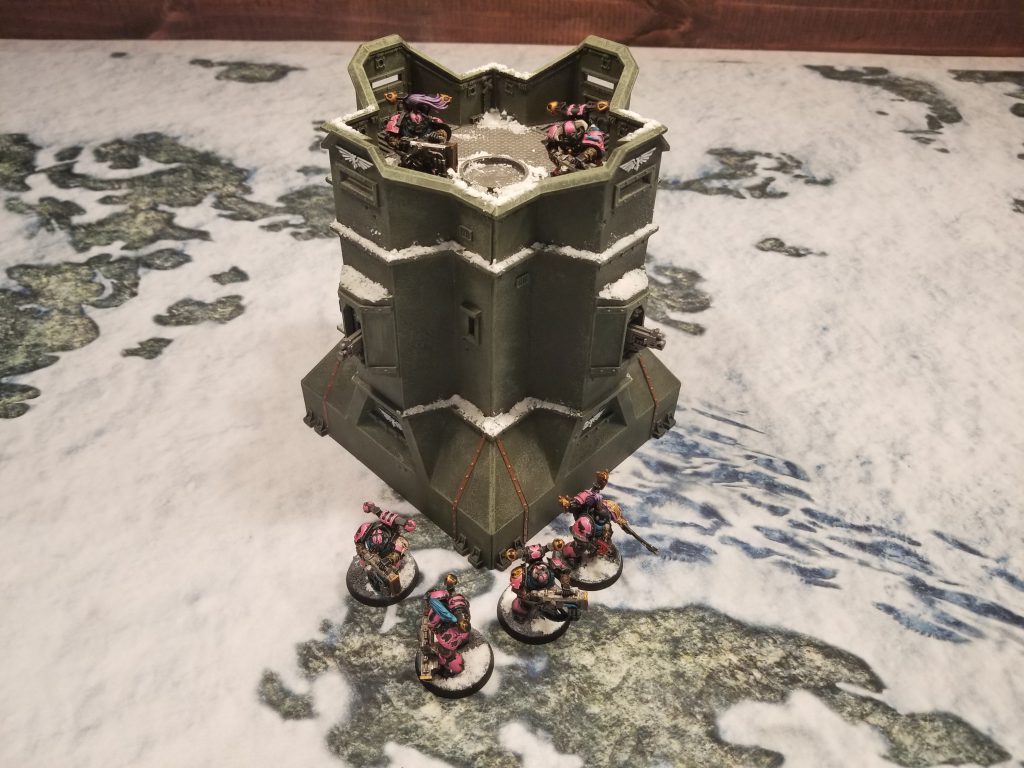 Credit: Robert "TheChirurgeon" Jones
Bastions, Bunkers and Redoubts
For these, there are three issues: First, they need to be tougher. Second, they need to provide better fire support. Third, they need to provide better protection for the units inside. Let's address that durability issue:
- Save Characteristic: These fortifications have a 1+ Save. They cannot be damaged by weapons which are AP0. They can never have the benefit of Cover.
- Ballistic Skill: Increase the Ballistic Skill for ranged attacks on these fortifications to 4+.
- Impenetrable Fortress: This model cannot lose more than 8 wounds per turn. At the end of each turn, if this model lost 8 or more wounds, its owner chooses one weapon on the model; this weapon is destroyed.
- Hard Cover: A model on top of this fortification has the benefit of cover and a 4+ invulnerable save.
- It's a building: Melee attacks automatically hit this unit on a 2+, regardless of the attacker's Weapon Skill.
That should go a long way toward making these playable, and ensure that they stick around longer to make the game more interesting while still rewarding a player for attempting to destroy them. I'd also probably add a houserule that you can only use firing deck from the bunkers/redoubt to shoot things from the front vision slits, so if someone slips past you, they're no longer visible. That will help solve the problem of "I went past the bunkers but spent three turns getting shot to pieces and lost" which I could see happening.
Finally up the BS on the Vengeance Weapon Battery to 4+ and we're cooking. It can be destroyed normally, though.
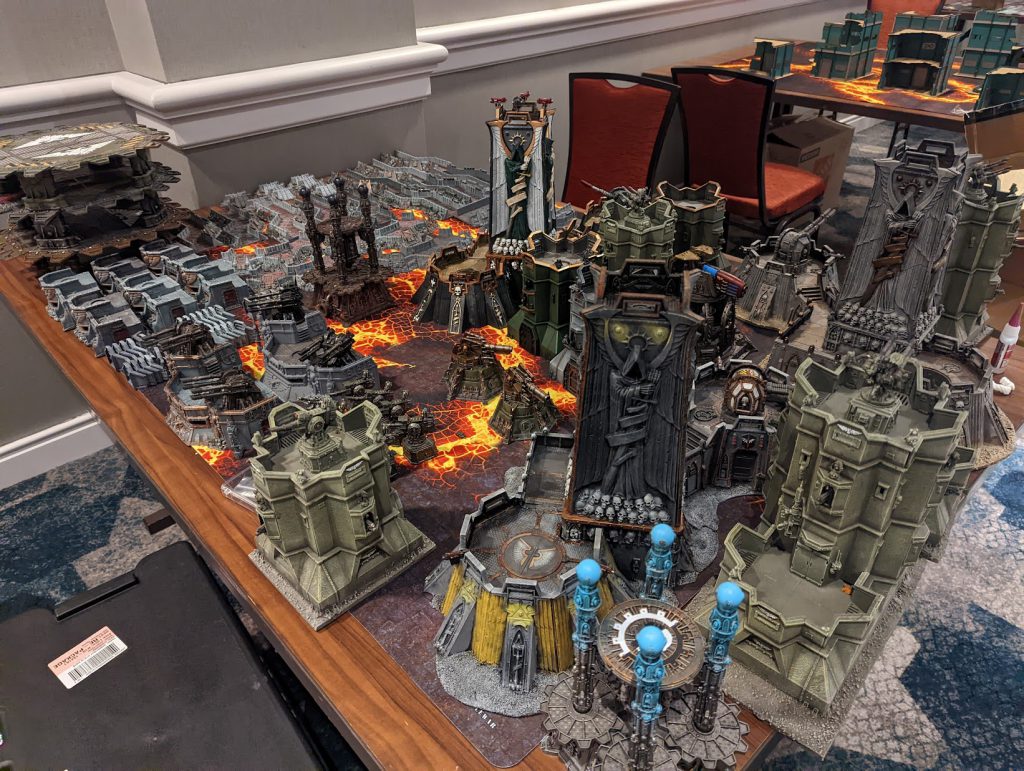 The Fortifications Table
Other Rule Ideas
That's where I've ended up and it's something I need to test, but there's more you can do here. I think having damage -1 with no floor (so you can go to 0) on fortifications is also worth looking at, and there are some interesting things you can do with a Genestealer Cults Cult Ambush-like rule to bring back dead units and put them in your fortifications. I'm also thing about a "defense network" rule where units can emerge from any connected fortification on a disembark, or a rule for reserves to arrive disembarking from a fortification.
Something wings suggested to me was that you can also put aura debuffs on fortifications. These can normally be a problem - things like -1 to wound rolls - if they can move around, but having something where friendly units within 3" of a bunker get -1 to be wounded or having enemy units get -2 to their Leadership tests could be really solid. This can force enemy units to go around these structures and funnel movement accordingly.
I'd also probably simplify the points process for taking these down to something more like power level, where being down 1,000 points gives you 10 points of Fortifications. A Wall of Martyrs is 1 point, Bunkers are 2, and the Redoubt and Bastion are 3. That'd make things easier and avoid issues of trying to move around the last 50 points to maximize value.
Next Time: More Houserules
That's it for this week's article but check back next week when I'll talk more about houserules for terrain and some things you can do to make them more interesting and have more than just ruins in your game. See you next week.
Have any questions or feedback? Drop us a note in the comments below or email us at contact@goonhammer.com. Want articles like this linked in your inbox every Monday morning? Sign up for our newsletter. And don’t forget that you can support us on Patreon for backer rewards like early video content, Administratum access, an ad-free experience on our website and more.Thank you for being a friend.
 This website uses cookies. Learn more.

 Goonhammer App and Patron Updates: April, 2026
 Kill Team Tournament Report: Engage, Party, Repeat's March Madness 2026
 Goonhammer Reviews: Tribal Conquest