We’ve written a ton about competitive terrain layouts but in this short series we’re looking at how to make good layouts for narrative play – layouts which go above and beyond the paintball arenas and bare MDF often presented in competitive formats. Last time around, I looked at building layouts for asymmetric missions. If you’ve missed our previous articles in this series, you can find them here:
I feel like I've more or less covered the major bases so this time around, I'm going to take a look at questions I've received from readers and patrons over the past few weeks.
Let's start with this question I received last week from Christopher A:
This has been an excellent series and really timely as my friends and I are starting our first ever crusade campaign (and are also pretty new to the game in general). The question I have is about incorporating non-ruin terrain. Your previous articles had a lot of useful info, but I'm still unsure.
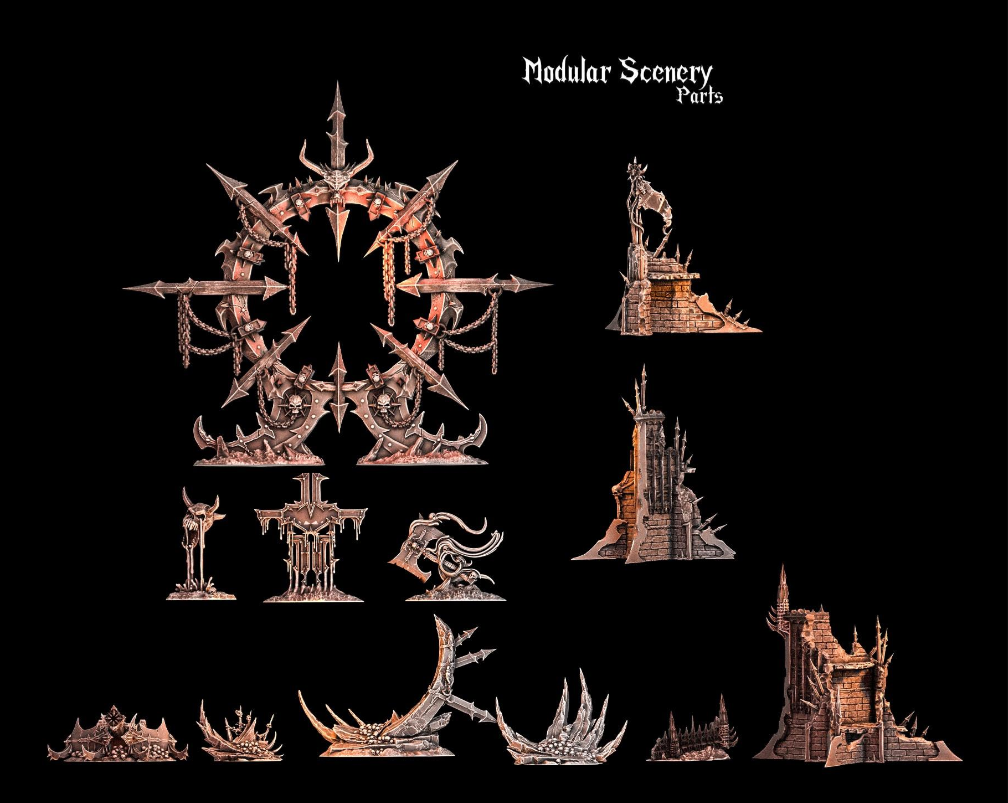
In my case specifically, we're running Armageddon and so I have some lovely chaos themed 3D printed terrain pieces including some statue-esque scatter pieces and a large warp gate.
How can I incorporate these? I was thinking of putting the gate on a base and either counting it as a wood (seems more accurate) or a ruin (for LoS blocking).
As for the scatter terrain (disregarding the L pieces), they are >2" so are an obstacle for vehicles and other non-flyers, but do nothing much for shooting. Your layouts tend to revolve around lines of sight, movement lanes, staging grounds etc, and these seem to just get in the way of all that?
I was thinking that one thing I could do would be to make some sculpted footprints with some of these things (and other debris) on it, and again either count them as woods or as ruins. What are your thoughts?
Hey Christopher, thanks for reading! You're right in that you essentially need to put these on bases. The scatter terrain should go on smaller bases and count as 2" tall ruins (so units can just walk over it freely). You can combine several on a single base if you need but the general idea should be that these block line of sight across an area that's at least 6 inches wide. Meanwhile you can put the Chaos gate on a larger base to give it a more substantial footprint. You can always make the case that it's swirling with dark energy that obscures the other side to make up for the fact that it's basically a giant hole.
Either way, you're definitely going to want more than just what's here, but these can be a good start. I'd recommend other taller ruins or eldritch structures if you can get them. Or just good old fashioned large rocks. I'm pretty sure they have those in the warp.
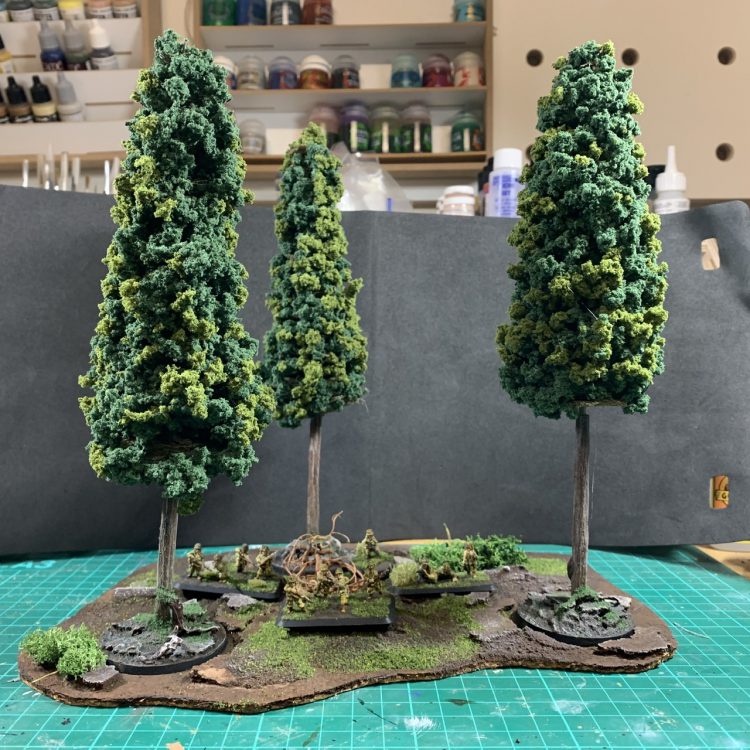 Woodland bases. Credit: Pvt_Snafu
Here's one from Book Golem two weeks ago:
I'm not sure it's as relevant as other things, but I remember Woods (alongside hills) being the thing which just tends to be ignored when setting out competitive boards. Do they have more of a place in a narrative layout, or are they just kind of inconvenient everywhere?
Woodland bases. Credit: Pvt_Snafu
Here's one from Book Golem two weeks ago:
I'm not sure it's as relevant as other things, but I remember Woods (alongside hills) being the thing which just tends to be ignored when setting out competitive boards. Do they have more of a place in a narrative layout, or are they just kind of inconvenient everywhere?
This is a great question. Woods are a tough one in 40k. They fall into the category of terrain features which look great but aren't great to play on - having dense trees makes it possible to actually put a unit in a forest easily and just throwing down three trees on a base tends to feel unsatisfying. That said, the rules for them in 10th edition aren't great - you can't see through them, but you can't see units which are wholly inside them - while units wholly within Woods can see
out of them normally. This makes them a bit like "magic boxes," completely safe -
too safe - spaces for vehicles and other units to hide and shoot out of without impunity. That's going a bit too far, in my opinion. On the other hand, woods have no walls so if you take that rule away they're more or less just open terrain once you step in side.
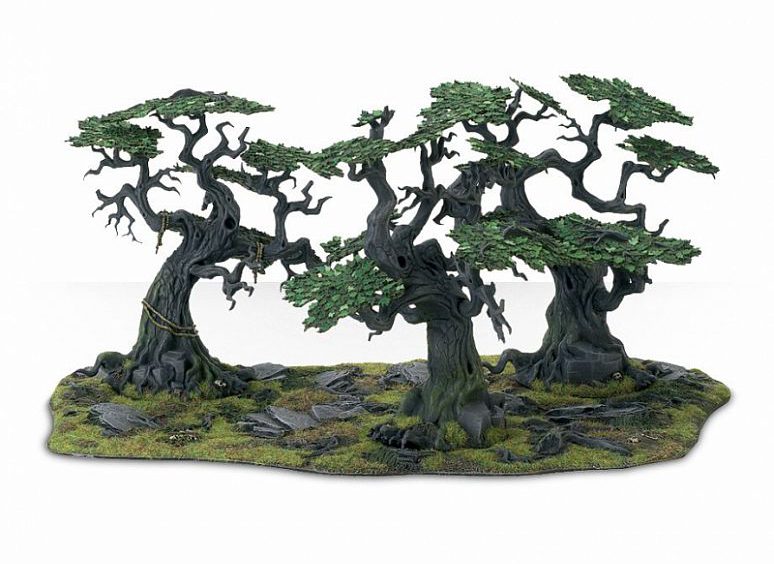 Credit: Games Workshop
I'm generally a fan of woods, and I miss the days when they'd slow you down as difficult terrain. I think I'd split the difference here and make it so that while you're wholly within ruins you get -1 to be hit rather than being completely invisible, going back to the old rule. Otherwise it's going to be hard to make Woods work well unless you design your forests to actually be playable for 40k. You can certainly do that, and regardless of whether you create a wall of dense undergrowth, you will want your Woods to be on terrain bases so you can
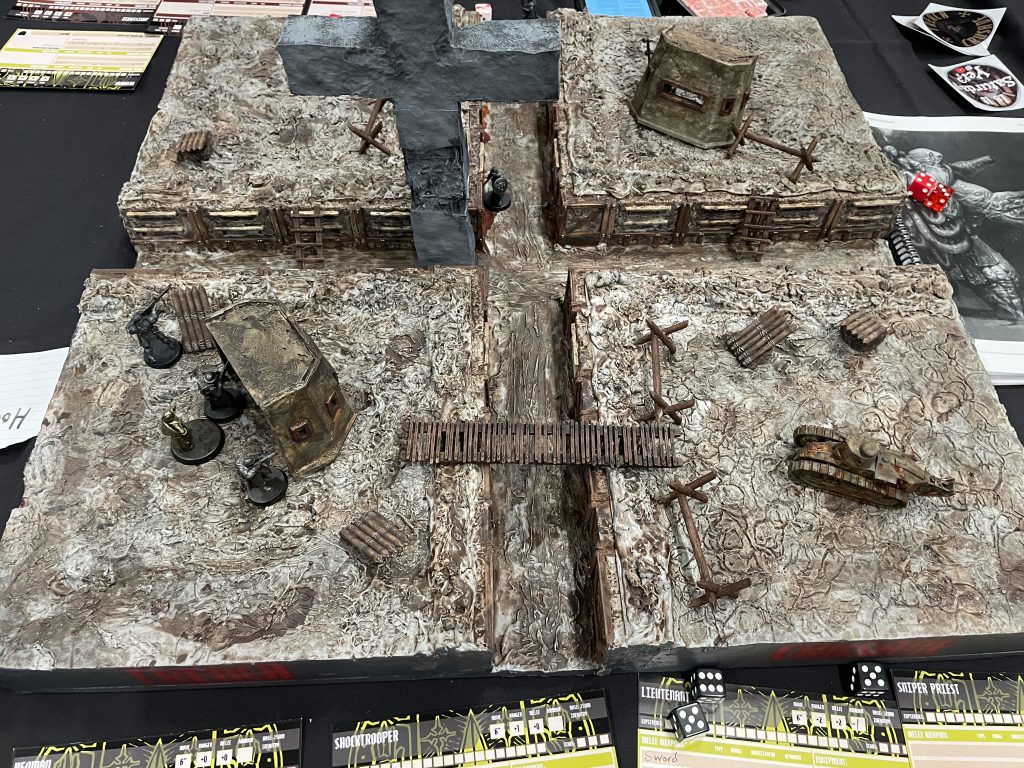 Trench Crusade Demo at Adepticon 2025.
Shadowsun asks:
Would you perhaps be able to go over guidelines for more deliberately asymmetric maps? If I want to do a charge over dead ground into a trench system, how should I make it feel unbalanced without being too unfair?
Actually, do you have any tips for modelling trenches in a way that's playable?
Trench Crusade Demo at Adepticon 2025.
Shadowsun asks:
Would you perhaps be able to go over guidelines for more deliberately asymmetric maps? If I want to do a charge over dead ground into a trench system, how should I make it feel unbalanced without being too unfair?
Actually, do you have any tips for modelling trenches in a way that's playable?
You've hit on something that was a major challenge for my buddy Norman when they were making terrain layouts for the
Adepticon competitive Trench Crusade format - the purpose of a trench is to generally be a low-cost fortification for protecting your troops from enemy fire and helping you defend territory so that a smaller force can effectively hold off a much larger force. In particular they're great for creating stalemates and stalling enemy offensives. Trenches are great for buying time and holding ground while more forces arrive to overwhelm the enemy.
In battle, trenches aren't necessarily meant to be a place you fight, either - they're designed explicitly to make losing ground as costly as possible for the enemy, and easily abandoned. And they're typically not actually structured in long lines like the Adepticon table above, but in jagged, teethlike configurations to remove long sightlines and protect troops from shrapnel. On the tabletop, this is a difficult ask - it requires building sunken trench lines into the table, and these are typically not very wide, creating the same problems as scaffolding where it makes actually fighting with a full unit in melee difficult to impossible. That's by design, which is kind of cool, but also means that the table itself will heavily bias you toward shooting units who can see out of the trench and minimum size units of elite infantry like Terminators or Custodes, and create unbalanced issues for Orks and Tyranids or anything on a base that's too large to fit inside a trench. Again, that's a cool design but bad for having fun games where both players feel like they're participating.
You also have to handle how vehicles move over trenches -
can they? This needs some homebrew rules.
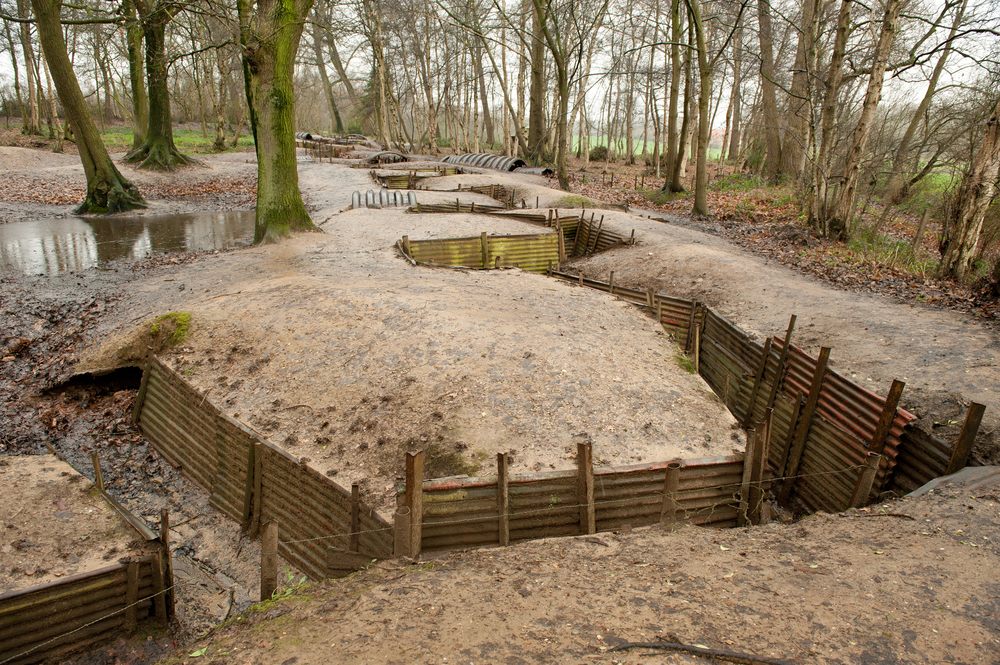 Sanctuary Wood in Ypres, Belgium. Credit: John Gomez
40k's lore is full of grinding battles and trench warfare but most games aren't based on this, they better represent skirmishes over terrain, moving from point to point and capturing ground. At best, they represent the moment troops come out of their trenches and stage an assault across no man's land.
So with trenches what you end up with is something that is thematically on brand for 40k, but doesn't really fit with the way 40k has been written and balanced over the years. I think you can write a good scenario around using trenches or defensive lines, but you need to more or less custom build those for the armies who will be fighting, and they make better "last stand" or "assault on the trenches" style missions than ones I'd expect to randomly play in a campaign.
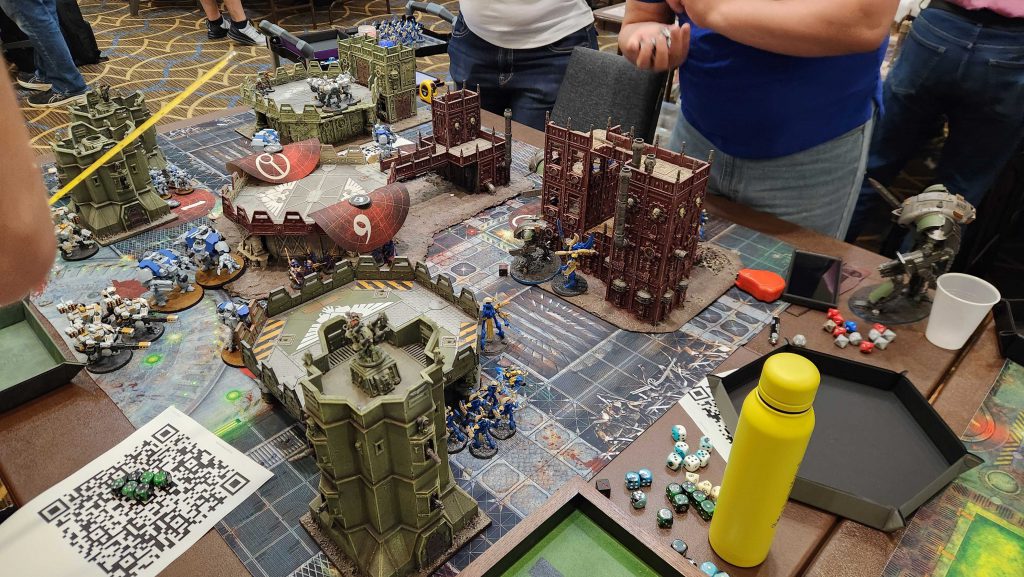 Here's one on Skyshield Landing Pads:
Currently I am painting a Skyshield landing pad and the issues of being hard to reach under it with your hand and it not blocking sight well are both present. Would you say it's also well served by some storage containers between the pillars?
Here's one on Skyshield Landing Pads:
Currently I am painting a Skyshield landing pad and the issues of being hard to reach under it with your hand and it not blocking sight well are both present. Would you say it's also well served by some storage containers between the pillars?
These are tough. I like the Skyshield for the large area it provides units to interact on and how great it looks. I hate the open space underneath and the short height. You can usually solve this in one of two ways. The first is to vault the thing and make it taller. The second is to fill in the space under the legs with walls - the older Sector Imperials ruins had 3" tall wall sections that are perfect for this. Or just put it on a base and say you can't see under it. That's fine too.
Is ruins all there is?
Thank you for this series, which Is really inspiring. You already talked briefly about this in a past article, but I would be curious to know how one could use terrain types other than ruins, like craters, forests, rivers and such, and if you think it would be possible to build a table without ruins.
You can absolutely build a table without ruins. The problem is that for 40k, Ruins are a crucial part of the game because they provide clear areas of obscuring terrain
and large walls to block line of sight. I think you can use woods pretty well instead of ruins - see my note above on Woods and how to houserule them - and craters are OK as ways to give infantry the benefit of cover as they move across the table, but generally cover isn't too hard to come by in 40k if you can hide a model or two. I do like the idea of putting objectives in craters occasionally, however.
As for the other things - rivers and impassible terrain, these are much rougher. You're basically talking about terrain features which don't do anything except block or impede movement, reducing the size of the table. A river is never going to block line of sight, merely force units to go over or around it, making it the ideal terrain feature for shooting units to hide behind. That's kind of an issue for 40k, where the game is already very deadly at range. I think rivers have their place - I love doing battles over bridges and having an advantage for units which can FLY - but you need to be really careful with how you use them and make sure that players have multiple ways to move across them and hide on either side of them. Rivers ultimately have similar problems to trenches in that regard and this is just kind of the issue with most non-ruins terrain: If it doesn't block line of sight, it doesn't do much in 40k. Is that a failing with the game's rules? Well, kind of but also that's just going to be how things are with guns.
That said, you've given me some ideas for next week's article - I'll tackle a few ideas for houserules on different terrain features and how you can incorporate them better into your games.
Next Time: Creating Some Houserules
That wraps up this week's article but if you have any lingering questions or things you want to see me tackle in a final article on this series, let me know! I'm happy to answer questions about layouts or terrain, and help make your tables better. I'll also talk about some houserules and how you can make varied types of terrain work in your games.
See you next week.
Have any questions or feedback? Drop us a note in the comments below or email us at contact@goonhammer.com. Want articles like this linked in your inbox every Monday morning? Sign up for our newsletter. And don’t forget that you can support us on Patreon for backer rewards like early video content, Administratum access, an ad-free experience on our website and more.Thank you for being a friend.
 This website uses cookies. Learn more.

 Goonhammer App and Patron Updates: April, 2026
 Kill Team Tournament Report: Engage, Party, Repeat's March Madness 2026
 Goonhammer Reviews: Tribal Conquest