 This website uses cookies. Learn more.
This website uses cookies. Learn more.
This website uses cookies. Learn more.
First off, the short answer to that second question is "Yes," and in this post I'll be talking about why that matters and more
This one almost every player I've faced does correctly, often because it's perceived to be in your opponents interest for these dice to be slow rolled; which arguably it is.
Some example, below are the dice rolled for damage from 5 successful Las Cannon shots that have punched through the armour of a squad of 6 Space Marine Primaris Aggressors, where each model has 3 wounds.
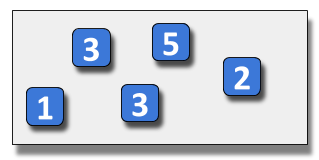
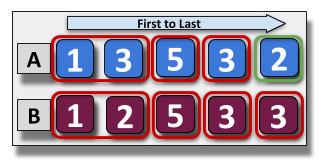
In Scenario A: The dice manage to kill 3 Aggressors and then reduce one of them to 1 wound.
In Scenario B: The same numbers but in a different order manage to kill 4 whole aggressors.
This won't matter every time you have to roll for damage, but it's important to note that if it isn't clear that a result might be affected by slow rolling, then do so. Note that this will also be important for models that only have a single wound, but have a way to ignore damage, such as Plague Marines with their Disgustingly Resilient ability to ignore incoming damage on a 5+.
The only example I'm aware of for this is the Tau Cyclic Ion Blasters;
If you roll one or more hit rolls of 1, the bearer’s unit suffers a mortal wound after all of this weapon’s shots have been resolved. [Tau Empire FAQ v1,4, Pg. 1]
Each time you fire one, if you the results include one or more hit rolls of 1, the bearer's unit suffers a mortal wound. For example let's say we have a Tau Commander with 3 Cyclic Ion Blasters (their fourth slot filled with war-gear) and we roll their dice together;
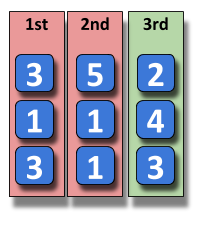
We covered in a previous article that cover can be gained during a shooting attack; in this situation though you could still "fast roll" the hits and the wounds, it's only the saves that need to be rolled in groups until all the models not in cover are removed. The rest of the unit would then get to roll their saves with the cover bonus.
Inadvertent Precognition
Some attacks will have special rules such as "on wound rolls of 6+, increase the AP of this attack by 1." These attacks have an interesting interaction with Tau Drones. I'm still looking into if any other "bodyguard" abilities are similar, but so far Cogitated Martyrdom is the closest but in a slightly different way.
Regarding the Drones though, if a unit of Genestealers charges and attacks a Tau Broadside that has some Shield drones nearby, I think following the exact wording of the rules you would need to roll every Genestealer attack one at a time. Here's why: Because attacks are meant to be slow rolled, the Tau player arguably shouldn't know ahead of time how many AP-4 wounds are coming their way. In this case fast rolling effectively gives the Tau player advanced knowledge (without any sacrifices to the warp too, the cheek of it). Slow rolling each attack would cause them to need to decide after each individual attack whether or not to attempt to pass the wound off to a drone using the Saviour Protocols rule, now that they know the AP, or save the drone in case a higher AP wound comes later. There might be other bodyguard abilities that are similarly affected, however most of the others happen when a model "loses a wound" after the save, not at the "is wounded" stage, as occurs with Saviour Protocols.
I will probably dedicate a whole future post to the ridiculous level that the word "wound" is overused in the rules.
Orks - The Grot Shields Stratagem
Iron Hands - The Cogitated Martyrdom Stratagem
Genestealer Locus - The Unquestioning Bodyguard ability
The three I'm most aware of (not I'll pretend I've checked every codex) are all triggered on losing a wound. Cogigated Martyrdom however can intercept multiple wounds so it's possible that slow rolling damage against a model protect by it could force your opponent to make some decisions on when to use it.
Attacks that cause Mortal Wounds on 6+
Direct from the FAQs:
Q: Some attacks deal mortal wounds in addition to their normal damage. When are these mortal wounds allocated? A: Any mortal wounds inflicted by an attack in addition to normal damage should be allocated after that attack has been resolved (note that this may prevent fast dice rolling when resolving attacks with this ability). Core Rules FAQ Pg12
Gaining the mortal wound for wound rolls of a 6+ on weapons such as Sniper Rifles can mean you need to slow roll. It won't always though--if you shoot them at a multi-wound, multi-model unit you should technically slow roll for each weapon's wound and damage so that you assign the mortal wound to the correct attack. When these weapons target characters (who are usually just a single model), or units of models with only one wound then you can fast roll all of the shots as normal because the Mortal wounds will spill over to the rest of the unit.
This one is possibly specific entirely to Tau but if a unit with multiple Markerlights is firing at a target that has not been hit by a Markerlight yet, they can/should slow roll their hits until they get their first Markerlight token. Having 1 Marker Light on the target allows the unit to re-roll 1s from then on.
When a unit is hit by a markerlight, place a counter next to it for the remainder of the phase.
You can re-roll hit rolls of 1 for T’AU EMPIRE models attacking this unit. [Tau Empire Codex Pg 123]
This distinction I want to make clear though is that Markerlight specifically place a token when a model armed with one hits. If the ability is worded that the buff applies when a unit does something it will vary based on the specific wording. Feel free to use the Ask A Question form to let me know about specific rules I can check.
Compared to the section above this will be nice and short, this doesn't come up every game but for players like me who occasionally have lots of one shot weapons to keep track of, I think it's important to note both when using them and when facing them.
The issue here is that it's declaring the one shot weapon at a target that uses them up, if that weapon is an imperial hunter killer or a Tau seeker missile it's still the same. When you chose targets for all the weapons on the model and decide to fire the one shot weapon, it's used up from then on, even if you roll the other weapons on your model first at the same target and manage to kill it before rolling for your one shot weapon. It's not something that will happen every game, but it can easily be forgotten. I personally fire mine first, just so that they don't feel wasted, which is obviously ridiculous but I do it anyway.
Why do you need to keep rolling these? Lets check the rules for attacks first:
Choose Ranged Weapon The weapons a model has are listed on its datasheet. If a model has several weapons, it can shoot all of them at the same target, or it can shoot each at a different enemy unit. Similarly, if a unit contains more than one model, they can shoot at the same, or different targets as you choose. In either case, at the same time that you choose targets for the shooting unit’s attacks, you must declare how you will split the shooting unit’s shots; then resolve all the shots against one target before moving on to the next. [Last Sentence of this rule was changed: Core Rules FAQ, Pg. 1]
Number of Attacks Each time a model shoots a ranged weapon, it will make a number of attacks. You roll one dice for each attack being made. The number of attacks a model can make with a weapon, and therefore the number of dice you can roll, is found on the weapon’s profile, along with the weapon’s type. A weapon’s type can impact the number of attacks it can make (see overleaf). [Core Rules 40k, Pg. 5]
These rules make it fairly clear that ALL attacks should be resolved before you move on. For most shooting attacks this is just resolved as usual, a squad of five models with Plasma rifles will usually all be rolled together and I think most players would not approve of a player rolling them one at a time until their target has died, in my opinion the rules don't even allow this as an option.
Therefore If you declare you're going to shoot a weapon using it's overcharged profile at a target, and the target dies to other weapons the unit or models has beforehand. You still need to roll the hit rolls for the other weapons.
For instance if you have a Leman Russ with two Plasma Cannons, and Battle Cannon and declared that both Plasma Cannons would overcharge and target the same target as the Battle Cannon. Even if you decide to resolve the Battlecannon first and get lucky with the two rounds of firing due to Grinding Advance and kill the target. You should still make hit rolls for the Plasma Cannons to see if they cause any overheating damage to the vehicle, even though their target has been removed, otherwise you haven't actually resolved all of that units attacks before moving on as instructed in the shooting phase rules.
I hope this has helped to clear up some of the most common slow rolling quirks, maybe it's just made you think of even more questions. I'm always after more rules issues for future posts or Q&As, you can submit them here, you can join the discussions on Reddit here, or you can drop us a note in the comments below or email us at contact@goonhammer.com.
Tags:

Thank you for being a friend.
 Games Industry News Roundup- April 7th, 2026
 Infinity N5 First Principles: Understanding the Outcomes of Face to Face Rolls
 A Brush With Greatness, Part 1: Introductions
Support us on Patreon to get access to our Discord and exclusive App features.
Thank you for being a friend.
Already a Patron? Login with Patreon.
Visit our incredibly official store on RedBubble.
Support us on Patreon to get access to our Discord and exclusive App features.
Thank you for being a friend.