 This website uses cookies. Learn more.
This website uses cookies. Learn more.
This website uses cookies. Learn more.
‘IF EVERY UNIT IN YOUR ARMY’ RULES Many armies have abilities that only apply if every model in your army has a specific keyword. For example, many units in Codex: Space Marines have the Combat Doctrines ability, but this rule only applies if ‘every unit in your army has the Adeptus Astartes keyword’ (with a few listed exceptions). The condition of ‘every unit in your army’ is checked once, after you have selected your army, which happens at the end of the ‘Muster Armies’ step of the mission sequences used in a mission pack, and such rules either apply for the duration of the battle or they don’t. If the condition is satisfied at the end of this step, then those rules will apply throughout the battle, regardless of whether or not new units are added to your army during the battle that might not satisfy this condition. Similarly, if at the end of the ‘Muster Armies’ step, this condition is not satisfied, then it will not apply for the duration of the battle, even if during the battle you suffer casualties to the point where all your remaining units would start to satisfy the condition.It's now 100% clear that if the Army met the conditions for Contagions when you mustered the army, then it keeps them for the entire game. They can't be lost by adding units and they can't be gained during the battle when the last conflicting unit is destroyed.
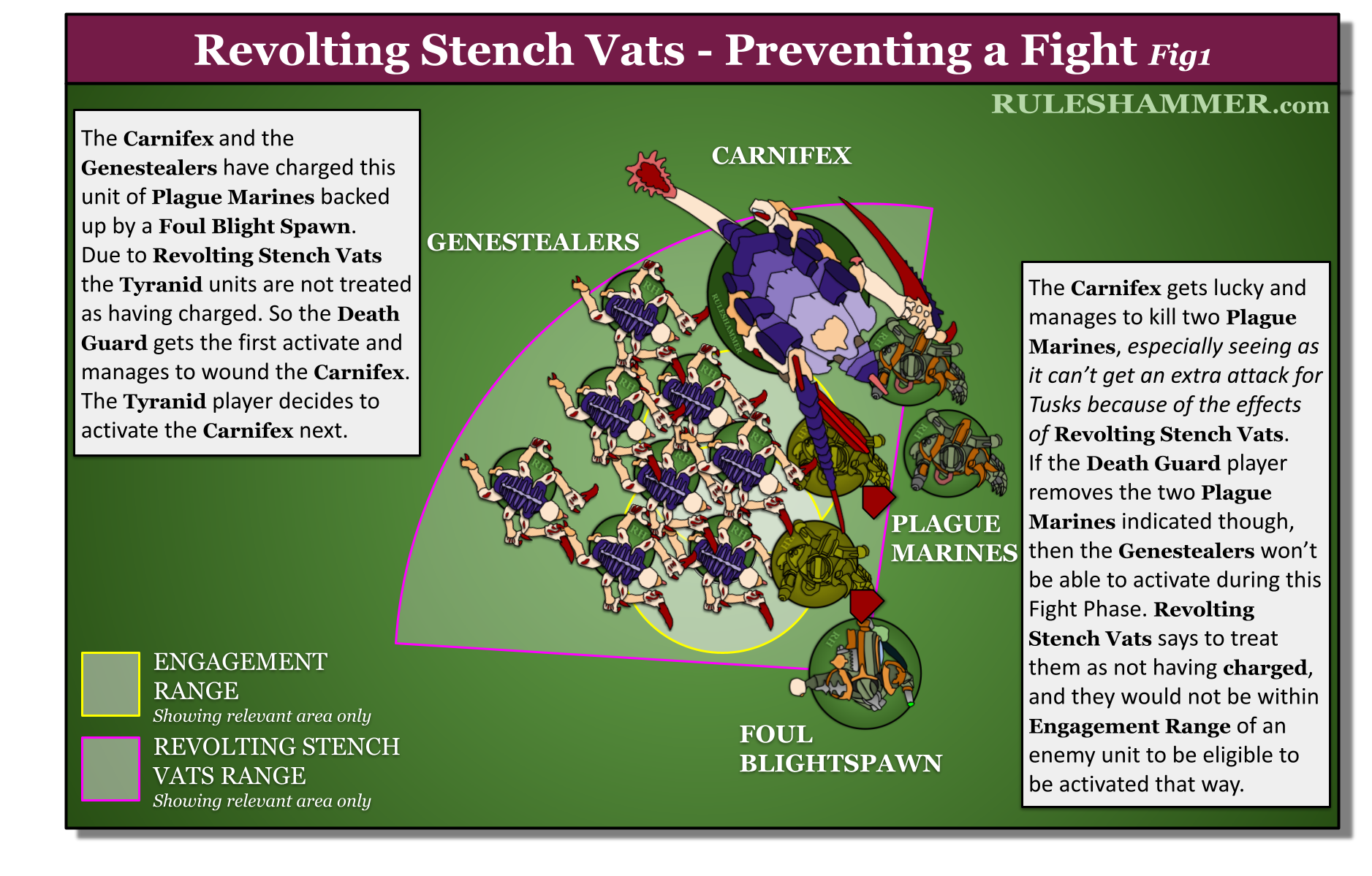
Revolting Stench Vats (Aura): While an enemy unit is within 6” of the bearer, that unit cannot make use of any rules that allow it to fight first and never counts as having made a charge move this turn.So whilst it does make units within Range into Fights Normally it's for slightly different reasons, the Stench Vats never causes a unit to become Fight Last. What's unchanged is that they can still cause a unit to end up unable to fight at all under a specific set of circumstances. Specifically, the rules for which units can fight state that “An eligible unit is one that is within Engagement Range of an enemy unit and/or made a charge move in the same turn.” (Core Rules, “Fight Phase,” Paragraph 1), which means that a unit affected by this that is pushed out of Engagement Range as a result of removing casualties won’t be eligible to fight, as shown below:
7. Even if a Transport model is subject to such a rule, embarked models still cannot disembark from that Transport during the Movement phase if that Transport has already moved, unless that Transport (or the models embarked within it) have a rule that explicitly allows them to disembark after the Transport has moved.The new FAQ stil firmly prevents that though.
‘If a unit makes a Normal Move, Advances or Falls Back, and any of its models wish to move over any part of this terrain feature, subtract 2" from the Move characteristic of every model in that unit (to a minimum of 0), even if every part of this terrain feature is 1" or less in height. If a unit declares a charge, and any of its models wish to move over any part of this terrain feature as part of its subsequent charge move, subtract 2 from that unit’s charge roll, even if every part of this terrain feature is 1" or less in height. These modifiers do not apply if every model in the moving unit can Fly. These modifiers do not apply if every model in the moving unit is Titanic and this terrain feature is less than 3" in height. The height of a terrain feature is measured from the highest point on that terrain feature.’No longer does this rule modify the abstract concept of "max distance" it now clearly modifies the movement characteristic and the charge roll.
Inexorable Advance: If this Unit has the Infantry Keyword, it can ignore any or all modifiers to its Move Characteristic, Advance Rolls and Charge Rollswhich Inexorable Advance now without doubt makes the unit immune to modification. This is progress, slow but inexorable progress.
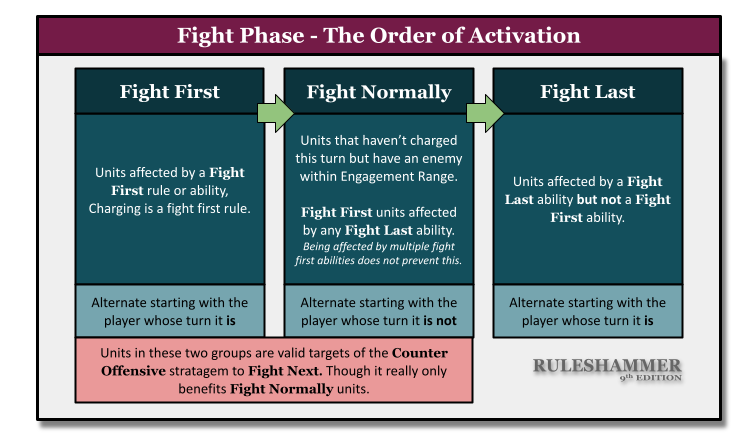
The rare rules then clarify a few things: 1. If a unit has charged it is a ‘fights first’ unit that turn. 2. A unit is a ‘fights first’ unit whether it is under the effect of just one, or multiple, ‘fight first’ rules. 3. A unit is a ‘fights last’ unit whether it is under the effect of just one, or multiple, ‘fight last’ rules. 4. If a unit would be both a ‘fights first’ and a ‘fights last’ unit at the same time, it is instead a ‘fights normally’ unit.
The only other thing the rare rule does is clarify which units are eligible to fight, and so can make use of the Counter-offensive Stratagem (which lets a unit ‘fight next’). In practice, using the above terms, you can select any ‘fights first’ or ‘fights normally’ unit for this Stratagem.
Obeisance Generators: At the start of the Fight phase, if there are any enemy units within Engagement Range of Szarekh, then until the end of the phase, those units cannot fight until after all other eligible units from your army have done so.however the commentary is pretty clear on the intent here, and so far Silent King and the Whirlwind stratagem are the only abilities that use "cannot fight" rather than "not eligible". It's a shame that the FAQs didn't change their wording but I think the commentary is still enough written intent to play these as described by the rules writers. Maybe send an email to the GW FAQ department though and we can get the wording amended to match!
Tags:

Thank you for being a friend.
 Games Industry News Roundup- April 7th, 2026
 Infinity N5 First Principles: Understanding the Outcomes of Face to Face Rolls
 A Brush With Greatness, Part 1: Introductions
Support us on Patreon to get access to our Discord and exclusive App features.
Thank you for being a friend.
Already a Patron? Login with Patreon.
Visit our incredibly official store on RedBubble.

Support us on Patreon to get access to our Discord and exclusive App features.
Thank you for being a friend.