 This website uses cookies. Learn more.
This website uses cookies. Learn more.
This website uses cookies. Learn more.
Warhammer 40k | Ruleshammer | Columns | Core Games

Use this Stratagem in your Movement phase, when a GENESTEALER CULTS INFANTRY unit from your army is selected to move, or in your Fight phase, after a GENESTEALER CULTS INFANTRY unit from your army has resolved all of its attacks but before it makes a consolidation move. If that unit is more than 6" away from any enemy units, remove it from the battlefield. In the Reinforcements step of your next Movement phase, set that unit back up on the battlefield anywhere that is more than 9" away from any enemy models. If the battle ends and that unit is not on the battlefield, it is destroyed.
Update: My original answer proved to be quite a controversial one, the core argument in the feedback I received was that timing implies that the unit was eligible to fight to get to the stage of after it's attacks and before consolidating. I have been convinced I was wrong because unlike "after charging" or "after moving", not every unit had the option to "make attacks", so every unit doesn't have an "after making attacks" moment. I'd still like it to be clearer, but I do think this logic makes sense. My argument that GW is just trying to head off a timing ambiguity seems thinner in comparison.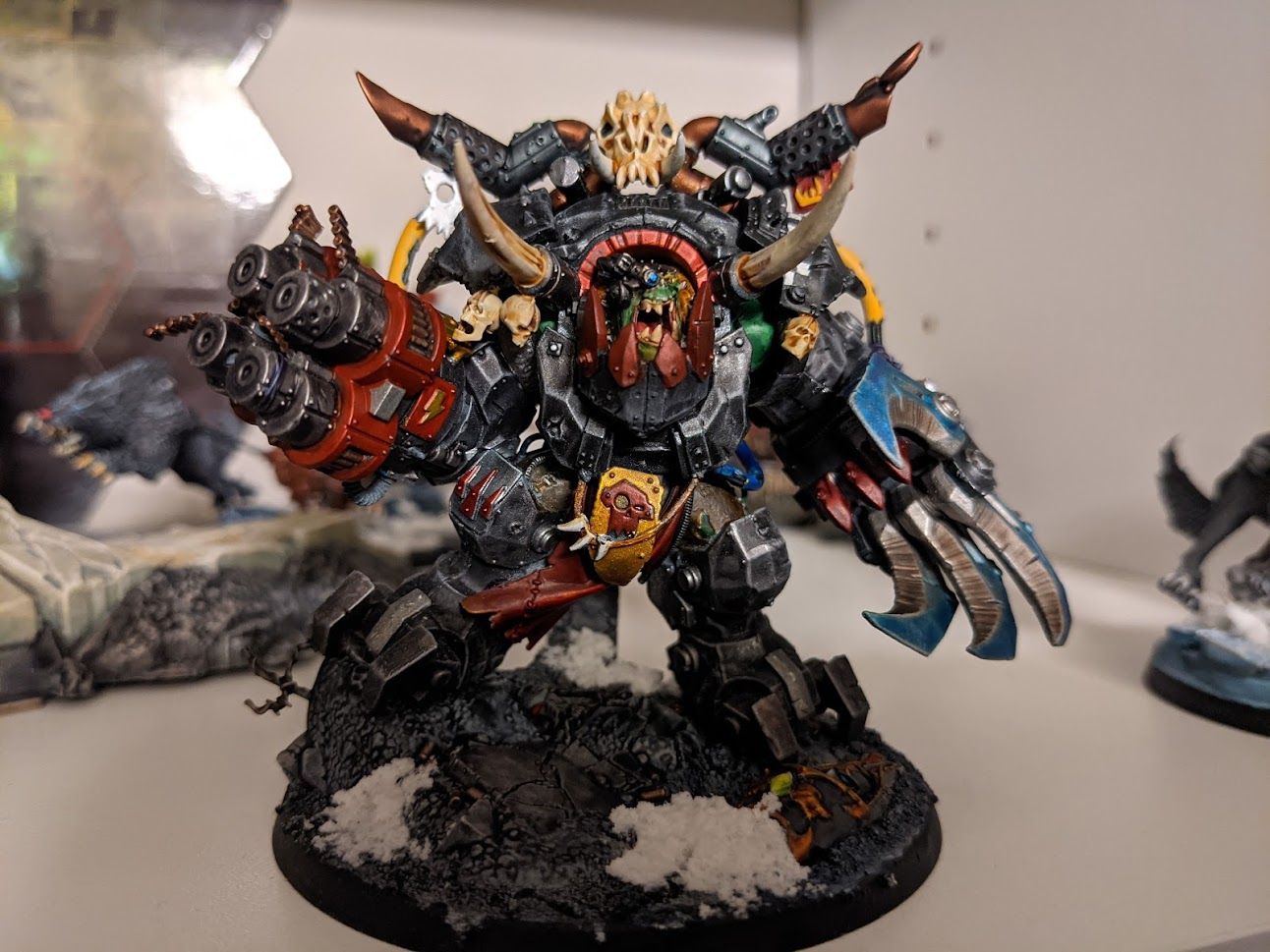 Credit: Kevin Stillman
Each time this WARLORD makes an attack, you can ignore any or all modifiers to its hit rolls, wound rolls, or damage rolls.
The Bow To None trait is only excused from modifiers to rolls, and as is very relevant to this discussion, damage rolls. Damage Rolls modifiers have been FAQed as distinct from Damage Characteristic modifiers in perhaps one of the weirdest FAQs in the game as it stands.Q: For the purposes of the Bow to None Warlord Trait, what constitutes a modifier to a damage roll, and is this the same as a rule that modifies the Damage characteristic of an attack?
A: A modifier to a damage roll is something that modifies the result of the dice roll itself. This is not the same as something that affects the Damage characteristic of an attack. For example, this Warlord Trait would affect a rule that said ‘…subtract 1 from that attack’s damage roll’ but it would not affect a rule that said ‘…subtract 1 from the Damage characteristic of that attack’.
As it stands I'm not actually aware of a single rule that modifies an incoming attack's damage roll, so that part of the trait currently does nothing at all.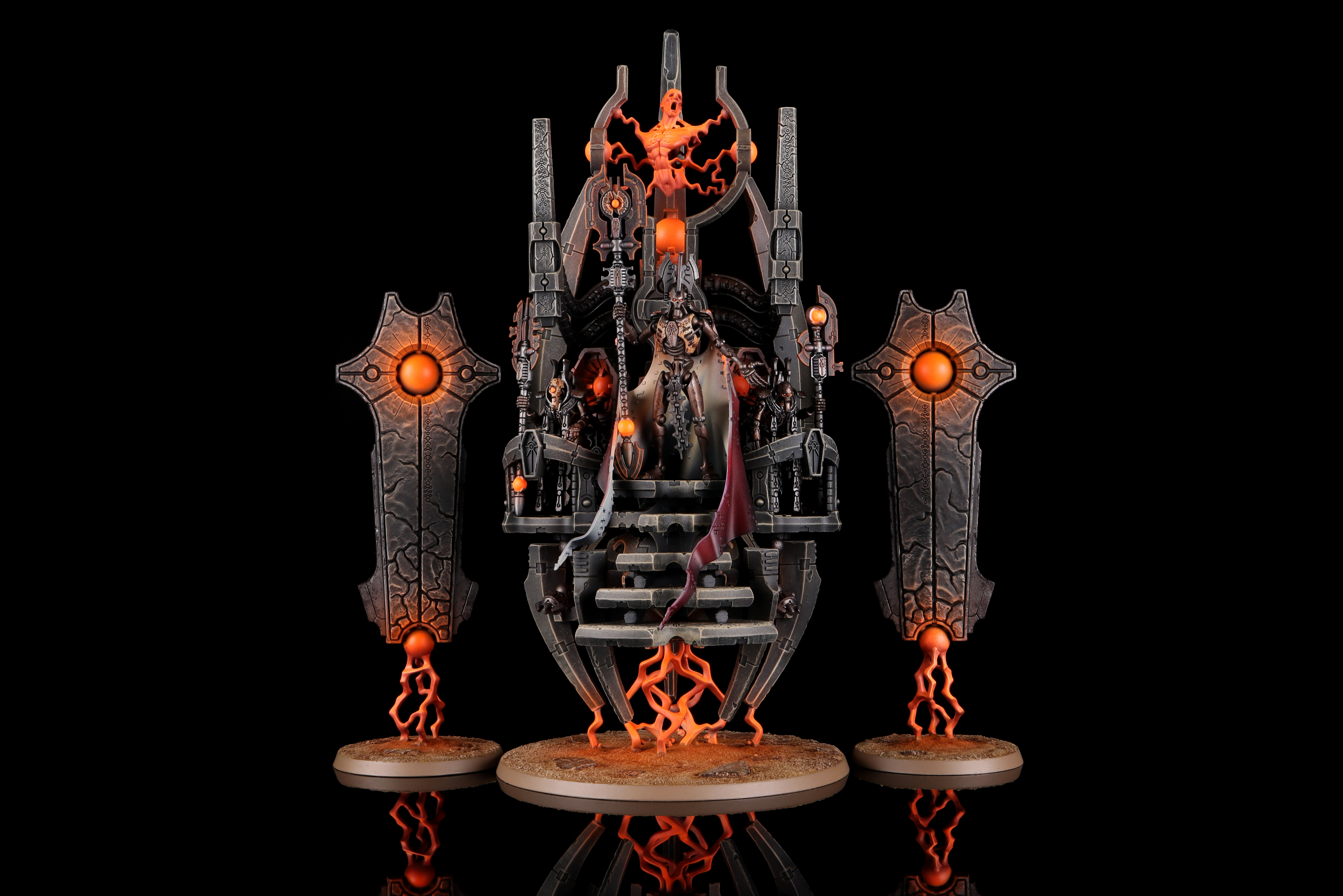 The Silent King. Credit: Pendulin
Rites of Reanimation: In your Command phase, you can select one friendly <DYNASTY> CORE unit within 6" of this model. One destroyed model from that unit is Reanimated. If the selected unit is a NECRON WARRIORS unit, D3 destroyed models from that unit are Reanimated instead. Each unit can only be selected for this ability once per phase.
Reanimate has a definition in the Necron Glossary as follows.Reanimate (pg80): When a model Reanimates it is set back up on the battlefield with its full wounds remaining.
The page reference is to the ability Reanimation Protocols. There's a lot of opinions about whether this means that a unit or model needs the Reanimation Protocols ability to reanimate or not. I don't think a page reference is enough to establish that for certain either way. Looking at the wider context though, the book doesn't use reanimate for any other models that lack Reanimation Protocols. There are even other healing abilities in the book such as this one:Resurrection Protocols: Use this Stratagem in any phase, when a NECRONS INFANTRY NOBLE or NECRONS INFANTRY CRYPTEK model from your army is destroyed. You can choose to roll one D6 at the end of the phase instead of using any rules that are triggered when that model is destroyed (e.g. the Surrogate Hosts abilities). If you do, then on a 4+, set that model back up on the battlefield as close as possible to where they were destroyed and more than 1" away from any enemy models, with D3 wounds remaining. This Stratagem cannot be used to set the same model back up more than once per battle.
There are key differences, such as this ability only giving D3 wounds rather than full wounds, that could explain them not using the Reanimate term. However I think that when compounded with the wound allocation issue, I'd suggest that Menhirs can't be reanimated.If a model in the target unit has already lost any wounds or has already had attacks allocated to it this phase, the attack must be allocated to that model.
and the Silent King rule says this;Triarchal Menhir: While this unit contains any Triarchal Menhirs models, it does not count as a CHARACTER for the purposes of the Look Out, Sir rule and each time an attack successfully wounds this unit, that attack must be allocated to one of those models. The destruction of Triarchal Menhirs is ignored for the purposes of Morale tests. If Szarekh is ever destroyed, any remaining Triarchal Menhirs in this unit are also destroyed.
Some players will argue that Codex beats Core rules resolves this, but that's not actually a concept written anywhere in the rules and acting as if it is causes more issues. For instance there are many "counts as remain stationary abilities" in the book and the core rules have passages such as this in in Disembarking;Units that disembark can then act normally (move, shoot, charge, fight, etc.) in the remainder of the turn, but its models count as having moved that turn, even if they are not moved further (i.e. they never count as having Remained Stationary).
If Codex beats Core was a thing, then remain stationary effects would work for disembarking units. As such there is no resolution to this in my opinion and if the unit was to find itself in the position of having a wounded Szarekh and unwounded Menhir, I don't know where the wound should go. I'd definitely discuss this and if Menhir can reanimate at all pregame.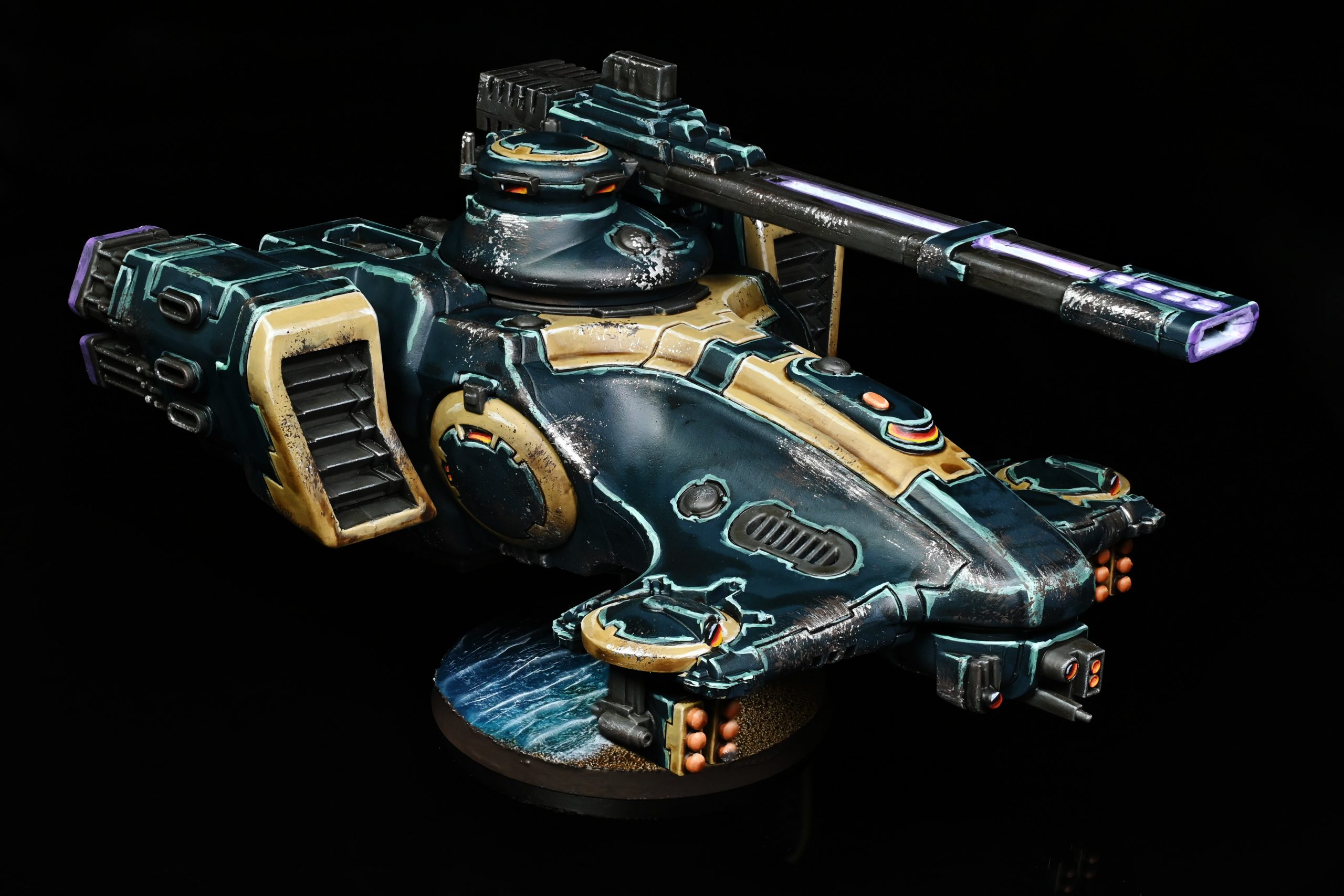 TX7 Hammerhead Gunship. Credit: Rockfish
XV02 Pilot Battlesuit: In your Command phase, you can select one other friendly T’AU SEPT CORE or T’AU SEPT HAMMERHEAD unit within 6" of this unit’s HAMMERHEAD model. Until the start of your next Command phase, each time a model in that unit makes an attack, the target is treated as having a Markerlight token.
It's not each time a model in the units shoots, it's specifically "makes an attack". Making attacks is a specific step of the Shooting Phase that happens after targeting. It's also arguably only during the making of the attack that it's treated as having one, not before or after. As such, it doesn't count as having one when Frequency Lock requires it.Use this Stratagem in your Shooting phase, when a T’AU EMPIRE model from your army is selected to shoot. Until the end of the phase, each time that model makes an attack with a seeker missile, seeker missile rack or destroyer missile: - That attack can target units with one or more Markerlight tokens that are not visible to the attacking model. - Add 1 to that attack’s wound roll.
Frequency Lock allows for targeting none visible units that have one or more Markerlight tokens, but at the targeting step Longstrike's doesn't treat every unit on the board as having one; it doesn't say to treat them as having one until the unit makes attacks. For this reason I don't think you can combine these abilities in this way - the target would require a Markerlight from a more traditional source.Tags: 40k | Warhammer 40k | FAQ | featured | Ruleshammer | 9th edition

Thank you for being a friend.
 Games Industry News Roundup- April 7th, 2026
 Infinity N5 First Principles: Understanding the Outcomes of Face to Face Rolls
 A Brush With Greatness, Part 1: Introductions
Support us on Patreon to get access to our Discord and exclusive App features.
Thank you for being a friend.
Already a Patron? Login with Patreon.
Visit our incredibly official store on RedBubble.


Support us on Patreon to get access to our Discord and exclusive App features.
Thank you for being a friend.