 This website uses cookies. Learn more.
This website uses cookies. Learn more.
This website uses cookies. Learn more.
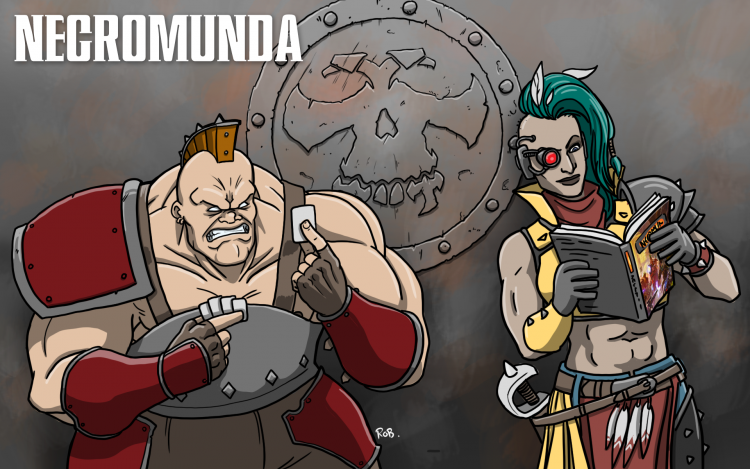
Howdy scummers! In the wake of the new Bastions of Law book for all things enforcer-related, we have extensively updated our guide on Palanite Enforcers. To keep things a manageable length, and because the division between them is now much more clearly explained in the book, this guide will not cover Badzone Enforcers - look forward to a separate guide for them, to be released imminently.
Enforcers are a consistently popular gang with both new and experienced Necromunda players. In the game of brutal gang warfare in the 40th millenium, it makes a lot of thematic sense to have at least one player as the cops in this grimdark version of cops and robbers. Very new players who (unusually) haven’t come to Necromunda by way of Warhammer 40k, may have to learn that as Enforcers you are certainly not playing the good guys, even relative to the other gangs! Regardless of whether the player envisions their Enforcer gang as the thin line holding the chaos of the hive cities in order (albeit with brutal measures) or the repressive fascist jackboot stamping on the underclasses, there are a lot of storytelling possibilities.
Enforcers also strike many new players as the elite, heavily armoured, defensive gang - but this isn’t entirely reflected in the rules, as we will see. Older players, who have vague memories or hard experience of old Necromunda (any time from the mid-90s to 2017) may remember the days when Enforcers genuinely were very elite, with a level of equipment and training beyond all but the most experienced underhive gangs. Nowadays they are very much on a par, in terms of stats, with House gangs. Their advantages lie in widespread access to good ranged weapons, and fighter types which are well adapted to specialise in ranged or melee combat, as well as good skill access.
After some revisions in Bastions of Law (published September 2025), Palanite Enforcers are now a very well-supported gang, with 3 plastic boxes for their normal fighters, plus a separate Brute and vehicle in plastic. Rule wise, they work much like any House gang, with an all-round excellent leader and two types of champions skilled in ranged and melee combat respectively. Where they differ slightly is in having two types of ganger, again one for ranged and one for melee combat, with different weapon sets (these correspond to the Palanite and Subjugator boxes).
There is a second, completely separate list for Badzone Enforcers which has a simpler structure with a leader and one type of champion and ganger. They have no juve equivalent, but can take Enlisted Hive Scum as a sort of extra fighter. Badzone Enforcers are cut off from the unique Brute, Hanger-On, vehicle and Exotic Beast options that Palanites enjoy, and the stats of their Gang Hierarchy models are markedly worse, so they’re something of a challenge gang. They will be dealt with in a separate gang guide article.
Like all gangs, Enforcers must have 1 Leader, the Enforcer Captain. This is an all-round exceptional fighter; adept at ranged and melee combat with WS/BS3+, the real advantage is in starting with 3 Wounds - any conventional weapon short of a lascannon or meltagun won’t be able to take a Captain Out of Action (OoA) with a single hit. As such, most players want to fit them out with both a decent gun and a close combat weapon. We recommend buying one of those at gang creation (whichever role your patrol is lacking) and then adding the other as the campaign develops. We particularly like the plain enforcer bolt gun. Power swords and mauls are both nice. A plasma pistol is useful both for shooting, albeit at short range, and for a punchy single Sidearm attack in melee. Once fully kitted out, many Captains will want a pistol and close combat weapon, for the extra attack, but you might also consider a Riot Shield. It doesn’t do anything for their melee damage output, but making a 3W model tankier is very useful.
Common skill picks for a fighting Captain would be Got Your Six or Threat Response, if your opponents play gangs that like melee combat. The alternative to a versatile close-quarters role is to focus your Captain’s skills on campaign-layer bonuses. They have access to Savant and Leadership Skills as Primary (your only fighter that does). Some players may value income-generating skills like Fixer or Savvy Trader over stats/skills to directly improve fighting power. Ditto for Iron Will to keep your gang from Bottling Out, or a Captain could take the Overseer skill, keeping their own gear cheap and funnelling activations to a more expensively-equipped Sergeant. If going for this kind of support build on a Captain, our advice is to give them a ranged weapon and keep them back - fire support is intrinsically less dangerous than charging in head-first. A sniper rifle works well.
These are your shooting-focussed champions, with BS3+ and Primary access the Shooting Skill tree (as well as Palanite Drill). This lets them straightforwardly boost their firepower via favourites like Trick Shot or Fast Shot, or play more reactively via Got Your Six. Some players really like to pair that last skill with a sniper rifle, which is thematic, and not at all bad if you play on big, open tables. But the enforcer boltgun is perhaps the most flexible and effective choice – Rapid Fire and Damage 2 makes a huge difference. The more expensive alternative is to use a template weapon (the Web Gun is much stronger than the flamer), and pick Hip Shooting to extend its threat range. Palanite Sergeants can also access a full suite of close combat weapons, but with only 1A at WS4+, that isn’t a sensible use of credits. Ideally, if they find themselves in melee combat, someone else will come along to help. The one exception is the Riot Shield, which is a terrible close combat weapon but a good survival tool.
The last build we will mention is a Gunslinger Sergeant. While using pistols akimbo is certainly fun, players should just consider whether the cost is worth it. Two plasma pistols, for example, are obviously strong, but only really beat a plasma gun (not available initially but can be bought for the same total price at the Trading Post) within 6”. Two autopistols, with or without special ammo, are much cheaper, but that isn’t particularly strong firepower for a champion. Our experience has largely been that Gunslingers are a cool modelling opportunity, but frustrating to play on the tabletop.
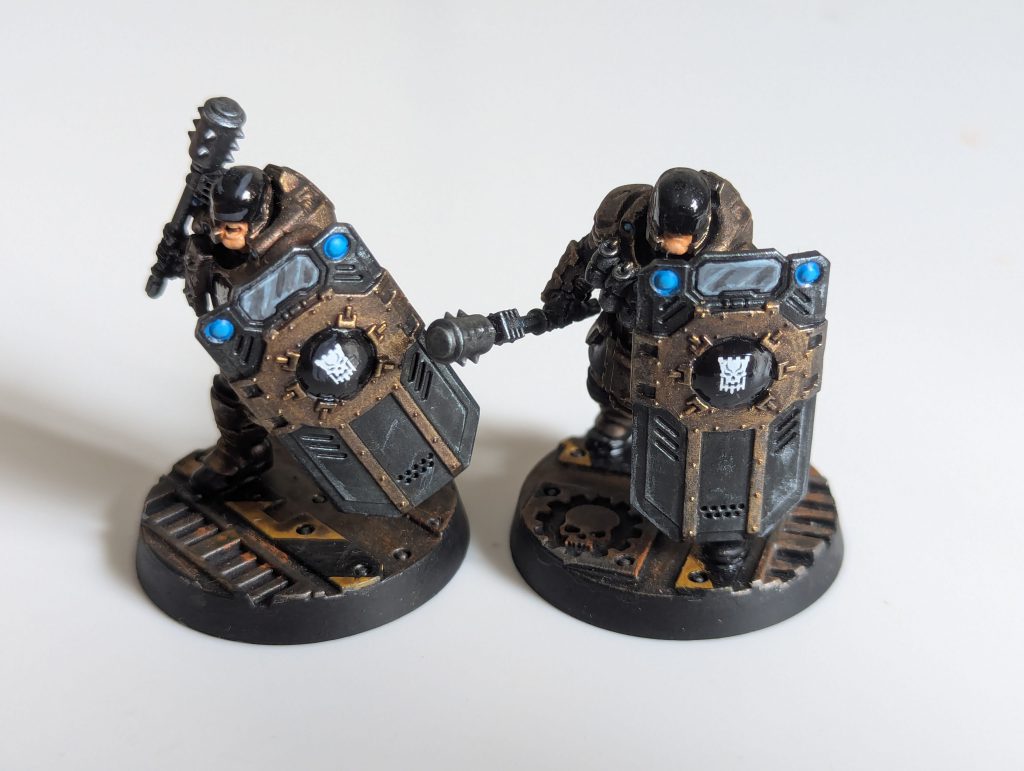
These are your melee champions, with a much more threatening WS3+ and 2A. But they trade off mediocre BS, Initiative and a small points increase. Beyond making much better use of Power weapons, the standout option for Subjugator Sergeants is access to Vigilance Assault Shields. These are perfect for a melee role due to the stacking power of +2 to armour saves in melee (only from the front, remember) and the power of Knockback to potentially move enemies and deny Reaction Attacks. Most builds for Subjugator Sergeants will eventually include a shield and upgraded armour, to protect them as well as possible in brutal close quarters engagements. The only problem for them is limited Skill access. Palanite Drill and Brawn are Primary; Combat, Ferocity and Leadership are Secondary. Because of how easily melee fighters can be neutralised via Pinning, a skill to mitigate that effect is considered vital. That means Nerves of Steel, but as a Secondary (Ferocity) skill, it can’t be selected at gang creation and would cost 12XP to buy as an Advancement. We mustn’t complain, there is still a very good skill available in Threat Response, but that shines most in a specific situation – protecting other fighters from melee attackers. A good tip for Subjugator Sergeants is to include some sort of pistol or grenades in their kit – there will be situations where they can activate but are unable to charge because they’re Pinned. In those instances you want to be able to do something to hit back.
One weapon option which we want to highlight is the SLHG assault ram. This is a more expensive, and two-handed, weapon, but it is the hardest-hitting option available from the fighter list, its Versatile property is extremely useful, and it includes a ranged attack option for when melee is unachievable.
Palanite Patrolmen are your all-purpose weapon carriers. Their Basic/Special weapon options are uniformly excellent, so despite lacking the accuracy of a Palanite Sergeant (or a Van Saar ganger) they are one of the game’s better choices as the basis of a shooting-oriented gang. The issue, especially at gang creation, is that their ranged weapons start at 30 credits, so it can be difficult to squeeze additional bodies into the gang roster. Indeed, the enforcer boltgun is perhaps the best basic weapon in the game, so it’s all the more tempting to take in multiples, and that does cost. Even if that can seem to produce expensive fighters in the early campaign, you will be extremely glad of their power ceiling later on. A common issue for Necromunda gangers is that upgraded champions are difficult to threaten with autoguns and lasguns – no such problem for the weapons on offer here.
Palanite Patrolmen can also be loaded down with a surprisingly tasty choice of melee weapons, but as with their Sergeants, the Riot Shield is the only one we would seriously look at. Just remember that they are more expensive than basic armour and undersuits, so something of a luxury for later in campaigns.
The initial Specialist (and any subsequently promoted) is a minor upgrade for an Enforcer gang. Any patrolmen can access the same special weapons, and while concussion carbines and sniper rifles are both excellent tools, they aren’t particularly high cost, and a Specialist could justifiably take a boltgun or shotgun instead. Their main advantage is in picking Advancements, so could target BS, Toughness, or even save up for an extra Wound or a specific Shooting skill.
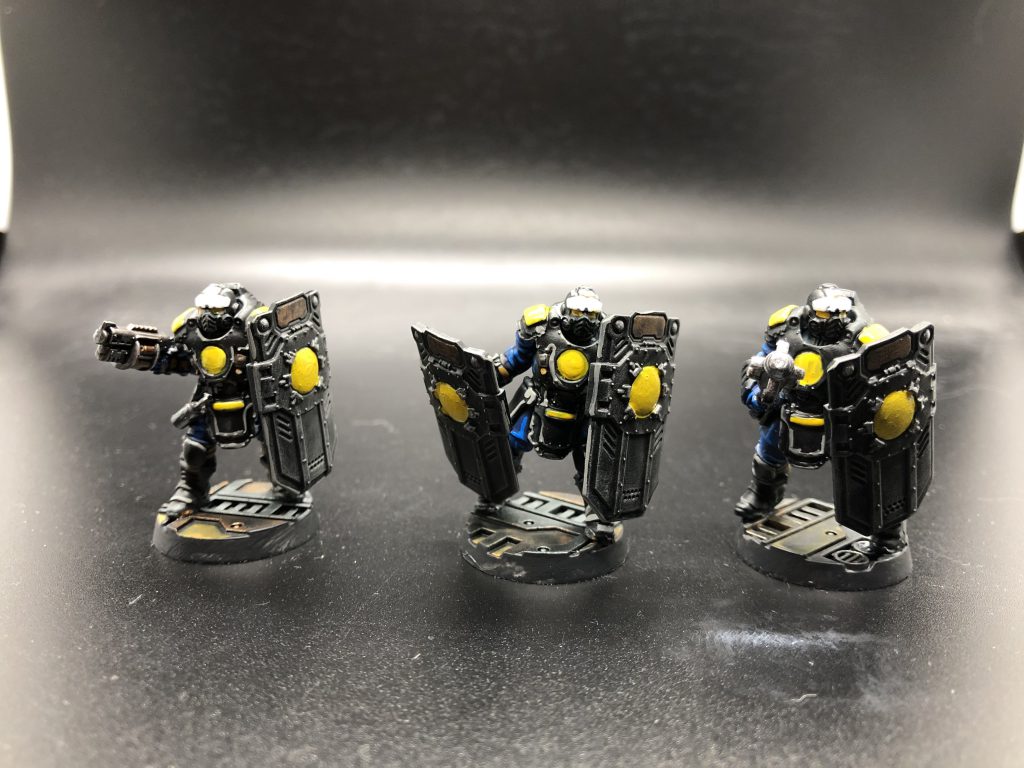 Credit: Greg Chiasson
Subjugator Patrolmen are unusually punchy gangers with 2A on their basic profile. That lets them realistically threaten most enemies, even enemy leaders or champions, with tools like Power weapons available to them. This gives them a clear role, but in our experience, most Enforcer players need/want fewer of these than they do the flexible shooting of the Palanites. As with their Sergeants, Subjugators are defined by their access to armour and shields, but need to remember the fundamental difficulties that fighters can have getting into melee contact against firepower Pinning them down.
On that note we should mention the ranged weapon options for Subjugators. Aside from pistols, it’s slightly unusual that their exclusive special weapon is a grenade launcher, which means it is actually less accurate at close quarters, where you would think Subjugators would want to position themselves. See the equipment section for our thoughts on this weapon and its upgrades, but in short, it is less impressive than the Palanite basic/special weapons. The main use we can see for it, is later in campaigns, to give even your melee fighters dangerous ranged weapons, so that they are flexible enough for any situation.
Any Subjugator can take their heavy weapons, although we are not fans – the heavy concussion ram isn’t terribly efficient for its cost and Subjugators don’t have any particular aptitude for shooting. The SLHG, as mentioned, is very tasty, but often a high cost melee weapon of that type is better carried by a champion, who is more resilient and can tailor Advances to make best use of it. On that note, a Subjugator Specialist, much like the Palanite equivalent, is only notably better than a Patrolman by virtue of picking Advances. There might be some scope to give one Threat Response or some specialised Palanite Drill skill, but generally, boosting their stats will be a better option.
There’s a perennial issue with Juves in Necromunda – most players find the reduced WS/BS, as well as mental stats, very unattractive compared to gangers, even though Movement is slightly boosted to compensate. A Rookie is 20 credits cheaper than a Palanite Patrolman, but if you were planning to buy a 50 credit enforcer boltgun, and the Rookie misses more often, that starts to look like a false economy. Our opinion is that in general, the value question is open for debate. As Juves, Rookies can pick their Advances. By the end of the campaign, a Juve can improve their BS, Toughness, potentially Cool, or save up and grab a vital skill. A ganger could, in a similar timeframe, roll increased Toughness and BS . . . or they could end up improving Intelligence twice, effectively gaining nothing. Basically, Gangers have a substantial chance of gaining sub-optimal or incredibly niche stats, and it’s impossible to intentionally build them to suit a specific role. So, while Rookies might seem like a worse bet at gang creation, or in your first few games, just remember that they could overtake Patrolmen in a long campaign.
There are a couple of ways to ensure Rookies can shine despite their poor WS/BS. The most obvious is to buy them an Enforcer Shotgun – the scattershot teardrop template doesn’t roll to hit. They can then use their XP towards enhanced Movement and/or the Hip Shooting skill. Rookies are also good candidates to carry photon flash grenades – missing with a large template can be less punishing, since it is quite likely to clip the original target even when scattering away. Rookies are also your best choice as ‘runners’, used to carry loot crates, accomplish any other scenario objectives [that don’t require a mental stat check], or threaten to coup de grace injured enemies.
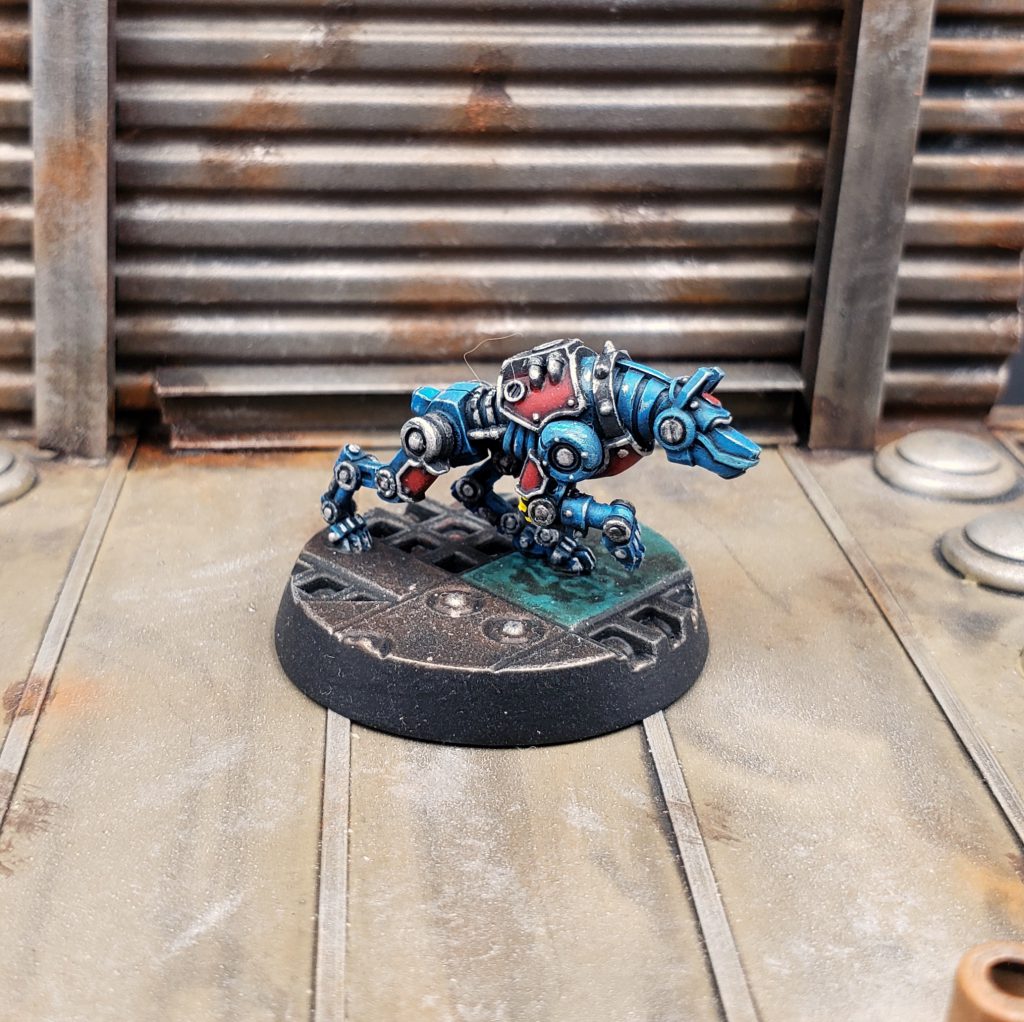 Hardcase Cyber-Mastiff. Credit: Fowler
These cyber-hounds, like all Exotic Beasts, have some differences to full, independent fighters which overall make them more restricted than you might think. First, a hardcase doesn’t really bring its own activation, it always activates in a group with its master (a Captain or Sergeant). One of the main advantages of numbers in Necromunda is to ‘out-activate’ your opponent, which gives you significant control by forcing them to activate critical fighters before yours, and hopefully giving you a safer crack at the enemy. Beasts don’t help with this, so they are fundamentally something you should only add once you have enough actual fighters to reliably fill the Crew sizes in the scenarios you are using. On the flip side, because they are attached to a Capt/Sgt, hardcases do give you additional bodies on the table, over the normal Crew size. This does mean more targets for the enemy, and more actions you can take during a round. But beware of the restrictions on what you can do – hardcases can’t perform some scenario objectives or interact with some terrain, due to low Intelligence – and especially on where they can move.
Exotic Beasts must stay within 3” of their owner. There’s a potential rules debate around whether a player can send a beast further than that intentionally, and just risk them Breaking at the end of the activation and potentially fleeing back toward the handler. That would be a real freedom, but our interpretation here at Goonhammer is that the player must abide by RAI and never intentionally try to move beyond that distance. That restraint factors in very badly with the melee-only nature of the Hardcase Cyber-Mastiff. Essentially, they can only declare Charges against enemies within ~4.5” of their owner. They also suffer from the same issue as any melee fighter which lacks any resistance to being Pinned – it is easy for enemies to keep them Prone and stop them from charging. This means you can’t expect too much of them as offensive units.
In terms of pure stats, a Hardcase is a beast by nature as well as name. T4 with a 4+ Save. 2 Attacks at WS3+, at S3, AP-1, but with Rending and Shock. That’s a better melee output than most Gangers in the game, and means that when they do manage to charge, they have a very good chance at taking out a baseline T3, 1W, lightly armoured fighter, and if they don’t, they have a good chance of surviving Reaction Attacks. Much better than most Exotic Beasts, although you would expect them to be for 130 credits! Because their weaponry can never be upgraded, players should just accept that they aren’t well suited to fighting uninjured champions, leaders, or brutes with real melee chops.
The little edge hardcases have, and the scope they have for a savvy Enforcer player to use them as good defensive units, lies in their special rules: enemies can’t Coup de Grace their owner while the Hardcase is still standing within 3”, the mastiff can move into melee to support its owner as a free action when the owner activates (this is one of the only ways to effectively use the rules for assistance/interference in close combat) and if the mastiff is taken Out of Action before activating in a Round, it can take its Activation before being removed. Nice! Perhaps best of all is their tenacity – if you would take a hardcase Out of Action, before it activated in the Round, it can instead stay on the table until it does activate, and be removed at the end. That doesn’t help in most situations where one gets shot (because it will be Pinned, must spend an action standing up, and can’t Charge), but it does nearly guarantee that if your mastiff reaches base contact with the enemy, it will at least try to bite their backside before being removed. It’s not quite clear if Tenacity kicks in when the mastiff’s owner is take OOA.
So, do we recommend taking Hardcase Cyber-Mastiffs? Yes, absolutely, once you have enough Enforcers to fill your crews. They’re not as high a priority as other fighters and weapons for them to carry, but they are a much better use of credits than most other wargear, even leaving aside the real question – who doesn’t want to include robot dogs? They are best used to accompany close-quarters Captains or Subjugator Sergeants who actively want to get up close and personal with the enemy. Just be careful of the owner’s positioning to let the mastiff get in contact with the enemy when possible. For true dog-lovers, look at the Mynerva Prefecture, which unlocks unique skills that mitigate the limits on Exotic Beasts.
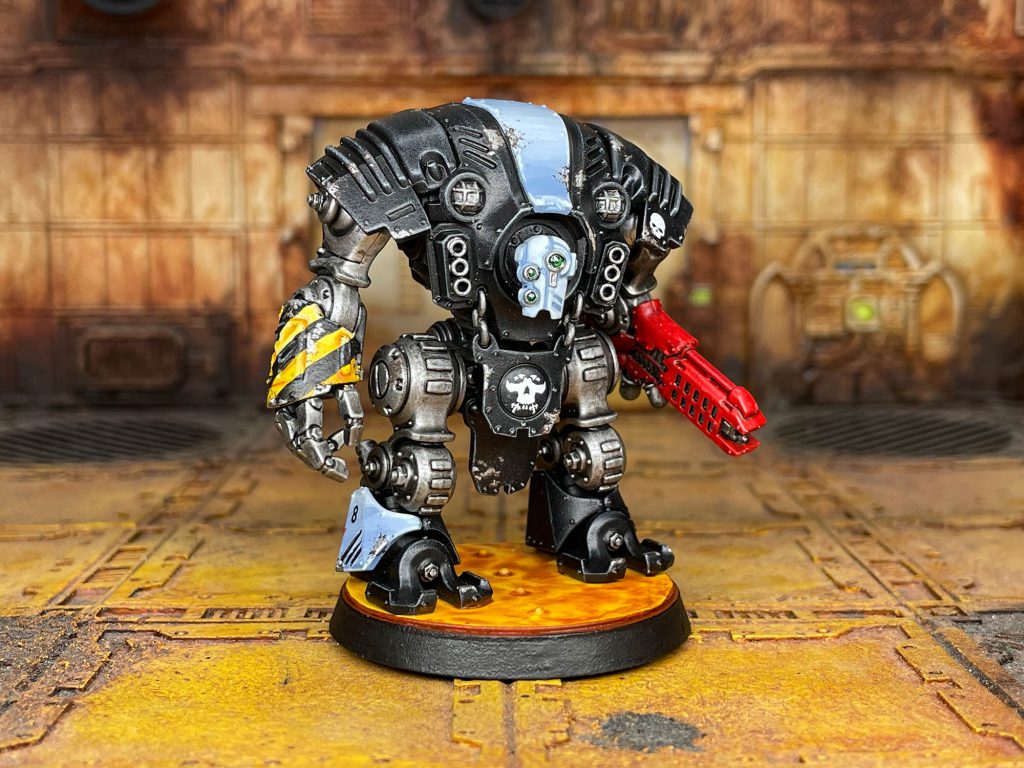 Sactioner Automata. Credit: 40khamslam.
At 205 credits these start at just slightly less than the commonly-available (and very good) Ambot and there are some real similarities. Both bots have T5, 3W and included light carapace armour for a 4+ save. That’s a resilient model. The difference is that Ambots are geared for close combat, with WS3+, BS5+ and S5. The Sanctioner may come stock with a pair of close combat weapons, but make no mistake, this is a versatile shooting and melee threat. It has quite a few options, but let’s go through its special rules first:
Those skills build a picture of a hardy model which can provide mobile cover from small arms to your Enforcers, and cover them against enemy charges, while shrugging off ranged attacks. Great, but firstly you need to carefully judge the threats, since it’s even more of an investment if it does get taken out by something scary. Of course you don’t win games just by weathering enemy attacks, so let us look at the weapons it can bring to bear:
○ You can spend credits to get additional grenade types. These are all skippable. Smoke is cheap and situationally useful, Stun is less cheap and rarely something you’d want to use. Choke and Scare Gas grenades, as exotic as they sound, are both too expensive, and are Limited - you delete them from your roster if you fail one of their [punishingly hard] Ammo Rolls. That’s ridiculously bad value, especially since, RAW, you can only buy a Brute kit when you recruit it. So if you run out of Choke or Scare grenades for your array, you are never allowed to buy more!
That dump of information probably seems a bit overwhelming. With one built-in weapon and 5 options, there are about 10 possible loadouts. How should you build your Sanctioners (beyond the practical real-life modelling solution of magnets or friction-fitted swappability)?
There you go, bit of a complex Brute that Sanctioner! Overall we think it is perfectly competitive with other Brute options like the mighty Ambot. Effectively it is more expensive than that old standby, because you will want at least one weapon upgrade and the heavier armour. But for that price it has a defensive shooting capability which supports the Enforcers’ playstyle. While it may not be as scary offensively as the best melee gangs’ Champions, its robust statline means it can brawl with most models in the game, and ultimately it’s the best melee model Enforcers can get, except perhaps a later-campaign Captain or Subjugator Sergeant who has been heavily invested in.
While they are Hangers-On, so their eligibility to be recruited (and stay with) the gang is tied to Reputation, Haunts have a special rule making them part of the crew (as with other fighty hangers-on like Squats’ Claim Jumpers). So they will at least always be an option to bring in a crew. But their status as not fully members has other downsides. They don’t develop XP, and they must be deleted from the roster on suffering any permanent Lasting Injury debuffs. Those are both serious negatives – remember that even some positive changes from Lasting Injuries, like Fearsome Scars, will trigger this condition, so it’s nearly a ¼ chance to lose a Haunt permanently every time they go Out of Action. The flip side of this is you get a 2-Wound fighter with good Wyrd powers available off the bat, no additional investment needed, for a very reasonable credit cost.
Haunts have Rookie-level fighting stats and no weapons, but hopefully they will be using Wyrd powers in most situations. They have Hardened Flak Armour, which is fairly minimal protection (see the equipment section) and do at least have the Fearsome skill. They are extremely effective as Psykers – a 5+ Willpower stat, and the Sanctioned Psyker rule to allow them to re-roll a failed Willpower check once per game. They are also insulated against Perils of the Warp – should that happen, the Haunt simply goes Out of Action, Knocked Cold. Very forgiving. On recruitment, the player selects one of two types for the Haunt: the Psyrender, focussed on mental effects, and the telekinetic Bonecrusher. Each has a unique special rule and knows a set of three Wyrd Powers. Hot take: The Psyrender is miles better – we will endeavour to explain why below. But this is the kind of thing which irks us about new Necromunda rules. Tons of cool, thematic ideas and new options, but very little thought put into making them work on the table.
First off, the Psyrender has a Fearful Aura rule which seems to do exactly the same thing as Fearsome – requiring a Willpower roll for enemies to charge them, and stopping the activation altogether on failure. Is this meant to stack, so enemies who want to charge a Psyrender must make two Willpower checks? Is it an editing oversight? Your guess is as good as ours. But their Wyrd Powers are exceptional.
The Bonecrusher, despite the awesome name, is actually much more restricted. Their special rule is Fists of Fury, adding +1S and +1 Damage to their unarmed attacks. Reminder, these guys are WS5+, 1 Attack, and getting them into close combat generally means forgoing using the Wyrd Powers that are their raison d’etre. This is a bananas piece of rules design. Their powers have some issues that reveal a similar lack of thought:
So overall, a Psyrender Haunt seems like an extremely strong pick to shut down key enemy fighters. When you think that they cost the same as a plain Rookie with an Enforcer shotgun (and no armour), they seem pretty damn great. The Bonecrusher has an awesome name and not much else. The only use case there, in our opinion, is as a dedicated Force Field projector for your breaching squad, but that is highly dependent on match ups, particularly opponents who lack the blast and template weapons to punish clumped up targets.
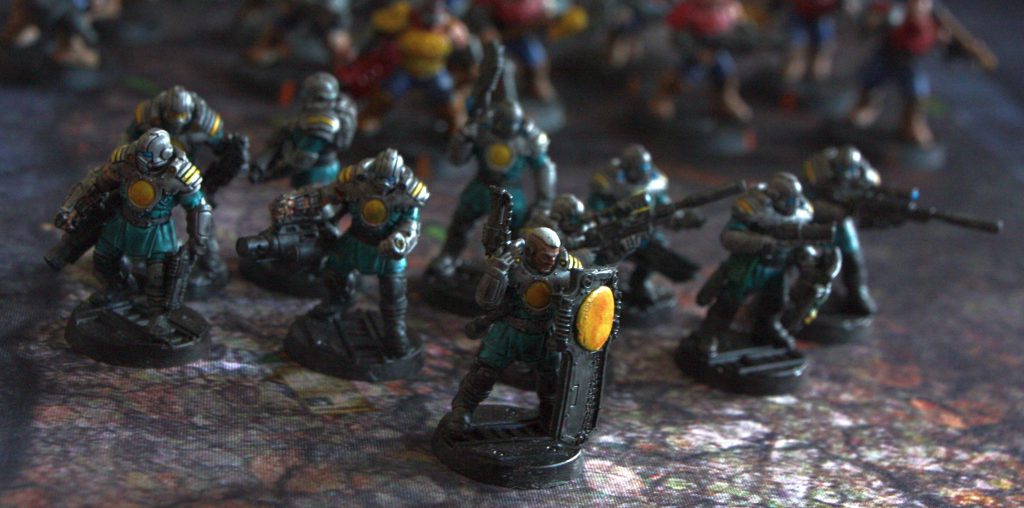 Bravo Oscar Bravo 8135th Precinct by Beanith
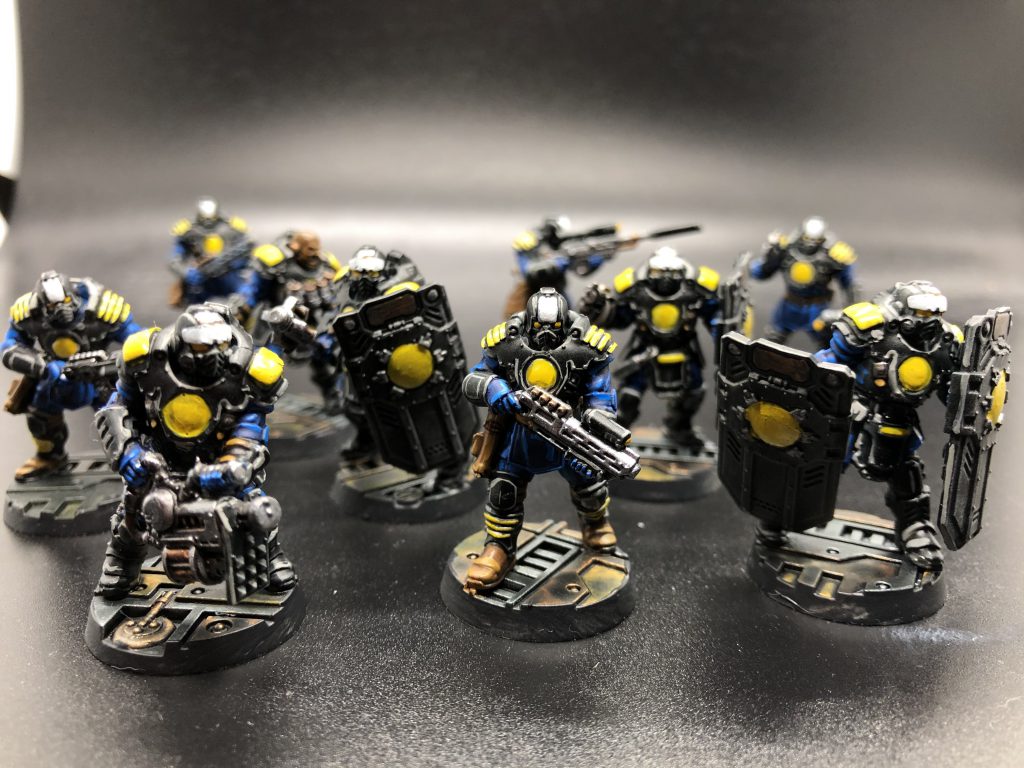
Unlike most gangs, Enforcers don’t have restrictions on basic Patrolmen using their listed Special Weapons. But there is a distinction between weaponry which is for Palanites (Rookies, Patrolmen and Sergeants) as opposed to Subjugators (and their Sergeants). Captains broadly use Palanite weaponry, although with access to a couple of Subjugator-tied options.
Enforcers also use the general Necromunda convention for the Trading Post (TP): any fighter can access that wider pool for Wargear, notably including grenades and armour. But only Captains and Sergeants can use weapons from the TP. Everyone else will be reliant on the options below, which, fortunately for Enforcer players, include some really good stuff.
Enforcer Boltgun: What if you took the best Basic weapon in the game, and addressed its only weakness, then shaved a bit off the price? Boltguns are great for any gang that can take them, and here they have their Ammo Roll dramatically improved, plus a small price cut to 50 credits. An absolute steal, the only issue with these is trying not to spam them, since your friends will soon grow tired of punchy, rapid fire D2 hits. It’s usable out to 24”, which is often all you ever need, and accurate within a generous 12” - this also makes it pair well with a cheap Telescopic Sight from the TP. Rating: A+, no patrol is complete without some.
Concussion Carbine: (not available to Rookies) Holy special weapon traits, Batman! This thing may look underpowered compared to the boltgun, at S3, -1AP, D1. Its range is also a bit worse, although still flexible. But the beauty of the carbine lies in its special rules. Blast weapons can do more than normal ones. You can affect multiple models at once and even a miss can clip enemies as the shot scatters (this is also a risk to your allies, I admit). You take a -2 to-hit penalty if the blast is not centred over an enemy model, but that’s no worse than targeting a model in Full Cover (and targeting a point on the floor gets around that cover penalty) so there will still be times where a blast template carefully aimed in the midst of multiple enemies is a good move. Knockback is situationally handy as careful positioning can net you +1 Damage, or make your opponent risk falling damage. Concussion inflicts a -2 Initiative malus on your target, which pairs excellently with Photon Flash Grenades. Seismic means a target hit must be Pinned, even if they have Nerves of Steel, are a Chaos Spawn (this could still use a bit of errata clarification) or Lobo-Slave, etc. It also makes hits ignore armour saves on a Wound roll of 6, which is surprisingly handy. For their bargain price of 30 credits, one of the cheapest non-grenade blast templates in the game, Concussion Carbines are a mainstay at Gang Creation and the Concussion and Seismic rules will keep them useful throughout a campaign, unlike many lighter weapons. Rating: A-
Enforcer Shotgun: the classic combat shotgun, it doesn’t get any additional benefits the way an Enforcer Boltgun does, but in fairness it is still pretty damn good. The reliability of the auto-hitting teardrop template at a relatively low price is a great tool to have. The salvo mode is nice against targets with light or no armour, but you may notice it’s strictly worse than the boltgun profile. The draw here is definitely the template, which makes a perfect tool for Rookies with their BS5+. Unfortunately, although the Enforcer shotgun’s price is slightly discounted from the TP version, it is a different weapon, meaning it cannot use Firestorm Rounds, the best additional ammo type in the game, which transforms the generic combat shotgun into a Heavy Flamer with Suspensors. You will still want 1-2 of these shotguns in any patrol to inflict mass pinning, and if you’re lucky some casualties, on the enemy, but you will find their actual killing power is highest in the early campaign, and falls off as opponents Advance their Toughness and buy armour upgrades. Rating: B+
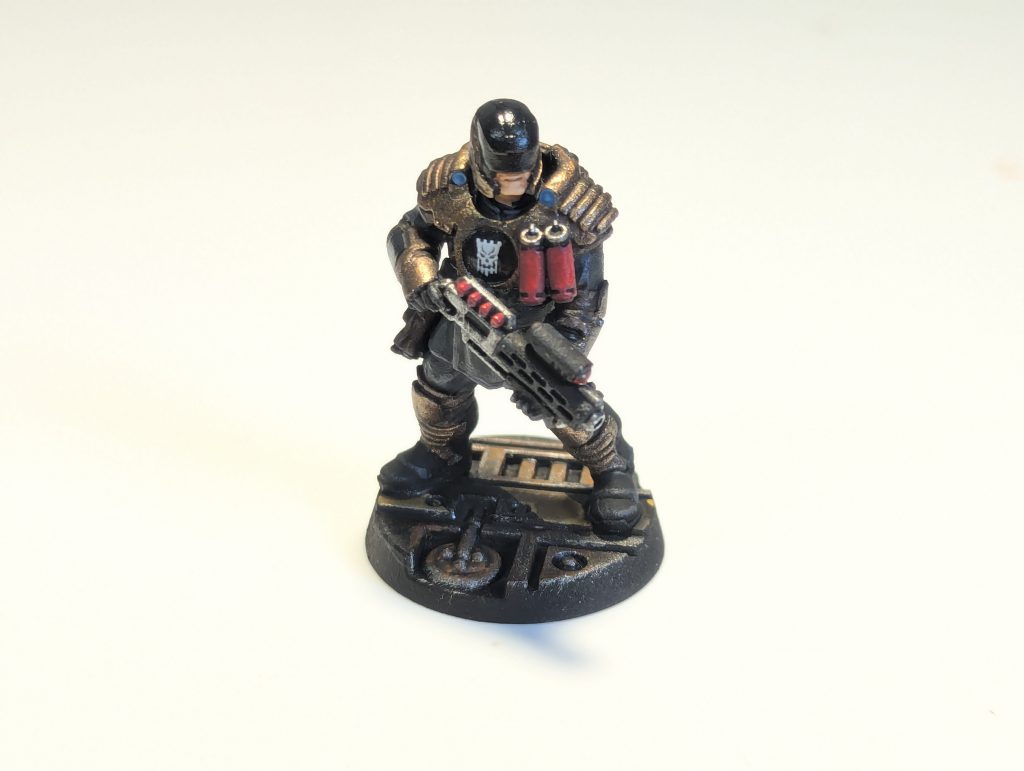 A Rookie didn't choose the shotgun life - the shotgun life chose him. Credit: Genghis Cohen
Sniper Rifle: (not available to Rookies) this is very similar to a Long Rifle, with Rending (not a bad little rule, extra Damage on 6s to Wound). It’s usable to 48”, gaining an accuracy bonus >24”, which makes it the premier option in the gang for truly long-ranged firepower. That will either be a great capability or a bit of a waste, depending on what sort of tables you play on, and we can’t emphasise enough how much those terrain realities will impact your enjoyment of the weapon. If you rock up to your friends’ coffee table and play 2x2’ Zone Mortalis games every week, even if you think snipers are cool, don’t bother! If you commonly use a misappropriated 40k table at your FLGS or club, then go nuts. Just remember that it’s only D1, so unless you can cunningly set up Knockback shots, you won’t often be doming Champions in one shot, unless Rending kicks in. Rating: B, higher if you play on big open tables.
Vigilance Assault Shield: Awesome name, awesome kit. The iconic Subjugator ‘weapon’ is really mostly a piece of extra armour. But it is a weapon, so not only can you use it to hit people in close combat, if you want to use it as one of dual weapons (to claim the +1 Attack bonus) you must allocate half your attacks to it. It gives no bonuses to Accuracy, Strength or AP, so this is a double edged sword (or shield - sorry not sorry). Basically, because they have 2A base, when charging, a Subjugator or Sergeant with a power weapon would probably be more dangerous if they weren’t using a shield! Unfortunately, most players and Arbitrators would agree that if you don’t use the Shield as a weapon, you can’t claim its protective benefits in melee.
The one upside of the VA Shield as a weapon is it has Knockback, so by rolling high on the hit roll, you can push your opponent back, either gaining Damage or moving them out of engagement and thus unable to make Reaction Attacks without Versatile weapons. Remember that using a Knockback weapon in melee does give you the option to ‘follow up’, moving the 1” in pursuit of your target. This obviously keeps you in Engagement if the target survives, and you survive their Reaction attacks; it also gives you the chance to Coup de Grace if your hits subsequently wound them, pierce their saves and Seriously Injure them. There are a lot of times when you’d rather some enemies stayed Engaged with your Subjugator, who can pretty easily gain a 2+ save against melee attacks from their front arc.
We also have to mention the practicalities and aesthetics here: shields are just part of the ‘look’ for Subjugators, and you can’t actually build the models with one-handed weapons without using a shield piece, or converting them - the only left arms in the kit are slotted for shields, or posed for carrying two-handed weapons. So, from a pure game point of view, it would be justifiable to buy a stronger melee weapon and an armoured undersuit at gang creation, leaving a shield as an upgrade for later. But in practice, we almost always start Subjugators by buying them a shield. Rating: A, basically mandatory.
Subjugator Grenade Launcher: a ‘normal’ Grenade Launcher costs 65 credits and is widely agreed to be an excellent budget special weapon. This is partly because of the Blast & Knockback rules (see Concussion Carbine above) on Frag grenades, but it’s also because of how punchy Krak Grenades are. Unless there’s a chance to catch multiple targets in one blast, or the only chance to hit is by using the blast to target around cover, most players default to firing Krak Grenades. The Strength, AP and Damage are too good to pass up. The Subjugator Grenade Launchers do not include Krak Grenades, you have to pay 35 credits extra. Now at 85 credits, Grenade Launchers don’t look so great. At 50 credits without krak, they’re way overpriced, even before we make the stinging comparison to Enforcer Boltguns.
These do include Stun Rounds, but despite their useful Concussion rule, those just aren’t as good as things like Concussion Carbines. You’re only going to fire those if there’s some specific reason to reduce enemy Initiative, like setting up for Photon Flash grenades, otherwise you’d fire a Frag. Just buy Photon Flash grenades for the launcher for 15 credits (see the grenades entry for how these work). Rating: B- with just Frag/Stun; B+ (fine but overpriced) with Frag/Krak; A- with Photon Flash.
Heavy Concussion Ram: Please note that this weapon has a 3” blast - in the Bastions of Law book it lacks that crucial info, which has now been FAQ’d. Hilariously, the same mistake was in the original Enforcer rules in the Book of Judgement - not great editing! However, even with Blast, this weapon, while not Unwieldy, takes up two weapon slots and costs 70 creds. For that budget, you get S4 over the carbine’s S3, and you gain a lot of range, shooting to 30” and accurate within 15”. If you play on bigger tables, that clearly has a use, but a Subjugator with this starts at 125 credits, a Palanite with a Concussion Carbine starts at 75. That also wastes the Subjugator’s greater melee combat capability by hanging back. Rating: C
SLHG Assault Ram. This is a weird one. For 90 credits, it’s a rather powerful Versatile melee weapon, which includes a grenade launcher. Unlike the regular Subjugator grenade launcher it has Frag and Choke grenades. The latter is a 3” blast Gas attack - it doesn’t pin, but a failed Toughness test causes targets to roll an Injury dice, circumventing armour and Wounds. Really not too bad a capability to have if you’re facing gangs with stacked armour saves. As a melee tool, it’s perhaps the punchiest in your arsenal - S+2, AP-1, D2, with the useful Knockback and Pulverise rules. Versatile gives a lot of flexibility and power.
It takes 2 weapon slots, but note that it is not Unwieldy. As odd as it seems, you can use it alongside a shield or another melee weapon; some players may find this difficult on WYSIWYG or ‘realism’ grounds. Rating: B
Stub Guns and Dum-Dum Rounds. Clearly, stub guns have a place for Enforcers, as for all gangs, as back-up weapons, as the cheapest way to make a naked Rookie usable or prevent a melee fighter being completely useless if Pinned, or alongside a melee weapon to give a cheap extra attack. But they aren’t really the point of any particular weapon loadout. Enforcers fighters either have access to really great ranged weapons, or they have 2A and should be taking a proper melee weapon and a shield. The stub gun is just something you take when you can’t afford those options. We commonly see new players add Dum-Dum Rounds to their starting Stub Guns. This is not a great use of your credits, our advice is really to save up for equipment that makes more of a difference - a Stub Gun is still a Stub Gun, does the bump to S4 make that huge a difference, especially if you’re sacrificing accuracy to do it? Rating: B for Stub Guns, C+ for Dum-Dum Rounds.
Autopistols and Special Ammo. Many gangs can make a reasonable choice between Stub Guns and Autopistols, because while more expensive, the latter is objectively better as a melee sidearm, and almost always better within 4”. So most of our points about the stub gun apply. The Manstopper (S4) and Fragmentation (-1AP) Rounds get top marks for coolness, but either is an additional 10 credits on top of the Autopistol, and you lose them permanently on failing an Ammo Roll. These upgrades can’t compete with the excellent Basic/Special weapons that Palanites get, and on Subjugators, there isn’t really room, they want a proper melee weapon. Rating: C+
Enforcers can access Shooting skills, which opens up Gunfighter builds with two pistols. This is very thematic if you want to convert a loose cannon detective (sorry, Scrutinator) who doesn’t play by the rules and jumps through the air while firing two guns and screaming. That might even be tempting under the impression that you’re accessing a starting ‘build’ for a Leader/Champion without spending many credits. But ultimately the pistols in the Enforcer Armoury aren’t punchy enough to make a Gunfighter worthwhile. You’d have to go to the Trading Post, something we’ll come back to later.
Shock Baton. Urgh. This is a terrible weapon; Shock and Parry are good rules but don’t justify the price for something that hits like a wet noodle. Rating: F
Power Maul & Power Knife. (not available for Rookies) These are both punchier and more worthwhile weapons than the shock baton, with effectively similar stats. The knife has S+1/AP-2 (its Backstab rule will very occasionally help) and the maul has S+2/AP-1. Since both are Power weapons, which will sometimes ignore armour altogether, the maul gets a bit more from that rule, but in practice, the differences are incredibly minor. We like the maul as being more thematic, but you could argue the slightly-cheaper power knife is the pro pick. Rating: B+ for both, they are really the bread and butter melee kit for your close combat fighters.
Power Sword. (not available to Palanite Patrolmen or Rookies) Our eagle eyed readers will immediately notice that this weapon has the same stats as the power knife, except it has Parry instead of Backstab. Now Parry is a good rule; it is a good benefit for a tanky fighter, giving that extra notch of survivability to an armoured, shielded Subjugator type. Beware of fighters with WS2+, who often won’t care, but even in those situations, it can be great to force your opponent to re-roll a 6 on a Shock or Power weapon. Is that trait good enough to be worth 25 credits straight up? Probably not. This is an OK choice, it works as a weapon, and aesthetically there’s a longstanding tradition that officers carry swords. But it isn’t that efficient. Rating: B-
Autogun: This is a standard Necromunda weapon, and there’s not much call for it in Enforcer gangs. Lots of gangs use autoguns as their early-campaign weapon, to give their supporting Gangers a useful ranged attack without much investment. If you could take them on Patrolmen/Rookies, there might be some point in doing so, to get extra armed bodies on the table right from Gang Creation. But the unique Palanite-type ranged weapons are all better deals, and none of them have such poor ammo rolls as to need a back-up gun. There’s just no reason to ever buy one of these for a Captain/Sergeant with their valuable shooting ability. Rating: D
Plasma Pistol. One of the best pistols in the game, this is definitely worth having on any Captain, or more rarely a Sergeant, who is looking to operate at close quarters. As well as the BS attacks, which are comparable to the Enforcer boltgun, if shorter ranged, if you are stuck in combat and don’t want to be there, the overcharged profile is the single punchiest close combat attack that your officers can make - a necessary risk for a 1A Sergeant if he finds himself in melee with an enemy Champion. Rating: A
Bolt Pistol. While undeniably cool, this is objectively worse than a plasma pistol for a measly 5 credit saving. It is also far worse than an Enforcer Boltgun, if you don’t need the Sidearm rule. It’s not strictly bad in itself, it is a punchy handgun, but the competing options are head and shoulders above. Rating: C
Heavy Stubber. Worth mentioning because it can fire out to 40”, albeit with poor accuracy, and Rapid Fire (2) means it’s not strictly awful. The perennial problem with this iconic Necromunda heavy weapon is it’s overpriced. For a minimal additional buy-in you can get a Heavy Bolter or other long range weapons from the Trading Post which put the stubber’s damage output to shame. Suspensors are practically mandatory on all Unwieldy ranged weapons, so the cost is just too high. This is one for fluff reasons only. Rating: C-
Web Gun. This is probably the most terrifying template in the game, and one of the most reliable weapons around at neutralising enemies within 8”. It bypasses Wounds and armour saves, which are the most common defensive tech, and to-hit penalties. You just need to roll to Wound, and it’s straight to an Injury roll, which is simply more dependable than almost any other Necromunda weapon. It’s infuriatingly good, and all the better on a Sergeant who can access gems like Overwatch, Got Your Six and Infiltrate (see the skills section). Web is also great for reliably setting up Coup de Grace charges with a Group Activation or a Cyber-Mastiff. The only possible criticism is that, as per the December 2025 FAQ, webbing enemies does not grant XP, so a champion wielding this may not shoot up in Advances. Rating: A+
Flamer. This is an OK template weapon, but why use it over Web Guns which are inexplicably cheaper? Blaze is a great rule, but overall it can’t stack up. Rating: C-
Confusingly, there are 3 exclusive types of Enforcer armour, and various options that are the same as available to other gangs, but the way the options are distributed across fighters is odd:
Photon Flash Grenades. Basically a flashbang to blind your opponent’s fighters, is both highly thematic, rather cheap, and extremely powerful. It has the short range of all grenades, but it is a 5” blast. When they hit, you are forcing enemies to take Initiative tests to avoid losing their Activations. So of course they are non-lethal, you are only delaying the enemy rather than taking them out. That will eventually be a problem, since you roll Ammo whenever you chuck a grenade and you can expect to run out after 1-2 uses per game. But they circumvent armour, Toughness and Wounds, as well as many special protective rules. So it’s a way that any Enforcer, for the low price of 15 credits, can (temporarily) neutralise the beefiest Goliath Forge Tyrant or rampaging Brute. Of course the usefulness will be less against gangs with good Initiative (or enemies wearing Photo-Goggles, which adds +1 to their roll).
You can increase the odds by smashing the enemy with Concussion weapons before chucking the Photon Flash, for -2 Initiative. We cannot recommend these things highly enough. It is a good idea to scatter them liberally around the patrol. I especially like them on melee Subjugators. Your Palanites have a job to do already firing their awesome ranged weapons. Cheap, effective grenades give the melee fighters something to do if they are pinned, or a charge is otherwise just out of reach. Rating: A, one of the best tools in the game against hard targets.
Infra Sights. These are an excellent improvement to any powerful weapon, except they can’t be put on any Rapid Fire or Blast weapons. So their use for Enforcers’ ‘house’ weapons is restricted to sniper rifles. That’s fluffy and cool, but paying 40 credits to improve the accuracy of a 35 credit weapon which isn’t especially punchy is a luxury purchase. Consider these after you’re happy with your weapons and armour, and remember to weigh them against the other weapon attachments in the Trading Post. Rating: B
Magnacles. All Enforcers carry these for free. You can use them by making a Fight (Basic) Action, or as part of a Charge instead of fighting. Essentially the target makes an Initiative check, if they fail they cannot move, make ranged attacks, and can only make melee attacks at -2 to hit. They can only break free with a Double Action and a difficult roll (equal to or under Strength on 2d6). This is obviously pretty strong against models that are great in melee but have poor Initiative. Magnacles are a strong, situational alternative to fighting that all your Enforcers have for free. Rating: A, probably wouldn’t ever buy them, but hey, they’re free!
 Credit: Greg Chiasson
In a rare, unexpected balance pass, the particularly bad/unworkable skills in this tree were updated in Bastions of Law. The Enforcers’ unique skill tree is available to all of their fighter types as Primary, and there are still two great skills which stand out:
The other skills are more situational:
Perhaps the best skill tree in the game, this has a lot of great choices for Palanite Sergeants and will be a common source of starting skill picks.
Any Palanite Enforcer gang can, on gang creation, pick a Prefecture to hail from. All 5 of these are tied to regions or hive clusters. This is a lovely imagination kick-start, to get players to think about where their gang is from on Necromunda, or if your group is playing in a setting/campaign tied to a certain location, it gives players a steer on potential themes. Mechanically, they aren’t that impactful. Almost none of the rules are extra, passive benefits for the gang, and those that exist are very minor. The bulk are either Skills or equipment which can be picked up (and paid for as normal) during campaigns. That means there’s a real opportunity cost, and few of these options are powerful enough to be incentivised over the better options in the generally-available rules.
One note on Skills - all of these options are extra skills for the Palanite Drill tree. Most importantly, this means that all of your fighters treat them as Primary. But it’s explicitly noted that they are not available for random generation, you have to pick them, which essentially means they cost 9XP (or can be chosen as a starting skill on recruitment for a Captain or Sergeant).
This prefecture is themed around the well organised, drilled teams of the central Palanite structure, and offers 3 available skills:
This is the cyber-mastiff prefecture! 3 skills are available, all expanding what fighters with attached cyber-mastiffs can do. Technically the rules all mention ‘Exotic Beasts’ but that is normally Hardcases - they’d also apply to generic things like Grapplehawks. The overall usefulness here is thus strongly tied to your views on Cyber-Mastiffs, which as discussed above, are cool, but limited compared to real human fighters.
Themed on the forces which patrol the Secundan Exclusion Zone and the Skull (a toppled hive which is probably infested with Orks), this is very clearly an option for vehicle-friendly campaigns, since its options are 3 pieces of vehicle wargear. So it will only be one you want to pick in Ash Wastes type campaigns, and there it will be an attractive option.
This prefecture features a rare, but highly situational, passive benefit: Badlands Prefecture gangs can access Bionics at a slightly reduced price (0-10 credits) and/or availability (some become Common, some go down a notch or two). That is characterful (the enforcers are apparently just grabbing bionics off the scrapheaps and surgically grafting them on) but close to irrelevant in terms of building a gang up through a campaign. There are also two skills:
Via the power of corruption, patrols from this prefecture get very slightly reduced prices (0-5 credits) and/or rarity (typically 1-3 notches) for chems. As with the Badlands’ bionic access, those are very gentle nudges, not amounting to much as a campaign benefit. But even more than bionics, which are at least situationally desirable if you’re unlucky with injuries, chems are famously not a good thing to spend credits on. Very few players are willing to spend on one-off benefits, even before considering the side effects. This is only likely to appeal to committed drug-corruption roleplayers, but there are a skill and a piece of wargear as additional options:
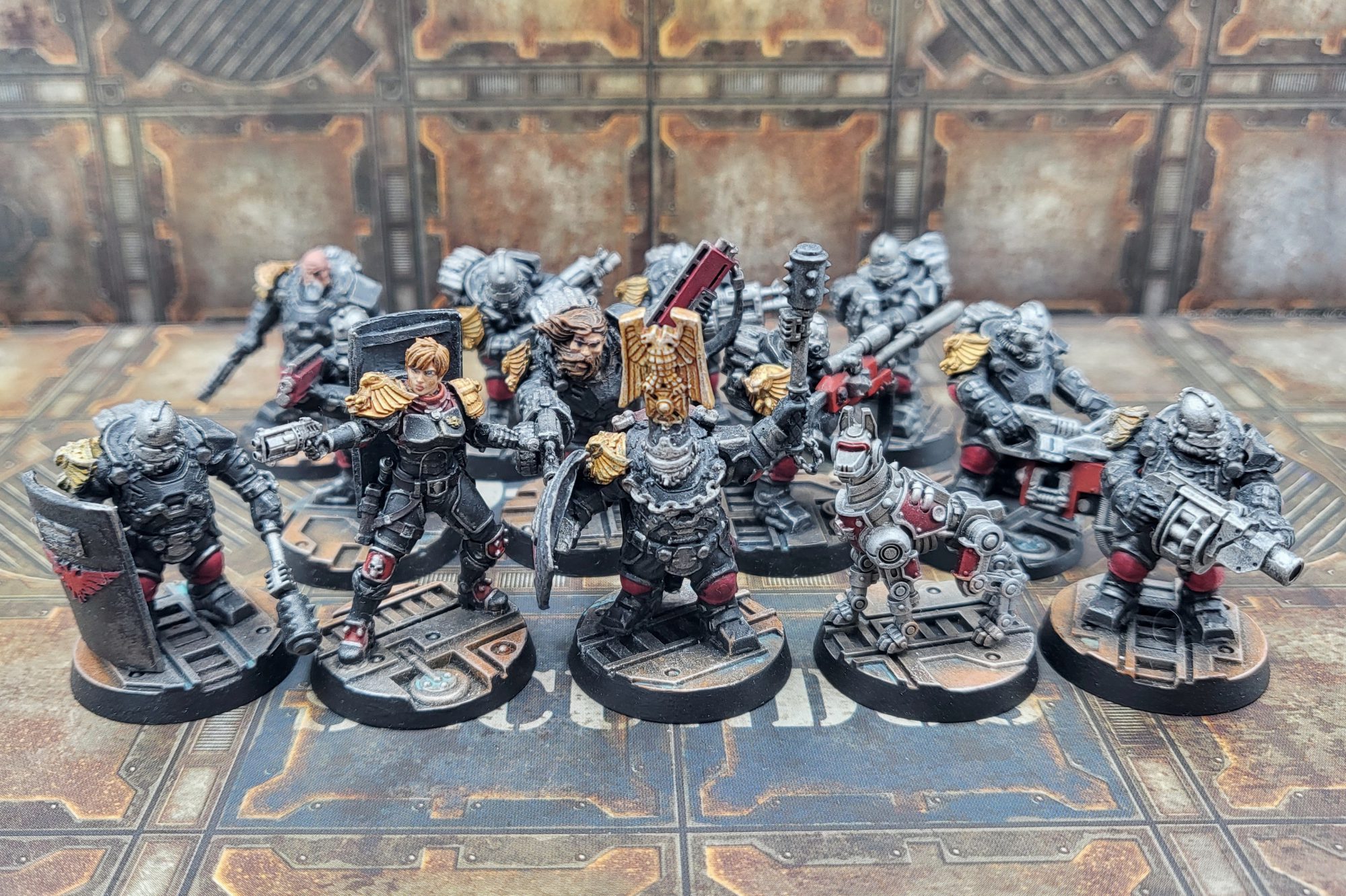
The Enforcer-unique crew is fine, but nothing special. They have 7+ across the board in the mental stats (most gangs get Cool 6+), but they do cost 30 credits which is similarly slightly below-average. They also have Savant & Driving as Primary skills, which isn’t really as good as having Shooting as Primary. It’s still Secondary for them, so not a huge problem. In most vehicle builds, that will be far and away the most important skill tree, so this just means it will cost 3 more XP if you want to unlock those crucial shooting skills. Overall this fighter type does what it needs to, providing a vehicle crew that’s also a Gang Fighter, helping out with gang composition.
The Enforcer-unique vehicle is a medium-weight, highly mobile shooting platform for one weapon. The combination of 7” Movement, 5+ Handling, with its Dedicated Gunner rule allowing it to move its full distance and fire a single weapon as a Basic Action (most vehicles are limited to half move distance), and 360 degree vision on its weapon mount, mean it should have no problem moving into position to fire. At the same time, 3 Hull Points and a 4+ save make it better protected than almost any light-medium vehicle - although below the custom Heavy vehicle or Rockgrinder, and far below the mighty Ridgehauler and its equivalents.
The starting options for the Tauros’ one weapon mount are twin linked Heavy Stubbers or Concussion Cannons. The former have good maximum range, but are -1 to hit from 20-40”, and that means that in certain Ash Wastes Visibility conditions they are always going to be at -1 to hit. Twin linked helps the Rapid Fire (2) stubbers a hell of a lot, making it likely to score 3 or more hits on a successful BS roll. Against that, Heavy Stubbers as a whole aren’t popular heavy weapons; players can simply get so much more punch for a little more investment, and the price difference is minor once you consider the already sunk costs of the vehicle and crew.
Twin-Linked Concussion Cannons have a drastically shorter maximum range (18”) but at least are more accurate, and the Tauros’ inherent mobility might offset that problem. Like all this line of weapons, their strength lies in the special traits. Blasts are always nice to have and Seismic has a vital niche in Pinning enemies who have invested in Skills like Nerves of Steel - it also gives the weapon a real boost against Mounted enemies, by our understanding of the rules it would force a Mounted fighter to go Prone and suffer the resulting hit for falling off. Concussion is actually a very good rule to use against enemy vehicles - because it affects their Handling stat, any wounds that go through are more likely to provoke failure on Loss of Control tests. Not only is that a good way to mess with your opponent’s movement and plans, you can fish for that magical ⅙ chance to roll and wreck the target whenever it fails. Hardly reliable, but against really big vehicles like Ridgehaulers, that’s actually one of the best ways to try and wreck them. Despite these great rules, the overall damage profile of the Concussion Cannons just isn’t that impressive. Neither stock weapon option is really competitive with Trading Post favourites - and remember, as with all vehicles, you can slap any TP weapon onto the Tauros Venator’s weapon mount.
So the Tauros can absolutely perform that role of zipping around shooting its one crew-operated weapon. The broader question is whether it compares well to the custom vehicle profiles (probably yes) or to the other preset vehicles (not so much). The sticking point here is price. A Tauros Venator hull runs to 140 credits, which is much more than the Ridge Runner (95) and just a smidge less than the heavier Rockgrinder (145). The former has worse Handling and Armour Save, the latter worse Handling and Movement, but better Toughness. But critically, both have two weapon mounts. There is a strong argument to be made that most vehicles are primarily shooting platforms - putting multiple strong weapons onto a vehicle is very efficient. Passenger-operated weapons are also quite strong since they can be used by your Sergeants, who can start with Shooting skills. Now we don’t think this is a one-way street, the more weapons you pile onto a vehicle the more eggs you have in that basket should it get wrecked, spin out of position and stall, get blinded by smoke grenades, etc. Additionally, having passengers on a vehicle operating weapons makes you very vulnerable to Blast weapons. But Enforcers players should be aware that the Tauros Venator is going to function a bit differently to the generally-available vehicles and is arguably a worse value. We don’t think it is at all bad in a vacuum, especially if you put a nice TP gun on it.
While it doesn’t have the complete freedom to pick Upgrades that a Custom vehicle enjoys, the Tauros Venator does have some of the better options available to it: Reinforced Armour to add another Hull Point is great, Tyre Claws to improve Handling into really safe territory is cheap and easy. For the Tauros’ crew, the Shooting skill Hip Shooting meshes very well with the vehicle’s role as a single-weapon mobile gun platform (as long as the weapon is not Unwieldy, so it would work on the Concussion Cannons, but not on the Heavy Stubbers). Shame it’s Secondary for your Palanite Rangers, but still worth picking at the 12XP cost. Action economy is a big deal.
Our advice in previous articles has always been ‘boys before toys’ with the aim of fielding 10 models, or close to it, in a starting gang. This is a stretch with regular Enforcers, just because their options for truly cheap weapons are limited. Palanites are really looking at the 30-credit concussion carbine as their entry level weapon, and the siren call of the 50-credit enforcer boltgun is hard to resist. Subjugators are more expensive at base, and if you are going with fidelity to the models, they usually want a 40-credit shield even before an offensive weapon. But as we’ve discussed in previous articles, what you really need in Necromunda is for each fighter to have one good weapon they can use to hurt the enemy. So our general advice is to give most of your Enforcers something they can do damage with, and because Palanites lack native access to good armour, skimp on the trimmings. There is often space for 1-2 Rookies with stub guns to provide Activations and run Coup de Grace threats, but we wouldn’t include more than that since it diminishes your punch.
Some example starting gangs:
If you only have access to Palanite models, say because you only bought that one box, it makes sense to focus your starting gang on shooting. Bear in mind the 10-model kit comes with options for 4 boltguns or shotguns, but only 2 concussion carbines and 2 sniper rifles, so some slight proxying may be needed. The only real problems with this format are that it’s a bit dull visually and in gameplay, and since no one has a scrap of armour, casualties are certain.
Palanite Captain: boltgun, Got Your Six - 170 credits
Palanite Sergeant: boltgun, Trick Shot - 130
Palanite Sergeant: boltgun, Fast Shot - 130
Palanite Patrolman: concussion carbine - 75
Palanite Patrolman: concussion carbine - 75
Palanite Patrolman: concussion carbine - 75
Palanite Patrolman: sniper rifle - 80
Palanite Patrolman: sniper rifle - 80
Palanite Rookie: enforcer shotgun - 85
Palanite Rookie: enforcer shotgun - 85
Total: 985 credits, 10 models
Assuming that many players will mix in the Subjugator and/or Captain/Sergeant/Cyber-mastiff boxes, a more interesting gang can be made. This has a couple Subjugators to provide front line blocking and melee threats:
Captain: enforcer boltgun, armoured undersuit, Fixer - 195
Subjugator Sergeant: power maul, vigilance assault shield, photon flash grenades, layered flak armour - 195
Palanite Sergeant: boltgun, Fast Shot - 130
Subjugator Patrolman Specialist: vigilance assault shield, power maul, layered flak armour - 145
Palanite Patrolman Specialist: enforcer boltgun - 95
Palanite Patrolman: concussion carbine - 75
Palanite Patrolman: sniper rifle - 80
Palanite Rookie: enforcer shotgun - 85
Total: 1000 credits, 8 models.
Do you think Subjugators are rad? Do you have little regard for common sense and a righteous fury to nightstick the revolting subjects of Lord Helmawr? Is your gaming group a long way from competitive? Try roleplaying an all-Subjugator battalion!
Captain: enforcer boltgun, riot shield, armoured undersuit, Got Your Six - 230
Subjugator Sergeant: power maul, vigilance assault shield, photon flash grenades, layered flak armour, Threat Response - 195
Subjugator Patrolman Specialist: vigilance assault shield, power maul, layered flak armour - 145
Subjugator Patrolman: vigilance assault shield, power maul, layered flak armour - 145
Subjugator Patrolman: vigilance assault shield, subjugator grenade launcher, layered flak armour - 155
Subjugator Patrolman: vigilance assault shield, photon flash grenades, layered flak armour - 130
Total: 1000 credits, 6 models
Palanite Enforcers are a gang defined by the excellent mid-priced weapons available to all of their fighters; it makes them a gang where absolutely all of your models can be credible threats to most of your opponents’ models. They have a good skill selection and all the tools available to create well rounded gangs that can cover some melee as well as their core shooting skillset. They also enjoy thematic and powerful Brutes, Hangers-On and beasts that can genuinely add something to their regular fighters.
Have any questions or comments about Enforcers? Want our opinion on adding them to your campaign? Want to share photos of your rad Enforcer gang with us for us to feature in a future article? Feel free to start a conversation with us in the comments, hit us up on Facebook, or email us at contact@goonhammer.com. We’d love to hear your thoughts about Enforcers or the Book of Judgement or whatever else! We’ll be back next week with another Necromunday column, so make sure to check back. Thanks for reading, now get out there and indiscriminately stomp some bad guys, rookie!
Have any questions or feedback? Drop us a note in the comments below or email us at contact@goonhammer.com. Want articles like this linked in your inbox every Monday morning? Sign up for our newsletter. And don't forget that you can support us on Patreon for backer rewards like early video content, Administratum access, an ad-free experience on our website and more.
Tags: necromunda | Necromunday

Thank you for being a friend.
 Goonhammer App and Patron Updates: April, 2026
 Kill Team Tournament Report: Engage, Party, Repeat's March Madness 2026
 Goonhammer Reviews: Tribal Conquest
Support us on Patreon to get access to our Discord and exclusive App features.
Thank you for being a friend.
Already a Patron? Login with Patreon.
Visit our incredibly official store on RedBubble.

Support us on Patreon to get access to our Discord and exclusive App features.
Thank you for being a friend.