If high-tech power suits, time travel, and clashes with destiny sound like your cup of tea, Atomic Mass Games has just the box for you with their descriptively titled Iron Lad, Iron Monger, Kang the Conqueror & Rescue character pack. The set covers a wider array of affiliations than most Marvel Crisis Protocol sets, with reinforcements for Shield, Avengers, A-Force, Criminal Syndicate, and Cabal (and, most likely, our first member of the yet-to-be-released Young Avengers).
Today, we’re breaking down this box of tech-enabled heroes and villains to see how they play, how good they look, and where they’re likely to fit in.
Characters
Iron Lad
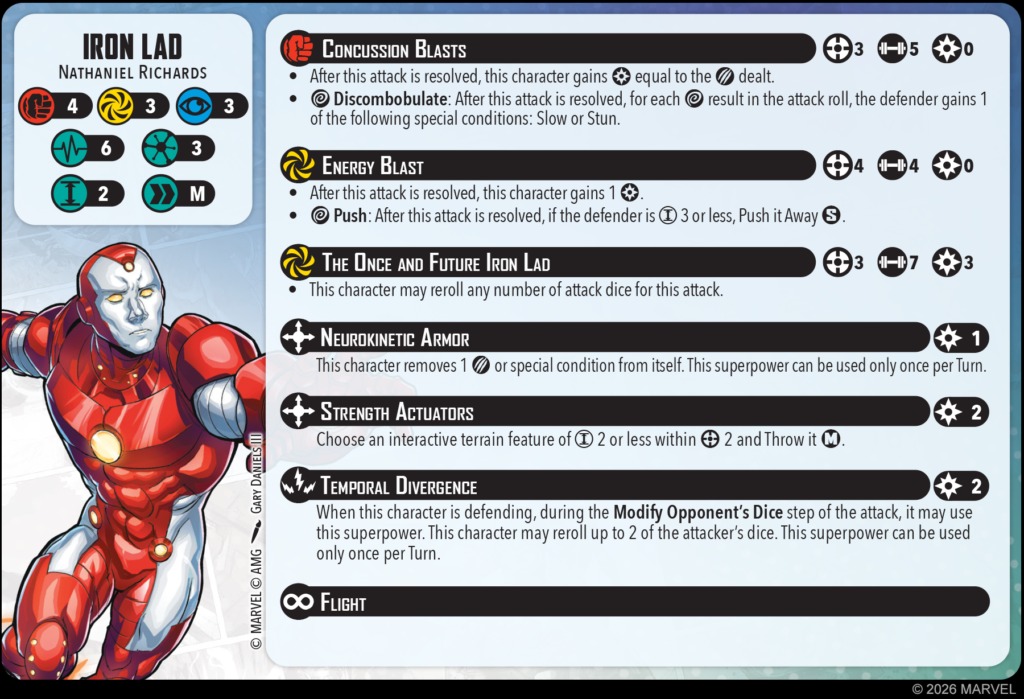 Note: Iron Lad has no changes on his Injured side.
Iron Lad might look like Iron Man, but young Nathaniel Richards is actually a time-displaced hero trying to escape a possible future - someday becoming the horrible Kang the Conqueror. In MCP, Iron Lad is a jack-of-all trades, boasting reasonable damage, tankiness, and displacement.
Lad’s card starts strong with two solid 0-cost attacks.
Concussion Blast has average range and strength but can add Slow and/or Stun (not limited to one).
Energy Blast may be weak with only 4 dice, but range 4 and a Wild Size 3 Push Away is a great option to have. When he needs to do damage,
The Once and Future Iron Lad has a much higher damage ceiling. 7 Dice for 3 power is standard, but the ability to reroll any (not all!) gives it great consistency.
However, Lad is a jack-of-all-trades model, and his moderate damage output is matched by some above-average durability. His stat line of 4-3-3 with 6 HP on both sides is a solid start, but
Neurokinetic Armor lets him heal damage or remove conditions each activation, and
Temporal Divergence lets him reroll attack dice while he’s defending. Add on his
Strength Actuators that let him throw terrain, and he can do a little bit of everything.
Note: As previewed, Lad’s throw is not limited to once per turn. This would be an incredibly unique mechanic, and it’s not yet clear whether it's intentional or a misprint.
Iron Lad reads as a very solid workhorse 3-threat that most affiliations would be pleased to have. Unfortunately, at release, Iron Lad has no affiliations. Fret not, though, as it seems very likely that he’ll be part of the upcoming Young Avengers.
Kang the Conqueror
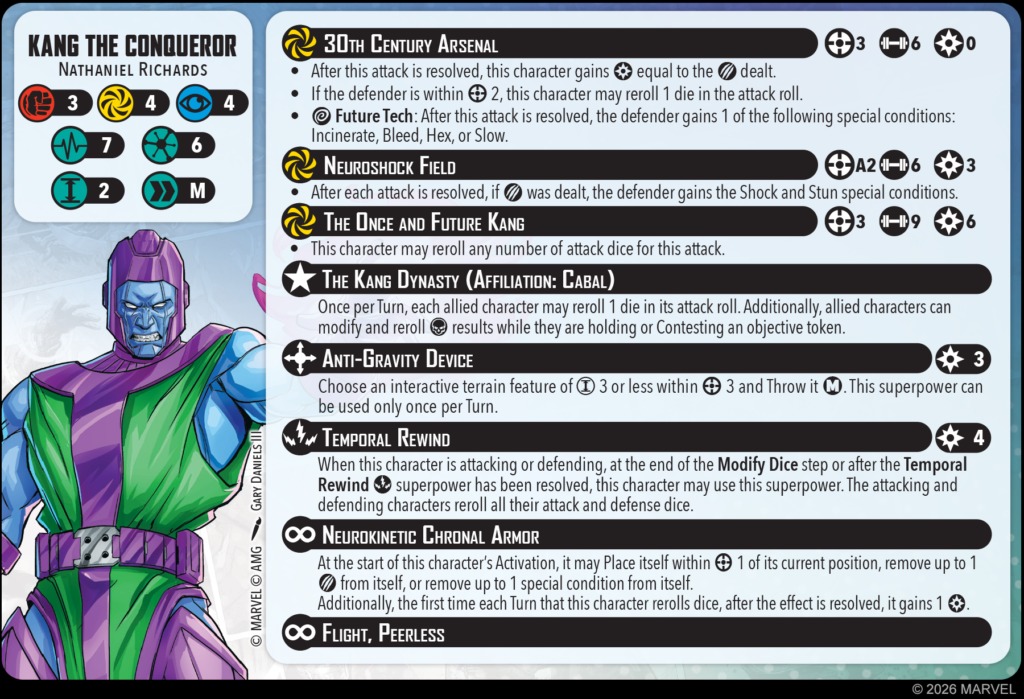 Note: Kang has no changes on his Injured side.
Thematically paired with Iron Lad is his future self, the iconic villain Kang the Conqueror. Kang comes in at a whopping 6 threat and is the fourth leader for the Cabal. Despite his unique abilities in the comics, Kang is a surprisingly - and, in my opinion, disappointingly - straightforward character. That isn't to say he isn’t good. My limited testing so far has found him to be fairly middle-of-the-road, but it’s a rare AMG theme miss that all of his time travel and other shenanigans boil down to just rerolls.
Kang makes a strange first impression as a 6-threat with very low defensive stats, more in line with what one would expect on a 4-threat, not a 6. 3 physical defense is poor, and 4 energy and mystic aren’t anything to get excited about. Moreover, only 7 HP means that Kang's death from even weak attacks is a real concern.
However, Kang isn’t designed to be a tank. Instead, he has reasonable attrition and access to some strong conditions. His builder,
30th Century Arsenal, throws 6 energy dice at Range 3, but it gets a reroll if the target is within Range 2 and can give one of Incinerate, Bleed, Hex, or Slow.
Neuroshock Field is also 6 dice (and costs 3 Power), but it’s an area attack that dishes out both Shock and Stun. So, while Kang is squishy, he can drop debilitating conditions that will help him stay alive.
But, like Iron Lad, Kang has a big spender that can easily put people in the ground.
The Once and Future Kang costs six power, but it’s an impressive 9 dice and, like Iron Lad’s similarly named attack, lets Kang reroll any number of dice. Simply put, it’s one of the strongest single attacks in the game.
Kang also has a few other tricks up his sleeve to help him survive or attack more. His
Neurokinetic Armor grants him mobility or damage/condition removal, and
Temporal Rewind is Recalibration Matrix on a stick. If enemies drop a big hit into Kang, he can simply make everyone reroll their dice (and it's not once per attack). He also has a terrain throw that isn’t particularly impressive for its cost but can add to his damage output, and extra power when he rerolls dice helps him fun his kit.
Last but not least is his Cabal leadership ability,
The Kang Dynasty. It’s simple in concept - each character may reroll 1 attack die once per turn, and if they’re holding or contesting Objectives, they can modify Failures. It’s not flashy, but with characters like Kang and Zemo able to reroll any dice on attacks, it stops them from being “Skull locked.” Is it a bit more straightforward than I’d like for someone like Kang? Yeah. Is it strong? Also yes.
Iron Monger
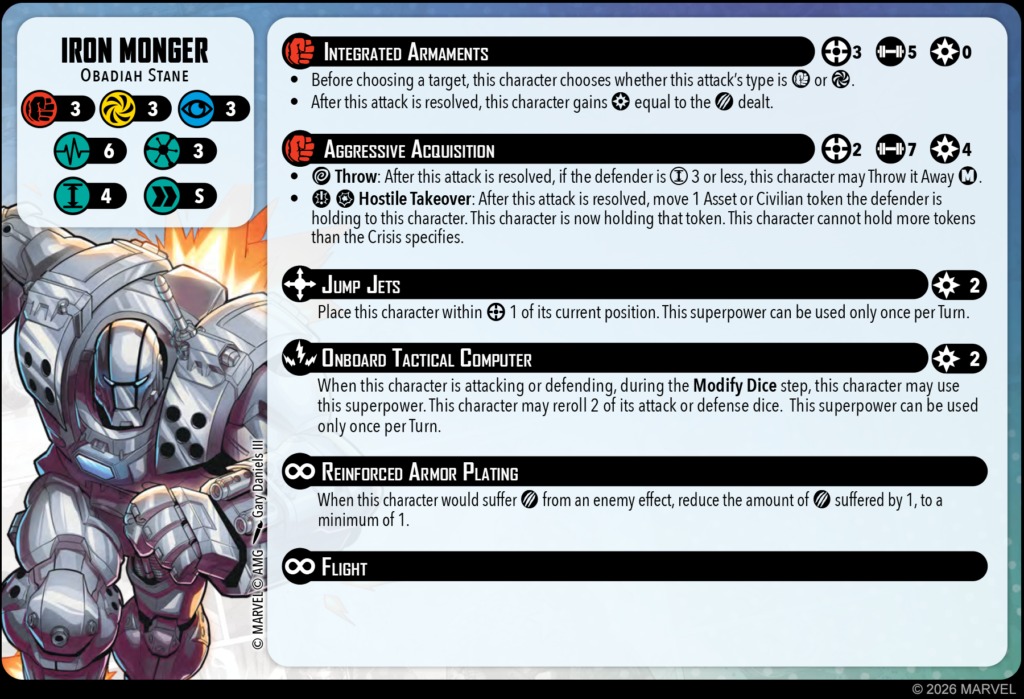 Note: Iron Monger's only injured side change is a drop to 5 HP.
The next tech-powered villain in the box is Obadiah Stane, aka evil Iron Man, aka Iron Monger. Like Iron Lad, Monger reads as a rock-solid staple for his affiliations, which, according to the Timelines Document, appear to be Criminal Syndicate and Cabal.
From a raw stats perspective, Monger is quite tanky for a 3-threat with 3-3-3 Defense, 6 HP, Damage Reduction, and an
Onboard Tactical Computer that lets him pay to reroll 2 attack or defense dice. He’s also set to be only the second 3-threat on a 65 mm (large) base.
His
Integrated Armaments are perfectly par at 5 dice range 3, but choosing Physical or Energy may let him pick on weak defenses.
Aggressive Acquisition is more exciting because, for 4 power, it can both throw the target and steal an Objective. It’s not reliable, but the upside is good enough to take the gamble.
Last,
Jump Jets allow Iron Monger to place Range 1, letting him get into position to attack or move to safety. Overall, Iron Monger isn’t flashy, but I expect to see him a whole lot in both of his expected affiliations.
Rescue
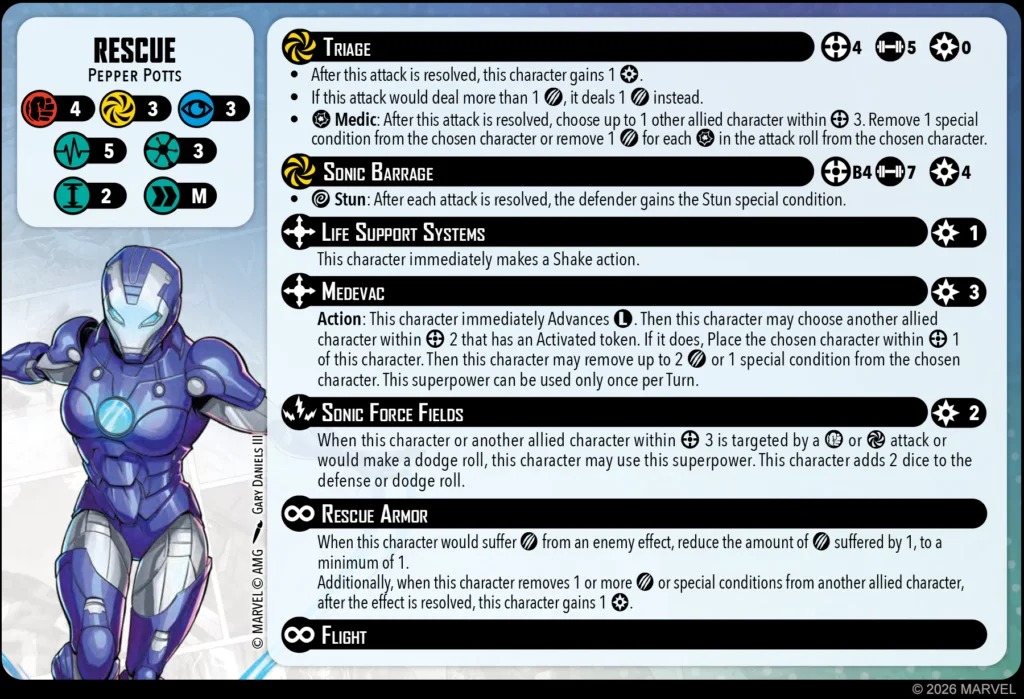 Note: Rescue's only injured side change is an increase to 6 HP.
Of all the tech-powered characters in this box, Rescue is the hardest to get a read on without more table time. I’ve played with her or against her a few times, and my big takeaway so far is that it’s going to be a tough decision during Squad Selection to determine if a pure support model will pull its weight.
Rescue’s free attack,
Triage, does what its name implies. It’s got great base stats at Range 4 and 5 dice, but its damage is capped at 1. Instead, for every Hit in the attack roll, Rescue can remove one damage or one special condition from an ally within 3. That’s a lot of potential healing! However, in a pinch, Pepper Potts can still lay some pain.
Sonic Barrage is a Range 4 Beam attack that can Stun, which is no joke.
After that, though, her superpowers are all about support. The most unique, and also the most niche, is
Medevac. For an action, Rescue can move long and pull an ally to safety while healing them. She can also add dice to an ally’s Defense rolls, and she gains power every time he heals someone.
As I said, Rescue is going to be interesting because MCP really doesn’t have any other pure support pieces outside of Wong, who is a 2-threat. She seems like a great companion for any of the Hulks (she’s affiliated with several in Avengers and A-Force).
Team Tactics Cards
While Kang’s character card is straightforward, AMG put all the wackiness on his TTCs. Each one has a lot of wording and can be challenging to parse at first glance, but the effects are relatively straightforward. Not that they can all also be played by Iron Lad, as they share an alter ego.
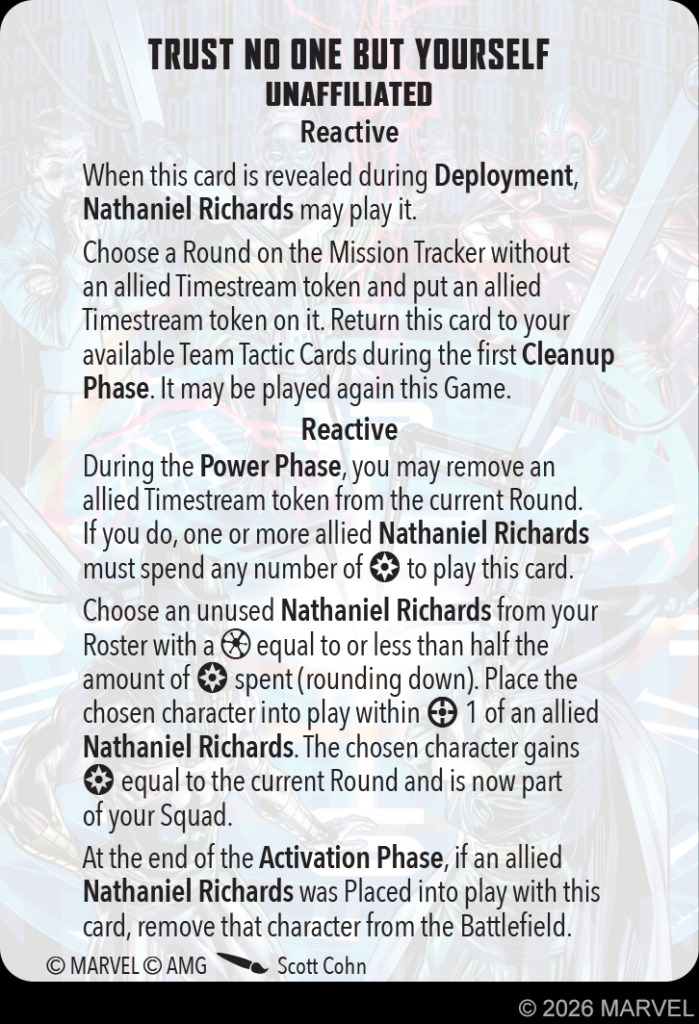 Trust No One But Yourself
 is the most unique. At the start of the game, the player places a Timestream token on a specific Round of the score tracker. During the Power Phase of that Round, Nathaniel Richards can pay any amount of Power to spawn another Nathaniel Richards with a maximum Threat of half the Power paid. Put even more simply, on a pre-determined Round, Kang can pay 6 Power to summon Iron Lad, who gets Power equal to the round and sticks around until the end of the Activation Phase. Given Kang is 6 Threat, Iron Lad cannot play the card (double 6 is 12, which is above max Power), but it will scale with any future Kang variants who come to the game.
In my testing so far, this card is quite strong. Placing the token on Round 3 means that Lad comes in with enough power to drop a spender. It’s also great to play Sacrifice onto Lad to protect your other models since Lad goes away at the end of the Round anyway. The downside is that if Kang doesn’t have the power at the start of the pre-selected Round, the card does nothing.
Note: As written, you cannot remove Iron Lad from the battlefield at the end of the Activation Phase if he’s Dazed, as Dazed characters cannot be affected by special rules. This is almost definitely an oversight, and I recommend removing him as specified until AMG can issue a ruling or Errata.
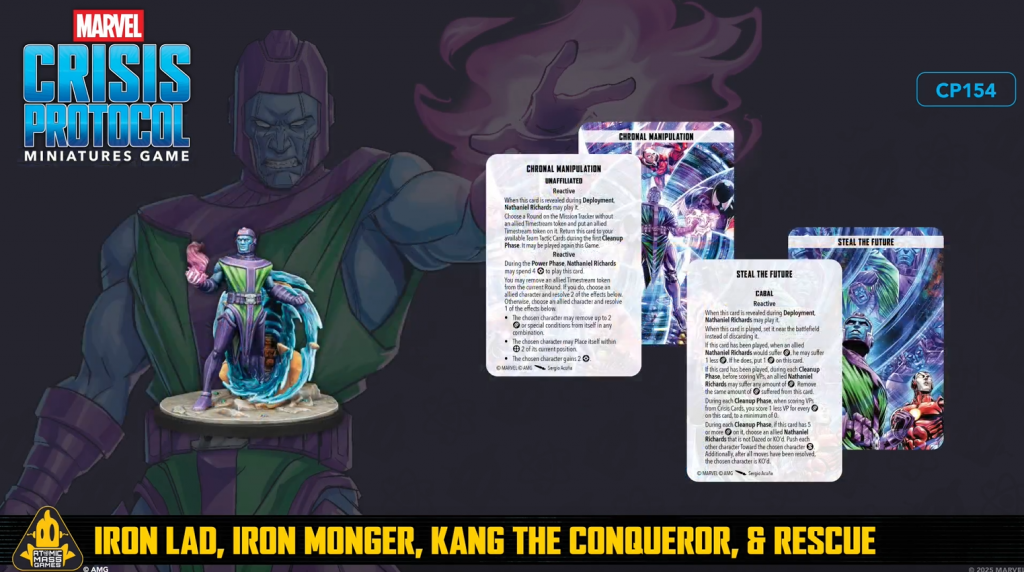 At the time of this writing, no higher-definition images of these TTCs have been released by AMG.
Chronal Manipulation
At the time of this writing, no higher-definition images of these TTCs have been released by AMG.
Chronal Manipulation also asks the player to put a marker down on a Round and, given it’s the same marker used for the previous card, playing both gives players flexibility with which effect to use when. This card allows either Iron Lad or Kang to pay 4 Power to move, heal, or power up an ally. If this is done on a round with a Timestream token, you choose two of the three effects. If it’s done on another Round, pick 1. Note that the card appears to tell you that you can use the effects more than once, but that’s not the case. Players play the card to place the Timestream token at the start of the game, then it returns to your pool of cards to be played again to get the described effect. Nothing tells you to put it back into your pool again after that.
I’ve seen some hype around
Steal the Future, but to be frank, it seems pretty bad to me. Let me explain. In short, the card does this: Each time Kang would take Damage, he can reduce the Damage by 1 and instead put that 1 Damage on the TTC. Then, during the Cleanup Phase, Kang (or Lad) suffers all the Damage stored on the card, or his controlling player scores that many fewer VPs. So if you’ve reduced damage twice, you either take 2 Damage in the Cleanup Phase or you score 2 fewer VP that round (and make the same decision next round).
Here’s the issue - if Kang Dazes or KOs while there is damage on the card, the result is absolutely disastrous. If there is damage on the card and Kang Dazes, his controlling player is forced to take the negative VPs, but the damage also doesn’t leave the card - you’ll have to either put it on your Injured (and already squishy) Kang next round or continue to lose VPs. If he’s KOd with Damage on the card, you’re forced to take negative VPs every round moving forward, as the card doesn’t disappear when Kang KOs. There are niche situations where the card will let Kang get an activation in before Dazing, but that’s such a niche situation and comes with such massive risk that I don’t see a world in which this card is worth taking in your 5.
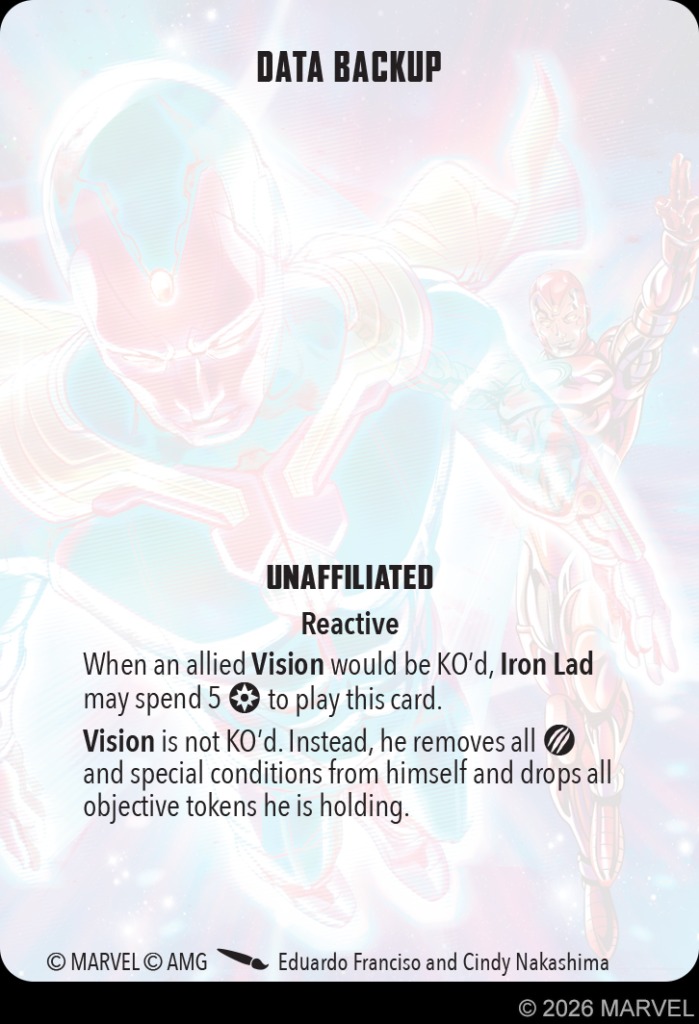
Iron Lad also has a card all to himself.
Data Backup is a team-up card with Vision (who could reasonably be affiliated with Lad in the Young Avengers) that lets Lad prevent Vision from KOing and instead remove all damage from Vision (though he remains on his Injured side). Team-up cards are usually a tough sell since they require specific Squad compositions, and Vision isn’t currently seeing much play, so it’s tough to judge this one until Iron Lad (and possibly Vision) have their new affiliation.
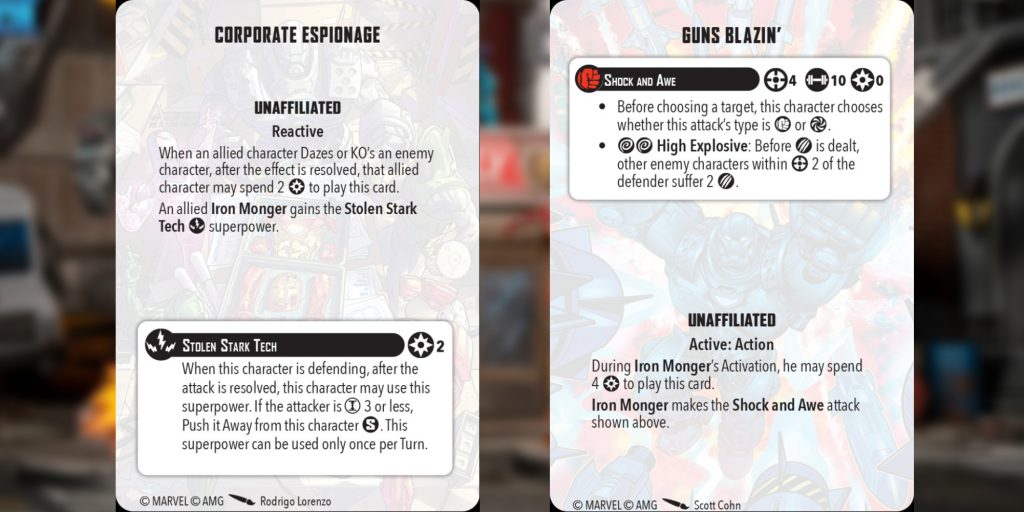
Moving on to other characters, Iron Monger has a great offensive and defensive TTC.
Guns Blazin’ grants him access to use a massive Range 4, 10 Dice attack for 4 Power that can do 2 splash Damage to other enemies in the area. This is fine in its own right, but it pairs with Cabal’s Dark Reign well to give Monger the ability to reroll any dice in this huge pool. Defensively,
Corporate Espionage gives Monger a tool similar to Blob. When an enemy of Size 3 or less attacks him, he can pay 2 Power to push them away. Both cards are reasonable, and I expect to see both pop up in different lists.
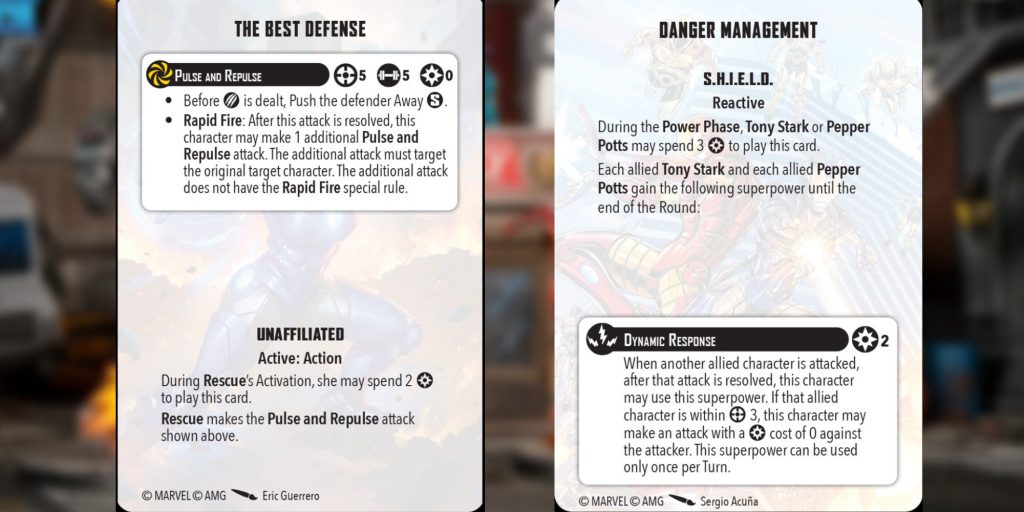
Rescue also has two TTCs.
Danger Management is a SHIELD-Affiliated, Iron Man team-up card. It lets Rescue and Tony both make 0-cost attacks after an enemy attacks a specific ally. Given Rescue’s attack heals and Iron Man’s pushes, it’s got the potential to be quite a strong effect.
The Best Defense is unaffiliated and gives Rescue some displacement, letting her make an auto-rapid-fire attack at Range 5 that automatically pushes the target away. Her Tony team-up seems stronger, but SHIELD is famously full of great TTCs, so it might be tough to fit it in.
Overall, this tech-powered box is another big win for AMG. While I’d like to have seen Kang be a bit more thematic, each character in the box seems strong enough to see consistent play and brings at least one new mechanic or combination of effects to the table.
Thank you for being a friend.
 This website uses cookies. Learn more.


 Goonhammer App and Patron Updates: April, 2026
 Kill Team Tournament Report: Engage, Party, Repeat's March Madness 2026
 Goonhammer Reviews: Tribal Conquest