Learning how to paint is a process, a punctuated equilibrium that proceeds in stately steps should we wish it to. We attempt, we learn, we master. We get better. We rarely get worse. There’s an almost relentless pressure to improve in some way. More detail. Less detail. Smoother blends. Better colour placement. Read this, watch that. The How of building and painting changes too, with new kit and new ways to do what we’ve always been doing. Every day, it seems, there’s another video or Insta post about using a technique that purports to be new to us - oils, grisalle, hot glue, fabric, glass, hair, isopropyl alcohol - but is well established outside the confines of metal, resin, and plastic.
We tell ourselves that for our community technique is all - don’t we just love how to do better? Achieve smoother gradients, or crisper edges, improve your speed or banish procrastination. Sometimes hobby painting becomes mechanical, so enmeshed in a way of doing that it becomes rote. In a rush to paint to play, or to master the pile of opportunity, do we strip something out of our art? Sometimes I see a flash of the Singing Butler when I’m at my hobby desk - am I Jack Vettrianoing our way through the same praxis, to create an infinite mediocrity, and if we are, how can I escape it? What could happen if we looked outside of our hobby for guidance? Perhaps there are perspectives to be found out there that approach creation differently, that will allow me - us - to think about our hobby in a different way. I want to find them.
Welcome, then, to The Warhound. Over the next few months I’ll be making a titan through the guidance and inspiration of craftspeople, artists, professionals, and friends, to see what we can learn as hobbyists from the world around us. One model, one year to complete it. Lots of time to learn.
Intent
The Warhound was a gift, given thoughtfully by a group of comrades. That’s a good place to start. It means that there are no expectations, no schedules, no requirements. I don’t have to make it - I want to - and I don’t have to write about it (but I will). The motivation for doing so is somewhere between internal and external. I feel, have felt, a compulsion towards this challenge, and looking to the arts and crafts world around for guidance is as solid a hook as any. So why do we make, and what are we saying when we do it?
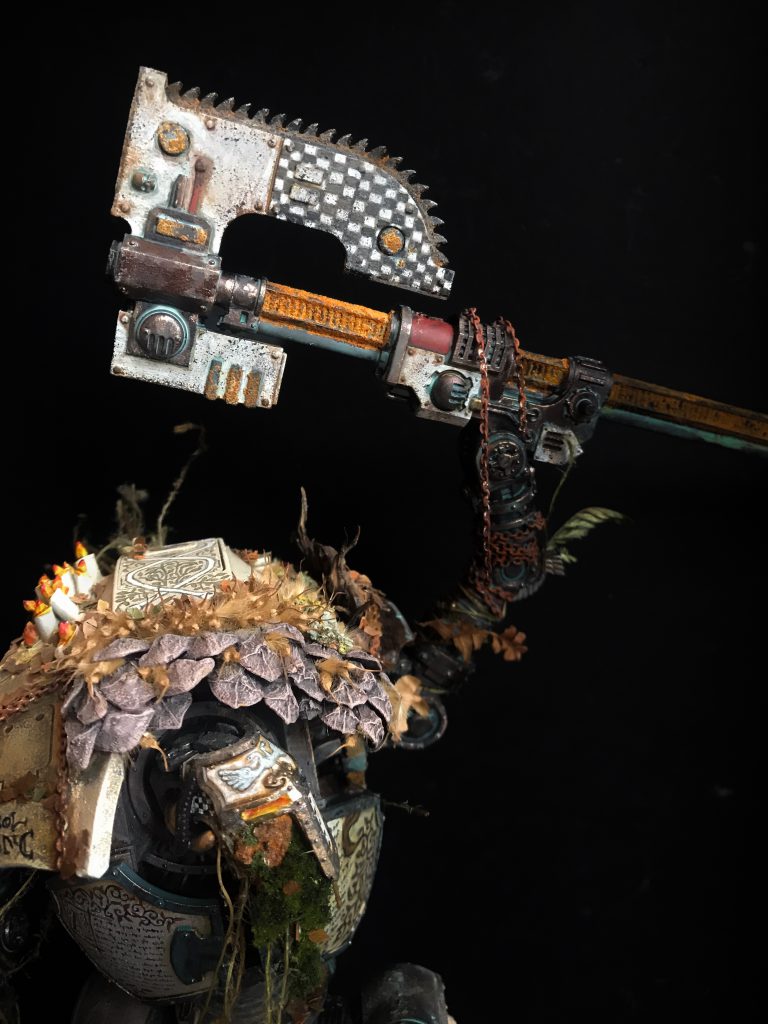 Where do we go from here? Lenoon's Lancer
To an extent I know exactly why I’m making this. It’s the next logical step, right? I started small, went big, bigger, biggest and stopped, and wept, no more affordable worlds to conquer given the arrival of my own Elladan and Elrohir. I know we’ve been a species - a family - obsessed with making for millions of years. I’ve stood and looked out at a landscape stretching to infinity lined with nothing but the made, and live in the dying world we have created in an act of environmental destruction unrivalled since the birth of blue green algae. We make things. I make things.
“I want to make a Warhound” is a known truth - Christ knows I’ve hinted/flat-out said it enough - so this is a gift given in acknowledgement of the need that I have to do this, with excitement to see what comes next, but no expectation or demands. There’s perhaps a little pressure - what is that weirdo going to do this time - but at most that is a cursory interest, lightly worn. I can, effectively, do anything. So what do I want to do?
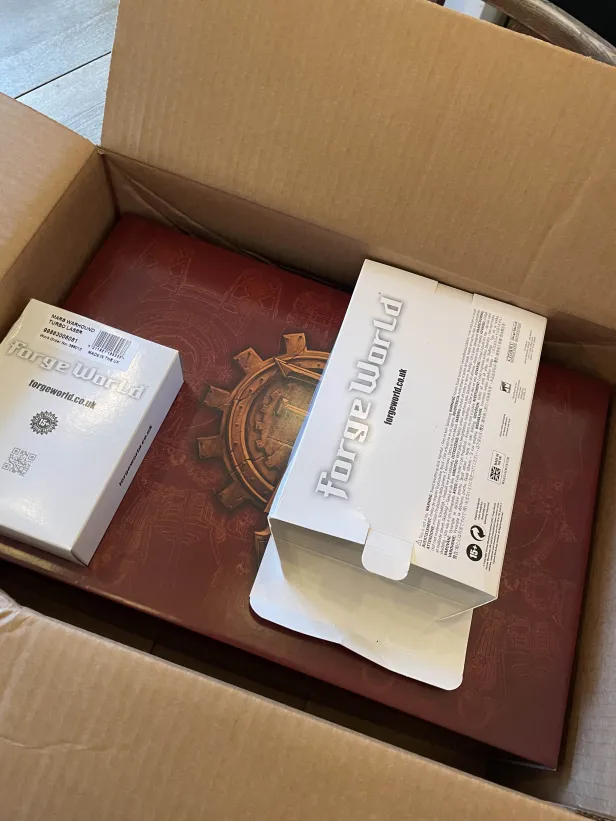 The most exciting box I've ever opened
A hard question to answer. I make a foot. It goes well. Then, I’m stuck.
Therapy
I’m not sure how we decide what we want to do when we’re making our models. There are considerations - rules, base sizes, equipment, silhouette - that I don’t tend to pay attention to, and WYSIWYG is long dead in my hobby space. There are others that matter, to the extent they have to. Instructions are one, the precise ordering of part and piece. Kitbashes work alongside instructions, swap a head for a head, add a piece or switch out a component. There’s certainly an instruction set for the Warhound, such as it is - six a4 sides of pictures of various completed components, and they will be followed to make it a titan as opposed to a heap of resin shattered on the tabletop. My process, if it can be called one, is chaotic, stop-start, with little forethought, and that won’t work this time. I want to create something, and get advice along the way, but there’s no clear idea beyond that this one has to be special. The blank page of creation should be filled by the vision of the Warhound-that-waits, the model that already exists within the big, red, box. It isn't. It's hazy, nebulous, shifting between too many half-formed ideas. I don't know what I want to do here.
Saying and doing what I want is difficult. I’ve been working through it, slowly and occasionally painfully, and the knights have been part of the process, but it remains hard for me to say this is what I want/need/will do. That difficulty is reflected in my Warhammer. As long as I can’t say I want this, I'll remain chaotic, and while I’ll give myself that liberty with easily replaced plastic, this is a challenging build and a capstone to five years of building increasingly large weirdoes. I need to operate differently, to find a route through chaos that retains everything I like about it, but means I won’t have to smash apart a titan with a hammer to rebuild it. To even start thinking about how I want to build this monstrous resin chunk, I need to be able to say what I want to achieve. So, on a Wednesday night, I resolve to talk it through.
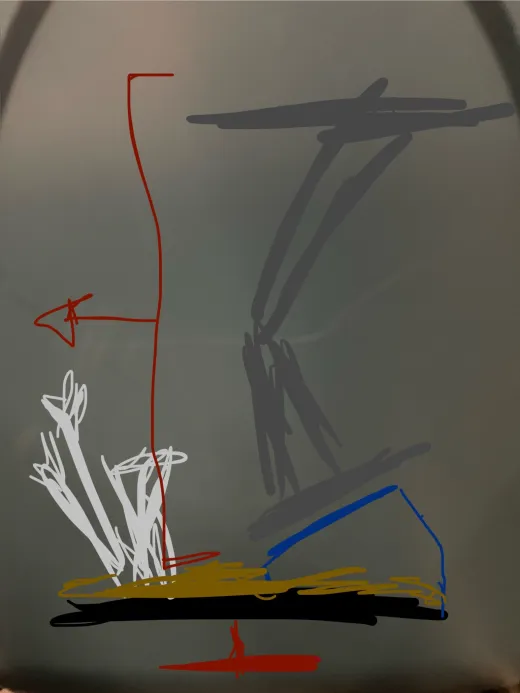 I sketch out leg positions on the bus
I tend to enjoy my journey to therapy. It’s one of the rare times these days that I enclose myself in earth and the gritty humidity of the tube. The novelty will never wear off for me, one who was raised up high on lime and grit. London is a warm, wet corpse and we the maggots blithely, contentedly, blissfully, tunnelling through Eocene clay. Unlike my usual route home which traces a roman road and gradually leaves the City behind, it’s a shift-change, a boundary crossing that swallows me in central and spits me out north east. It’s a space to think and compose myself, to try to order the events of the preceding seven days into categories and subjects, before I am open, and vulnerable. This time all I think about is the Warhound.
Thought is action. I find myself walking on my toes, loping along roads named after places I’d lived, long past. My head sinks, bobs, as I run through poses and structures, lift my feet just so, envision a pin through my hips and knees, extend an arm that in breaking sodium light looks, just for a second, like a weapon, radius and ulna. Rain haloes my vision and I wonder if I have spare glasses to shape into lenses, and cherubim to keep them clear. Once, I might have felt leather when my fingers brushed my coat as I turn my phone off, tracing the line of skulls and chain I imagine hanging from a cockpit, but I’m a father of three now, so feel goretex instead. Just outside there is a treestump that would make good material, while last year's roses nod under falling water by the door. There is a brass bee on red - Napoleon would approve - I knock and shake off the machine-spirit.
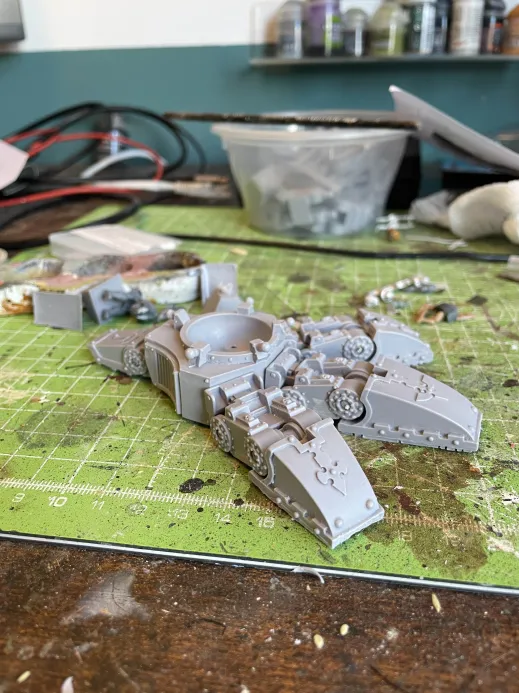 A foot. Lenoon's Warhound
I usually don’t like talking about Warhammer in therapy. It seems an expensive way to deflect from analysis. But my therapist is kind, patient, and punctures pomposity. I have been making Warhammer a long time.
It's important to you. Yes, it is. In many ways it is my oldest and most consistent relationship. It predates my marriage, it journeyed with me to university and beyond, and the scent of polystyrene cement, the eye-watering superglue fumes, the grey sprue dust we have all inhaled far, far too much of, forms a longer hydrocarbon chain of experience than love, or family, or even self-awareness. I started before I could think, continued during times when my roll-ups shared the same chipped mug as my paintbrushes, and now guides me through parenthood. Perhaps I should talk about it more.
I know why I love it. It is order. Every step is controlled and deliberate, but most importantly it’s mine. I take no notice of good practice, I make mistakes and choose not to correct them, I developed a style through hard graft that is, finally, recognisably mine and mine alone. It all pours out. I spend five minutes of my session, and therefore around £7.50, waxing lyrical on my hatred for the airbrush, then move on to how a 40ft tall death-dealing killing machine came to me from love and kindness. I know where I am in the world, and this knowledge frustrates me. I want to be where I am, but with more purpose, more life, living in a better - juster, kinder - version of this world. Warhammer does that for me. I know everything that I put into it, I say. It is the world as I wish it to be, predictable, understood, able to be shaped without effort. I can see the pressures and levers that shape responses. I can choose my reactions, choose my emotions. I can make my world, but not the world outside. I make, because I can force creation into the shape I wish it to be.
There’s a power to intent, she says.
It’s a pin -- as she always provides - that works the conversation out beyond resin and dust-masks, therapist as winkle-picker image that recurs again and again. We talk about intent. I reflect that the Knights I’ve made with an exterior aim, or that I’ve made for you, are the poorest ones. If there is order of a sort within, and chaos without, our hobby is an externalisation of it, the extension of the mind and soul into reality - intentio ergo sum - where I am able to show myself that the sharp world isn’t just one damn thing after another, the unceasing assault of existence. I close the door of my office/warhammer room, I shape the world into forms that I imagine and I open it, bolstered and more certain, the same as when the door shuts behind me after a session. As above, so below.
I walk home, with a resolution, and the beginnings of a soundtrack.
This Time, Magic is Sympathetic
I was educated to believe this was called correspondence - Aquinas’s grand comparisons of the spiritual and the physical - but simile is not metaphor, and analogy is insufficient. I refuse to separate intention and action now, of all times. Our enemies don’t. There is no compromise there, no attempt to water down a message to be palatable. Intent, action, consequence. To intend must be to act. This is not correspondence, but magic, sympathetic magic, a concept first encountered in age-old lessons on cave art. Paint the horses on the wall and they will come to the valley. Draw the hunt and it will be a success. It’s stuck with me, clearly, for twenty years.
I have enjoyed a little semi-ironic flirtation with magical practice, little more than an indulgence in my process, and then, well...as time passes, those scraps have sunk tendrils deep, rot on wood. I notice things. I whisper thanks to woodlice, greet familiar lichens, nod to the birds, feel a long dormant strength in the roots that underlie the romanitas. I see through tarmac and concrete to a trackway running east high above fen and mire, and I need to because the tarmac hurts and the grass doesn’t. When the sun shines, I wryly reflect that when you no longer believe in god, you believe in anything. In quiet times of the night, and these days there are so many long, quiet, times of the night, I believe it all.
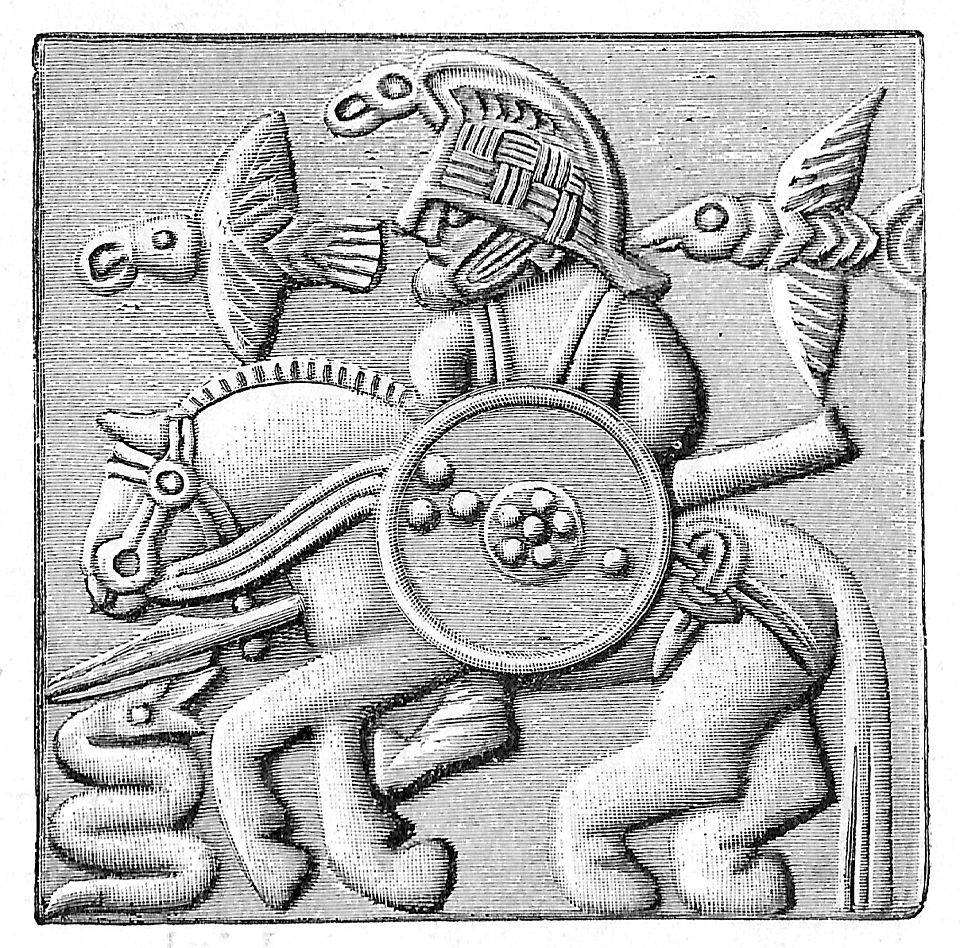 By Unknown author - Oscar Montelius, Om lifvet i Sverige under hednatiden (Stockholm 1905) s.98, Public Domain, https://commons.wikimedia.org/w/index.php?curid=4013587
Continuing that thread unguided seems wrong, even dangerous. I send an email out to the most magic-steeped person I know. In exchange for a near decade old poem (
Aboven wei perchen y raven, sable y alderweis), we will meet to discuss the Warhound. She knows Warhammer, which makes this easy. I am surprised as to how I respond in anticipation. I have flailed to find something meaningful in the world beyond my children, some tie that anchors me into the world that was and will be. It’s been expressed in reading folk horror, in my music choices, in painting and plastic, but it’s all, always, been at a remove. The Freya’s day before the Moon’s day, I choose to embrace it - I will meet with a shaman, Magin Rose.
I should meet a shaman in a stone circle, or after being summoned via pibgorn, but instead it’s a slick, professional Zoom meeting room setup. There’s a waiting room, which gives me enough time to circle myself in knights, and scrawl another sketch or two of whatever this will become on my pad. I’m not sure why I’m here, but it would be rude to turn away now.
What can I help you with? I don’t know, really…. and then, sudden and knife-sharp, I do. This is an opportunity to reconcile hobby and desire, politics and place, identity and history, mother’s son and father’s regret, a process of spiritual modelling that I’ve groped towards blindly that asserts a purpose, a place, a story. She listens. She says:
You are doing the right things, you are grounded, warded and you know and hold your intent.
And here it is again. Intent is the heart of it.
Maggie talks of speaking runes and tales - her voice as soft and pleasant as I remember it from meetings - and how they come through her,
powering, sustaining, echoing. There’s something there, I think. We visualise models and create them, filtering subconscious cues and conscious thought into a paint scheme or kitbash. The model, perhaps, is already there inside us and we cut, snip, glue, sculpt and paint it into existence. That argument will be familiar and accepted - the reciprocal action of the model doing the same to us is possibly harder to accept. I’ve put something of myself into these, and they’ve shaped me back. When we create something we enter a relationship with it, no matter how casual, or time-strapped, the process.
We leave something in there, some part of us that communicates to others. That can be dangerous, she says, and recommends protection (
you are a father, you may have built it already). I’m looking at it, I say, eyes alighting on four armigers in turn, involuntarily, with a shiver. My Grandfather knights seem a little brighter under the dust and I think of soft, squared hands.
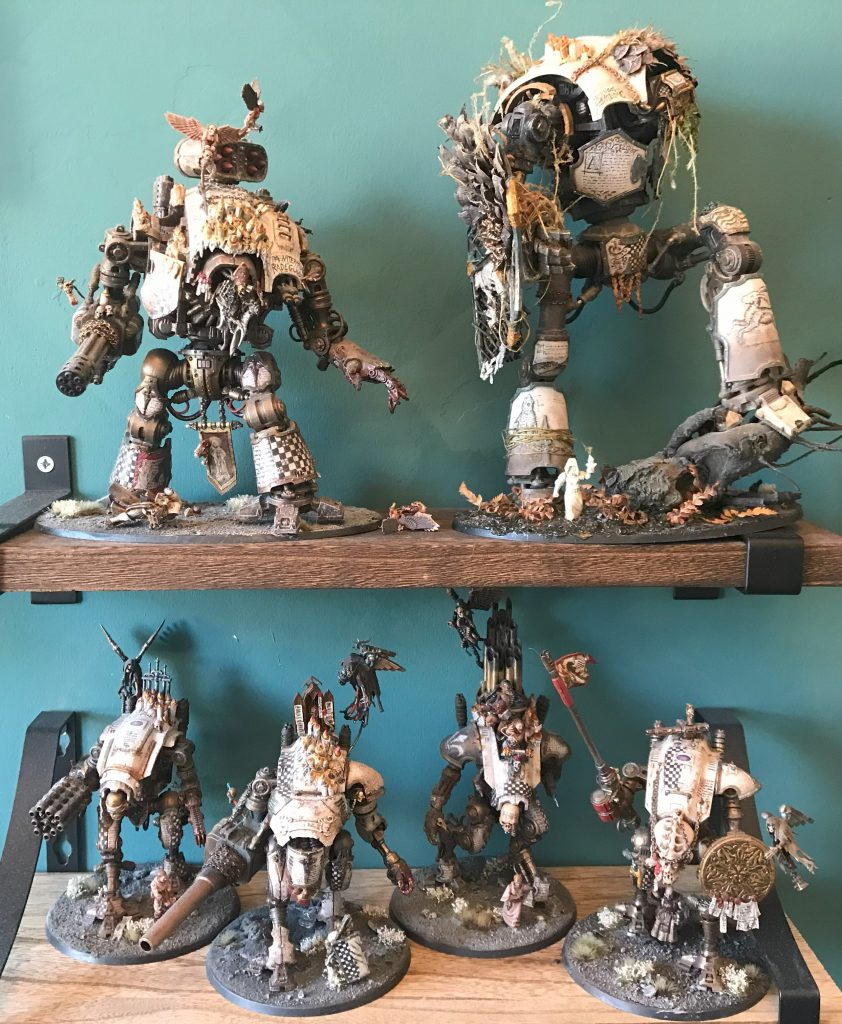 Family protection. Lenoon's Lancer
We discuss plastic as a ritual object, and how it can have as much, or more, pull, fate-strewn warp and weft, than the substances traditionally thought of as special. I don’t believe in the healing power of crystals (even with your bros), but there are things that calm me when I handle them - once I would have felt this way about flint and obsidian, but now my ground is made of rubble, fox shit, broken glass and discarded vapes, so plastic is more appropriate. We are culturally, economically, biologically, even geologically, defined by it. Plastic begs for meaning and challenges time as an almost-imperishable. It is more than a symbol of the anthropogene, but the first anthropic substance*. All else is adjusted, while plastic is made. It is Agent, Structure, and Magic. I receive homework: to dust my creations, to feel them as anchors, to water the lichen and the bark, to bring some life back into my workspace and, then, to create.
*Alright even I’m going to nitpick this one, as organic polymers have been used for ages. Still, I’m going to pin it to the invention of Bakelite. It’s my article, anyway, so you should expect at least a little bullshit.
Not quite done, we talk of old colleagues and old bosses, but half my brain is elsewhere and I can almost see the shape of the Warhound - almost hear it. Harsh, coarse, Muninn-and-Huginn, called into my office by their adherent on the other end of the internet. I avoid eye contact. I remember a friend telling me she’d started to pay thanks to Uskglass and the Yorkshire-that-will-be-again, no matter their origin in a novel. I think of Sparrowhawks and Buzzards out at Curbar Edge. I saw, once, a Shrike - or at least I think I did - stabbing a hunk of fur and blood onto a hawthorn, in thick morning mists wreathing Grantchester meadows. One foot raised. The caw, head-down and the preen of green-black, Branwen and Bendigeidifran. Out the window I see Big and Little chasing the thief-birds away, as they always do in the mornings, before they lapse into self-congratulatory croaks. Magpie-wise, Blessed Crow, Raven king, Devil, Devil, I defy thee, as we finish the call I can hear it, echoing, promising, demanding.
[audio m4a="https://assets.goonhammer.com/wp-content/uploads/2026/03/New-Recording-14.m4a"][/audio]
I am shocked from a kind of reverie to find it isn’t the voice of some helpful spirit, but my son, cawing his crow-call to announce he is home from the park and has brought me a stick. Now there is a sign. We can begin.
Badusernametag
From the corvid image spills a thousand ideas of feather, bone, clutching claws, iridescence, leather, a smell of dampness, and a poem of a raven perched high above. And then, the thought: in the most practical, real sense possible, I don’t know how to do this. It’s a very, very, heavy resin model, and I want to turn it into a bird.
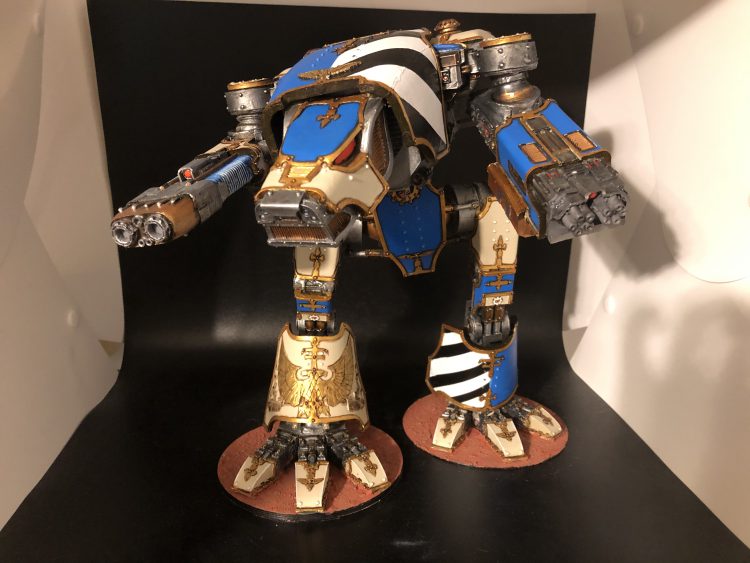 Warhound Titan Credit: Greg Chiasson
If I don’t know how to do something in the hobby, my first port of call is, unsurprisingly, Goonhammer. Greg and Rob ran through building a Warhound, and a damn good job of it was done. I know where to pin, and where to drill. I follow their instructions and jam brass rod and steel into the foot I’ve made, and start on a leg. I know it’s possible to put both feet on the ground, without a base, and have the model stand up well. But that’s not the image in my head, or perhaps the image that’s working its way through from somewhere other than my head. I see the giant, blessed, crow. I can see it, but I can’t make it.
Who could? The large resin son community paints well, and does lovely things with LEDs, but beyond the hard graft of making a titan, few seem to channel madness and passion into resin to make something strange. I know a man who does. He has produced the definitive Warhound, the best model I’ve ever seen in the flesh, a work of terrifying, hideous art: Foetus Fidelis, the Child of Hope.
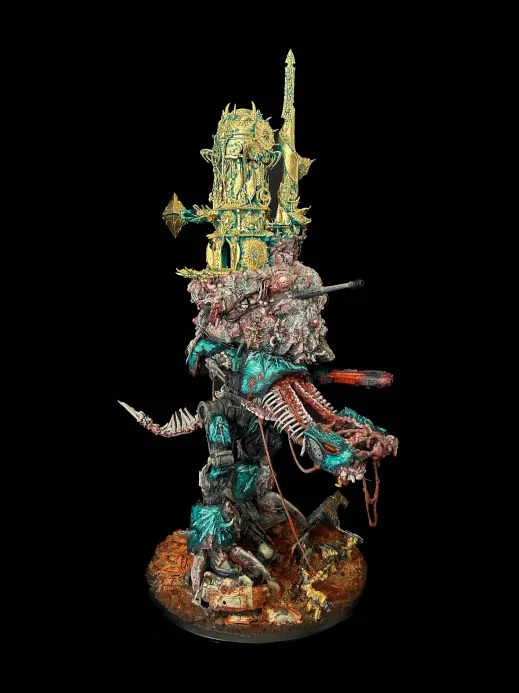 The Child of Hope, Badusernametag's incredible masterpiece
Badusernametag is a kindred spirit, and inspiration, an artist and the only other person I know who would even think about the modelling properties of dogfish egg sacks. Luckily, he’s also a very nice guy.
You can peruse his works on insta, but you must see Foetus Fidelis in the flesh. It is a staggering, monumental work. It bleeds intent.
Again, I feel we should meet in some dank and forgotten glade, but instead it’s a WhatsApp call that cracks and slides as both of us move in and out of Bluetooth range of set-aside headphones. We have what I might call complementary neurodivergence, so my plan to talk about leverage and posing isn’t a realistic one. Almost immediately I realise it isn’t what I want to talk about anyway. There are key, practical pieces of advice:
- Use Adeptus Titanicus models to test poses.
- Reinforce the legs, structural issues are hard to fix when the build is progressing.
- Draw out the design in advance.
- Not every component is necessary - but some are integral to the structure.
That’s all good advice, but within 30 seconds of us finally stabilising the call, he mentions
Artistic and Emotional Intent (All three have - maybe this article idea might work after all). We’re comfortable talking about intent with capital-A Art, a fully accepted part of the process. You are intended to feel something in relation to a work of Art, and the success or failure of it tends to stand on that quality, regardless of aesthetic. When we say we don’t get it, or don’t like it, we usually mean we don’t feel something - like me and the cursed airbrush, or your boomer dad and contemporary art. Here is one of those happy few on the vanguard of miniatures as art that
feels and extends an empathetic hand for you to feel too.
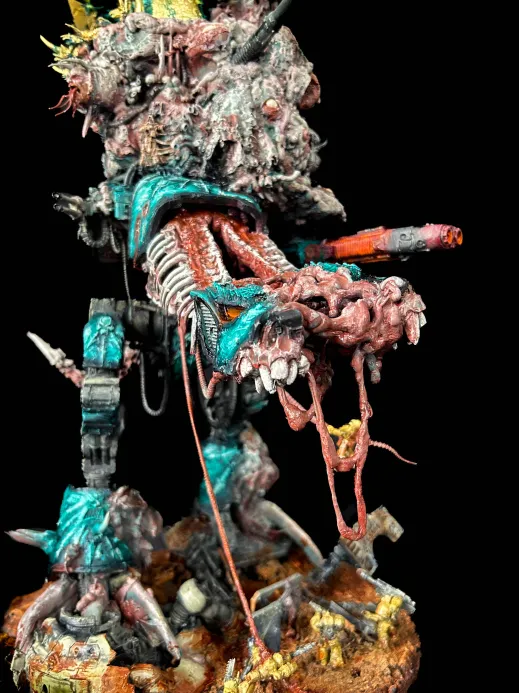 Feeling something yet? Foetus Fidelis, Credit: Baduernametag
So what was the intent here? Myriad. Feeling, after all, isn’t always comfortable.
I want people to feel sick when they look at it exists alongside the Foetus Fidelis as a
product of love, of care and attention. There is an intention there to make you recoil, a combinatory force of awe and terror, and then to be drawn in.
The first reaction is emotional, and then you’re thinking about how it will affect the viewer intellectually. You pour over detail, you can’t look away. It is arresting, even in a room of 60 Heresy players all bringing their painting A-Game.
There’s a lot going on here.
There is, and I think that more than anything else is why I love it. There is a lot going on, and it’s a riot of contrasts of texture, form, taste and colour. Gold leaf and red gore, green and white. There’s magic and beauty in the found materials -
driftwood is a gift given by the universe - slamming into the carefully cast resin.
Warhammer, he explains,
is easy. Someone else has already made the shape you’re working with.
Toy soldiers are easy, quick. The form leads the way.
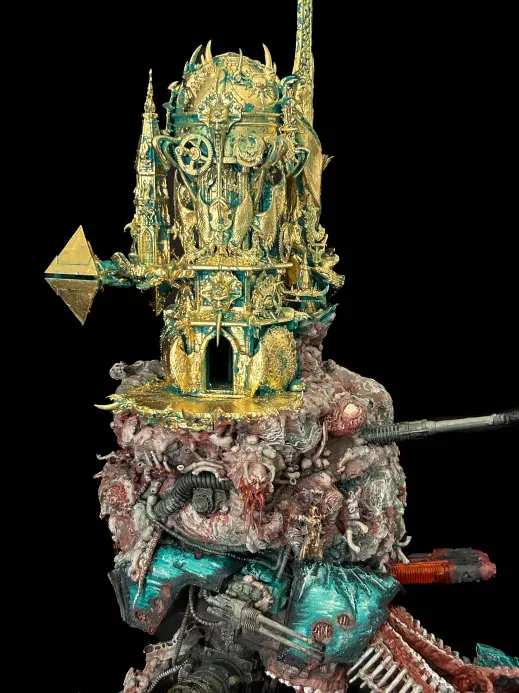 Madness, distilled and beautified. Credit: Badusernametag
We have hit on the same problem of agency and structure in building, the limits we impose - or think we have imposed - on what we can do, how we can make. It’s the difference between a hobby and The Hobby, a self-imposed set of limitations, and what he says makes such absolute sense to me I'll repeat the lot of it:
You can’t be sacred about anything when it comes to materials. If you’re going to make art, to create, you can’t be precious about what does what. Am I ruining my kit if I take away something to use something else? It doesn’t matter, get kits and don't look at the instructions, look at the instructions and you’ll taint yourself. Look at the sprue, think that’s cool. I wish I had the time to create something properly.
I cut him off there, because if his work isn’t creating something “properly”, no one's is.
I stripped it, it sat in a box seven years, wait a minute, thought “it’s smashbash let's do it”, in a month. It needs more work - I painted it in two days.
Two days! This will, I think, take a little longer, but it's a good spur to action. I should do
something even if it's a mistake. I drill and hammer 3mm steel drill bits through the legs and waist. Something is done.
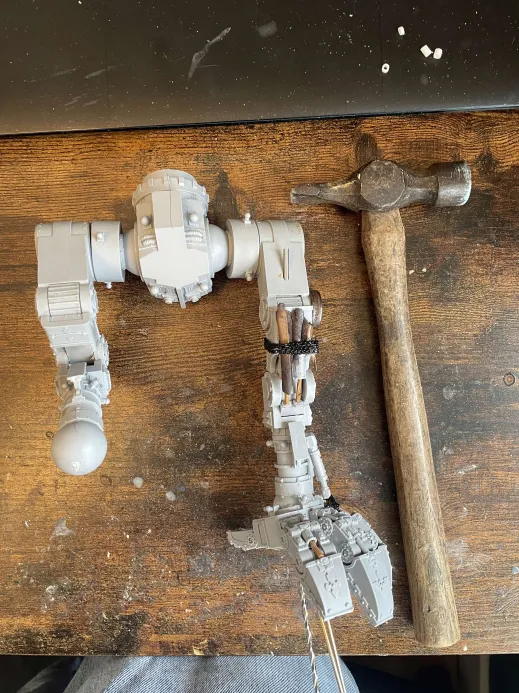 Legs and groin. Lenoon's Warhound
Learnings
My family went interrailing in 2024 and 25, a truly wonderful, if occasionally draining, experience. Throughout, we talked about “learnings” - things we would do differently, but not things we would place blame for, or recriminate against, just learnings, new truths floating in thin air we could choose to adopt next time. It’s an appropriate tool for this build, a mental state that allows growth and mistakes. I’ll need both. There’s lots to learn, after all, lots to get wrong, and costly effects if it all goes to hell. The process of the Warhound has already been longer than most of my builds - the porphyrion took a month from start to finish, and already we’re past that with more-or-less just a leg built - so there are learnings aplenty.
The learnings here are of intent and desire. It is possible to do what you want - what a facile, silly thing to type, when it is hard to believe - and there is an idea within that is not just a nice build, but something significant and important that I do not have to explain, or analyse. I can feel it. It is mine. I have the learning that I can prioritise intent, acknowledging the social and personal importance of doing a good job here. I have the learning that there is potentiality and danger in imbuing intent-in-object, and that I can embrace the push and pull of object to subject relationship, hear the call from the Dane’s Law. I ken that instructions are a crutch - but perhaps not for the legs. I have the learning, the knowledge, sure and simple, that I’m not on my own in doing this to Warhammer, precious indeed that one, when you feel like the only weirdo in town. I put on my playlist, pick up my son’s crayons, and suddenly, it's there.
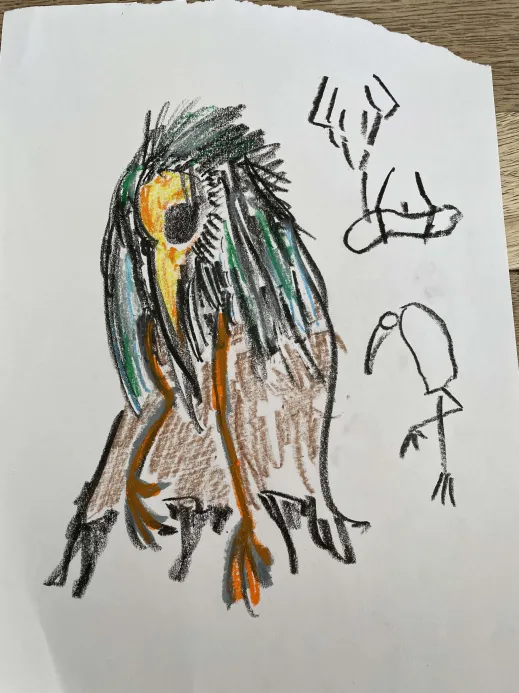 Perhaps
It isn't much, but it's there. I talk the curve of wing, the prominence of beak and skull, I hum and caw and croak the bird-spindle legs, I drone unmusically of magpies to conjure shawl and cloak. I remember that it should speak through me, in me, holding therapist and shaman and friend as a triangulation of what I want to achieve, a frame - a gap - to autocreate. I do not draw well, but I draw anyway. There it is, Blessed Crow, Bendigeidfran the Giant, or at the very least here is one version of it. Feathers, bones, metal, plastic, a near infinite potential for - let's be honest - bizarre nonsense is shrouded within. To pull it off there’s a lot of people to talk to, and a lot of learnings to find. Time to get on with it.
Have any questions or feedback? Drop us a note in the comments below or email us at contact@goonhammer.com. Want articles like this linked in your inbox every Monday morning? Sign up for our newsletter. And don't forget that you can support us on Patreon for backer rewards like early video content, Administratum access, an ad-free experience on our website, and subscriber-only content covering competitive Warhammer 40K!Thank you for being a friend.
 This website uses cookies. Learn more.


 Goonhammer App and Patron Updates: April, 2026
 Kill Team Tournament Report: Engage, Party, Repeat's March Madness 2026
 Goonhammer Reviews: Tribal Conquest