This website uses cookies. Learn more.

Painting | How To Paint Everything | Hobby | Warhammer 40k | Goonhammer | Core Games | Horus Heresy

How to Paint Everything: Iron Warriors Chaos Space Marines

by SRM, Magos Sockbert, Robert "TheChirurgeon" Jones | Jan 21 2024

In our How to Paint Everything series we look at how to paint well, everything, with different methods, approaches, and painters. In this article we’re looking at how to paint the traitorous forces of the Iron Warriors for Warhammer 40k and The Horus Heresy.


The IVth legion of space marines were masters of siege warfare, particularly the destruction and dismantling of defenses. They were known for their grim determination and steadfast resolve, as well as their chant of "Iron Within, Iron Without" when they went into battle. As a legion they followed their Primarch, Perturabo's lead, being technically adept and being experts at the application of vehicles and siege engines.

When Horus rebelled against the Emperor, Perturabo and his legion followed suit. They'd been stretched to the breaking point during the Great Crusade and were tired of never receiving the recognition they felt they deserved, even as they engaged in a grueling campaign against the Hrud. Turning against their brothers, they relished the opportunity to attack the defenses built by their rivals, the Imperial Fists. They played an instrumental role in the Siege of Terra, working to break down the defenses of the Imperial Palace.

After Horus' death, the legion retreated into their fortresses and strongholds, and were only chased into the Eye of Terror at considerable difficulty and cost. They continue to attack the Imperium to this day, serving as siege experts in Abaddon's Black Crusades and leading warbands of their own, often teeming with infernal daemon engines.


Covered in This Article:

  • How to paint the Iron Warriors, with different methods for painting the legion.
  • How to paint Heresy-era Iron Warriors, with a link to an article on how to paint the legion's Primarch, Perturabo.
  • Notes on the Heraldry and iconography of the Iron Warriors.
  • How to paint the distinct yellow and black hazard striping the legion is known for.


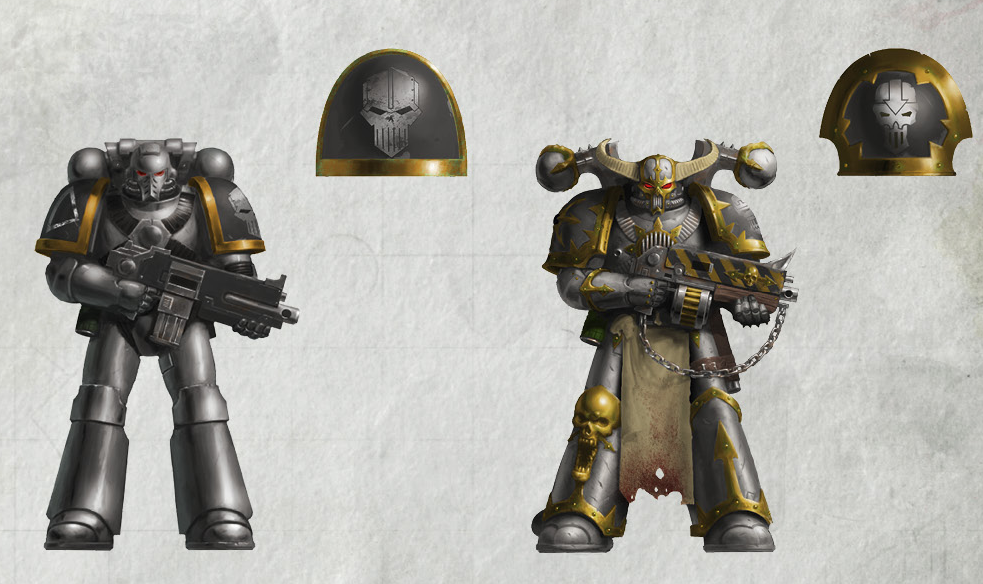
Iron Warriors Heraldry - Click to Expand


Like the other traitor legions, the Iron Warriors abandoned most notions of proper organization following the Heresy, splitting into smaller warbands led by powerful Chaos Lords, Warpsmiths, and Daemon Princes. That said, there are some notable quirks to the legion - Warband leaders in the Iron Warriors are called Warsmiths, and the warbands themselves usually employ a larger number of Warpsmiths, Daemon Engines, and Obliterators. The first recorded instances of Obliterators were from among the Iron Warriors' ranks.

Credit: Games Workshop

The legion's colors and heraldry have changed little from the days of the Heresy, with the addition of gold trim and additional hazard stripes being the only major change they've implemented.


Hazard Striping - Click to Expand


We've written a whole guide to painting hazard stripes, zigzags, and checker pattern designs. You can find that guide by clicking on this link.


Campbell's Method - Click to Expand


Hey, it's me, the guy who writes a painting tutorial before actually painting anything! I have this awful habit of writing a painting tutorial completely off the dome, then going back and following it, adjusting as needed. It's not a good process, but it's my process.

This will be working from black primer. You could use Leadbelcher primer instead, but I find it dries kind of glossy and washes slide off it. We're also going to be going darker than Leadbelcher, but if you really wanted to use it instead of Iron Warriors I can't stop you. I'm neither a cop nor your dad, so do what you will.

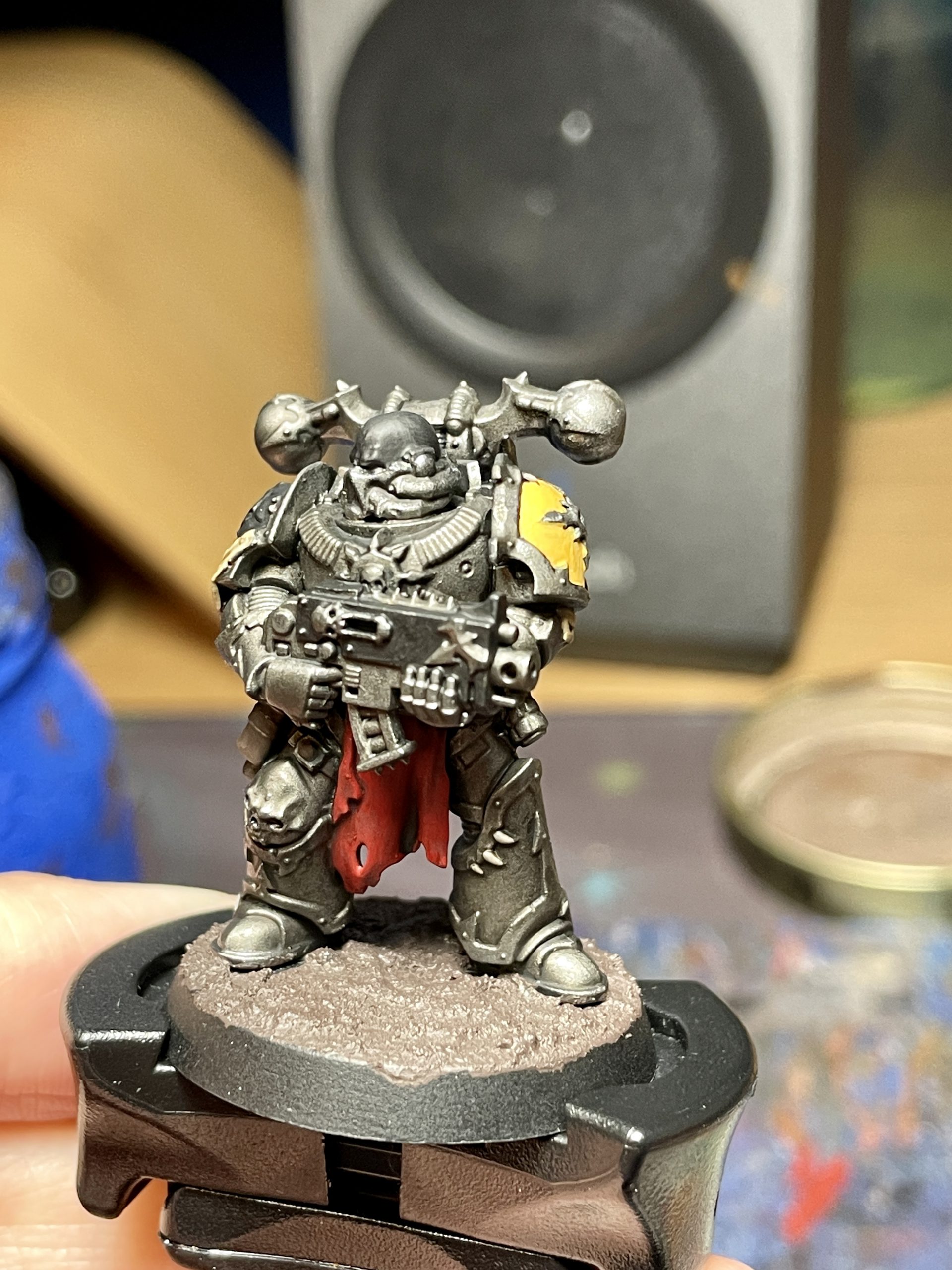
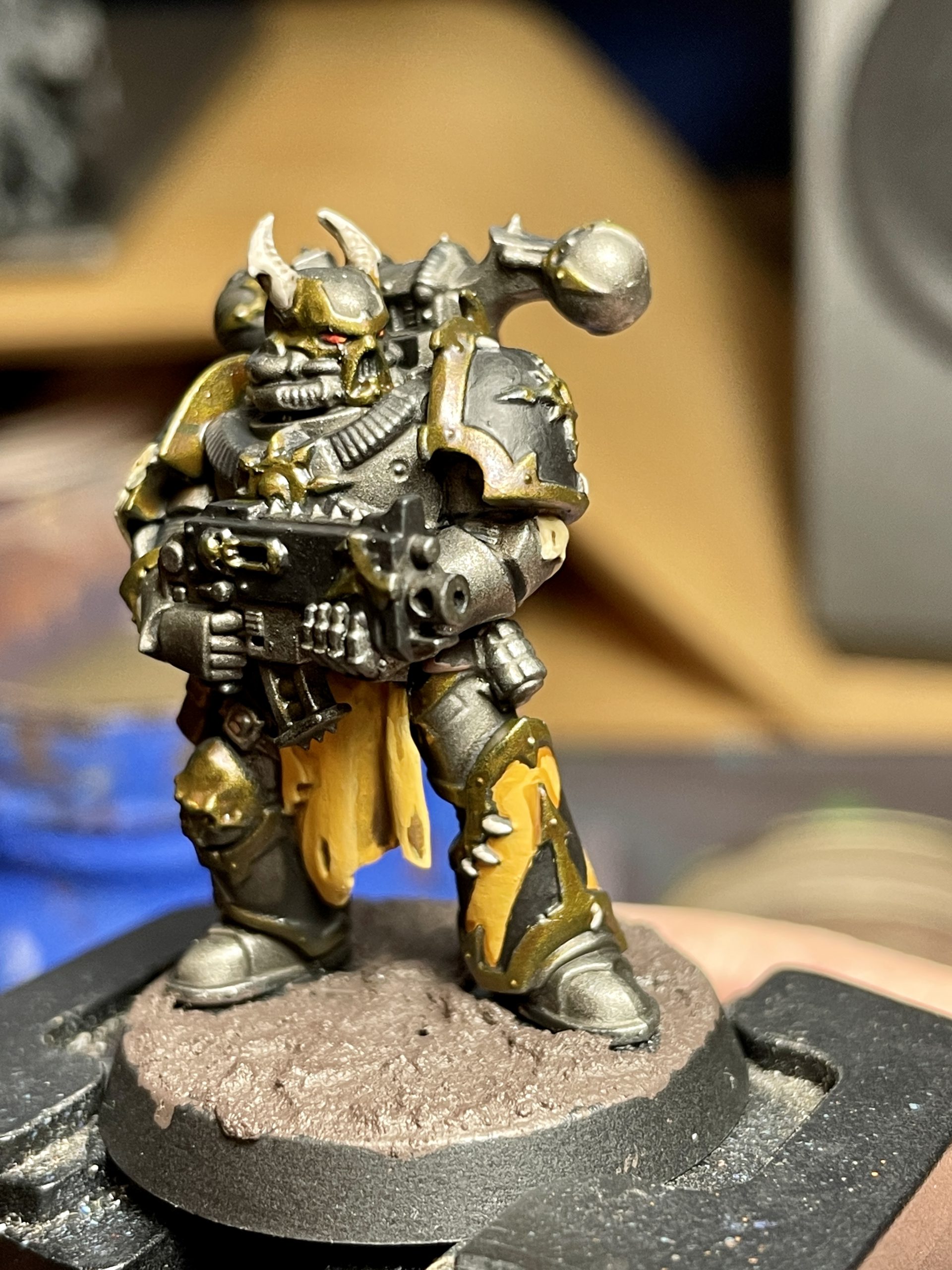
Iron Warriors WIP. Credit: SRM

Appropriately, we're going to start by painting the whole miniature with Iron Warriors metallic paint. Don't worry about getting onto other details, you can be sloppy with it. We'll follow that by popping on our basecoats for the leather, cloth, bone, and other details, then slathering the whole mini in a 50/50 wash of Nuln Oil/Agrax Earthshade. Mixing these two gets an oily, dark and dirty look. You could do one then the other but it'll double your drying time, and I want to get these guys on the table fast. Once the wash is all dry we can go back and start layering and highlighting up each of the previous colors, then take the time to fill in the black and yellow details.

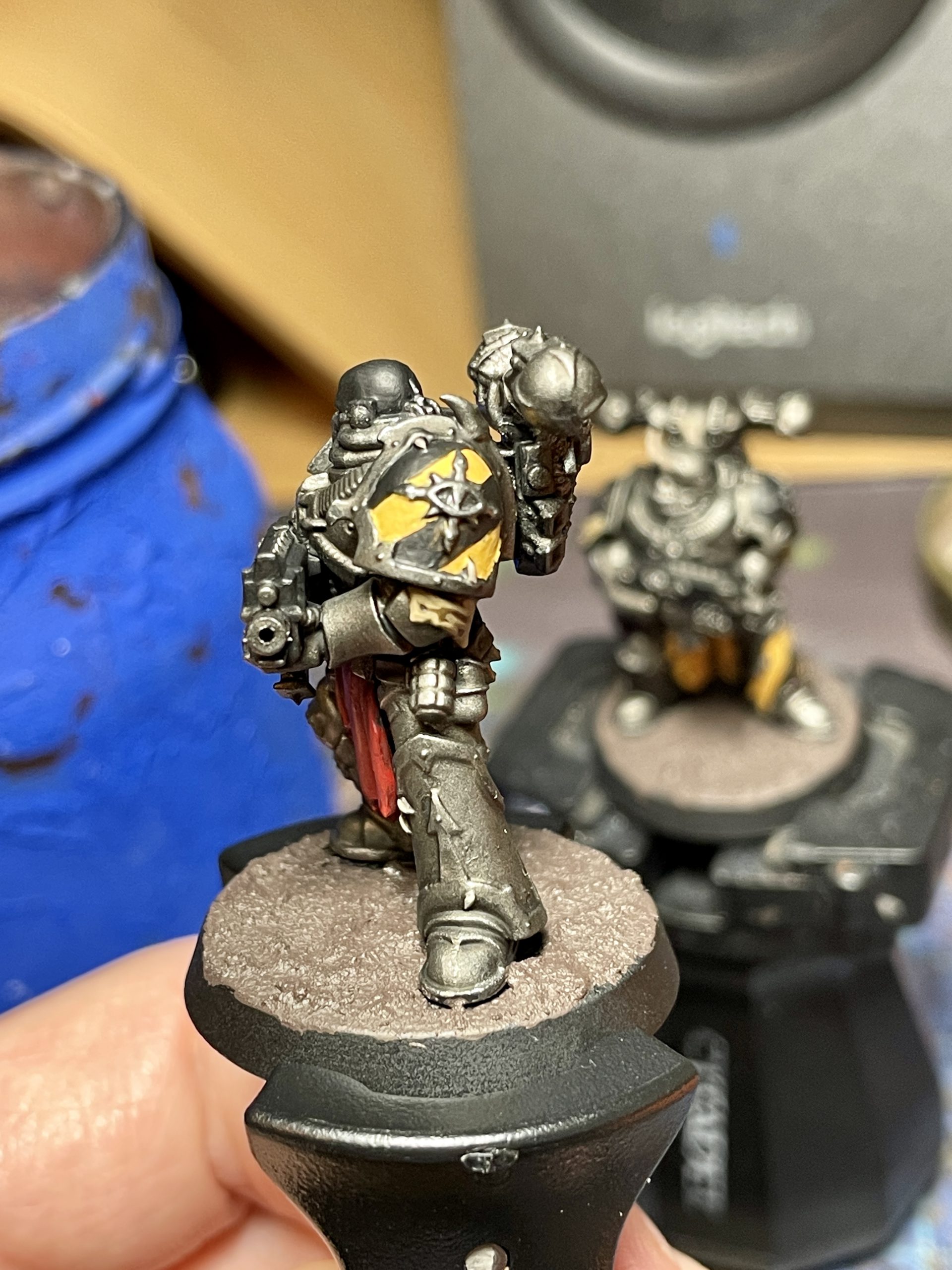
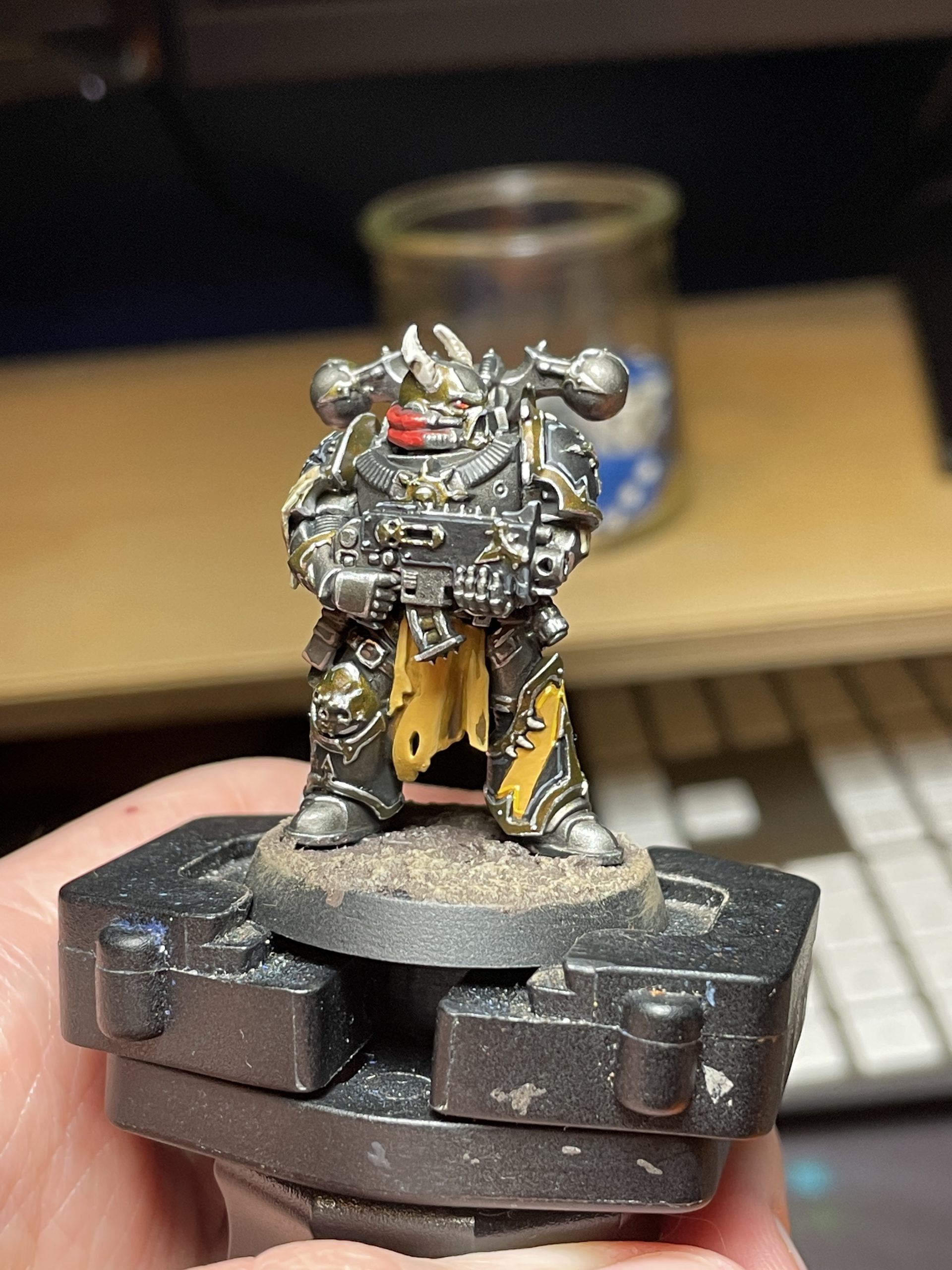
Iron Warriors WIP. Credit: SRM

We'll begin by going back and blocking in all the areas we want to be black or yellow. For hazard striped areas like the field on the pauldrons (and potentially greaves and gun casings if you're feeling spicy) paint them with Averland Sunset. It's easier to paint black over yellow than it is to paint yellow over black. It'll probably take 2-3 coats. You can then take thinned black (I use P3 Thamar Black, but GW's Abaddon Black will do) and lightly paint the lines where you want the hazard stripes to be. Fill them in with black, clean them up if need be, and do a recess shade of Seraphim Sepia on the yellow. You can then highlight with Yriel Yellow, followed by Dorn Yellow for the sharpest points. The black should be highlighted with Eshin Grey then Dawnstone, following the same techniques. For more detail on painting hazard stripes and such, we wrote a great article with loads more methods.

Black areas can simply be blocked in with your black paint of choice. This is generally going to be one or both pauldrons and the weapon casings. As the legion badge sits on the left pauldron, it's usually a good shout to put down a more plain color so it won't look so cluttered if you freehand the Iron Warriors symbol or slap a decal down there. Highlight the black as detailed in the caution stripes step above.

There's often some cloth or hair floating around, like loincloths, capes, topknots, or some other textural elements. As the Iron Warriors scheme is heavy on neutral colors, it's a chance to get a pop of color in there without straying too far from the established color palate. For yellow cloth, I base with Averland Sunset to tie it in with the hazard stripes. For red cloth, I base with Mephiston Red, which ties in with the eye lenses and weird Chaos tubes. Lastly, for a more neutral cloth, I base with Zandri Dust. These all get knocked down by the 50/50 Nuln/Agrax wash, so we'll bring them back up to their base coat and layer up by mixing in lighter shades of yellow, red, and tan respectively. You could just go straight to highlighting instead, but I like layering cloth up - it's relaxing and a nice break from sharp edge highlights. The specific colors I use are further down this article but the method is what's most important.

Teeth and bone find their way onto Chaos models on the reg. We've already based these areas with Rakarth Flesh and washed them with that same all over 50/50 Agrax/Nuln mix, so let's brighten them back up. Using Rakarth Flesh, go back and highlight all that osseous detail, then mix in gradually more Flayed One Flesh for increasingly raised areas. I like doing a final highlight of Flayed One Flesh for any sharp edges.

Iron Warriors WIP. Credit: SRM

Contrast paints are going to be your friends for a lot of the details here. First, use Black Templar on all the ribbing in the joints, all the ribbed pipes, grilles, vents, and so on. It'll help make those pipes stand out from the dark steel of the armor, and add some depth and a blackened effect to things like the backpack vents. Next, it's the real magic trick of this whole process - Nazdreg Yellow on all the trim. Painting and highlighting the trim is always the biggest pain in the butt on Chaos models, but one coat of Nazdreg Yellow over the dark steel we've already established will give you a dirty gold that fits perfectly with the Iron Warriors aesthetic. If there's any other gold you want to put on the model, like some of the random Chaos icons, hanging baubles, or what have you, this is still the go-to method. Just be careful and don't bother thinning it down at all, as we don't want it flowing elsewhere on the model. If you spill over a little, be quick and soak it up with a brush.

Invariably you'll run into lenses - eyes, weapon targeters, those cool cyber-monocles, whatever. Base these with Mephiston Red, and highlight the bottom half of the lens with Evil Sunz Scarlet. Now highlight the very bottom edge with Fire Dragon Bright. Then in the furthest corner from these highlights, use a tiny amount of that same 50/50 wash to darken a round area at the top of the lens. Put a tiny dot of White Scar in that darkened corner. On eye lenses, do the same process but with the white dot appearing on the far outside corners, and the oranges concentrating towards the center of the face. You could do that darkened dot in a darker red or even a black, but I'm trying to be quick here.

There are these fleshy tubes that find their way onto Chaos models which I'm not exactly buckwild about. They're kinda gross and usually have some mechanical ribbing, but there's a few ways you can go about painting them. My first attempt was Mechanicus Standard Grey with Black Templar Contrast paint, then a soft highlight of Eshin Grey on the most raised areas. This lacked lower-case-c contrast with the steel of the armor, so on my second attempt I went for red instead. Starting from Mephiston Red, I washed it with the same 50/50 Nuln/Agrax wash I love to use so much, then highlighted it back up with Mephiston Red. I mixed in just a smidge of Wild Rider Red for some of the sharper highlights on it, but I really don't like these details so I didn't spend too long on them.

Iron Warriors WIP. Credit: SRM

Lastly, it's time to highlight all the metals. This is the longest part of the process, but the one that makes all those details pop and brings the scheme together. I went with Stormhost Silver, as I wanted to maximize the contrast and definition of these models.  Normally I'd do some weathering too, but these models are already so busy that adding scratches and such just seems like it would be too much.

Tying it all together, I went with a pretty neutral muddy base with some Galeforce Nine dead grass I bought in 2008. The basing was just Stirland Mud with successive drybrushes of Steel Legion Drab and Karak Stone, with a final coat of black around the base rim.


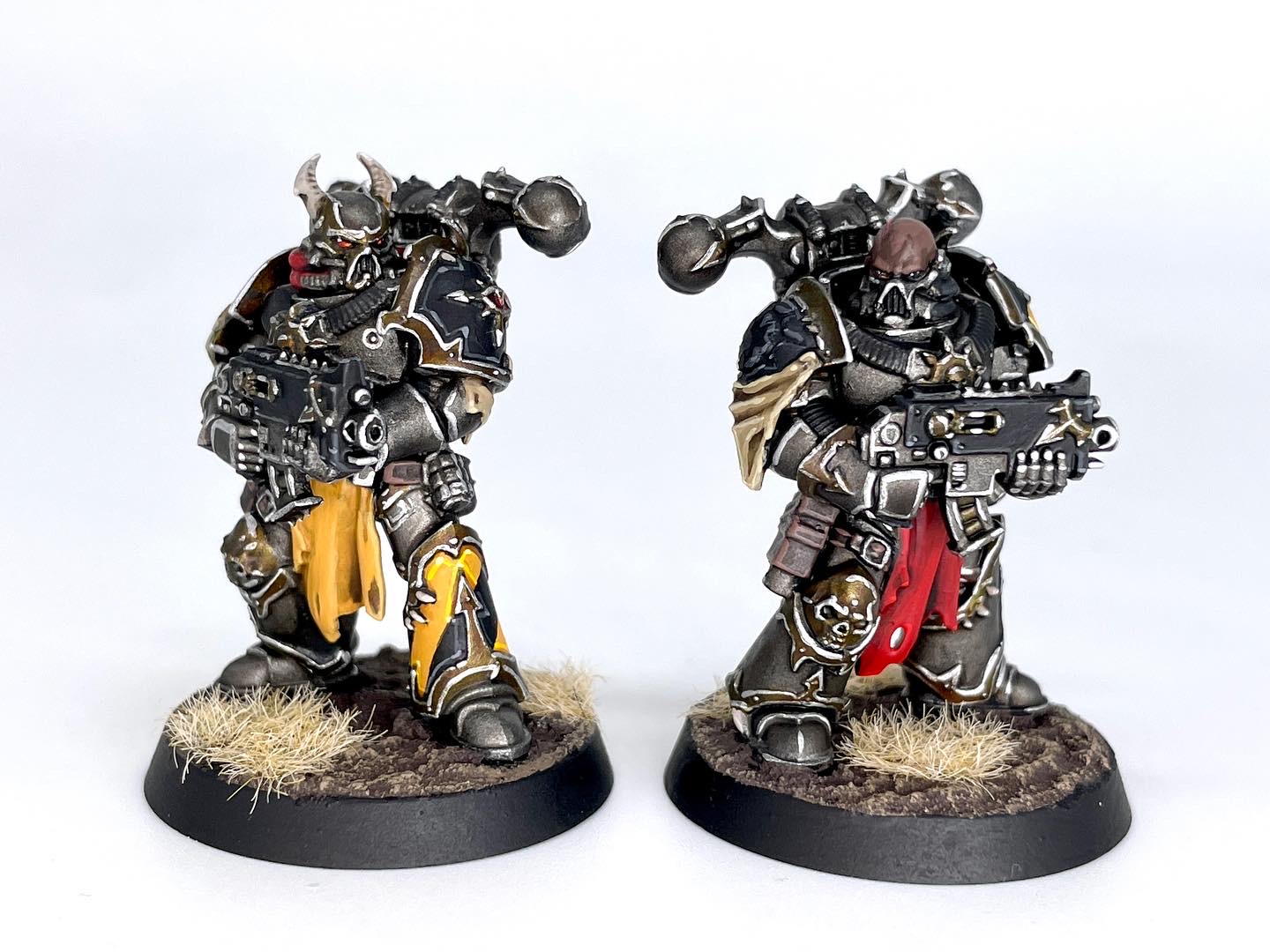
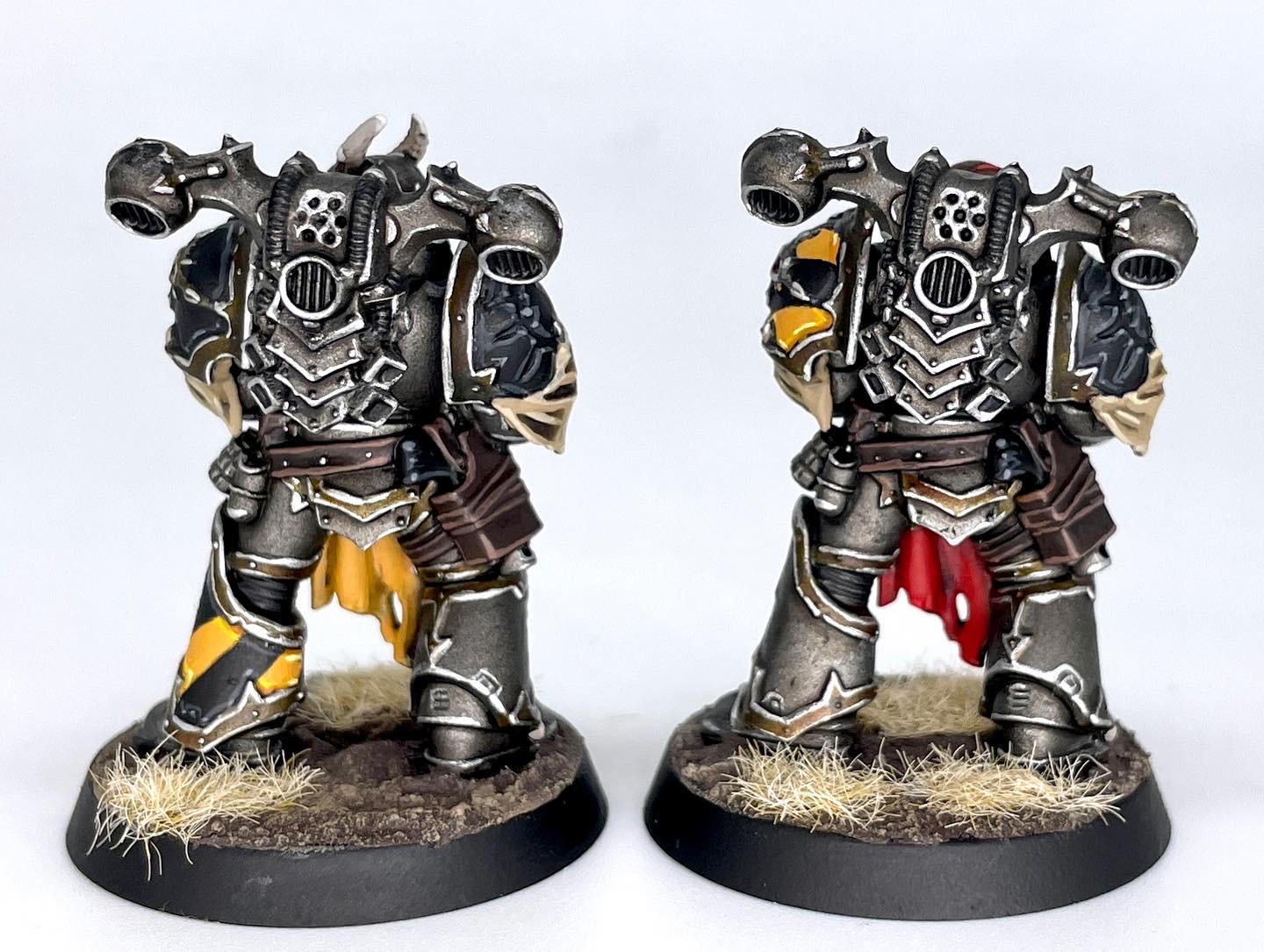
Iron Warriors. Credit: SRM

Iron Warriors. Credit: SRM

Paints List

[expand title="Paints Used - Click to Expand"]

Thing (Location):
  • Paint color
Dark Steel (Armor):
  • Iron Warriors
  • 50/50 Nuln Oil/Agrax Earthshade wash all over
  • Edge Highlight Stormhost Silver
Ribbing (Joints, vents, grilles):
  • Iron Warriors
  • 50/50 Nuln Oil/Agrax Earthshade wash all over
  • Black Templar
Dirty Gold (Trim):
  • Iron Warriors
  • 50/50 Nuln Oil/Agrax Earthshade wash all over
  • Nazdreg Yellow
  • Edge Highlight Stormhost Silver
Black (Gun casing, shoulder pad field):
  • P3 Thamar Black
  • Edge Highlight Eshin Grey
  • Extreme Edge Highlight Dawnstone
Leather (Straps, holsters):
  • Dryad Bark
  • 50/50 Nuln Oil/Agrax Earthshade wash all over
  • Edge Highlight Gorthor Brown
Bone (Horns, skulls, uhhh femurs I guess? ):
  • Rakarth Flesh
  • 50/50 Nuln Oil/Agrax Earthshade wash all over
  • Layer back up to Rakarth Flesh, leaving the wash in the recesses
  • Edge Highlight Flayed One Flesh
Hazard Stripes (Shoulders, greaves, wherever):
  • Averland Sunset
  • Paint thin lines in thinned P3 Thamar Black
  • Seraphim Sepia recess shade
  • Highlight yellow with Yriel Yellow
  • Highlight the sharpest yellow areas with Dorn Yellow
  • Highlight black with Eshin Grey
  • Highlight the sharpest black areas with Dawnstone
  • Sponge on Rhinox Hide
Neutral Cloth (Tabbards, cultist uniforms):
  • Zandri Dust
  • 50/50 Nuln Oil/Agrax Earthshade wash all over
  • Layer back up to Zandri Dust, leaving the wash in the recesses
  • Blend up to Ushabti Bone, mixing gradually more Ushabti Bone in with each pass
Red Cloth (Tabbards, spicy cultist uniforms):
  • Mephiston Red
  • 50/50 Nuln Oil/Agrax Earthshade wash all over
  • Layer back up to Mephiston Red, leaving the wash in the recesses
  • Blend up to Wild Rider Red, mixing gradually more Wild Rider Red in with each pass
Yellow Cloth (Tabbards, pissboy cultist uniforms):
  • Averland Sunset
  • 50/50 Nuln Oil/Agrax Earthshade wash all over
  • Layer back up to Averland Sunset, leaving the wash in the recesses
  • Blend up to Yriel Yellow, mixing gradually more Yriel Yellow in with each pass
Lenses (Eyes, targeters):
  • Mephiston Red
  • 50/50 Nuln Oil/Agrax Earthshade wash all over
  • Evil Sunz Scarlet, concentrating on the inner edges of the eyes, lower corner of a round lens
  • Fire Dragon Bright, at the very sharpest corner of the inner edges of the eyes, lowest corner of a round lens
  • White Scar dot in the far back corners of the eyes, upper opposite corner of the previous highlights on a round lens


TheChirurgeon's Method - Click to Expand


I've been playing Iron Warriors since 3rd edition, when the Index Astartes article convinced me to start an army for the legion. I've always really liked their backstory and paint scheme, and they're definitely among the easier schemes for beginners.

I started by priming this model black. You could do Leadbelcher, but I had the same issues Campbell has had with the spray.

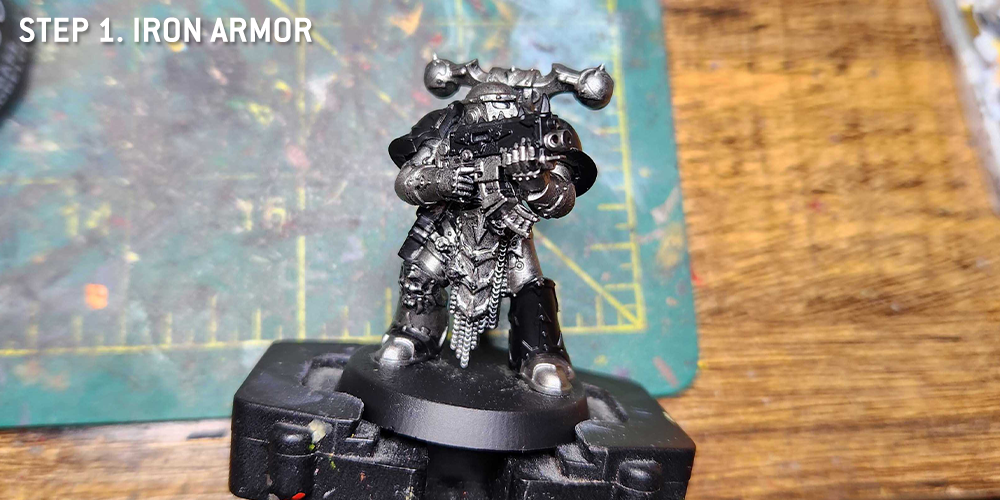
Step 1. Armor Basecoat

I start by painting the armor with Leadbelcher. I'm going to shade it with Iron Warriors and Nuln Oil but if you wanted to instead start with Iron Warrior and highlight with Leadbelcher, that's fine too.

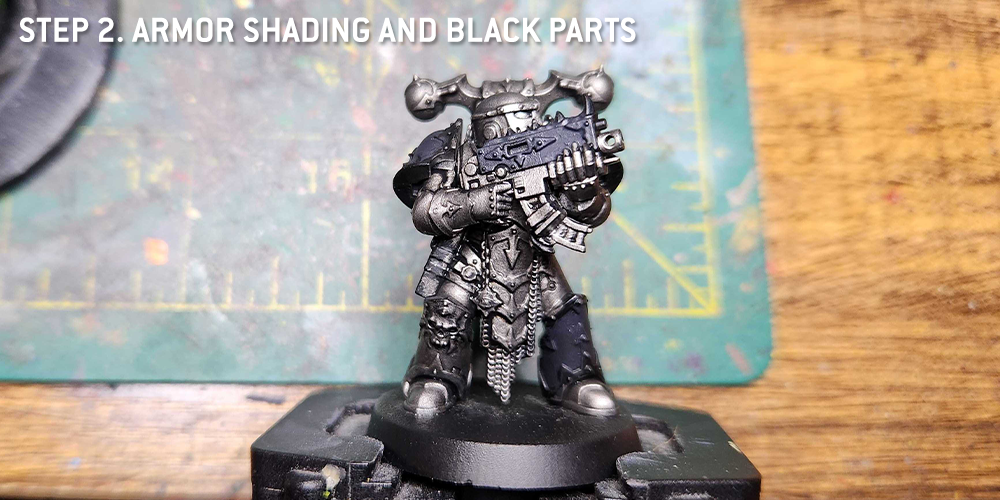
Step 2. Armor Shading and Black Armor

I shade the armor with Iron Warriors and then wash it with Nuln Oil. Then on the black armor parts - both pauldrons and one of greaves, plus the gun casing - I shade up using Corvus Black. I'll blend this using mixes of Corvus Black and Black Templars Contrast Paint. I'm going to paint hazard stripes on the greave and the gun.

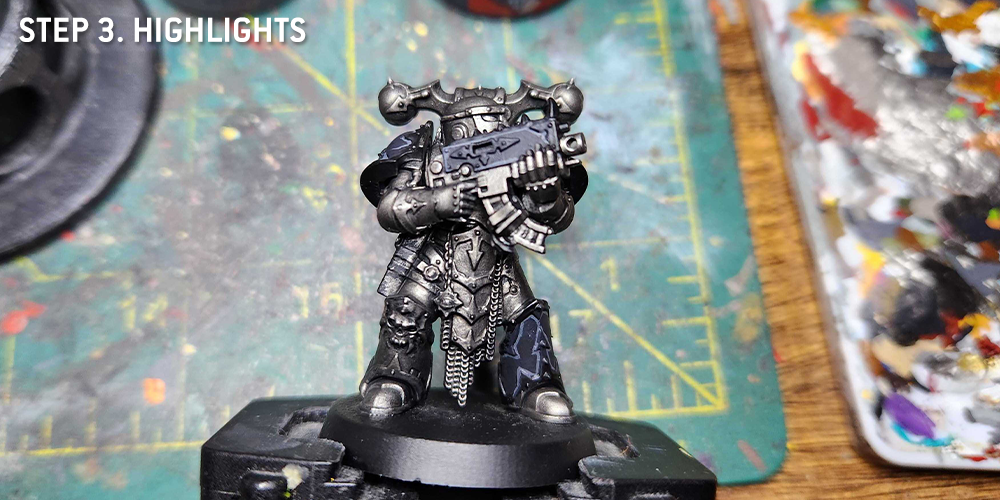
Step 3. Highlights

Time to do some highlights. I'm primarily tracing the black armor panels around the trim using Mechanicus Standard Grey. I'll eventually edge highlight the metal armor with Runefang Steel.

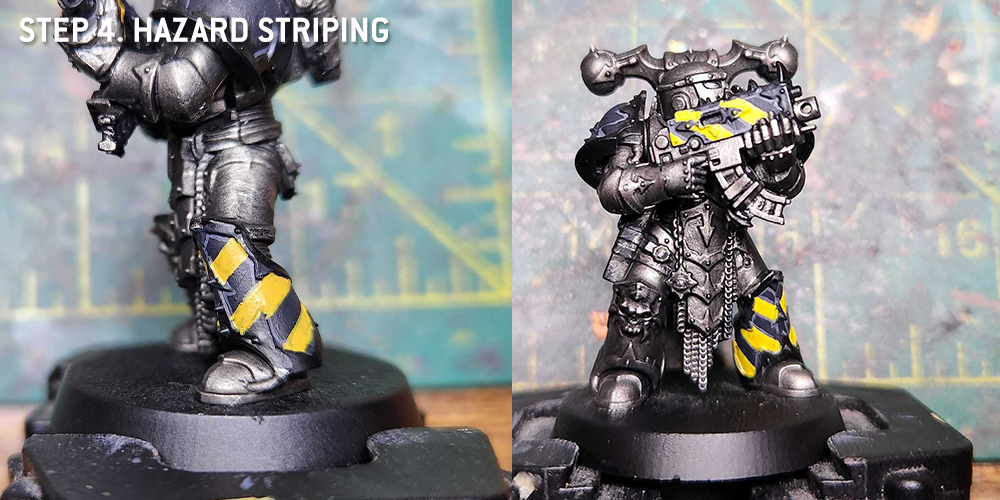
Step 4. Hazard Stripes

I start my hazard stripes with the outlines, painting those with Averlund Sunset before filling them in with a few thin coats. Once those are down and I'm happy with the width I'll come back and highlight them with Flash Gitz Yellow, then edge highlight them with Dorn Yellow. Finally I'll come back and shade them a bit with Cassandora Yellow. 

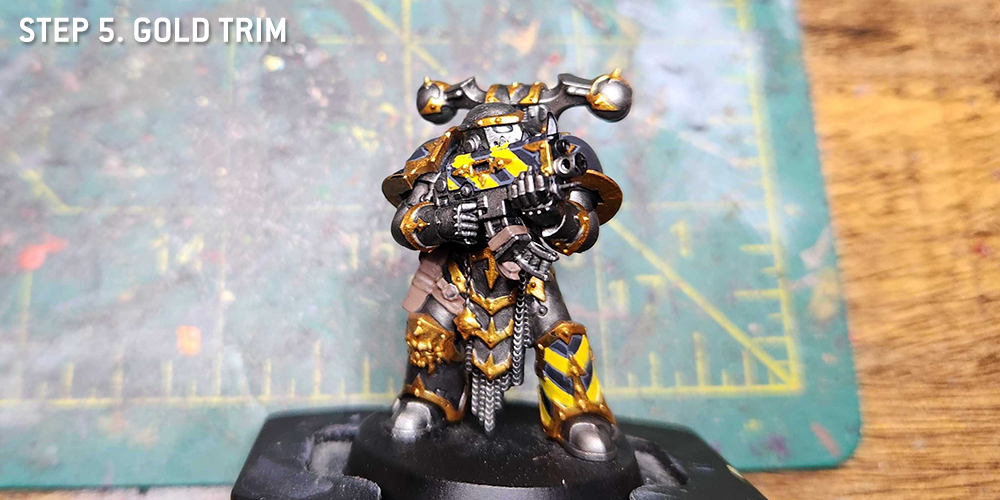
Step 5. Gold Trim

Time for the trim. This is pretty straightforward - paint the trim with Retributor Armour Gold. 

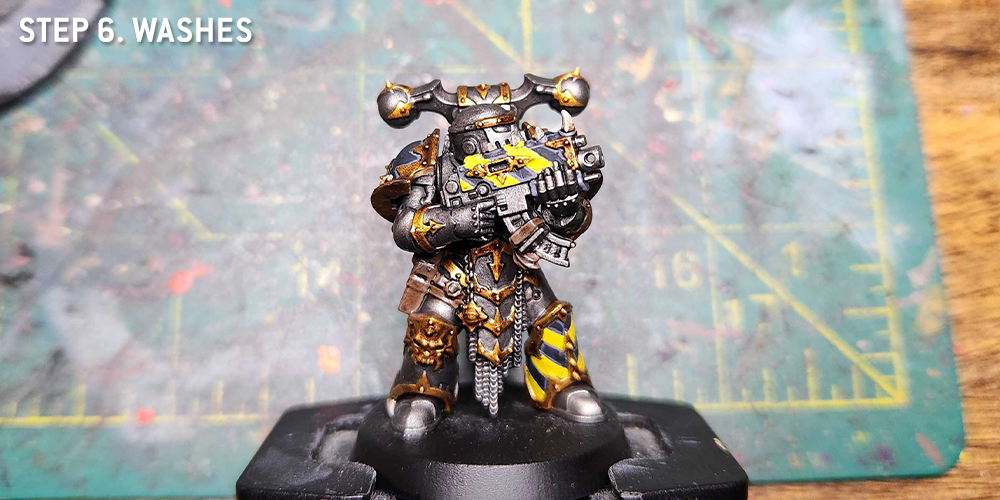
Step 6. Washes

Next wash the trim with Agrax Earthshade.

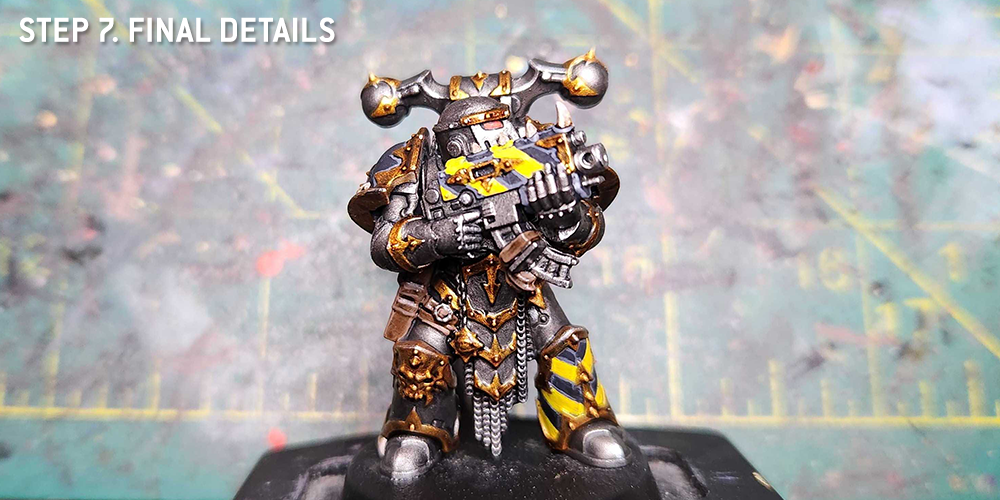
Step 7. Final Details

Not a ton left now. The eyes are Mephiston Red with a highlight of Evil Sunz Scarlet, while the leather is done with Gorthor Brown washed with Agrax Earthshade, then highlighted again with Gorthor Brown. This is also when I usually come in and add the edge highlights of Runefang Steel, and I'll paint the rivets.

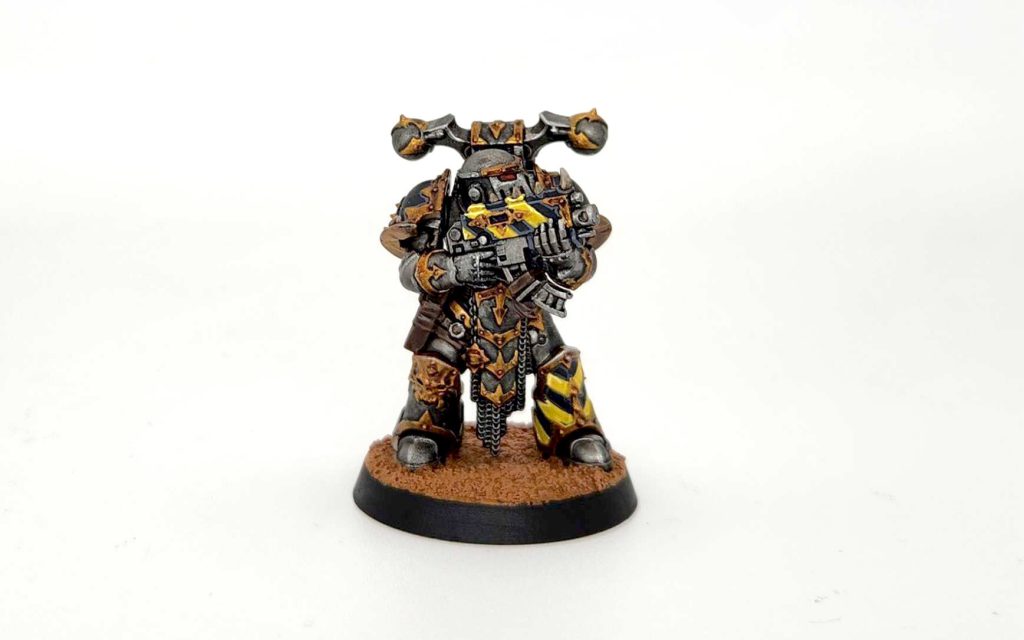
And that wraps up another Iron Warrior. I tend to base them with a muddy bases to emphasize their trench/siege warfare inclinations.

Credit: Robert "TheChirurgeon" Jones


Sockbert's Heresy-Era Method - Click to Expand


We've had Chaos and loyalist Space Marines from the 41st millenium, so lets take a trip back in time to the Horus Heresy! My painting talents lie in quantity, not quality (I've somehow painted about 6000 points of Iron Warriors since Horus Heresy second edition dropped...), and, knowing that going in, I recognised I'd need a simple, easily repeatable scheme where the priority is getting models on the table to be wasted and ignored by those that commanded them.
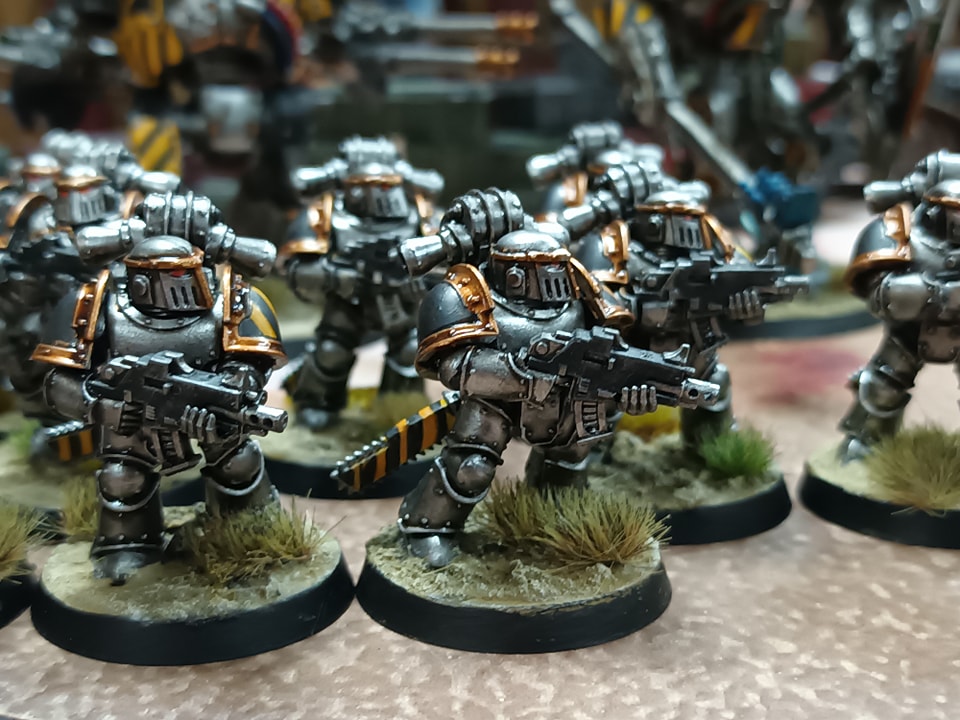
Iron Warriors Tactical Squad 30k Horus Heresy Credit: Magos Sockbert My first tactical squad. Aside from decals, this is a complete and simple scheme.  Credit: Magos Sockbert

The steel is the most important part, and while a lot of people go with a very grimy look for this most grimdustrial of Legions, I wanted to go with something a bit brighter after the heavyily weathered look I went with for my Mechanicum. To get this gleam, I primed black before getting a nice even coat of Vallejo Metal Dark Aluminium with my airbrush. I don't normally paint with an airbrush, and only use it here to ensure this layer was as smooth as possible so the next step works. You could use Ironbreaker, or even a rattlecan of Leadbelcher if you wanted a darker look, but I prefer the more metallic, gleaming finish of the excellent Vallejo Metal range. This may take a few coats, and you really need it to be even and smooth across the model, but the next step is simple: slather the model in Nuln Oil Gloss. Make sure it doesn't pool too heavily anywhere, but after that you're done. The natural glint of the Dark Aluminium combined with the gloss of Nuln Oil, particularly flowing into and around all those cracks and crevasses, gives a finish that looks way better than it has any right to for how little work you just put in. The brass trim and spot colouring is pretty similar: basecoat with Brass Scorpion, then wash with Agrax Earthshade Gloss. You'll probably want to highlight the brass (I used Runelord Brass), and if you want to pick out a few shinier spots on the steel, try Vallejo Metal Silver; I don't use it as a line highlight, rather almost a smudge on high points where the light may hit. Sadly, Nuln Oil Gloss and Agrax Earthshade Gloss are both extinct in the wild, but there are a few alternatives I'm yet to check out. Vallejo's Gloss Medium is a frontrunner, but I'd also like to try just a simple black wash using Windsor & Newton ink.
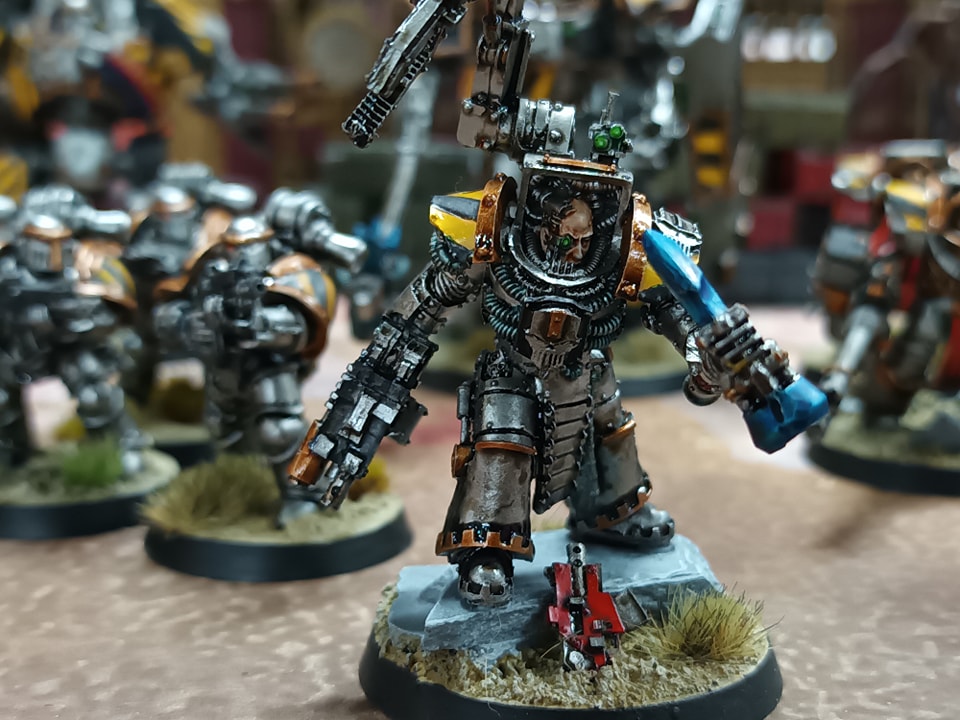
Iron Warriors Praetor 30k Horus Heresy Credit: Magos Sockbert A Warsmith of the IVth Legion. Credit: Magos Sockbert

The guns are simply Black Templar Contrast over however the metal of the guns has ended up (no need to neaten it up first!); it gives them enough definition at a distance to not look like just a blob, and doesn't draw away from the rest of the model. The red, which I used as a spot colour and for most eyes, was simply Mephiston Red washed with Carroburg Crimson, then relayered with Evil Suns Scarlet. Green, used for lenses and screens, is Moot Green washed with Biel-Tan Green, then with spots of Moot Green taking up less of the lens. You may find that the Moot Green doesn't cover the now much darker base layer; this is fine, and you should lean into it. Do your next spot of Moot Green much smaller inside, so you'll have a focused, bright spot of Moot Green in the centre, fading outwards. Cables were simply washed with Coelia Greenshade.

As for bases, a sand mixture was placed down and painted with Tallarn Sand before being drybrushed with Tyrant Skull and then Terminatus Stone. Tufts were whatever I had lying around and, finally (before the fun of hazard stripes!), stones were painted with Dawnstone before a rough drybrush of Celestra Grey, and a lighter drybrush (or line highlight where possible) of Ulthuan Grey. Big shout out to DeathWatch Studios for this trick, taken from their MCP bases painting guide.
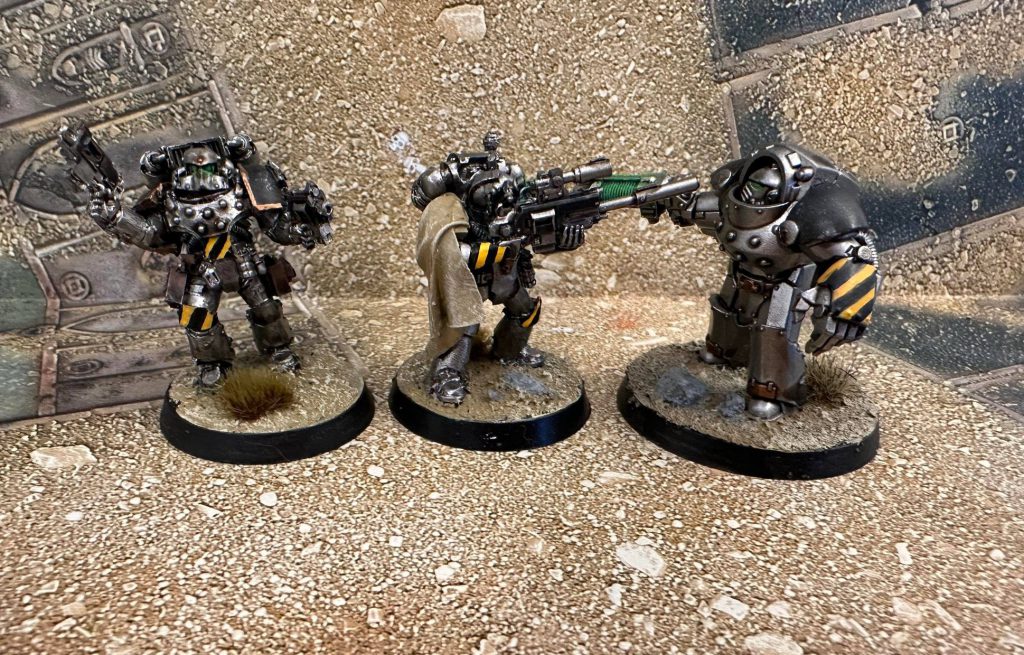
Iron Warriors hazard stripes. Credit: Magos Sockbert Hazard stripes should be used throughout your army. Credit: Magos Sockbert

Hazard stripes aren't... well, they're not complex, but they're not exactly easy either. I've found that after a certain point you're losing a lot more time than you're gaining results, and for me the aim was an army that looked good across the table and in a cabinet, not one that was going to win a painting prize. Where possible, I used Iron Warriors pauldrons and parts which have hazard stripes moulded into the pauldron, but I don't think you should worry too much about precise smooth lines if you're army painting. I free handed a lot of these stripes (obvious, I know...), but you can also draw an outline on with a pencil or micron pen. I used Zamesi Desert as a base, being a very yellowy brown, as it covers over whatever you've got there much, much easier than any yellow I've found. Some people stop there, just neatining up with Abaddon Black. I wanted somethin a bit brighter, so the next step was a thinner layer of Averland Sunset, which covers just fine over Zamesi. At this point I did all the neatening I could, including drawing a thin line with a micron pen around all the edges of the black, doing an almost black-on-black highlight. Finally, a heavily thinned Yriel Yellow was applied down the middle of the yellow stripes, making the whole thing pop a little more.



[expand title="Rockfish's Method - Click to Expand"

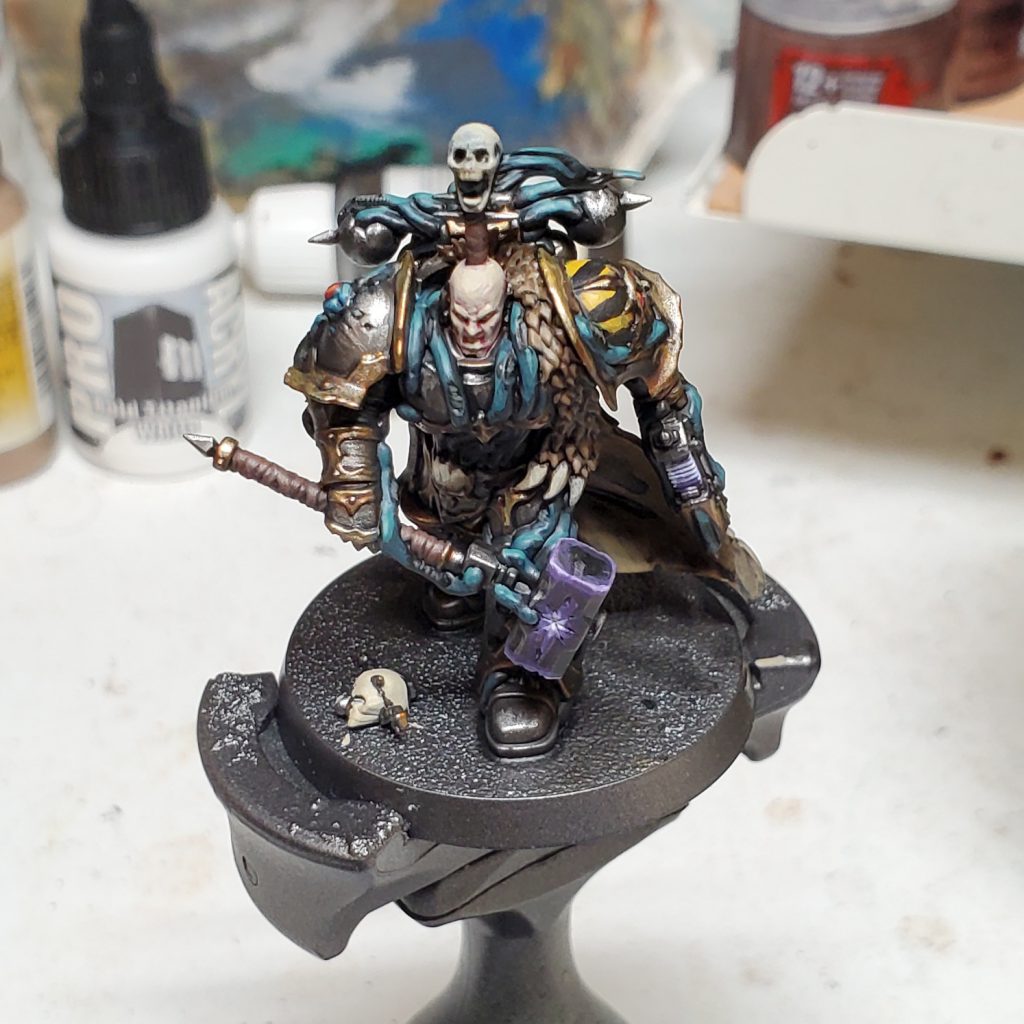
The horrors and life in general have been easing up a bit, and there's nowhere better to start writing again than to talk about yet another new army I've started. In this case, Iron Warriors! I've managed to avoid the call of painting a chaos army for years due to trim hell that has plagued every conceptualization of a colour scheme I've thought of. Sadly the beckon of some spiky marines appears to have overpowered my dread at the thought of painting that much trim. I was a bit strategic with this scheme though, I went for one where most of the work is base coating that nasty trim with the rest being made up of high coverage paints and a minimal number of different base colours on any given model.


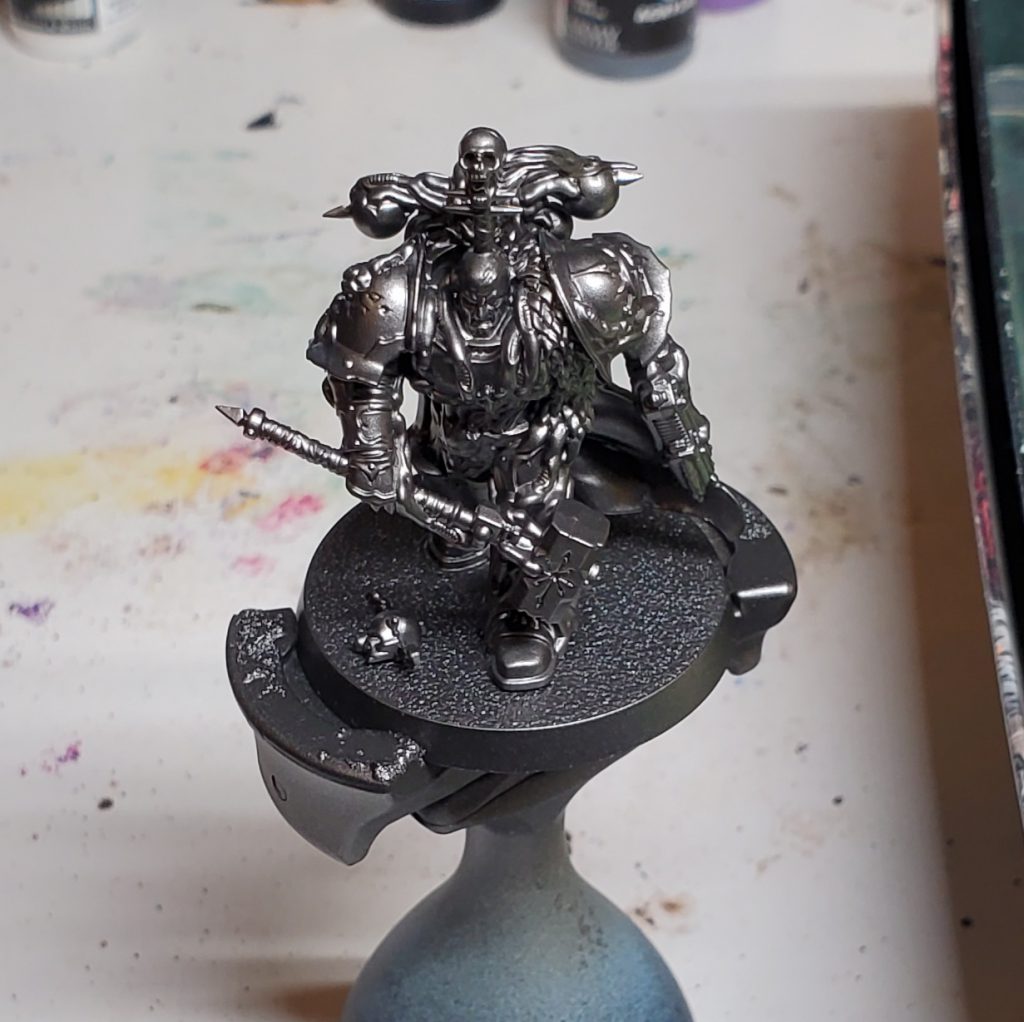
Jumping into painting the models themselves, I start with our primary colour - Vallejo Metal Colour Gunmetal, I quite enjoy how smooth a metallic this is through an airbrush. (I know some people brush paint with this line but can't understand it, it's waaaay too thin for my preferences.)


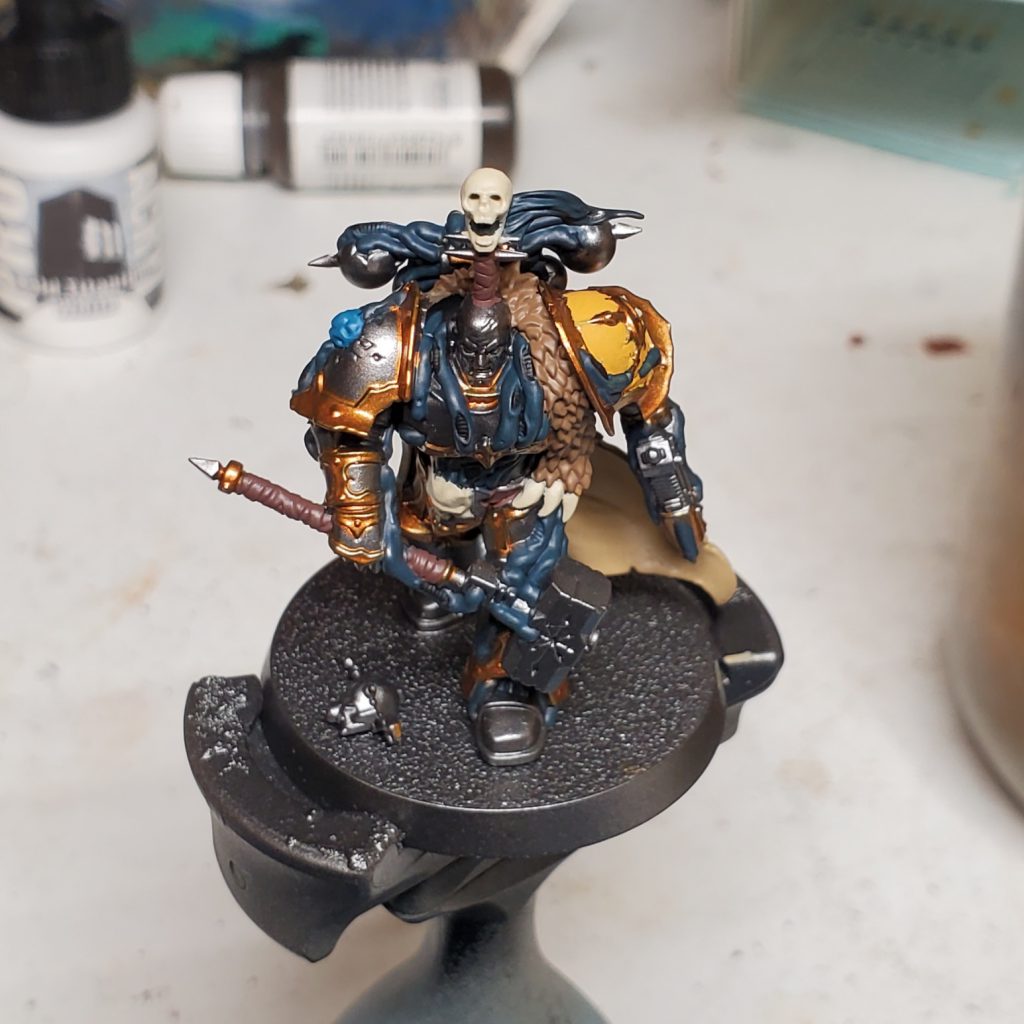
With the initial colour down it's time to pile on a ton of base coats, you'll note almost the full model is base coated in one step as that is one of the other compromises I made as it enables a fast full model wash in the next step.

For the colours you'll need for now, it's pretty straightforward:
  • Speed Paint 2.0 Golden Armor for the trim
  • Incubi Darkness for the fleshy tubes
  • Fanatic Abyssal Blue for the demon flesh in this case, I've varied demon flesh a bit mostly keeping to blues/purples/greens for now
  • Black Legion for the rubber bits
  • Fanatic Oak Brown for leather
  • Averland Sunset for the yellow base of the shoulder pad
  • Steel legion for the fur
  • Fanatic Skeleton Bone for the teeth and well, bone
  • Finally Zandri Dust for the cloak


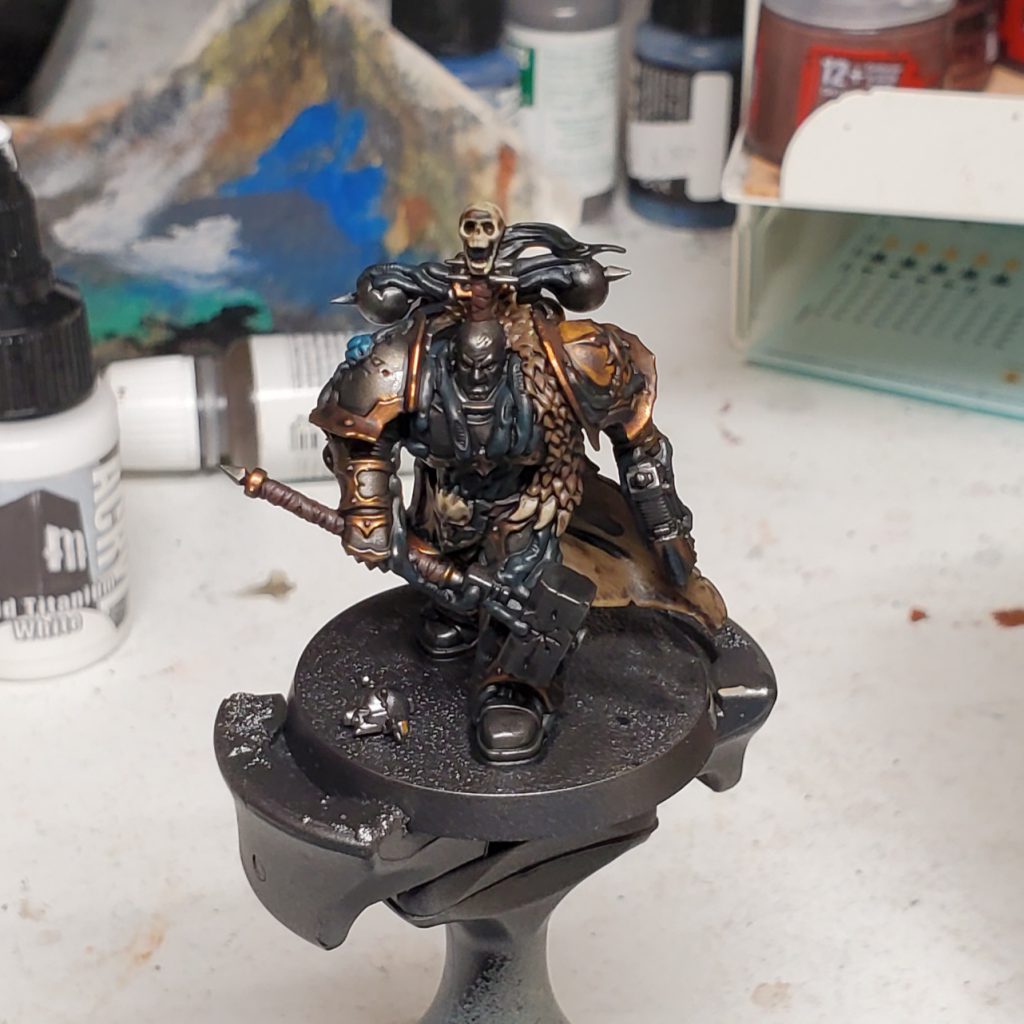
Here's that big time save I mentioned before, I drowned everything in thinned Ratling Grime and it gives a great look and avoids having to individually wash the different details. There are a lot of schemes where I might use half a dozen different washes as the colour tone is pretty important for not squashing colours, but in this case it works well for a chaos scheme and opens us up for some dramatic highlights to really differentiate details.


Now for the fun stuff! Usually, unless I say otherwise, I'm gradually mixing the highlight colour into the base coat, but there are a few cases where the wash being a dense dark contrast means that the base coat is good enough as a highlight.

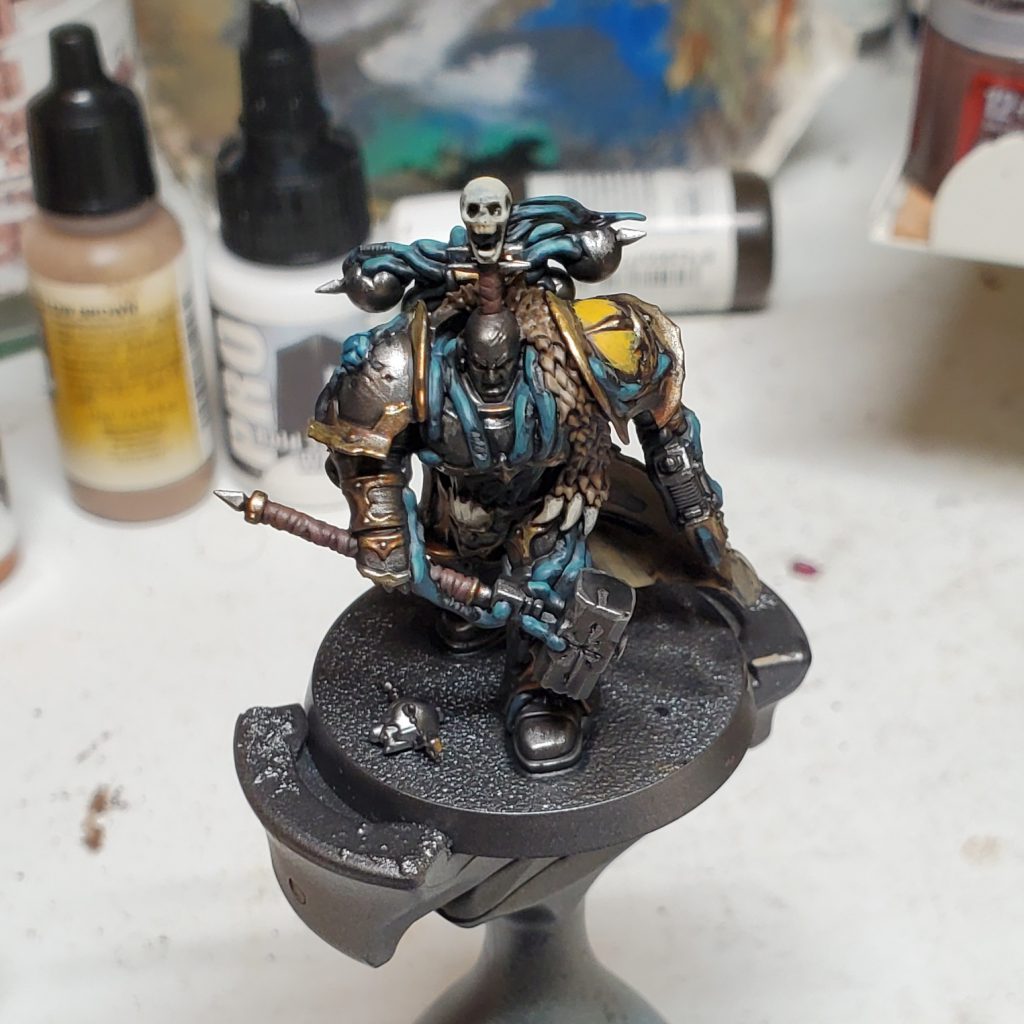
Probably my favourite thing here is the tube/secondary colour highlight which is just mixing Sybarite into Incubi gradually, it's not a particularly fancy colour but I like how it pulls the tubes out of the rest of the model. For some of the mixed highlights, the leather is Fanatic Oak Brown with a bit of Zandri mixed in and the various demon skin colours usually use some light flesh tone like Kislev. The remaining mixed highlight is glazing mixes from Averland to Yriel on the shoulder pads

The black rubber is unusual for this scheme as it's two distinct colours, Skavenlight and Stormvermin straight up as a 'conventional' highlight without glazing or blending.  Then there are the two main examples of using the basecoat again in Zandri, Steel Legion and Fanatic Bone for the cloak, fur and bone respectively where the difference was stark enough that I could even glaze on the highlight.

It's worth breaking out the two metallics as distinct as they are both handled a bit differently from the others, the trim highlights make use of liberator gold having sorta mediocre coverage by letting you get almost glaze-like behaviour just by doing a couple of different layers of it. The steel highlight is odd in that it's applied like a area highlight but with 'feathered' edges, where rather then glazing or transitioning the colour like you would expect from the art usage of that term the colour is applied with intentionally rough edges to the highlighted areas as a single non glazed layer. The idea being to replicate light reflecting from a surface that's streaked with gouges like a coarse brushed metal surface without it being damage with serious depth to it, a few things get conventional edge highlights instead mostly just dependent on what vibe I want the part to have.

Now we're in the home stretch! The details really get the model to the 'done' feeling state and I personally find a ton of fun. The simplest is also in someways the most annoying, as I just free-hand the black stripes on the shoulder pad on - you could use tamiya masking tape or advanced techniques to get accurate but all of that stuff is annoying so I just roughly throw stripes on and hope it looks ok once you get enough models around.
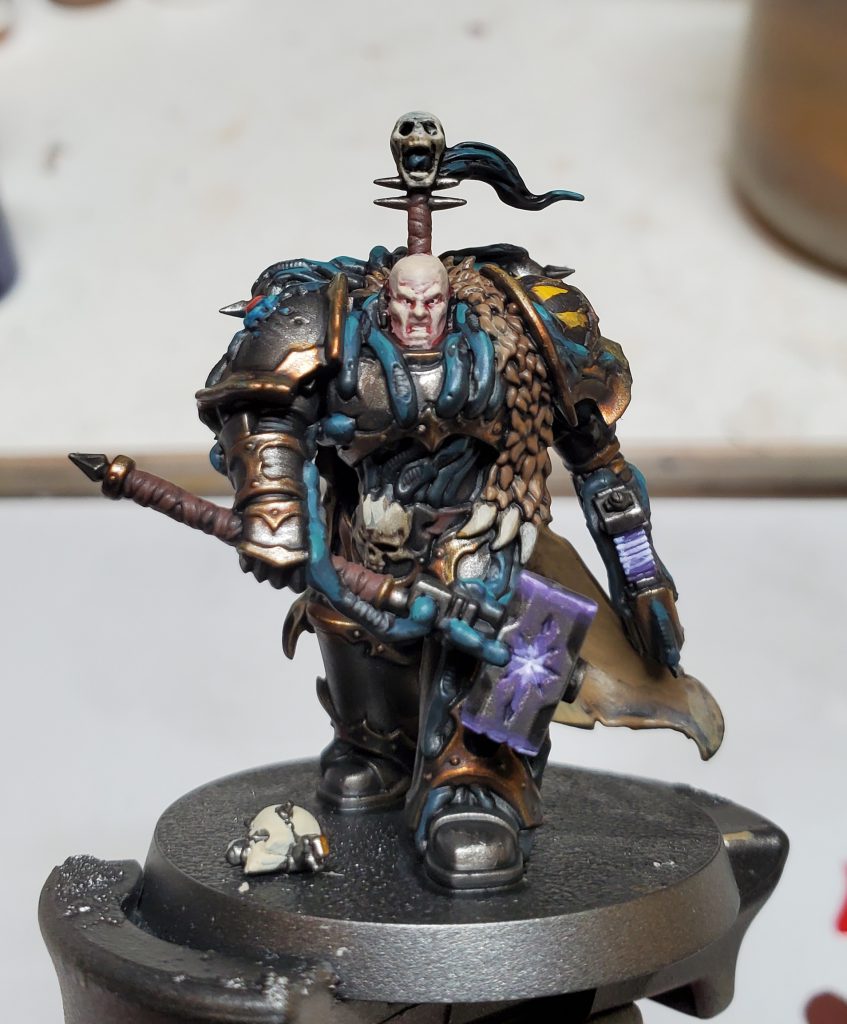
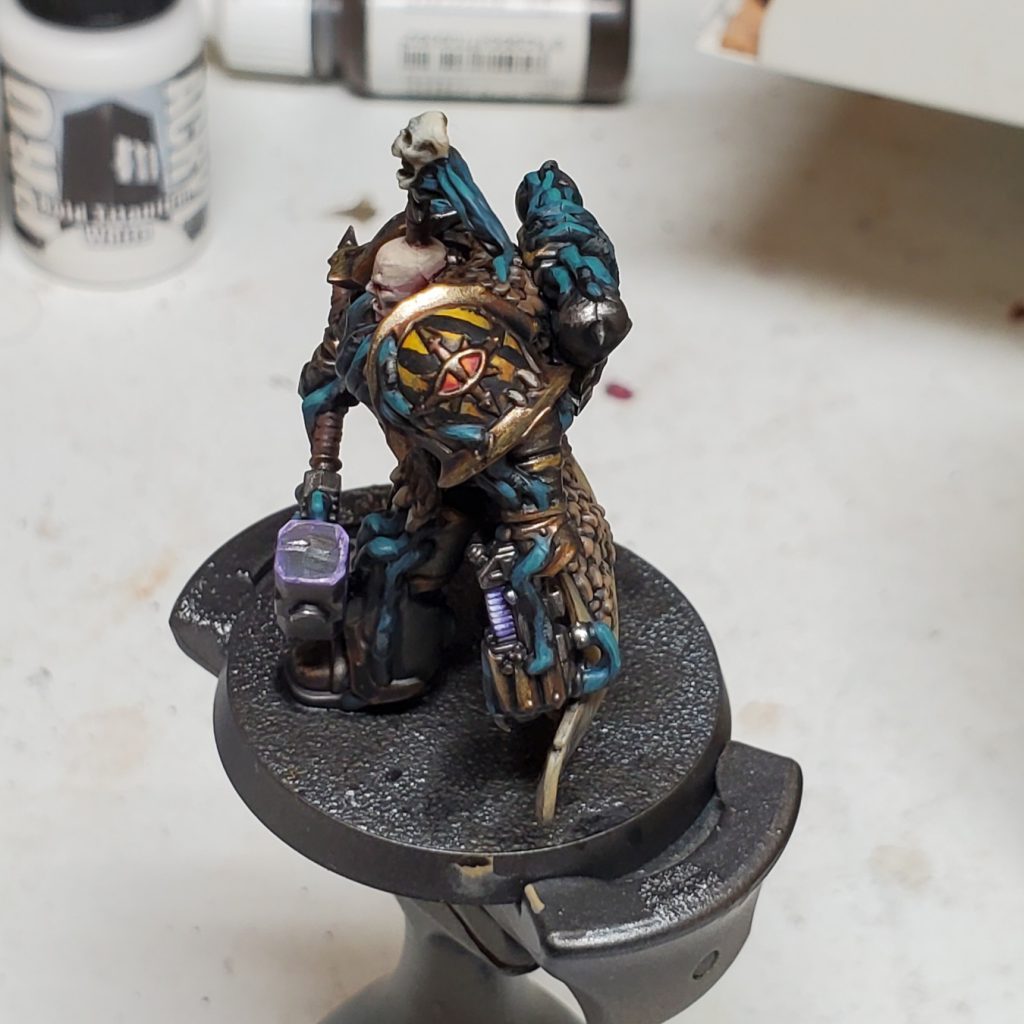
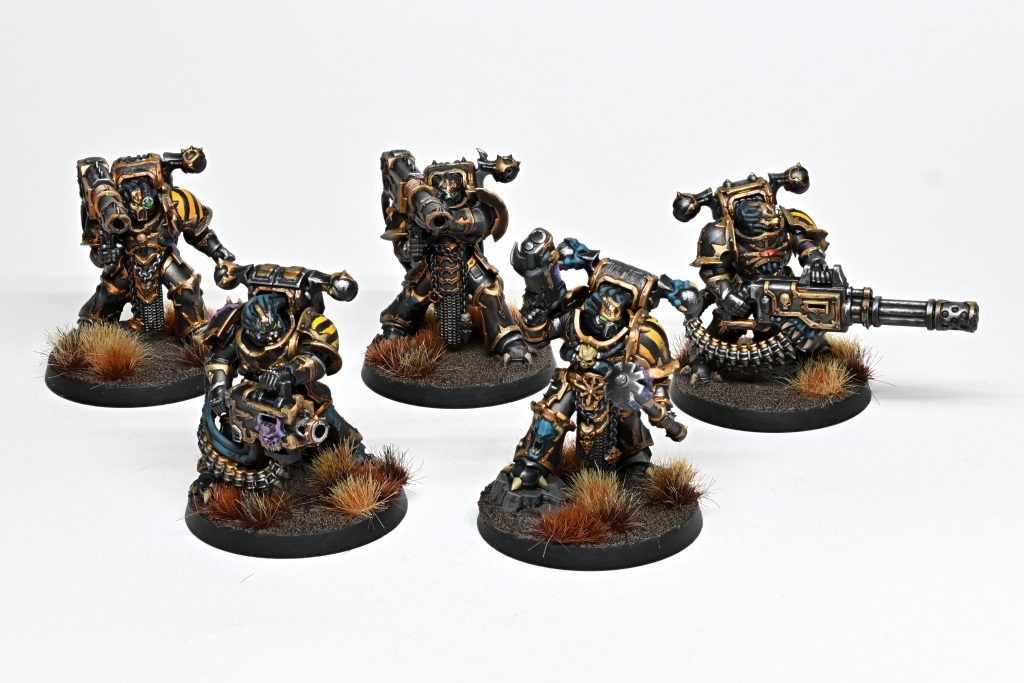
The most intensive detail on this particular is the skin, and also the most loosely defined part of the scheme. Rather then specifically lay out the colours I'd prefer to focus on the concept I want as there are a bunch of different skin tones that might appear depending on how many helmetless models I do. My thought is, pallid and messed up, so lean towards pale versions of human range tones and use strong reds and purples for washes so the recesses are overly emphasized as if sunken in along with a desaturated pale highlight colour being mixed into the base skin tone. These are a bunch of weirdos that have pledged themselves to the nefarious wills of daemons and twisted lords and their existence is drained away because of the costs of that sorta life style, kinda as a contrast to how the imperium drains everyone else to feed the marines maybe.


The red of daemonic eyes and iconography is a simple sequence of blends between Mephiston Red and Flash Gitz yellow, unlike a gem effect since I am going for an 'illuminated' style I usually pick a point as the origin of the glow and work towards having it brightest there. This is similarly reflected in how I do the purple glow for the plasma and thunder hammer, except there the transition from Naggaroth Night to a pure white can be from a variety of areas like the hottest of the coils on the plasma or the active edge on the force weapon. I did do a slight glaze to the force weapon using the same set of blended colours as the pistol just less opaque away from the edge.

Havocs. Credit: Rockfish Havocs. Credit: Rockfish
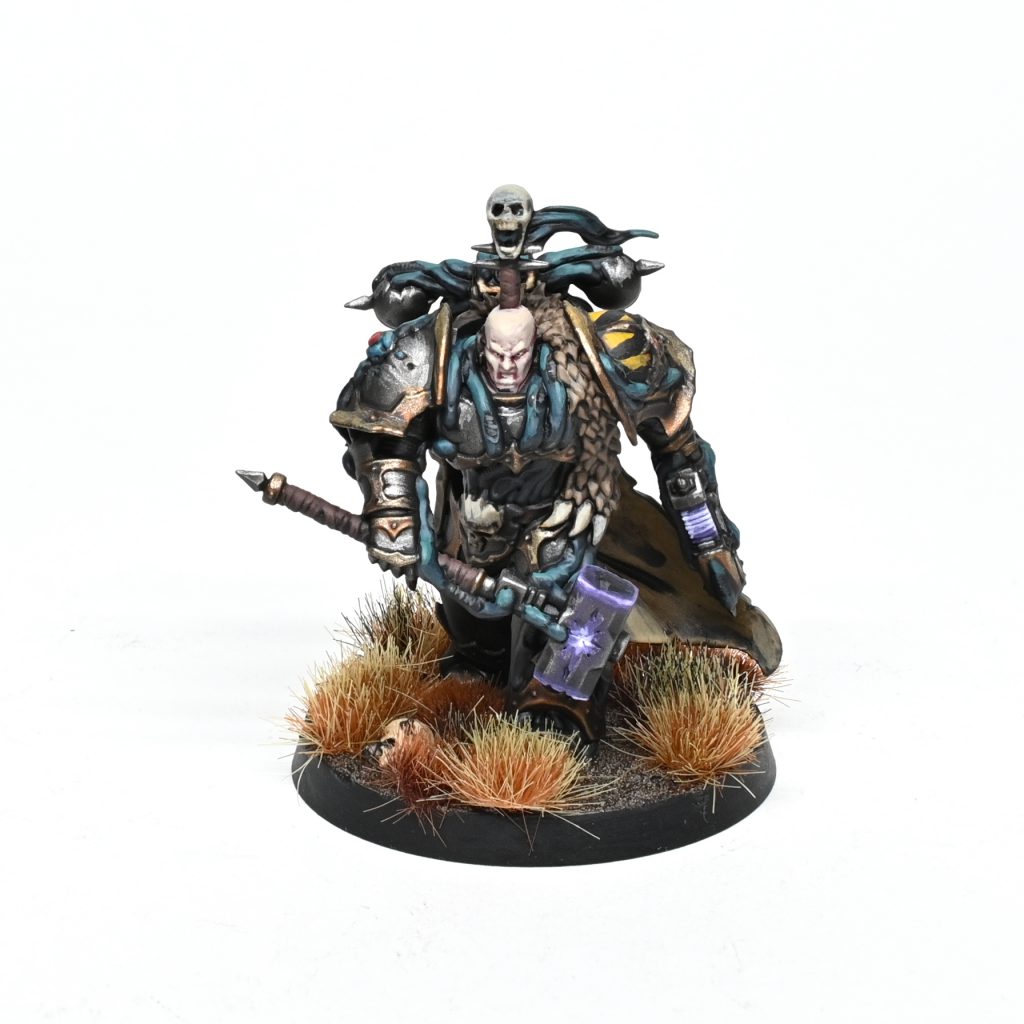
Something not represented on this model is the eye lenses I use on the marines where it's a blend from Sybarite to Flash gitz using the traditional gem effect pattern.

Chaos Lord. Credit: Rockfish Chaos Lord. Credit: Rockfish
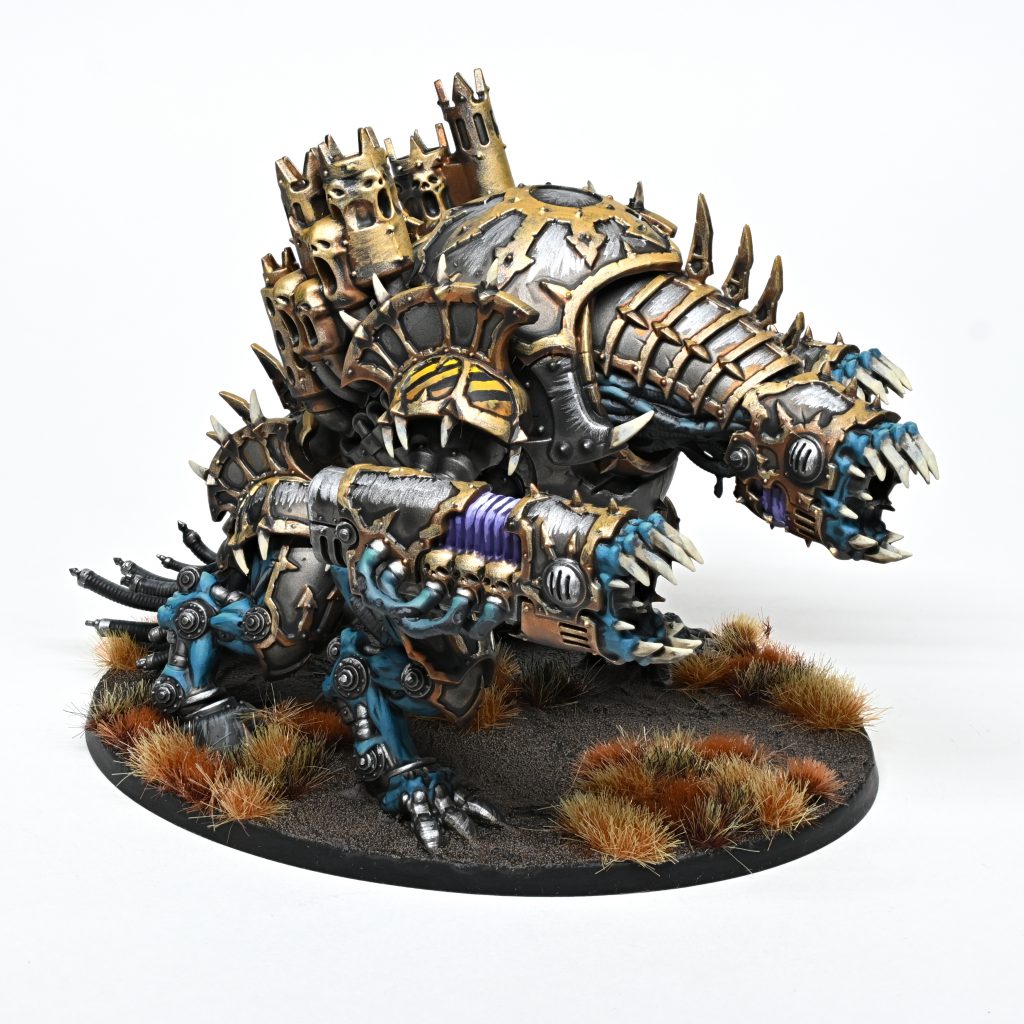
Wrapping up the model from this point just means getting the Vallejo Dark Earth texture paste on the base, washing it with agrax and then varnishing the model. (In my case I like using Vallejo Premium Air Matte varnish as my favourite final texture and spraying experience.)

A quick trim clean-up and throwing Burned, Brown and Dry tufts from Gamers Grass finishes the model and it's ready for the table!

Loading...


If you want an example of how this scheme can work out on a larger model, I finished up a Forgefiend while working on this article!

Forgefiend. Credit: Rockfish Forgefiend. Credit: Rockfish

Loading...


[/expand]


Special Units

There's a dearth of named character models for the Iron Warriors, in both 40k and Heresy. However the Iron Warriors were one of the first legions to receive a Primarch model, and if you're interested in painting Perturabo, you can find our guide to painting him by clicking on the banner or link below.

How to Paint Perturabo

As always, if you have any questions or feedback, drop us a note in the comments below or email us at contact@goonhammer.com.


Tags: chaos | Painting | 40k | hobby | chaos space marines | tutorials | Warhammer 40k | Iron Warriors | Horus Heresy | How to Paint Everything

Thank you for being a friend.