 This website uses cookies. Learn more.
This website uses cookies. Learn more.
This website uses cookies. Learn more.
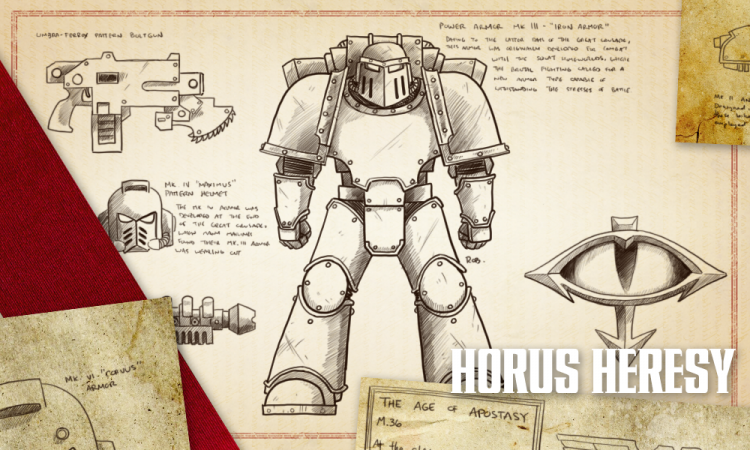
Zone Mortalis games – small point value games of Warhammer played in claustrophobically tight settings, with the environment itself posing a hazard beyond just your opponent – has been a hallmark of the Forge World/Specialist Games/Whatever We’re Calling It Now line stretching back to the Badab War series.
It also happens to be one of my favorite ways to play Horus Heresy.
Last week, the Horus Heresy team released a free PDF of rules for playing these sorts of games in third edition Horus Heresy. It’s a small document – Zone Mortalis rules have historically vacillated wildly between nearly full supplements and a couple pages of rules, so this isn’t a surprise, but let’s dig into it.
Zone Mortalis games (insert “Danger Zone” jokes here…) are as much about the environment being played in as the armies themselves. Secret hidden laboratories, twisting hive environments, and starships are all potential settings, and they share similar characteristics: They are dangerous, crowded, and labyrinthine.
Given all this, it’s not surprising that the first part of the rules defines this environment, as compared to the more open battlefields of the Age of Darkness.
We first, hilariously, have the definition of The Ceiling. Which is what it sounds like. These battlefields have ceilings. In addition to gifting us with the hilarious phrase “…a mutual understanding of the ‘Ceiling’” it does mean barrage weapons and aircraft are out of the picture. This is faintly disappointing to me – last edition’s PDF rules suggested you needed to decide if there was a ceiling or not. Doing so had a lot of consequences, and I found was actually good for mixing up Zone Mortalis games. But alas…
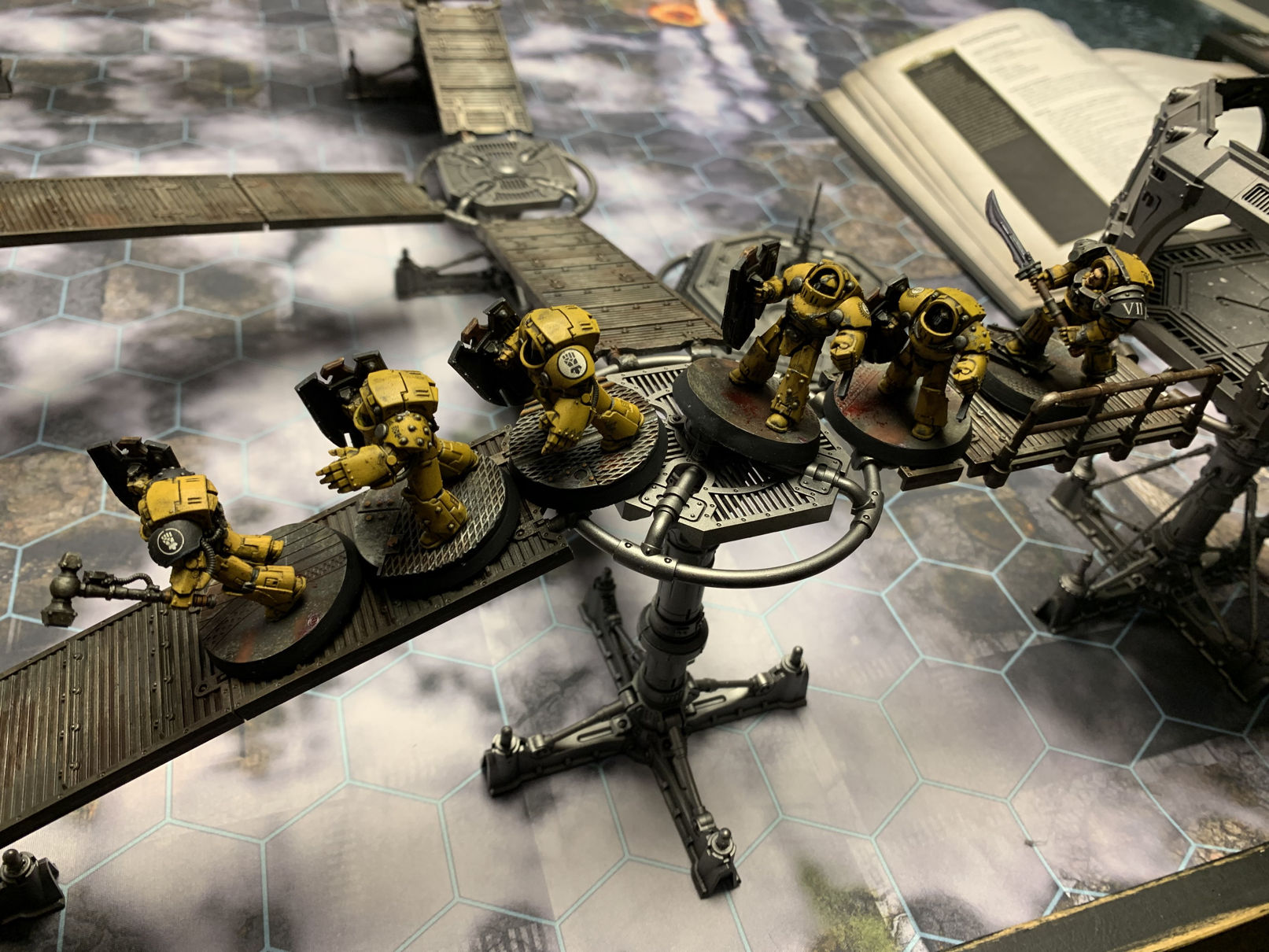 Lacking a mutual understanding of the ceiling, Imperial Fist Terminators advance across a narrow walkway suspended high in the stratosphere. Credit: Eric Lofgren
The rest of the section is a fairly aggressive codification of the battlefield. Some of these are somewhat rigid gameplay definitions that seem mostly in service of selling tile kits, like wanting everything in a 12”x12” definable section. A lot, however, streamline things that Zone Mortalis has always struggled with.
All manner of units are now allowed in Zone Mortalis that might previously have been prohibited: Jetbikes, Cavalry, etc. There’s just the small matter of if you move more than 9” during any phase, you take a hazard check for each model that did so, and on a 1, they’re gone. This opens up a wider variety of lists and lets people play with the collections they have, and some truly entertaining ideas like dozens of rough riders pouring into tunnels, wiping out left and right. Simply roll 6s and I’m sure this will be fine.
How this broader range of units now fit in tight spaces gets refined with the rules for Corridors and Doorways, and how they work with large units. Primarily, this is accomplished by giving Corridors the Confined Space (X) rule, where units with Bulky(X) of the same value of X or higher will find said Corridor impassible. This is in lieu of previous attempts to anticipate which unit types, base sizes, etc. should be allowed, as has happened in the past. Similarly, “Can I fit through that door?” now has an unambiguous answer: each door is assigned the Doorway(X) rule. If you’re Bulky(X) where that value is greater than the Doorway’s, there will be no charging (or making a setup move) through the door for you, and if you’re just passing through, you lose movement equal to the difference in the two values. For example, if you’re Bulky(5) and the Doorway you want to move through is Doorway(2), you’re going to lose three inches of movement. If the difference is double, it’s impassible. There’s also wording here to cover vehicles, which while not expressly banned, will find all Corridors and Doorways to be impassible if they have more than 3 Hull Points.
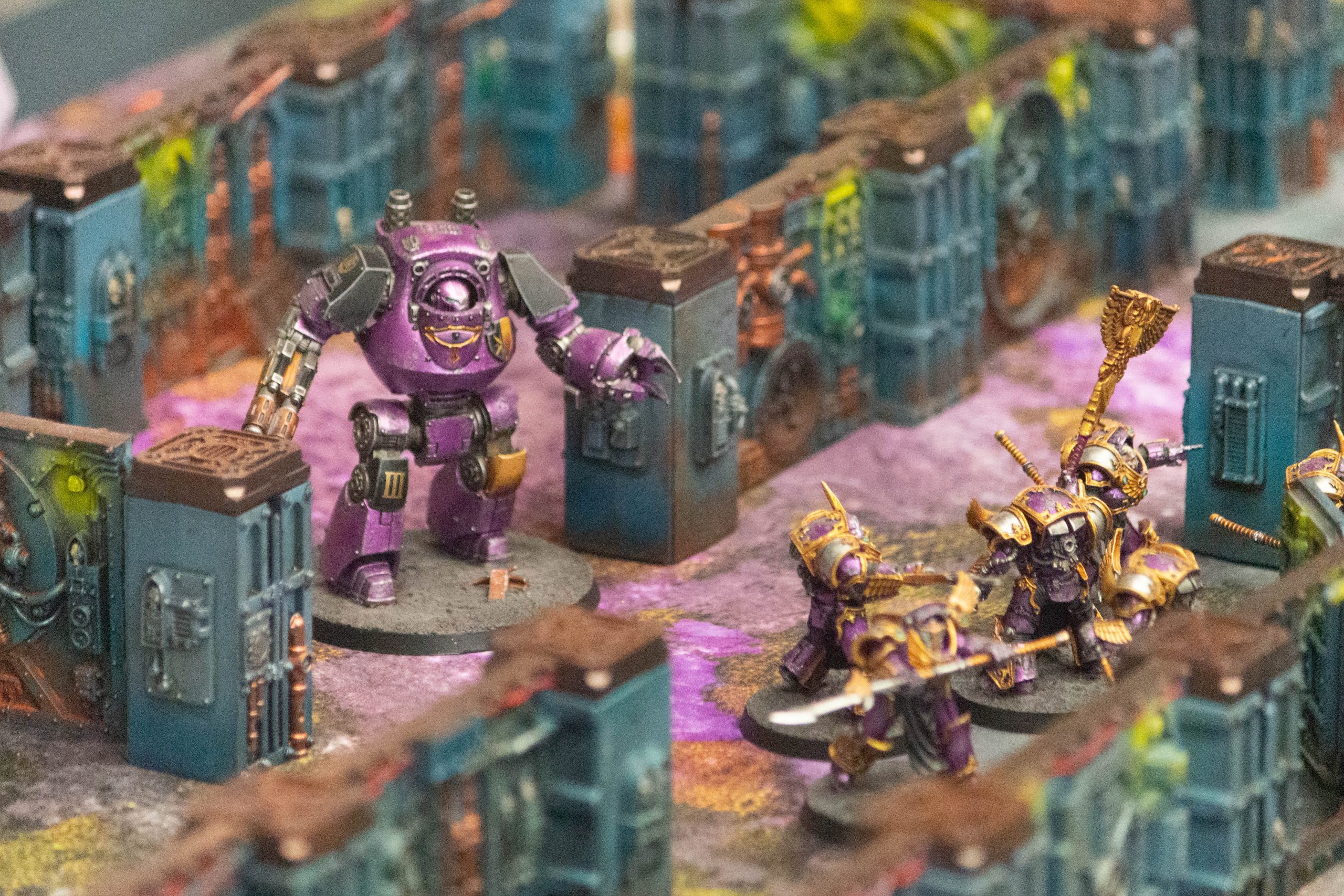 Zone Mortalis at the Goonhammer Open. Photo Credit - Soggy
This carries on with third edition’s awkward but precise way of wording rules to try to stamp out edge cases as much as possible. It is, for lack of a better word, grognardy. And given my gaming interests, I mean that in both a positive and negative sense. It doesn’t exactly make for great reading, and I’m not sure trying to chase those edge cases (and the players using them) is worth the cumbersome writing, but it is at least clear.
Doorways retain their ability to be attacked, charged, etc. and can be either Closed or Open, with the ability to change that status using an Intelligence check, which may potentially make for amusing and/or frustrating “How do buttons even work?” moments. They also retain my all-time favorite ability to just crush units caught in closing doors or cut off from coherency because that happens, even if this rarely happens in practice.
In case the awkward mutual understanding of the ceiling was somehow not a mutual understanding, we also reiterate that Flyer sub-type models are right out, and units with Barrage(X) need line of sight to shoot.
The increased lethality of template and blast weapons from the Firestorm and Shrapnel special rules in past iterations of the Zone Mortalis rules have been dialed down a lot, in that now blasts simply can’t scatter through walls or closed doors, so stop when the center of the blast reaches that point. That’s likely to make them more dangerous, but in a much more abstract sense. Blind Panic now causes Routed units to potentially cause friendly units with a Pinned, Stunned or Suppressed status on them to Rout as well. This is also narrower a condition than it used to be and provides a strong reason to sprinkle statuses around liberally if you can.
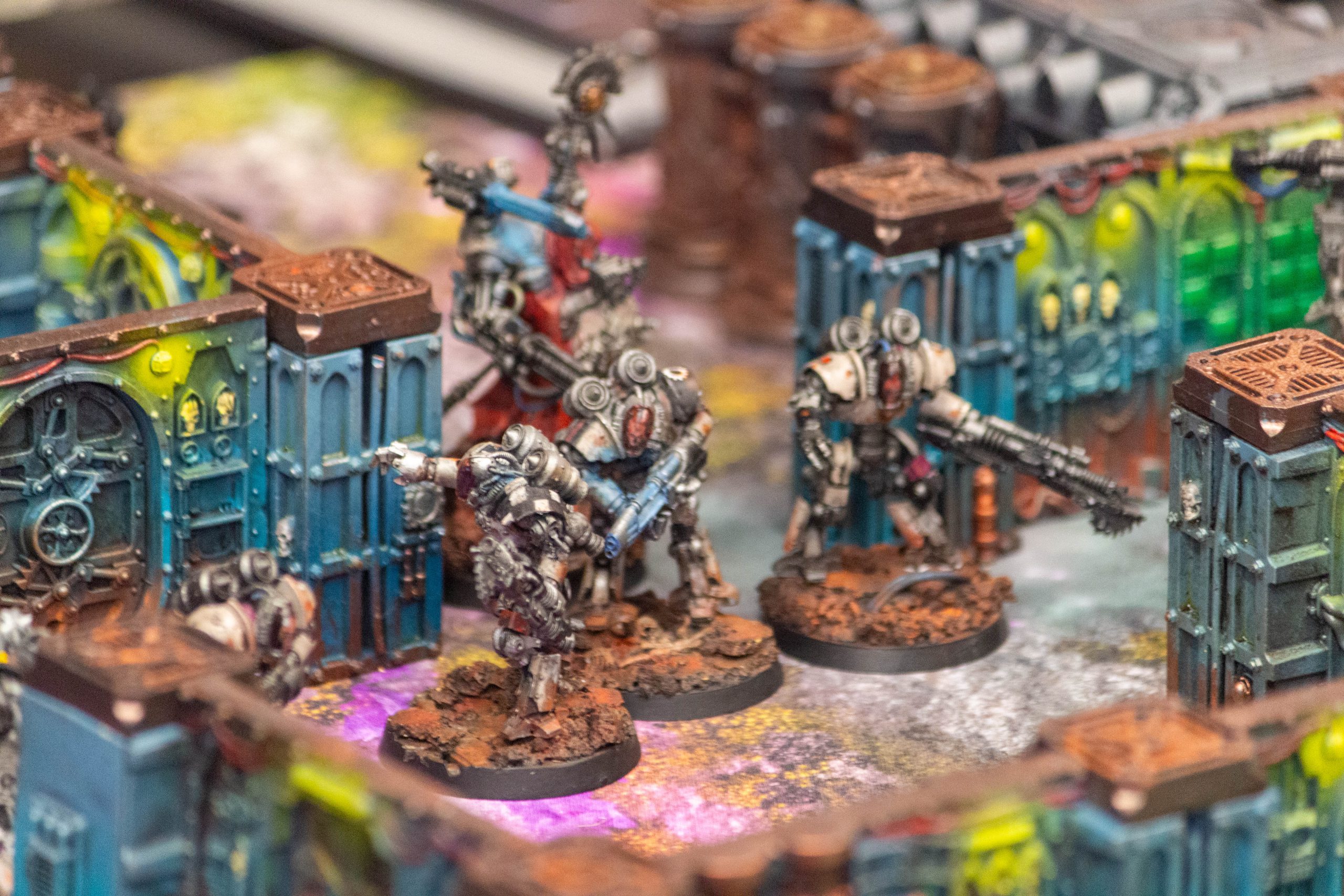 Zone Mortalis at the Goonhammer Open. Photo Credit - Soggy
You don’t get to the other special rules, which are at least ostensibly mission specific, until later, but we’re going to talk about them here. The first, Abyssal Darkness, is just a condition where, if it’s in effect, it is hella dark, and the limit of Line of Sight is now 6” or less. The second is Impenetrable Area, which effectively turns off Deep Strike. While this is ostensibly a mission specific rule, it appears in every mission, which means unless you’re designing your own, it’s essentially a fixed rule.
I understand the intent – the rules writers have always struggled a bit with the fact that you probably shouldn’t be able to arrive onto a Zone Mortalis board because you have wings or a jump pack, but probably should if you have a teleporter, and how exactly to disambiguate that. In this case, the answer is “Don’t.” I do somewhat struggle with this, as a teleporting Terminator assault is pretty much the iconic Zone Mortalis action. It’s a simple thing to abstract that out to “It happened just off-screen”, but that’s much less dramatic. If nothing else, it behooves event organizers and the like to make it clear in their mission packs in advance if Impenetrable Area is likely to be in the mission rules, given the narrative desire to take Terminators conflicting with their often-frustrating lack of mobility and the rules’ mandatory-but-maybe-not status.
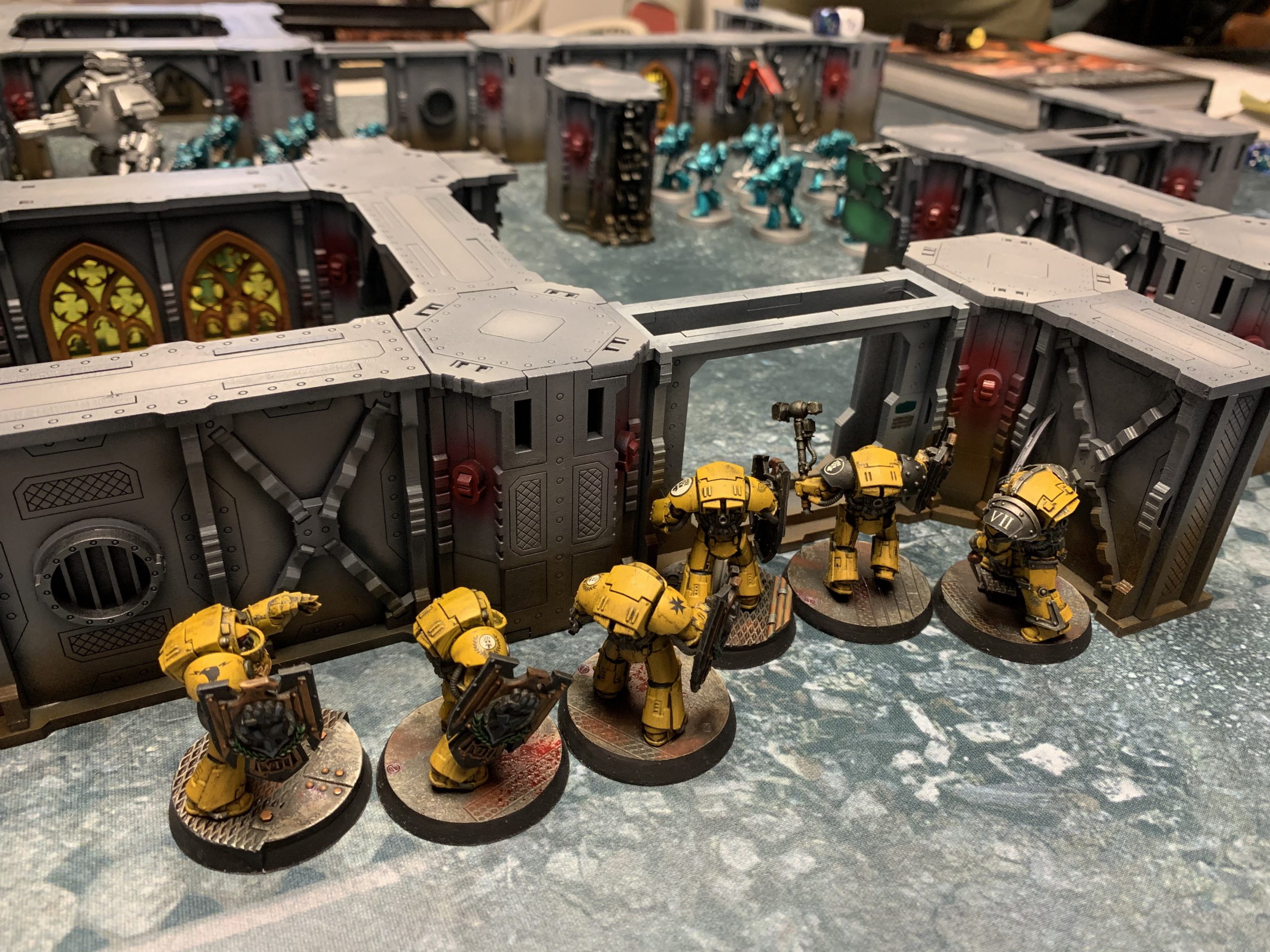 Lacking the ability to teleport, the Imperial Fists walk laboriously to intercept a unit of Alpha Legion. Credit: Eric Lofgren
Also notable is what’s missing here: specific Zone Mortalis-specific reactions. In past editions, these generally appeared as a more limited, watered down version of some of the regular reactions, usually with an accompanying prohibition on Legion-specific reactions. Those are simply gone, and everyone is free to use the full-fat reactions out of the main rulebooks, albeit at a reduced frequency due to the smaller game size. Having played in the NOVA Centurion games which also allowed this, everything seemed okay, but I’m sure there are combinations of reaction, army, and Zone Mortalis that can make the more powerful reactions more devastating. It’s also one of the few places where the rules (or lack thereof) upped lethality.
Three missions are provided, all of them 1500 points and played on a 4’x4’ board. There are a lot of instructions as far as how many walls, doorways, barricades, etc. should appear. Honestly, I tend to build my boards based largely on vibes, but it’s a good guideline for what the designers are picturing when they write a mission. Even if you follow the rules exactly, it’s an order of magnitude more freeform than 40K’s Boarding Action layouts.
There’s also a lengthy bit on objective markers and what it means to control an objective, which again, is fairly cumbersome to read, but will probably be helpful, as Zone Mortalis games often involve multi-unit scrums where it’s ambiguous who, if anyone, is controlling an objective.
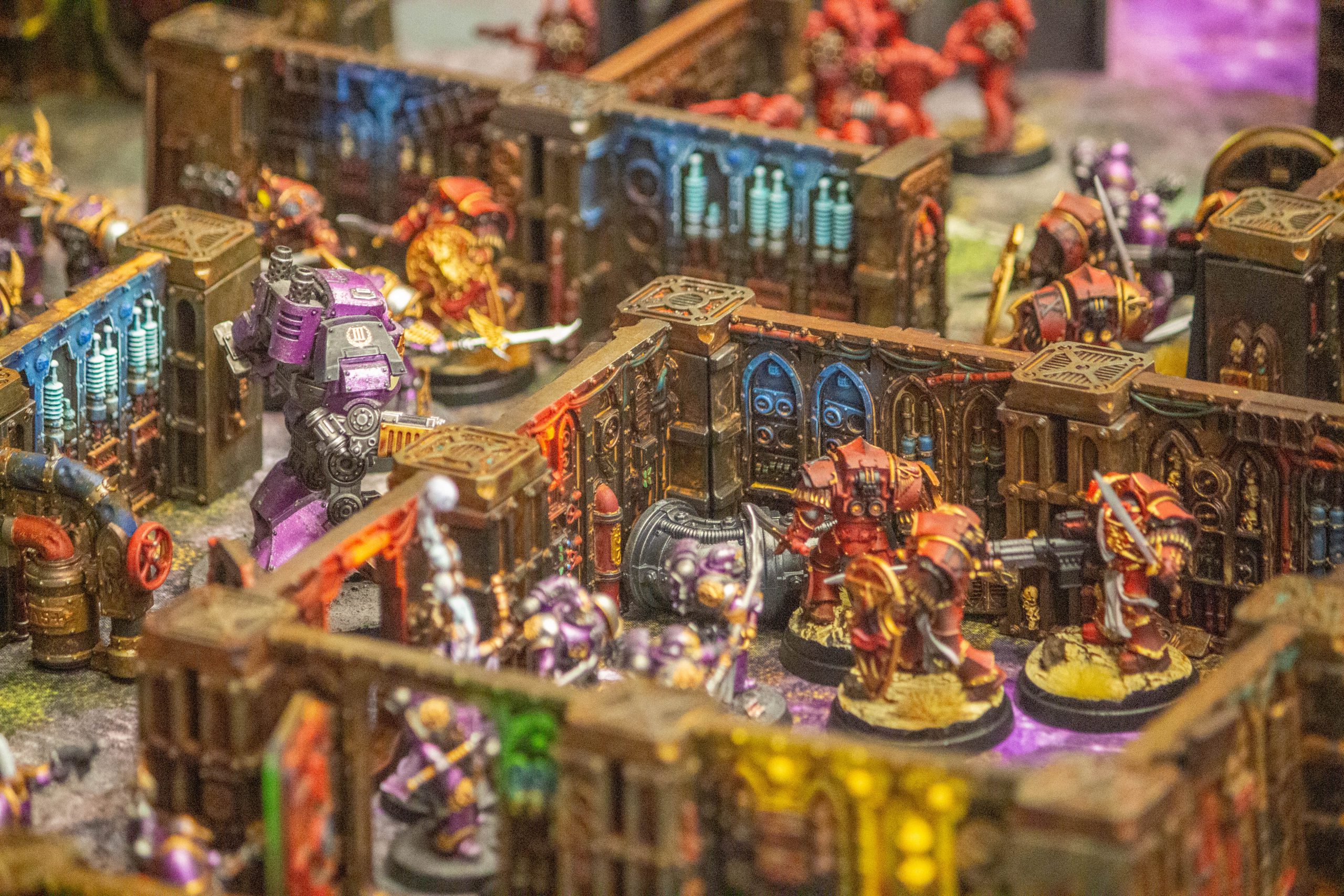 Zone Mortalis at the Goonhammer Open. Photo Credit - Soggy
The first mission, “Sector Sweep”, is a classic progressive objective mission, with four objectives, each a foot in from each board edge. The board itself has a specific layout, with the inner four sectors being Confined Space (6) while the outer sectors are Confined Space (8), confining larger Dreadnoughts and the like to the periphery of the board. The other twist is Failing Power Conduits, where you roll a dice for each section at the start of each game turn, and on a 1, that section is in Abyssal Darkness. There are sixteen sectors on this map. It’s a neat idea, but it feels both tedious (and token) heavy, and exactly the type of rule where by about turn three, players go “Oh, we forgot to roll for darkness…” and then everyone moves on.
Mission Two, “Terminal Control”, has that same No Big Guys In The Middle board layout, but with table edge rather than diagonal deployment zones. The five objective markers here can “interface” with an objective they control by making an Intelligence check. The margin they pass by is the value of the objective, to a maximum of three. This is going to really punish units with low Intelligence, who are both going to struggle with doors and computers. Poor Ogryn.
Finally, we have “Signal Influx”, where players each deploy in two adjacent corners and there are nine potential objectives, which will turn on and off so only three are active at a time. Combined with this, each sector that doesn’t have a unit in it gets a D6 rolled for it at the start of the game. If the result is two or more, that section has the Confined Space(X) rule, where X is the value of the dice roll. If it’s a one, it’s got Abyssal Darkness instead. That’s a lot to keep track of again, and while I haven’t had a chance to play this one a bunch of times, feels the most like people will feel like they got beaten by the dice, not their opponent, through the combination of shifting objectives and potentially wildly reduced mobility.
Legiones Astartes Sergeants and Command models can get Breacher Charges for +10 points per model, which can be used vs. models with the Fortification type (i.e. Doorways), which will auto-hit, have a Strength of 10 and do D6 damage. Given the widespread availability of melta bombs in Legiones Astartes lists, this feels like a solution to a problem that doesn’t exist. It also feels weird to favor Space Marines expressly here, given Solar Auxilia are, among other things, meant to be elite boarding troops, and have less access to high strength weaponry to take care of stubborn doors (and less innate ability to open them without blowing them up).
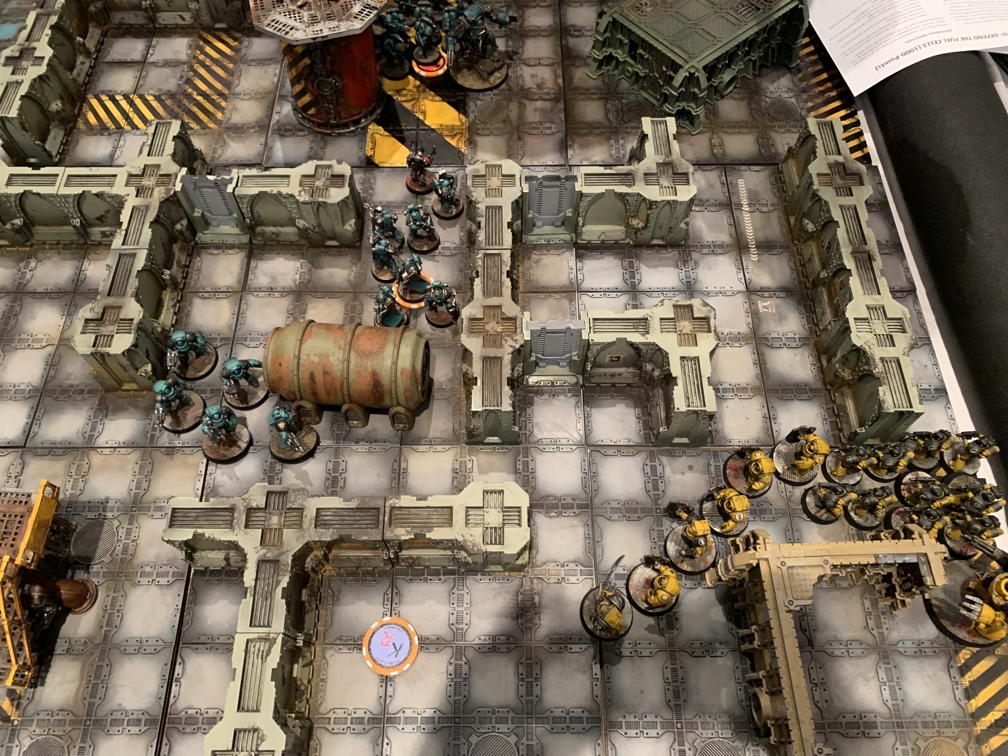 Sons of Horus and Imperial Fists face off in the bowels of a void craft at NOVA Open. Credit: Eric Lofgren
The Siege of Cthonia from second edition represented, at least for now, the high-water mark of Zone Mortalis rules complexity. And I’ll be blunt – they fell somewhat flat with my group. This ruleset is a return to the lighter weight version of Zone Mortalis rules. Critically, the looser restrictions make more armies able to be fielded in Zone Mortalis games, without enabling jetbikes to go racing around claiming objectives while leaving classic Zone Mortalis units like Breachers and Terminators in the dust. At least not without potentially hilarious consequences.
What this feels like is a good start. A foundation to build out from using the Journals system to introduce more missions and more variety, as well as hopefully notions for both larger and smaller game sizes. That does make it feel somewhat half-done, like the rules writers themselves don’t have a mutual understanding of the Ceiling, hence the need for redundant rules to make sure really, no for serious, no Flyers. Similarly with Impenetrable Area being a mission-specific rule, but also one that is, thus far, universally applied.
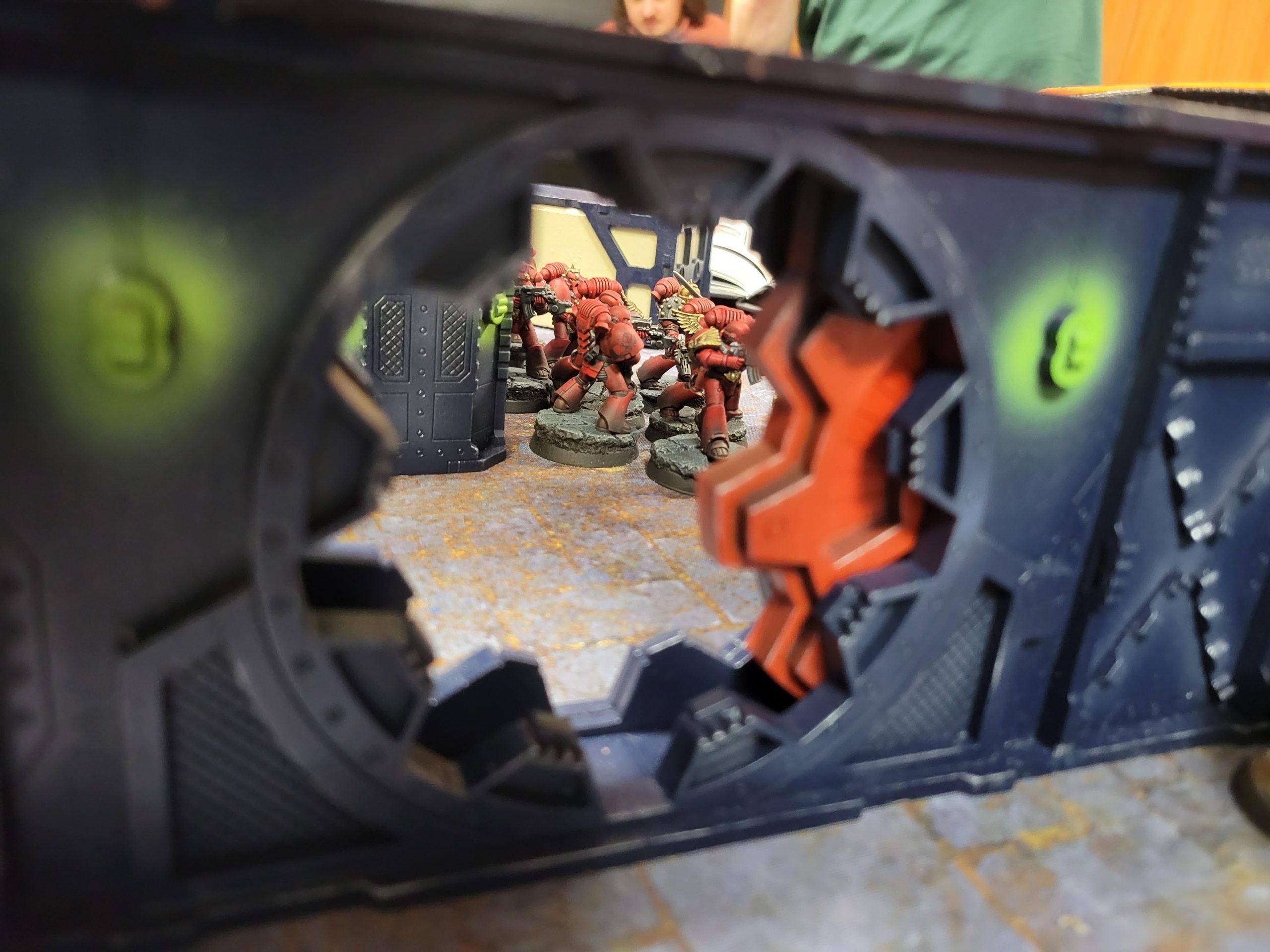 Blood Angel tactical marines seen through a Zone Mortalis door. Credit: Jack Hunter
While I’m glad to see a lot of the complexity trimmed down, I’m a little skeptical of the sector-by-sector rolls for things like just how narrow the corridors are, or whether the lights are on. Environmental effects like that are a perennially popular narrative effect, but their actual use seems limited. That just feels to me like the sort of thing that calls for a ton of tokens (in an already token heavy edition) and is likely to be missed or skipped when the game enters the more complex and combat-packed turns.
At the end of the day, I think the Zone Mortalis PDF exposes enough of the internal logic of the system that players will easily be able to make it their own, and for the moment, I think it’s more broadly accessible to a larger base of players and armies, which is all together a good thing. I’m looking forward to playing it more.
Have any questions or feedback? Drop us a note in the comments below or email us at contact@goonhammer.com. Want articles like this linked in your inbox every Monday morning? Sign up for our newsletter. And don't forget that you can support us on Patreon for backer rewards like early video content, Administratum access, an ad-free experience on our website and more.Tags: zone mortalis | Horus Heresy | the horus heresy | heresy 3rd edition

Thank you for being a friend.
 Goonhammer App and Patron Updates: April, 2026
 Kill Team Tournament Report: Engage, Party, Repeat's March Madness 2026
 Goonhammer Reviews: Tribal Conquest
Support us on Patreon to get access to our Discord and exclusive App features.
Thank you for being a friend.
Already a Patron? Login with Patreon.
Visit our incredibly official store on RedBubble.


Support us on Patreon to get access to our Discord and exclusive App features.
Thank you for being a friend.