Perhaps they're not the most glamorous or fun purchases you might make, but every hobbyist needs
tools to do what we do. When it comes to putting miniatures together, there's nothing more annoying than dealing with a blunt knife, clogged file, or chipped clippers - not only is it frustrating using crappy or damaged tools, they're more likely to make a mess of whatever it is you're building. Having good tools will make everything you do with them easier and less painful. It's also worth noting that when using a blunted knife, you're more likely to press too hard, slip, and cut yourself.


Clippers
Unless you're the kind of barbarian that twists parts off the sprue with their fingers (I do this sometimes, particularly for parts like heads, forgive me), clippers should be your first port of call when it comes to removing parts from the frames. There are broadly two different types of clippers (also known as snips) available, a very sharp kind for cutting plastic and a sturdier kind for cutting everything else - The Army Painter sells one of each, somewhat confusingly (in my idiot's opinion) labelled as "Plastic Frame Cutters" and "Precision Side Cutters". The former are
only for plastic, I cannot emphasise enough just how
not for anything else they are, do
not attempt to use them to, for example, clean parts off your metal models. The blades are very sharp, but they are not very hard; they will immediately become pitted or straightforwardly break if you try to use them on metal.
The other kind, "precision side cutters, are much more robust but lack the razor sharpness of the frame cutters. You can use these for cutting just about anything with enough force, and while they'll potentially become pitted if you're not careful, you don't need to baby them quite as much as the frame cutters.
When cutting things out of the frame, put the flat end of the cutter next to the piece and apply just enough pressure that it pops off cleanly. If your frame cutters are kept nice and sharp, they'll slice evenly through the plastic without stressing it (the white-ish discolouration that happens to the grey plastic when it's subjected to some kind of force or pressure), and with the minimal amount of flash left behind.

Knife
Every hobbyist needs a good, sharp knife to carefully slice the flash off the parts of their model where it once connected to the frame, ideally one with easy-to-replace blades. The Army Painter's knife is nice for this, with a comfy rubber handle making it easy to hold for such delicate work. The knife is also useful to address the mould lines all over plastic, resin, and metal cast models by scraping them with the blunt side of the blade. Take care when using a knife that you cut away from yourself, or at the very least that you only slice your thumb tip rather than something important. If you're young, just let your parents do it, their hands - weather-beaten and thickly calloused from years of thankless labour - are more resistant to the kiss of steel than your soft and tender paws.
A little safety information: When using a hobby knife/scalpel, make sure that you change to a fresh blade when you notice it becoming slightly dull. If you use a knife with a dull blade, you are more likely to press or pull too hard, hugely increasing the risk of a slip and a damaging (and potentially dangerous) cut to the hand or wrist. A knife that struggles to cut plastic is still more than enough to cut you, so keep that in mind.
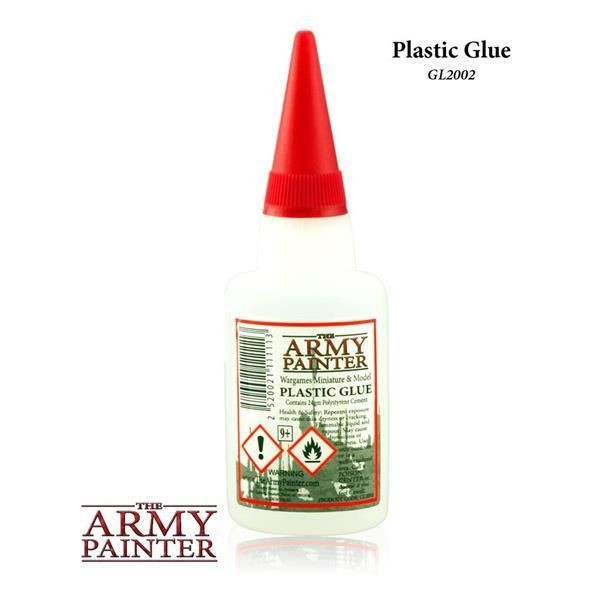
Plastic Glue/Cement
Plastic Glue is typically some kind of Butyl Acetate formula, and works by melting pieces of plastic so that they fuse to one another, effectively forming a single piece. Plastic glue can be quite smelly/fume-y so make sure when you use it that you're in a well-ventilated area and crack a window if you notice that you're getting a bit faint or dizzy.

Superglue
You're probably going to need some cyanoacrylate/superglue as well, for times when you need to repair broken/snapped off pieces in a hurry, or when you need to glue non-plastic things together.
 File
File
As you might expect, we use a diamond file to smooth down the parts that might be a little rough where they've been clipped. As you might expect, there are different grades and shapes of file available - the Army Painter has 3, a triangular prism shape, a flat file, and a circular file, the latter two have a sharp tip for getting into difficult areas as well. Diamond files are much more resistant than emery boards or nail files, so although they're more expensive, they're a much better bet in the long term.
Important health info: If you're using a file while constructing any kind of
resin model kit, you will
need to wear some kind of respiration protecting mask with a decent particulate filter, this is
not optional. When inhaled, resin dust can cause serious, irreversible scarring to the lungs and bronchi (Pulmonary Fibrosis) which, in very serious circumstances, can
kill. Don't take the risk.
 A diagram that will hopefully scare you into wearing a mask when working with any kind of resin. Credit: National Heart, Lung, and Blood Institute
 Drill
Drill
Now we're getting into the "not-essential but good to have" tools - a drill is very useful both for drilling for magnets and pins, and for drilling out the bolter barrels that GW
still obstinately refuses to model with holes in the end. The Army Painter drill very usefully comes with a series of differently sized chucks and bits, held within the body of the drill itself - accessible through pulling off the back plate. The back plate also freely rotates independently from the drill, so you can apply pressure while still allowing the drill to spin, which is so nice compared to the palm-blistering pin vice I was using before.

Tweezers
I have said "it's very handy" a lot in this article, haven't I? Well, here's another thing that's very handy - Tweezers! Quite a few times, you'll be working on something pretty small and will need very, very precise handling. Maybe you have big sausage fingers like me and need to put a head into its hole, then tweezers are a good answer to these concerns.
 Sculpting Tools
Sculpting tools could probably be an article all by itself, but here's a cursory glance. There are various tools that can be used when sculpting with putties, from something as simple as a toothpick, through to the same kind of stainless steel picks and shapers dentists use, all the way to powerful rotary tools like those made by Proxxon and Dremel.
The Army Painter produces a set of stainless steel dentist-esque sculpting tools that are a great option for impressing and scribing details into putties like Green Stuff and Mililput.
Silicone "colour shaper" brushes are also excellent for manipulating putty, with the added bonus that nothing will stick to them, removing a very common problem people encounter when using green stuff - that it sticks to the tool and tears.
If you're considering getting a power tool along the lines of a Dremel or Proxxon, you're probably already considerably more advanced than the intended readership for this particular article (though thank you for reading anyway!) In a strange way, they're a bit like an extremely high-powered electric toothbrush, a rotating stick to which various attachments can be added, ranging from cutting disks to sanding and polishing points.
Toothbrushes/Soft Makeup Brush
Your models will get dusty; that is a fact of life, either while building or while sitting on the desk and waiting for their turn in the spotlight. Dust is constantly falling on your guys. If that dust gets mixed into paint when you put it on the model, it's going to make an awful mess, forming a nasty texture and general unpleasantness. To combat this, using a big, soft makeup brush to dust the model is a must. For more stubborn, harder-to-reach parts, interdental toothbrushes are handy to really get in there and fettle them out. Toothbrushes are also essential when it comes to stripping the paint from models if things go awry.
Respirator Mask
As I already mentioned in this article - and in our article about working with different materials, if you're working with any kind of resin, you
need to be wearing a respirator mask. The dust produced from filing and sanding resin will get into your lungs and can cause permanent scarring (Pulmonary Fibrosis) that
can kill you. This is no joke, nor something to take lightly.
If you are working with resin, you must protect your lungs with a respirator mask.

Sponge Brushes
These are super useful, not just for doing chipping (although they absolutely excel at that), as my dear friend Lenoon points out in
his article from last year, you can do a lot of the hard work of painting your model using sponges. It's quick and a little dirty, but sometimes that's all you need for great results.
Masking Putty/Tape
If you're either using an airbrush or intend on painting patterns like hazard stripes, you should get yourself something with which to do masking. There are a few different kinds of tape, from the normal painter's tape to finer and less adhesive Washi tape. When it comes to putty, I prefer to use a silicone putty - it doesn't adhere strongly at all and comes away cleanly without leaving any residue.
Hot Glue Gun
Not useful for building the actual miniatures, but when it comes to the kind of scrappy DIY terrain building I like to do from time to time, a hot glue gun is worth its weight in gold, just be careful not to touch the tip or get hot glue on yourself, yeah?
Razor/Jeweller's Saw
Not really relevant as much anymore since metal miniatures are going the way of the Dodo, but if you're planning on chopping up and converting/reposing miniatures,you're going to want one of these for clean, precise cuts of larger pieces that don't damage the surrounding plastic/resin in the same way as clippers and knives do.
There really are so many tools that a dedicated, advanced hobbyist ought to have in their toolbox - and should know how to use them too. They may not be the most exciting hobby purchases, but they'll certainly make your life easier!
Have any questions or feedback? Drop us a note in the comments below or email us at contact@goonhammer.com. Want articles like this linked in your inbox every Monday morning? Sign up for our newsletter. And don’t forget that you can support us on Patreon for backer rewards like early video content, Administratum access, an ad-free experience on our website and more.
Thank you for being a friend.
 This website uses cookies. Learn more.


 Goonhammer App and Patron Updates: April, 2026
 Kill Team Tournament Report: Engage, Party, Repeat's March Madness 2026
 Goonhammer Reviews: Tribal Conquest