In Hammer of Math we look at statistics and probability in Warhammer. This week, we’re looking at the lineup for the World Championships of Warhammer happening this week and trying to predict a winner!
Welcome! Jeremy “Curie” Atkinson here from
Stat Check and I'm back this year with some bonus
World Championships of Warhammer stats coverage. In this article, we’re going to be reviewing how the event is going to work, the expected winners of each group, the expected faction performance, and finally who we think is going to perform the best with their respective faction and who will take it all!
Event Overview and Structure
The World Championships of Warhammer for Warhammer 40k is split into two stages, which have three separate components: First is the group stage, followed by the concurrently-run “World” and “Champs” brackets. These are played over the course of four days, with two games played per day.
The first stage of the event consists of 16 groups of 24 to 26 players (totaling 411 registered attendees in total) who will play through four rounds of Swiss with the winner of each group advancing onwards to the Championship bracket. This year each group has more than 16 players, and as a result there is a very high probability that there will be more than 1 player with a 4-0 record within each group, necessitating a “shadow” round on the Friday evening to determine the winner of the group.
The second stage has two components: The championship bracket, where the winner of each group will then play a further four rounds of Swiss, resulting in a single player who wins the entire event (note that draws are not permitted in this stage and they have a system for draws), and the rest that will fall between 2nd and 16th places. The remaining players who did not win their respective groups will then also play four games of swiss, with the pairings continuing based on their record at that point.
Note that while winning it all comes with the most accolades, there are multiple other awards to win, including finishing 4-0 in the world stage, winning best in faction (which is determined by the best record for a player within a faction by Wins -> OGW% -> Battle Points), Best Overall, Best Painted, and many others. As this is the World Championships of Warhammer, each player can also contribute to their nation’s score to determine where in the national rankings their country finishes.
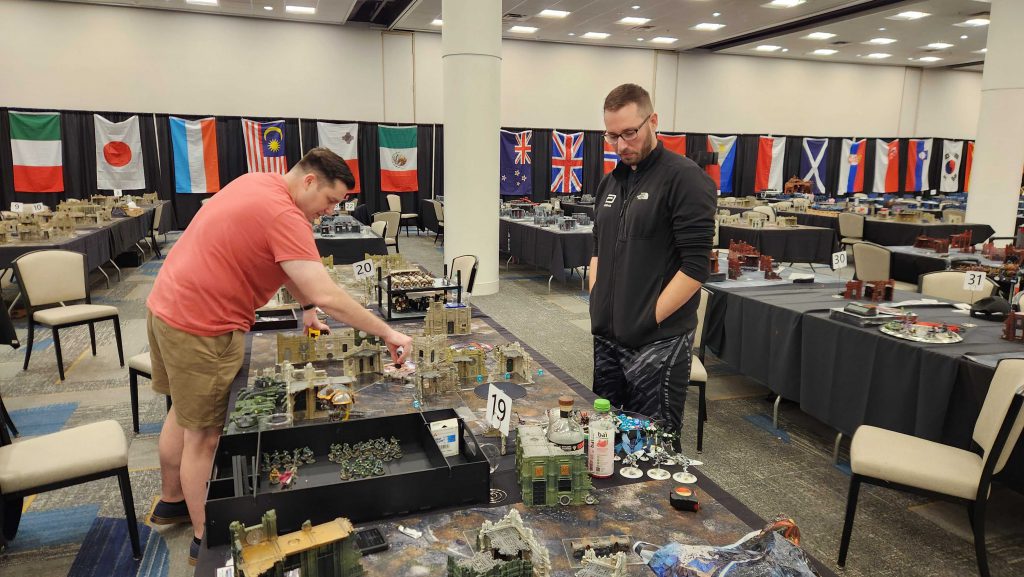 Pictured: Two brave competitors stay late at the 2024 World Championships to determine which among them is the superior player. Spoiler: It's Scott
The Elo-phant in the Room
This article is based entirely on the Elo system we here at
Stat Check have developed over the last three-and-a-half years, which tracks (nearly) all games at Warhammer 40k events with 24+ players and a minimum of 5 rounds (referred from here on out as GT+ games). Elo is one tool in predicting outcomes, and while we’ve covered how well it can predict outcomes https://dev.tabletopbattles.com/from-theory-to-tabletop-the-accuracy-of-elo-predictions-in-warhammer-40ks-las-vegas-open-2024/ , one of the restrictions is that it requires a fair amount of data before it starts to accurately represent the skill of the players involved. Similar to
last year, we have extensive data on the majority of attendees, lacking GT+ information on only 13 of the 411 registrants (including two Canadians who have only played in Teams events and not any GT+ events in our tracking time). Of the players we do have data for, the average player has played 79 GT+ games and has a 69% game win rate. This gives us a fairly high confidence level in the players we do have ratings for.
The Simulation
For the rest of this article, we’re going to be going through the results of an attempt to simulate and predict the outcome of the overall tournament. We’ve taken each group, randomly generated pairings for each round, and then used the expected winner based on the Elo difference between each player against a random number generator to predict the outcome (E is the expected chance to win for player A of Elo RA vs player B of Elo RB).
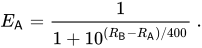
We then ran the tournament to conclusion using the pairing process provided in the player packet - which was done by Wins, Path to Victory, and then Random within that bracket while trying to avoid same country pairings. We then seeded the championship bracket with the winner of each group, ran the championship/world brackets, and repeated all of this 10,000 times to get to our resultant.
Now let’s go through the groups that have been assigned.
The Group Stage
The 40k group stage of the event has been broken down into 16 groups of 24 to 26 players, distributed as evenly as possible between the countries in attendance. Below we can see each of the groups, with their average Elo ranking, the player who is favoured to win the group, and their respective country & faction. The final column gives us the chance that this particular player will win their group.
[table id=127 /]
The first thing to note is that the highest Elo rank player in each group is expected to win their group, but several of the groups are actually quite close in terms of expected winner. As an example Group 1 has The other interesting thing here is that while Americans make up just under 39% of the playing field, they are predicted to win 12 of the 16 groups! Last year we saw a similar expected result, due to the pairing system avoiding same country pairings until absolutely necessary (so with an increase in American representation this effect is magnified), and was somewhat attributed to the American players having the third highest average Elo of all countries in attendance. Americans are the 5th-highest average Elo countries when you exclude single-representative countries (sorry, Scotland!), passed by Germany, Belgium, Spain, and England.
The table that follows summarizes each country’s representation at the event, the average number of their players that make the champions bracket, and finally the chance of a player from that country winning the event.
[table id=126 /]
We’ve hinted at the predicted event winners, but let’s look at faction performance first.
Faction Performance by Player
For faction performance, we focused on what would be required for a player to achieve Best in Faction (BiF) for their particular faction - which is by Wins, Opponent Game Win % (OGW%), and Points (battle points were randomly generated based on a win/loss so they're fairly arbitrary here). Several places have already covered the faction distribution at this event, and you can watch this space later this week for some breakdowns of the most popular factions.
[table id=128 /]
Event Favourites
Now let’s talk about the event favourites - and similarly to last year with the calibre of talent on display at the event, there is no clear winner to project here. There are many very familiar names in the top ten, with the three most likely winners likely to be Wesley St. Hines (fresh off of his win at LVO XII), returning WCW champion Folger Pyles, and defending ITC champ Innes Wilson all showing strong odds to win. Right now defending champion Folger Pyles is the favorite to repeat.
[table id=129 /]
One interesting thing to note is this year some of the groups are more "determined" than last year, i.e. Folger Pyles and Innes Wilson both have above 50% odds of winning their respective groups - a significantly higher chance than last year, where the biggest favourites only had about a 1 in 3 projected chance of advancing. That means that the odds to win this year for the top players are considerably higher when you start stacking on those chances - last year the field favourite was Tim Schneider at 6.14% to win, but this year’s favourite is Folger Pyles at 9.24% - nearly 1 in 10! Vegas would love those odds…
The Full Results
As with last year, here are the full results to see how your fellow patriots will perform - any surprises? Similar to last year the Average Placing column may lead to some questions, but as there are no guaranteed group stage winners, the average placing gets pushed down below the top 16.
[table id=125 /]
Closing Thoughts
That wraps up our look at this year's field. Looking back on last year's article, we're pretty happy with how things turned out, with #2 elo player Folger Pyles eventually winning the event over John Lennon. It'll be interesting to see how things shake out this year, and how close the results hew to predictions. Of course, there are always confounding factors - army selection and matchup are big ones - and that may be something we take a look at after the event.
If you're reading this and attending the event, good luck! And if you're not, be sure to follow along the next few days as we post updates here on Goonhammer and potentially show up on streams of the event.
Have any questions or feedback? Drop us a note in the comments below or email us at contact@goonhammer.com. Want articles like this linked in your inbox every Monday morning? Sign up for our newsletter. And don’t forget that you can support us on Patreon for backer rewards like early video content, Administratum access, an ad-free experience on our website and more. Oh, and don’t forget to check out the work we’re doing at Stat Check over on our website.
Thank you for being a friend.
 This website uses cookies. Learn more.

 Pictured: Two brave competitors stay late at the 2024 World Championships to determine which among them is the superior player. Spoiler: It's Scott

 Goonhammer App and Patron Updates: April, 2026
 Kill Team Tournament Report: Engage, Party, Repeat's March Madness 2026
 Goonhammer Reviews: Tribal Conquest