Those of you who have been reading the site for a while will know there are some die-hard Gundam weirdos present at the Goonhammer headquarters. It should come as no surprise to hear that quite a few of us are very excited for Gundam Assemble, the upcoming miniatures game from Bandai featuring a bunch of massive murder machines piloted by traumatized children.
What Is Gundam Assemble?
Jake "Starting Hex" Bennington: Gundam Assemble is a hybrid board/miniatures/card game that's played on a game board made out of hexagons. Each player will take control of some number of iconic units (so far it seems to be between 3-5) from the long running franchise and battle it out to see who is the victor. A bunch of information came out today (March 4, 2026) about how the game works – we're talking a ">quick play video, a ">longer gameplay reveal, and an in-depth quick start guide. This is all in addition to the hands-on experience Goonhammer's very own Fowler was able to partake in while at the GAMA Expo in Louisville, Kentucky.
There are multiple different scenarios, each with modifications to how the game will play out. So far we know that the scenarios can change the number of units for each side, the terrain and other components placed on the board, and how victory points can be scored. There are even going to be scenarios that allow players to reenact various battles from the different Gundam shows and films.
Once the scenario is chosen, players pick their units (each of which come with a corresponding unit card that has all of their gameplay stats), and a set of Tactics Cards. You'll have a total of nine of these cards and be drawing three of them at the start of each phase. The scenario showcased so far has two phases, so it means you'll see most but not all of your deck in a game.
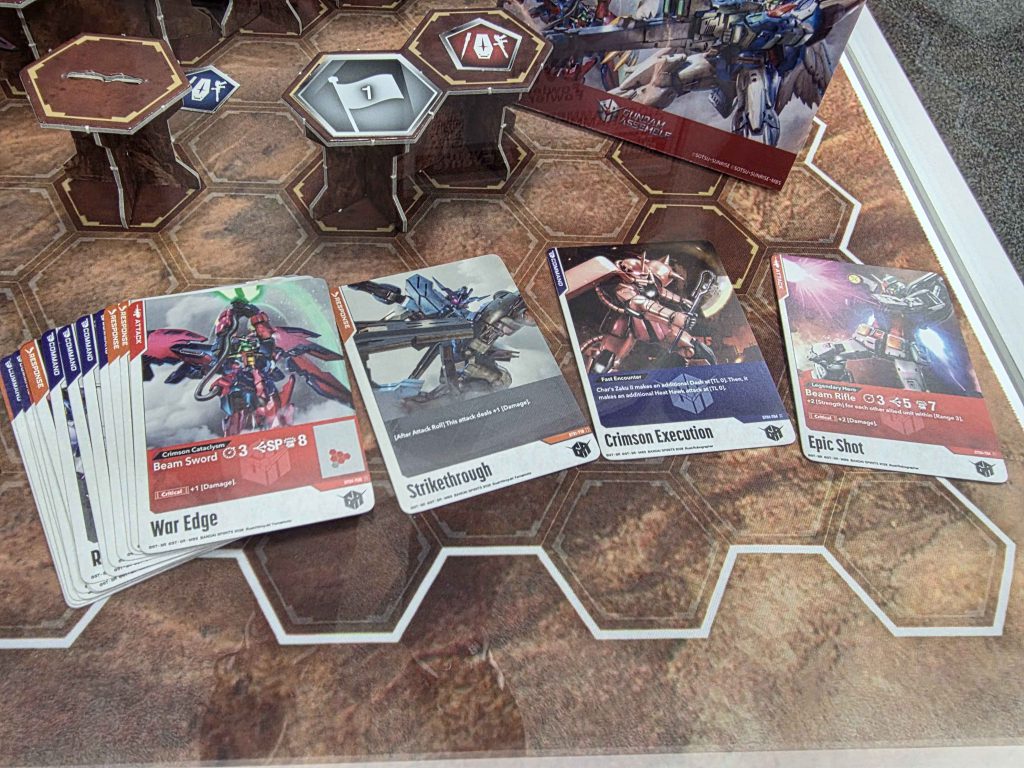 Strategy Cards. Credit: Fowler
From what we've seen, there's a nice mix of ways to score victory points. You can, of course, go forth and brawl to beat up the opponent. Destroying an enemy unit will earn a big chunk of victory points as noted on each unit's card, but there are also objectives scattered across the map. You can maneuver your own units to capture these objectives – whichever player is in control of them at the end of the phase will score a nice chunk of points. It's kind of a Battlefield 1942 style flag capture mechanic (give me a break, I haven't played a shooter in a while and that is my benchmark) where you take a neutral point and capture it, or convert an enemy point into a neutral point and then capture it. There are also garrisons sprinkled around the map. These are keyed to each player, so there will be red and blue ones. You can either rescue friendly garrisons or attack and destroy enemy garrisons, both of which will earn you points.
When you activate a unit, there are a few options available. Each one can be selected once in the same activation and performed in any order. A unit can advance (i.e. move 3 hexes), perform a primary action (attack, dash, energize, or rescue), use a command ability (special abilities unique to units), and/or play one of your tactics cards. There is a requirement that the unit must make one of the primary actions in each activation, but the rest are all optional.
Strategy Cards. Credit: Fowler
From what we've seen, there's a nice mix of ways to score victory points. You can, of course, go forth and brawl to beat up the opponent. Destroying an enemy unit will earn a big chunk of victory points as noted on each unit's card, but there are also objectives scattered across the map. You can maneuver your own units to capture these objectives – whichever player is in control of them at the end of the phase will score a nice chunk of points. It's kind of a Battlefield 1942 style flag capture mechanic (give me a break, I haven't played a shooter in a while and that is my benchmark) where you take a neutral point and capture it, or convert an enemy point into a neutral point and then capture it. There are also garrisons sprinkled around the map. These are keyed to each player, so there will be red and blue ones. You can either rescue friendly garrisons or attack and destroy enemy garrisons, both of which will earn you points.
When you activate a unit, there are a few options available. Each one can be selected once in the same activation and performed in any order. A unit can advance (i.e. move 3 hexes), perform a primary action (attack, dash, energize, or rescue), use a command ability (special abilities unique to units), and/or play one of your tactics cards. There is a requirement that the unit must make one of the primary actions in each activation, but the rest are all optional.
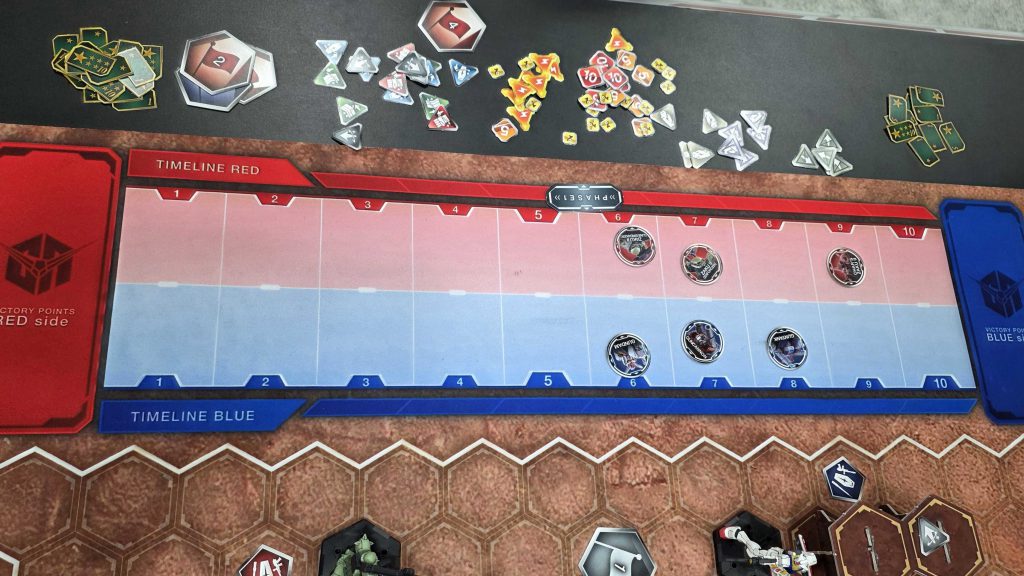 The timeline, from the GAMA demo. Credit: Fowler
Activation order is handled with a large tracker off to the side of the board called the Timeline. It's... a timeline. It starts at 1 and goes up to 10, with each number having a box near it so the players can put their unit tokens there. Each of the primary actions costs time to use, which will bump the unit's token up further along the timeline. Units also have different starting points on the timeline. More powerful units might have a higher starting value, so they won't get to act until multiple other units have gone. Play starts at the 1 spot on the timeline, and any units there are able to activate. Once a number on the timeline has been emptied of units, it progresses up to the next number and so on until the end of the phase is reached. That's when scoring for objectives comes into play and (if applicable) the next phase kicks off.
This means some actions will have lower costs and allow your unit to activate again sooner while others are more impactful, but have an effective cooldown built into them which leaves your unit chilling out on the battlefield for a longer period of time.
Upgrade tokens are also scattered around the board, and any unit that ends a move on one is able to pick it up and add it to their unit card. This is a permanent buff that applies to the unit for the rest of the game, even if they're destroyed. That's right, destroyed units can come back into play. They're mobile suits, after all, so a quick trip to the repair bay means they're ready to go again. Mechanically, this means that after a model is destroyed, their token on the timeline gets pushed two more values up but then they can return to play.
The timeline, from the GAMA demo. Credit: Fowler
Activation order is handled with a large tracker off to the side of the board called the Timeline. It's... a timeline. It starts at 1 and goes up to 10, with each number having a box near it so the players can put their unit tokens there. Each of the primary actions costs time to use, which will bump the unit's token up further along the timeline. Units also have different starting points on the timeline. More powerful units might have a higher starting value, so they won't get to act until multiple other units have gone. Play starts at the 1 spot on the timeline, and any units there are able to activate. Once a number on the timeline has been emptied of units, it progresses up to the next number and so on until the end of the phase is reached. That's when scoring for objectives comes into play and (if applicable) the next phase kicks off.
This means some actions will have lower costs and allow your unit to activate again sooner while others are more impactful, but have an effective cooldown built into them which leaves your unit chilling out on the battlefield for a longer period of time.
Upgrade tokens are also scattered around the board, and any unit that ends a move on one is able to pick it up and add it to their unit card. This is a permanent buff that applies to the unit for the rest of the game, even if they're destroyed. That's right, destroyed units can come back into play. They're mobile suits, after all, so a quick trip to the repair bay means they're ready to go again. Mechanically, this means that after a model is destroyed, their token on the timeline gets pushed two more values up but then they can return to play.
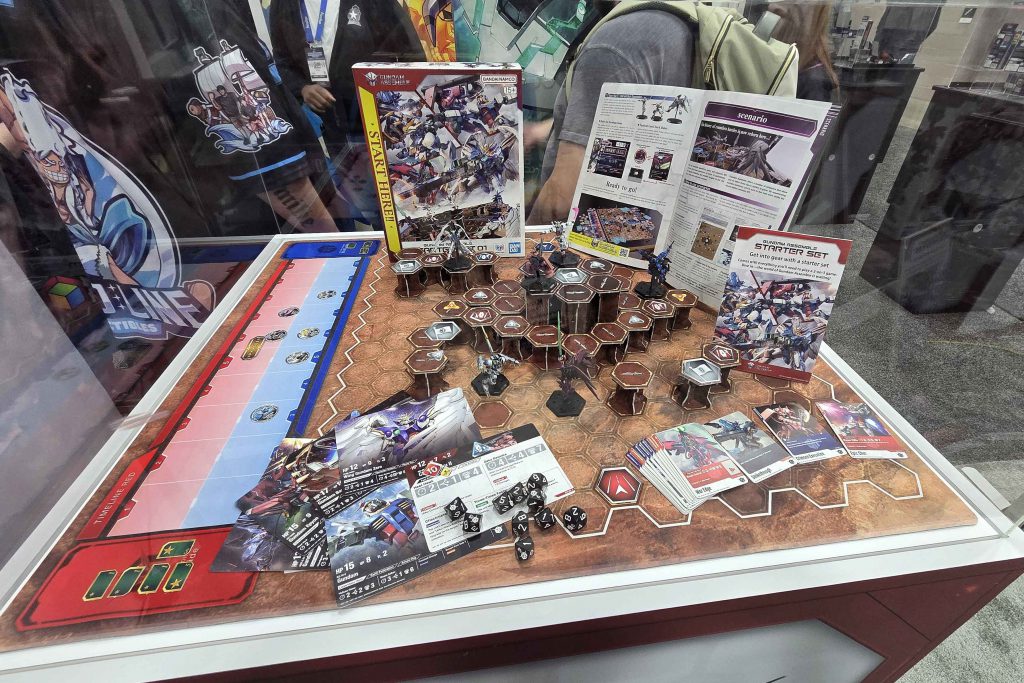 The first starter box. Credit: Fowler.
First Impressions of Gundam Assemble
Fowler: My demo at GAMA wasn't a full game, but I really enjoyed the first bite. Abilities feel thematic, and decisive fights keep things pretty brisk. Pushing UC models around was
extremely satisfying. The unit cards make it easy to remember what everything does, and it never felt like the board state got too complicated. Overall, I am psyched to see how the full game plays.
Jake "Starting Hex" Bennington: I've been writing for Goonhammer for nearly two years now, and about 98% of the stuff I've done has been for Warhammer Underworlds, a hybrid board/miniatures/card game that's played on a hex board. It's no mystery why I am drawn to Gundam Assemble because it has a lot of gameplay elements I'm already a big fan of, but also includes kick ass giant robots. I'm a relative newcomer to the world of Gundam and Gunpla, but it's been something I have been infected with since hanging out in the Goonhammer Discord server. I have zero experience with Bandai as a game company, so I came into this not knowing what to expect.
Thundercloud: I was very cautious at first, given the history of tie in games with Japanese cartoon franchises like Macross (see my review on Macross:Dogfight here), and the tendency of Japanese wargames to favour a board wargame format and philosophy. However I’m open to it, even though I like Macross much more than Gundam, because you’ve got to go with what you’ve got and no one is rushing to give me a 1/200 scale Zoids wargame based on the 1980s British Zoids continuity.
A 1/350 ish scale game meant a fairly small footprint, it would just be about how the mechanics worked and how fun it was.
CYRAC: I've been keeping an eye on Gundam Assemble for a while. I have all of the early Assemble sets as well as a few Gunpla now. With my competitive roots from Underworlds as well as my tiring with Kill Team due to its own issues, this game looks like a breath of fresh air. D10s, hex-based, minimal terrain invest, low cost, that's all amazing. Plus they have a steady release-system planned while also striking a good balance between competitive and narrative play.
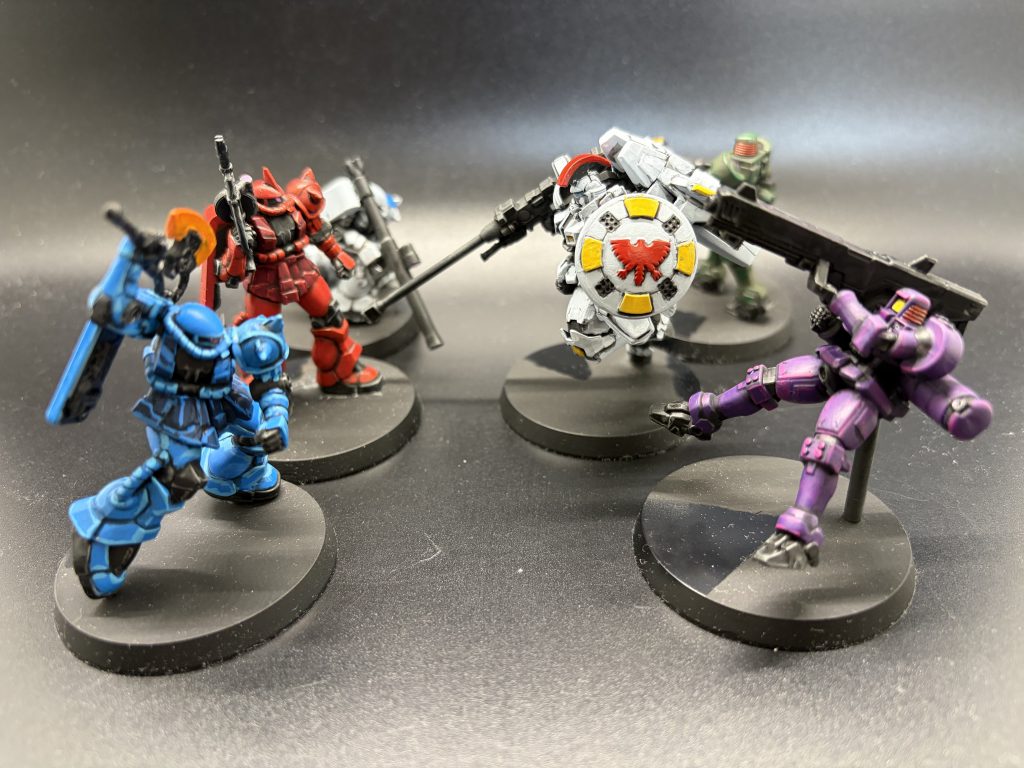 A whole bunch of Gundam Assemble Miniatures. battling. Credit: Greg Chiasson
Thoughts on the Models
Jake "Starting Hex" Bennington: We've already seen a teaser of these models from the fancy Gundam Card Game kits that were released last year and they're pretty rad. Goonhammer's resident weird Greg reviewed them a while back. Verdict: very cool.
Thundercloud: I thought the hex bases would mean you couldn’t use the round based models with the card game in the battle game, but this appears to not be an issue at all, meaning you can model bases for your Gundams (and 50mm is the correct size, so 50mm Legions Imperialis bases from GW work fine) to make a little dioramas for your gundams.
Fowler: During my demo I asked about bases - I was told that the shape doesn't matter, as long as it fits in the board hexes. There is no facing or true line of sight. Go nuts with your basing!
CYRAC: Having already played around with the Assemble models, I find them quite nice. Not as crisp as GW models but they still have a good level of detail while also being much cheaper. I do think the models will look better with more traditional miniature paints as the Bandai selection don't seem great. Later sets look more posable too, so I can't wait to see how Bandai expand the range.
Fowler: I was lucky to snag a Zaku model at GAMA last year, and the quality is great. Some models are relatively simple, others may benefit from extra care and quality time with 1000 grit sanding sticks.
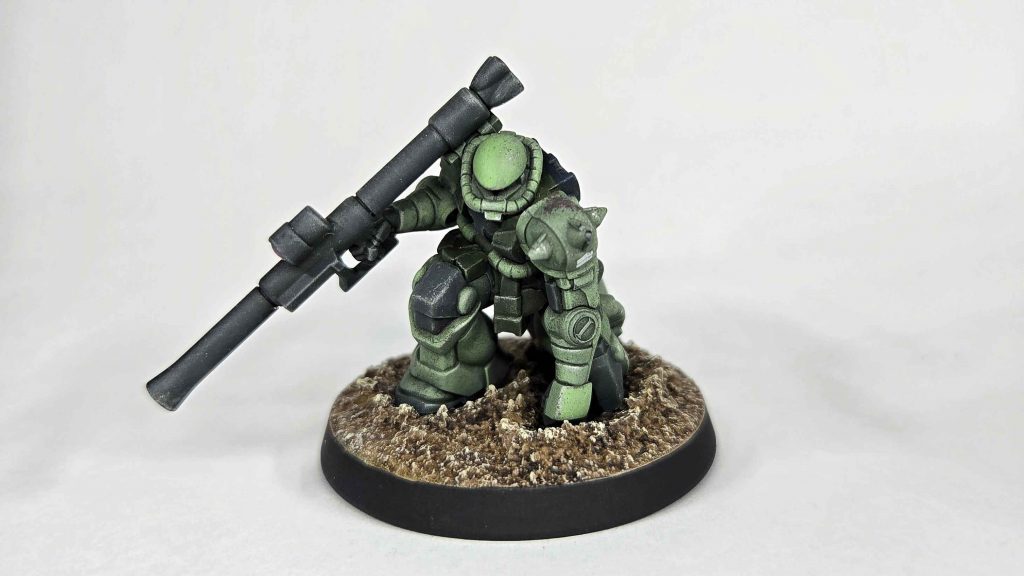 TP-007B Zaku II. Credit: Fowler
Thoughts on the Game Pieces
Jake "Starting Hex" Bennington: Going off of the videos released from the game's YouTube channel, it looks like these starter sets are going to contain a variety of tokens, dice, and cards like any self respecting game would. I noticed that there seem to be two different versions of the terrain used for elevation – some of the previews are showing what looks to be cardboard terrain that will slot together, but in other media there are some fancier (and sturdier) looking plastic pieces that lock together. Maybe this is a difference between the normal Starter Sets (MSRP $35) and the Deluxe Set (MSRP $100 & $170)? Regardless, I assume there will be a plethora of 3d printed options available any day now.
I also like that the game uses d10s. Too many games rely on the boring old d6. It's also going to make doing probabilities for dice roll results easier on my dumb brain. A normal attack will deal a damage on each dice that rolls a 4 or higher, so it's effectively dealing 0.6 damage per dice. That'll make eyeballing attacks to see how effective they will be much easier. Attacking at lower elevation and gaining that sweet +1 to hit? That's 0.7 damage per dice. Going after someone on higher elevation and thus less accurate? 0.5 damage per dice.
Fowler: Scoring crits on 9's and 10's was a riot in the demo. My Guncannon got rocked by Char's extremely hot roll, piling up 9's and sending him back to the bench.
Thundercloud: Going for D10s vs D6s is a pleasant surprise, as a lot of games are either tied to the D6 or mess around with custom dice. I’ve got a bunch of D10s in a bag somewhere from playing Void and B5W, so I can dig them out.
CYRAC: They had me at Crits. D10s are great compared to D6s. Plentiful card tokens too, so I'm interested to see what other companies do with their own acrylic versions. The timeline being built into the board is great as well.
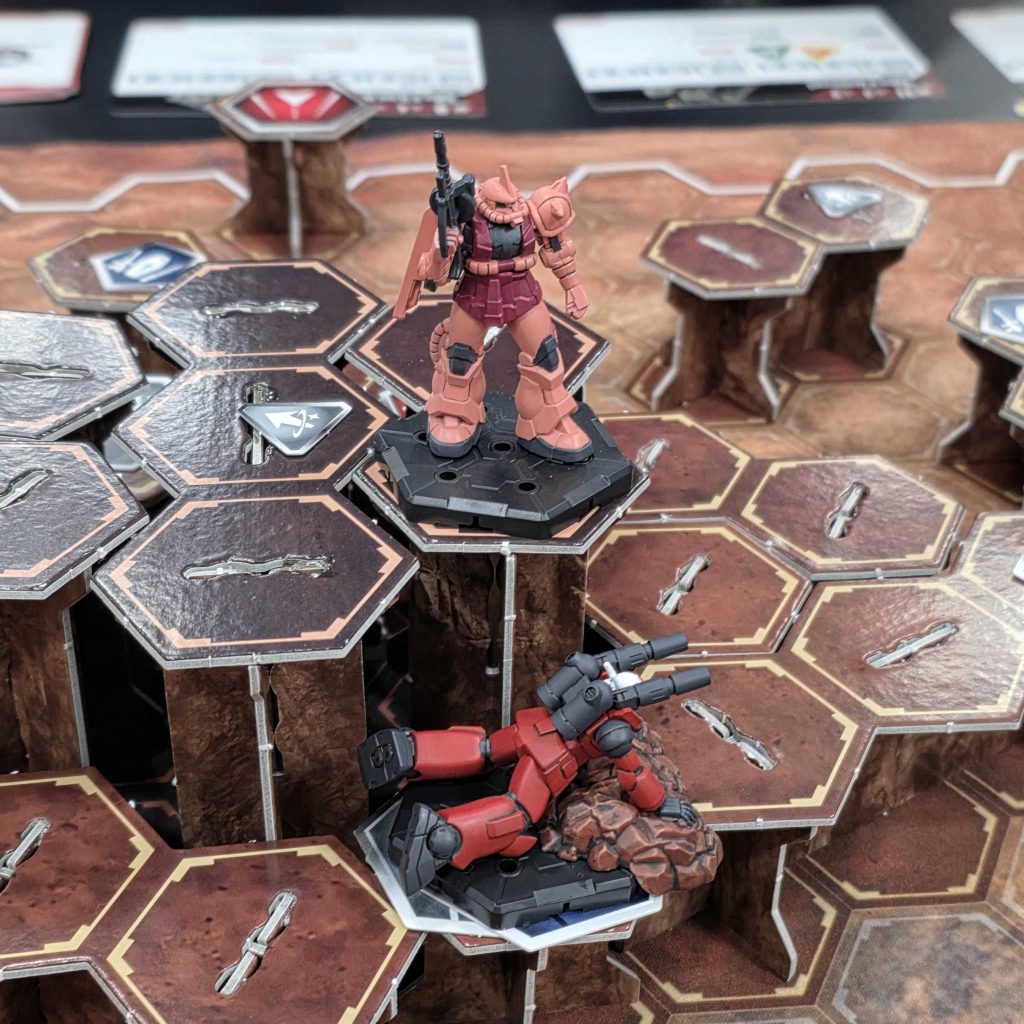 Char put the Guncannon directly into the dumpster. Credit: Fowler
Jake "Starting Hex" Bennington: There appear to be a ton of different tokens in the game. Multiple denominations of damage and victory points, timeline tokens, objective tokens, garrison tokens, upgrade tokens, energy tokens… It's a lot to fiddle with, but it seems like any of the unit relevant ones sit on your unit cards while the ones on the board are there to mark special hexes on the board so there aren't any "floating" tokens that have to follow your models around. That's nice from a clutter standpoint, but I worry about how devastating it'll be if someone bumps one of these tables.
Thundercloud: My skepticism regarding the kits lasted until I actually got my hands on a couple of them. They are very well tooled, go together nicely and paint up well. My only complaint is a lack of inscale transfers but I’m sure the secondary market will fit that gap in soon enough.
Char put the Guncannon directly into the dumpster. Credit: Fowler
Jake "Starting Hex" Bennington: There appear to be a ton of different tokens in the game. Multiple denominations of damage and victory points, timeline tokens, objective tokens, garrison tokens, upgrade tokens, energy tokens… It's a lot to fiddle with, but it seems like any of the unit relevant ones sit on your unit cards while the ones on the board are there to mark special hexes on the board so there aren't any "floating" tokens that have to follow your models around. That's nice from a clutter standpoint, but I worry about how devastating it'll be if someone bumps one of these tables.
Thundercloud: My skepticism regarding the kits lasted until I actually got my hands on a couple of them. They are very well tooled, go together nicely and paint up well. My only complaint is a lack of inscale transfers but I’m sure the secondary market will fit that gap in soon enough.
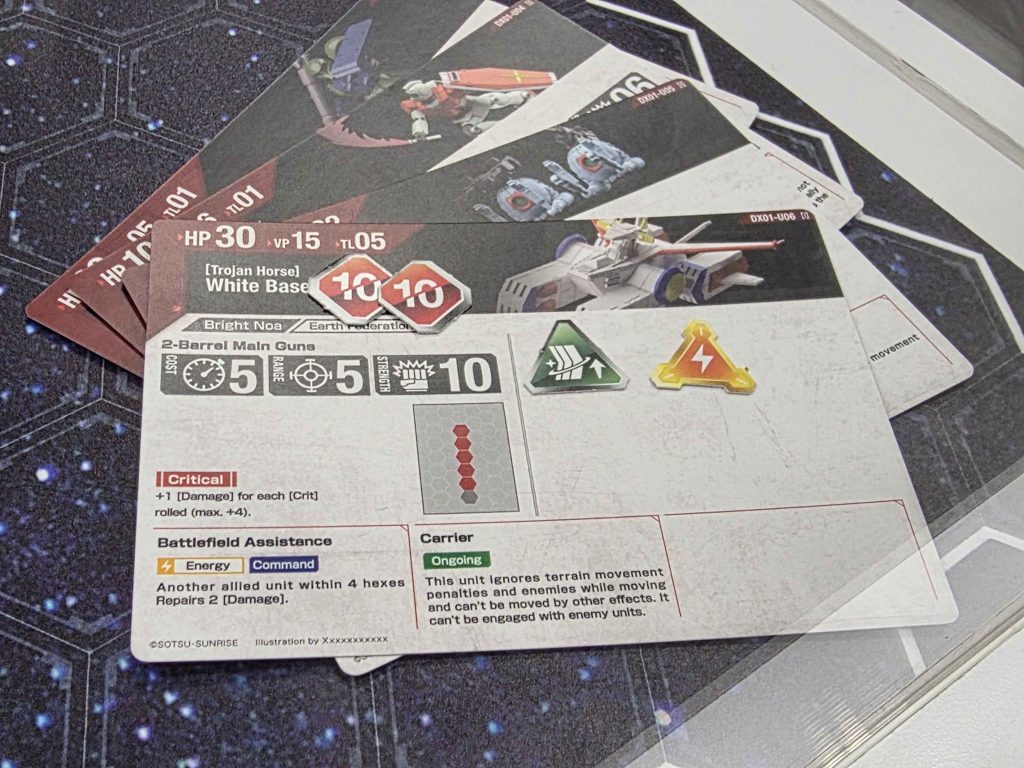 Unit Cards. Credit: Fowler
Game Mechanics Examined
Jake "Starting Hex" Bennington: I'm enamored with the timeline tracker to determine turn orders. It's kind of like an initiative order from D&D combined with a resource management system. Do you want to invest the time required for a big, decisive attack or instead squeeze in more attacks that are perhaps weaker? You'll be able to break down attacks into "dice per time" and movement options into "hexes per time" to evaluate decisions. I enjoy this already.
Thundercloud: I think the timeline tracker and how you use and manipulate it with cards and different activations is going to be the key to playing the game, and it works very cleverly from a game design perspective. If people cast their minds back to Star Fleet Battles and the Impulse chart, this works in a similar fashion, where different actions move you in the timeline (and the choice of model you have determines your starting position on the timeline tracker).
This means you could manipulate it through different mecha, different pilots, strategy cards and other mechanics, and because it defines how many actions you can take, there’ll be a bunch of interesting ways to manipulate it.
CYRAC: The timeline is the most confusing and interesting part of the game. Once you get the hang of it, everything clicks together. Damage seems a bit…too strong at the moment but the fact everything seemingly has “2 lives” helps offset this. Cards feel very strong but are tied to “eras” among some limited universal cards, hopefully limiting the issue of cards such as how they went out of control with Warhammer Underworlds. Also only 9 card decks too, which you'll only get to use 6 of each game.
Fowler: If two of your models occupy the same spot in the timeline, you place the older token on top. When that place in the timeline comes up, you activate top down - so it is first in, first out - maintaining the same order they activated in before. This presents some interesting challenges when you want to change the order of your activations. If you absolutely need to rearrange the order of your activations, you need to have a unit go to a different timeline!
Jake "Starting Hex" Bennington: There's a fairly standard baseline in that all the units have the same base movement and base dash speed, but some have already been shown that can break this symmetry with bonuses to dash distance (Char's Zaku II, for instance) as well as some models that fly and can ignore penalties for moving to higher terrain, or models that gain bonus advances after meeting certain criteria. It's obviously really early in this game's lifecycle, but it appears to have plenty of room for mechanics to grow with how many levers they've already shown.
I find it interesting that the attack rolls are weighted more heavily toward successes, and any successful roll will deal damage. This means there won't be many turns where you activate a mobile suit and roll a handful of dice for an attack only to have it completely whiff and do nothing. This combined with the fact that destroyed units simply come back later on in the timeline cycle makes me think there's going to be a constant ebb and flow of models getting beat up which is clearly what every wargame should aspire to. Something something "wow cool robot" and the horrors of war.
Fowler: Buffs were pretty abundant among the units in the demo. Some mobile suits got permanent boosts to hit rolls based on landing crits, others can be improved with the strategy cards.
Thundercloud: The strategy cards giving you a choice of three types that we’ve seen so far: Attack gives you a special attack, so an extra powerful beam gun shot for example, Command which lets you do an additional action of some kind during your turn and React, which let’s you react to your opponents actions in a certain way.
Combining this with the timeline means you have alternate activations with reactions possible within your opponents activations. This will keep the game flowing back and forth and mean you aren’t staring at your phone for ten minutes while your opponent moves their little guys.
Jake "Starting Hex" Bennington: The fact that there are multiple routes to scoring victory points is interesting. I hope there is a nice balance between beating other mobile suits up and needing to zip around the battlefield to grab tokens. Some of the units in the starter box also showcase that they can be specialized for different roles – the Guncannon, for instance, is able to rescue allied garrisons after firing its shoulder cannons and the Bazooka packing Zaku gains more damage for every garrison you've rescued this game. Char is also amusingly good at dashing near an enemy garrison and kicking it to death.
Fowler: Units that lose all of their HP are removed from the battlefield, but it is not the end! You move back a bit in the timeline, and can redeploy from your home base. This might be devastating if you are trying to secure a far objective, but I can foresee some situations in which a KO might teleport you to an advantageous position.
Jake "Starting Hex" Bennington: The battlefield consists of multiple levels, garrisons (friendly and unfriendly, worth 2 victory points to destroy or rescue), upgrades (which give a permanent stat bonus to your model), energy (which unlocks your Gundam's special action without having to spend timeline to charge) and objectives (which are worth five victory points if held at the end of the turn).
This means there are three different ways to score victory points - killing models, killing/rescuing garrisons and holding objectives, and there’s a certain number of victory points available from control play and a certain number from engaging and destroying the enemy.
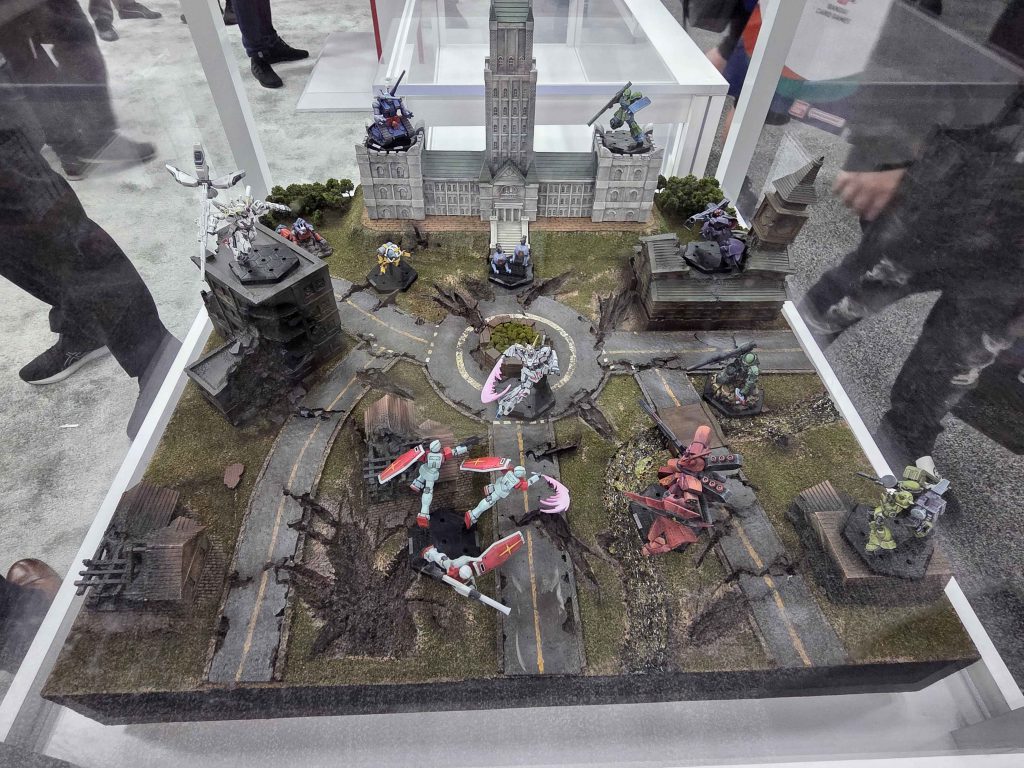 Gundam Assemble diorama from GAMA. Credit: Fowler
Overall Thoughts and Hopes for Release
Jake "Starting Hex" Bennington: I am cautiously optimistic. I was probably going to pick it up anyway unless it looked atrocious, but the gameplay videos I've seen have me excited to crack it out and play as soon as it releases. The mechanics seem sound, there appears to be room for enough variation to keep different mobile suits feeling unique, and being able to list tinker is always fun. I'm obviously biased in favor of hex based miniature card/board games but even with that in mind, I'm excited.
I've heard some worrying things about how difficult it is to get Bandai game products, so I hope that doesn't become an issue here and that supply can meet the demand.
Thundercloud: It’s looking pretty good. There is a point buying the starter and the deluxe starter, as they have different mechs, and it appears there’ll be advantages to themed forces (so going all classic Gundams or all Mercury, etc) but the devil will be in the detail. There appears to be enough variety to get a meta going with different scenarios and mecha, and the first wave in October/November gives 27 different models (I’m not counting the one that’s just a head as a separate model, and since there’s 13 models in the set it’s in I don’t think they do either but if you do it’s 28).
There’s potential for a deck building element in the strategy cards, especially as some of the cards will be tied to eras (so classic or Seed or Mercury) and the expansion sets are themed by time period.
I’ll be getting it, and it’s far enough away I should theoretically have painted some things in my painting queue by then and have time to start turning out the mini painting projects these will be.
CYRAC: I'm hyped. Low cost game, hex based, game length of 1 hour, Bandai prize support, are all amazing to me. Plus it could shape up as a large and consistent rival to GW games. I am slightly concerned about squad construction but I need to see the full rules for that (seems hard to balance around selecting any 3 Gundams). Overall, it all sounds amazing. Bandai has strong roots in competitive play too with their great TCG app which hopefully gets easily ported for this game. Don't forget the all important CRITS too. I can’t wait!
Fowler: The models are great, the price point is low, and it was fun hands-on. I really hope that this can be a gateway game for people who want to get into the hobby. Is it October yet?
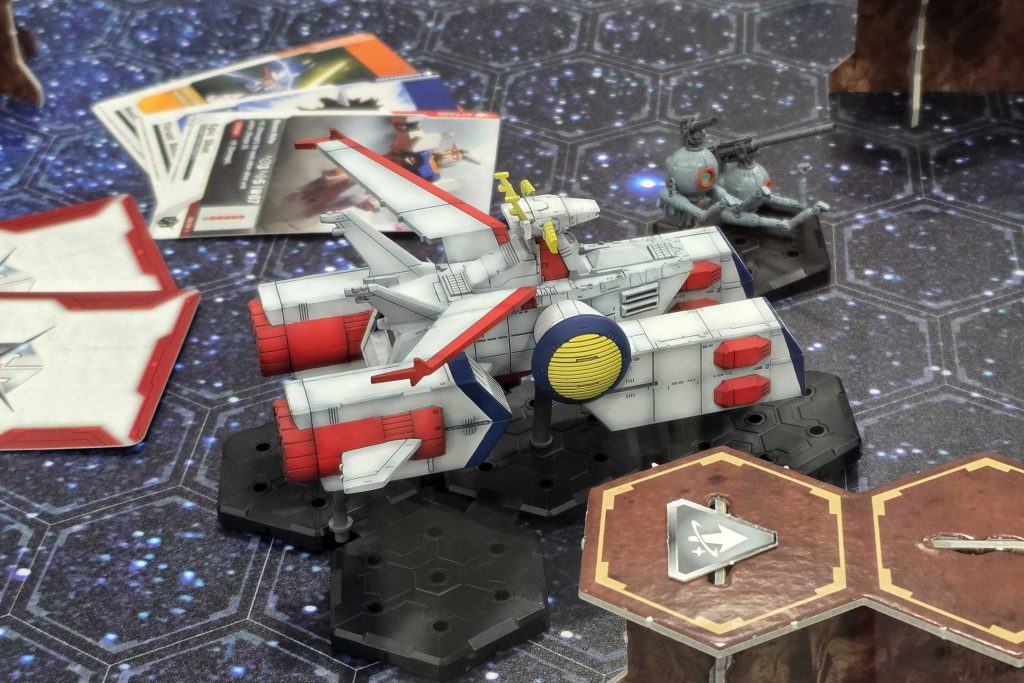 White Base at GAMA. Credit: Fowler
Have any questions or feedback? Drop us a note in the comments below or email us at contact@goonhammer.com. Want articles like this linked in your inbox every Monday morning? Sign up for our newsletter. And don’t forget that you can support us on Patreon for backer rewards like early video content, Administratum access, an ad-free experience on our website, and subscriber-only content covering competitive Warhammer 40K!
White Base at GAMA. Credit: Fowler
Have any questions or feedback? Drop us a note in the comments below or email us at contact@goonhammer.com. Want articles like this linked in your inbox every Monday morning? Sign up for our newsletter. And don’t forget that you can support us on Patreon for backer rewards like early video content, Administratum access, an ad-free experience on our website, and subscriber-only content covering competitive Warhammer 40K!
Thank you for being a friend.
 This website uses cookies. Learn more.


 Goonhammer App and Patron Updates: April, 2026
 Kill Team Tournament Report: Engage, Party, Repeat's March Madness 2026
 Goonhammer Reviews: Tribal Conquest