Disclaimer: Tsuburaya Production Co. kindly provided us with review copies of the game for the purpose of this review.
I have a particular soft spot for Ultraman as a key part of my childhood. I remember watching VHS tapes of the show, and I had a few oddly sourced toys, but my biggest introduction and memories of the franchise came from the SNES game of the same name that I received as a gift; although most people would say that particular game wasn’t exactly, well, great, I fell in love with it, and it made me want to know even more. Ultraman has remained something of a lifelong comfort for me since then, and in the last decade, the series has gone through a bit of a renewal here in the United States thanks to better availability of the original and new series releases, and more Ultraman merchandise also became more widely available. Perhaps it is because of the simple and heroic nature of Ultraman’s narratives, but I’ve always found it unlike other tokusatsu series, something that I’m always willing to watch and entertain at any moment.
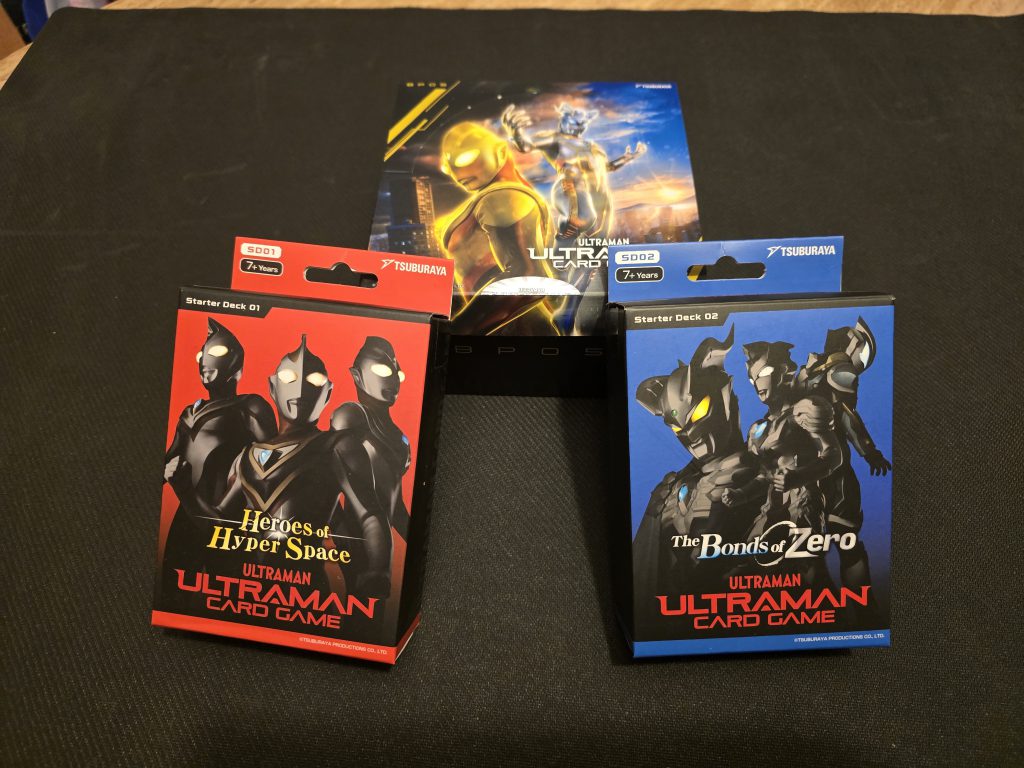
So when I heard about the live action show Tsubaraya Productions was putting on at the American Dream in NJ last year, I had to check it out, and the event was a blast, but the biggest shock to me was that there was an Ultraman card game that I’d never even heard about! I immediately inquired with the company if there would be some way to arrange a review copy, and was pleasantly surprised when I received an email back saying that would be the case. The childhood Ultraman fan in me was absolutely tickled to receive an official email from Tsuburaya’s offices with a Zetton icon, and I started looking into the game to get to know it a bit better while awaiting its arrival. In a recent review, I mentioned that the current card game market is booming, but that can also make it hard for games to find success if they don’t find ways to attract players beyond their licensing niche or focus, and I had to admit that I had some reservations for Ultraman; I know that the title is not quite as well known as others in America, so for me, the game had to do something interesting to really keep me interested.
Perhaps you can tell, but the result was exactly that. I found Ultraman the Card Game to be a remarkably fast and simplistic game that utilizes hidden information to create a dynamic combat focused game that allows players to push and pull against one another in a game that was, for once, as actually fast-paced as it advertised; our testing rounds of the game never exceeded 20 minutes, and that included our teaching game!
Ultraman: The Legacy
If you’re unfamiliar with Ultraman, the series is one of the oldest running tokusatsu (think Power Rangers, or Kamen Rider)/kaiju (giant monster) franchises in Japanese history. Originally starting as a spin-off of a show known as Ultra Q, Tsuburaya Productions (founded by Eiji Tsubaraya, whose works on films like Godzilla made him a legend) spun off the character Ultraman, an interstellar warrior of justice who hid his identity while fighting alongside the Science Patrol. The series expanded from there, and there’s a total of 31 Ultraman series to date, with a new one scheduled for this year to continue the tradition. Ultraman’s various incarnations are all new individual characters, sometimes related to one another literally, other times sharing some sort of connection or reason to have the “Ultra” title, and alongside of the various Ultramen is an equally famous cast of alien kaiju to fight against.
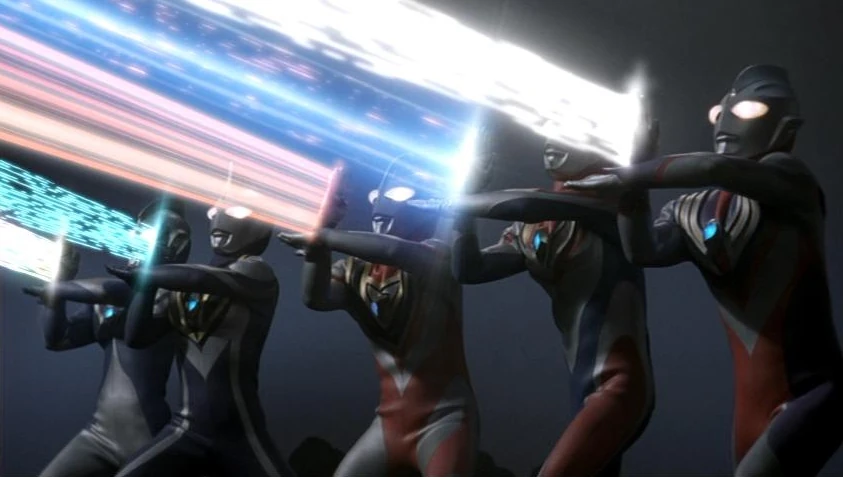 ULTRA BEAM!
Perhaps surprisingly, the Ultraman Card Game focuses almost entirely on the various Ultramen as the primary characters in your decks. I had initially thought the game would be some sort of variation of Ultraman vs Kaiju, but in practice, the game is generally your deck of Ultramen sparring against your opponent’s selection, with each Ultraman from the various series getting their share of cool looking cards and time to shine. I will say that this can present as a bit of a turnoff if you are not familiar with the franchise, however, as the game really wants you to known Ultraman at some level or wishes to appeal to your interest in Ultraman as an initial attractor to the game; since Ultraman is the hero, each one of them that is featured in the game has various alternative art versions, and the upgraded versions of each Ultraman looks very cool, but to a player who has little idea who these characters are on an individual level, it might just seem like many versions of the same guy, which is kind of fair.
 Anno's entire career, even in his own words, is about Ultraman and his love for Ultraman. He finally even got to direct one in Shin Ultraman.
Ultraman’s impact on pop-culture, both inside of and outside of Japan, is possibly hard to measure if one is unfamiliar with the series. Certainly, Tsubaraya’s legacy on film and media is huge, and Ultraman is perhaps the biggest icon of that legacy, with the series influencing numerous other series and perhaps most iconically Hideaki Anno and Neon Genesis Evangelion. In America, Ultraman has been a bit more of a subculture hit, with various broadcasts, dubbings, and other attempts to popularize the series, even culminating in Marvel comics series with the character teaming up with Spider-Man.
In our household, my partner is far less familiar with Ultraman than I was, so while I was having a moment looking at the various cards and remembering some of my favorite episodes and scenes, she was mostly remarking on how the card looked cool, which made me realize that selling the game would require a bit more skill than simply ‘don’t you just love Ultraman’? Well, theme was the biggest hurdle we had, because the game is also fast, fun, and easy to pick up, all of which went a lot further than my love of the series did in getting her to continue playing.
Ultrabattles
Ultraman’s gameplay focuses entirely on battles. There are no complex win requirements, no player life points, or other abstract concepts like Life Decks or sum totals that a player needs to accrue. To win in Ultraman, a player simply needs to win 3 or more Battles in a single turn; if both players have 3 or more, the player with the most wins, and if players tie, the game continues until someone wins. In a particularly fast game, this means that a player could win as early as turn three, but in practice, I found that most of our games went till about turn 5 before things seemed likely to be decided one way or the other.
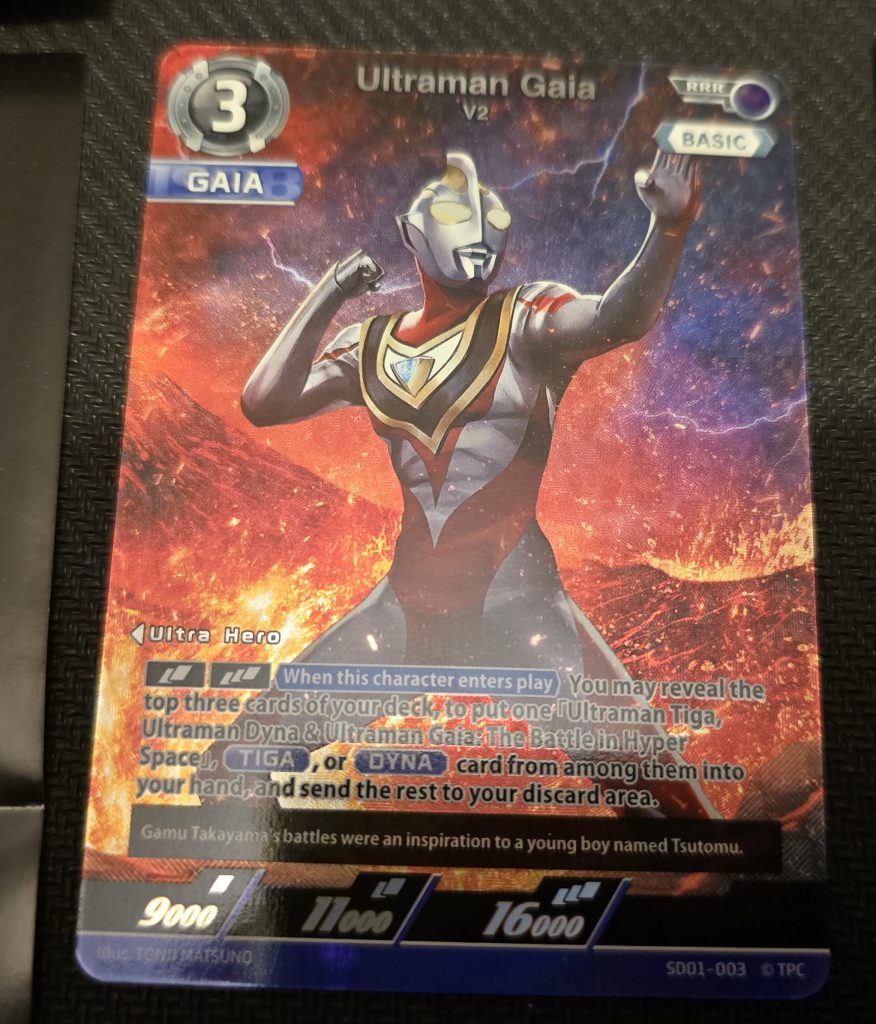 Higher level cards, like Level 3 Gaia here, have abilities that can actually help start swinging the game for you, but even these aren't that complex; that said, draw 3, keep 1, in a game where thinning your deck is strong? Pretty good...
Ironically, my partner picked up on the game faster than I did, because I kept trying to discern or expect some sort of more complicated level of mechanics or something I was missing, and she simply understood the assignment and beat me quite a few times over the course of our playing. The game really is that straightforward: you try to win as many battles as you can in order to have 3 or more in a turn and claim victory for the game, and the way you do it involves hidden information that your opponent won’t fully know until the revealing phase, meaning that there is some strategy into how and when to play things from your deck.
In a turn, players take turns going from the Lead player to the follow up player, and start by placing cards in that order. The Lead player sets a card first, while the follow up player responds afterwards; this is basically the flow for every action in the game, and Lead player changes based on who the previous turn’s winner is. The Lead player gets a single separate action that the other player doesn’t, which is playing a card known as a Field card; this Field card has various effects and the Lead player of every turn has the chance to replace the current Field card, if one exists.
Otherwise, the Lead player puts a character card face down onto the board, and then the following player does the same. After that, players can Level Up their character if they are able or choose to do so, placing the leveled up version of the character on top of the one they just placed, also placed face down. Once the set and level up phases are done, players flip their characters over, and determine who the winner is based on the Battle Power of those cards. Once that’s resolved, both characters remain on the field, but the loser is turned sideways to mark that they lost the previous battle, which also determines who the winner is for that turn (and thus the Lead player in the following turn).
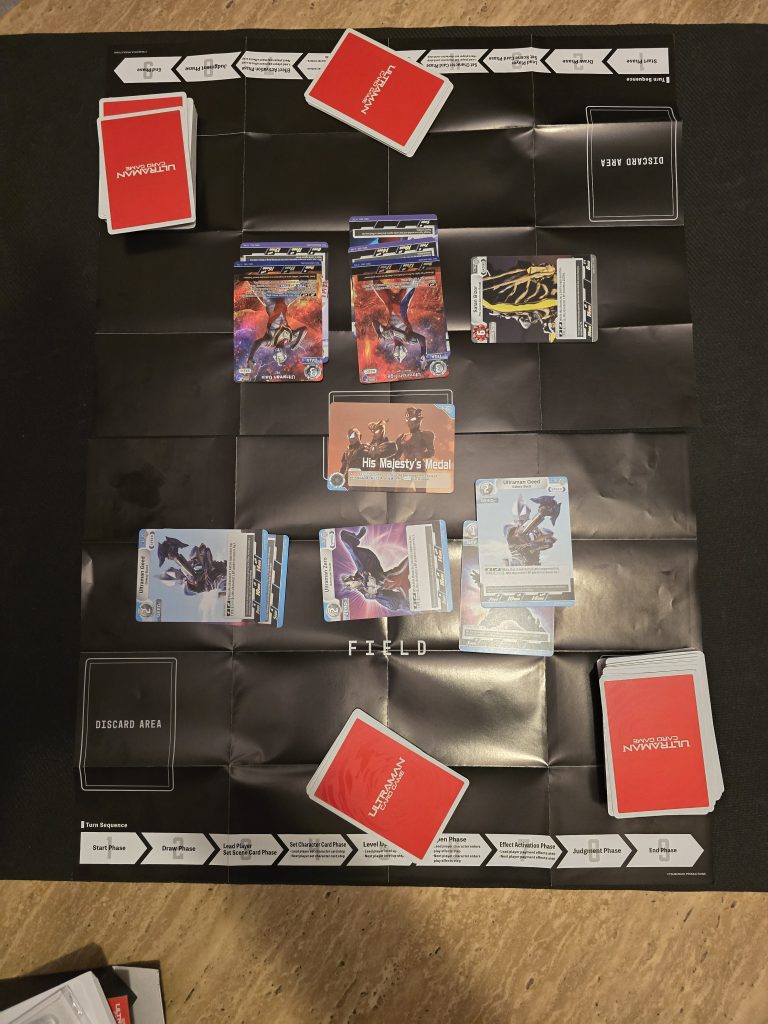 Turn 3, which could almost have gone for my opponent, if my field ability didn't allow me to overcome their Zetton. For now.
As you may have guessed, this means that no player can truly win before turn 3 of the game, as you can only play a single character a turn. You can level up characters once per turn, but you are able to level up any characters that are on the field that have the ability to be levelled. That’s really all there is to the game, although characters do have abilities that can impact the battle they’re currently engaged with. Once a player wins three, the game ends, and there is some real sense of desperation and struggle as the game rarely felt like it would go entirely to one player off the rip. We did have a few games where that did actually happen, but turn three victories were pretty few and far between.
I did a bit of research into the game’s competitive meta, and 2 out of 3 battles are the standard, which makes total sense to me based on how quickly entire games could go. Since there are no “instants” or “spells” or similar cards that impact the gamestate, you also have to somewhat rely on drawing what you need rather than tutoring things up or searching through your deck, which is notable because the deck size in Ultraman is quite large: 50 cards, with 4 copies of a card allowed.
Constructing a Deck
Since a deck has 50 cards, you might be surprised again by the fact that there are really only two types of cards in the game: Characters (of various levels), and Scene cards. The starter decks we were sent surprised me because when I researched top decks from various competitions, I was surprised at how similar these starter decks were to what would be considered professional decks. Most professional decks I saw focused on running 2 Ultramen, while the starter decks were built around 3.
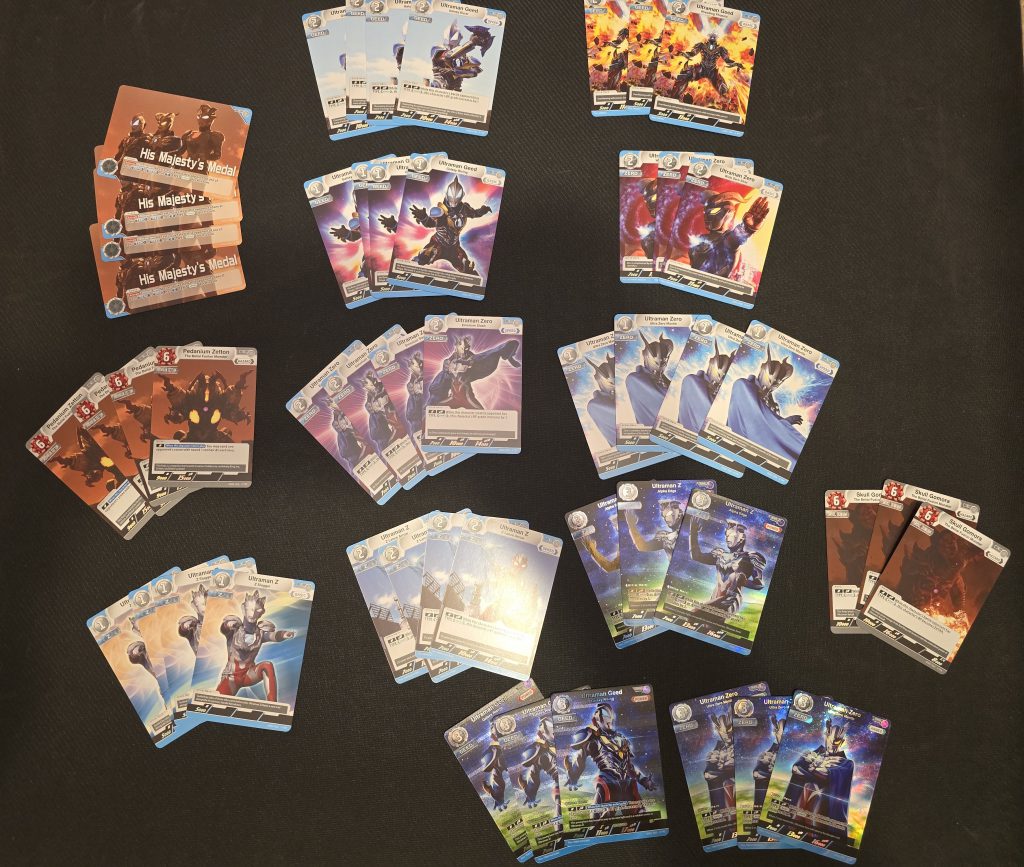 The blue starter deck we were given is shown here; if I were to edit this, I'd probably remove one of the three Ultramen and focus on a pair oriented deck.
We were also sent a booster box from the Heroes of Radiant Dawn set, and so I looked to see what the booster box offered me in terms of deck construction. I certainly wasn’t able to discern if my deck was competitive at a top level, but I was happily surprised that we were able to modify and build fairly competitive decks against one another out of the cards from the single booster box and the starter decks we had. Were I to buy more cards, it would likely be far easier to make the decks more consistent, as the biggest issue I had with my constructed versions was that lacking 4 copies of cards made the decks less likely to fire off the way they needed.
The booster box also helped us get a hold of “Hazard” cards, which are Characters themed around the various Kaiju. The starter decks came with them, but only in a very limited capacity, and our experience with the Kaiju characters is that they are extremely strong on turns 1 and 2, but fall off completely later as they are unable to be levelled up. The booster box showed us that isn’t inherently the case, as we discovered Hazard cards that had levels that could be used to increase the strength of played characters. I even noticed that an event in Singapore had a deck that took first place that used exclusively Kaiju, so that means to me that there’s pretty deep creativity possible!
Fast, Fun, and Frenetic
Perhaps because I was predisposed to love Ultraman related things by nature of being a fan, I wanted to see whether we’d want to return to the game at all after a few rounds of initial testing. I got my answer in a somewhat unexpected way, as during the course in which I had initially received the game, my partner and I had to take a fairly long trip, and on a whim I grabbed the Ultraman decks we had made and packed them along. We ended up having far more downtime than we initially expected, and I popped the game out of my travel bag and offered to play, which she eagerly agreed to.
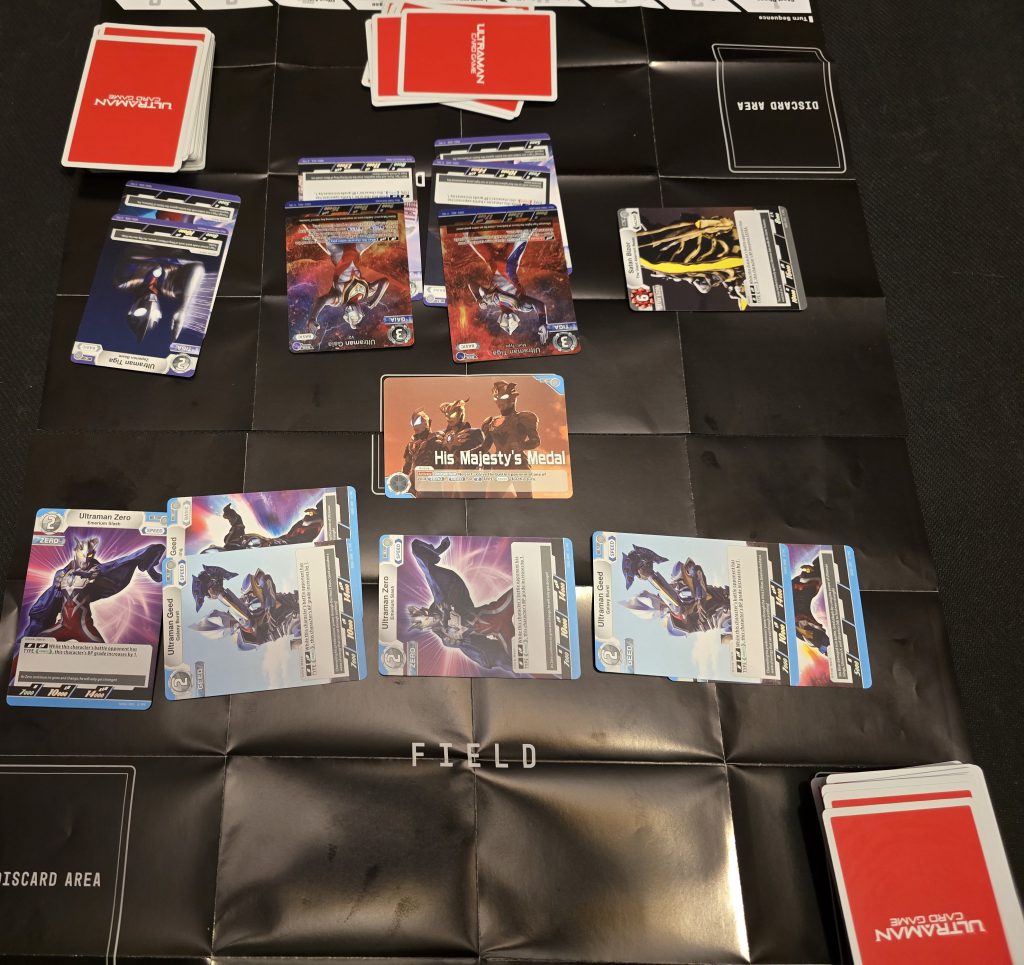 A turn four loss, right at the 10 minute mark, after a fairly good start from my deck, my opponent just walloped me with 2 level 3s.
We found the game something easy to pick up, play for a few rounds, and put away, and even though we lacked the ability to really edit or change them, the games never felt repetitive or stale. Some of that was due to the likelihood that our decks were fairly evenly matched (even the starter decks felt the same way, so that was a good sign to begin with), but also spoke to the fact that the game state was often decided based on who drew what they needed and was able to capitalize on it, rather than a specific deck strategy or type of card walloping the other.
This did also mean that the game often stayed for about an hour before we had our fill of it, but an hours worth of 3 to 4 games total was about the right time to easily take out, play, and put away a game in a satisfying way. Although my partner hasn’t quite become more of an Ultraman fan between then and now, she enjoyed the game and found the mechanics appealing if the theme didn’t immediately jump out at her and grab her.
Ultraman for All
So, would I recommend Ultraman the Card Game? Ultimately, I think it does best with players who enjoy Ultraman already, and for those readers, I suspect you may have already started looking up how to purchase starter decks or booster boxes while reading this review. If you’re less familiar with the series, though, I do think it is fair to be more cautious about the game and whether or not the mechanics and play style are of interest to you over the series itself. Ironically, the theme of the game is generally in aesthetics, as the rules and mechanics don’t rely on buying in to or knowing the theme source itself, but that can also limit exactly how much enjoyment comes from ripping open packs of cards or building a deck of things you don’t recognize.
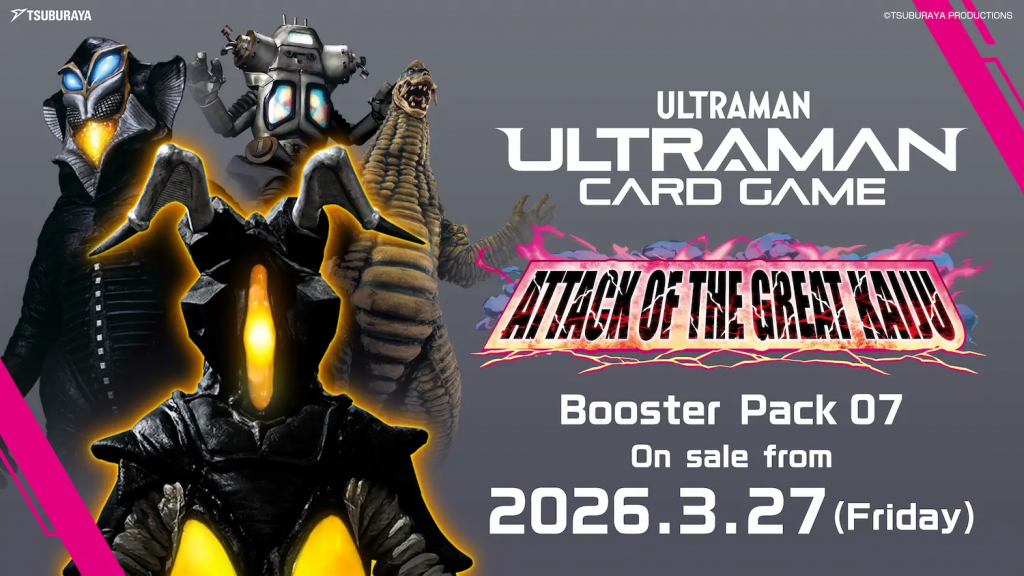 The newest set focuses on the kaiju, and I'm absolutely getting at least a box of it.
I do, however, think the game is very solid, and fun, and also an extremely good starter or card game for families. If you have children that are into tokusatsu, anime, or monster battling already, introducing them to Ultraman is a pretty easy in to something to do together, and the card game is simple and easy to understand that younger players would very likely be able to pick up and play the game with minimal reading ability; most card abilities are quite simple to read and explain, and the primary thing needed is understanding the number values on the bottom of cards, making it a great game to play with just about anyone, but especially a great pick up for younger players. If you’re in the market for a fast, easy to pick up collectible card game and happen to love Ultraman, then the Ultraman Card Game is a great game; if you aren’t very familiar with Ultraman, but still want to try it out, I do think it does enough that’s unique and interesting to give it a shot if you’re in the market for a new TCG. I do know that there is a fairly dedicated playerbase for the game, and I was even able to find a few local players interested in it and some shops that carried the game, as well as players who used webcameras to play the game online, which made a lot of sense given the fairly small footprint the game requires. If you do happen to give the game a chance, I hope you’ll strike your best Ultrabeam pose when you win! Just ignore the way your opponent might stare at you afterwards.
Have any questions or feedback? Drop us a note in the comments below or email us at contact@goonhammer.com. Want articles like this linked in your inbox every Monday morning? Sign up for our newsletter. And don't forget that you can support us on Patreon for backer rewards like early video content, Administratum access, an ad-free experience on our website, and subscriber-only content covering competitive Warhammer 40K!
Thank you for being a friend.
 This website uses cookies. Learn more.


 Goonhammer App and Patron Updates: April, 2026
 Kill Team Tournament Report: Engage, Party, Repeat's March Madness 2026
 Goonhammer Reviews: Tribal Conquest