The new Maelstrom campaign book doesn’t just have new detachments and lore, it also has its own standalone, pirate-based campaign for players looking to mix it up with their friends in a battle to plunder the galaxy. In this article we’ll be looking at the new campaign rules - how they stack up and whether they’re worth your time.
Before we dive in we’d like to thank Games Workshop for providing us with a preview copy of these rules for review purposes.
Why yes, it does feel like it was just last month since we’ve reviewed Games Workshop's latest campaign book, 500 Worlds: War on the Vespator Front Campaign because shockingly enough, it has been only a month. But with that little bit of sour grapes out of the way, we can happily point out that the two Campaign books couldn’t be any more different with who their target hobby group is aimed at. 500 Worlds: War on the Vespator Front Campaign focused on big team battles with 3 to 12 players split between 2 to 3 teams as their battles span over vast star systems and their planets over the next 4 to 6 months.
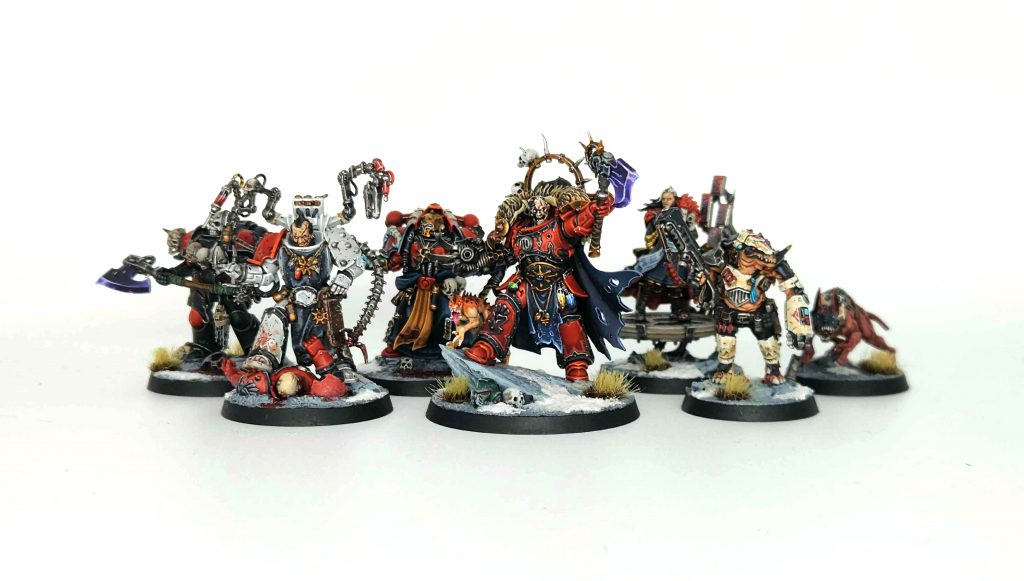
The Raid and Ruin Campaign goes in the complete opposite direction, instead solely focused on your Warlord battling for supremacy in the Maelstrom, searching for rare and lost artifacts while fighting rival Warlords and building a formidable reputation as a pirate/reaver/privateer or possible hunter of said pirate/reaver/privateer. This system is aimed at the smaller hobby groups recommending two or more players. The campaign itself can be finished in as little as four battles which also makes it ideal for weekend tournaments or hobby weekends with friends.
Raid and Ruin missions are planned for Incursion level battles with a revised mission sequence, special stratagems, and twelve new missions that have the usual weird rules to spice things up. Plus there are also rules included for playing 3 and 4 way multiplayer battles with special rules in how to resolve shooting and melee which are pretty well thought out.
Credit: Robert "TheChirurgeon" Jones
The Raid and Ruin Campaign
Winning the campaign is nice and easy, simply just be the player with the most Notoriety Points after everything is done and dusted. Earning those Notoriety Points requires your Warlord and friends completing Challenges which also earns them various titles. There are seven Challenges and each has three levels to them. Each level will reward you with Notoriety Points starting a 3 NP and ending with 5NP. Players can complete multiple Challenges per battle but can not complete the same Challenge multiple times in the same battle and lastly the Notoriety Points per Challenge are not cumulative meaning you may want to focus on completing multiple early stage Challenges rather than focusing on maxing out 2 or 3 Challenges.
Raid and Ruin Campaign is balanced with the special rule No Corsairs Left Behind as it relies on every player playing the same number of battles. For those that missed one or two battles, GW recommends playing those games but the opponent can not earn any extra Notoriety Points or count any wins towards their victory count (used for tie breaks at the end of the campaign).
Challenges
Challenges themselves are largely straightforward. They start with the incredibly simple Challenges with which your Warlord murking units in the Fight phase or ending the game in the opponent’s deployment zone. Killing the enemy Warlord is always rewarded as is holding more objectives at the end of the game. Having your Warlord Secure the Plunder is always recommended. The harder Challenge is making sure the enemy has been wiped out or reduced to Below Half-strength. And the slightly confusing Challenge is earned by winning a mission that you haven’t won in this campaign nor can it be your first victory in the campaign.
Spoils of War
Spoils of War is a cool mechanic allowing your Warlord to gain a few treasures as they meander about the battlefield, sticking the boot in as they go that will either help or hinder them in the next battle.
At the end of each battle, both players count up how many objectives they control at the end of the game which will tell them how many times they get to roll on the Spoils of War table.Luckily for the Admech enjoyers and Beanith with his well documented blind spot for objectives, those that ended the battle with zero still get a roll on the table.
Both players will then roll on the D66 table however many times and then choose one of the spoils of war to carry into the next game they play. Spoils of War come in all sorts of shapes and sizes and their effects will vary by changing how you follow the mission sequence; grant units extra abilities; grant your Warlord a powerful dohicky; or just give you some bonus Notoriety Points. The Spoils of War come in six different categories, starting out with Cursed, followed by Essential/Cartomantic/Martial/Plundered and ending up in the Exotic range. Some examples are:
Cursed: Thirsting Chalice gives your Warlord 1 Notoriety Point if you survive the next battle without winning said battle.
Essential: Racks of Blades lets you choose a unit at the start of the battle and reroll any Hit roll of 1 in melee
Cartomanic: Umbral Veil lets you choose two schemes in the Determine Mission step and then lets you pick which one is valid after the opponent reveals their choice.
Martial spoils are all weapons for the character making them much meaner in the next game.
Plundered spoils are a bit more varied, the Waystone ring for example rewards you an extra Notoriety Point if your Warlord doesn’t survive the next battle.
The Exotics are all powerful abilities for your Warlord to wreck things and make life difficult for your next opponent. The Soulsnare Casket gives you extra Notoriety Points every time your Warlord destroys an enemy unit in the Fight phase.
After the next battle, the spoils of war are melted down for scrap but not to worry as you will generate replacement ones.
Credit: Robert "TheChirurgeon" Jones
Raid and Ruin Mission Sequence
To help balance things at the Incursion level, GW has added a few changes to the mission sequence when fighting in the Raid and Ruin campaign.
You’re restricted to having the one Epic Hero (Beanith: a crutch for the weak spirited)
Character, Monster and Vehicle units are limited to a single datasheet instance.
Battleline and Dedicated Transport get four datasheet instances.
Everything else gets two datasheet instances.
Beanith: A little mean towards the giant robot enjoyers especially Imperial Knights who end up restricted to only one Warglaive and one Helverin which may hamper their battlefield control.
The other change to the sequence is the inclusion of the Maelstrom Mission Matrix in which both players secretly choose from Rapid Raid; Planned Strike; Ambush; and Hold Prize. They will reveal their choice at the same time and from that, the matrix will show you which mission you will be playing and who is the Attacker and Defender.
Additional Mission Rules
Hate leaving your models in the middle of nowhere just because some inconsiderate jerk left the holy macguffin objective out in the open? Well in Raid and Ruin, you can pick those suckers right off the ground and waddle towards a board edge to secure the loot.
Grab the Plunder is pretty easy, anyone other than vehicles (walkers excluded) can move up to an objective and so long as their Objective Control and Level of Control is higher than your opponents, they will pick up the objective. While carrying the heavy thing, the unit will subtract 2” from their Movement to a minimum of 4” and units with FLY also lose that keyword. Also a unit can only carry one objective at a time.
Dropping the Plunder can voluntarily be done at the start or end of your movement phase, or forced should the unit become Battle-shocked. If any of that happens or the unit is destroyed, the objective marker survives unscratched and is placed back on the board within an inch of the coward’s smoking remains.
Secured Plunder is achieved at the end of your opponent’s turn or the end of the battle by getting the objective markers within 3” of a board edge/ The unit holding the objective marker and the marker itself are removed from the game and the objective remains under your control for the rest of the game.
Finally we get to the cool rule, Lurking Reavers. Because we are raiding and ruining in the Maelstrom, warpfuckery is out in force with blinky lights, distorted visions and whom we assume is Tzeentch who is messing with the light switch.
In practical terms, Infantry, Beasts and Swarm units and the opponents entire army if they go second get the Lurking keyword. While they have the Lurking keyword, units can not be targeted by ranged attacks unless the attacker is within 18”. The Lurking keyword is lost if they move, charge or make any attacks during their turn but can also be regained by standing still and not attacking.
Raid and Ruin Stratagems
During a Raid and Ruin campaign, everyone will gain access to four very cool stratagems that are a bargain at 1CP each.
Larceny will let you slap the objective out of an opponent’s hands/claws/suckers if they are within engagement range which will see play in trying to prevent them from wandering off the board.
Fortune Favours The Bold lets you take a Desperate Escape test to move through enemy models allowing you to bypass screening units and roadblocks trying to stop you from reaching the board edges.
Hasty Retreat is for the extra yellow bellied cowards who Fall Back, they get an extra D6 inches to run and hide.
Warp Revenants seemed powerful at first where for one CP you could bring back a destroyed Battleline unit and shove them into Strategic Reserves but the stratagem can only be used in any phase in the first battle round. Meaning it’s probably only of use to the player who went first and gave up the Lurking keyword to move up and take objectives.
Mayhem Missions Rules (3-4 Players)
Every now and then Games Workshop has a crack at trying to make three or four player games an enjoyable experience. Typically though it turns into a lot of sitting around on your phone while your two mates are brawling in a different corner of the battlefield while you take the occasional potshot from the sideline and from what I can see not much has changed here.
Turn order is decided at the start of the game with a roll off who gets to choose their deployment zone and the first turn going forward is with that player going clockwise around the table. Command Points will flow readily at the start of every player's Command phase.
Shooting at enemy units engaged with other enemy models will attract a -1 to Hit and Wound rolls. Fight phases are a little bit more involved, the player whose turn it is is free to swing at anybody within range, everyone else can only swing back at units from the player whose turn it is currently.
The Lurking Reavers special rule here will do a lot of heavy lift making sure everyone gets a chance to survive and have a chance to do anything especially the player going last in each round.
Beanith: I want to like the idea of 3-4 player games in general but in practice one player tends to get dogpiled early game and then sits out the rest of the game while the survivors turn on each other. That said, some of my favorite memories of games with friends were big multiplayer affairs which were helped along with a modified set of old Triumph and Treachery cards from the older old World of Warhammer. It was an excellent take on the multiplayer format. Some people might have found it a bit silly especially with all of the uno-reverse style card play but I still have a lot of fond memories of those games and the shenanigans we took part in.
Mayhem Stratagems
Unique to the Mayhem missions are five stratagems, one of which is new and the other four replace existing Core stratagems.
Parley lets you spend one CP in order to make a deal with another opponent during your Command phase where you can offer them any excess CP you may have to extract iron clad promises sealed with oaths sworn in the heat of battle and forged with friendship that they will help you deal with another opponent or ignore something for a turn… Of course your opponent can simply take those CP and promptly backstab you on their turn but hey, you would have done the exact same thing.
Treacherous Offensive is Counter-Offensive with an increased price tag of 3CP. Opportunistic Volley is Fire Overwatch in the enemy’s Movement phase and Reactive Fusillade is Fire Overwatch in the enemy’s Charge phase. And bringing up the rear is Duplicitous Intervention replacing Heroic Intervention.
Credit: Robert "TheChirurgeon" Jones
Raid and Ruin Missions
Nothing too wild and wacky here, most missions have slightly different deployment zones and most of the mission revolves around grabbing the objectives and dragging them off the table. Others like High Stakes are loosely based around the Hammer and Anvil deployment but both your Warlords and a convenient meatshield start the game 4” away from the center eyeing each other off hoping to win the roll off for the first turn. The surviving Warlord may even have a chance to run away thanks to the special mission rule Bring Me Their Head making them untargetable unless you’re within 12” of them.
Beanith: You know it's a narrative mission pack when the writers avoid the bog standard Dawn of War deployment like they owe it money.
Final Thoughts
Beanith: You better believe I was moaning and carrying on about having to review another campaign book so soon after the last one. And in this instance I’m happy to be proven wrong. The two books couldn't be any more different with the scale and format. Of the two books I like this one more as this campaign setting suits my smaller group much more readily than 500 Worlds did.
Sadly again there is no Crusade nonsense for me to gush over but there’s nothing to say you can’t throw those rules on top of the ones in this book and add a little bit more growth and bite to your forces in this short form campaign format.
I like how the campaign is balanced out to Incursion level allowing for quick games and a short campaign length means you may actually keep everyone interested right up until the finish line.
The Mayhem section seems a little out of place in this book because as I mentioned, the Lurking Reavers special rule carries the day especially with a fixed turn order. You may have better luck with random turn order or bidding with excess CP after the first round.
Have any questions or feedback? Drop us a note in the comments below or email us at contact@goonhammer.com. Want articles like this linked in your inbox every Monday morning? Sign up for our newsletter. And don't forget that you can support us on Patreon for backer rewards like early video content, Administratum access, an ad-free experience on our website and more.
 This website uses cookies. Learn more.

 Credit: Robert "TheChirurgeon" Jones
 Credit: Robert "TheChirurgeon" Jones
 Credit: Robert "TheChirurgeon" Jones

 Goonhammer App and Patron Updates: April, 2026
 Kill Team Tournament Report: Engage, Party, Repeat's March Madness 2026
 Goonhammer Reviews: Tribal Conquest