It is sometimes difficult to imagine that there is any more gaming to be done in Middle-earth. Tolkien’s masterpiece and the films based on it have inspired everything from 1970s cardboard chit wargames to lavishly produced board games, several different roleplaying systems, and even a
Magic: the Gathering card set – and that’s only including the stuff that’s officially licensed. It seems like it should be getting more and more difficult to create an interesting and original game based on
The Lord of the Rings or
The Hobbit.
Asmodee development studio Office Dog Games thinks they’re up to the challenge, and for
The Hobbit: There and Back Again they’re bringing out one of the game industry’s biggest guns, Reiner Knizia. One of the world’s most prolific game designers has turned to a particular game mechanism that’s become very popular in recent years: roll and write.
“I am looking for someone to share in an adventure that I am arranging...”
Roll and write games started with
Yahtzee in 1956 and have since evolved into a category with more than a thousand entries on
BoardGameGeek. The format has steadily gained popularity, possibly due to the low production cost involved – most roll and write games consist of a printed score sheet of some kind and little else, with many boxed games including no more than a handful of dice and a pad of paper. The ability to distribute roll and write games electronically via PDF has no doubt increased the format’s appeal.
But that same lack of components can often be underwhelming to game buyers, so Dr. Knizia and Office Dog have gone all out to make
The Hobbit: There and Back Again as deluxe an experience as possible. In lieu of the usual printed paper pad, the game features four hefty cardboard booklets that can be re-used thanks to a set of dry erase markers that have been included. Along with the requisite proprietary dice are a generous number of even heftier cardboard counters representing swords and food, the only things that really matter in Middle-earth.
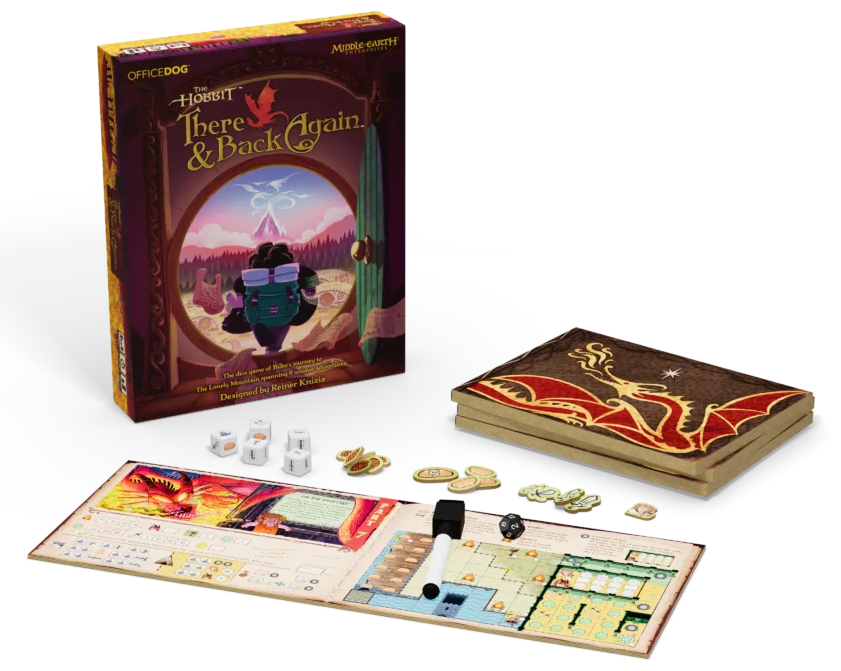 Image credit: Office Dog Games
More importantly, all of these components (well, except for the dry erase markers) are graced with delightfully stunning artwork by Lorenzo Colangeli. The roll and write category of games loses some “wow” factor due to its lack of elaborate components, so it has to try to make up for it with stunning visuals, and Colangeli certainly delivers. His playful yet edgy illustrations go a long way towards making this game seem like more than just scribbling on a piece of paper.
“It's a dangerous business going out of your front door...there's no telling where you might be swept off to.”
The game begins by selecting one of eight different scenarios. They broadly use the same basic rules and mechanics, but each one has its own special rules and victory conditions. Played consecutively they go through all the important story beats from the novel, starting with Gandalf and the dwarves arriving at Bilbo’s home and going through to the dragon Smaug’s attack on Lake Town. The rules suggest playing the scenarios in order when first learning the game, but there is no campaign element and each can be played independently.
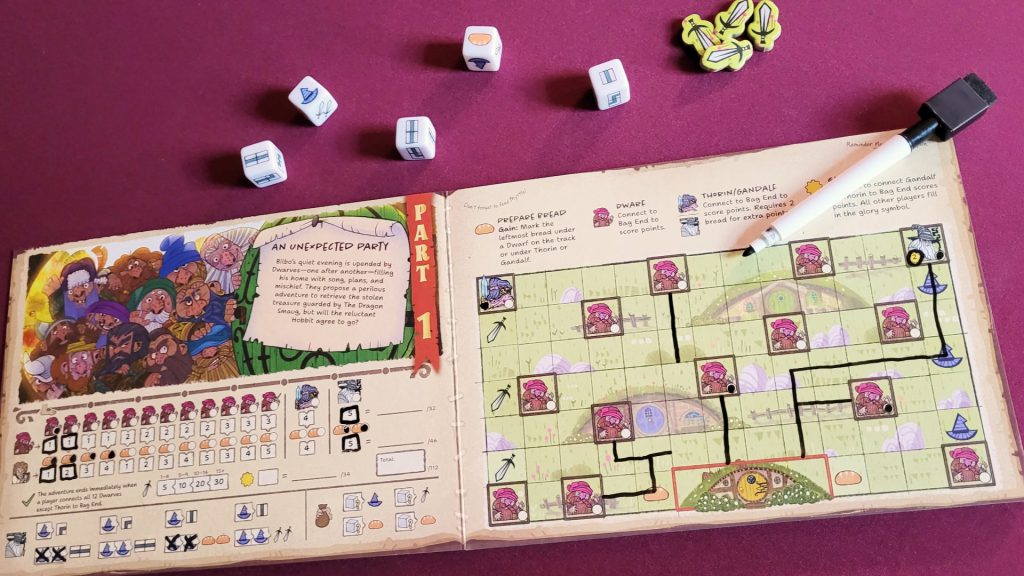 A game in progress. Image credit: Jefferson Powers
Each player gets an adventure guide, with a two-page spread for each scenario. One page contains the scoring criteria for the scenario being played, and the other side features a grid map representing the area being traveled through. At the start of each round, the first player rolls five six-sided dice: three of them depict different possible paths through the squares of the map, and the other two show the game’s primary resources of swords, bread, and Gandalf’s hat. Players then take turns drafting one die at a time and applying its symbol to their adventure guide. Paths are drawn on the map depending on the particular scenario’s goals and requirements, while resources are converted into counters to be spent later, or noted on the scoring side of the adventure guide. When the five dice run out, the player whose turn would come next rolls them all, and play continues.
“Bilbo saw that the moment had come when he must do something...”
The game ends immediately when one player achieves a certain goal, usually getting a path drawn from one end of the map to the other. Along the way there are resources to be gained and hazards to be avoided, as well as specific tasks that will award extra victory points if completed. Several scenarios require resource use such as spending sword tokens to defeat trolls or goblins, so balancing gathering resources with making progress on the map becomes an important decision point.
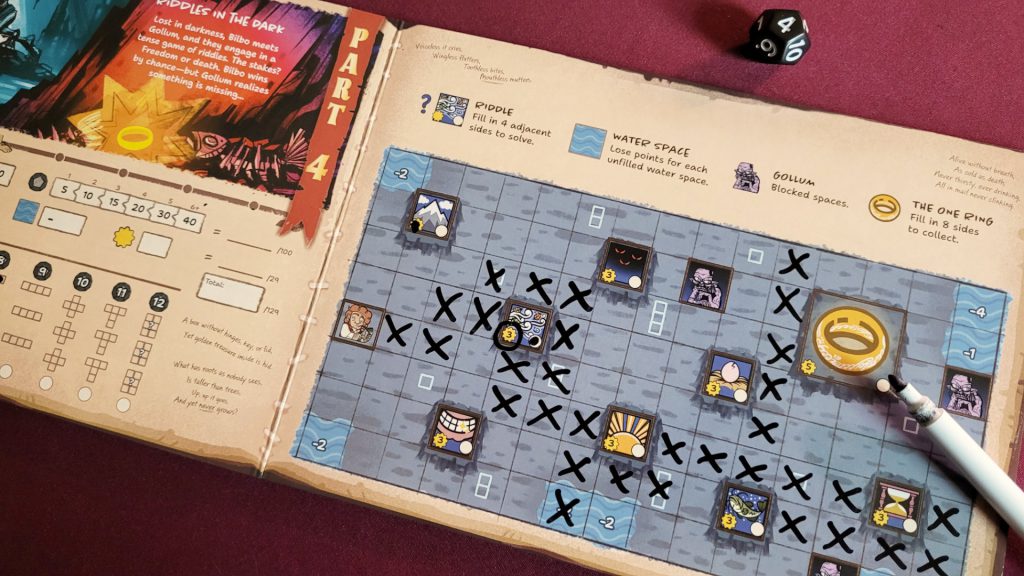 The map for the Riddles in the Dark scenario. Photo credit: Jefferson Powers
The Riddles in the Dark scenario is an interesting example of the game using the same basic structure while providing variety to keep things from getting stale. In this scenario, players don’t use the six sided dice. Instead, a single 12-sided die is rolled each round, with its result unlocking different grid patterns that players can use to fill in the squares on their map. The object is still to mark a path across, but in this case they also score points by surrounding different icons representing Bilbo and Gollum’s riddle contest, with the first player to score each one getting extra points for it. Certain squares also have negative point values that need to be blocked out, or bonus patterns of squares that can be filled in.
When the game ends points are tallied, and this is where you can tell you’re playing a Reiner Knizia game – clever scoring mechanisms are a hallmark of his designs. Each scenario has its own criteria for scoring, often consisting of elements like making sure you have enough food to feed all the dwarves, avoiding hazardous spaces on the map, or using the same map path pattern a certain number of times.
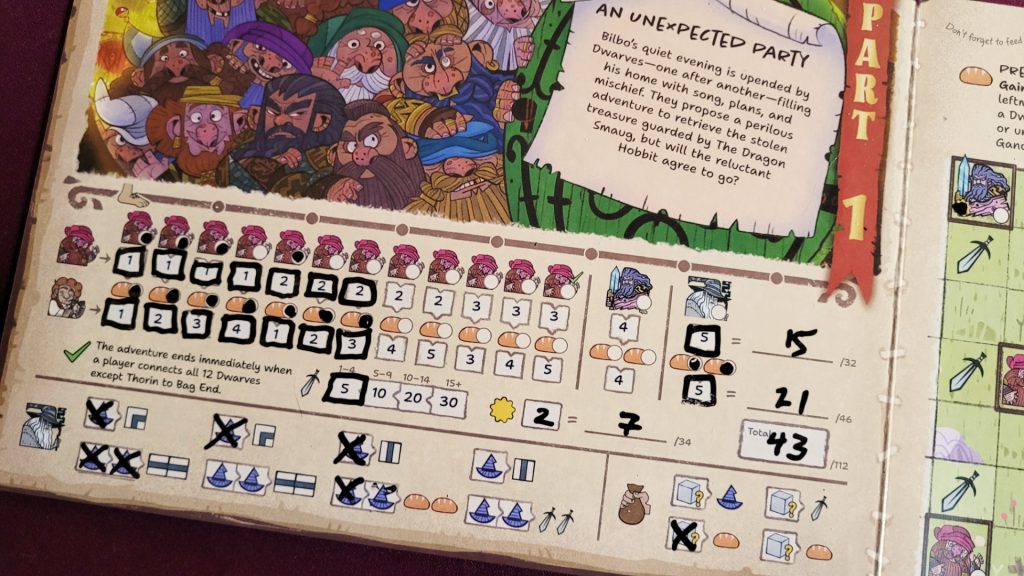 My score at the end of a not very successful game. Photo credit: Jefferson Powers
“There are no safe paths in this part of the world. Remember you are over the Edge of the Wild now, and in for all sorts of fun wherever you go...”
Another thing I really like about
The Hobbit: There and Back Again is how scalable is, both in terms of time and challenge. Each scenario takes around 30-40 minutes to play, so you can play this as a quick time-filler or spend an afternoon playing through the whole saga. There’s also a “hard mode” for experienced players who might want a greater challenge.
If you know you like roll and write games, this one should be a winner for you – it uses the mechanism well, giving players interesting choices to make and a lot of variety over the eight different scenarios. If you’re a Tolkien fan who hasn’t played a roll and write before, you might want to give this game a shot. The focus on journeying is particularly true to the source material, and the game calls out a lot of fun details from the book, enough to make me want to re-read it.
Plus the artwork is just stunning, and the fairly simple, puzzle-like game play might make this a good one to try out on your non-gamer friends and family too.
Have any questions or feedback? Drop us a note in the comments below or email us at contact@goonhammer.com. Want articles like this linked in your inbox every Monday morning? Sign up for our newsletter. And don’t forget that you can support us on Patreon for backer rewards like early video content, Administratum access, an ad-free experience on our website and more.Thank you for being a friend.
 This website uses cookies. Learn more.


 Goonhammer App and Patron Updates: April, 2026
 Kill Team Tournament Report: Engage, Party, Repeat's March Madness 2026
 Goonhammer Reviews: Tribal Conquest