We all have our own reasons for enjoying miniatures games. For many, it’s about proving mastery over a set of rules that still allow for a degree of fantasy and imagination – otherwise why play
Warhammer 40K or
Magic: the Gathering instead of becoming a lawyer or accountant (although I’m sure there are many who have done both)? But I suspect there are just as many of us who simply never outgrew the pure joy of moving little figurines around and making up stories about them. We just need a more defined framework of rules and guidelines to do it.
A Solo/Co-op Skirmish Game
Developed during the 2020 pandemic lockdown by
Gaslands creator Mike Hutchinson,
Perilous Tales was designed to fill a very particular niche: it’s a solo (or cooperative) skirmish game that plays on a 2 foot by 2 foot area and only requires around 10 models total. The rules and scenarios have a pulp horror theme to them, with brave heroes facing off against classic monsters such as vampires and mummies. But the game is very intentionally miniatures-agnostic, and its scenarios can be easily played out with whatever models and terrain you happen to have on hand. I came across this game looking for something I could play with my collection of Doctor Who miniatures, and it fit the bill perfectly.
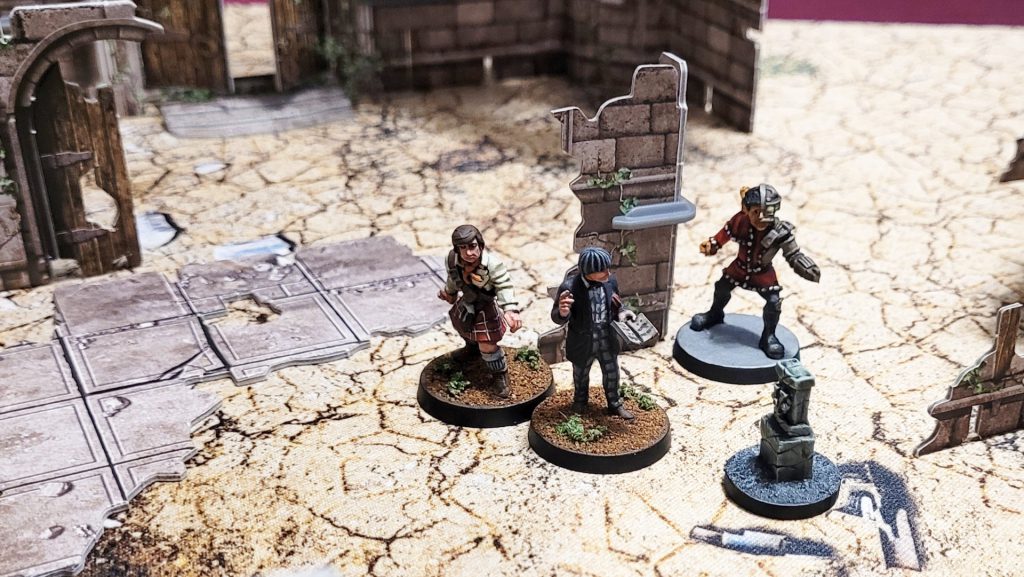 Doctor Who models in a game of Perilous Tales. Photo by Jefferson Powers.
The game mechanics are very simple but surprisingly engaging. Player characters have three stats – action points, skill, and wounds – plus one or two special traits. A character is either a Leader or a Teammate, with the number players determining how many of each type are used in a game. For the sake of simplicity, all Leaders have the same stats, as do all Teammates, but theirs are a little lower.
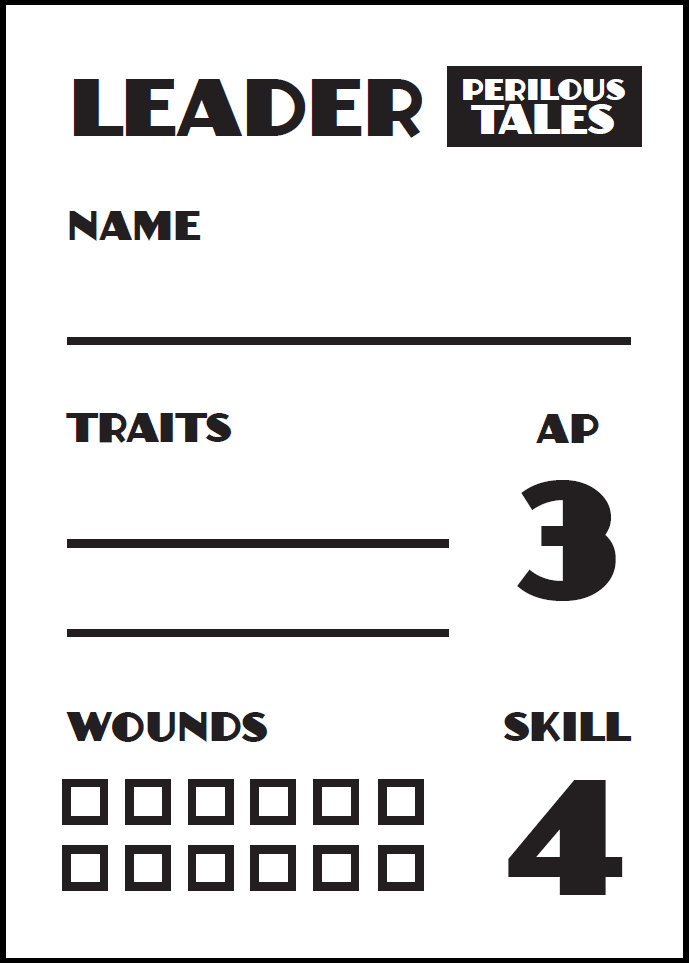 Perilous Tales stat card © Mike Hutchinson/Planet Smasher Games.
In a solo game, the player controls one Leaders and four Teammates; in a two player game, each player gets one Leader and one Teammate, and so on, with the spread of Leaders and Teammates always evenly split among the players. In multiplayer games this gives all the players equal agency in the game, which is a nice touch for a game that seems primarily designed for solo play.
Players then assign Traits to their characters, one for each Teammate and two for each leader. Traits are chosen from a list of special abilities that include things like bonuses to attacks or advantages when performing the more narrative aspects of the game (more on that in a moment). The rules include a printable sheet of blank stat cards, but honestly all the relevant information can just as easily be written down on a sticky note or scrap of paper.
How Does it Play?
Once the players are ready with their Leaders and Teammates, it’s time to set up the board. The game doesn’t start with any enemies in play. Instead, Eight tokens, numbered 1 through 8 on one side, are randomized and placed face down in a specific pattern, randomly chosen from a few different options. These are referred to as threat markers, and will be revealed throughout the game as player miniatures move close to them, turning into villains or causing one-time events to happen.
Before the game begins, the players draw three Objective cards, which provide their goals for the game. These are things like collecting objects from different locations on the board, making skill tests at various points during the game, or simply defeating some or all of the villains. The objectives are mapped to a standard deck of playing cards if players don’t want to print and cut out the provided PDF sheets of cards.
Attacks, defenses and skill tests are made by rolling a number of 10-sided dice equal to the character’s skill rating, plus one additional die of a different color, called the difficulty die. Any skill dice that roll equal to or higher than the difficulty die are counted as successes, with 10s always counting as 2 successes and 1s always counting as misses. Some tasks will apply a minimum difficulty, and various game effects will grant advantage or disadvantage, which requires rolling two difficulty dice and taking either the lower or the higher result. It’s a simple but surprisingly robust system, allowing for a fair number of different modifiers and a wide range of results.
Over the course of the game, players will move their characters around the board, attempting to complete their objectives while avoiding (or perhaps seeking out) threat markers. But they can’t dawdle for too long; at the end of each player round, a Threat check is rolled. This is a roll of escalating difficulty that moves threat markers and causes other in-game events, but also serves as a timer for the game. Each roll advances the threat level by 1, and, while there are a few ways to reduce it, once it reaches 10 the game ends – players then tally up their victory points based on which objectives they’ve managed to achieve, and compare the result to a chart in the rule book to determine their level of success or failure.
Bring on the Bad Guys
The villains and their behavior are determined by which of the game’s ten scenarios is being played. Each scenario features a primary Master villain and several minions, lesser villains that serve mainly to get in the way of the player characters. The Master villains run the range from Lovecraftian horrors to classic monsters like vampires, werewolves, and mummies, each with their own set of minions and special behaviors.
At various points in the game, most often when a player model moves to within 6” of a threat marker, the marker is revealed, with the effect determined by the number on the token. The specific scenario determines what happens as each number is revealed, either a Peril, a minion, or the Master villain.
If it’s a Peril, players draw a card for a one-time or possibly lingering game effect, usually traps or other environmental effects that create a disadvantage or require a skill roll to get past. As with the Objective cards, the Perils are mapped to a standard deck of playing cards for those who don’t want to print anything. If it’s a minion or the Master villain, the threat marker is replaced by the appropriate villain model.
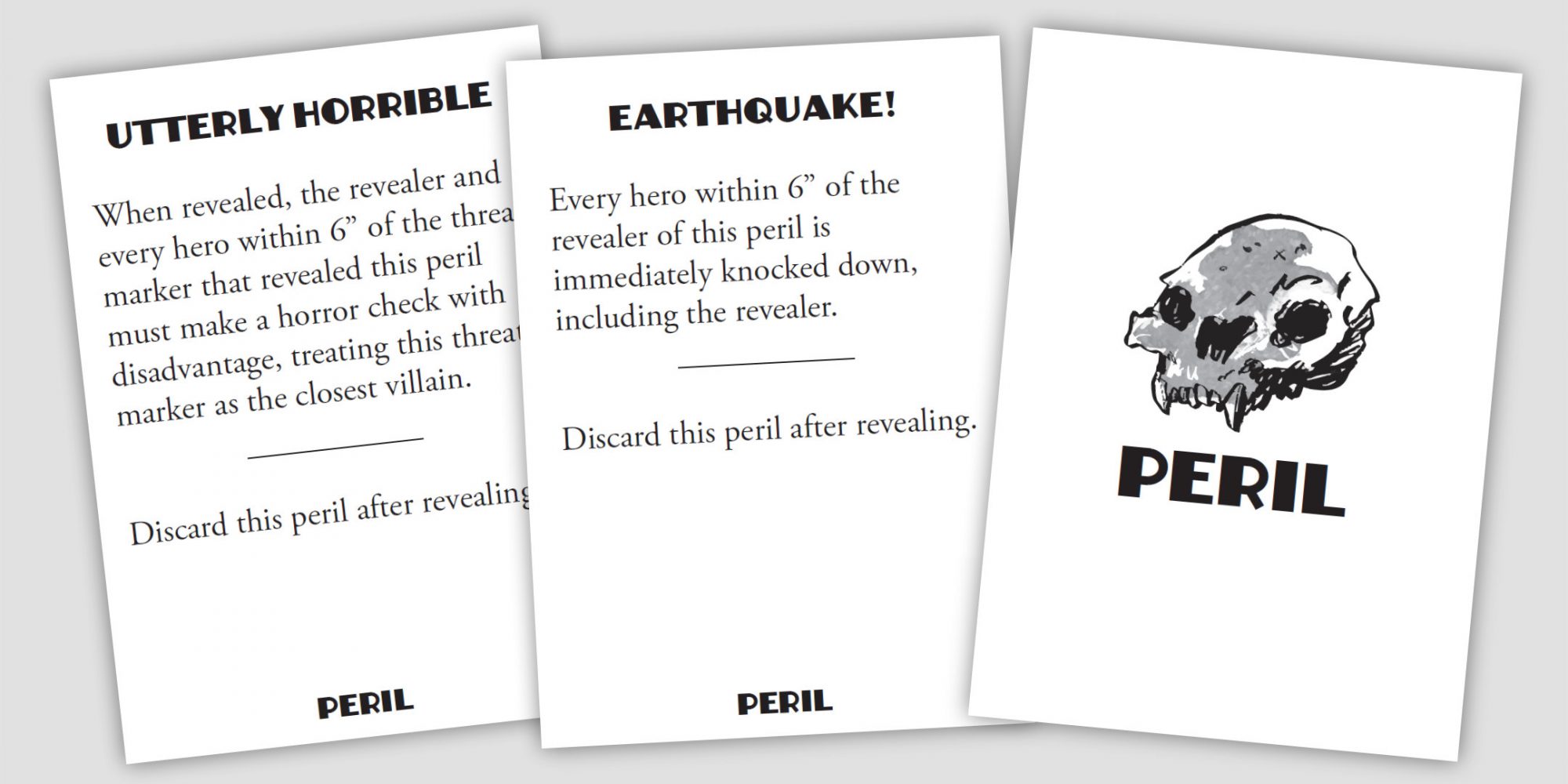 Perilous Tales peril cards © Mike Hutchinson/Planet Smasher Games.
Each villain has a specific type of behavior pattern that determines what they do on the board. These patterns take the form of simple rules for how they move, which player characters they target (if any), and what types of attacks they make. This is the most complicated part of what is otherwise a very simple set of skirmish rules. But once you get used to it, the behaviors are pretty easy to parse, and it makes the non-player villains’ behavior a lot more interesting than the usual “move towards the nearest hero and attack” that you usually see in these types of games.
Who is it For?
Players looking for a heavily narrative, almost RPG-like game will find that
Perilous Tales has a lot to offer. The simple list-building, low model count and easily adaptable theme should make it playable with whatever miniatures and terrain you happen to have – it would even work fine using printed poster maps like the kind Paizo makes for D&D, or you could even re-purpose one of those miniature-heavy Kickstarter board games. And with a play time of 60-90 minutes, could easily be slotted in between other games on a game day, as a replacement game if your DM has to cancel your roleplaying night. The short play time and relatively easy setup would make it a great convention game too.
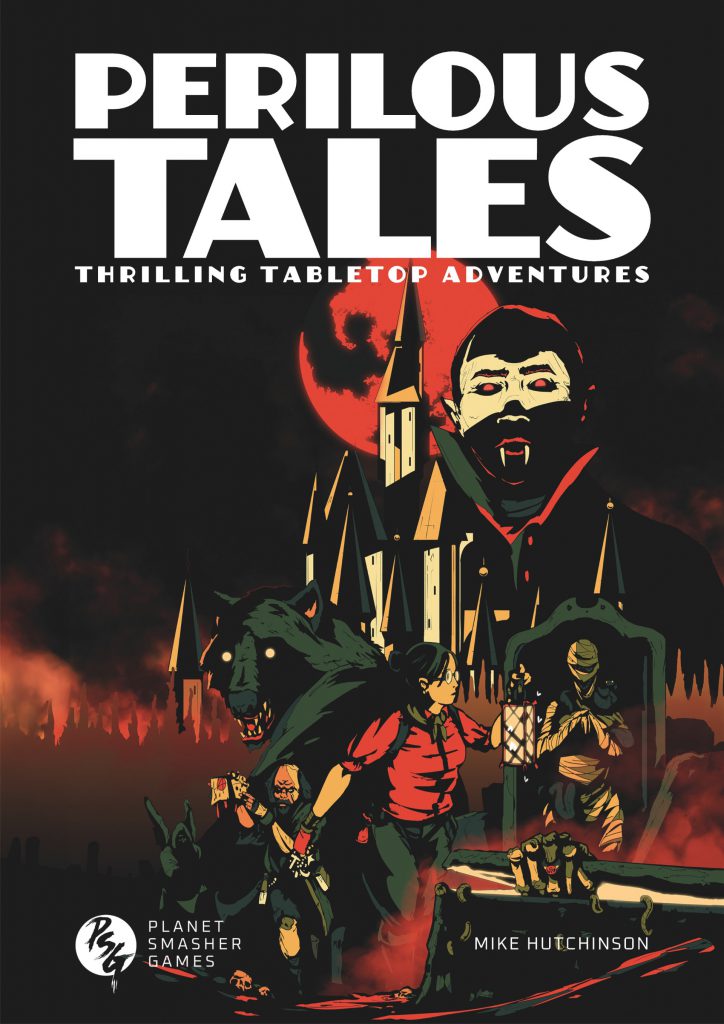 Perilous Tales cover art © Mike Hutchinson/Planet Smasher Games.
Have any questions or feedback? Drop us a note in the comments below or email us at contact@goonhammer.com. Want articles like this linked in your inbox every Monday morning? Sign up for our newsletter. And don't forget that you can support us on Patreon for backer rewards like early video content, Administratum access, an ad-free experience on our website, and subscriber-only content covering competitive Warhammer 40K!
Perilous Tales cover art © Mike Hutchinson/Planet Smasher Games.
Have any questions or feedback? Drop us a note in the comments below or email us at contact@goonhammer.com. Want articles like this linked in your inbox every Monday morning? Sign up for our newsletter. And don't forget that you can support us on Patreon for backer rewards like early video content, Administratum access, an ad-free experience on our website, and subscriber-only content covering competitive Warhammer 40K!Thank you for being a friend.
 This website uses cookies. Learn more.


 Goonhammer App and Patron Updates: April, 2026
 Kill Team Tournament Report: Engage, Party, Repeat's March Madness 2026
 Goonhammer Reviews: Tribal Conquest