Just What is “Pulp,” Anyway?
The term "pulp adventure" can be a little vague, referring to anything from Flash Gordon to Conan the Barbarian. The genre gets its name from the cheap paper that was used to publish story magazines such as
Weird Tales in the first half of the 20th century. Along with radio, this was the most accessible mass entertainment of its time, and while genres ranged widely from science fiction to horror to westerns and even romance, there tended to be a strong undercurrent of rugged adventure focused on individual heroes.
In the modern world, however, we tend to think of “pulp” as something a little more specific: globetrotting adventure set in between the two world wars, a time when the world still seemed big and unexplored but we still had modern touchstones like cars and radios. There are countless examples of this more specific definition of pulp, but the most successful (and arguably still the best) has been the
Indiana Jones franchise.
For obvious reasons, pulp has always been a popular genre for role playing games, and now Italian publisher Two Little Mice has thrown their fedora into the ring with
Outgunned Adventure, a stand-alone extension of their
Outgunned game system.
A Few Simple Rules
The game system is simple and intuitive. Characters have five basic attributes: Brawn, Nerves, Smooth, Focus, and Crime, each with four associated skills. Checks are made by combining an attribute with a skill and rolling that many 6-sided dice. Skills are grouped with the attribute they would most likely be combined with: Brawn + Fight, Nerves + Cool, Smooth + Flirt, and so on. However, any skill can be combined with any attribute, and players are encouraged to come up with creative combinations. Trying to intimidate a bad guy with a steely glare? Maybe Nerves + Force. Want to pick the pocket of the person you’re ballroom dancing with? Crime + Flirt, perhaps. It’s a fun system that hits the sweet spot between rewarding creativity while still providing ample rules structure to work within.
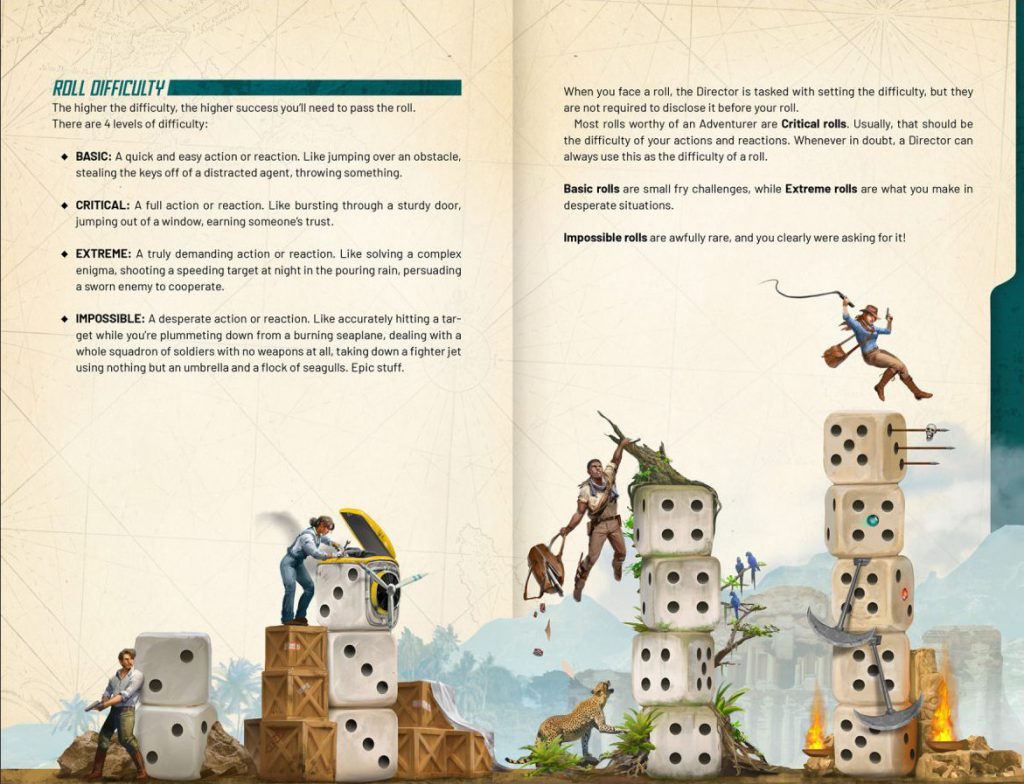 Image © Two Little Mice
Once you’ve got your handful of dice, the game gets really interesting. Rather than aiming to hit a target number, success in
Outgunned Adventure is determined by looking for of-a-kind sets. A pair of the same number is a basic success, three of a kind is a critical success, four is extreme, and so on. If a player scores at least one basic success they can re-roll to try for a better result, but if they fail to improve their roll they lose the success they had. Additionally, results can be combined or split up using a simple “three equals one and one equals three” rule – three successes convert into one greater success, and vice versa. And extra successes are never wasted, they can be used to improve the narrative result of a roll, increase damage in combat, or even left on the table for another player to use.
Outgunned Adventure uses a reward system that gives out Luck points to players for creating cinematic moments during the game. These can then be spent to add dice to rolls, activate special abilities, or saved up to gain a Spotlight, which in turn grants a more effective bonus such as a free Extreme success or mitigating the effects of damage.
It’s a rule set that definitely does not get hung up on the details. Character creation is a simple matter of choosing from a list of roles, such as Daredevil, Hunter, or Scoundrel, and then from a list of descriptive tropes like Gentle Giant or Reluctant Hero, combining the attributes, skills and feats (special abilities) gained from each, and then filling in basic details like name, age and background. Each player also selects a catchphrase and a flaw, descriptors that provide basic guidance on how to role-play the character, and can be used by the GM as a criteria for awarding Luck points and Spotlights.
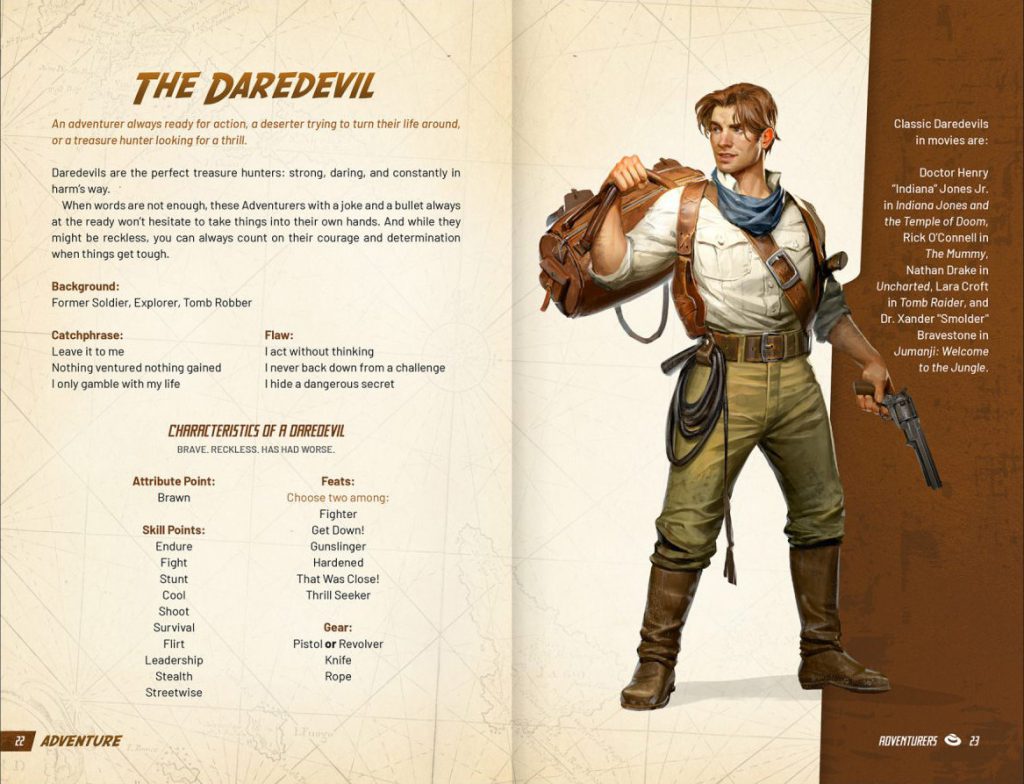 Image © Two Little Mice
Feats and equipment tend to focus on mitigating rolls by either adding dice or providing free re-rolls that don’t require or risk an initial success. Weapons don’t have much in the way of stats – firearms merely enable ranged attacks, and melee weapons such as knives and swords are generally tied to specific feats, reasoning that a sword isn’t much use if you don’t know how to use it. But that’s not to say that equipment is merely decorative – many items come with their own Feats that enable conditional bonuses to rolls, or provide other in-game effects. The game keeps equipment fairly abstract in order to keep the game play simple, with the idea that everything comes down to what the heroes do, not what their gear does.
It’s All About the Heroes
Outgunned Adventure keeps the players’ heroes and their actions front and center at all times, to the extent that all dice rolls in the game are player-facing – the game master never rolls dice. Rather than having an NPC roll for an attack or skill check, the affected player makes a reaction roll. For example, the player rolls Awareness rather than the GM rolling for the NPC’s Stealth.
Most adversaries in the only have three stats: the level of success required to hit them in combat; the level of success required to avoid being hit by them; and the number of times they need to be hit before they go down. That’s it. And if you think about it, what more does a GM really need? Main villains and supernatural menaces will have a feat or two to keeps things interesting, but in general the game treats enemies as a problem to be solved rather than individual characters than need to be played. Again, the focus of the game is on the actions of the heroes, and the consequences of those actions.
A Toolkit Approach
On the first page of the
Outgunned Adventure rule book, under the title, is the single sentence “These are tools, not rules.” The game certainly lives up to that promise, to the point that the content can almost seem a little sparse. The rule book’s smaller than average 6x9 inch pages have wide margins and are peppered with a good amount of illustrations. There’s almost nothing in the way of the normally ubiquitous charts and tables, with information instead presented in short, airy paragraphs and the occasional bullet list. The book contains chapters on Temples & Traps, Supernatural Threats, and a structure for campaigns, but these are presented more in the form of helpful advice and guidance rather than hard rules.
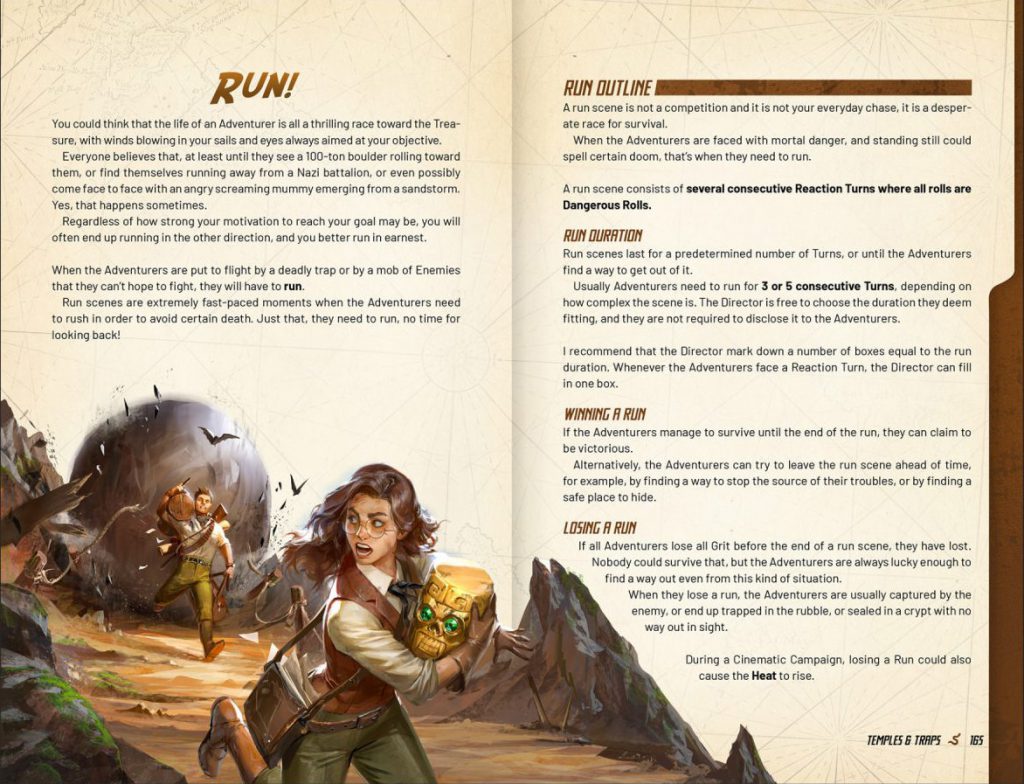 Image © Two Little Mice
If you are someone who is looking for a wealth of detailed setting information,
Outgunned Adventure might not be for you. Apart from four pages on the “Pillars of Adventure” that covers the basics of the genre, the book tends to focus on creating cinematic moments rather than exploring a detailed environment. It’s definitely much more
Raiders of the Lost Ark than National Geographic, and there’s very little in the way of pre-written adventures available: the free quickstart is the same as the intro adventure in the back of the rule book, which is also the first chapter of the (so far) only published adventure module, “Fall of Atlantis.”
However, it is a light, breezy game system that seems very well suited for one-shot games and short campaigns, as long as the GM has an idea of their own in mind. The chapter on running campaigns has some good advice on structure, how to get the adventure started, and how end it, and the game’s lack of granularity means that prep should be fairly minimal, even if you’re coming up with your own story from scratch. Personally I think it will be good for adapting material from older games that might have some good ideas but clunky mechanics, and it’ll be great for those times when I’ve watched a movie or read a scene in a book and thought “this would be great in a role playing game.” Just look at any of the Indiana Jones films: all you really need is a macguffin to chase down, a crumbling temple filled with devious traps, and a memorable villain, and you’re off and running.
Have any questions or feedback? Drop us a note in the comments below or email us at contact@goonhammer.com. Want articles like this linked in your inbox every Monday morning? Sign up for our newsletter. And don't forget that you can support us on Patreon for backer rewards like early video content, Administratum access, an ad-free experience on our website and more.Thank you for being a friend.
 This website uses cookies. Learn more.


 Goonhammer App and Patron Updates: April, 2026
 Kill Team Tournament Report: Engage, Party, Repeat's March Madness 2026
 Goonhammer Reviews: Tribal Conquest