Disclaimer: During the process of this review, Japanime Games offered us two starter decks and a booster box after I reached out to them; although all other items in this review were purchased by myself, I did thank them for offering this, accepted, and primarily used it to help test the four player variants.
During the late 90s and into the early 00s, trading card games as a medium had expanded and collapsed, leaving only a few real survivors in the wake, primarily Magic the Gathering, Yu-Gi-Oh!, and Pokémon. Perhaps due to the boom in TCGs as an investment vehicle and a resurgence in creative attempts to explore various licenses, the last few years has seen games like One Piece, Digimon, Godzilla, and many more pop up with their own attempts to break into the market. I’ve always enjoyed TCGs and have a box in my closet devoted to dead and abandoned games like MagiNation and the X-Files, primarily because TCGs provide a very fluid and easily understood two player experience that many two player board games try, and fail, to replicate. There’s just something about shuffling your deck of cards, drawing, and playing out what may happen between yourself and an opponent that makes TCGs so unique and interesting.
So color me actually surprised when I was able to get my hands on Japanime Games’ Oshi Push; I had initially been quite dubious about the game since other VTuber based products on the market eschewed actual gameplay for collectability and valuation, and also was just concerned that the game initially being a Kickstarter might hinder its wider reach and release. To be totally honest, I’ve been working on this review for quite a long time, as early as Fall 2025, because I truly wanted to test whether this game lived up to my own hype and interest, and whether or not it could deliver something that could be widely available and also complex enough to be worth investing time and, importantly, money into. As the title gives away, Oshi Push is absolutely exactly what I had hoped, and honestly more, but there may be a few hurdles to giving the game a chance, and I hope I can convince you to give a new game a try in a growing, crowded market.
VTubers and Theme: A Hurdle, a Blessing
Perhaps one of the first things that will be hard to convince some players to give this game a chance is the theme: VTubers are a somewhat niche cultural phenomenon, and if you are not a fan of the anime aesthetics or streamer/content-creator sphere, you are going to be left relying entirely on the mechanics and flow of the game to sell you on it, and frankly, I understand if that prevents you from considering giving Oshi Push a chance. That being said, if you could give it a chance, perhaps let me help sell it to you for exactly the reason why it makes for an engaging gameplay experience.
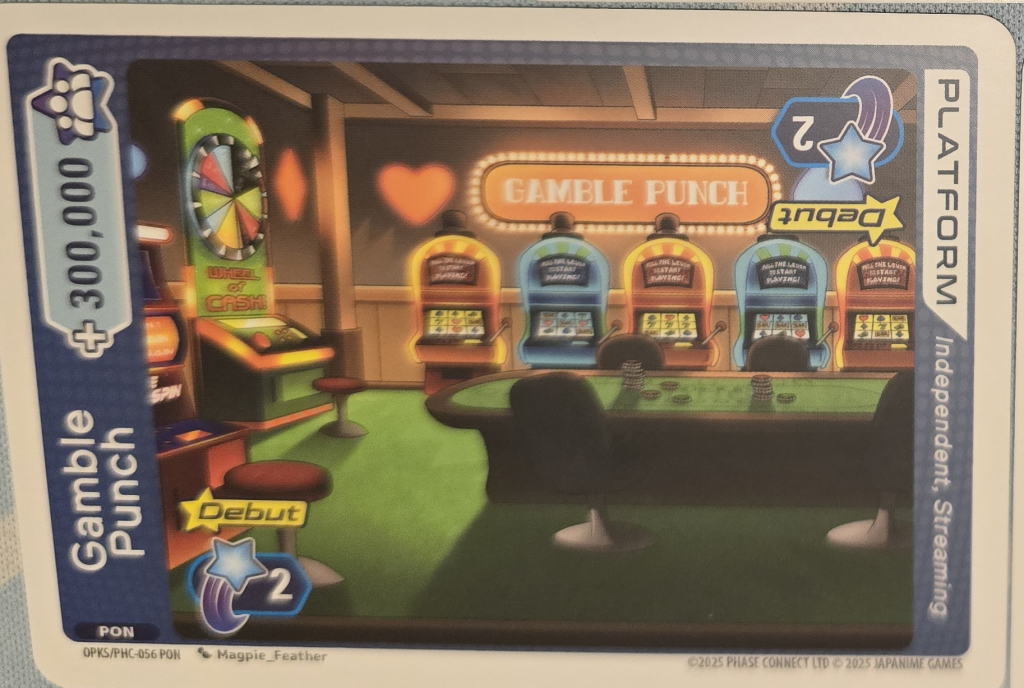 Play focuses on these Platforms, which when claimed, give the amount of subscribers shown on the left. The 2 cost is the minimum Influence needed to take it, but don't expect to only ever pay that much.
I tend to enjoy mechanics, but my partner is very thematic and vibes based, meaning that if the game is mechanically interesting but thematically boring, she’ll lose interest fast. For me, theme has to feel like it is represented in the game itself, and that the rules and mechanics of the game need to tie into those; in the middle, then, we tend to be a particularly discerning and even harsh judge of games. So when she not only loved playing Oshi Push but continued to ask me to play it, I knew that the game was on to something, and much of it has to do with how well it blends theme with gameplay.
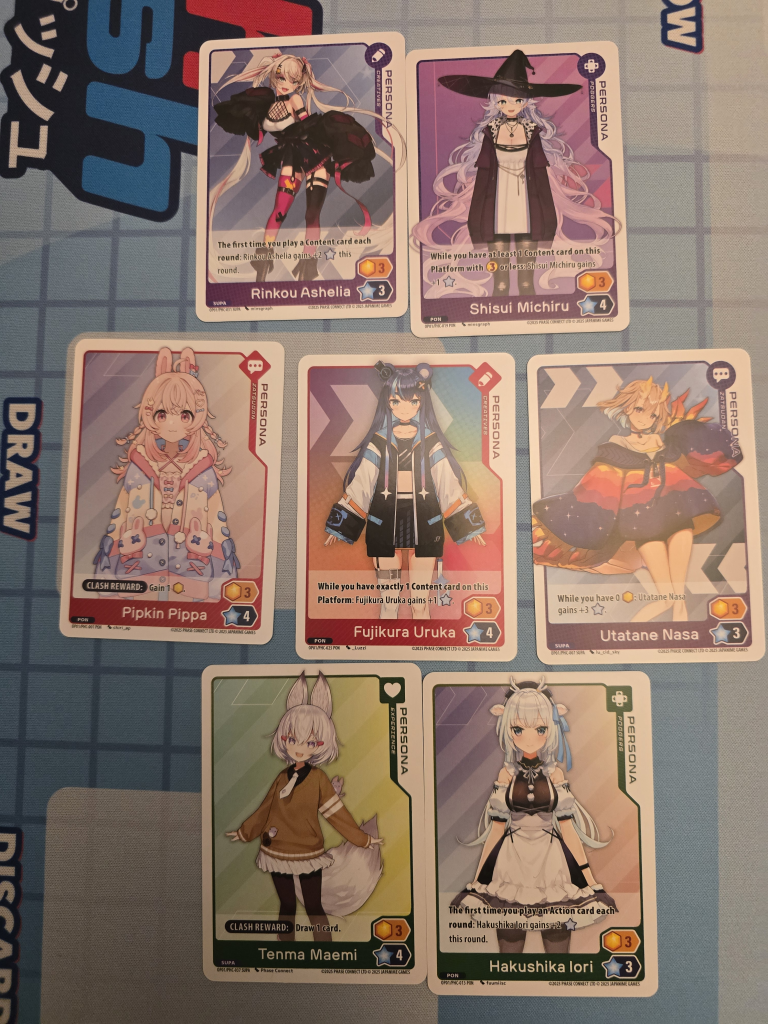 The seven Personas in the base game; Pippa and Tenma are the pilots of the 2 starter decks.
Oshi Push relies on players assuming the role of managers of a Persona, represented by a VTuber, and your goal is to help your particular representative accrue 1 million fans before the opponent does. Since both of you are competing for viewers and attention, the conflict in this game doesn’t take quite the same form as combat focused TCGs; you aren’t going to be directly smashing your talents into one another during Magic style combat phases, but instead looking to play the board in order to try and win control of three contested objectives referred to as Platforms. This was one of the first things that made Oshi Push click with me, but also with my partner; while you can indeed directly compete over Platforms, you can also choose to move strategically, trying to build up your influence across the board or moving to where your opponent isn’t, or similarly looking to block them from gaining a win.
The reason I particularly locked in on this mechanic is because it helped directly sell the theme of the game into what I was doing, rather than being abstract. My resources, which replenish each turn, helped me pay for cards, upgrades, and plays, while my Persona moved to Platforms in order to attempt wresting control of them from her competitor. I could feel the influence of Justin Gary in the way the game flowed, and there is certainly a bit of Magic game theme and flow to this that other “anime” games tend not to have; rather than paying for things with your cards, like in Digimon, One Piece, or Gundam, you also don’t have a standardized “Land” resource that clogs up your deck. Instead, each turn you earn Bits, which in turn lets you pay for things.
Everything you do, from the mechanics of Clashes and paying Bits or playing cards to up your Influence in order to win those Clashes, feels organic and makes total sense to the theme of the game. Part of that, as I said, feels like Justin Gary’s influence from his time playing Magic, and other parts feel like Japanime Games design advice from their board games, which makes the whole package just feel… nice. It also, oddly, makes conflict within the game important and possibly game changing when it happens, but also never feels mean spirited or particularly brutal in the way that certain playstyles can be in other TCGs (Control, Removal, etc.). Our match history in the time spent with the game is quite close to 50/50, and almost all of them came down to card draw and strategy, which felt balanced.
So even if VTubers are not something you are inherently interested in, if you do like TCGs or very good two player (and, possibly four player, but more on that in a bit) games, then view the theme in Oshi Push as you would in just about any other board game; a thing that helps sell the feeling of the game, rather than something you have to inherently buy into in order to enjoy the game itself.
Buying In: Availability and Community
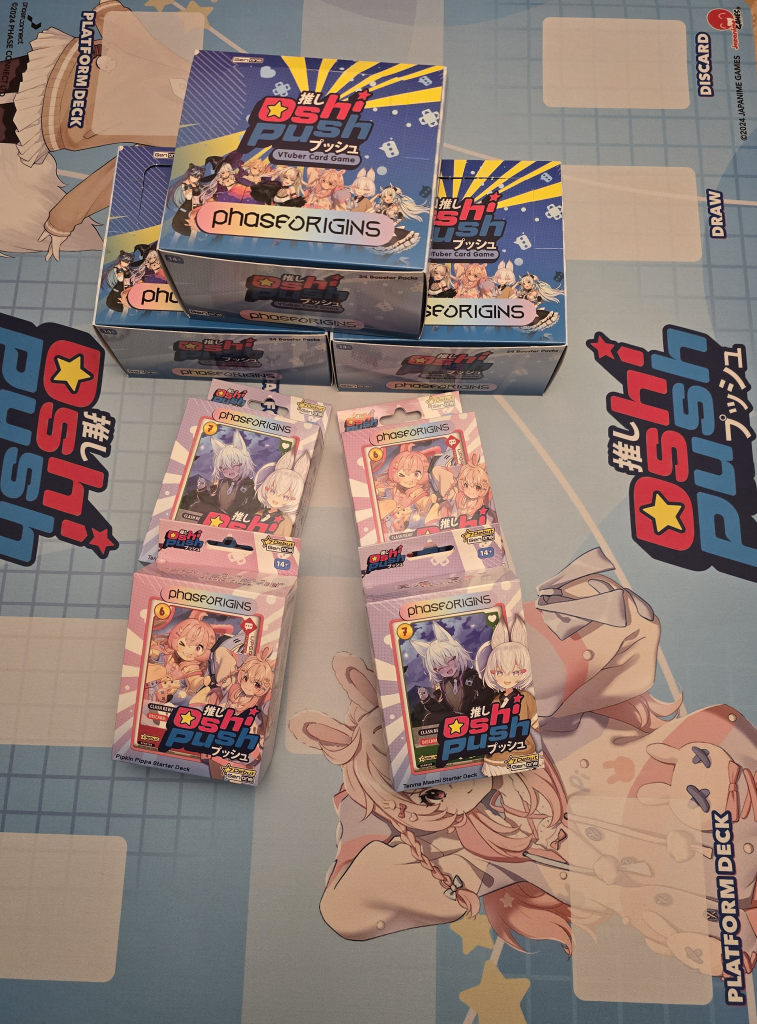 As this pile might attest, I really like this game.
As I mentioned, Oshi Push was a Kickstarter that Japanime Games funded successfully and then worked on delivering; like many Kickstarters and especially those in the Tariff Era, things certainly got a little hairy, so one of my other reasons to slow roll my review was to see something that truly influences my recommendation of just about any game: availability. So, back in November of 2025, I was pleasantly surprised to walk into my local TGS and see, in great supply, numerous boxes of Oshi Push packs and even a playmat, along with people already looking to organize local play and try the game out. Because while TCGs can be fun to mess with in a vacuum, but having no easy way to grow a collection or pool of potential players is always the number one way to get me to try something out and then move on. This is especially true to collectible products, because the ability to get cards that I’m missing in order to make playsets or construct a deck without having other players who aren’t seeking to just profit off of chase cards can be a nightmare (this is the primary reason why I gave up on One Piece).
Aside from finding people to play with locally and also a steady supply of product and support, I also found that the Japanime Games Discord has a fairly robust online player base that plays the game on Tabletop Sim, but also seeks to trade and exchange cards with one another; thanks to a very generous player in that server, I was able to obtain the full three of each card I was missing from my set to have a full collection of Set 1, which meant that if the game didn’t last, I could always endlessly play with what I had, but I think it also signals that the game’s community is interested in seeing it succeed and helping players participate in the game itself.
As far as cost is concerned, Starter Decks (at least at MSRP local to me) runs 18 USD, and a sealed box of boosters is $110; I bought tow sealed boxes and was given a third graciously by Japanime Games, and after the three boxes I really only lacked a few higher rarity upgrade cards related to Personas, but overall I had three of just about every card in the set, and none of the extremely rare chase cards are required for deckbuilding, but are instead just bonus alt art cards. If you do end up checking out the game, I am pretty confident that buying and finding singles to build decks shouldn’t be difficult, especially as the game expands.
Picking Your Oshi: Deck Construction and Identity
There are seven initial Personas you can select as your Talent in the first set of Oshi Push: Pipkin Pippa and Tenma Maemi (who make up the two starter decks), as well as Utatane Nasa, Rinkou Ashelia, Hakushika Iori, Fujikura Uruka, and Shisui Michiru; if none of those names mean anything to you, that’s fine, and actually doesn’t matter that much! What does matter is that each Persona represents a specific color identity and streamer genre There are three colors: Green, Red, and Purple, and the genres are labelled as Creative, Experience, Poggers, and Zatsudan (listen, you gotta accept the silliness with the theme, as I said). Each Persona has a specific Genre, but they have the ability to use cards that are EITHER their color OR their genre in their decks, meaning that your ability to construct varied decks is actually a lot deeper than it initially seems.
For example, Rinko Ashelia is Purple Creative, meaning she can us both Purple cards of any genre and Creative cards of any color. The starter decks do a great job of showing how this works by building decks that are constructed around the Personas that come with them, and it made developing ideas for deckbuilding beyond those starter decks easier to understand. The Personas help give your deck various limits, but those limits also create unique avenues to pursue victory conditions that makes each one unique; as mentioned, Rinkou Ashelia tends to gain Influence off of Content cards and wants to play a lot of them, while Utatane Nasa wants to spend Bits in order to gain a huge power spike in Clashes. While both of these cards have the same color identity, their deck strategies are totally different, and I’ve enjoyed tinkering with decks for myself and helping my partner with hers in order to construct a few different ones for us to play with; while some cards do overlap, I also noticed that most decks wanted completely different cards, which made constructing a set of decks a lot easier than I expected for us to play with.
Two Player, Four Player, and 2v2
Something that stood out to me while researching the game initially was the promise that it would come with four player variants, essentially a four player free for all, and a 2v2 mode. I’ve always been slightly dubious of games that promise to do “other” player counts than what they are initially created for, and TCGs that often want to play in larger player formats tend to get a little weird or add on their own new rules and styles (see Commander in Magic: The Gathering). The issue I had was that at the time I was working on getting enough familiarity with Oshi Push under my belt, I didn’t have access to another set of Starter Decks; while that wasn’t exactly a dealbreaker to use my collection to make four decks, it certainly made it easier, so once again I was happy when Japanime Games offered me another set of starters. This gave me enough tokens, some starter only cards, and basically rules for four people, and let me check out the game at higher player counts.
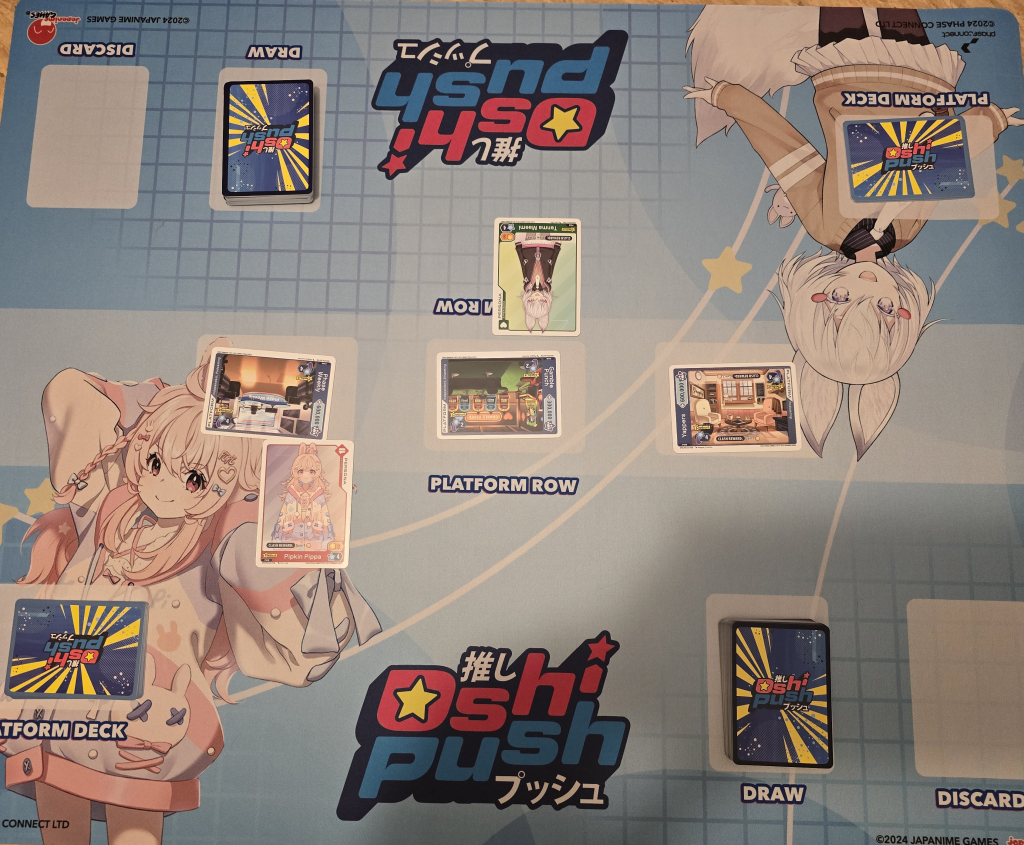 This is how the game looks as things get under way; content, upgrades, and other cards will make this a bit more chaotic.
In the two player format, players take turns in various phases in which players can pass. When both players pass, the phase resolves, and the game moves to the next phase; because of this, you can even take an action after having passed once before, but if you gamble on passing and your opponent passes, you’re out of luck! It is an interesting push your luck mechanic that also tests the waters to see what your opponent is willing to invest leading up to Clashes, and makes the resolution of Clashes more dynamic as players can bluff before taking an action that may cinch them a win. This flow helps keep the game dynamic and also rewards you for careful attention to the game state and what your opponent might be capable of doing.
In 4 Player, this mechanic changes a bit, which is (from my experience) mostly to make the game run faster. When a player passes, they pass and do not get to take another action; if you pass, you’re done until the phase comes to a close, even if other players take multiple actions in response to one another. I did appreciate this from a game speed perspective, although the other two players I roped in to try it kept forgetting that bit. Otherwise, there’s really no change, and I have to say that the four player Variant was actually fun and just felt like a slightly more chaotic version of the base game. Players still needed to amass 1 million subscribers, but what happened was that each player had a higher chance of Clashing and either failing to capture Platforms or made skirmishes for Platforms far more common. This mode also helped show how various Personas performed in various conditions, and I was pretty happy to discover that all seven seemed to be viable in four player and two player.
The other variant that we tried was 2v2, essentially Two Headed Giant, in which players make teams and play to collect 1 million subscribers first. There’s not a ton of big changes between this and two player or even four player, except once again to the Pass mechanic. Teams take actions together, meaning that teams have to decide who will take an action, and then it passes to the opposite team; you can have the pass, action, action mechanic again here, or in other words, passing does not take your team out of rotation. I will say we found this mode fun; while it didn’t quite match two player or Free For All (which can also be played with three), it was nice to see that it had some actual thought put into it and how it works, and didn’t feel like a half-attempt at giving the game another possible player count for the sake of it.
The Future of Oshi Push and Should You Buy It
 The second set, Hidden Links, comes out in May, and I'm excited to see how the game evolves.
As I’m writing this review, Japanime Games has announced a second set, called Hidden Links, which introduces another six new Personas and two new Starter Decks: Porcelain Maid and LineChu make up the new starters, while Eden, Raelice, Captain Camille, and La Avispa Necatrina round out the other Personas in the set. I was curious to see where the game would go after set one, which was primarily centered around talent from VTubing agency Phase Connect, so I was pretty excited to see a wider variety of VTubers in the second set, including men, women, and a cat, and makes me hopeful that future sets will continue expanding on the concept and creativity of VTubers.
I figured I’d also take a final moment to note the quality of the cards. Japanime Games is primarily a board game company, and the card quality here reflects that; these are some of the nicest, sturdiest cards I’ve played with, and they sleeve fantastically, and also feel great to hold. Perhaps that is just a Me thing, but the feel of cards in my hand means a lot to me while I play TCGs, and I really did love the physicality of Oshi Push’s cards; that also extends to their readability, as I found cards easy to distinguish and card text easy to read.
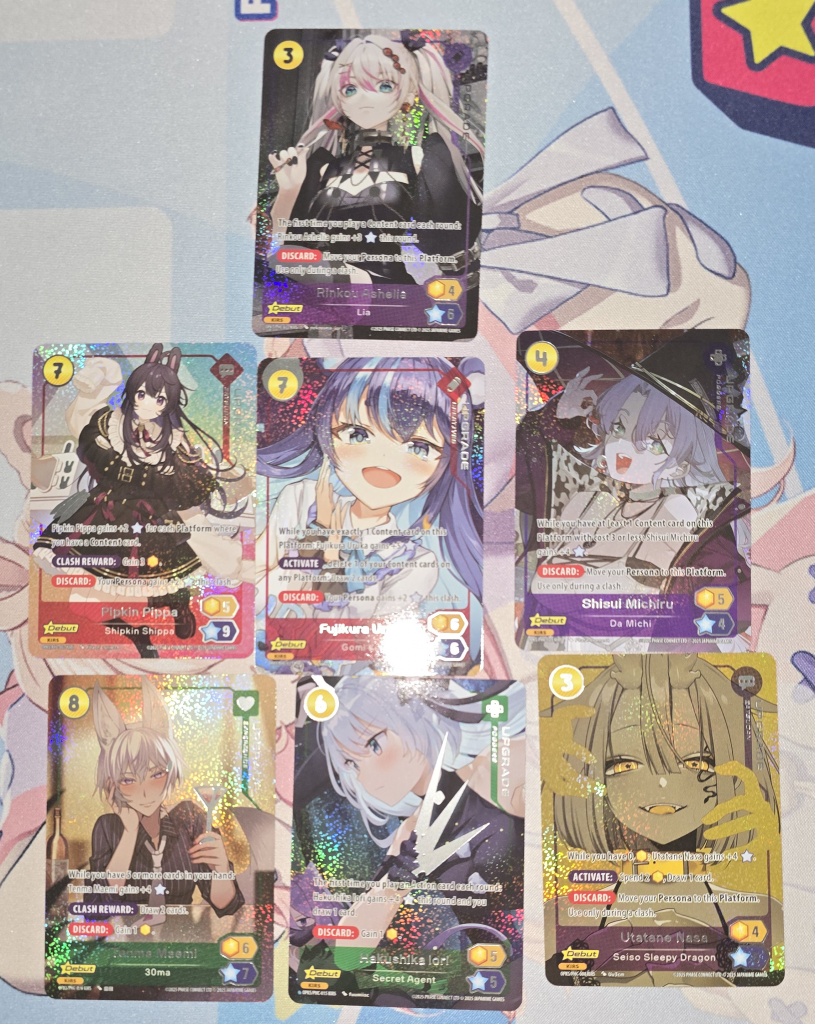 aside from the card stock, the holographics on rarer cards are really nice, and look super cool on the table when you play them.
So, should you try Oshi Push? If you like TCGs, I think the answer is a resounding Yes, because the game is one of the smoothest and most simple to understand yet complicated games I’ve played in quite a while; I know that sort of praise is often tossed around, but I really do want to sell that both my partner and I figured the game out roughly at the same time, and we even discussed possible deck strategies. Although the theme may not be for everyone, if you’re willing to give the game a chance, I think there’s something really special here. I’m hoping to get my hands on Set 2 and its starter decks as soon as I can, and I’ll be reviewing those as well when I get a chance; my hope is that they’ll be just as well constructed as the first set decks, which were some of the best constructed starters I’ve ever played with. If my review has at least made you curious, go track down a set of Starter Decks and give the game a try; if you get hooked, don’t say I didn’t warn you!
Have any questions or feedback? Drop us a note in the comments below or email us at contact@goonhammer.com. Want articles like this linked in your inbox every Monday morning? Sign up for our newsletter. And don't forget that you can support us on Patreon for backer rewards like early video content, Administratum access, an ad-free experience on our website, and subscriber-only content covering competitive Warhammer 40K!
Thank you for being a friend.
 This website uses cookies. Learn more.


 Goonhammer App and Patron Updates: April, 2026
 Kill Team Tournament Report: Engage, Party, Repeat's March Madness 2026
 Goonhammer Reviews: Tribal Conquest