It seems like trick taking games are all the rage these days. However, it might be more accurate to say that the term “trick taking game” has emerged as a bit of marketing shorthand to describe a particular type of card game based on classic “according to Hoyle” card games like Bridge, Spades, and Hearts. Stonemeier’s new game
Origin Story takes advantage of a time-honored game design technique, that of taking a classic game that everyone knows and bolting on additional game mechanisms to make it more interesting and/or thematic.
Just What Is a Trick Taking Game, Anyway?
Of course, the danger in assuming that everyone in your target market knows a particular style of game is in that very assumption. Even given my 40+ years of experience in tabletop gaming, I only vaguely knew what a trick taking game was, until very recently.
Classic trick taking games vary a little in the details, but they all start with the same basic skeleton. Using a normal deck of playing cards, a number of cards are dealt out to each player. The game is divided into rounds called “tricks” – the first player, designated the leader, plays a card to the center of the table, and in turn, each other player must play one card of the same suit if they can (this is called following suit). If a player doesn’t have any cards that match the suit of the first card played, they can play any card from their hand. After everyone has played a card, the player who played the highest card in the same suit as the leader’s card wins the trick.
Frequently (as in Spades), a particular suit will be designated the “trump,” which means it supersedes the leader’s suit card, and the player who played the highest trump card wins the trick instead. But they still only have the option of playing a trump card if they don’t have any cards that match the suit of the leader’s card (they can’t follow suit).
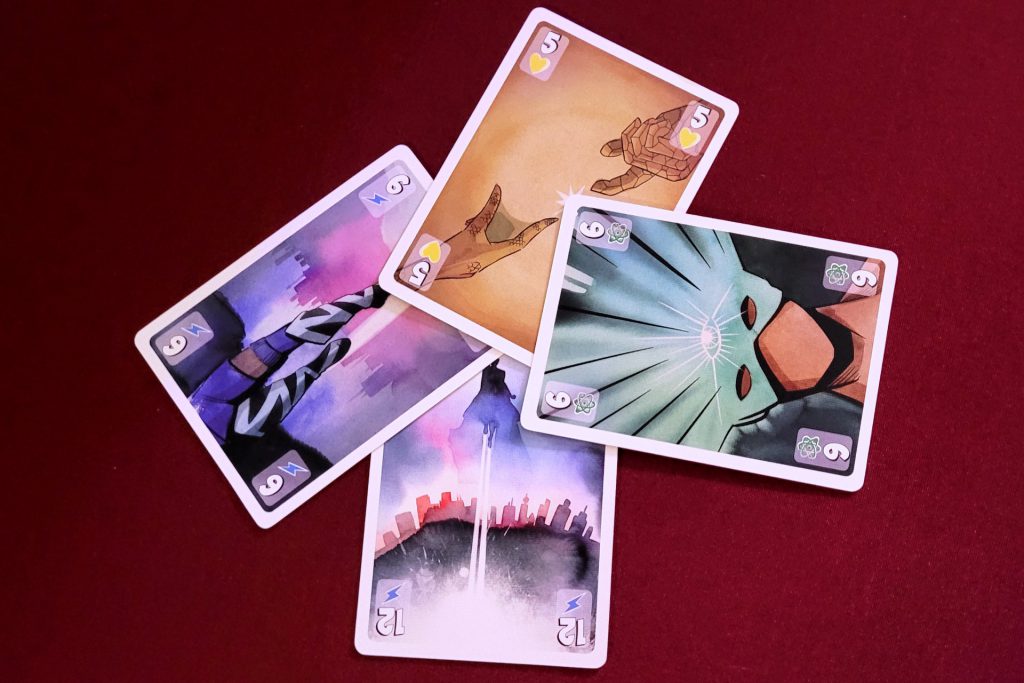 The leading player played the 12 of Speed, forcing everyone else to play that suit if possible. Love (yellow) is the trump suit, so even though it's not the highest card, the player who played it wins the trick.
The winner of the trick gathers up the cards and places them off to the side in a stack, and then leads the next trick. Play continues in this fashion until everyone’s hand is empty. Different variations of the game dictate how the overall winner is determined, with some having players bid at the start of the game on how many tricks they think they’ll win, and others requiring players to try not to win any tricks at all.
But What This Game Really Needs is Superheroes
Origin Story takes the basic trick taking framework described above and adds a few extra elements designed to reflect the tropes of the superhero genré. The game is played with a 52 card deck of playing cards with the suits re-themed to brains, love, speed and strength. But it also uses a second deck of 64 story cards, representing the powers, talents, allies, enemies, and gadgets that make up a superhero’s back story.
At the start of the game, each player is given a board that represents one of five different characters and gives the player a unique ability they can use to gain extra victory points or other in-game advantages. Players are also given two superhero cards, giving them a choice of the hero their character will become in the last round of the game, with a victory point bonus and sometimes an additional special power they can use. Finally, each player gets a double-sided dial that is used to keep track of their victory points, but also to signify whether they’ve decided to be a hero or a villain, something that can change each round.
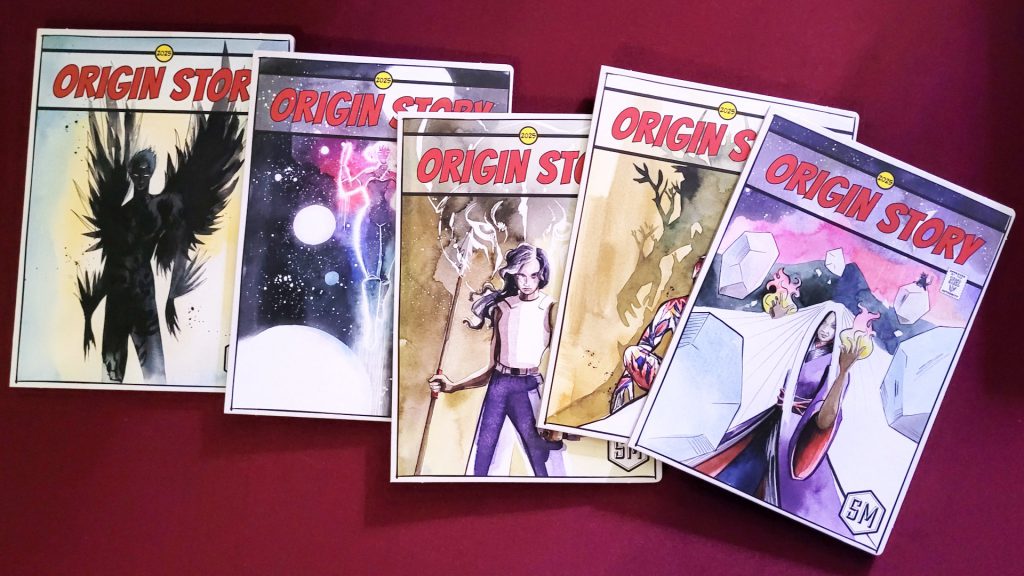 The game's five potential heroes...or villains. Photo by Jefferson Powers.
Let the Heroism Commence
At the start of each round, each player is dealt 8 cards from the playing card deck, and 3 from the story deck. After looking at their hand of playing cards, they each choose one story card, placing it on their player board, and discard the other two. The story cards give them additional abilities to use during the game – some are one-time benefits, some are conditional (such as when the player wins or loses a trick), and some are “always on” advantages that allow them to break (or at least bend) the rules, hopefully to their advantage. The game uses stamina tokens as a currency to pay for the use of these abilities. Players start with one and gain another each round, but many of the more powerful story cards cost more than one stamina to use, and since they get another story card every round, players will often find themselves having to pick and choose which powers they think they’ll want to use that round.
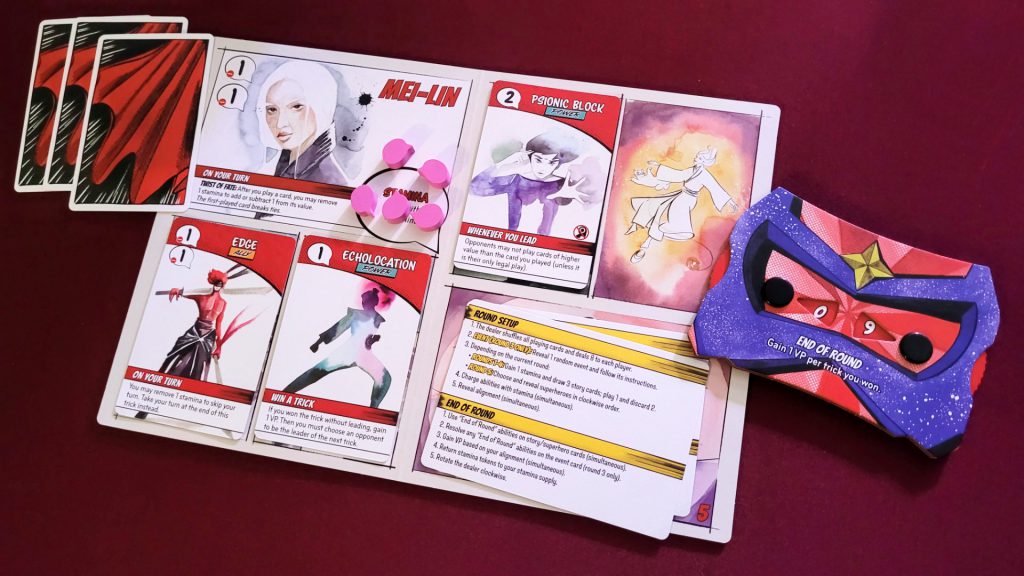 A player board at the start of round 4. Photo by Jefferson Powers.
After viewing their cards and choosing their new story card, players must decide whether to be a hero or a villain for the round. Heroes gain 1 victory point for each trick they’ve won at the end of the round, while villains instead get 4 points if they don’t win any tricks. From here the round consists of playing 8 tricks, with each player using their powers and abilities to manipulate things to their advantage.
At the start of round 3 a random event is drawn from a separate deck of 18 event cards. These are global events that shake the game up for one round, hopefully preventing any one player from holding on to too much of an advantage.
Round 5 is the final round, and at the start, after receiving their hand of cards, players choose their superhero identity from the 2 cards they were given at the beginning of the game. These all have a “when revealed” ability, most of which confer extra victory points, with a few also providing an ongoing ability for use in the final round of the game.
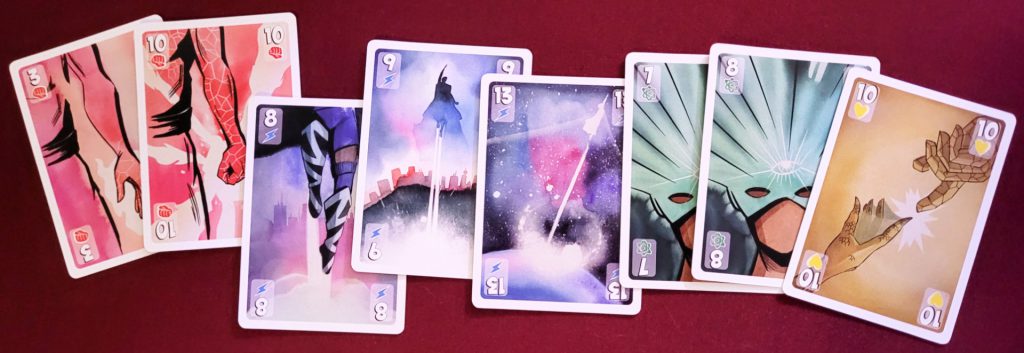 A starting hand of cards. Photo by Jefferson Powers.
The Exciting, if Unexpected, Conclusion
To be honest, the superhero cards tend to be pretty egregious, with the points they award varying wildly from a meager 5 to 15 or more, often doubling players’ scores. There is a small amount of strategy involved in choosing between two cards, but even that is often based on the hand of cards you were just dealt. There are only two (out of ten) that rely on which story cards you chose throughout the game – one of those maxes out at 8 points while the other veers between 6 and a potential 15 if you’re extremely lucky. It makes for a somewhat chaotic finish to what is otherwise a fairly even-keeled game.
That’s not to say that
Origin Story isn’t an entertaining, engaging game. In particular, it has a lot to offer if you are a fan of trick taking games. The simple mechanisms layered on top of a familiar base game will make it easy to learn (and probably a lot more interesting) if you’re already familiar with the format. In the group I played with, the player who had a lot of familiarity with classic trick taking games seemed to enjoy it the most, and the rest of us had a good enough time with it.
I should add that it’s a much better game with a larger group. The two player game requires two dummy players whose only purpose is to add cards to the trick, which made the game seem a little anemic compared to playing with a full table of 4 or 5. And the solo variant adds a little too much rules overhead for my liking, although experienced solo gamers more accustomed to playing with automa systems might have an easier time with it than I did.
Have any questions or feedback? Drop us a note in the comments below or email us at contact@goonhammer.com. Want articles like this linked in your inbox every Monday morning? Sign up for our newsletter. And don't forget that you can support us on Patreon for backer rewards like early video content, Administratum access, an ad-free experience on our website and more.Thank you for being a friend.
 This website uses cookies. Learn more.


 Goonhammer App and Patron Updates: April, 2026
 Kill Team Tournament Report: Engage, Party, Repeat's March Madness 2026
 Goonhammer Reviews: Tribal Conquest