 Image credit: Games Workshop
While the requirement to contribute additional content for a Special or Limited Edition is probably determined at the Black Library level, I suspect that the author has some leeway as to whether they'd prefer to write a Foreword or an Afterword. Regardless of choice (as you usually only get one), each have their advantages.
For a Foreword, it's the opportunity to get out in front of the reader before they've turned the first page of your story. Often these focus anecdotally on the
why of a book, such as with
Robbie MacNiven's Vagabond Squadron ("[
Dan Abnett's]
Double Eagle taught me a lot about writing, and it also left me with a desire to pen aerial action of my own.") or
Marc Collins in
Krakenblood's Introduction ("Sitting in a converted barn [in Norway], I listened as I was given the chance to tackle the Space Wolves themselves. Specifically, to write a Wolf Priest. I couldn't say no.")
Afterwords have the benefit of the author knowing you've already read the book, so there's no fear of spoiling anything. As a result, they can often get into the
how of the book.
Dale Lucas, for instance, uses his to unpack
Ushoran, Mortarch of Delusion ("I reasoned [that] the reader and I might best examine the Mortarch of Delusion
indirectly by contrasting his world view, his desires, his motives and his methods with a more human- and more relatable- figure.").
In a similar way, the Afterword that
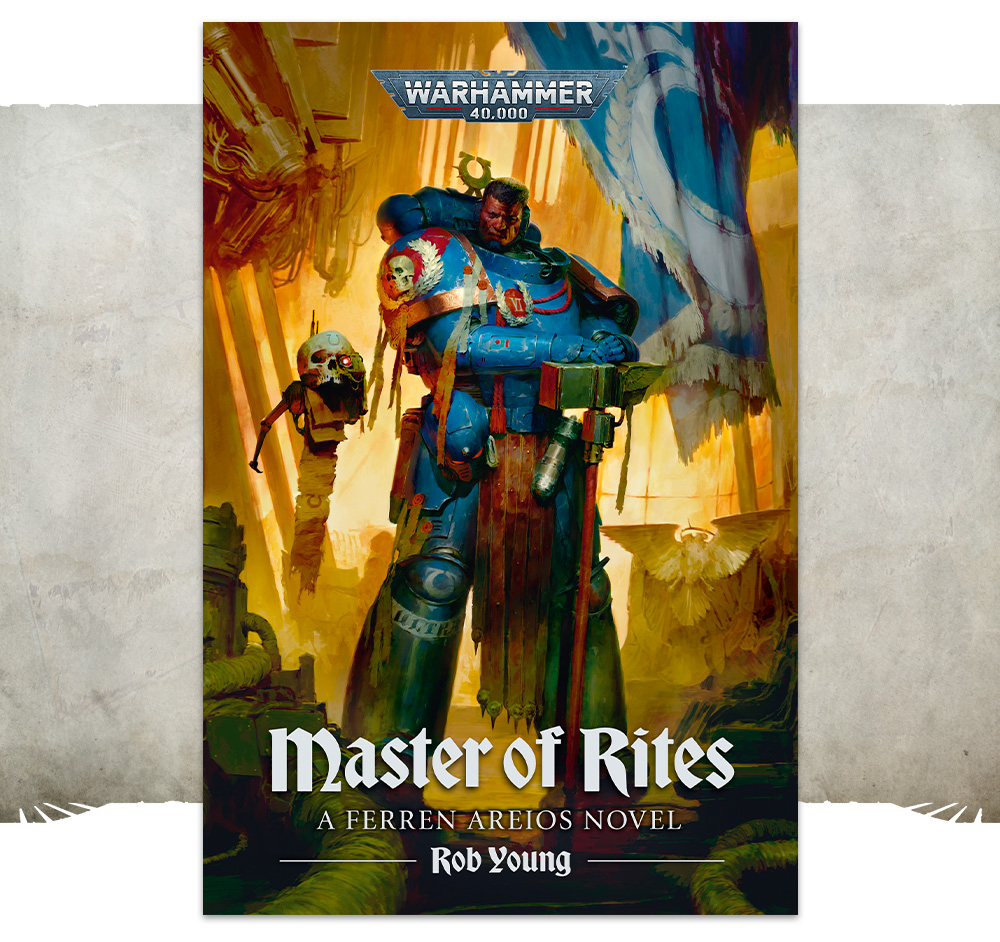
Rob Young has included in the Special Edition of
Master of Rites is a very candid look at his initial feelings of anxiety at writing the character of Ferren Areios. "Cards on the table," he wrote, "I hesitated when the offer came through to write Ferren Areios' first standalone novel."
"It wasn't because I didn't like the character- it's quite the opposite." Young goes on to note that Areios had already been written by "two absolute titans of the Black Library stable: Guy Haley and Nick Kyme," and he quite naturally wondered if he'd be able to follow in their footsteps with the character while bringing something new to the table.
This gives us a terrific lens through which to view the finished product, which I ultimately found to be full of promise- although in parts somewhat uneven in execution.
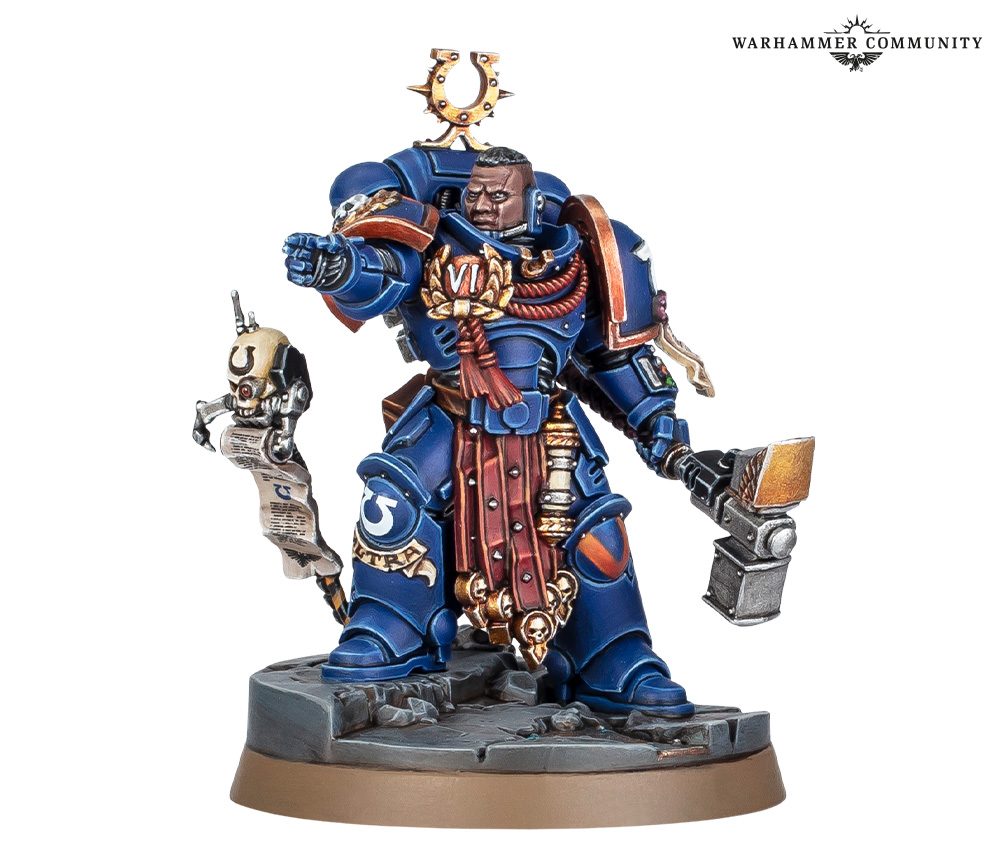 Image credit: Games Workshop
Telling the Tale
Master of Rites, while a standalone book
1, is firmly in-universe in the sense that it takes place in a specific part of the timeline. At the start of the Dawn of Fire saga, Areios wasn't yet an Ultramarine but rather one of the Unnumbered Sons, those Primaris Space Marines created by Belisarius Cawl and held in an unofficial reserve Chapter of their own until assigned one by Roboute Guilliman.
Young's narrative is set after the conclusion of the Indomitus Crusade and Plague Wars, with the Ultramarines propelled by the ambition to bring the 500 worlds of Ultramar back into the Imperial fold while continuing to run into Death Guard resistance. I mean, nobody ever said this was gonna be easy, right?
Enter Ferren Areios, Captain of the Sixth Company. The fact that the Sixth is tasked with joining the fight gives some clue to the all-hands-on-deck nature of the retaking of the 500 worlds campaign, as the Sixth is normally designated one of the Ultramarines' Reserves. Not only that, but whoever holds the Captaincy of the Sixth is also designated as the Ultramarines' Master of Rites, a ceremonial position tasked with upholding their rituals, traditions, and history.
Joining Areios is a battlegroup consisting of Imperial Navy, Astra Militarum, and even a Rogue Trader's retinue as
Master of Rites depicts the world-by-world struggle to purge the taint of a Death Guard warband, the Brotherhood of Rust. Along the way Ferren will see his resolve pushed to the breaking point, and must reach within his spirit if he hopes to prevail.
Or as Young himself put it in the short Warhammer Community interview
2, this was Areios being "forged in fire."
A Shroud Most Sinister
Awhile back I adapted the
Crusade: The Nachmund Gauntlet narrative campaign book for Warhammer 40K RPG's as part of my (very) occasional
Lore & More series. One of the adventure hooks I proposed was this:
As agents of the Inquisition, the players are tasked with exploring a mysterious space station at the edge of the Gauntlet’s realspace that has reappeared after being swallowed by the Great Rift. Strange signals have been received from the station, cryptic and puzzling. As the players close in on the sinister secrets of the station, a strike force of Night Lords arrives, scouts from Worldclaimer’s fleet who also picked up the signals. As the heretic Astartes hunt the players across a station that seems to have a mind of its own, can they escape with their lives?
I was delighted to see Young mining similar earth here as the story opened not with a space station, but rather a whole
region- the Khorsari Reach- that had returned from the Great Rift. It's a gripping premise, and Young makes a meal of the otherworldly mystery and
weirdness of the first world they encounter. Infested with the forces of the Archenemy no longer entirely recognizable as human, the Ultramarines find a world choked by a mysterious, toxic fog that obscures sight and corrodes any metal it encounters.
This is delicious stuff, ratcheting up the tension in a way reminiscent of Stephen King's
The Mist3. When Areios and his band are contacted by a holdout group of rebels deep in the fog, he plays well off the paranoia as I found myself wondering whether these erstwhile allies might be hiding secrets of their own. Indeed, this is such a strong scenario that I felt a little shortchanged by how quickly things move towards the inevitable action-based conclusion of the book's first arc. Young could easily have teased another hundred pages out of exploring the sinister, fog-laden planet.
In this, I was reminded more than once of Robbie MacNiven's
Oaths of Damnation (
review). There too we had an enigmatic mystery unfold in the first act that eventually regressed towards the mean of protracted action sequences, which are perfectly fine (this
is Warhammer, after all) but also make me wonder if there was something a little more in there that could have made for an even better story.
 Image credit: Games Workshop
Humanizing the Transhuman
And it's not like Young can't tell them, as evidenced by his first two novels- both tales of the Astra Militarum. 2023's
Longshot was a 40K version of the movie
Enemy at the Gates, recounting a duel of wits between a human sniper and her T'au counterpart. Then the following year saw him release
Leontus: Lord Solar, which
in my review I noted had fun echoes of the
A-Team.
Both of these were cracking reads, so I wasn't entirely surprised to note that some of the best parts of
Master of Rites had nothing to do with the Astartes at all. Young's passages anchored on his Navy or Guard characters (as well as those of his terrific Rogue Trader, Demetria Calvaros) were written with a veteran's hand, terrifically paced and filled with a depth and character that used every bit of the scant column inches awarded them.
Calvaros in particular had a lot of opportunity. She appeared to be positioned as a sort of voice of conscience for Areios, her mortal perspective providing a vital counterweight to his more narrow, transhuman scope. This was essential to Young's vision, given that this book is (again from the Afterword here) "an exploration of what emotions are to a Space Marine... answering questions about how they might process complex feelings, and how they might move through the different stages of grief."
While overall this element of the book wasn't given quite enough oxygen to work (particularly as it related to the debate of "redemption versus exterminatus"), you could see what Young was going for here- and respect the attempt.
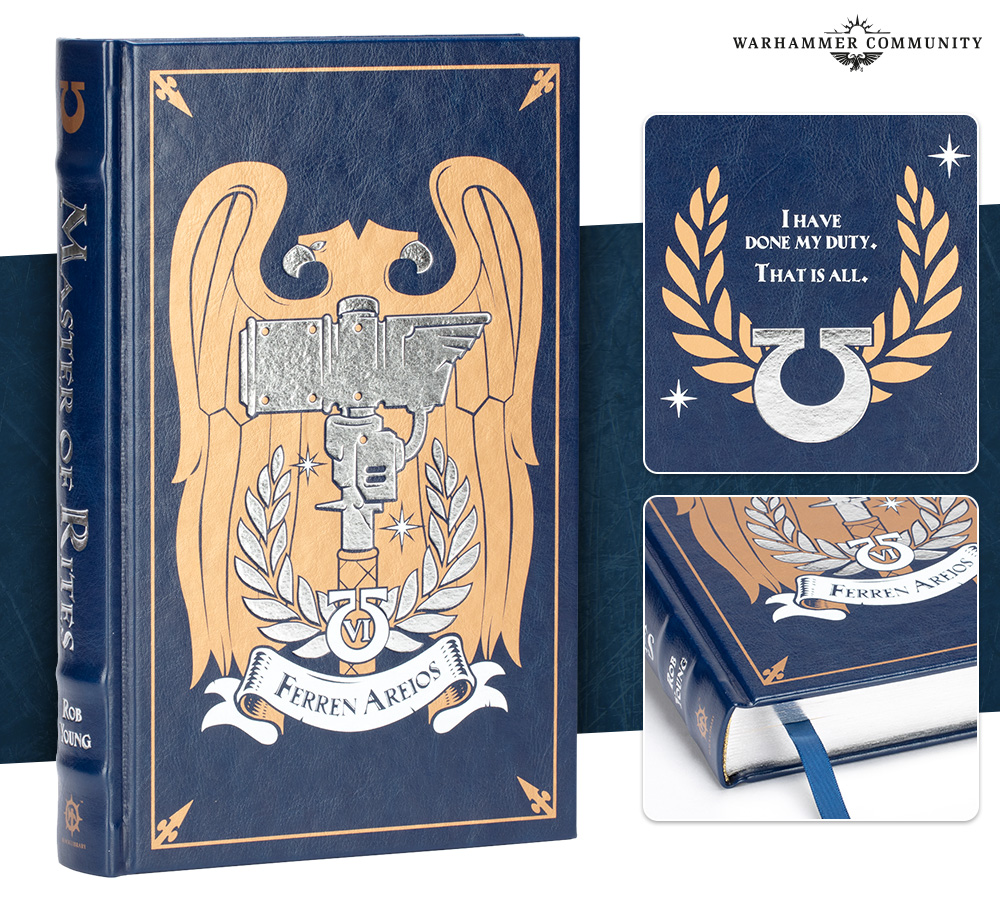 Image credit: Games Workshop
Final Thoughts
Overall, when I note the book being uneven, it's because Young showed so many good ideas but didn't quite carry them as through as I'd have hoped. The book's second act never quite carried the same momentum or suspense as the first, not because it was
bad but simply because the first act had so much promise. The non-Astartes characters were terrific but could have used a bit more screen time to really tease out the emotional notes and depth Young was going for in both them as well as in Areios himself.
For example, later in the book there's a great discussion between Calvaros and Areios where a simple question-
is there anything left of you that is human?- is put to him, and I'd loved to have seen this given a bit more room to blossom. This is personal preference, of course, but I tend to enjoy Space Marine-centered books a bit less on the whole precisely
because these sorts of angles don't get explored enough
4. You have to give Young some credit just for taking a run at them in his first-ever Astartes book rather than playing it safe with bolter porn and interminable action sequences.
In
my recent review of MacNiven's
Vagabond Squadron, I talked about how a successful band sometimes rolls the dice and changes up their sound- for better or for worse. MacNiven, the pen behind truly enigmatic and even esoteric Chapters like the Carcharodons (
Red Tithe et al) and the Exorcists (
Oaths of Damnation), scored a home run with his first-ever take on the war stories of ordinary mortals in the Navy and the Guard.
In
Master of Rites, Young runs the playbook in the other direction. I enjoyed the read, and am very curious to see where he goes from here. Does he play it safe and dip back to the Guard, or will he dig deeper into the themes he touched on here and really get in under the hood of what it means to be transhuman?
I won't be disappointed either way.
Footnotes
- Maybe? There's enough in the conclusion to set up a second book, so this may not be the last we've seen of Young's Ultramarines.
- It's only about three minutes long, but I do enjoy these little featurettes on WARCOM.
- An outstanding read and decent viewing- though the end of the film is legendary for being about as grimdark as it can possibly get.
- Funnily enough, the "cost to one's humanity" of being transhuman actually seems to come up more often in Chaos Space Marine stories, because there it's a much more acute concern given the nature of warp corruption.
Have any questions or feedback? Drop us a note in the comments below or email us at contact@goonhammer.com. Want articles like this linked in your inbox every Monday morning? Sign up for our newsletter. And don't forget that you can support us on Patreon for backer rewards like early video content, Administratum access, an ad-free experience on our website, and subscriber-only content covering competitive Warhammer 40K!Thank you for being a friend.
 This website uses cookies. Learn more.


 Goonhammer App and Patron Updates: April, 2026
 Kill Team Tournament Report: Engage, Party, Repeat's March Madness 2026
 Goonhammer Reviews: Tribal Conquest