Malediction is a new genre of tabletop wargaming that blends the competitive creativity of card games with the impactful placement of miniatures on a battlefield. It is designed and brought to you by Loot Studios, a titan in the 3D Printing scene for miniatures, who are taking the next step in their journey to make a game of their own. I will be diving on in to bring you an in depth review of this new type of tabletop game. Come with me, and delve into… The Malediction.
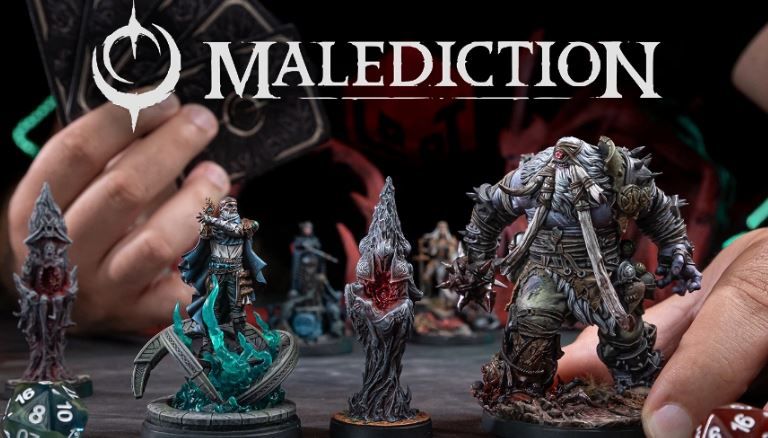 Malediction - From Loot Studios Gamefound Page
Who Are Loot Studios?
Loot Studios was founded in 2020 and was known as just Loot. The brand began by creating high quality and extremely detailed miniatures to meet the demand of painters and the roleplaying game scene at the time. This was a time where a large amount of hype around D&D was skyrocketing with the likes of Critical Role and Dimension 20. Loot provided a membership platform that you could subscribe to and gain monthly miniatures to print using a 3D printer.
Loot have created minis to be used in almost any roleplaying gaming and not just fantasy games like D&D, but sci-fi games as well. On top of this they did make miniatures to go with popular board games Arkham Horror and Rise of Cthulhu.
However, Loot was not satisfied with making miniatures for other key tabletop gaming companies due to them not prioritising the players all the time. This didn’t align with who Loot are or who they want to be. With this in mind they then began making their own game in 2022 which would go on to become Malediction. You can read more about this
over on their website as well as
the Gamefound page for the project.
So what is Malediction?
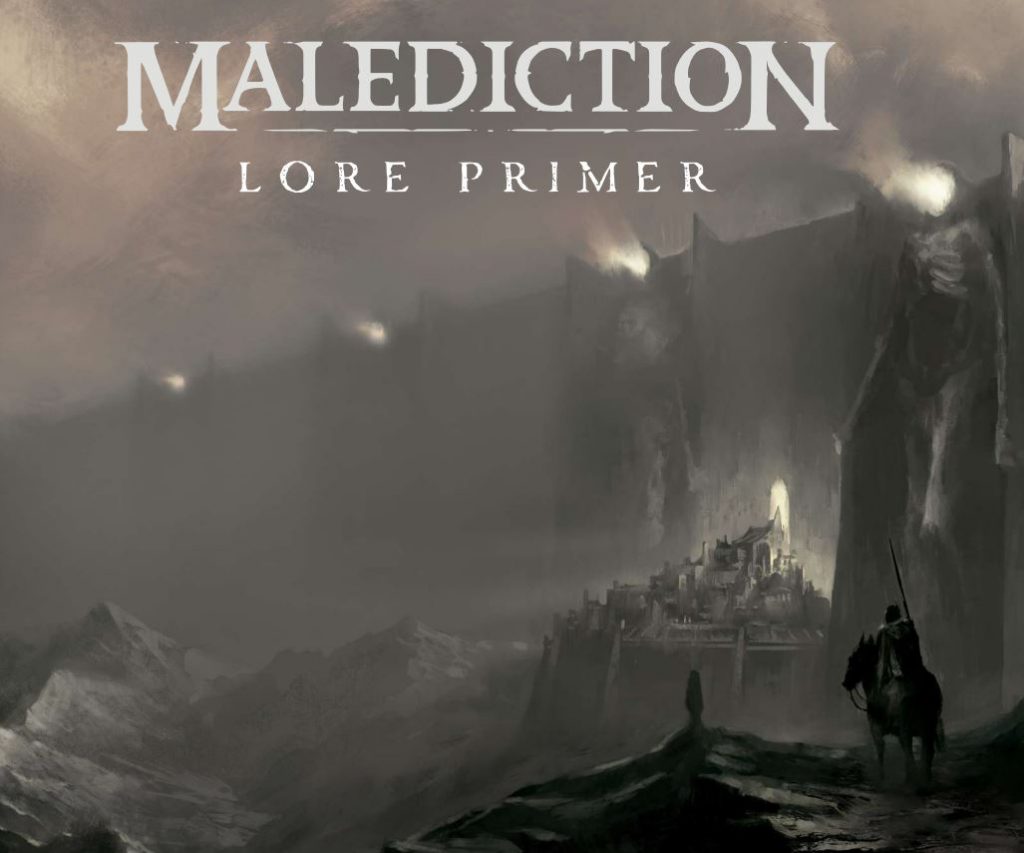 Read More about Malediction from the 38-page Lore Primer on the Malediction website.
Lore
This is a brief summary of the lore using small segments from the website as well as the lore primer. You can read more on the Malediction website which goes into further detail. An exciting aspect of the writing is that the lore was developed by Tracy Hickman, a renowned American author known for the likes of Dragonlance, which is a popular book series and setting for D&D.
Malediction is set in the world of Agnar. This world is relatively young and was created by a Goddess known as Ymiris, who created life on the planet. These First Children were taught how to wield magic by harnessing the power of Ymiris’ soul, and in turn their own souls. They used this power to explore the world and advance civilisation. Until one of them, Myrkos, discovered the intentions of Ymiris; to evaluate the life on Agnar and then enact judgement if they were not adequate.
Myrkos then assembled a council of thirteen of the wisest and powerful amongst them, to which they all came to a grim understanding; they could not allow their fate to be decided by the whim of a God. With that they became the thirteen, and devised a plan to wound Ymiris in an effort to seal her into an eternal slumber. They created a weapon known as the Thorn of Olem that pierced through the physical world into the spiritual heart of Ymiris. In retaliation, the Goddess released a colossal magical storm that the thirteen fought to control. Whilst Olem was torn a sunder around them, they utilised this magic to grant them power unimaginable.
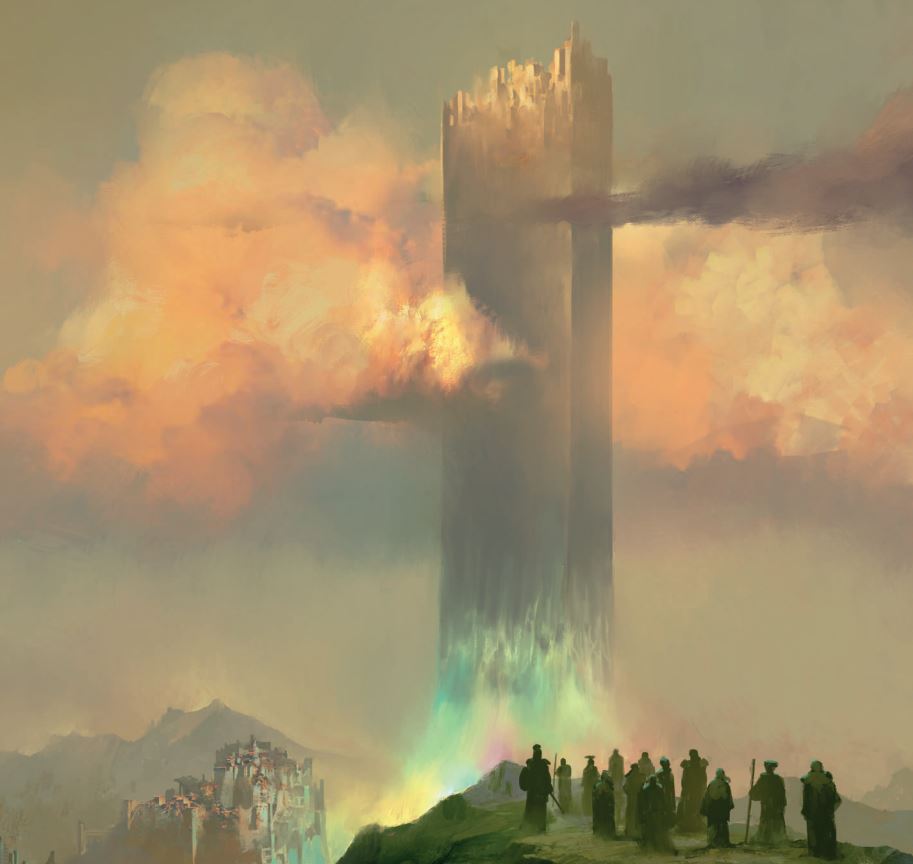 The Thorn of Olem - Malediction Lore Primer
But now, life was subject to the curse of mortality. Only the thirteen could sustain themselves with long life thanks to the storm's magic. Thus they became known as the Everlasting. Over the years the Everlasting would lead the people of Agnar, only for themselves to tear each other apart through infighting. It all ended when the Thorn of Olem was attacked. There are differentiating accounts of what happened on the day of the fall, but the thorn weakened and another surge of magical energy came forth from Ymiris. This storm was fueled by the cries of freedom and desperation to obliterate all life, and thus was born…The Malediction.
Following this came the Age of Strife, a time where magic became unreliable and civilisations were torn down by the anger of Ymiris brought by the Malediction. The Everlasting were gone, either dead or hiding from their shame, and the few survivors forced to fend for themselves. Over centuries many would brave the Malediction to retrieve artifacts lost to the ages that would grant power to restore them to greatness. None would return. Until someone did.
Over time, people would dare to brave the Malediction, finding routes into it to hunt for the treasures cloaked by Ymiris’ wrath. Reality is warped inside the Malediction, your own mind assails you whilst the environment rejects your every move. Only the brave or the insane would delve into the uncertainty. Each faction or nation that remains knows that the Malediction holds the key to their salvation, or in the hands of their enemies, their destruction. And so there is no choice, but to enter, The Malediction.
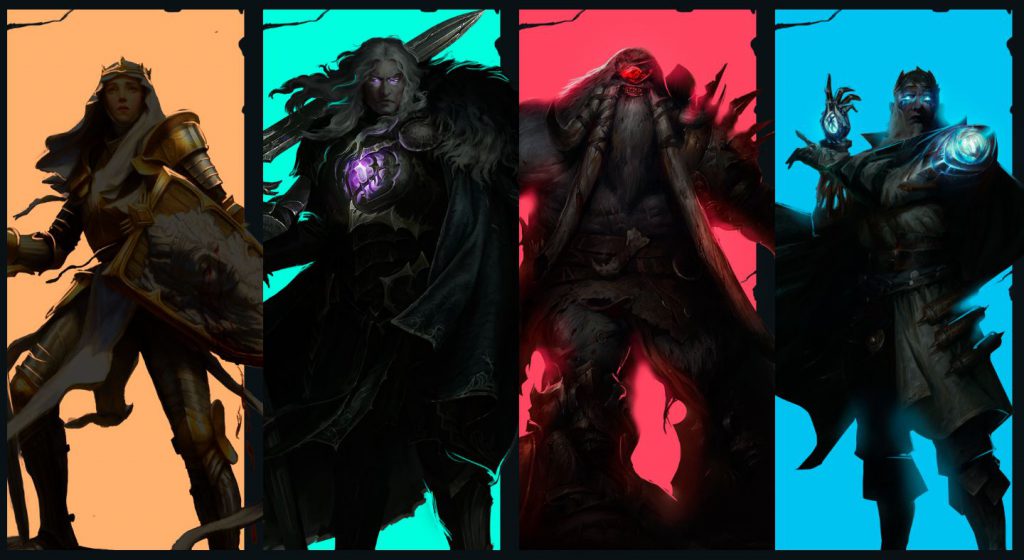 The four main seekers of the four factions in Malediction - Malediction website.
The Four Main Factions
Primal Blood: The story of the Primal Blood is that of honour and tragedy. They follow the teachings of a guilt ridden Everlasting member who felt incredible shame for their part in wounding Ymiris and rallied the people who followed her, the Oerikan, to take on some of the other Everlasting to free Ymiris. They failed, and became second class citizens under tyrannical rule. But one was able to raise a rebellion and lead their people back to their home of Oeri. From there they remained closely connected to Ymiris’ magic, even when it threatened to drive them to madness. The faction is a shadow of what it once was, where an honored fight to free their All-Mother has descended into a primal lust of blood.
Conclave of the Spheres: A faction of magic schools with a monopoly on study of the magic of Agnar. An Everlasting created an artifact called the Oracle which contained a power unlike any other and could set him free from the power of Ymiris. But he would fall during the Everlasting War and become part of the artifact influencing his people, the Erisyr, from the shadows. True power belongs to those who pull the hidden strings of the universe. Liastrum is the magic they wield and those who are adept enough become part of the Conclave, whilst the rest are consumed by the flames. Manipulative mages refuse to get their hands dirty, and instead puppet constructs of flesh and stone to further their growth in the arcane. The Conclave work in the shadows as they pursue the missing spheres.
Order of the Shattered Throne: Three of the Everlasting that led the thirteen formed the Triumvirate to lead the world of Agnar, forming a tyrannical great empire. The Triumvirate believe in absolute control and that the Everlasting must hold dominion over all to prevent cataclysm. However, their empire would come crumbling down during the fall and now lies in ruins within the Malediction. The Order of the Shattered Throne is the successor to this empire, with members of the order holding shards of the throne. One day they would reclaim the capital of Osterath and the Triumvirate can be reborn. The order will mend what was broken, and reclaim what was taken.
Legion of the Fallen: Beginning as a people who sought equality of power and dreamed of removing the curse of death, the Belyos people were struck down by some of the Everlasting known as the Triumvirate. They saw the Belyos people’s ideals to remove the control the Everlasting had as dangerous, if no restraints were placed on mortals by the Everlasting this could spell further doom. Thus their great floating city of Abysola was wiped out. But a new one rose from their corpse. The leader of the Belyos stricken by grief used a magic that could vanquish the curse of death on the murdered kingdom to lead them against the Triumvirate. But this magic was limited, thus she sacrificed herself to become a wellspring of this magic and judged all rulers of the people of the Legion so that none ruled for themselves. Death is far from the end, and the dead now serve the living.
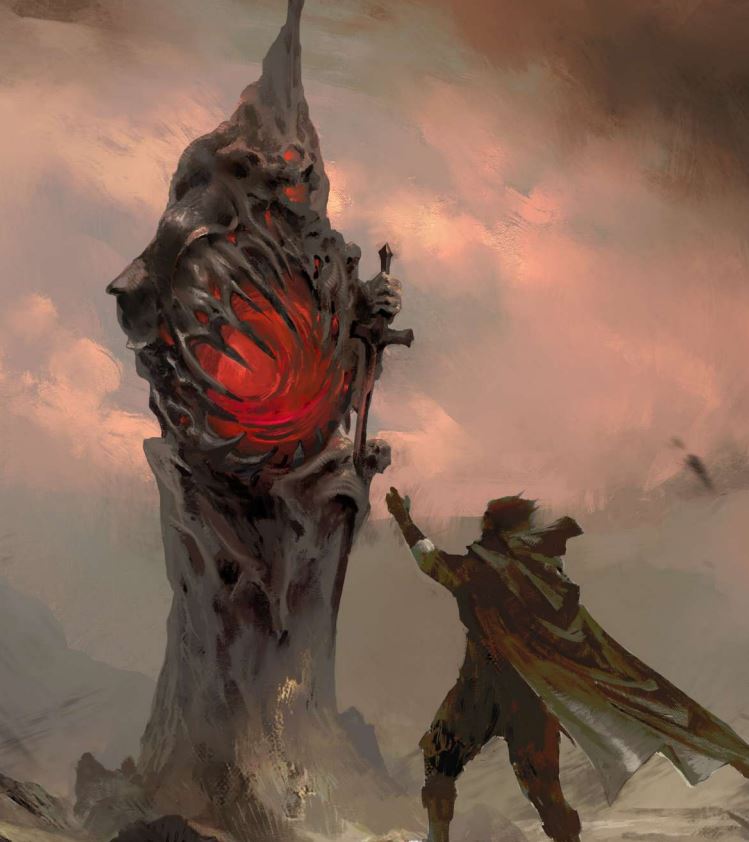 Artwork of a Husk - Malediction Lore Primer
The Game - Objective
The game revolves around a Seeker who delves into the Malediction to seek out Relics of great power lost to the storm. With them comes some of their faction, and together they may bend the magic of the Malediction to claim victory against the rival factions also vying for the Relics.
In Malediction, the aim of the game is to achieve 40 Mastery, or 25 in a tutorial/demo version of the game. You earn Mastery through collecting Husks or by eliminating Units. Husks provide you with 10 mastery and a Relic card, whilst each unit is worth Mastery equal to the cost of playing them. If at the end of a round you have the
required Mastery, then you win.
Husks are like objective markers on the battlefield that can be claimed by a model. When a Husk is claimed it is removed from the field and the model which claimed it gains a Relic. If the model is killed it then drops the Husk for others to claim.
Relics are powerful attachments that can turn the tide of any game. At the beginning of the game you shuffle the Relic deck and draw four Relics. Whenever a model claims a Husk, they can pick one of these four Relics to attach to that model, or a random one from the deck.
I have three favourites; the first is the Fang of the Damned, which allows you to perform a free attack at the cost of some health but if you hit you heal. It works quite nicely with the duelist Seeker of the Legion of the Fallen Vorendal. The Everlasting Heart is a relic that boosts health, gives regeneration, and if the unit it is attached to is not a Seeker it then returns to your hand rather than the discard pile. I like it as I love the rare unit cards you only get one of, and I want to play with them more rather than losing them too soon. The Ring of Time is my third favourite. Spells are a big deal in game, but they are an even bigger deal when you get to play them from your discard pile for free with this card. There is a whole deck of relics to discover your own favourite.
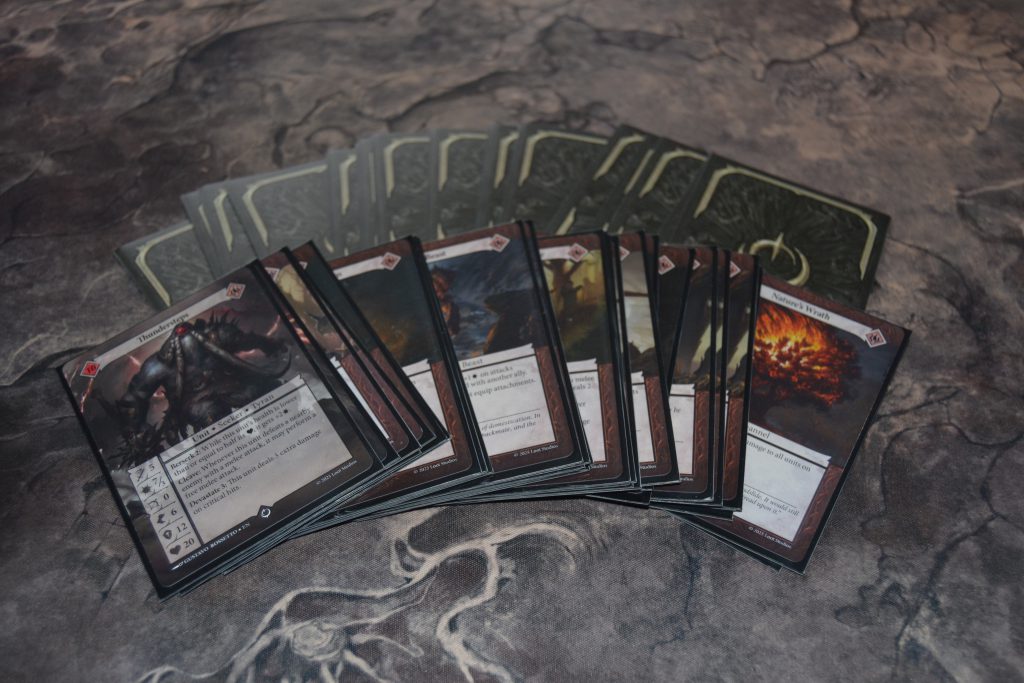 Cards and Sleeves from Malediction
Cards - Design & Deck Building
In some tabletop games you need to create an army list, or a warband. In Malediction you create a deck of cards that contain spells, units, and attachments to improve said units. Deck building will be crucial for achieving your desired playstyle within the game of Malediction.
The design of Unit cards is what makes Malediction so unique. Each card is broken down into statistics that make up who they are. Following this they will have some abilities that enhance these stats. The stats are: Accuracy for how capable you are at hitting your target, Power for how much damage you can do, Range for how far you can attack, Speed for how far you can move, Defense for how hard it is to hit you, and finally Max Health for how much damage it would take to defeat your Unit.
There is a fun aspect to Power from this list. It has two values. This is because the game uses a varying damage dynamic depending on how well you hit the target. If you hit the target you do the larger value, if you miss you do the lower value. On a natural 1 you do one damage only, on a natural 20 you deal both the larger and smaller values combined. No matter what you roll, you will be doing damage.
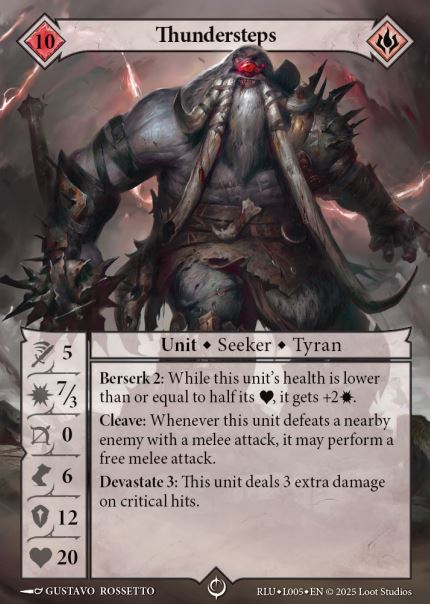 Thundersteps Seeker Card
When you play Malediction, you need both Miniatures and Cards. Cards are made up of three different types of cards; Units, Spells, and Attachments. Units will create your miniatures for the tabletop, Attachments are equipment the Units can upgrade themselves with, and Spells are magic being utilised in the fray. In addition to these cards will be your Seeker and their Legacy which is like your leader for your force and special artifact that influences your playstyle.
Before a game, you will assemble a deck that you will play with. You first pick a Seeker, and then their Legacy. Unlike other Units in the game, once a Seeker is defeated you can bring them back, although they do cost a lot of resources so it may not be the best idea. A Legacy can change the playstyle of your force since it can affect everything you play. Consider the Legacy like a faction ability or rule that can change based on who you bring to lead the force. They also tell you how much Echo you start with, which is spent to summon Units or cast spells.
Some Seekers are dual faction, which means you can pull cards from both factions when assembling a deck. Further to this, some cards are dual faction and can only be taken by a Seeker with the same dual faction. At the moment there is one for each faction in the faction boxes giving you a different spin on your force.
Spells come in two different types, Swift which can be done at any time and any number of Swift spells can be played per activation, then there is Channel which can only be done once per activation as well as having some limitations on when it can be used. I expect decks to be about 45% Units, and then 45% Spells, with some room for an attachment or two. Spells are just as impactful as Units.
Attachments also come in two, Items and Relics. Relics are items gained from requiring Husks in game, the rest are built into your deck when you assemble it. When you spend Echo for a Unit you can spend the Echo to attach an Attachment card to that Unit, but you can only have one attachment of each. So you cannot have multiple items or relics. Relics can massively impact the game, whereas Attachments can upgrade an aspect of a Unit giving a creative spin on what it would otherwise be able to do.
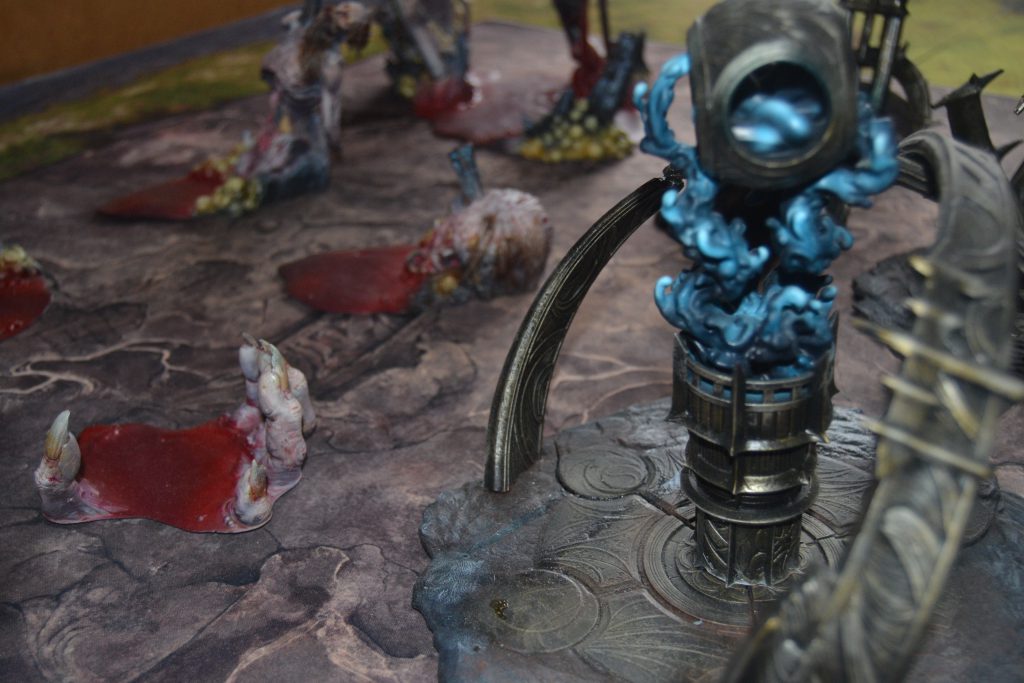 Terrain of Malediction - Picture by Carly
The Board - Setting Up the Game
Now that you have assembled your deck and know what you need to do to win, you need to set up the battlefield you will be playing on. This means setting up terrain. On a 30 by 30 inch table you will be setting up terrain pieces based on your chosen terrain card. Each faction box comes with a terrain card but they are not locked to a specific faction. Terrain cards come with abilities that the terrain has like extra movement, and the terrain themselves can block line of sight whilst creating an obstacle to get around.
Following this you will place four Husks one at a time and alternating between players. These cannot be in deployment zones and must be a minimum distance from one another according to the rules of the game size. So in a standard game they would be at least 10 inches from each other.
Then you figure out who goes first. In most games this is a roll off but not in Malediction, it is a through a bid. Each player picks a card in their hand and the associated cost is how much they are bidding. The winner gets the initiative token and gets to decide the order of operation for things like who deploys first in a turn or goes first in a turn. Sometimes you may not bid at all as the initiative is not important, sometimes you may spend an expensive card because you need the initiative at an opportune moment. Whatever card you pick, it is then gone so pick wisely. In the place of ties it does go back to a boring dice roll so don’t you dare tie!
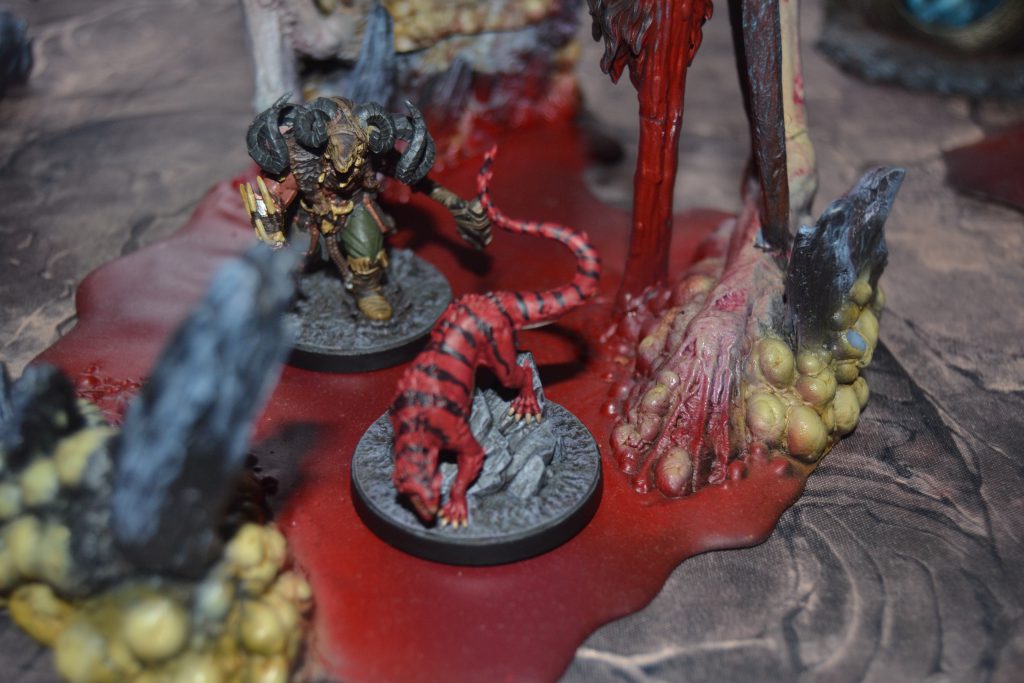 Cabra Mauler and a Taurok Beast in action - Picture by Carly
Turn Sequence
Each round is split into four phases; Refresh, Deploy, Action, and End. In the refresh phase you gain Echo which is your currency, refresh your Units, draw cards, and bid for the initiative. In the Deploy phase, the player with the initiative bid decides who deploys their units first. At the beginning of the game this can only be in the deployment zone which is one of the corners of the table, but later turns you can deploy within an inch of an unengaged friendly Unit on the table. So going first will give you more places to position, but going second would allow you to react to the deployed Units.
In the Action phase, players take turns activating their Units. Each Unit has 2 Action Points they can spend on a number of different actions. These can be basic actions like moving or attacking, or some niche actions like charging or shifting. Some Units have actions on their cards unique to them and with their own cost. There are quite a few basic actions in the game that make positioning very important.
The charge action costs 2 Action Points but allows you to make a move twice your movement value towards an enemy and then make an attack against them. This doesn’t need to be a straight line, but you do need to make a line of sight line then make sure that is not broken in your move. The shift action costs 2 Action Points but it allows you to move a Unit through a space it wouldn’t normally be allowed to fit through due to the size of its base. This makes blocking not always a guarantee however you won’t have enough action points to make use of the shift unless you have a way to activate again, and there are ways to do this in the game.
After these phases are done it is then the End phase. This is where you claim Husks, gain Relic cards, and check for victory. The game is quite simple and has a lot of basic rules, but they require precision to master. The true depth and complexity comes in the deck building, and then executing the plan you have designed on the tabletop. All the flavour is in what you bring to the tabletop and how you use it.
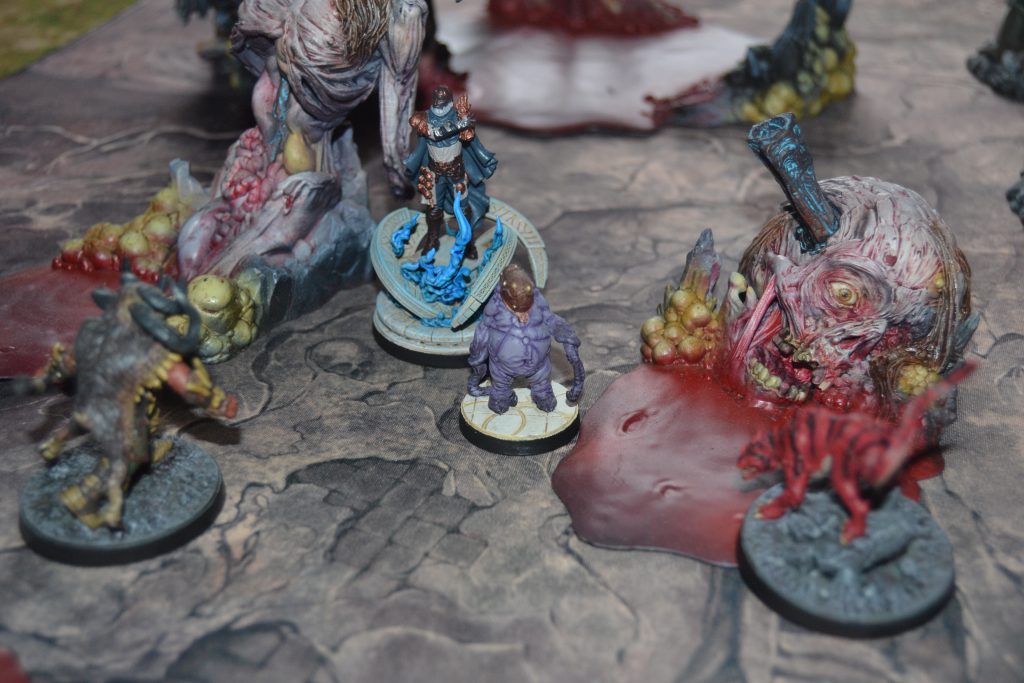 Conclave vs Primal Blood - Picture by Carly
How It Feels to Play
If I would describe the best moments of a tabletop game, it would always be those moments where you beat the odds and created an epic memory to share with your friends. I have memories of a melta pistol in 40k destroying a ork dreadnought as it was charging in, or where one lone warrior survived the full might of an army in ASOIAF on pure luck alone. In Malediction there is that same vibe when you roll just what you need or even a natural 20. Loot Studios came from roleplaying games and understanding how incredible a natural 20 moment can be.
One moment that has stuck with me was when Thundersteps from the Primal Blood hit Vorendal from the Legion of the Fallen doing an incredible amount of damage on a natural 20. But I had a rule at the time which meant that I would push him back the same amount as the damage. Normally this would be a few inches, but at this moment it was 15 inches. The undead duelist ragdolled across the table. This was so funny and will remain a strong memory in the game.
The length of the game can vary depending on size and playstyle. Some games can be quick if you go for a mash in the middle, especially in the smaller version of the game. But there can be games where a lot of strategy is being thought about creating some cagey gameplay. It is a varied experience but one which changes due to so many factors.
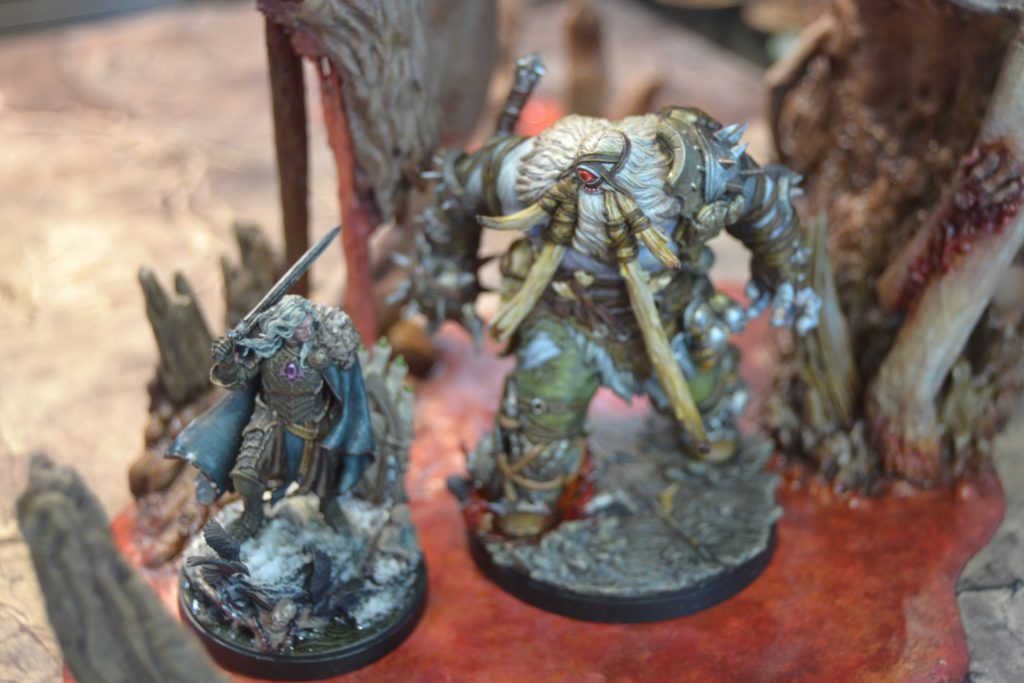 Vorrendal vs Thundersteps - Picture by Carly
Some games may say they have distinct styles of play but then always fall into who can kill the other player first. While that can certainly be a strategy in this game, there are some forces that are just not going to roll over to this play. Order of the Shattered Throne has lots of control mechanics alongside healing, whilst the Conclave of the Spheres has lots of magic shenanigans and tough constructs to chew through. The dual faction Seekers then change this up with the Primal Blood character not being about damage and speed but bringing a shaman twist to the faction. Order of the Shattered Throne goes from a healing paladin, to a smithy designed around adding attachment cards everywhere. All of this is just from the release of the game, not to mention the future releases coming down the line that will shake this up further.
One aspect I appreciate is that the cards feel like how the lore is written. It may seem like an obvious take but it is remarkable how often rules are written that don’t reflect the model on the table. As an example, Thundersteps, the Seeker for Primal Blood, is like the Godzilla of Malediction. He isn’t a leader, more of a force of nature that devastated everything in his wake, and the rest of the faction follows the trail of destruction taking advantage of what is left behind by this giant. He is big, tough, and hits hard, which represents his tremendous power and terrifying legend. If Thundersteps couldn’t take a hit from a foot soldier, or couldn’t squish a flesh construct, then it wouldn’t be right. Each card has been crafted to have a good feel of play.
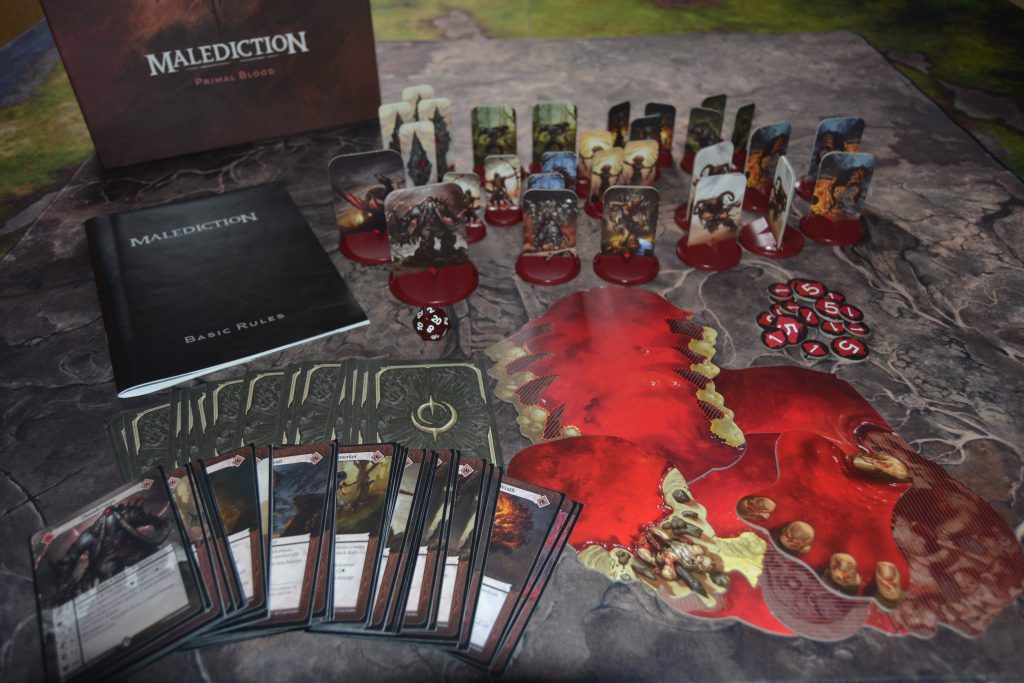 Rulebook, Standees, Die, Cards, Cardboard Terrain, tokens, and a Code for 3D minis - Contents of a Faction Box
How to Get Into the Game
Those who did not back the game at the crowdfunding stage may be lucky enough to pick up the game at one of the many events from around the world. But if you weren’t able to attend one of these gaming conventions, you can pick up the boxes from the Malediction website. Your local gaming store may also be stocking Malediction soon.
To get into the game all you need is a deck box. This comes with the cards for the Seeker and faction you picked as well as a D20 matching the faction, and a code to get the STLs for printing your miniatures. You can obtain a Two Player Starter box which comes with all the game aids you need, as well as cardboard standees so you can play the game straight out of the box. The single faction boxes don’t look to be sold on the website at the moment but these may be at conventions or even at your local store.
One thing to note is that the miniatures would require a 3D printer to be able to use, however they are also being sold in miniature packs on the Malediction website for those who may not have access to a 3D printer. But one deck box and standee kit would be all you would need to play, or if you have a friend who may be interested then grab a two player set which would have enough for you both to wield a faction each straight out of the box.
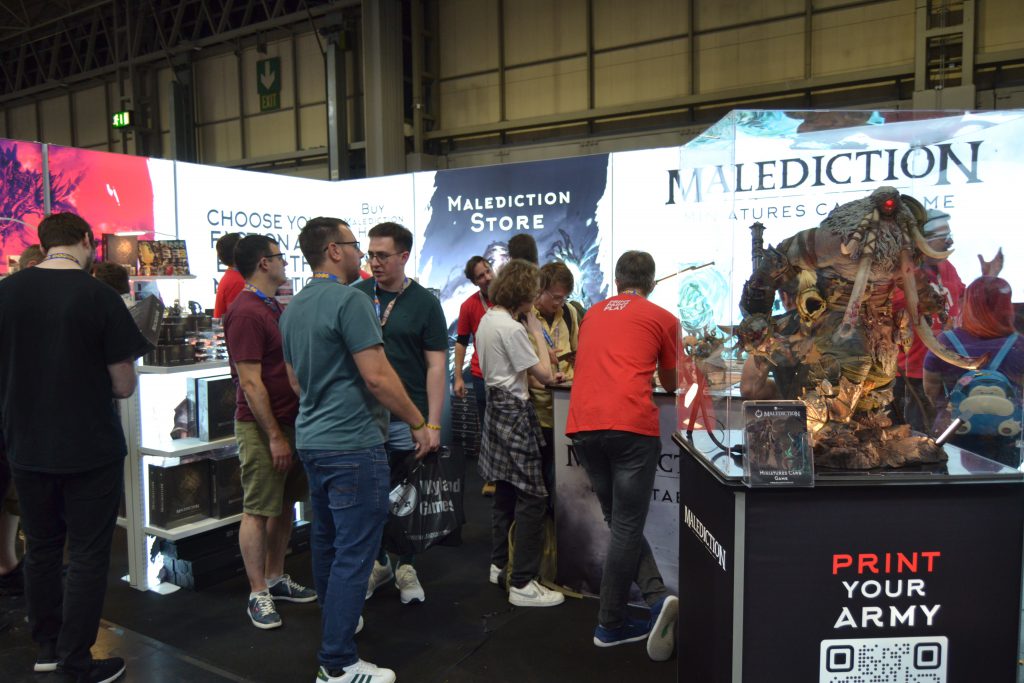 Malediction at the UKGE 2025 - Picture by Carly
Events & Community
The tabletop industry has a lot of miniature games that come and go over the years. Those that stick around are those that cultivate a community or have community champions that help cultivate it. The community is crucial to get right for a miniatures game, as without it you would not have an easily accessible game from players to get into in the early stages of the games lifespan.
Loot Studios are working hard to make sure the community has everything it needs to grow. They have a Tabletop Simulator mod that is supported by their team with updates, so you can play online with your friends. They also have the Herald program where they support event organisers from around the globe as they set up demo days, and competitions to get people playing the game. Further to this, they have an awesome discord with players sharing their strategies and paint jobs about the game, with constant community manager engagement. The team really are putting their all into prioritising the player, which aligns with their goal that they laid out from the beginning.
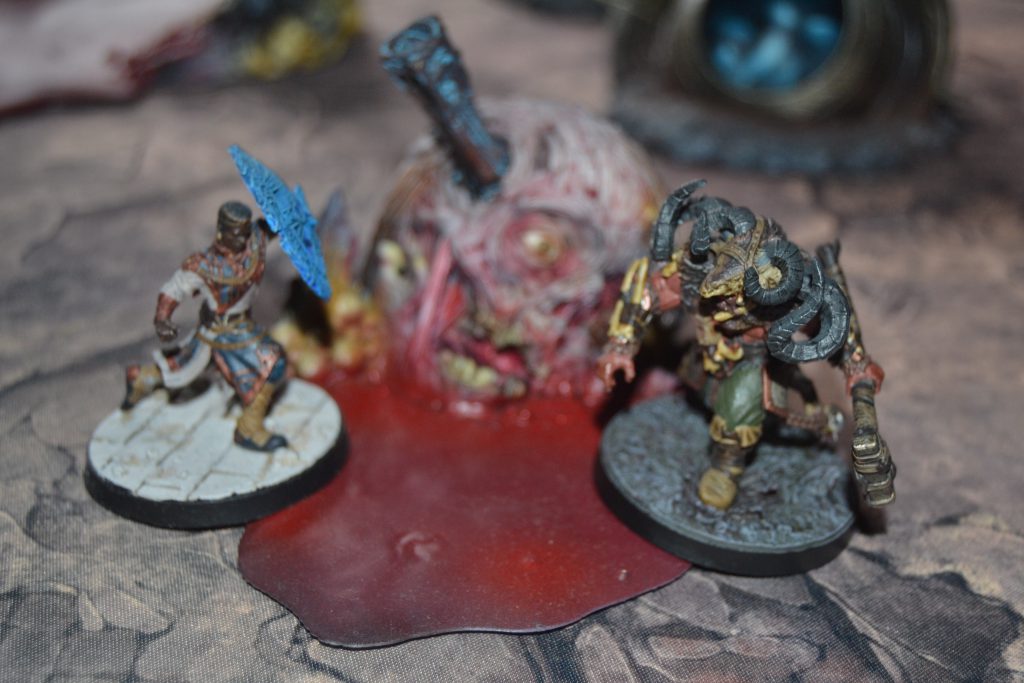 Akhenzan Shieldmage vs Cabra Mauler - Picture by Carly
Final Thoughts
Within gaming in general, and not just tabletop gaming, companies have been acting more predatory to their audience. We’re in the realm of micro transactions for wacky aesthetics that don’t fit into the world of the game the creators are making, and that have quite likely been made by a robot rather than a human. Or there are new releases with amazing rules to manipulate you into buying more. It is refreshing to have a studio dedicate their focus on the players and not on the player’s pocket, and this is proven with the game of Malediction.
It has a strong foundation of basic rules that are then enhanced by the depth of deck building when you devise a strategy around your playstyle. You decide how you want to play and you are rewarded for being creative. You then top this off with incredible miniatures that can be obtained from the comfort of your own home if you have a 3D printer (something a lot more people are getting their hands on each and every year) but new miniature kits are on the way. The game not only feels good but looks good.
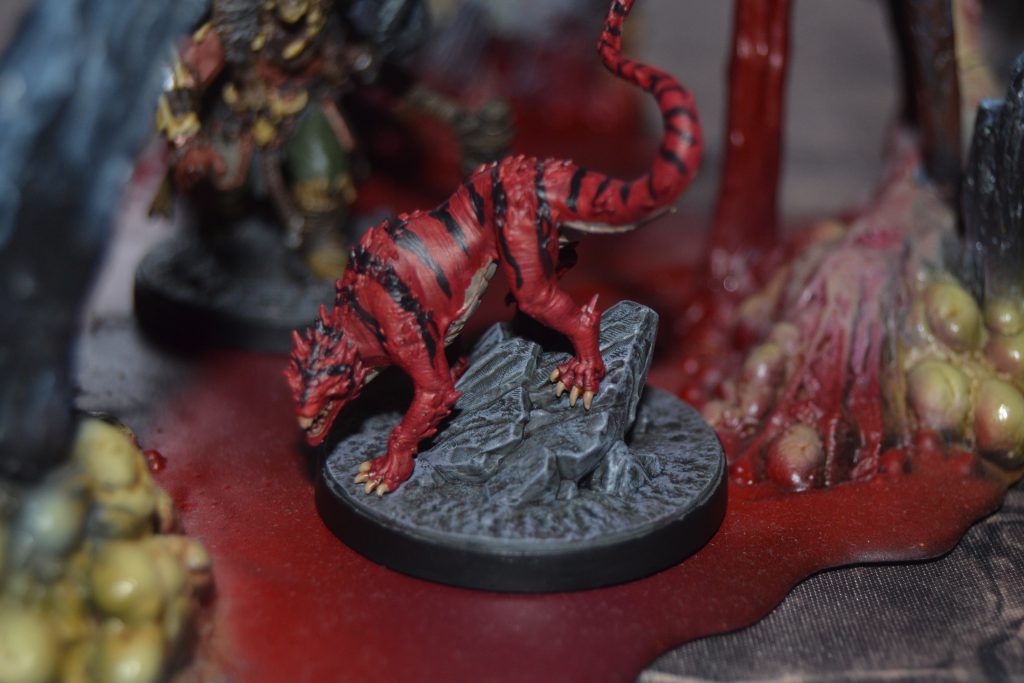 Taurok Beast - Picture by Carly
The game is very accessible with the TTS module, and the community management team helping the player base through event support. Miniature games need strong guidance and cultivation in the community and since Loot Studios has the player as their priority they have already laid the groundwork to support the players. The Herald program is a good sign that the company is serious about investing in the players and not taking them for granted. The Herald program is to help those community champions who want to help their community enjoy Malediction.
Ultimately, the best thing about Malediction is that it is memorable. The amount of heightened emotions I have experienced or witnessed with the game being played has brought a sense of nostalgia for when I first got into miniature wargaming. One model, one dice roll, can change it all. That tense interaction sparks a flood of adrenaline that is hard to forget, especially when it is a crazy moment like a seeker getting flung across the battlefield.
I cannot recommend this game enough, and I cannot wait to see what is to come in the future when we dare to delve further into the Malediction.
Have any questions or feedback? Drop us a note in the comments below or email us at contact@goonhammer.com. Want articles like this linked in your inbox every Monday morning? Sign up for our newsletter. And don't forget that you can support us on Patreon for backer rewards like early video content, Administratum access, an ad-free experience on our website, and subscriber-only content covering competitive Warhammer 40K!Thank you for being a friend.
 This website uses cookies. Learn more.


 Goonhammer App and Patron Updates: April, 2026
 Kill Team Tournament Report: Engage, Party, Repeat's March Madness 2026
 Goonhammer Reviews: Tribal Conquest