Our next pair of Battletomes are here, and this time it’s an arcane double header. The Lumineth Realm-Lords, erstwhile Aelven scholars, arrive alongside their magical rivals the Disciples of Tzeentch - check out our review for that one elsewhere on the site. Lumineth has remained a popular army among elf fans in the fourth edition of AoS, but it’s fair to say that the launch faction pack rules stripped the army of a bit of its personality, or at least its variety. With a thorough rework in this book though, they’re looking more magical than ever.
We’d like to thank Games Workshop for providing us with a review copy of this Battletome. We have also been provided with a provisional Battle Profile list for the army to use when writing the review, but please note that any points referenced in this review are subject to change until they are published on Warhammer Community.
The Army
Battle Traits
It’s a full rewrite here, and the Lumineth now have just one battle trait:
Depict Rune. Don’t be tricked into thinking the army has been simplified though, this single trait is a full page of the Battletome.
At the start of every battle round, a Lumineth player chooses one of five runes to
depict on their
battle scripture. There’s a lot of variation here, but broadly they each have an active effect that takes effect when the rune is depicted, with bonus effects dependent on which other runes are also present on your scripture. The book handily includes a template for the battle scripture, which could be photocopied, but I struggle to think of a battle trait that could make producers of laser cut/3d printed gaming aids rub their hands together with glee more than this one so you'll probably be well-served with plastic options not long after release.
Let’s cover the runes in more detail. It’s a complex landscape, so to avoid repetition a couple of things apply to all of these: they only affect Lumineth Realm-Lords units, and the effects last for the whole battle round. The runes each remain on your battle scripture for the rest of the battle, unless they are removed or replaced by another ability (more on that later). Bring on the runes.
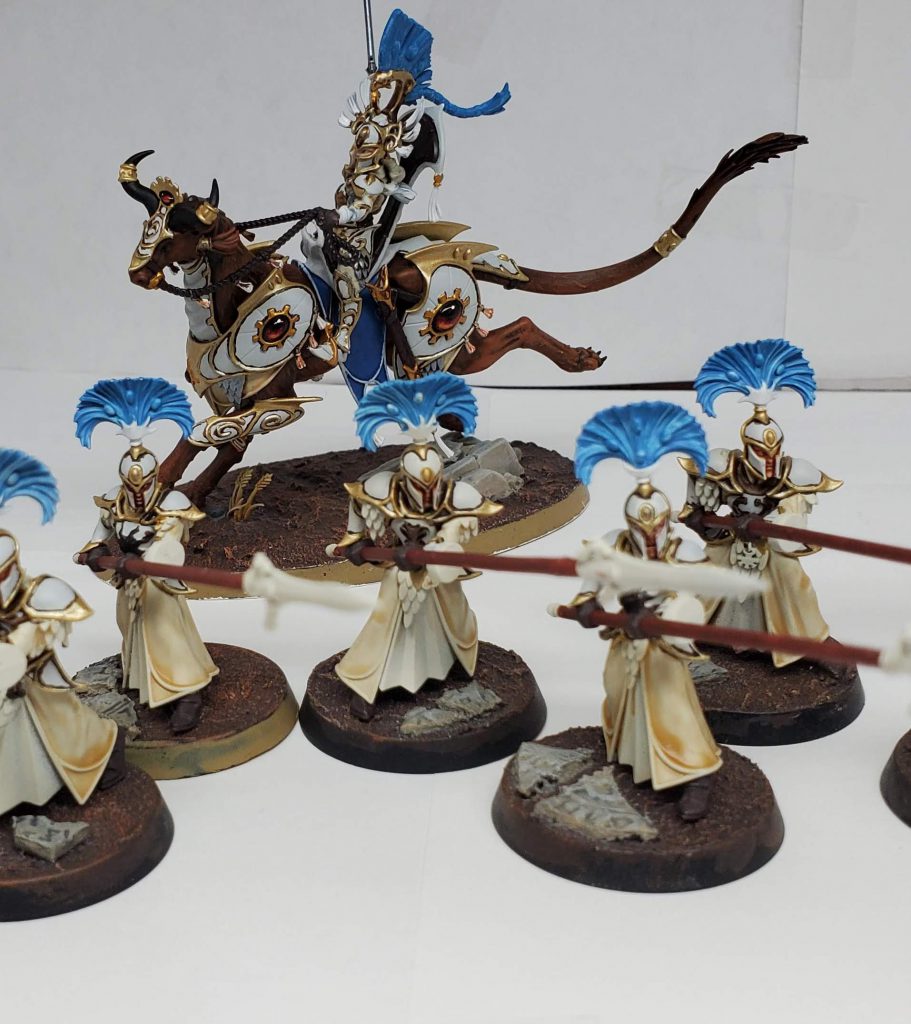 Vanari Lord Regent and Wardens Credit: Joshua Saunders
Varinor, Rune of Strength
Pick up to two units per instance of this rune depicted on your scripture, which each get +1 to run and charge rolls.
Enhanced Effects:
- +1 to wound rolls for the target's combat attacks while Ydriliqi, Rune of the River is also depicted.
- While Oreali, Rune of the Wind is depicted, target units can shoot and/or charge even if they used a RETREAT ability in the same turn.
Situationally very useful, allowing your combat units to reposition or that big block of Sentinels to escape the unit that has tied them up. Varinor also unlocks some excellent enhanced effects in other runes, so it’s one I expect will pop up on most battle scriptures.
Alaithi, Rune of the Mountain
Pick up to two units per instance of this rune depicted; each target gets
Ward (5+).
Enhanced Effects:
- While Varinor, Rune of Strength is depicted, targets’ melee weapons also gain Anti-Charge (+1 Rend).
- While Ydriliqi, Rune of the River is depicted, enemy units in combat with the targets take a -1 penalty to wound rolls.
This one is easy to see the value of, especially when it has been depicted multiple times and your whole army is getting a ward. The core effect lets you protect key units much more flexibly than a spell aura would, and the enhanced effects can turn your front line into a real bulwark.
Ydriliqi, Rune of the River
Pick up to two units per instance of this rune depicted; enemy units are -2 to charge rolls while within 12” of a target.
Enhanced Effects:
- Targets ignore negative modifiers to hit and wound rolls for all attacks while Alaithi, Rune of the Mountain is depicted.
- If Oreali, Rune of the Wind is depicted then each target can immediately move up to 3”. This move can pass through the combat ranges of enemy units and units can end that move in combat (or leave combat with it).
This is a standout. The -2 to charge rolls is a great turn 1 defence against armies that want to deep strike or rush forward and make long bomb charges, but it really sings with the enhanced effects. Alaithi unlocks ignoring all negative hit and wound modifiers, which includes the -1 that Sentinels would take to hit from either firing lofted shots, or from making a Covering Fire attack. The move is situational, but out of phase movement is always welcome.
Oreali, Rune of the Wind
Pick up to two units per instance of this rune depicted; each hands out a -1 to hit debuff to enemy units while they are in combat with them.
Enhanced Effects:
- While Varinor, Rune of Strength is depicted, add 4” to each target’s move characteristic.
- While Alaithi, Rune of the Mountain is depicted, add 5 to each target’s control score.
It’s easy to see how this would make Hurakan units a true pain to tie down, with Spirits of the Wind able to flip underprotected objectives from a huge distance away with that extra move and control score. This will be a great late game rune, when every bit of extra positioning and objective control counts.
Thalari, Rune of the Zenith
Add 2 to casting rules for all friendly Lumineth units.
Enhanced Effects:
- If you have four or more unique runes depicted on your battle scripture, all friendly Lumineth units get +4” movement and score crit on unmodified 5+s.
This feels like the big “go turn” enabler, if you can get there. The only problem being that it needs 4 different runes (including itself) to be present, so it’s potentially arriving too late in the day. Still, the base effect of +2 to cast is pretty handy. This is now Lumineth’s only route to critting on 5’s, so it does feel like it’ll make a big impact.
Overall, it’s easy to see that all of these runes are going to have a place and get used. I do worry that there are going to be some established patterns for different list archetypes, but ultimately the flexibility is there to adapt to your or your opponent’s playstyle and board position. Later in this review we’ll look at some other ways the army can interact with this mechanic, too.
Battle Formations
Four options here, all with quite different effects.
Warhost of Duality (Strike as One): This resurrects Lumineth’s traditional “fight with 2 units in a row” feature. Without picking this formation, you’re back to fighting one at a time, as Sigmar intended.
Aelementor Guardians (Ancient Spirits): Every hero phase, pick a Lumineth
MONSTER, and it gives a 12” aura of ignoring the first damage point for every unit in each phase. This is a huge efficiency boost, especially with Wardens and Sentinels being 1 health units. Downside, if you don’t have a monster, or it dies, then this is useless.
Pilgrims of Haixiah (Trick of the Light): Friendly Lumineth units can use the
Power Through command even if they have not charged this turn. Makes your cavalry and wind spirits a living nightmare to deal with.
Scinari Council (Arcane Focus): Spells from the Lore of Hysh and Lore of Awakened Realms get the
UNLIMITED keyword, with the limitation that you can’t target the same unit with the same spell twice in the same turn. Great flexibility for wizard-dense lists.
These all have a place, and depending on your list choices and play style, any one of these could add an extra dimension. I expect to see Aelementor Guardians a lot in Teclis lists, taking advantage of his huge base and the general desire to cluster an army around him. Pilgrims of Haixiah feels like it might be the most meta choice, especially if you're going heavy on Hurakan spirits who have enough wounds to beat out most things other than monsters. Warhost of Duality is great for forcing engagements in your favour. It’s worth pointing out that unusually for a Battletome two of the options here already cost points, which maybe gives you a hint as to where the designers think the power lies, with Pilgrims of Haixiah costing 20 points and Aelementor Guardians costing 10.
Artefacts of Power
Three choices here, all of which make a return from the faction pack:
- The Phoenix Stone is back, giving the bearer a 3+ chance to stay alive the first time it would be destroyed. Useful for key heroes, but investing in artefacts that require a dice roll remains a gamble. It does now Heal (D3) rather than Heal (1), a minor improvement.
- Silver Wand gives a non-wizard hero an unbind, or otherwise gives a wizard hero +1 to casting rolls. There are other sources of bonuses to cast in the army, but when it comes to casting rolls bigger is better. Arguably this was better in the faction pack, where it added 1 to a wizard’s power level. It’s back to costing 0 points though, so that’s something.
- The Waystone remains the same as the faction pack, giving the bearer a teleport instead of their normal move if they so desire. It’s lost the CORE keyword, so you can now do a move/run/retreat before using it if you want to for some incredibly specific reason.
Nothing here sets the world on fire, but that’s OK. The Waystone is great for grabbing objectives and battle tactics late game and I imagine that might get picked most often, but they all have their place in lists.
Heroic Traits
Lumineth retain access to the
Aspects of Enlightenment traits from Scourge of Ghyran:
Aetherquartz Requisitioner,
Flawless Commander,
and Martial Perfectionist. The Battletome reworks the faction pack’s Lords of Brilliance traits, which are now called
Facets of Brilliance.
- Masterful Tactician remains as it was - if a friendly Lumineth unit wholly within 12” of the hero rolls a 1-3 for a Redeploy, they count it as a 4 instead. This remains useful wherever it pops up, making the investment of a command point much less risky.
- Acolyte of the Runes has you pick a friendly hero within 12” at the start of each battle round, and that hero can then be chosen as an additional target when you depict your next rune. This helps with more efficiency early game, or when you are trying to vary your runes and so aren’t growing the number of units you can select each time.
- Flawless Commander has you pick 3 visible Lumineth units wholly within 18” in the Deployment phase, and each gets to make a pre-game Normal Move. Powerful for shuffling your line forwards and grabbing some early objectives.
Have you spotted the issue yet? That’s right, for some reason both sets of available traits have one called Flawless Commander. Expect confusion when submitting lists to events. If I had to guess on the reasoning for this, perhaps the Battletome version is (or was, originally) a rework of the Scourge of Ghyran rule that is popular - SoG is valid for the 25-26 General’s Handbook, so maybe is the first time we’re seeing something that has been tested in that and then implemented in a modified form for a tome release. That’s 100% speculation on my part though, and either way it’ll stay confusing for a few months before any new season happens.
Spell Lores
Lumineth Realm-Lords armies have access to two spell lores in this Battletome, alongside the
Lore of Prismatic Resonance from Scourge of Ghyran.
Lore of Hysh
It’s back, and modified from its faction pack iteration.
- Overwhelming Heat (7) - This one is the same, halve the move characteristic of a target unit within 18”. Then roll a dice, equal or beat their save value, and do D3 mortal damage.
- Piercing Refraction (7) - This is a simple horde clearer. Pick an enemy unit within 18”, roll a dice per model, each 5+ does a mortal damage.
- Beacon of Hysh (6) - Targets a friendly non-monster Lumineth unit wholly within 12”. Until the start of your next turn, hit rolls of 1-3 always fail against the target. A real boost in survivability for your anvil units.
This lore is great, and all 3 spells are useful. Beacon of Hysh is great for creating unfavourable engagements for your opponent, especially when layered with the wards and other defensive buffs available from your battle scripture.
Lore of the Awakened Realms
This one’s new, although one spell is familiar.
- Focused Erosion (6) - Subtracts a point of rend from a target enemy unit’s weapons until the start of your next turn. Always useful, especially with high-rend hammer units remaining popular.
- Elemental Push (6) - Pick a friendly unit wholly within 12”, move them 5”. They cannot end in combat. If they start in combat, there’s a -1 penalty to cast this spell. Still, it’s a free retreat in the hero phase, freeing a key unit up to shoot, move elsewhere, or charge back in.
- Realmshield (7) - A wholly within 12” 5+ ward bubble, they’ve rebadged Protection of Hysh. Always useful, and makes you slightly less reliant on choosing Alaithi in turn 1.
These are all useful toolbox additions, and there are strong arguments for any of the three lores being chosen for your army. It’s possible to have your cake and eat it too though, depending on your army construction - more on that soon.
Manifestations
The Manifestations of Hysh have had a bit of a shakeup, with some changed functions from the faction pack.
- The Hyshian Twinstones now cast on a 6+ and have reverted to their 2nd edition form, building up a reservoir of arcane power for each friendly or enemy spell cast within 12”. Once per turn, a Lumineth wizard within 3” of the spell can add those charge points to a casting or unbinding roll. Also, it’s predatory now, and while its attack profile is nothing to shout about that does at least mean it can keep up with your wizards (almost - it's move is 5" for some reason).
- The Rune of Petrification has its setup range shortened to 12”, and still casts on a 7+. Effect wise, it’s the same as before - roll a D3 for every enemy within 6”, on a 2+ it does that much mortal damage, and if it’s 3 then the unit also has strike-last. This remains an excellent control piece, although the shorter range hurts a little.
- The Sanctum of Amyntok has a slight wording change - the spell now targets a hero wholly within 12” and is set up around them. Functionally this gives a slightly extended range as the spell no longer needs to be kept wholly within 12”, but it’s marginal. It’s also casting on a 7+ now, a huge increase from the 4+ of the faction pack. It’s worth it though, as while a hero with 10 or less health is wholly inside the ring they are not visible to enemy units, and enemy abilities that would target the hero have to target the manifestation instead. Your own personal piece of obscuring terrain, except better. The restriction that dispels the spell if the hero moves is also gone, meaning a hero can move out and a new one can move in if needed. If you want an indicator of how good this is, Sevireth’s base will fit inside the sanctum, so he can shoot from it with impunity, or hop in and out of it over your turn for extra protection.
Overall, the manifestations feel slightly more impactful than they did previously, so I expect to see them taken a lot, even if mainly for the Rune.
Warscrolls
Named Characters
Let’s start with the big dog (cat?),
Archmage Teclis. First off, he’s back to a 4+ save! Praise the gods. He retains his built in 5+ ward, and is still a flying Wizard (4). A couple of minor changes to his weapon profiles, his ranged shot now does D3+3 damage instead of D6, a welcome change. Celennar’s talons also gain an extra point of damage, making him slightly fightier. On the warscroll abilities, there are some more significant changes.
Storm of Searing White Light effectively stays, renamed to
The Light of Truth, and now inflicts a D3 of mortal damage on each target without the risk of rolling a 1 and having no effect. Celennar’s aura also stays, now adding +1 to both casting and banishment rolls for nearby friendly wizards. This rule also expands to specify that Teclis can cast spells from the Lore of Hysh, Lore of the Awakened Realms, and any other Lumineth wizards on the battlefield, meaning that he has access to a huge range of options.
In return, Teclis’ guaranteed casts of 10 and unbinds of 8 are gone. Instead, once per turn the
Archmage ability lets you choose one of two effects: either an unmodifiable value of 12 for the next spell cast, or the draining of one power level (to a minimum of 0) for an enemy wizard or priest nearby. This is very powerful, letting you shut down or limit your enemies’ buffing/debuffing potential.
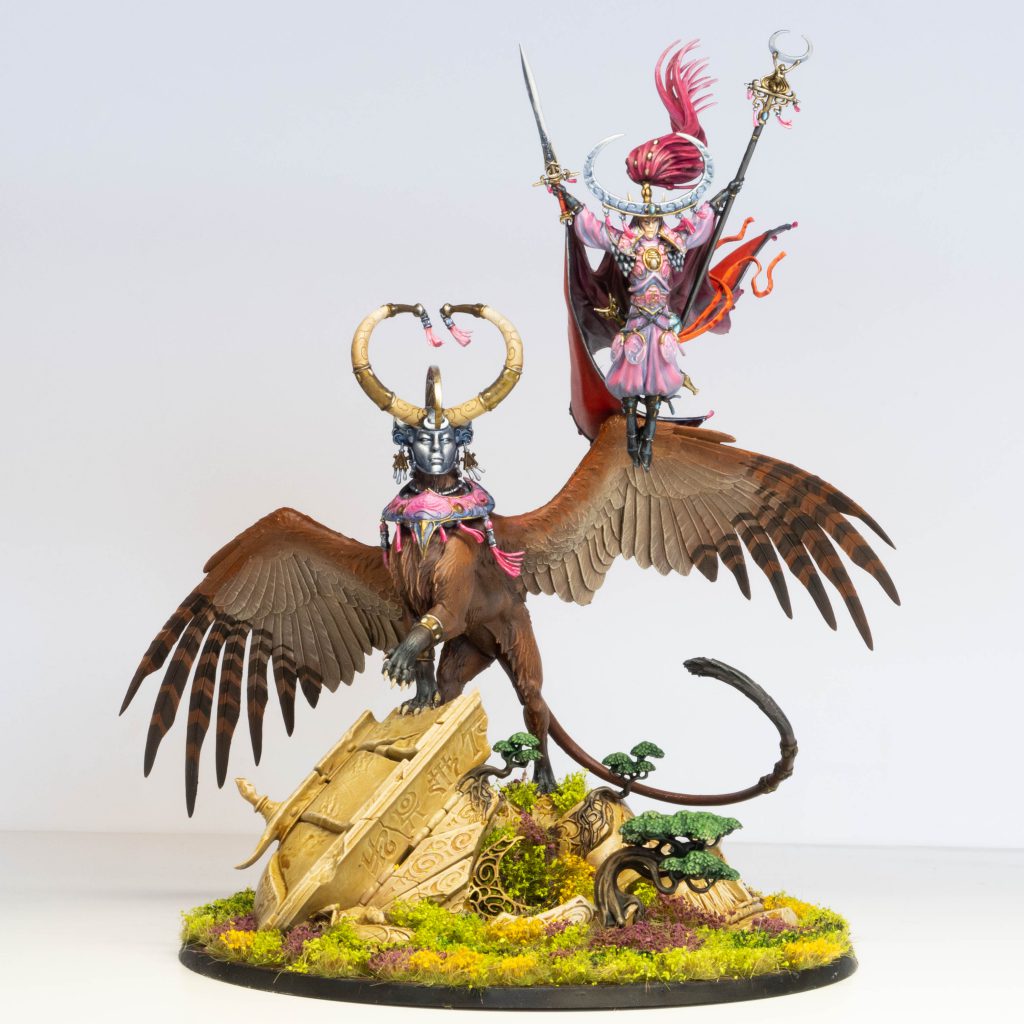 Archmage Teclis and Celennar, Spirit of Hysh. Credit: Rich Nutter
Teclis has one more trick up his gigantic sleeves, and it’s this that I think will see him included in a lot of lists. Once per game at the start of any battle round but the first, Teclis can depict an additional rune on your battle scripture. The rule clarifies that this doesn’t activate the rune’s abilities (as it isn’t the Depict Rune ability), but it can be used to unlock enhanced effects, and counts as present on your scripture for anything that relies on that (e.g. the Thalari rune looking for 4 unique runes). This is huge, giving you a massive swing in scripture effectiveness going into battle round 2, and potentially unlocking Thalari’s bonus move and 5+ crits ability in round 3 instead of 4. I really think this alone is enough to justify Teclis’ inclusion, and it helps to explain why his points have jumped back to 640 at time of release.
It’s not just the Teclis show though, we’ve got a few more named characters.
The Light of Eltharion feels like a development of the Scourge of Ghyran version, retaining the 3+ save, 4+ ward and attack profiles from that scroll, with the ranged attack getting
Shoot In Combat. He still ignores negative modifiers to hit and wound rolls in combat, and like the Scourge version he’s no longer ethereal. He doesn’t resurrect like that version, but this warscroll’s real sauce is an incredible new ability called
Valorous Intervention. In any combat phase, as long as he isn’t already in combat he can pick an enemy unit and be set up within 1” of them and in combat. That’s it, no other restrictions. This is
nuts good. In our test game I was able to charge a horror screen with some Riverblades in turn 1, which then let me deploy Eltharion within 1” of them but also, more importantly, in combat range of Kairos, whom he promptly dealt something like 12 damage to. In that case it didn’t quite kill him, but arguably that can be a game-winning move very early, and in other situations the threat of Eltharion arriving is going to ruin your opponent’s plan for an easy charge onto an objective to flip it. I’d expect to see him a fair amount, and will definitely be trying to put him in my lists, although you do pay 290 points for the privilege so potentially there’s quite a large opportunity cost there.
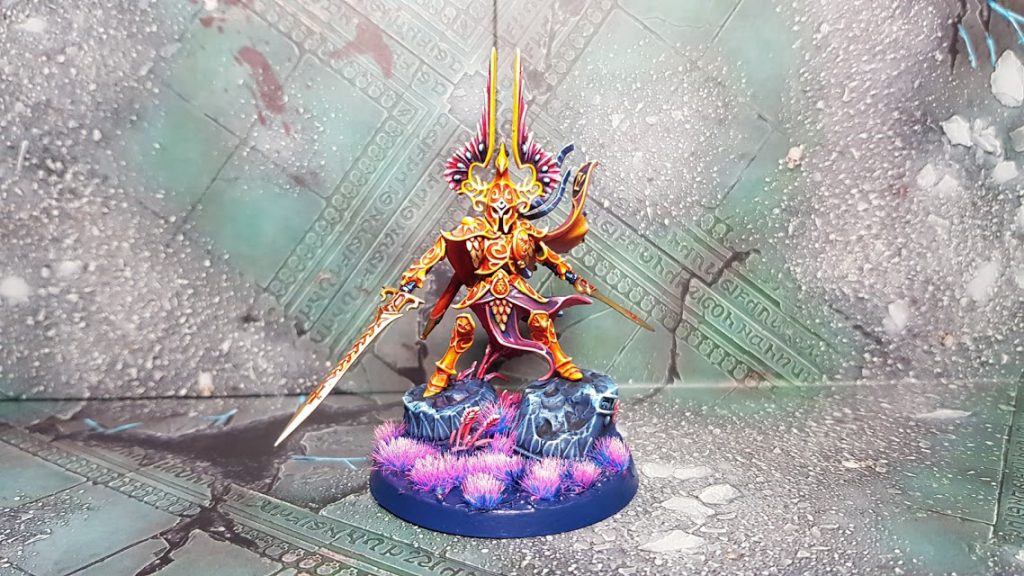 The Light of Eltharion. Credit: Rachel
Ellania and Ellathor
The Light of Eltharion. Credit: Rachel
Ellania and Ellathor, the nation’s favourite precariously-balanced twins, are back in almost exactly the same form, with just a few minor changes. Melee profiles remain the same, and the Blazing Sunbolt ranged attack loses a point of rend and hits on 3+ now.
Equal Prodigies is the same, letting you choose between better casting and wards or extra damage for Ellathor’s sword, and
Sudden Translocation does the same post-combat heal and teleport, although you no longer have to choose Ellania as leading next time.
Total Eclipse has a minor wording update, clarifying that the command has no effect unless your opponent chooses to spend an extra command point, rather than implying that they
must do it. These two seem fun, and like a good control piece that can reach out and strike in a decisive turn without putting themselves at too much risk.
Lyrior Uthralle goes up by a whopping 50 points, so what’s changed to justify that? Well, his Daemonbane weapon is now a melee profile with an extra attack and
Charge (+1 Damage), for a start. His sword has gained an attack, and
Charge (+1 Damage) too, and Farael’s Horns and Claws move to a 4+ to hit and gain a point of rend. On the abilities front it’s a complete rewrite - his warscroll spell
Focused Fury (5) gives this unit
Strike-first for the rest of the turn when successfully cast, and he gains a +2 to cast it if he’s in combat. Charge him into combat in your turn, and then if he’s still locked down in your opponent’s turn there’s a chance for him to chop his way out of trouble before your opponent can hit him. It’s worth noting that Teclis can also steal this spell if Lyrior is on the battlefield, making him a slightly less appealing charge target if you do have to break apart your screens. Lyrior also picks up
Champion of the Lord Phoenix, an ability that interacts with the battle scripture. Any Vanari units wholly within 12” of Lyrior count an extra instance of
Varinor, Rune of Strength for any abilities on their warscroll, and if they’re picked as a target of
Depict Rune they can benefit from any enhanced effects that key off of
Varinor even if it isn’t present on the battle scripture, effectively giving you extra mileage from your Vanari units. We’ll see if he’s worth the points bump, but Lyrior Uthralle seems like another fun option for your lists.
Sevireth, Lord of the Seventh Wind has a similar scripture-based makeover. The bow is now flat 3 damage, an improvement over D3+1, and the
Swirling Shards lose a point of rend but gain
Crit (Mortal).
Call of the Winds is an equivalent ability to Lyrior’s, but affecting
Hurakan units and referring to
Oreali, Rune of the Wind. He keeps his
Searing Desert Winds mortal damage ability from the faction pack, and
Spirit of the Wind changes effect. It’s now
Once per turn (army) in any shooting phase, and gives him a D6” move after using a
SHOOT ability. A command point for a combined
Covering Fire and
Redeploy seems like a good deal. He gains 2” on this distance for every depicted instance of
Oreali, and note that he is within 12” of himself so he’s always going to count one more than you actually have thanks to
Call of the Wind. Severith has pretty much always been good, and that doesn’t look like it’s going to change any time soon.
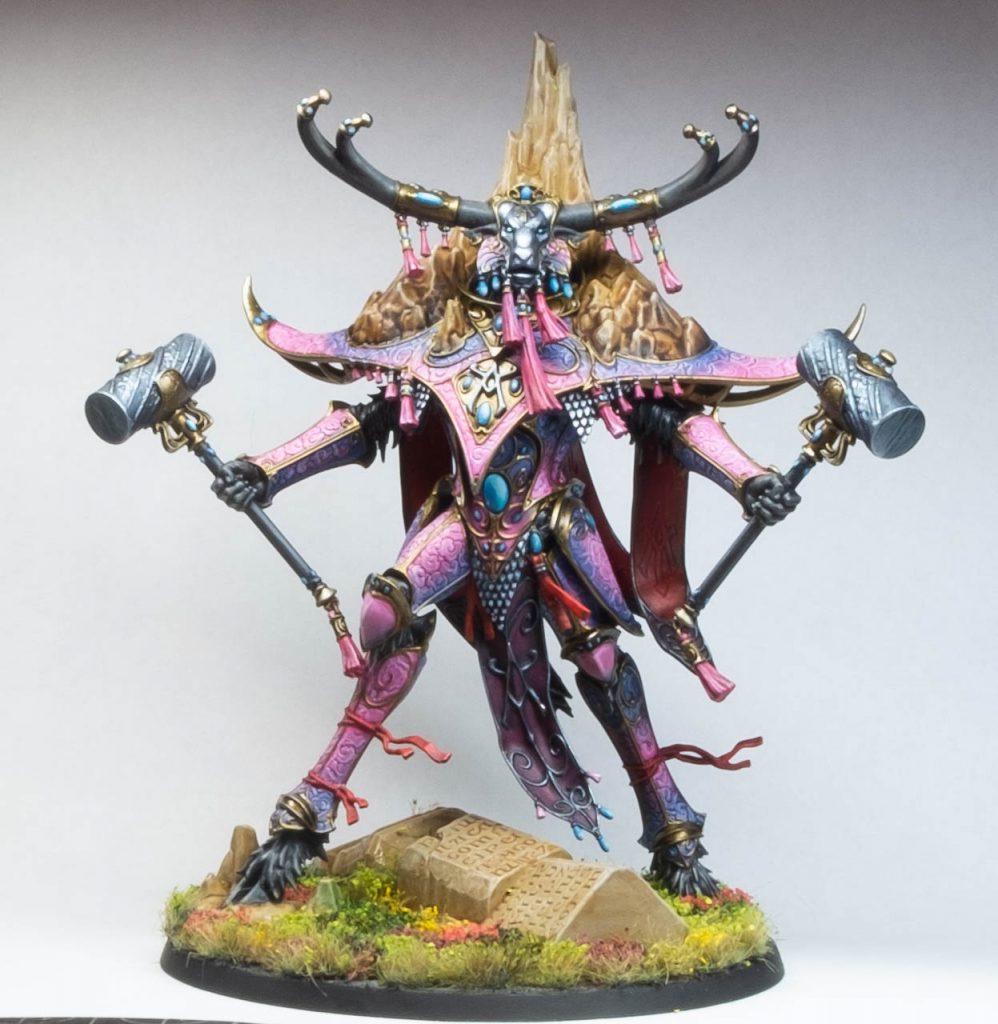 Avalenor, the Stoneheart King. Credit: Rich Nutter
Last, but certainly not least we’ve got
Avalenor, the Stoneheart King. He’s lost his
Ward (6+), but obviously has much easier access to a 5+ ward now through the
Alaithi rune. Like the other heroes before him,
Call of the Mountain buffs other
Alarith units’ interactions with the
Alaithi rune. He’s gained
Shoot in Combat on his
Geomantic Blast, but his initial melee profile takes a step down - the Cloven Hooves are gone, and the
Firestealer Hammers now hit on a 4+. However he’s now adding an attack to the hammers for every instance of
Alaithi, and like Sevireth that’s always going to be at least one. The
Unbreakable Bulwark rampage remains in name, but now on a 3+ it forces an enemy unit in combat with him to attack only Avalenor, useful for protecting other models in the combat. Overall, it feels like Avalenor might come off worst of all the named heroes here, as he also goes up by 20 points, but in an Alarith-heavy army he has the potential to put out a lot of damage whilst also buffing a lot of your other units, so I expect he does have a place in the right list.
Wow, that’s a lot of named heroes. For the rest of the units I’m going to break them down by their temple/discipline, as that way it’s easier to understand the overlap of abilities
Scinari
Scinari are your foot wizards, for the most part, and these guys all get
Wizard (1), apart from the
Enlightener who gets an extra power level. She still duplicates spells, but it now applies to any
UNLIMITED spell and happens on a 4+. The Enlightener's warscroll spell is replaced by
Clarity of Thought (7), which turns off enemy critical hits on attacks that target an infantry unit wholly within 12”. Likely to be a popular choice with the chance of casting 3 spells for 180 points.
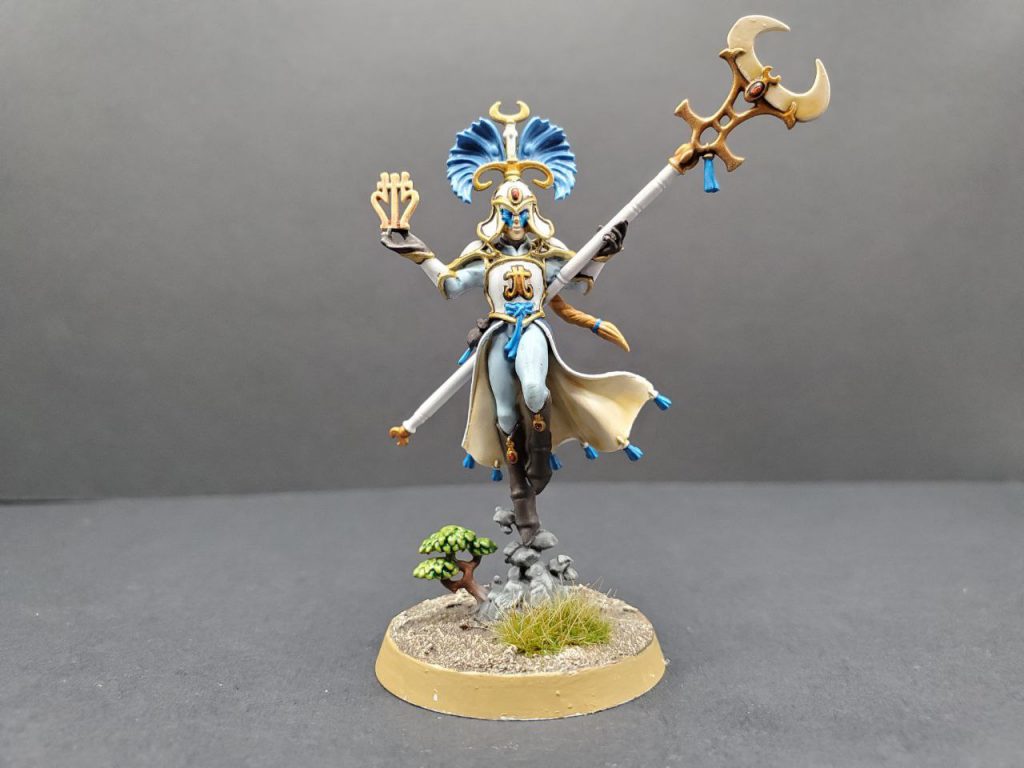 Scinari Enlightener Credit: Joshua Saunders
The
Loreseeker’s deep strike ability now lets it be removed from the battlefield after deployment and redeployed 9” from enemies, getting rid of the strange version of this where enemy units could deploy into combat with him. Once per game, he can empower a piece of terrain to give +1 to cast for all units within 3” of it. At 140 points I’m not sure there’s a huge use for this guy, although deploying a backline irritant before the first turn has even begun can be useful, especially if you can manage to do something tricksy like casting the Sigil into the middle of your opponent’s deployment, or halving a key model’s movement. OK, maybe he
is good actually.
The
Scinari Calligrave is nice and simple, once per game they can replace an instance of a rune with any other except for
Thalari. Great insurance for those times where your carefully planned battle scripture doesn’t survive contact with the enemy, although there are only so many times you can pay 130 points for a once per battle “just in case” effect and it’s arguably less useful than their previous ability to replace casting rolls.
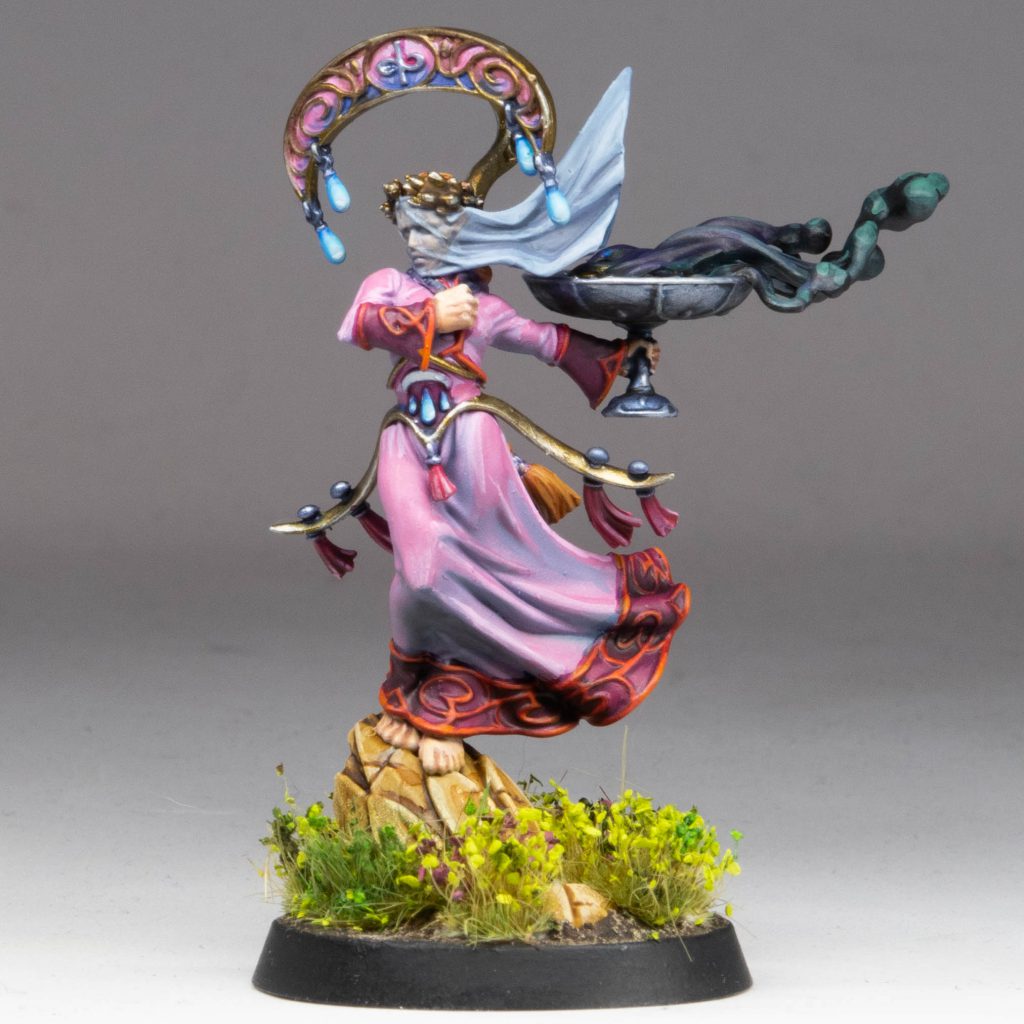 Scinari Cathallar. Credit: Rich Nutter
Finally, the
Scinari Cathallar is slowly recovering from two editions’ worth of punishment for being too good by finally being OK again. Once per turn (army) in your hero phase she can pick a visible enemy unit within 18”, and on a 3+ they can’t use any commands until the start of your next turn. It’s on a dice roll so not ideal, but definitely more useful than previously. In penance, she gains 20 points.
Vanari
Vanari are your good old-fashioned military Aelves, and it’s here we find Lumineth’s singular new unit this edition, the
Vanari Lord Regent (on foot). He’s a pretty standard foot Lumineth hero, with a 4+ save that feels a bit mean, and 5 attacks at damage 2 with
Crit (Mortal).
Wall of Blades lets him pick a unit of Wardens nearby to give them an
Ardboyz style shield bash in the combat phase, doing mortals on 5+ for every model within 3” of the enemy. As if you needed a way to make your Wardens an even less appealing charge target, he also gives out a 12” aura of adding 3 dice to any Lumineth units’
Rally rolls, which pairs well with the
Vanari Bannerblade’s
World Banner ability. Lumineth units wholly within 12” of the Bannerblade can use
Rally commands even if they’re in combat. This is hugely powerful, letting you heal your big monsters for longevity or turn your Stoneguard or Wardens into an immovable recycling hell blob, and even at 140 points I expect to see Bannerblades in quite a few Vanari-focused armies.
Finally for Vanari heroes, we have the
Vanari Lord Regent on Lightcourser, who keeps their
Purest Aetherquartz once per battle ability and has their reroll charge ability slightly modified - it now affects a 6” aura, but no longer confers a +1 attack buff. The Lightcourser’s horns get a slight buff on hit and rend, too. Most significantly, the Lord-Regent is no longer a wizard, which does somewhat impact their previous role as a roaming support caster. They’re now down to 150 points, which is at least a big drop, but it’s hard to see why you’d take one of these over any of the other heroes around the same price. It’s still one of the best models in the Lumineth range though, an all-time classic.
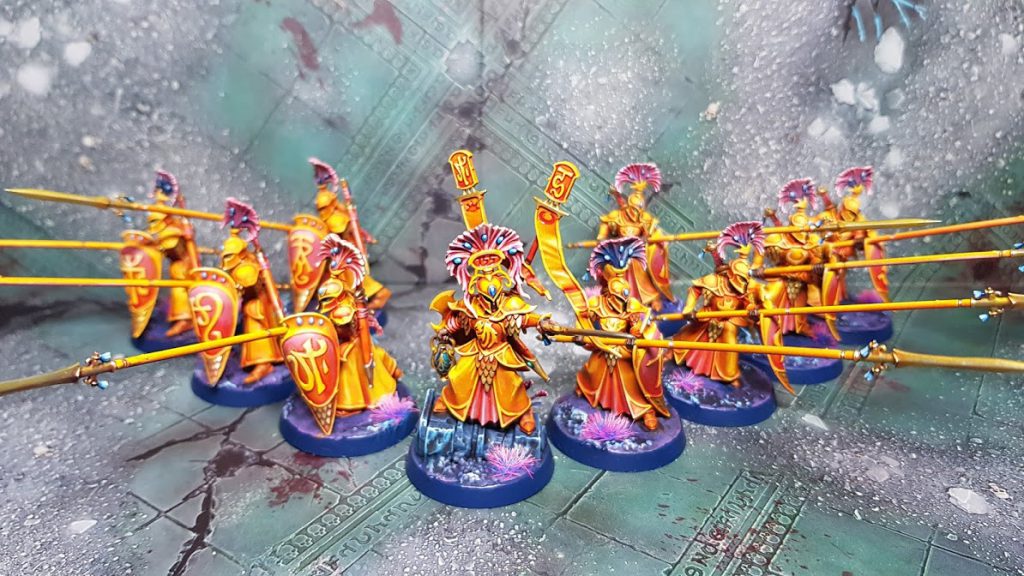 Vanari Auralan Wardens. Credit: Rachel
Vanari Auralan Wardens
Vanari Auralan Wardens. Credit: Rachel
Vanari Auralan Wardens, the long-speared bread and butter of any defensive line, have never been cheaper at 120 points. Their profile remains the same, but they swap their 4+ strike first ability for a simpler offering - as long as they haven’t charged themselves, they turn off
Charge (+1 Damage) for attacks targeting them. Combine that with other stacking buffs like -1 to hit/wound, wards, and the big rally in combat, and these single wound infantry become distinctively tough to chew through.
Vanari Auralan Sentinels remain exactly the same, having reached their current iteration through much pain (mostly pain inflicted on enemy units very far away). As mentioned earlier, depicting
Ydriliqi gives the potential for these to fire lofted shots or use
Covering Fire without taking the -1 to hit penalty, which enhances their utility, and they’re down 20 points to 140 too. At sub-300 for a reinforced unit, I expect you’ll be seeing at least one of those in every Lumineth army you encounter.
The
Starshard Ballista is up 30 points to 120 (
how had it gotten as low as 90?!). It’s gained a shot, damage has changed to a flat 2, and it still buffs its own range when near a unit of Sentinels.
Blinding Bolts is now once per turn (army) rather than once per battle, but now also requires you to roll a 3+ to inflict -1 to hit, or 2+ if the target is a monster. Unfortunately it feels like this still has the same issue as the old ballista - it basically doesn’t do any damage against anything you want to shoot. Once your 4 shots have navigated 3+ to hit and wound and being rend 2 at best, you’ll probably be lucky to do 2 damage. It feels like this either needs a lot more shots to settle into an infantry-clearing role, or a much higher damage peak against monsters, or it’s going to stay on the shelf.
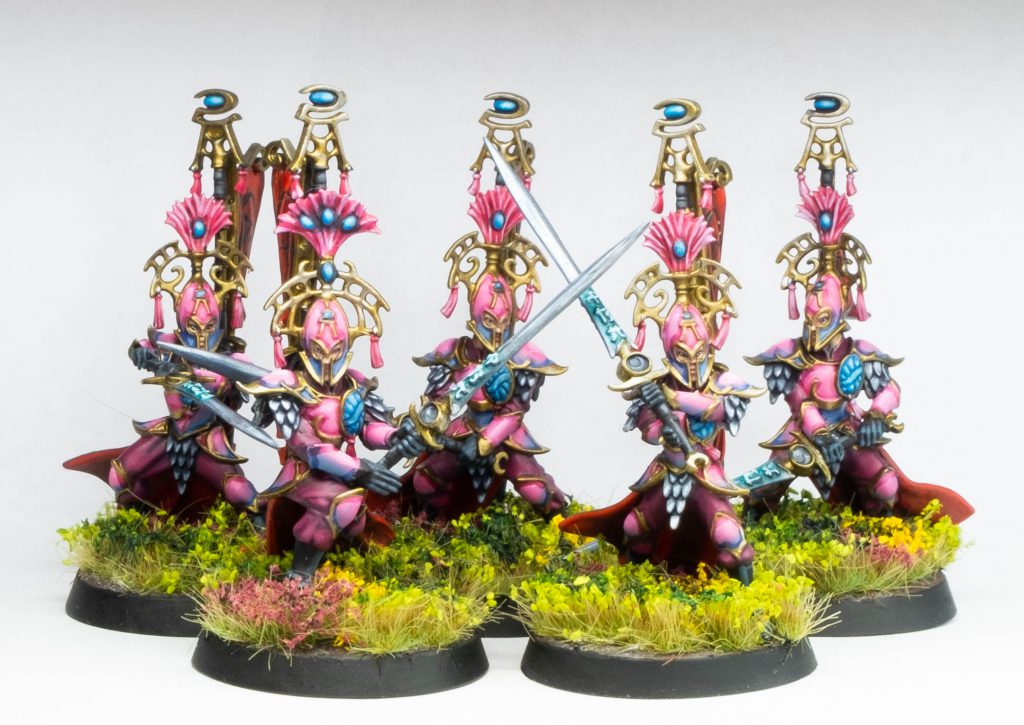 Vanari Bladelords. Credit: Rich Nutter
Vanari Bladelords
Vanari Bladelords. Credit: Rich Nutter
Vanari Bladelords still give themselves and nearby Scinari heroes a 5+ ward, and they’ve lost their perfect strike mortal wound ability. They’ve also lost
Anti-Infantry (+1 rend) from their swords. In return though they gain a point of rend for every instance of
Varinor on your scripture, giving them a potentially high volume of high rend attacks to push through those irritating armoured targets. This feels like enough of a change to dial them back from the spam we were seeing in some lists, whilst still remaining a useful and usable option, and they stay at 150 points which would imply the designers feel similarly.
Finally, the recipients of this year’s “I have been punished for being too good” award are the
Vanari Dawnriders. Their profiles stay the same, but the
Deathly Furrows mortal wounds ability is completely gone, replaced by +1 rend on their lances if they charge. It’s not all bad news, they’re still a very fast cavalry unit capable of clearing a screen or locking down a priority target. I wish they had 3 attacks each though, as most other similar cavalry units (Stormstrike Palladors, Barrow Knights, Freeguild Cavaliers, etc) have more attacks, impact mortals, a more interesting warscroll ability, or a combination of multiple of those. I do think we’ll see them on the table still, but perhaps more often as units of 5 for taking objectives and flanks, and in that role they’re competing with Windchargers from the same book.
Alarith
Hysh’s number one temple for cows and fans of cows, the Alarith are immovable objects, akin to the stone they venerate. The
Alarith Stonemage now adds +1 rend to a friendly Stoneguard unit without needing to roll for it any more, although in exchange they are not allowed to pile in. Their warscroll spell is replaced by
Raise the Earth (7), which targets an objective within 18”. Any non-fly unit contesting that point, either friendly or enemy, takes D6 mortal damage if it uses a
MOVE ability before the start of your next turn. A great option for controlling the flow of a battle, especially if you can lock down that objective with a block of Stoneguard that aren’t going to move anyway, or if you need to prevent a redeploy to secure a charge onto the objective. At 130 points it’s fighting with some very nice Scinari and Vanari hero options, but I can see the value.
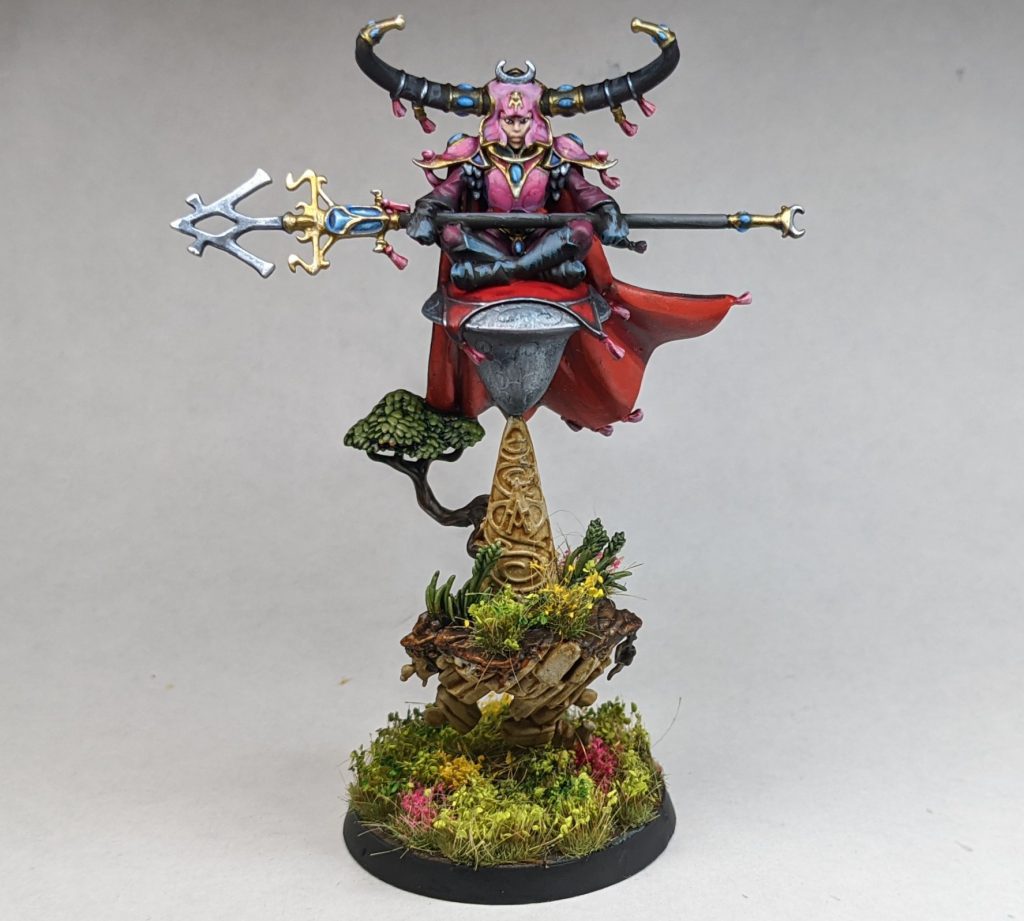 Alarith Stonemage. Credit: Rich Nutter
Alarith Stoneguard
Alarith Stonemage. Credit: Rich Nutter
Alarith Stoneguard gain a much-needed extra inch of movement, and lose their ward ability in exchange for gaining a 3+ save whilst your battle scripture features 2 or more instances of
Alaithi. Coincidentally you could use
Alaithi to give them a 5+ ward too, so I think these are just slightly better than they were before, and they stay at 130 points per 5 too.
Finally, the
Alarith Spirit of the Mountain. Like Avalenor they can now shoot in combat, and also like Avalenor they’ve lost their hoof attacks and their hammer now hits on 4+. Thankfully they’re also gaining a hammer attack per instance of
Alaithi, so they’ve still got killing potential. They also have a new ability once per turn (army) combat phase ability to do D3 mortals on a 2+ to an enemy unit in combat with them. You get a +2 to this roll if the cow charges, meaning that you know you’re going to deal between 3 and 5 mortal damage in that situation. They’ve lost the ability to give out
Strike-last, which is a shame. They’ve also gone up by
60 points, which feels massive. Still, the potential to buff loads of these with a combination of Avalenor’s aura and multiple instances of
Alaithi does feel like it would be good.
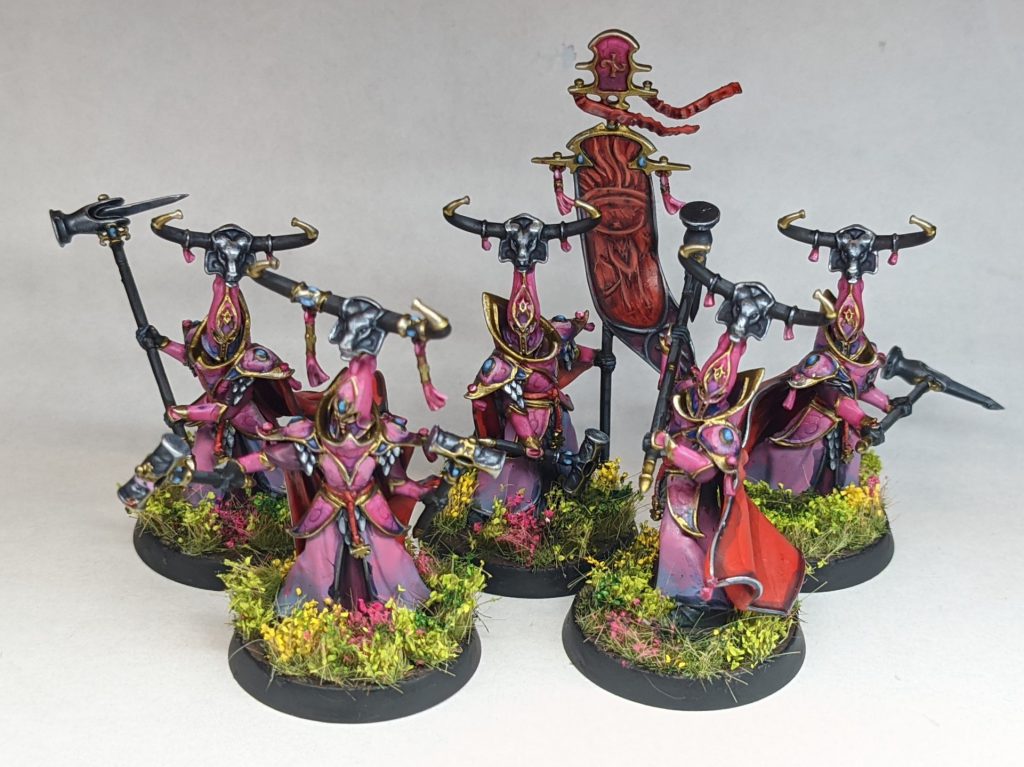 Alarith Stoneguard - Unit 2. Credit: Rich Nutter
Hurakan
If you gotta go fast, Hurakan is the temple for you. The
Hurakan Windmage buffs your nearby
Hurakan units, now automatically giving up to three units Run and Shoot/Charge rather than having to roll a 3+ to add a bit of movement to some Windchargers. They still have the teleport spell too, another great candidate for Teclis to steal. Another one for the pile of 140-ish point single cast wizards, depending on what flavour of Lumineth you want to play, but the run and shoot is great.
Hurakan Windchargers get a buff to their shooting, losing
Shoot In Combat but gaining
Anti-Cavalry (+1 Rend) and
Crit (Auto-Wound), as well as being able to extend their reach to 18” while 2 or more instances of
Oreali are depicted. At 160 points they’re affordable, very fast, reasonably resilient, and decent enough to do some shooting damage, so I’d expect to find these in quite a few lists even before factoring in how flexible they can be when layering on the other Hurakan units.
Finally, the
Hurakan Spirit of the Wind. I feel like every AoS player who played before 4th edition has at least one horror story of facing an army with multiple of these. The good news is, they still seem very good. Their bow has flattened out to 2 damage instead of D3, but they keep the extra rend and damage into monsters. Like Sevireth, they’ve gained
Crit (Mortal) in melee too. They share the
Spirit of the Wind ability with Sevireth and it’s once per turn (army), so while the reposition is good you can’t do it with a whole line of these, which is arguably less flexible than their prior ability to retreat and shoot (although that is accessible still through runes, as we’ve seen). Once per turn you can pick a unit that had damage allocated from a Spirit of the Wind’s shooting attacks, and roll a 3+ on a D6 to give it
Strike-last for the rest of the turn. With a price increase to 270 points I think it’s unlikely we’ll see these being spammed, but one or two may be a powerful inclusion.
Ydrilan
We’re still left with just one River Temple unit at the moment, the
Ydrilan Riverblades. Their teleport is slightly buffed, letting you ignore the board edge condition and set them up anywhere within 9” of an enemy unit if you depicted
Ydriliqi this battle round. They keep their 2d6” move in combat, but in acknowledgement of their prior ubiquity they lose an attack each, and lose
Anti-Hero (+1 Rend). They do come down by 20 points though, so a unit of these is probably still a good include for some battle tactic scoring and extra mobility.
Shrine Luminor
The aelves’ faction terrain remains almost exactly the same, with the very minor change that it now only gives a reroll for a Lumineth wizard rather than any friendly spellcaster. It’s back to 0 points again, so there’s really no point not to take it, other than its large and quite irritating footprint.
How They’ll Play
In a word: Complicated! If I have one criticism of this Battletome, it’s the huge amount of flexibility in the listbuilding stage that can, if you’re not careful, lead to quite an inflexible battle plan. There are hardly any options in the book that feel like they’re not worth taking, especially when it comes to foot heroes in the 100-200 point bracket, but different choices here can lead to vastly different possibility spaces on the tabletop. Overall I think that’s worth celebrating, and this army really has access to quite a few different playstyles, but it can definitely seem intimidating from the outside and I can only imagine that trying to explain your rules and list to your opponent pre-game might be a huge exercise in frustration.
Depicting runes on your battle scripture is, of course, going to be central to any gameplan you make, and it seems like the best lists will strike a balance between going in with a plan, and retaining enough flexibility to respond well to your opponent’s play. In our test games I used a Teclis-focused list, and having depicted
Alaithi in battle round 1 I found myself needing to do it again in round 2 as Matthew had won a double turn. This threw off my planning quite a lot, so it feels like Lumineth lists might reward players who are good at understanding the flow of the game and guessing their opponents’ intent correctly.
We talk a lot at Goonhammer Towers about “modular” listbuilding, grouping together obvious units and then building lists out of those blocks, and the Lumineth tome feels like it can really reward that way of thinking too. Alarith Stoneguard are much more effective when supported by a Stonemage or Avalenor, Wardens love the Lord Regent’s rally and mortal damage abilities, and Sevireth or a Windmage with multiple blocks of Windchargers can reach across the whole battlefield, just to name a few examples. The named heroes in the book also all feel very impactful with their ways of interacting with the battle scripture, and if you’re not taking Teclis then I expect most lists will feature at least one of the others.
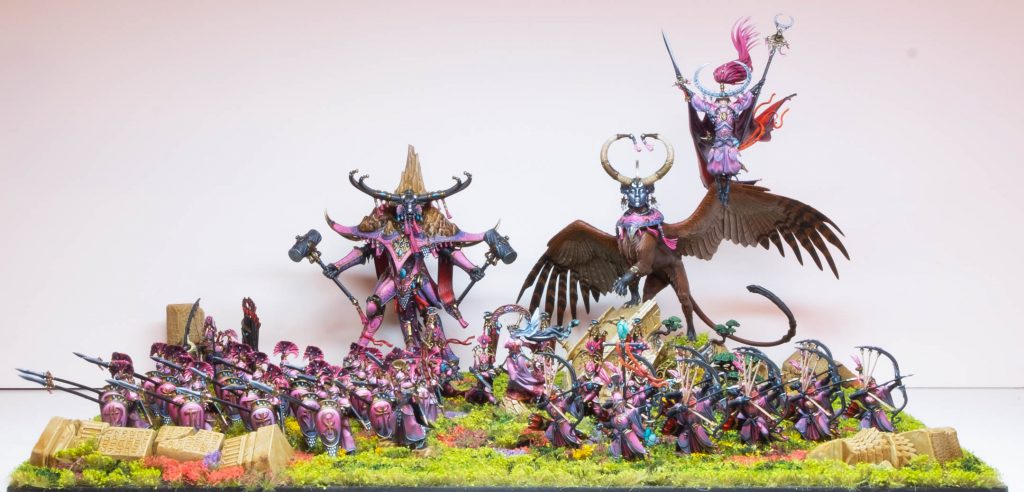 Lumineth Realm-Lords army. Credit: Rich Nutter
To show the breadth of the book, we’ve created a couple of different example lists, starting with this Teclis-focused offering from Rich.
Teclis List - click to expand
Grand Alliance Order | Lumineth Realm-Lords | Aelementor Guardians (10)
Drops: 2
Spell Lore: Lore of Prismatic Resonance
Manifestation Lore: Manifestations of Hysh
General’s Regiment
Archmage Teclis & Celennar, Spirit of Hysh (640)
Vanari Auralan Wardens (240)
-reinforced
Vanari Auralan Sentinels (280)
-reinforced
Vanari Auralan Sentinels (280)
-reinforced
Vanari Lord Regent (110)
-Silver Wand
-Flawless Commander (battletome)
Regiment 1
The Light of Eltharion (290)
Ydrilan Riverblades (140)
1990/2000
It’s a pretty classic Teclis Castle. Teclis sits centrally, with Wardens/Bladelords in front and Sentinels either side to screen. Teclis’ magic plus the Sentinels’ shooting does the majority of the work in the list, with the Wardens presenting an unappealing charge target which your opponent has to engage if they want to crack the nut and get at the wizard inside. The Regent adds to that lack of appeal, and helps to keep the Wardens and Sentinels topped up against enemy chip damage. The Riverblades can reach out to grab objectives or deliver Eltharion, who otherwise stays in reserve as a thing that opponents will have to deal with if they charge. Against armies with a large fulcrum monster like Gobsprakk, the Riverblades can offer a way to get Eltharion into the enemy backline early to cause chaos.
Runes wise, the goal here is to get to
Thalari in battle round 3, which I would think will most likely flow as
Ydriliqi or
Oreali in the first battle round (depending on which protects you better),
Alaithi in the second (with Teclis depicting
Varinor as a bonus) then
Thalari in round 3 for the go turn. Of course, this could all be messed with by your opponent scoring a double turn, so there is an argument for twisting the list a bit to make room for a
Calligrave who can rescue your plan when it goes wrong.
I imagine this list loves any scenario where it can make the enemy come to it, and struggles more on maps with wide objectives, or against armies with a lot of shooting/ranged magic chip damage like Tzeentch. Teclis obviously hates Longstrikes, but the ward helps him to survive them and 20 Sentinels should put out enough ranged damage to take them off of the board in return.
Meanwhile, chimp has been to the cow farm.
Don’t have a cow, man - click to expand
Grand Alliance Order | Lumineth Realm-Lords | Warhost of Duality (0)
Drops: 2
Spell Lore: Lore of Prismatic Resonance
Manifestation Lore: Manifestations of Hysh
General’s Regiment
Avalenor, the Stoneheart King (420)
Vanari Bannerblade (140)
Hurakan Windchargers (160)
Alarith Stoneguard (260)
-reinforced
Regiment 1
Alarith Stonemage (130)
-Silver Wand
-Acolyte of the Runes
Alarith Stoneguard (260)
-reinforced
Alarith Stoneguard (260)
-reinforced
Alarith Spirit of the Mountain (340)
1970/2000
It doesn’t
have to be complicated for the Lumineth, and this is a smash list with a pretty simple gameplan. Avalenor and Acolyte of the Runes will help with your rune efficiency, as there are lots of units here that want
Alaithi up ASAP. From there, you’ll want to be looking at
Oreali and
Ydriliqi depending on the context of the battle. Both are essentially defensive buffs, I prefer the consistency of the effect of
Oreali but
Ydriliqi has a better combo with
Alaithi.
Varinor can be a situationally useful later game pick, not so much for its own ability but for the combinations with
Oreali and
Ydriliqi being quite strong.
Outside of runes, you run forwards and punch things in the face whilst stacking defences and using your Bannerblade to rally in combat. Honestly, this is a solid combat army that can turn any of its units into a hammer
and anvil. A unit of Windchargers are there to run around and be cheeky with objectives, but there are a bunch of options for that role in this book.
Armies of Renown
Matthew: As usual with Battletome releases, we've got two Armies and two Regiments of Renown to cover.
Aelementiri Conclave
The theme here is an army based around a temple to the three Lumineth elements: cows, wind and rivers. I didn’t write the lore. This means you can only pick
Alarith, Hurakan and
Ydrilan units, and you don’t get the faction terrain. What this army wants to do is play with the Rune-based abilities on the warscrolls of the elemental units, and it ends up doing this in quite a fiddly way. For each keyworded type of unit in your army at the deployment phase, you get 1 corresponding rune that gets put into your
library (so for example, if you have two Alarith units, you get two Alaithi runes). Then at the start of each battle round, you wipe your battle scripture clean and choose any number of runes from your library to depict on your battle scripture for that battle round. To be super clear: you don’t get the main army rune abilities at all, this is
just a way to trigger the abilities on your unit’s warscrolls. The economy of this isn’t amazing, as it’s 1-for-1 unit for rune and the abilities on the warscrolls require two runes to use. So in our example of bringing two Alarith units, one of them would get to use their ability once. This army basically requires the named characters to function, as they effectively double the efficiency of your rune library.
There are more battle traits though,
Entreat Spirit only works if you have three or more runes in your library and it lets you pick a non-unique monster that has been destroyed and it comes back to life with 6 damage applied, for the cost of discarding any three runes forever. Spirits of the Wind have 8 total health so this is a pretty bad deal for them, but bringing a big cow back is fun and probably the spiciest thing here. Finally we have
The Realms Fight Back, which happens every combat phase and lets you pick an enemy unit within 6” of a terrain feature and roll a d3 for one of the following effects.
- 3 mortals
- -5 control
- Strike-last
Which is all fine, but you are praying not to roll a 2. A fine enough ability to have come round every turn. The heroic trait is +1 to cast for each rune on your battle scripture, which could actually be a pretty hefty bonus on a Go! Turn, but is still very handy with just a +1. The artefact lets you use any terrain feature on the board as the thing you measure range and visibility for for your next spell. That’s cool, but spells are pretty limited in this army as you lose all Scinari units. Your sole spell lore spell is
Vexing Spirits, which casts on a 7 and shuts down commands on a unit for a turn. Neat, but notably not unlimited. The manifestation lore is one spell that casts on a 6 that can summon any one of the Lumineth manifestations, but you can only ever have one on the board at a time. Rune of Petrification then.
I’m not particularly inspired by this, I have to say. The rune business is a lot of hoops to jump through to access abilities you could already access, and whilst it’s true that you can potentially get them
earlier than you could in a standard army, the AoR is so reliant on named characters for its rune economy that it’s kinda moot - you’d have that rune power at that time with the same setup in a normal army. Losing
everything else about runes, aka most of their utility, isn’t worth the price of entry. If you really really really want to recycle generic cows, then this army does let you do that.
Vanari Paragons
Shock horror, you can take any non-Unique Vanari unit and the Light of Eltharion. These restrictions mean no Ellania and Ellathor, and no Lyrior. Not entirely sure why it was necessary to remove them, but OK. For battle traits you get to pick an extra artefact for one of your heroes at deployment, which is as good as the artefacts are. The gimmick here is that there are four
labours, abilities you can trigger once per battle if you meet a certain condition to get a particular effect. The
Labour of Control can be triggered at the end of any turn if you have a different friendly unit within 6” of each battlefield edge, and in return you get +2” move for all of your units. That’s a serious move boost, but without access to your Riverblades you’re reliant on punting some horses upfield to achieve this, which you’re probably not doing in the early game when you most want that move boost.
Labour of Might can be triggered once you’ve destroyed three enemy units, and you get +1 to wound in melee across your army. Super handy buff, but also totally at the mercy of the army you’re facing up against. Enemy brought Mega-Gargants? Oh well.
Labour of Precision has the unusual trigger of requiring no enemy units with an artefact of power on the battlefield, and for that you get +10 control on all of your units. Control is usually one of the weaker stats in the game, but getting +10 on literally everything is seriously meaningful. Again, pretty dependent on what your opponent has brought to be able to achieve this. Don’t say anything when a Stormcast player puts their artefact holder in reserve and then laugh your way to +10 control immediately. Finally there’s
Blessing of Tyrion which wants you to complete three labours and for doing so your whole army gets Ward (5+). This would be sick if 1. The labours weren’t so potentially difficult to achieve and 2. If base Lumineth didn’t have very easy access to 5+ wards. All of which is a lot of words to say that I don’t think this is it, really.
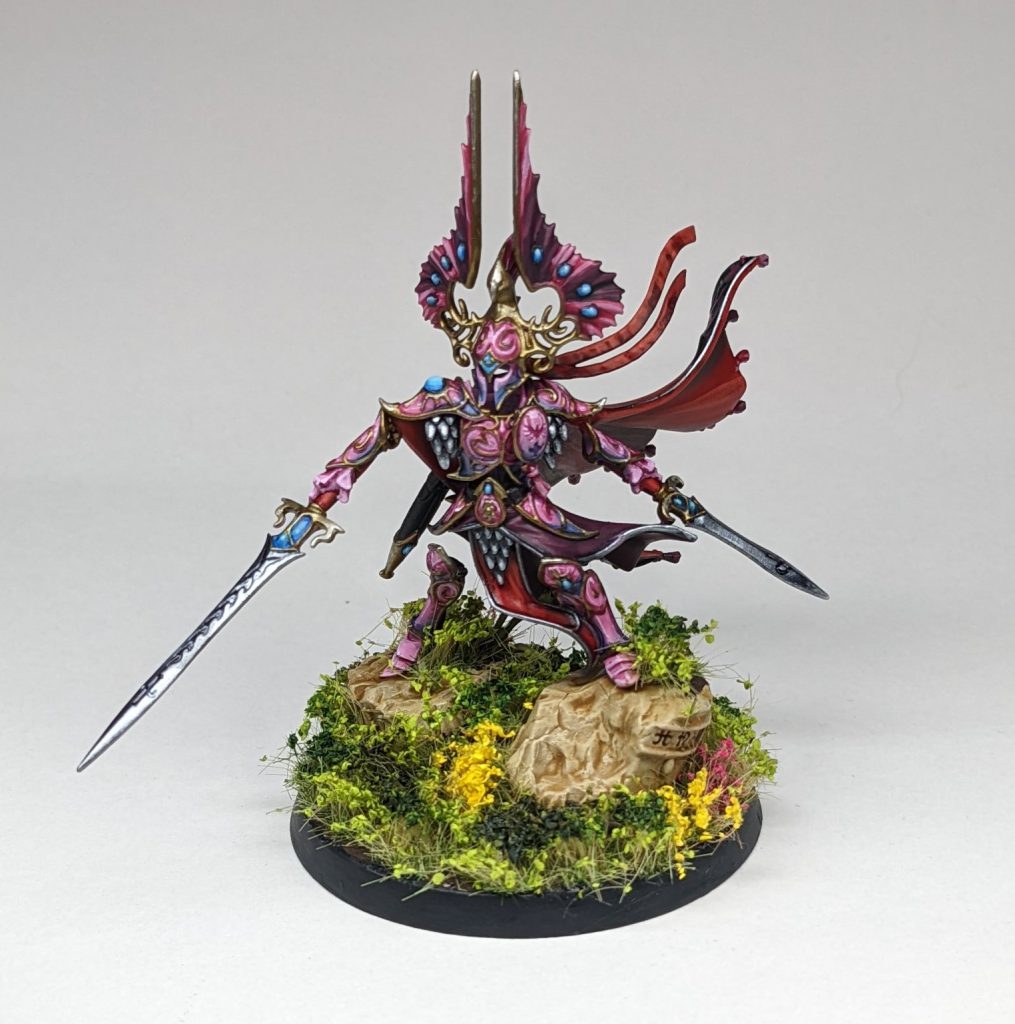 The Light of Eltharion. Credit: Rich Nutter
You get your requisite single heroic trait, which is a 4+ roll when you’re in combat with an enemy hero to destroy their artefact of power and make them Strike-last. Clearly the idea here is to suicide charge a Lightcourser at anyone holding an artefact and then roll a 4 to auto complete the Labour of Precision, but that’s not a gameplan I’m really in love with. For artefacts you get three, two of which you’ll probably use.
Phoenix Blade is 5+ crits for the wielder, which is alright on your Lord Regent but hardly lights the world on fire.
Swiftfeather Talisman gives a unit wholly within 12” +2 to move, which will pretty much always be useful.
Nullstone Beads lets the hero unbind as if it were Wizard (1). You’ll likely want to put the talisman on a hero in your list, and then flex between the beads if the enemy has a wizard and the blade if they don’t.
There’s a nugget of an interesting army here, funnily enough it reminds me a lot of the old Tzeentch Hidden Agendas, but the setup and payoff feels a bit off considering that you’re cutting out half of the power units in the Lumineth roster. A classic “you’ll never see this” AoR that they wrote because the format demands they print two of these things.
Regiments of Renown
Sigil Convocation
A really neat idea for a regiment. This regiment of renown gives you a Scinari Calligrave and the Lumineth manifestations, with a designers note that you get these on top of the manifestation lore that you can pick for your army. On top of that, you get three abilities: a spell to summon any one of the manifestations within 1" of the caster that casts on a 6, a teleport for the Calligrave that can put him wholly within 3” of a friendly manifestation (no stipulation that it has to be a Lumineth one), and a cheeky bonus ability for the Calligrave to make up for the fact that its warscroll ability does nothing.
Swift Erasure is a reaction to your opponent declaring a spell, you roll a dice for each friendly unit wholly within 12” of the Calligrave that is the target of that spell and on a 4+ the spell has no effect on them.
Because the wording of the summoning spell here means you can only ever have one manifestation out at a time, you’re realistically only ever going to be casting the Rune of Petrification, as the Twinstones only affect Lumineth wizards and the Sanctum is just a bit pointless in this context. Fortunately, that’s a really good manifestation and most armies would be quite happy with an endless spell that deals damage and hands out Strike Last, although you're going to have to put the Calligrave at risk to cast it with the 1" summon distance.
This is an interesting value proposition, 130 points is dirt cheap for a RoR and the extra bonus magic defense is a good ability. You’re essentially trading out an in-faction wizard that presumably has more synergy with the rest of your army for access to effectively a second manifestation lore. That’s not a bad deal at all, I can see this being a popular pick (especially given that both Duardin armies have access to it, giving them a cheap wizard option).
Dawnrider Lance
Much less interesting, sadly. You get a Vanari Lord Regent and 5 Dawnriders. This one is begging for an FAQ as they’ve written “Vanari Lord Regent” but presumably mean “Vanari Lord Regent on Lightcourser”. That would make sense and is what is pictured in the art for the regiment, but until it does get FAQ’d then rules as written you use the new foot guy. But that’s stupid, just use the horse.
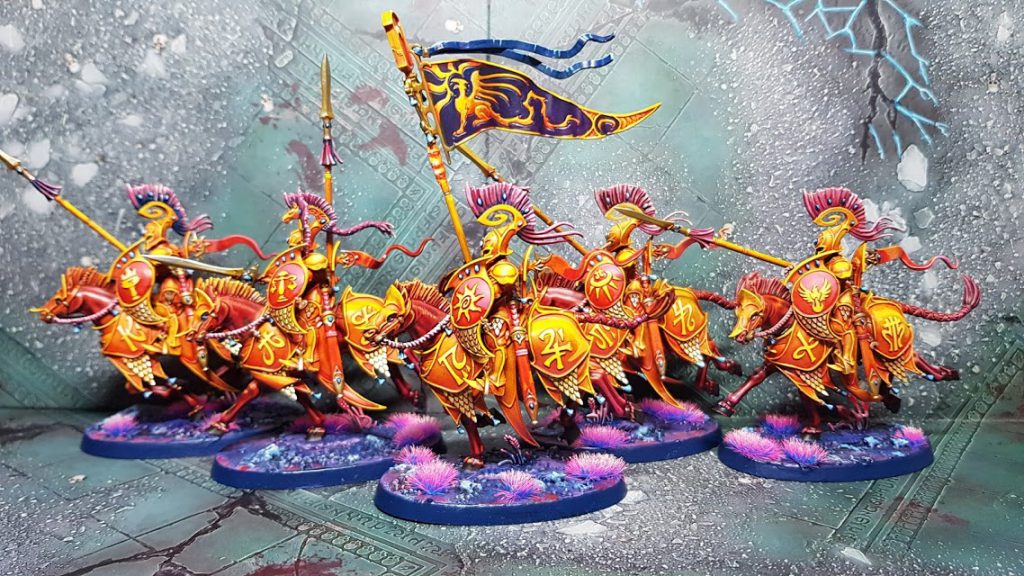 Vanari Dawnriders. Credit: Rachel
Two abilities here:
Blinding Charge is once per turn (army) and has you pick a unit from the regiment that made a charge move and then an enemy infantry unit to be the target, that enemy unit ignores positive modifiers to save rolls for the rest of the turn.
Master of all Terrain feels like it should just be on the warscroll it’s so basic, but it lets both units ignore negative modifiers to their movement, run rolls and charge rolls. Fine.
Not much to say here, the hero is pretty boring and an un-reinforced unit of cavalry isn’t setting the world on fire. Blinding Charge is quite nice to tack into a combat where one of your actual hammers wants to kill something, but it’s not worth 260 points.
Spearhead - Hurakan Vanguard
Badusernametag: As the name suggests the new Lumineth Spearhead brings the speed and hitting power of the Hurakan and their wind magics to Spearhead, including an extremely tricksy and spicy monster. Looks good.
The Hurakan Vanguard includes:
- Hurakan Windmage (General)
- 5 Hurakan Windchargers
- 10 Vanari Auralan Wardens
- 1 Hurakan Spirit of the Wind
So that's all the Hurakan kits as well as some wardens. Existing Lumineth players may well have these in their collection (didn’t
everyone have the spirit of the wind a few years back??) and by the look of things the Hurakan units are looking good in the new Battletome. It’s rare to see a monster in a Spearhead and the Spirit of the Wind is a beautiful model. As with all LRL kits I'm not sure these are best for a beginner, being full of floof, highly detailed and complex for building and painting both. But it’s a great set of models and would make for a great start to an army.
So what is this Spearhead trying to achieve and does it get there? Much like their feathered and chaotic counterparts in the new Tzeentch Spearhead you’ve got some strong theming here that they have endeavored to pull into the rules. The army has a mechanic that is linked to the Wind (surprised??), the first
Battle Trait being to define this with
Storm Brewing. At deployment you pick a battlefield edge and this becomes the
Leeward edge, then each time you use an associated
Ride the Hurricane ability (most of the Spearhead’s abilities) the
Leeward edge moves one clockwise. This is cool and very thematic, encouraging careful planning and positioning to make the most of these powers. The other two battle traits interact with this,
Pulled by the Winds allows a unit to move d6” in any movement phase, but only if it moves closer to the Leeward edge, whilst
Gale Force gives a unit +1 to hit for an attack ability, but only if the target sits in between the attacker and the Leeward edge. This mechanic is continued throughout the Spearhead with some care and it works thematically and should be powerful in the game, just so long as you can time the Hurricane just right…
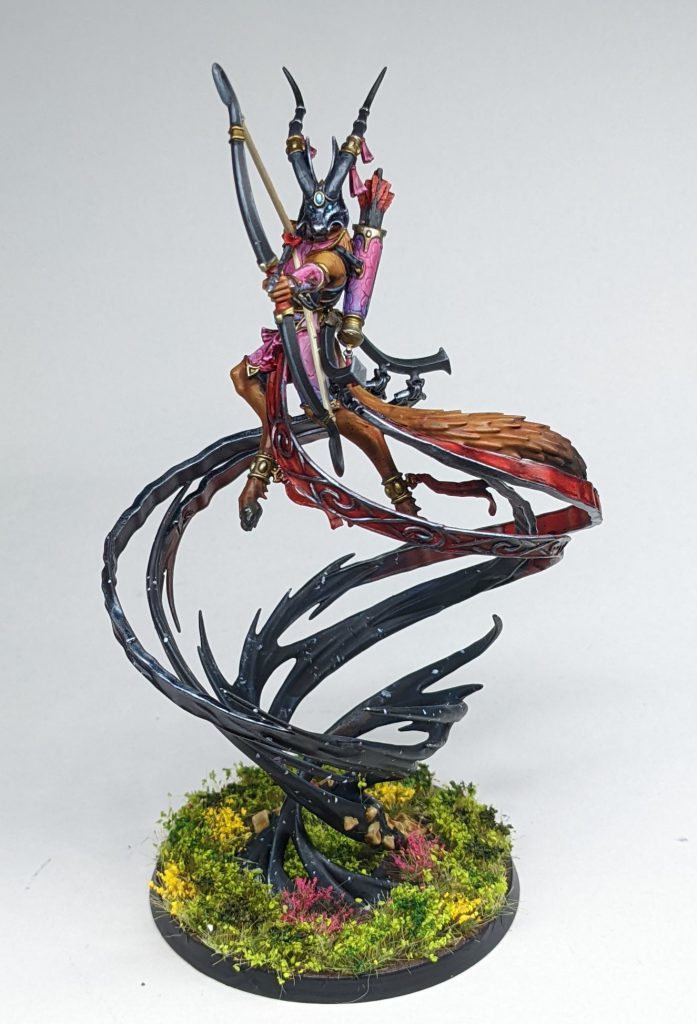 Hurakan Spirit of the Wind. Credit: Rich Nutter
The presence of a monster here is notable. The
Spirit of the Wind is no slouch. It has a 4+/5++ and an ability called
Eye of the Storm that means all attacks against friendly units (including itself!) within 6” are -1 to hit, which should keep it alive. This coupled with its amazing speed and the really strong shooting we’re used to makes this one of the most powerful units we’ve seen in Spearhead. Really excited to see how this plays on the table.
The
Hurakan Windchargers have a different ability here,
Leap into the Storm which replaces
Guided by the Winds (so only range 12” on those bows) and mimics the Windmage’s regular warscroll spell
Windleap, allowing them to teleport but only to within 3” of the Leeward battlefield edge. The fact that this move happens at the END of the turn means you can potentially LEAP out of the way once you've fired a deadly close range volley, so long as your timing is right.
The
Hurakan Windmage might be your Achilles heel here, as with only a 5+ save and 5 wounds they’re pretty squishy. They are fast of course, so positioning will be key. In some games you may want to give them the
Temple Guardians Enhancement, which gives them and the Wardens a 5+ ward as long as they stay within 6” of one another. The Windmage probably sums this Spearhead up; fast and deadly, with some great abilities, but you’d better get your timing just right if you’re to make it really work.
Excited to see this one on the table and I'd like to give it a try, as I feel the mechanics will be tricky to master, but rewarding when you do!
Pros:
- Fast
- Lots of good shooting
- Powerful and thematic mechanics
- Great models
- Big, centrepiece model
Cons:
- Glass cannon
- Mechanics that require careful planning
- Complicated models
- Vulnerable to return shooting
- Squishy General
Model Count: 17
Gaming: 8/10
Models: 8/10
Overall: 8/10
Good for starting an army: Yes, but NOT for a beginner to modelling and painting.
Final Thoughts
Overall this is one of my favourite Battletome releases of 4th edition so far. Maybe that’s unsurprising given that I’m a Lumineth fan, but I think it offers a huge variety of ways to play, the book has almost no units that don’t have at least a chance of inclusion in lists, and it’s all truly thematic. It’s definitely complex, but (bear with me here): that’s fine. Not every tome needs to be equally accessible, and Lumineth are exactly the kind of army that feel right inhabiting that complex, technical space. I do have some reservations about what this will be like to play against, not because it feels overpowered but because it’s an absolute deluge of information to absorb, but I’m sure the community will settle around what needs to be discussed and disclosed fairly quickly. More tomes with this kind of character, please!
Have any questions or feedback? Drop us a note in the comments below or email us at contact@goonhammer.com. Want articles like this linked in your inbox every Monday morning? Sign up for our newsletter. And don’t forget that you can support us on Patreon for backer rewards like early video content, Administratum access, an ad-free experience on our website and more.Thank you for being a friend.
 This website uses cookies. Learn more.


 Goonhammer App and Patron Updates: April, 2026
 Kill Team Tournament Report: Engage, Party, Repeat's March Madness 2026
 Goonhammer Reviews: Tribal Conquest