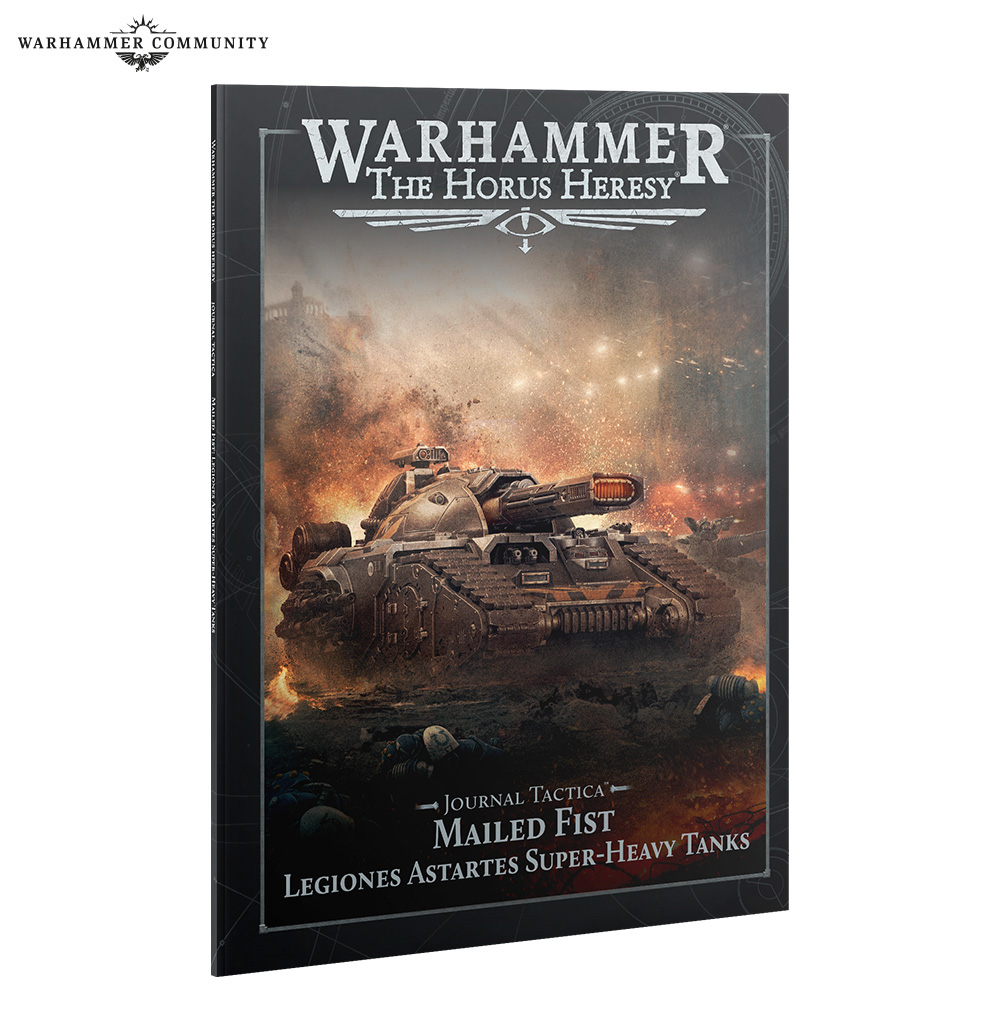
Ceramite-clad treadheads rejoice! The fourth Journal Tactica for Horus Heresy, Mailed Fist: Legiones Astartes Super-Heavy Tanks, is releasing soon. Like the other journals released so far, this book is a small snapshot of the Heresy, with an emphasis on a specific element of the war and relevant unit profiles for use in the game. This one focuses on the development of the Super-Heavy vehicles of the Astartes legions, their employment by the Legions throughout the Great Crusade and early Heresy, and some of the most notable battles of the galaxy-spanning civil war they partook in. This journal also includes new rules for the Decurion Magna, a Super-Heavy tank specialist, as well as the Whirlwind support tank.
Thanks to Games Workshop for sending the Journal to us for review.
Lore: A Guide on the Care and Feeding of Astartes Super-Heavy Vehicles
General Background: Astartes Super-Heavies
The first section of lore in the Journal starts with a deep dive into the general background of Super-Heavy tanks used by the Legiones Astartes, their use, and their heraldry. You get a quick rundown of STC designs and their versatility, how the Legions used STC designs such as the Baneblade, and Malcador (and their variants) in the early Crusade era, which gave rise to the need for Astartes-specific Super-Heavy tank designs. This is followed by a breakdown of the organization of Legion Super-Heavy tank companies, and examples of Super-Heavy tank heraldry. This last bit is of good use to hobbyists in particular - unless you have access to the very OOP Black Books from the first edition of Heresy, color plates with vehicle heraldry are few and far between.
After focusing on Astartes Super-Heavies in general, the next bit focuses on certain variants in particular. The reader gets separate sections describing the development, armament, and use of the Fellblade, Glaive, and Falchion Super-Heavy tanks. There is also a similar section about the Whirlwind as well, giving some more background info on everyone’s favorite missile tank. This section in particular reminds me of the Imperial Armour books from third to fifth edition of 40k, with tons of detail on the background of the vehicles and the Forge Worlds and Mechanicum magi that designed and built them.
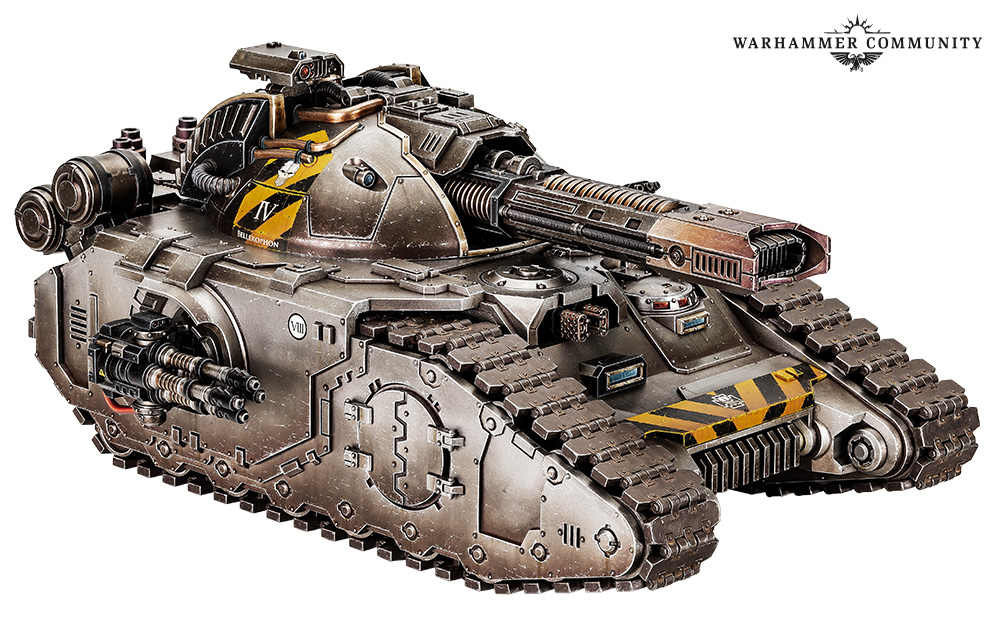 Plastic Glaive. Credit: Warhammer Community
Max:
Plastic Glaive. Credit: Warhammer Community
Max: These are 100% my favourite bits of the book. Things hinted at like the internecine politics of the Arch Magos Argnioss Krown and his conclave of Magi who are tasked with building the Super-Heavies, or their use of the Baneblade chassis as the basis for the tank (mirroring the original resin kits) are the real flavour I’m looking for in these Journals.
I’m also glad that Whirlwinds are getting the proper Heresy treatment with another classic example of the Heresy handwave. “Yes, they always have been here, why do you ask?” that we saw with the Kratos.
Their new lore now sees their development start at the end of the Great Crusade, weaving in their original lore about their initial deployment by the Salamanders on Taral III (that’s also expanded on later in the book). Their role is now more clearly defined in comparison to the Scorpius, with the Whirlwind acting as the saturation fire counterpart to the Scorpius’s targeted missile striker. There’s also a great bit in here about the box launcher on top needing an external loader to reload, which really opens you up to some fun conversion opportunities.
Notable Battles: Paramar V, Portresh, Taral III
Heresy oldheads will recognize the first battle featured in this journal - Paramar V was one of the main campaigns featured in first edition Heresy as part of Black Book III: Extermination. The forces involved were pretty unique - a not-that-sneaky force of armor-heavy Alpha Legion and Mechanicum, up against Loyalist Mechanicum and a Grand Battalion of Iron Warriors. In keeping with other older lore revisited by the journals, the section in here goes into greater detail about aspects of the campaign not covered before, in particular the Mechanicum forces involved and (surprise!) the prevalence of large Super-Heavy armored forces during the campaign.
The other two featured battles, Portresh and Taral III, are new to this book. The Battle of Aldrathan Ridge on Portresh describes a major armored battle between the Ultramarines and Sons of Horus (and is the basis for the missions featured later in the book), while Taral III features an armored force of Salamanders rolling a traitor force of Word Bearers. Both give a perspective of battles larger than your average Heresy game - Legions Imperialis players, these would be great inspirations for you! The lore section wraps up with a timeline of notable Super-Heavy tank engagements during the Heresy, giving players a few more lore tidbits to base their battles off of.
Legendary Mission: The Charge of the Kalaekorus
Based on a notable moment during the Battle of Paramar V, the new Legendary Mission provides a more maneuver and zone of control-based mission for players to try out. The attackers (Iron Warriors with a Lord of War in this case) gain VPs for controlling sectors of the table, rather than individual objectives, with sectors closer to the defender’s table edge scoring higher. The Defenders (the Alpha Legion and Mechanicum) gain VPs for holding the objectives within their deployment zone. This asymmetric scoring is a pleasant change from the rather basic matched victory conditions in the base Heresy rulebook, and with tweaks to the force composition rules could be a great narrative-esque mission to run in campaigns or events.
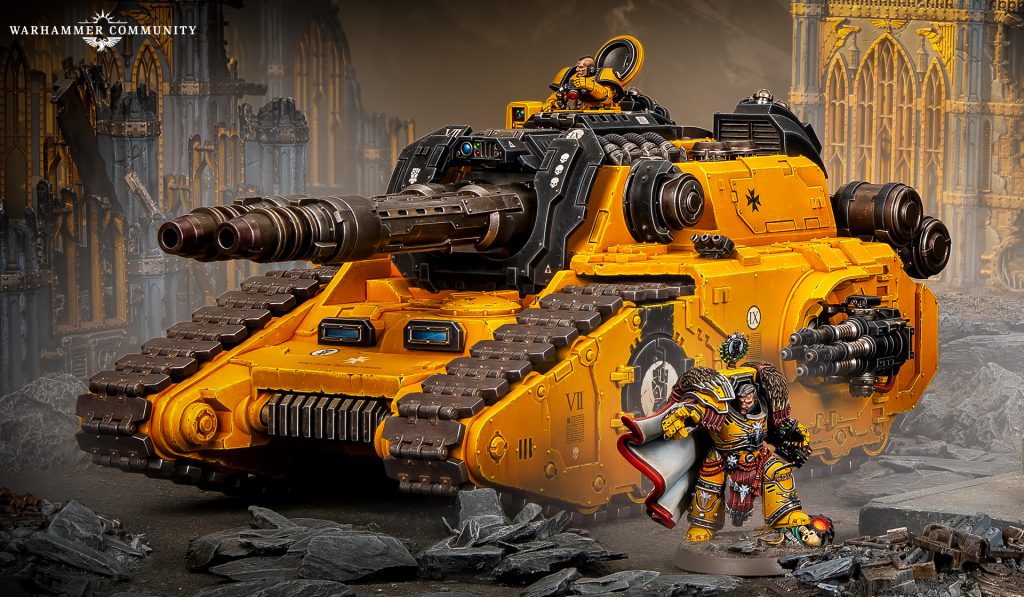 Plastic Falchion. Credit: Warhammer Community
Leviathan Missions
The journal also includes a new game type, called Leviathan missions. These are explicitly made for large points value, large table size games. The rules specifically mention that these missions can be utilized for multiplayer games, the first time I have seen this mentioned for Heresy games outside of Apocalypse missions in first edition.
Max: Large mega battle games are a staple of hobby, whether that be round a mate’s house or at big conventions like Adepticon or the NOVA Open. These generally have been hacked together by EOs (with care and love), so seeing a return to ‘official’ support for these activities is (if only as a baseline from which to create).
These missions also have two special detachments; the Leviathan Armoured Fist detachment lets Attacker players take three Lords of War without affecting the 25% Lord of War limit, while the Leviathan Bastion of Fire allows Defender players to take three Support choices (Max: though honestly you should both just take Bastion of Fire Detachments if that’s the game you’re looking to play).
The journal gives three missions for Leviathan games - Clash of Behemoths, Rolling Bastions, and Break the Lines. All three missions share the split victory conditions shown in the Legendary Mission - the Attacker’s goal is to control as many Zones of Control on the table, and the Defender’s goal is to hold as many objectives as possible against attack. Each mission’s main difference is their deployment zones, which gives each a different gameplay and narrative flavor. In addition, the split objective setup gives Heresy players a refreshing change of pace from the current objective-heavy, Line unit-centric mission design common in the main rulebook. With a little bit of tweaking, these would be great alternative missions to also play in your regular games of Horus Heresy.
Max: Anyone who attended our Tallarn event in the UK last year will know we’re big fans of using Area Control scoring for tanks, so seeing this covered in an official publication is very cool. I wish they’d included a more symmetrically designed mission that allows dual-scoring for both players, but that’s very easy to hack in if you’re planning a big game’s day.
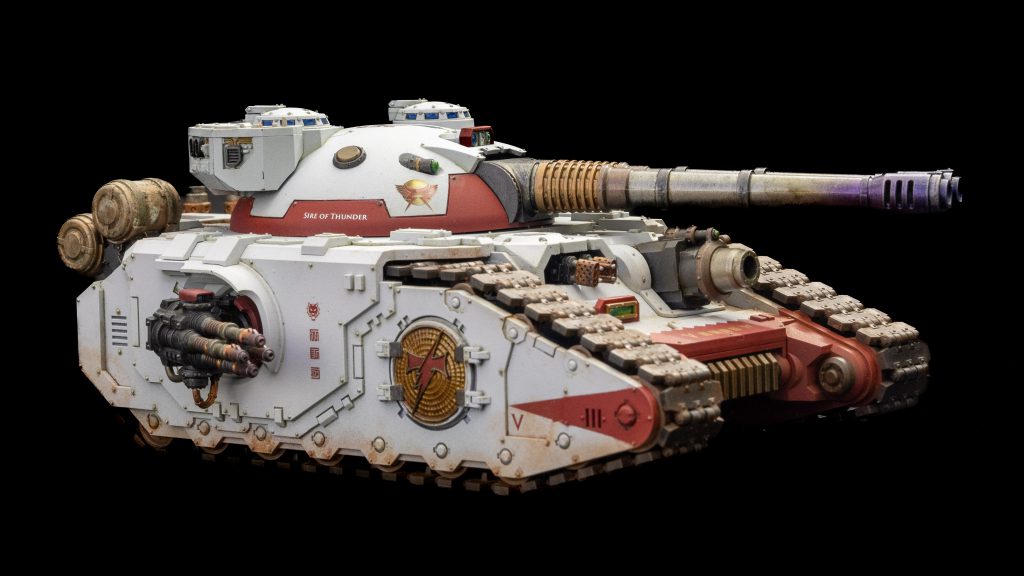 White Scars Fellblade. Credit - Soggy
Battlefield Assets
The Mailed Fist journal also introduces a new Mission Special Rule that can be used in any Heresy game - Battlefield Assets. Representing special equipment and weapons usable by Attackers and Defenders during the course of a battle, these rules give a bit more fun and narrative flavor to Heresy games. After determining who is the attacker and who is the defender, players get a number of Asset Points based on the points level played, that can then be used to acquire special equipment to use during the course of a game. These range from tank traps and neutron bombs, to specialist servitor clades. These are all supposed to be represented by models on the table, so they also give a great opportunity for players to convert up some fun asset markers to represent these with. I personally plan on adding these into as many of my regular Heresy games as I can - they add that little bit of narrative flavor that vibes well with the Heresy aesthetic. Bonus points to GW for including examples of conversions the studio made to represent these - in the modern era of GW, it's always exciting to see the older “just convert these!” vibe pop up in official publications.
New Units
Decurion Magna
Another “angry man gesturing from the top hatch of a tank”, but now in Super-Heavy flavor! Sixty points allows a Fellblade or Falchion to use Overwatch and Return Fire against all unit types, not just Paragon, Super-Heavy, Knight, and Titan units. This gives both vehicles a bit more versatility; with opened-up reactions and the Super-Heavy rules, these tanks with a Decurion Magna can now act as both big game hunters and also zone control units. Secondary armaments can tie up enemy infantry and vehicles with reactions and split fire, while leaving the primary guns to focus on big targets.
Max: Fellblades no longer have to just suck it up when blasted by Melta-Kratoses! Opening up return fire (even if it is just with Sponsons) means you’re much more a risky target for dedicated anti-tank threats. One final little bonus here is the Incursor Pattern Command Array. Super-Heavies can only ever gain statuses in weird ways, i.e. through Shock(x). This piece of wargear now bumps your Auto-repair to (4+) whilst you have the Stunned and Suppressed statuses (the main ones you’ll be getting from Shock) so even in those edge cases scenarios you’ll have a chance to clear it (though a dedicated techmarine/forge lord will do this more effectively, at the
start of your turn).
It would have been fun to see the Glaive able to take the Decurion Magna as well (their exclusion’s a bit weird given the Volkite Carronade isn’t a defensive weapon). Overall, the Decurion Magna would be a solid pick for Fellblades and Falchions if you have the points.
Max: Whilst this definitely opens up your Super-Heavies to more tactical play, 60pts extra on a 650pt hull feels like a lot. Given the best way to deal with big threats like these is to generally just ignore them, there’s a risk that the Decurion dissuades them from engaging with it entirely to focus on your scoring units. But in vehicle heavy metas or Leviathan missions it’s definitely got legs. And besides the modelling opportunities alone are worth it.
Whirlwind
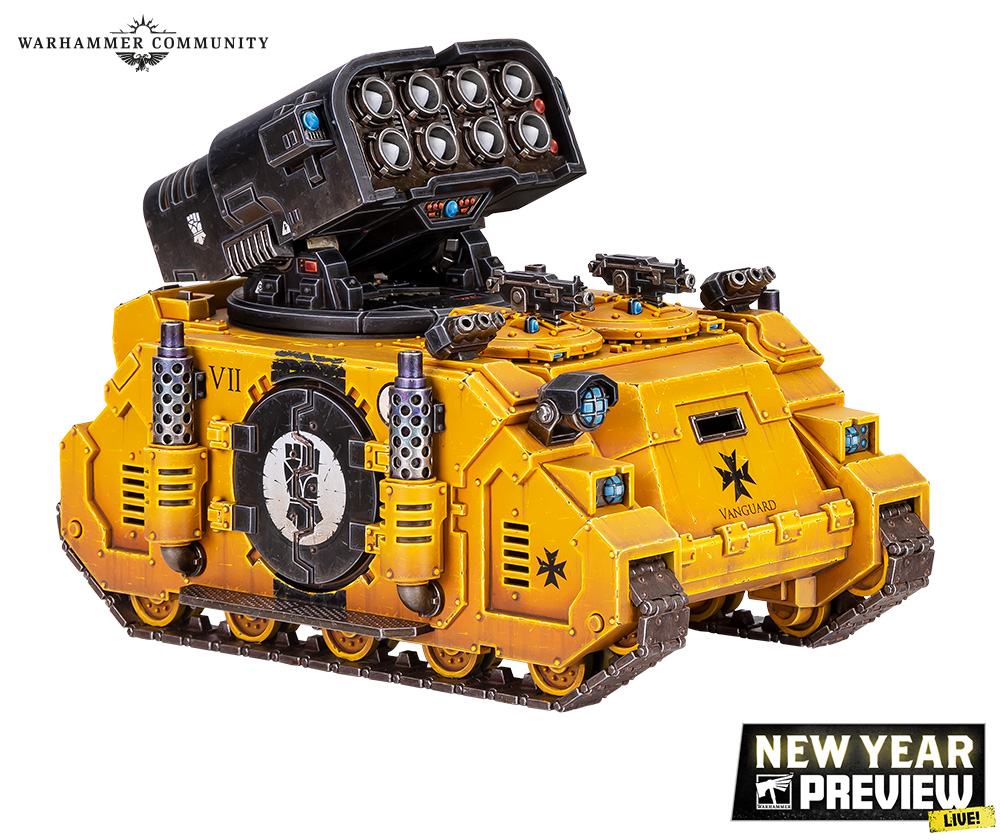 Plastic Whirlwind. Credit: Warhammer Community
The Whirlwind is 100pts and is your standard rhino based vehicle with 12/11/10 , 5 HP and a slightly slower movement of 10. The thing weighing it down is its main armament, the Whirlwind Missile Launcher. It has a 48” range and comes with one profile as standard:
HE Missiles are effectively a bigger, better havoc launcher with S6, AP4, Blast (5”), Stun (1), Barrage (1). AP4 is the minimum you want for chaff clearance against any non-marine armies, but as Marine players aren’t really lacking in options here. Anything you’re bringing to eat other marines (Plasma Contemptors, Conversion beamer Preds) do this already. Whilst the combo of Barrage (1) and Blast (5”) make this reasonably accurate out of line of sight, given the prevalence of Stun (1) from the ubiquitous (and highly undercosted) Havoc Launcher in any armoured list you’re not really gaining much additionally.
For 10pts, you can also include a Pyrax Missiles profile. These are S5, AP5, Blast (5”), Panic (1) and Barrage (1). Whilst weaker, these seem like an auto-take; having flexibility on which profile to use and what statuses you’re throwing out is great. Plus you can easily stick a Havoc Launcher on this for the potential to fire out 2 status checks a turn.
All in all it’s a neat little tank. I am gutted they didn’t go wild with the missile types like those mentioned earlier in the book (Viral, Grav and Phosphex missiles would have been class). Still I can see this easily fitting into a Armoured list as a low priority threat that can target pesky Line units hiding behind Medium Terrain.
Should You Buy This Book?
Despite being rather light on unit profiles compared to the other journals, Mailed Fist brings a lot of value to the table for Heresy players. Lorewise, we get Imperial Armour-esque background on some iconic Astartes armored vehicles, and some great background on battles. Both the Legendary Mission and the Leviathan Missions provide some much-needed alternative ways to play Heresy outside of the main rulebook missions, and the new Battlefield Assets special rules give some extra narrative flavor to all Heresy games as well. The new Decurion Magna gives some versatility to Astartes Super-Heavies, and the return of the Whirlwind to Heresy is welcome, but I wouldn't recommend picking up the book if you are only looking for the rules. That said, everything else in the book gives great value to Heresy players, both in terms of lore and giving their games additional depth.
Have any questions or feedback? Drop us a note in the comments below or email us at contact@goonhammer.com. Want articles like this linked in your inbox every Monday morning? Sign up for our newsletter. And don't forget that you can support us on Patreon for backer rewards like early video content, Administratum access, an ad-free experience on our website, and subscriber-only content covering competitive Warhammer 40K!Thank you for being a friend.
 This website uses cookies. Learn more.

 Goonhammer App and Patron Updates: April, 2026
 Kill Team Tournament Report: Engage, Party, Repeat's March Madness 2026
 Goonhammer Reviews: Tribal Conquest