If you’ve ever worried that your gaming table might not be big enough to play out the battles of the Japanese “warring states” period in the 15
th and 16
th centuries, worry no more. Osprey Games has you covered with
General Orders: Sengoku Jidai, a game that packs a lot of punch into a very small footprint.
General Orders: Sengoku Jidai comes to us from David Thompson and Trevor Benjamin, a design team who are no strangers to distilling complicated wars down to simple, elegant game designs. Their
Undaunted series combines light deck building with an innovative tactical movement system to recreate a whole host of WWII battles, from the storming of Normandy to the siege of Stalingrad. The previous entry in the General Orders series also covers WWII, but with the details stripped away to the point that it becomes more of an abstract strategy game.
For
Sengoku Jidai they’ve wound the clock back a few hundred years to further refine the General Orders game system, which combines worker placement and area control, with a bit of card play thrown in to keep things interesting.
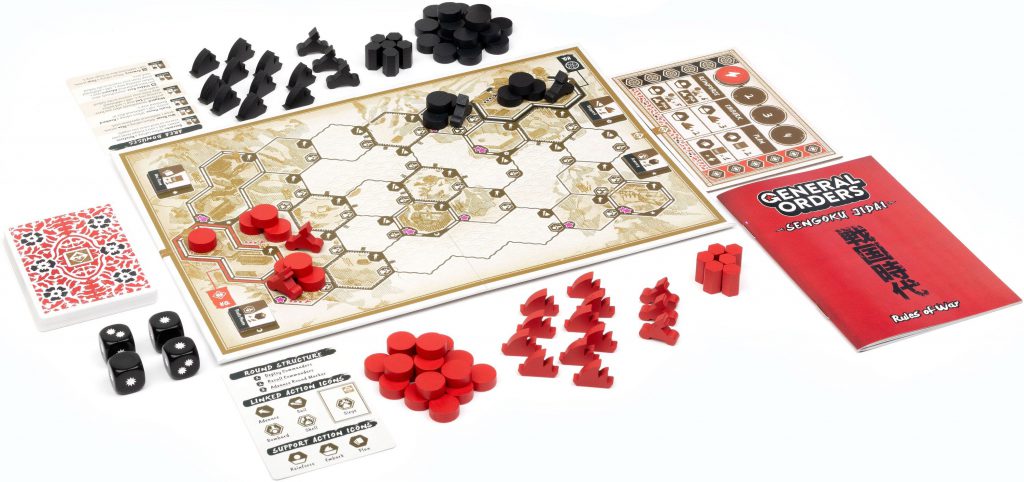 Image credit: Osprey Games
A Tiny Little War
The small, double-sided board gives us a choice of either a river battle or a fortress siege, each with their own peculiarities. The rivers board is intended as the basic game, and features a symmetrical hex pattern consisting of land and water spaces. Each hex has one or two worker placement spots, where players will place their commander tokens in order to move troops and ships (which may start a battle), bombard land spaces from the water, or use land units to shell nearby ships.
The game is played over four rounds. Each player has five commanders, and thus five actions per round. These actions can be used on the board to move and attack, or off the board to place more troops or ships, or to draw Operations cards, which can be used during later turns to improve attacks or defenses, or add extra benefits to the standard actions. Since it takes an action to draw one or two cards (depending on who gets there first), one of the game’s many agonizing decisions is whether to spend a commander now in order to gain a possible benefit later.
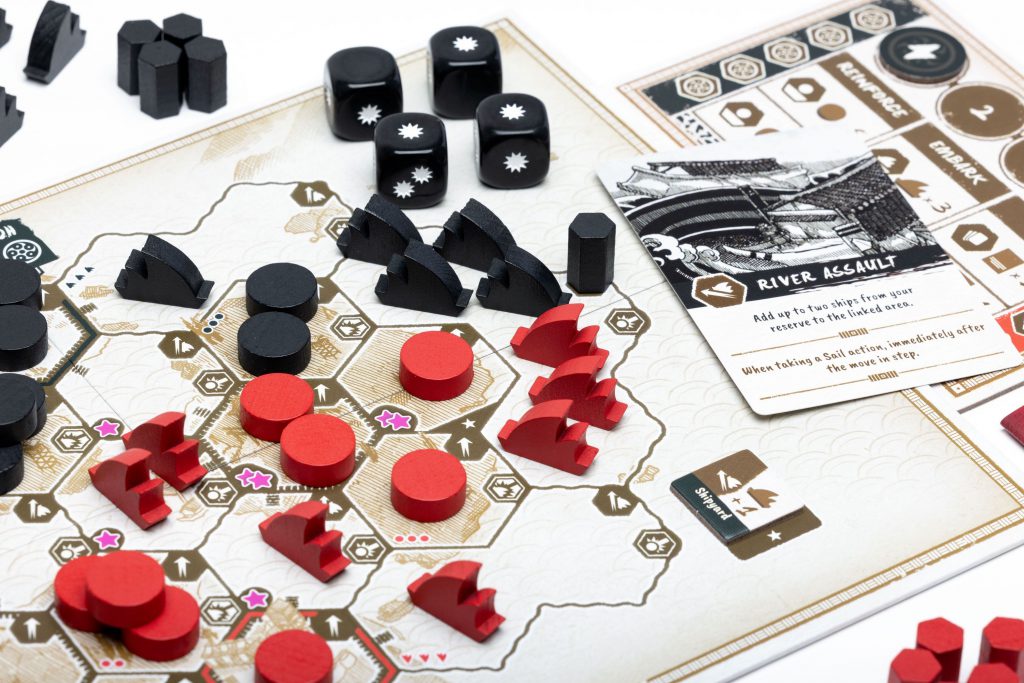 Image credit: Osprey Games
Marching Through the Hexes
There are a few concepts that keep the area control aspect of the game interesting. One is the idea of supply: in order to do anything, a player’s forces on the board must be able to trace a route of occupied spaces back to their starting HQ space. If they get cut off from headquarters, all they can do is defend themselves until they reestablish their supply chain.
The game’s worker placement aspect requires players to make thoughtful decisions about movement. In order to move troops or ships, the player places their commander in the hex they’re moving into; since there’s only one movement spot per hex, you can’t immediately respond by moving in to attack a force your opponent just moved. You have to think at least a round ahead. Compounding this is the rule that when you move out of a space, you have to leave at least one troop behind to occupy it – there’s no giving up ground in this game.
Fighting and Winning
Once you do move into a space with enemy units, a battle is triggered. Battles in General Orders tend to favor the defender: when the attacker moves their units in, the defender gets to roll a die, with will eliminate between zero and two of the defender’s units. After that, battles are decided by attrition, with each player removing units one by one until only one player’s units remain. It makes battles very costly, especially for the attacker, and with a limit of five units per space, you really have to think about what you’re doing and whether it’s worth the price.
Several spaces in the middle of the board are marked with one or two control icons. You can force an early victory by taking over your opponent’s HQ space, but normally, victory is determined by whose units are sitting on the most control icons at the end of round four.
Let’s Try it Another Way
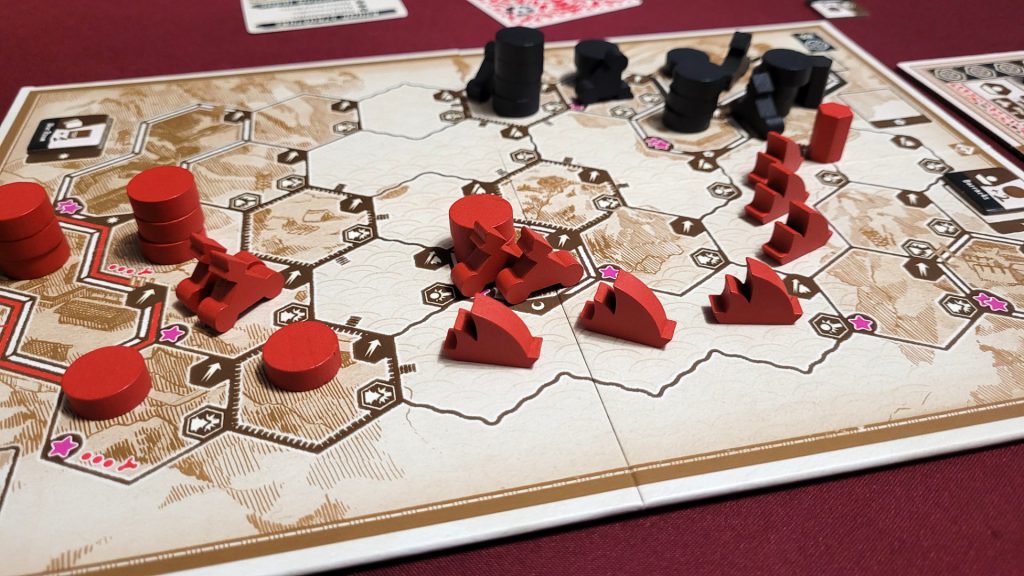 A Fortress Siege game in progress. Image credit: Jefferson Powers.
Once you’ve had your fill of river battles, you can flip the board over and give the Fortress Siege a try. This board is asymmetrical, with one side’s HQ occupying a smaller island than the other and providing a different mix of water and land spaces to contend with.
This game mode comes with its own separate deck of Operations cards, and adds siege engines into the mix along with a new action. A Siege action allows players to place siege engines on the board, and use them to attack the opponent’s troops from a neighboring space, without risk to their own. It’s similar to the bombarding that ships can do against neighboring land troops, but with a bit more leeway as far as where the attacks can be directed from. Of course, siege engines are vulnerable to attacks from enemy troops, and bombardment from ships if they’re close to the water.
But Does the Theme Come Through?
The action in
General Orders is abstracted to an almost chess-like degree. Troops, commanders and ships are reduced to simple wooden tokens, and the board, while graced with some lovely artwork by Tanner Staheli, reduces the battlefield to essentially a grid of hexagonal spaces with icons indicating what actions can be performed in each one. The cards are illustrated with battle scenes depicting soldiers in samurai armor and Japanese castles and ships, but even the artwork is a little on the simple, abstracted side.
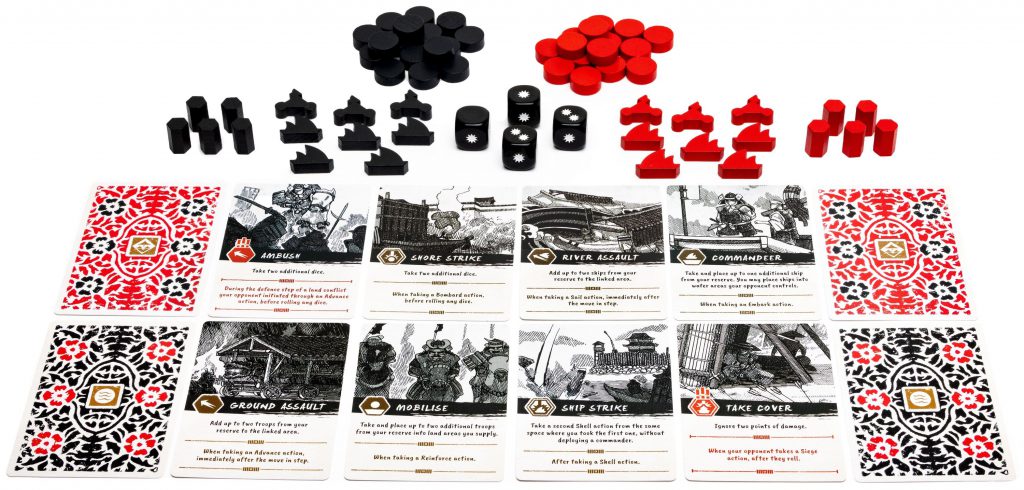 Image credit: Osprey Games
You’re not likely to learn much about Japan’s Sengoku period in this game, and it will take a little but of imagination to remind yourself that these little round discs are meant to represent armies of samurai cavalry and ashigaru footsoldiers. I couldn’t even say whether or not the game’s strategic choices are an accurate reflection of the sort of decisions that a Japanese commander would have been making at the time.
That's not to say that the game isn't great to look at: the sepia board artwork and the striking black and red pieces give the game a lot of table presence. It looks great, but
General Orders: Sengoku Jidai does not offer what anyone could reasonably call a deeply immersive experience.
What it does offer is an intriguing, practical, and playable wargame, abstracted enough to be simple while still offering at least a sense of its theme and setting. It’s easy to learn but gives you a fair amount to think about during the game, and once you’ve learned it an average game takes about 30-45 minutes to play. That, combined with its small box size and table footprint, make it a great little game to play in between heavier fare on game night, or even to take to the pub or coffee shop for a quick bit of wargaming.
Have any questions or feedback? Drop us a note in the comments below or email us at contact@goonhammer.com. Want articles like this linked in your inbox every Monday morning? Sign up for our newsletter. And don't forget that you can support us on Patreon for backer rewards like early video content, Administratum access, an ad-free experience on our website, and subscriber-only content covering competitive Warhammer 40K!Thank you for being a friend.
 This website uses cookies. Learn more.


 Goonhammer App and Patron Updates: April, 2026
 Kill Team Tournament Report: Engage, Party, Repeat's March Madness 2026
 Goonhammer Reviews: Tribal Conquest