 Image credit: Games Workshop
It's a tale as old as time- or at least sixty-six million years of it. A giant rock hurtling through space slams into the Yucatan Peninsula at a speed of around 45,000 miles per hour. The impact vaporized rock, ejecting massive, superheated quantities of it into the atmosphere where it immediately began raising the global temperature. What goes up must come down, and like a hellfire snow the debris fell back to earth where it sparked wildfires all over the world. Plenty of dust remained airborne, so thick that it blocked out the sun. Tsunamis- some as high as a
thousand feet- hurtled towards coastlines all over the hemisphere.
Over the months ahead, rain suffused with sulfuric acid scoured the land and surface of the oceans. Deprived of the warming rays of the sun, the planet rapidly cooled. Like kicking the stool out from under a condemned man, the food chain collapsed as the acidity and loss of photosynthesis led to mass die-offs of both plants and phytoplankton. One domino after the next fell, and ultimately this led to the extinctions of around 75% of life on Earth.
Like any imaginative kid obsessed with dinosaurs, I'd often wondered what life was like in those grim last days. Intriguingly, Black Library debut novelist
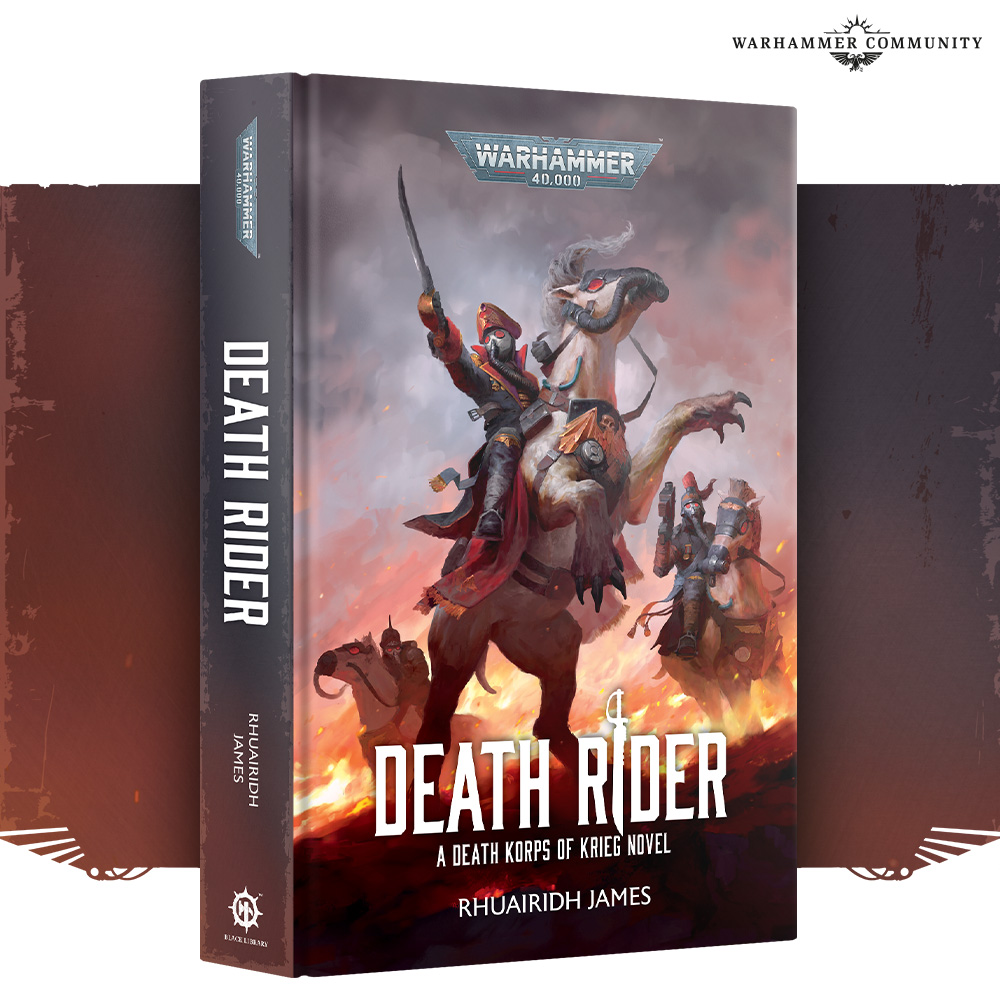
Rhuairidh James asks us to imagine just this sort of scenario- placed nicely in a grim, dark setting, of course- in his debut novel
Death Rider.
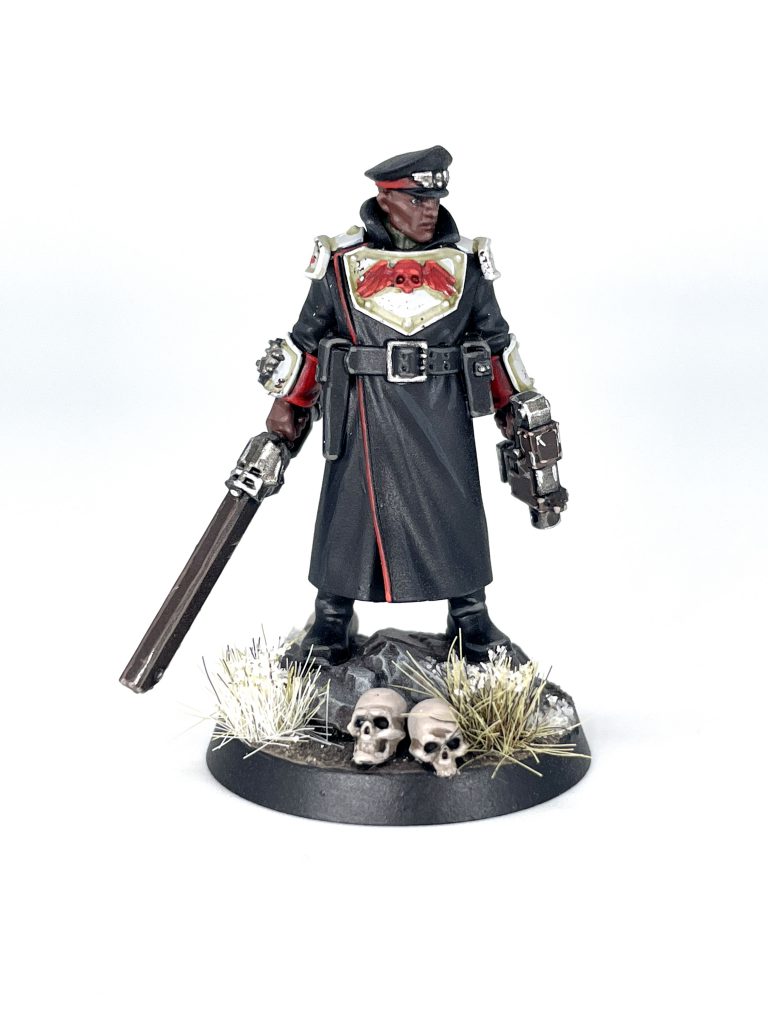 Imperial Guard Commissar. Credit: SRM
Battlefield Promotions
If you wanted to see the Black Library talent pipeline in action, you could certainly do worse than James. An employee of Games Workshop since 2017, he got his start as a content writer including long-form content for the website, email copy, and podcast scripting. Three years later he was promoted to Background Writer, and then in 2022 came his Black Library debut.
The Inevitable Siege was an Age of Sigmar short included in the anthology
Conquest Unbound: Stories of the Mortal Realms, and James showed off his range two months later when a 40K tale,
The Sum of its Parts, was featured in 2023's Astra Militarum Week digital subscription. Ultimately, less than a year after
The Inevitable Siege James had leveled up into longer form prose:
Da Gobbo Rides Again, a novella, was published that October.
Up until this past year, James would have had the distinction of being the first 'rookie author' to pen a Gobbo book, as
Mike Brooks,
Justin Woolley, and
Denny Flowers already had books under their belt when offered theirs. It's a distinction he now shares with Andi Ewington, whose
Da Red Gobbo's Last Stand marked his Black Library debut
1.
And now James has leveled up once more, adding his name to the pantheon of Black Library novel-writers with
Death Rider.
A Ticking Clock
It's not often we get genuine ecological disaster prominently featured as a book's narrative device unless it's the result of one of the setting's many antagonists. The end stage of Tyranid world digestion was the terrible setting of
Victoria Hayward's sublime
Deathworlder2, while the caustic and corrosive fog that made the early arc of
Master of Rites by
Rob Young (
review) feel so suspenseful and sinister were both directly (and deliberately) caused by actions of each book's adversaries.
While it's not a lizard-killing meteor, Death Rider's environmental calamity comes when a massive Imperial Navy command flagship, the
Caedis Omnis, is brought down while attempting an atmospheric skimming maneuver. These sorts of highly risky evasive tactics are technically banned over civilized worlds in the Imperium, but desperate times call for desperate measures when faced with annihilation at the hands of the T'au fleet.
Except... it didn't work, and the mortally wounded
Caedis Omnis smashes into Rezlan VI's surface. Think, "dino-killing meteor" effects to the planet- but with the added spiciness of massive radiation from all the engine cores rupturing. In a stroke, an "abundantly habitable" Imperial planet became a grade-black death world.
Valian Hesh is an Imperial Commissar to a Death Korps regiment, a posting that ranks just above retirement planning in terms of usefulness in the Astra Militarum. The Krieg, remember, are the ultimate "no retreat, no surrender" fanatics happy to throw their lives away in the name of duty if it can net a campaign one inch closer to goal
3. There isn't a lot for a Commissar to do (and Hesh is not himself a native Kriegsman), so many spend their time on other, related assignments. For Hesh, this means secondment to other regiments in preparation for possible joint-regiment operations.
This gives him a comparative ringside seat when the
Caedis Omnis delivers its mortal blow to the planet in the North, and the first arc of the book involves the desperate march for Hesh, his adjutant Jens, and others they encounter along the way to reach the Southernmost evacuation point. Once they do, Hesh is then tasked with recovering his Krieg regiment, the 472nd Siege, who appear to have gone rogue and headed off to fatalistically assault the T'au massing in the South.
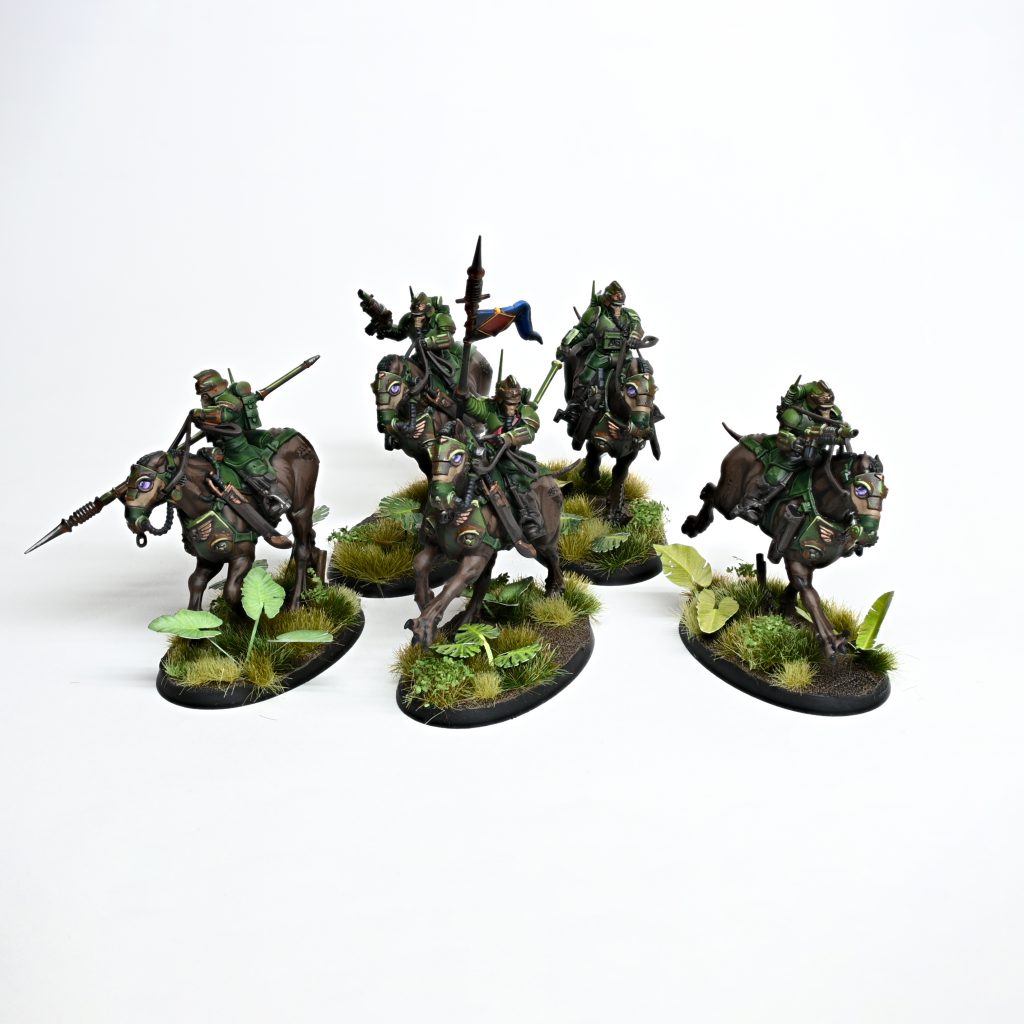 Death Riders. Credit: Rockfish
Road Warriors
I wish I could remember who said it in order to credit them, but it was pointed out that
Death Rider is somewhat like a 40K version of
Cormac McCarthy's story,
The Road. The parallels are certainly there, as both involve a long, drudging journey across apocalyptic (or post-apocalyptic) hellscapes. And while you'd expect the dreary bleakness of that tale to be a natural fit for the grim darkness of the far future, James takes it in a very different direction.
Instead, he strikes a delightful balance between his setting and his characters. Yes, the sense of mounting doom as always at their heels, a fact the reader is routinely reminded of through the little details like rad counters and bleeding gums
4. But the characters themselves, they're a lot more alive and vibrant.
James accomplishes this largely through the subtle use of humor, and it works. There's only one Commissar Cain and to his credit James stays well away from Mitchell's tone. Where Cain's tales are funny stories infused with witticisms and the odd bit of slapstick, Death Rider is written as a serious story with a protagonist who possesses a sense of humor. The interplay between Hesh and the buttoned-up (
actually Krieg) Jens reminded me less of Ciaphas Cain and Ferik Jurgen and perhaps a bit more- and I'm dating myself here- of
Doonesbury's Uncle Duke and Honey Huan.
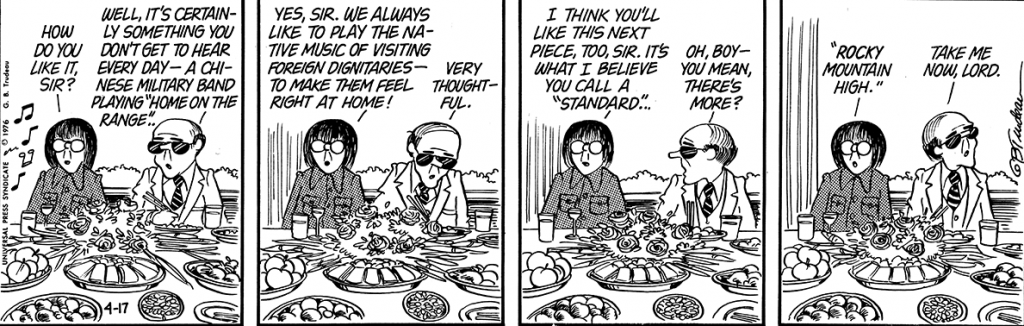 Image credit: Garry Trudeau
James is terrific at writing dialogue and moments that brings his characters to life, replete with little details that make them feel whole and lived-in. Hesh's first ("and second-last") kiss, behind a statue in Krieg Cavalry School. Sentinel pilot Lance's crumpled collection of ration sweets. "Human and equine chirurgeon" Ashe's folksy, feudal-world echoes. And of course, this wonderfully insightful passage:
Jens watched as he attempted to straighten himself out. Jens almost never removed her mask. When they had first started serving together, at the start of the Rezlan VI campaign, he had found it difficult to pick her out from other Korpsmen. Only her uniform was a guide. When they ate – When there had still been food, thought Valian – she had pulled her mask up and wolfed down her rations, showing only thin, scarred lips and uneven teeth. Valian had fastidiously looked away, out of politeness, until she asked him to stop. Valian was confused.
"I thought you Krieg like not to be looked at?"
"I am uncomfortable being the object of attention. When you’re looking away, I feel very central in your attention, sir."
So much of my enjoyment of
Death Rider was through its characters, and the first half of the book keeps them firmly in the frame.
Playing for Creeps
The other thing James wove particularly well here were his adversaries. A rogue armored column that they come across in the South felt less like
Mutiny on the Bounty and more like
Max Max, pitch-perfect to the setting at that stage of the unfolding apocalypse. Contemptuous T'au pragmatic enough to exit the stage when doing so meant "humans killing humans... better than humans killing T'au."
A hunting pack of kroot canny enough to mimic human speech at a time when communications were at their most chaotic is particularly delicious
5, but pride of place goes to a particular Commissar that looms large over Hesh throughout the course of the book. I don't want to spoil anything, but their
deeply personal climactic confrontation was masterful, with a level of emotional payoff I don't often find in genre fiction.
"You really were my favourite, you know. Vile little creature... I don’t know how you made it this far. I should have killed you, but I loved you too much."
Ten out of ten, no notes. When
John Rogers says that "the villain is the hero of their own story," it absolutely resonates here.
So to recap, we have a terrific premise, delightful characters, and a well-drawn gallery of enemies. I'd like to say that it was enough to carry the book all the way through, but somewhere around halfway though it started to lose cohesion.
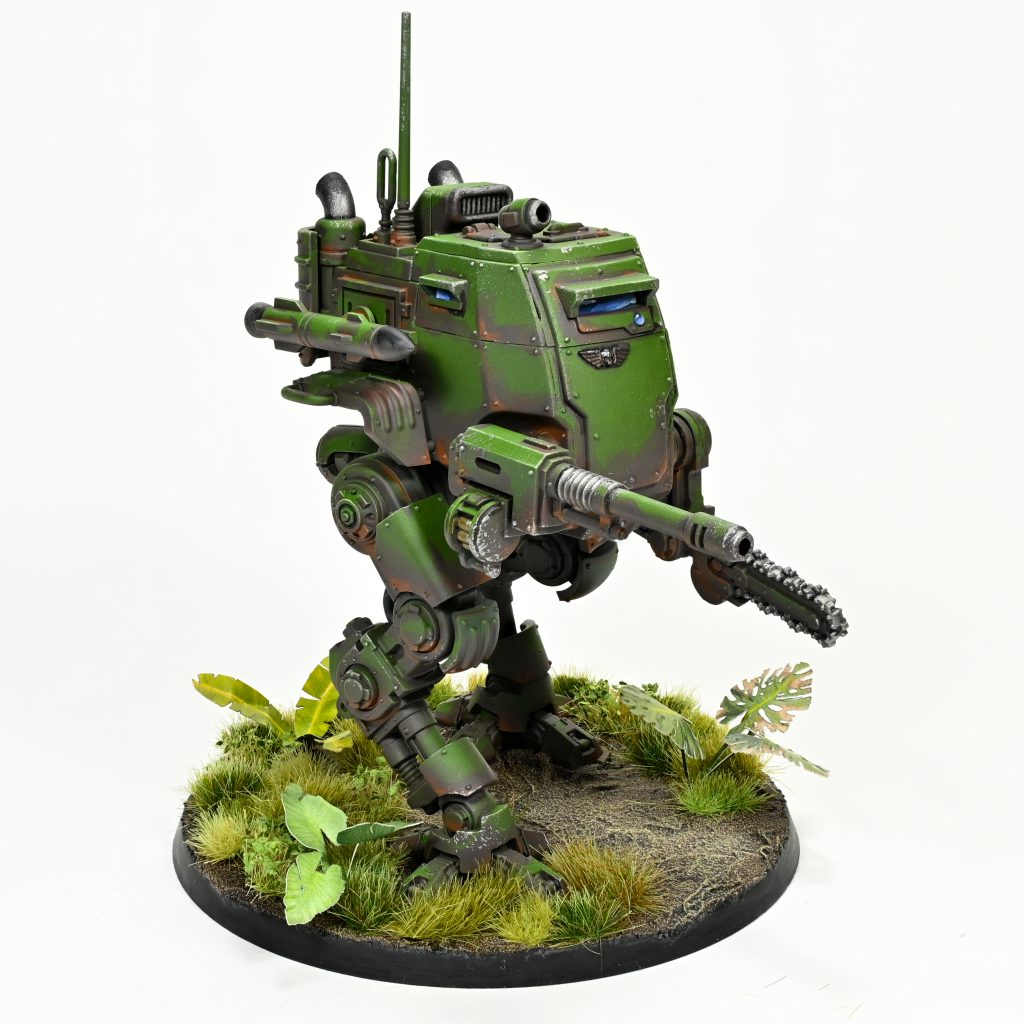 Armoured Sentinel. Credit: Rockfish
Shooting Blanks
In my last
Beyond the Black Library article,
a review of Richard Fox's Thane's Gambit, I dove into the notion of authenticity, lived experience, and how Fox's background as a combat veteran imbued his military sci-fi tale with terrifically-constructed action sequences. For another example,
Moby Dick author
Herman Melville himself served aboard whaling ships for years. But by the same token, fiction isn't documentary filmmaking- if you can imagine it, you can write it (at least to a certain degree).
Without that core of experience, however, the task is going to be a measure more challenging, and its kinetic scenes are where I found
Death Rider to be at its least effective. This was largely down to ambiguity and vagueness in some of the action, where I'd find myself reading and re-reading passages to try and be able to visualize what James had envisioned when he'd written them. The tank battle against he t'au was particularly confusing, and at a certain point I just decided to go off of vibes rather than details and soldier on.
Well-choreographed fight scenes to me are like process maps. They need to be detailed and well-documented, so that the reader can follow along with the action rather than become detached from it. In both cases, one of the greatest dangers to comprehension is assumed knowledge. That's where the writer skips details because they think- often subconsciously- that the reader is able to follow along
6. Too often these passages in
Death Rider felt like they needed just a little more time in the oven.
Final Thoughts
Overall, my concerns about the depictions of action scenes weren't enough to derail my enjoyment of the book- but they did menace it from a distance. That's because the action really starts to pick up in the book's back nine, and a lot of the character-building and delightful details that so populated the first half start to become eclipsed by the increasing momentum of the second.
James writes with a very distinct voice, and in building up his characters it was given time to stretch and breathe. The humor in particular was a nice touch, whether it's Hesh fumbling with his stimm pills or the banter between characters, but he also pulls from his writer's toolbox throughout the book with tense changes, flashback chapters, and even creative use of white space on the page (all just judiciously enough to nicely season the novel rather than feel gimmicky).
Earlier this week author
John French (
Dropsite Massacre, The Hollow King)
commemorated the 15th anniversary of his first novel,
The Lies of Solace, noting that he'd learned a great deal writing it. When asked what he might have done differently if writing it today, he replied, "I wouldn’t have planned it as much! I had everything nailed down in advance but that caused me some serious issues when it came to actually writing it. Don’t get me wrong, I’m a fan of planning, but I now write plans as helpful maps through writing a story rather than a blueprint."
It's always fascinating to see how writers grow and develop in the craft from work to work. So while
Death Rider ultimately felt a bit uneven, there was a lot to like- and even some things to love here. I'm already looking forward to James's sophomore effort.
Footnotes
- It's important to note that I mean 'rookie' in the Black Library sense. While James had done a lot of writing in-house for Games Workshop, Ewington was also a previously published author. We looked at his most recent, non-Warhammer novel recently as part of our Beyond the Black Library series.
- My Book of the Year for 2024, the Tyranid body horror was next-level stuff.
- This sounds a bit two-dimensional in summary, but there's more depth here than it seems. The Krieg abhor waste, and don't sell their lives lightly.
- Mother's milk to a Cold War baby like me, this was terrific stuff and if anything I'd have liked to see a little more of it explored here.
- I've never been a fan of the kroot, but they're growing on me. From Fehervari's sinister pack in Fire Caste to Mitchell's Gorok in For the Emperor, James has probably given me the last nudge I needed to be at peace with the fact that the upcoming Dark Heresy Collector's Edition opted to offer a kroot statuette rather than something more appealing7.
- My litmus test for a process doc is whether or not a complete stranger to the process could still navigate it using only the document.
- What the hell am I saying, it really should have been a Night Lord.
Have any questions or feedback? Drop us a note in the comments below or email us at contact@goonhammer.com. Want articles like this linked in your inbox every Monday morning? Sign up for our newsletter. And don't forget that you can support us on Patreon for backer rewards like early video content, Administratum access, an ad-free experience on our website, and subscriber-only content covering competitive Warhammer 40K!
Thank you for being a friend.
 This website uses cookies. Learn more.


 Goonhammer App and Patron Updates: April, 2026
 Kill Team Tournament Report: Engage, Party, Repeat's March Madness 2026
 Goonhammer Reviews: Tribal Conquest