 Image credit: Games Workshop
Starring
Tommy Lee Jones and
Anne Heche,
Fox's disaster movie
Volcano released in April of 1997 to a somewhat muted reception. Costing $90 million, it made only slightly more than half of that in its domestic box-office run. There were a number of reasons for this, ranging from the "surprisingly cheesy" plot with "lock-step storytelling" to the less-than-realistic lava effects, and the movie would go on to be nominated for a Razzie Award. Not to be discounted, however, was the
Dante's Peak effect.
Dante's Peak was another volcano disaster movie-this one with
Pierce Brosnan and
Linda Hamilton- that had released by
Universal in February of the same year. Rather than a volcanic event in Los Angeles, this one in Washington state. Ultimately neither film would do particularly well at the box office, reflecting some of the perils of what are known as "twin films," or stories that share similar plot elements and are released in close proximity to one another. Hollywood has plenty of other examples (
Armageddon vs
Deep Impact in 1998,
The Illusionist vs
The Prestige in 2006, etc), and the reasons run the gamut from coincidence to zeitgeist all the way to suspected plagiarism.
I was reminded of this as I approached reading
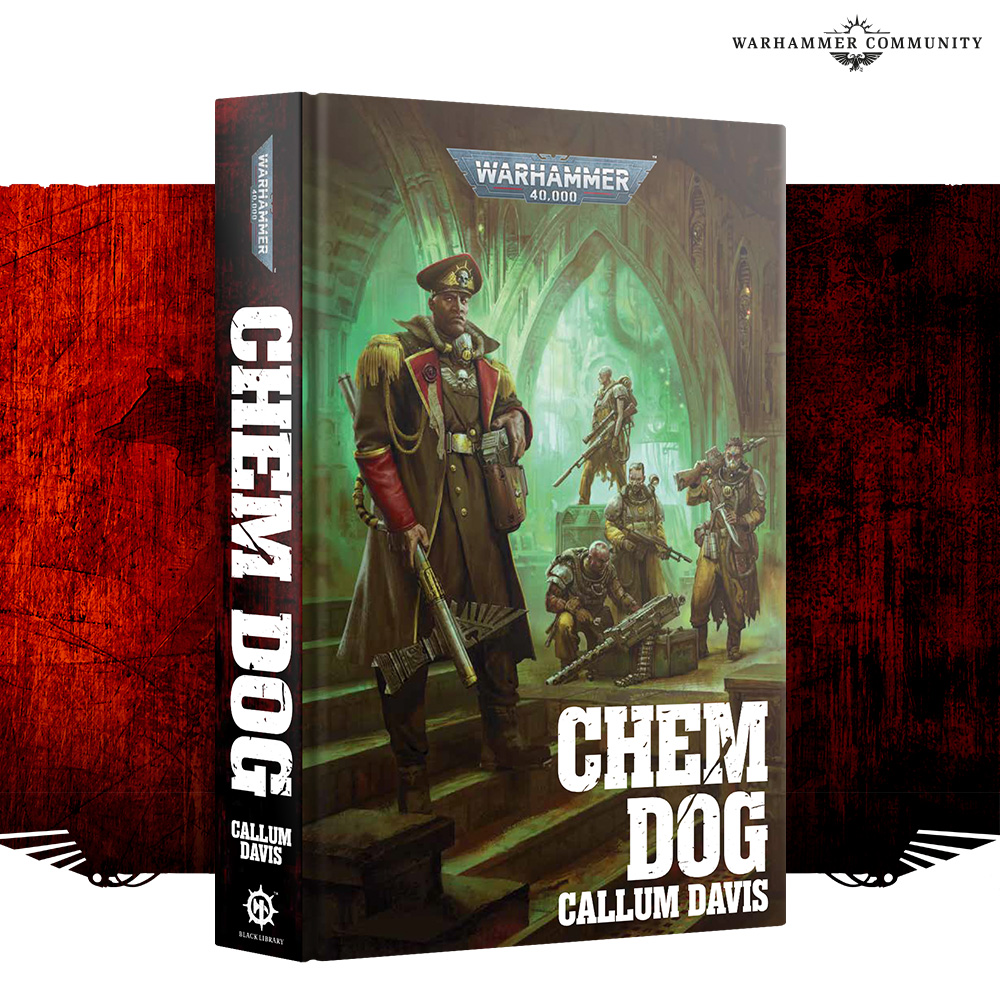
Chem Dog so soon after having completed
Death Rider (
review), as at first blush there seemed little shortage of parallels. Both books feature a Commissar who is a mis-fit for his regiment- whether its the personable Hesh and the stoic Krieg, or the martinet Hasp and his "mongrel" pack of Savlar Chem Dogs- and both prominently revolve around these Commissars leading their squads on a long journey through desolate, almost post-apocalyptic terrain.
The discerning reader will be happy to note, however, that the similarities extend little further than surface-level. Coincidences aside,
Death Rider and
Chem Dog are very different books in both tone and tenor. And indeed, Chem Dog is the first book this year that will be in consideration for my Black Library Book of the Year recognition.
Master and Mongrels
Things haven't been going well for the Imperium on Kruxx.
The Orks have not only mounted a full Waaagh! in the sector, but they've managed to establish a presence on the planet by taking over an Imperial bastion. Various regiments of the Imperial Guard- from the Mordians to the Krieg- have been tasked with taking it back- itself no small order as the Orks have been steadily building it up and reinforcing it ever since.
Meanwhile, Commissar Hasp has been assigned to lead a kill team of (deeply expendable) Savlar on an insertion and recovery mission. Turns out there's some vital Commissariat intelligence that was left behind in the fortress when the Orks took it over, and they need it back.
For those assigned to it, if it sounds it's a punishment detail that's because it is. The Savlar selected for the mission include those recently spared executions (see the short story
Those Without Mercy), while Hasp volunteered himself for it when he had the temerity to question the Lord Commissar's orders.
To get there, the squad will have to overcome a forced march through the ash-covered no-man's land, find a way inside the fortress, and recover the cache- a mission that would give Tempestus Scions pause. Not only that, but they'll have to overcome their antipathy for one another. To Hasp, the Savlar are the worst of the worst, dregs of the Imperium who sully its honor even by being allowed to don a uniform. To the Savlar, Hasp is an insufferable taskmaster who never tires of reminding them of their worthlessness.
Chem Dog marks the novel debut of
Callum Davis, whose trajectory to this point has followed an interesting path. He'd gotten his foot in the door at Games Workshop in 2015 as an Editorial Assistant, leaving behind a two-year stint at the Bank of England. By 2018 he'd become a Background Writer, and begun having short stories placed within the covers of
White Dwarf magazine.
The next jump came in 2020, when the Psychic Awakening narrative campaign kicked off for Warhammer 40,000's 8th Edition. This was a series of lore-and-gamebooks not dissimilar to the recent
500 Worlds and
The Maelstrom: Lair of the Tyrant, and unlike today's Collector's Editions (where you're mainly paying for a cover treatment) each of these contained additional lore and short stories
1. Davis's story
The Piercing Eyes appeared in
Psychic Awakening: Ritual of the Damned, followed two months later by
The Stand of the Saber in
Psychic Awakening: Saga of the Beast.
While the degree to which
White Dwarf and tabletop-book fiction intersect with the Black Library is a matter of some interpretation
2, Davis and the other Psychic Awakening short-fiction writers got their Black Library stripes when all thirty-four stories were published under the Black Library umbrella with
Psychic Awakening- The Collected Fiction3.
But from there Davis was off to the races. While he'd ultimately leave Games Workshop at the end of 2022 to be head of lore at video game company Plarium (maker of fantasy gacha auto-battler
Raid: Shadow Legends), he'd see two short stories placed in 2022's
The Successors: A Space Marine Anthology and another one (
Lessons of Rorphax, originally in
White Dwarf #482 in 2022) included in 2025's
Darkness Eternal: Stories from the 41st Millennium anthology.
But the big one, at least for today's purpose, was the aforementioned
Those Without Mercy from 2024's Astra Militarum Week. This was the story that not only introduced us to Commissar Hasp and a motley crew of Savlar Chem-Dogs, but directly set up the events in the novel.
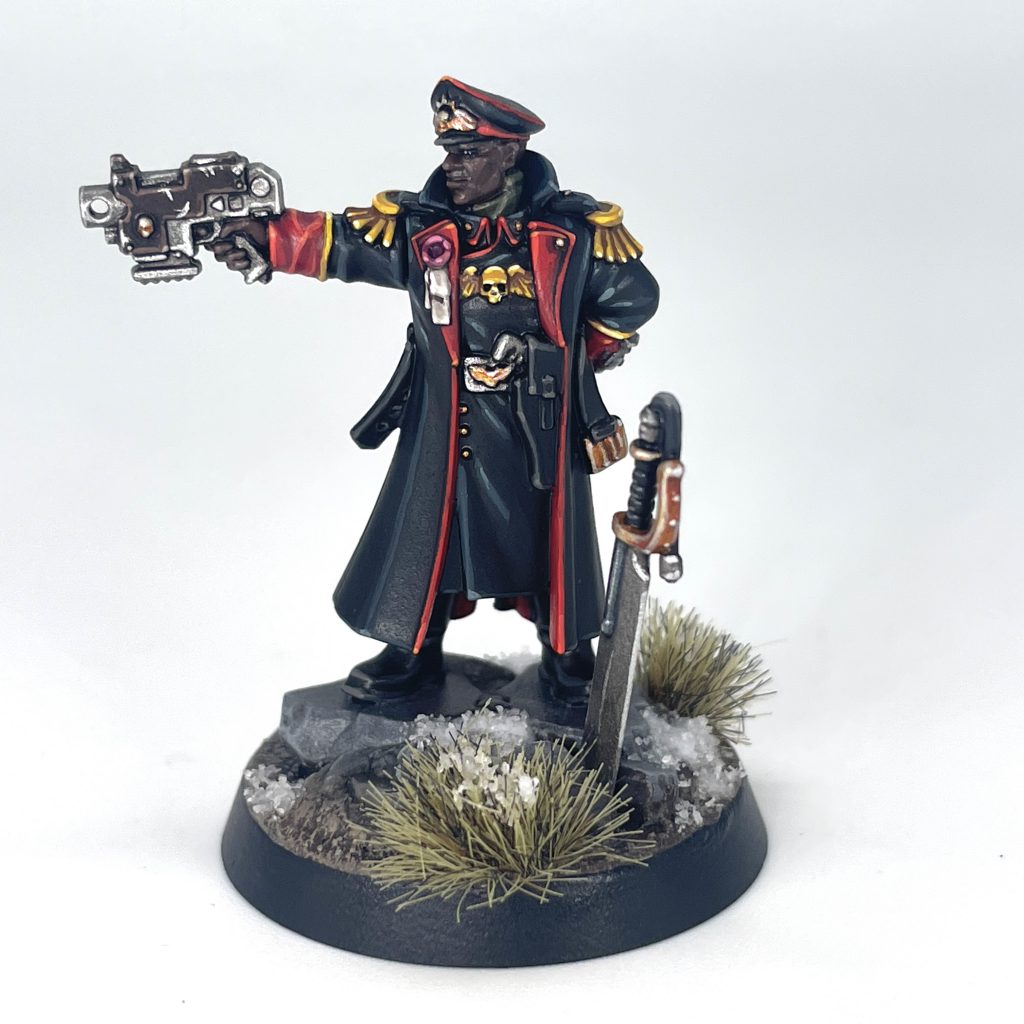 Commissar's Duty. Credit: SRM
Sympathy for the Devil
I have to confess to some reservations when cracking into
Chem Dog. While I was excited to see more of the Savlar Chem Dogs thanks to my fondness for quirky Astra Militarum regiments, but having read
Those Without Mercy I struggled to imagine where Davis was going to go with Commissar Hasp- a figure of almost cartoonish brutality:
‘Disrespecting our dead?’ came a voice, even more muffled and no less tinny than Rastus’. It was Kazyn. Had he not known her for three campaigns, Rastus wouldn’t have recognised a word she said. Behind her chem-inhaler, she had no teeth. Commissar Hasp had taken one for each time she’d sworn at a Cadian officer who said her boots needed polishing. The ramrod-backed man had run out of teeth to yank out, and so had moved on to her fingernails. When it was pointed out to him that that might make handling her lasgun more difficult for her, he ordered her tied to a post and lashed. A dozen scars now criss-crossed her back.
I didn't think there was enough depth there to sustain him as-is as a main character for a full novel, but by the same token I was wary of any kind of cliche
Bad News Bears story where the hard-ass leader of a pack of misfits sees his calloused heart soften over the course of their misadventures.
I needn't have worried, as Davis navigates the transition from short story to novel with a veteran's hand making full use of the available space. Given room to breathe Hasp isn't softened, but rather given an extra dimension of depth that contextualizes his internalized (and externalized) violence. Take, for example, his thoughts when enduring a grueling march across the wasteland with his Savlar kill team in tow.
He forced himself to remain at the head of the column.
I will not be seen to follow. None of them will be seen to be stronger than me. I am the Emperor's instrument. I have no right to stop or slow. I go where and when He wills and do what He demands without question.
And
that's how Davis humanizes Hasp and makes the unsympathetic sympathetic: Hasp can be brutally hard on the Savlar, but he is even harder on himself. I was pleased to note that Hasp remains Hasp the entire book, there's no overt "I guess you crazy kids aren't so bad after all" dénouement. Hasp, being human, doesn't have his personality chiseled in stone; there are a few times where he almost starts to at least appreciate some qualities of the soldiers in his care, but it never takes long for his bigotries and biases to reassert themselves. The result is a person that very much
feels like a person, and I give Davis full marks.
That's not the only bit of inspired character work in
Chem Dog either, as he also wields a deft pen when it comes to his ragged cast of Sevlar. Davis really does the work, using banter and dialogue to bring the Dogs to life. To anyone that's ever been used to long hours of menial labor, these conversations will feel immediately familiar and relatable as the characters bullshit each other, grouse about the suffering of normal life, and moan about lousy bosses.
Doing this work early sets up the rest of the book, where we watch these two intractable, almost incompatible positions (Hasp's and the Savlars') begin on opposite sides of the spectrum, then move oh so very slowly towards the center by the book's midway point. Not meeting in the middle, of course- that's the Disney ending- but rather just a slight bend towards common understanding that feels genuine and real.
It also helps that Davis has a refreshingly engaging style of writing. He doesn't pause the action to deep dive into internal dialogue, but nor does he spare it. He effectively interwove the internal through the action in small doses, enough to drive him the characters' perspective in the moments of action, but never enough to blunt the momentum.
Strange Things Afoot
Back in 2019, Keith Ammann published a book called
The Monsters Know What They're Doing, based on content from his popular gaming blog. Ammann, a lifelong dungeon master, had a very simple premise: what if monsters in role-playing games weren't just mooks to be slaughtered for XP and loot, but actually behaved how real creatures (given their stat bar) were likely to think and act. "Any creature that has evolved to survive in a given environment," noted Ammann, "instinctively knows how to make the best use of its particular adaptations."
I won't spoil what the novel's 'big boss' is because there's a fun lead-up to the final confrontation, but Davis took a similar approach with
Chem Dog and in so doing managed to stick the landing on the story's climax. It's not a "warlord of warlords" level of adversary, one forcing the characters to defy the longest of long odds to emerge gloriously heroic on the other side. Rather, Davis took a more appropriate enemy- and then gave it a
lair.
Just as there's an art to starting a book, there's an art to ending one as well.
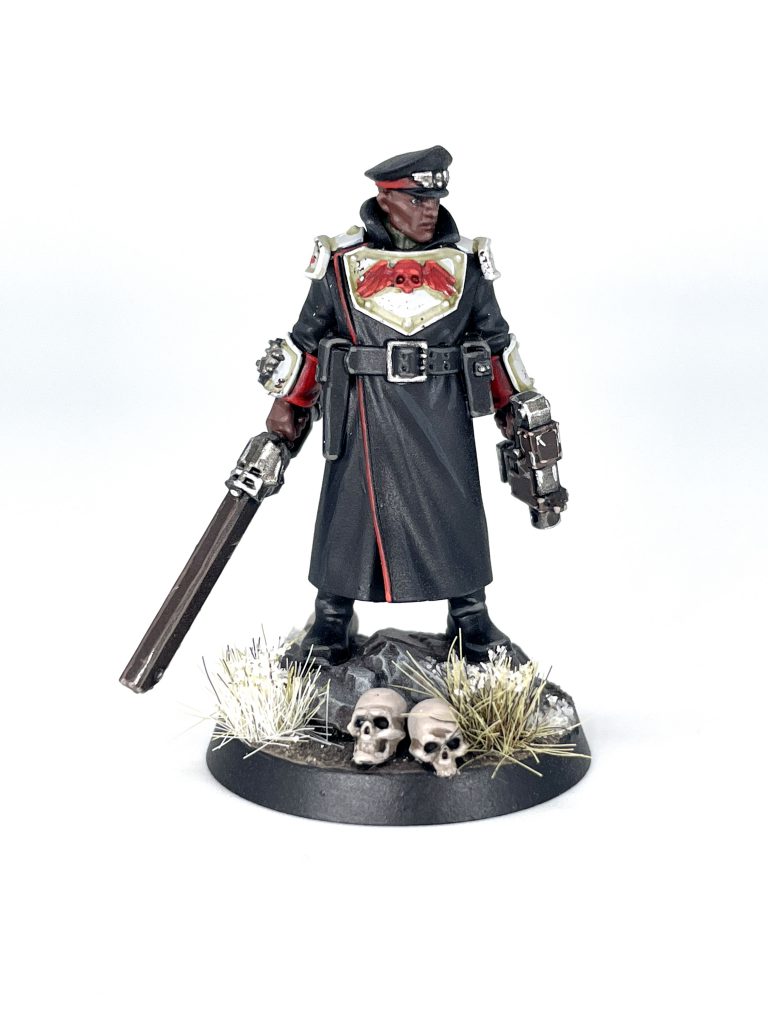 Imperial Guard Commissar. Credit: SRM
Final Thoughts
Overall
Chem Dog not only is a terrific story that has me hoping to see more of the (surviving) characters, but it's just as much a flag planted in the ground for author Callum Davis. He's clearly benefited from the long tutelage of short story crafting, turning in a debut novel notable in no small part for its restraint and maturity.
By restraint, I mean that he painted his canvas with muted colors and resisted the urge to overdo it. For instance, early on we discover that the upright Commissar Hasp has a bit of a temptation to dabble in the Savlar chemical stimms mix after initially being exposed to them. Unbeknownst to Hasp, one of his "mongrel" soldiers learns of this so of course, you think, this is a blatant sort of Chekhov's Gun setting up a dramatic situation in a later act.
Except, it didn't. I won't spoil how it's handled except to note that Davis completely avoids the expected and obvious here, and time and again he chose the more complicated and nuanced paths for his characters than the cliche and simplistic.
If I had any complaints it's that the terrific character building he managed in the first half sort of tapered off in the second. It's not that the characters stopped being interesting, but rather I was hoping to see that energy carry through the rest of the book. Their "foxhole chats" were exactly the kind of thing I always look for in books that want us to care about their characters, ways of offering depth and dimension to otherwise (often disposable) names on the page.
But I've read more than a few Black Library stories who take interesting characters and premise and come somewhat undone as the book rounds third, and
Chem Dog remained a delightful read all the way through to the end.
Well done, Mr. Davis.
Footnotes
- Really short. Less like the short stories in Warhammer anthologies and more like the uncredited mini-stories we get from time to time on Warhammer Community. Interestingly enough, WARCOM even published them as online content, and you can find Davis's Stand of the Saber and The Piercing Eyes available if you'd like to read them.
- I'm personally a completionist, seeing them all as parts of the same body. Technically Ian Watson's Warhammer books weren't officially "Black Library" at time of publication because the Black Library hadn't even been formed yet. I defer to the spirit here, not the letter.
- If you're keen to pick up a copy, though, you'll have a hunt ahead of you as this was a promotional book distributed at AdeptiCon in 2020, not a mass release.
Have any questions or feedback? Drop us a note in the comments below or email us at contact@goonhammer.com. Want articles like this linked in your inbox every Monday morning? Sign up for our newsletter. And don't forget that you can support us on Patreon for backer rewards like early video content, Administratum access, an ad-free experience on our website, and subscriber-only content covering competitive Warhammer 40K!Thank you for being a friend.
 This website uses cookies. Learn more.
 Goonhammer Reviews: Chem Dog, by Callum Davis