BattleTech Aces: Scouring Sands is the first of a series of single player (or co-op) expansions to Alpha Strike. Set in the hinterlands (the same area as the Hotspots Hinterlands campaign book), Scouring Sands has your mercenary force fighting against a unit of Jade Falcons for control over the planet Apolakkia. BattleTech Aces is a brand new system for solo play built using cards to determine how an enemy force of mechs will act, with a good balance of unpredictability and units acting in a way that makes sense – it’s a lot like having a second person sitting across the table from you, only you can play at 2am in your pajamas without anyone complaining about how the store isn’t actually open and why are you here?
What’s in Scouring Sands?
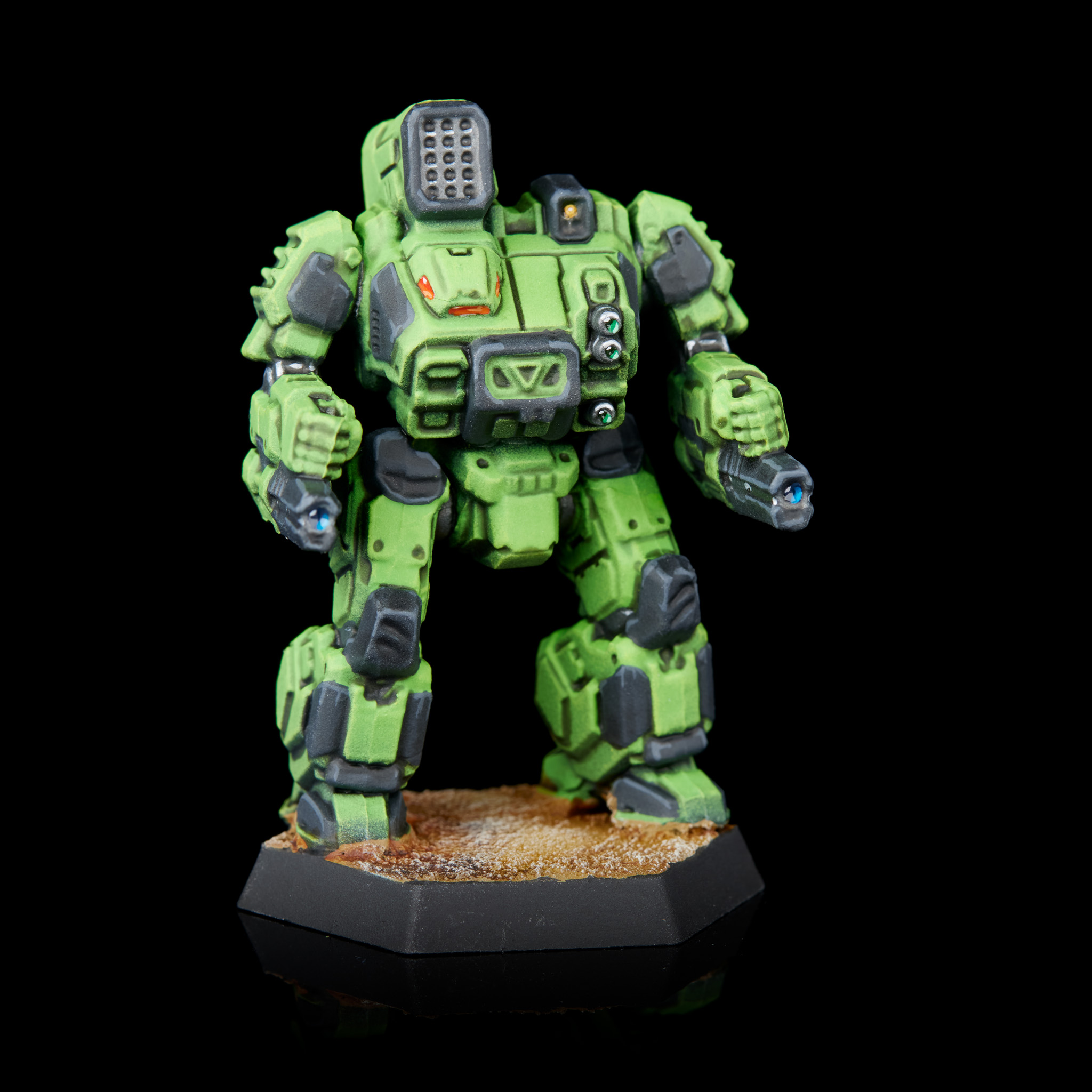
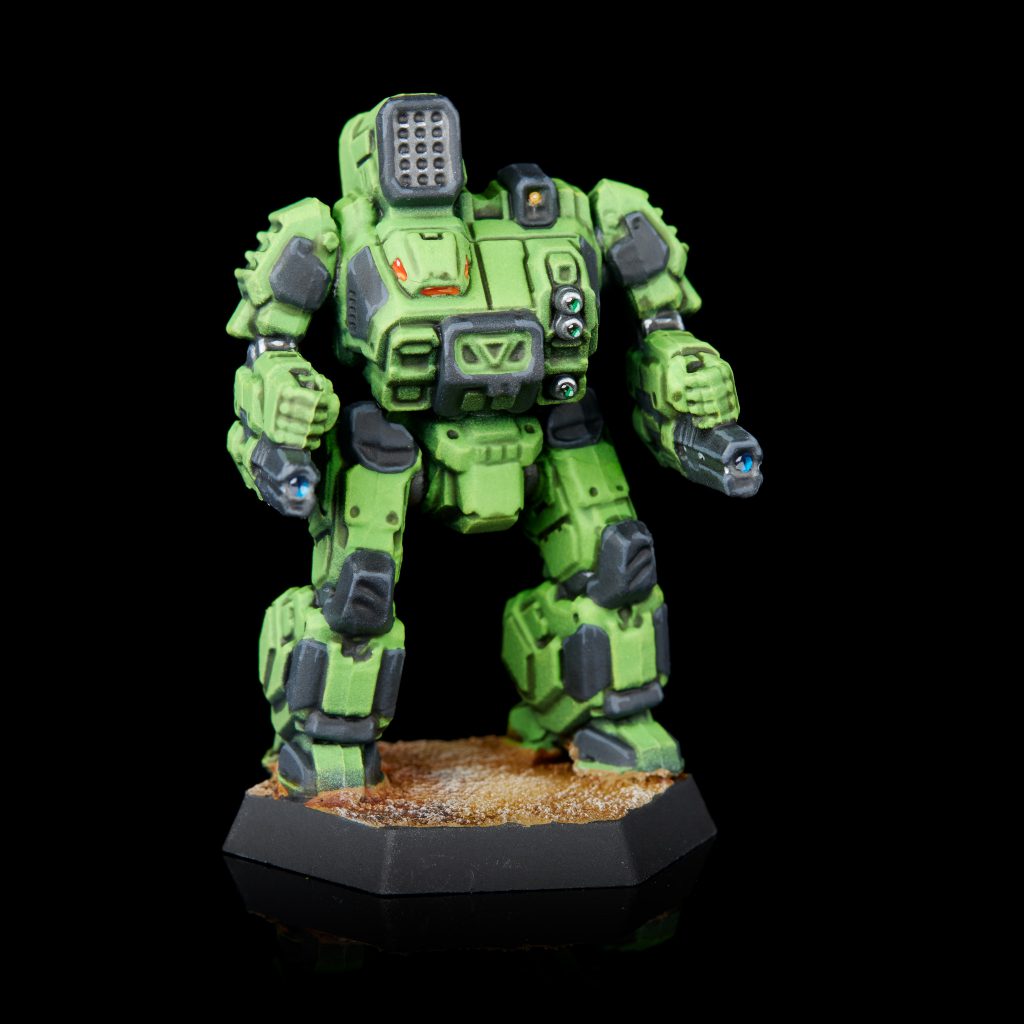 Jade Falcon Epsilon Galaxy Thunderbolt IIC. Credit: Jack Hunter
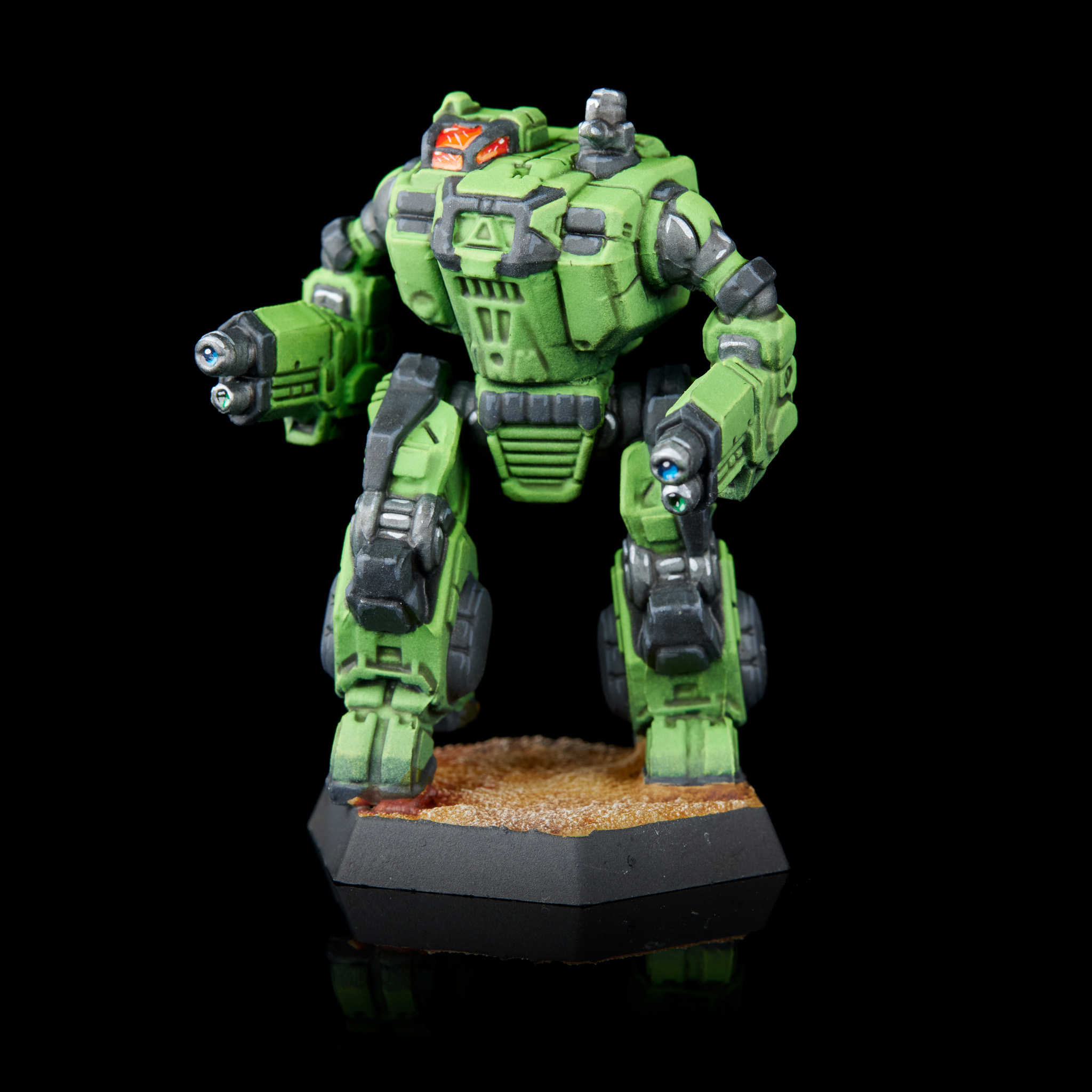
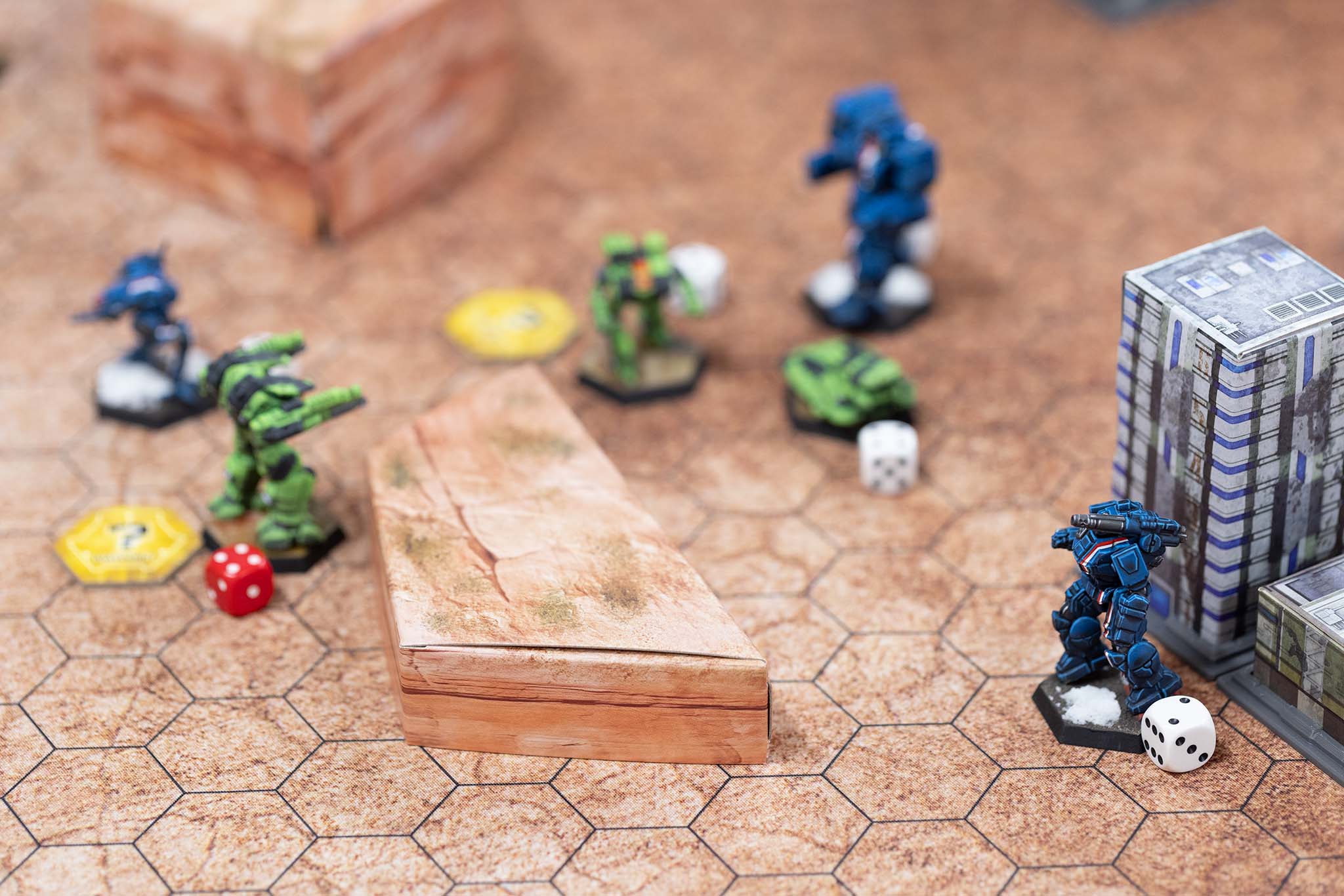
First up, as with every BattleTech box set are the nine minis. Every sculpt here is new, one of which is a completely new ‘mech, one which is a new vehicle (you get two of them), and the remaining six are new variants of existing ‘mechs. The new ‘mech is the Thunderbolt IIC, a chunky heavy ‘mech that’s designed as a close in brawler. The new vehicle is the Fulcrum, a heavy hovertank with a swoopier appearance than many other vehicles. The remaining six ‘mechs are the Bane 3 (with 8 LRM 15s) the Marauder IIC 10, Thor H, Rifleman C 2 (with the biggest visual difference from the previous variants), Howler 6, and Locust IIC 4. These do have a little bit of mixed quality – some bits (like the torso on the Thor H or the left knee on the Rifleman) are a little soft, while other parts (like the Thunderbolt IIC) are the same quality as CGLs recent force packs. They’re still pre-assembled PVC with more mold lines and softer detail than you’d get from GW or other more minis-focused manufacturers.
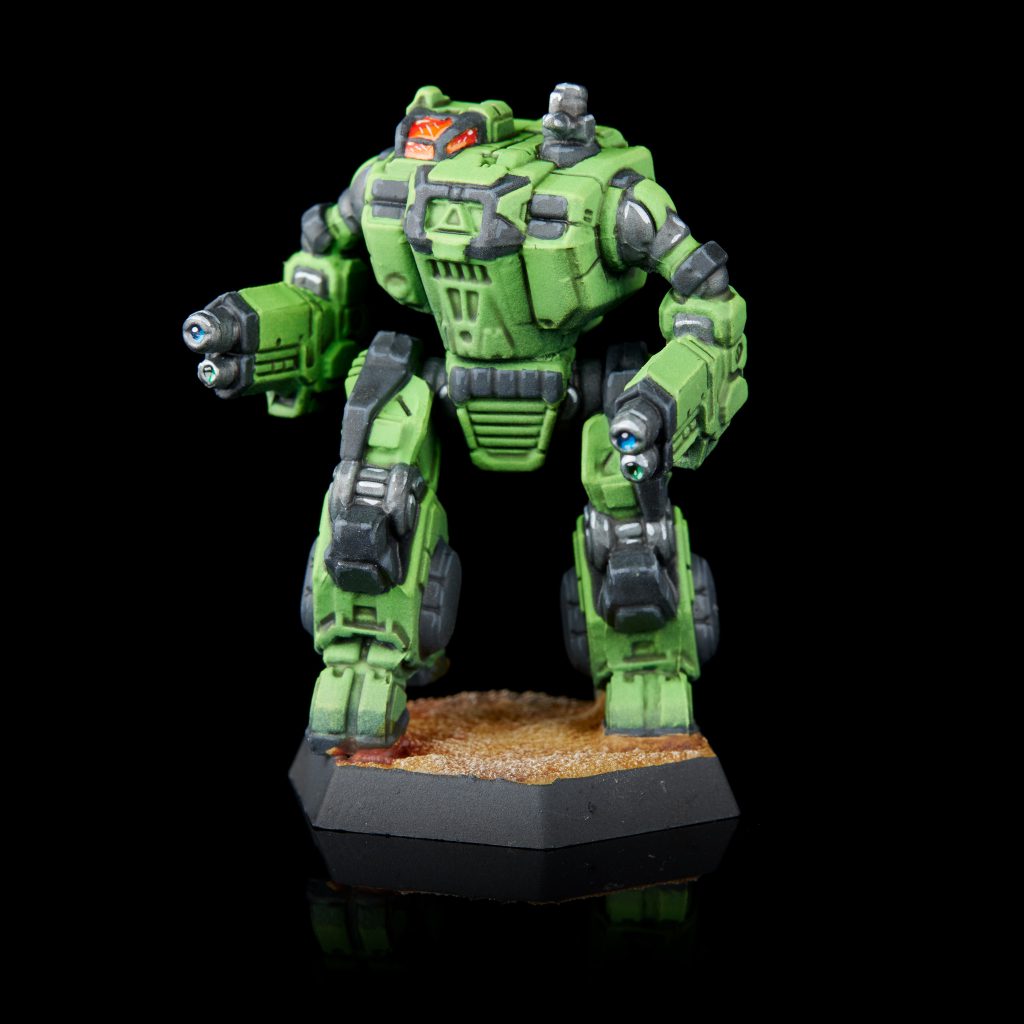 Jade Falcon Epsilon Galaxy Summoner (Thor) H. Credit: Jack Hunter
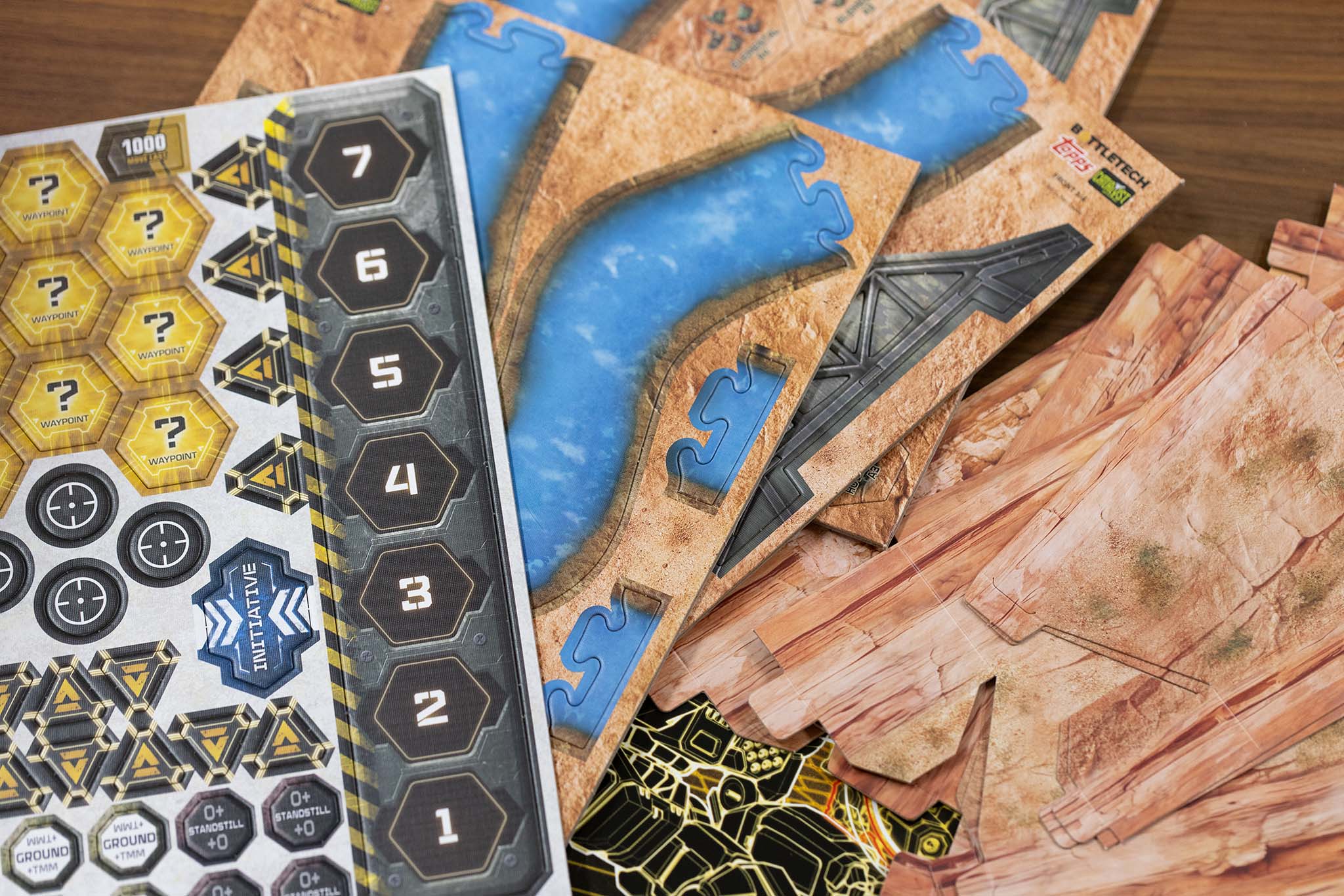
Other items in the box are two rulebooks, a couple sheets of punchout tokens and terrain, all the Aces cards you need, Alpha Strike cards for the ‘mechs and vehicles in the box, Battlefield Support asset cards for the elemental and emplacement tokens (these are just for classic BattleTech and not needed for Aces), and pilot cards and campaign record sheets for playing Scouring Sands. The two rulebooks are a 40 page booklet covering the core rules for Aces and one nicely spiral bound campaign book with all 21 Scouring Sands scenarios as well as two training scenarios to learn the system before diving in. One thing to call out here is that the fulcrum doesn't have a Battlefield Support card, which is disappointing. I particularly like that system and use it a lot in campaign games, but it only has cards for currently existing plastic vehicles. I was hoping that the fulcrum would be getting one.
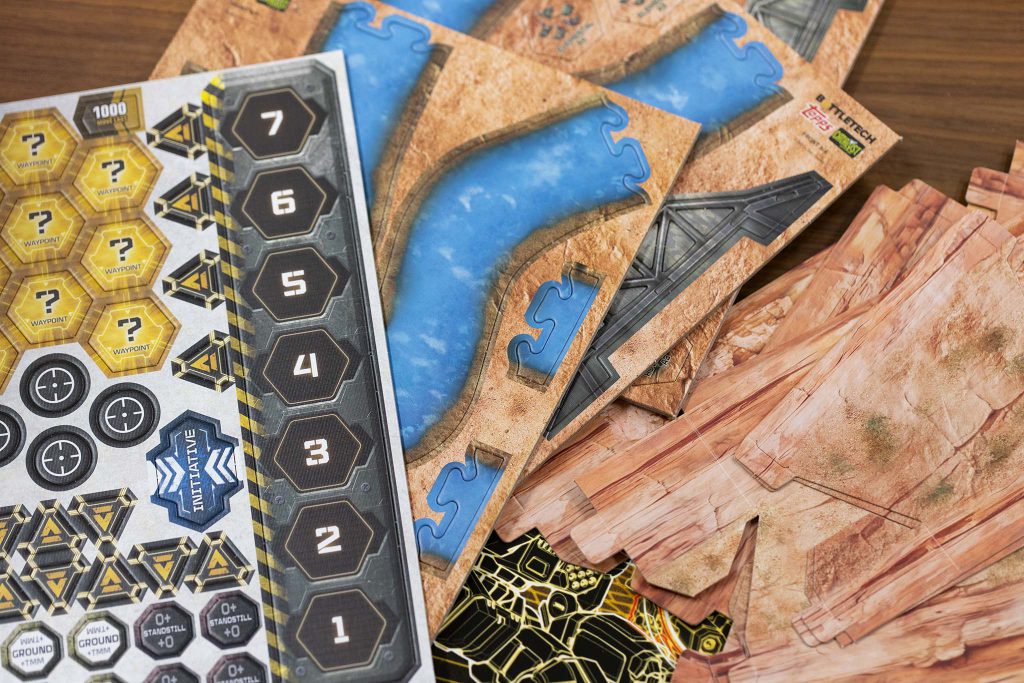
The box has most of what you need to play Scouring Sands, but not everything – as an expansion to Alpha Strike, it does expect you to have that box as well. Most important from it is the terrain, as the buildings (and especially trees) are featured in nearly every mission. If you don’t have the Alpha Strike box all the terrain is also available in the counters pack, but you will need to have your own collection of ‘mechs to use as your mercenary force. The actual ‘mechs in Alpha Strike are of less importance – they’re used in the two training scenarios (presumably so they could be written once for every Aces box rather than needing to be updated depending on what minis are included), but you can make do with your own.
You’ll also need a clear playing space between 3’ and 4’ square. The missions are all designed for 4’ square areas, but there’s a note on how to adjust for a smaller play area – mostly just moving units shorter distances on the first turn.
What Is Aces?
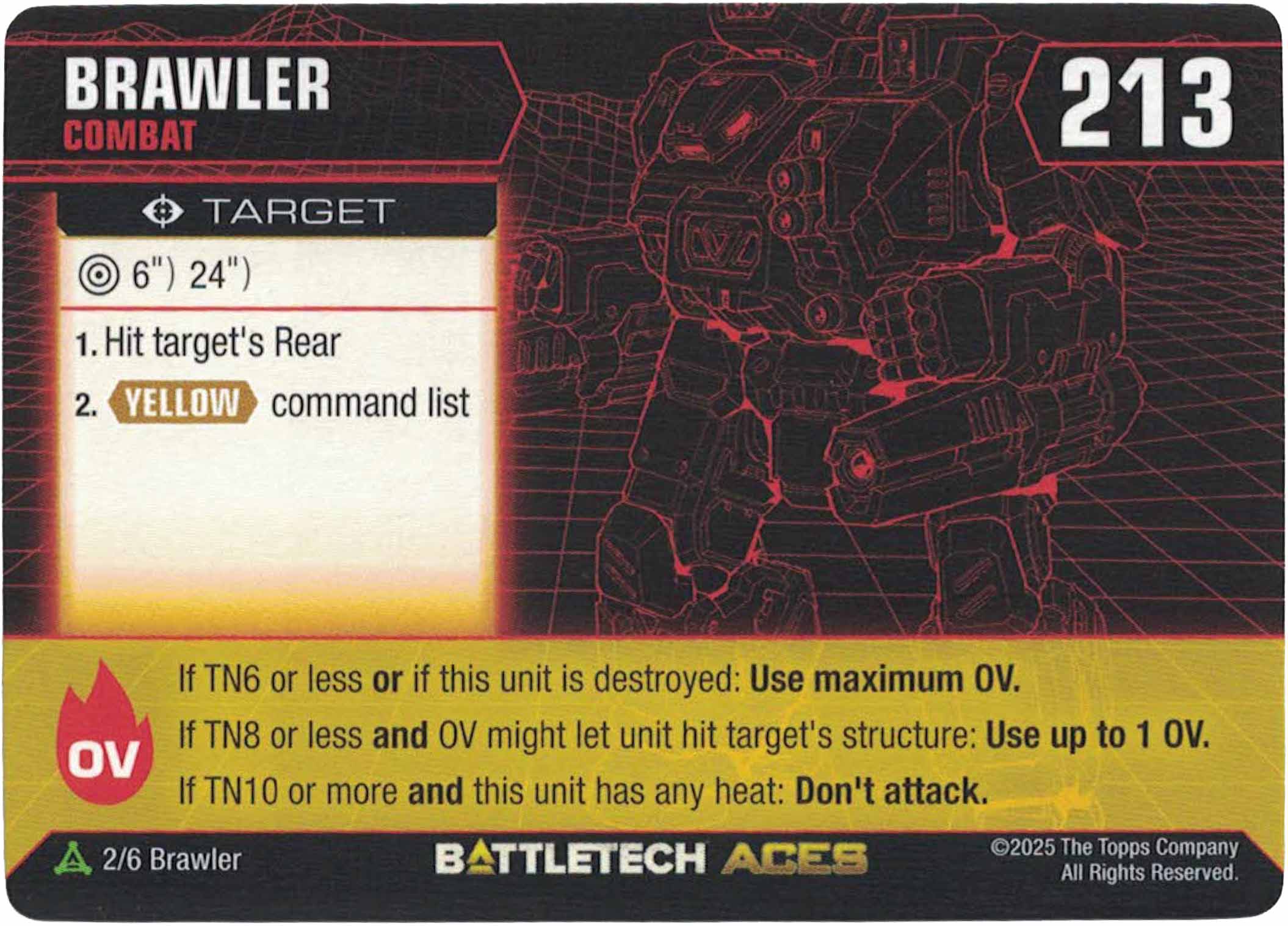
Aces is the card system that’s used to drive the automated force’s decision making. It’s not specific to the Scouring Sands campaign, and will be used in several more of these expansions over the next few years. Each unit gets its own small deck of cards based on unit type, plus the force as a whole gets a deck of commander cards to drive overall priorities. The cards are a bit icon-dense, so in my first playthrough it did take a while to work out what to do, but by the end of the second game I was getting the hang of it and the game was moving at a decent pace, though not quite as fast as with a person on the other side of the table. There’s a handy quick reference for them on the back of the Aces rulebook. While I’d prefer it to be on a quick reference card so I can see it at the same time as I have the rulebook open, it’s still incredibly useful.
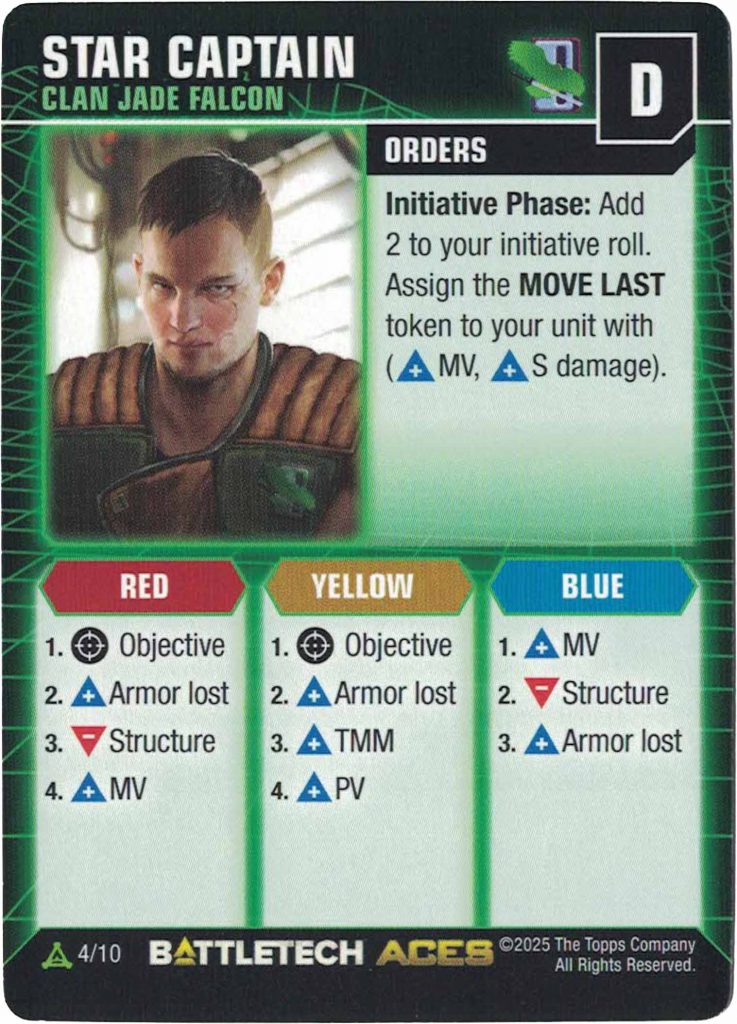
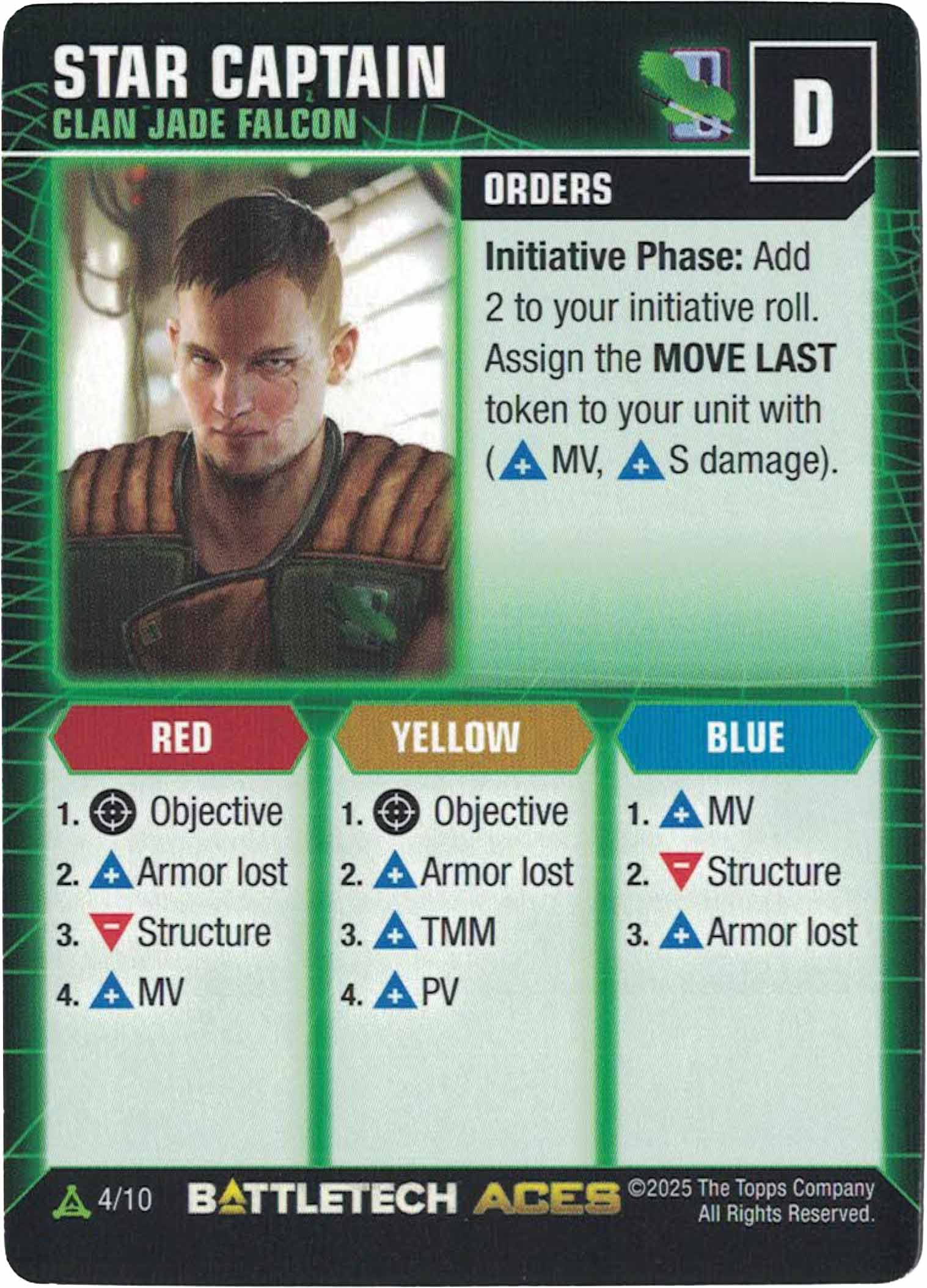
Your commander deck is the first step of decision making. On each card are some simple orders that apply to the entire force, three different target priorities that will influence what player units get targeted by the automated ‘mechs, instructions on how to use support assets, and instructions on how to shift from one commander card to another. Each of the five cards in a deck will have the automated force making slightly different decisions, and shifting into them is determined by how the battle is progressing. If the player has lost a ‘mech the automated force might try to capitalize on it, while if the automated force is taking damage it might want to play a bit safer.
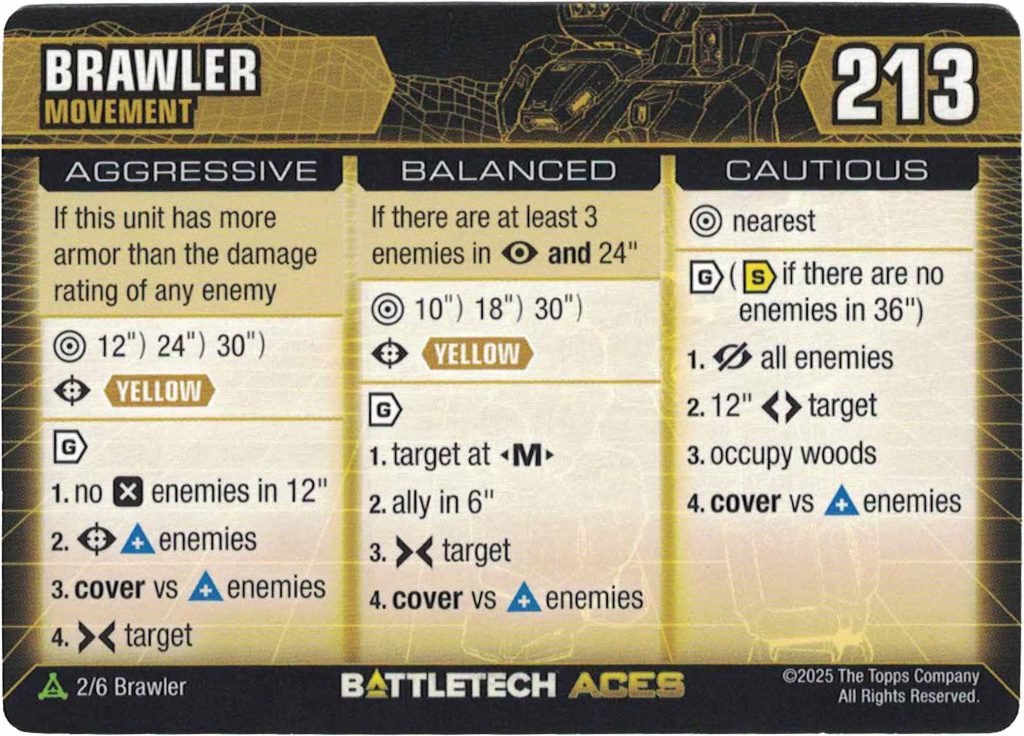
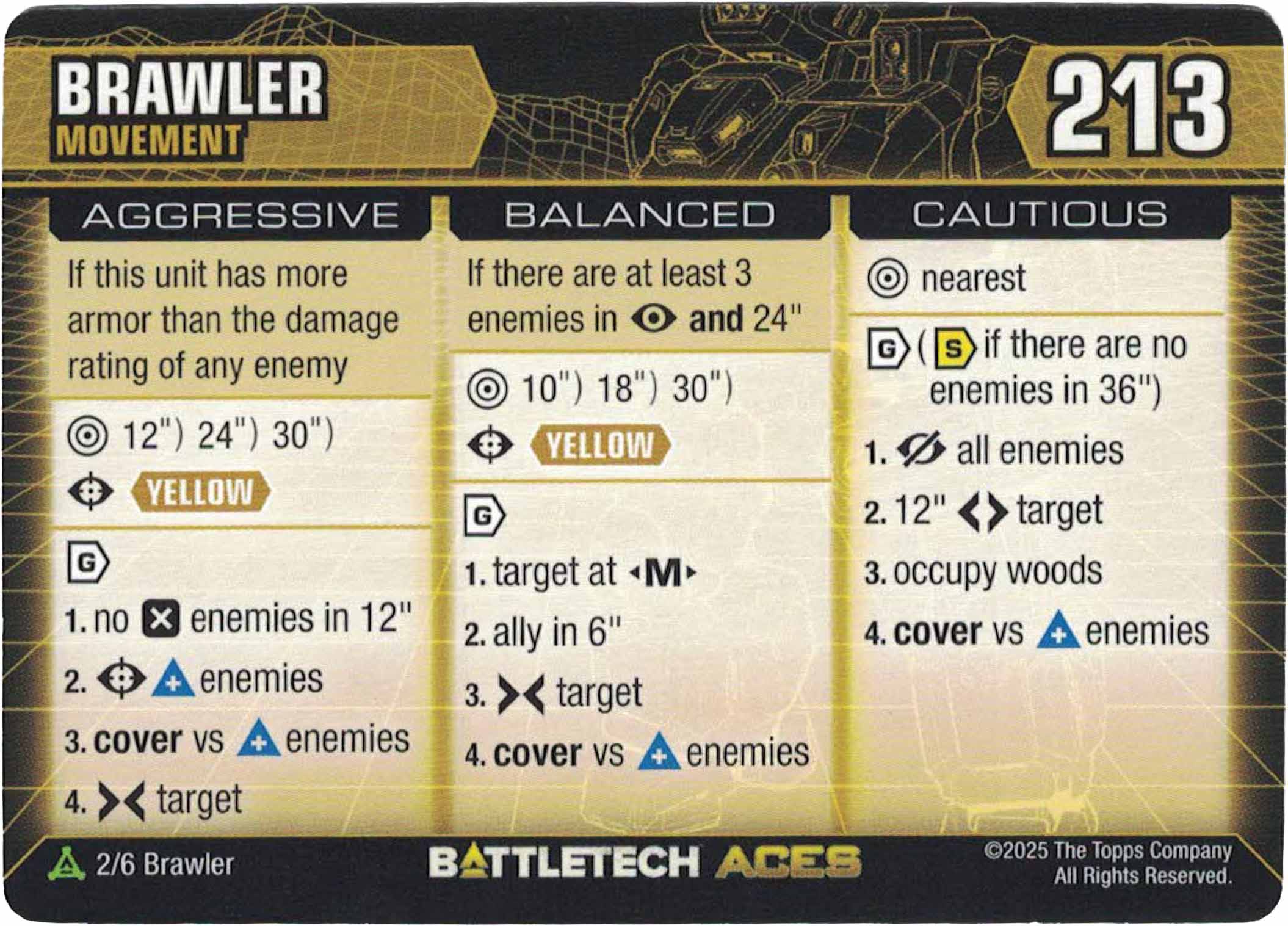
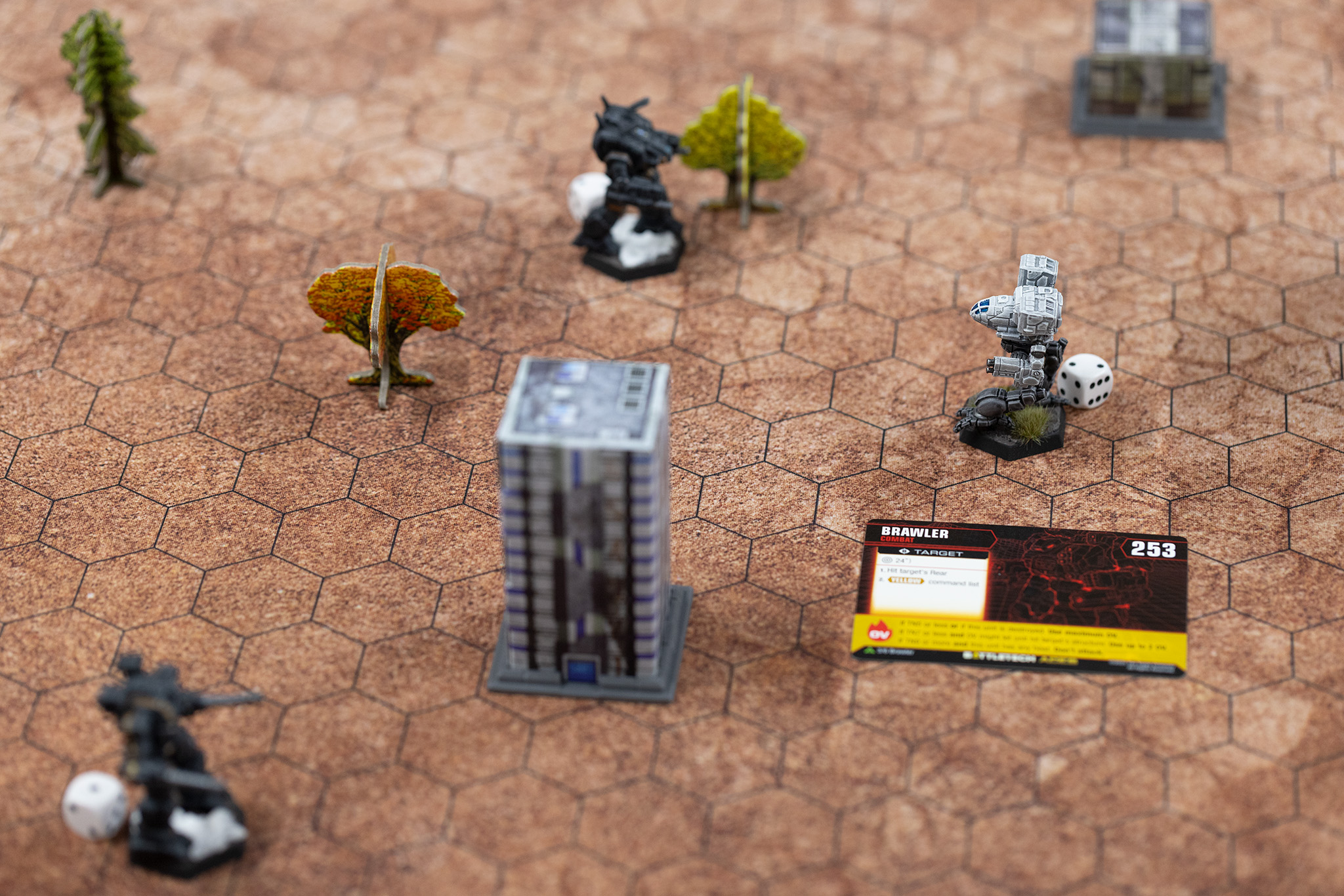
Each unit is driven by its own six card deck. Each card has a priority number, which drives what order units will be activated in. One thing to note that tripped me up while playing is that these numbers aren’t necessarily the same on both sides – you can have a card that moves late and fires early, or vice-versa. On the movement side you then have the relatively complicated decision tree. First is to determine if the unit will act aggressively, cautiously, or balanced based on a couple criteria (often referencing back to the commander card to determine what ‘mech to target). After determining behavior type there’s a set of filters for the actual movement, which in theory will locate one single point on the battlefield for the ‘mech to move to. In practice I found that it usually would get me down to a smallish area, but not always a single point.
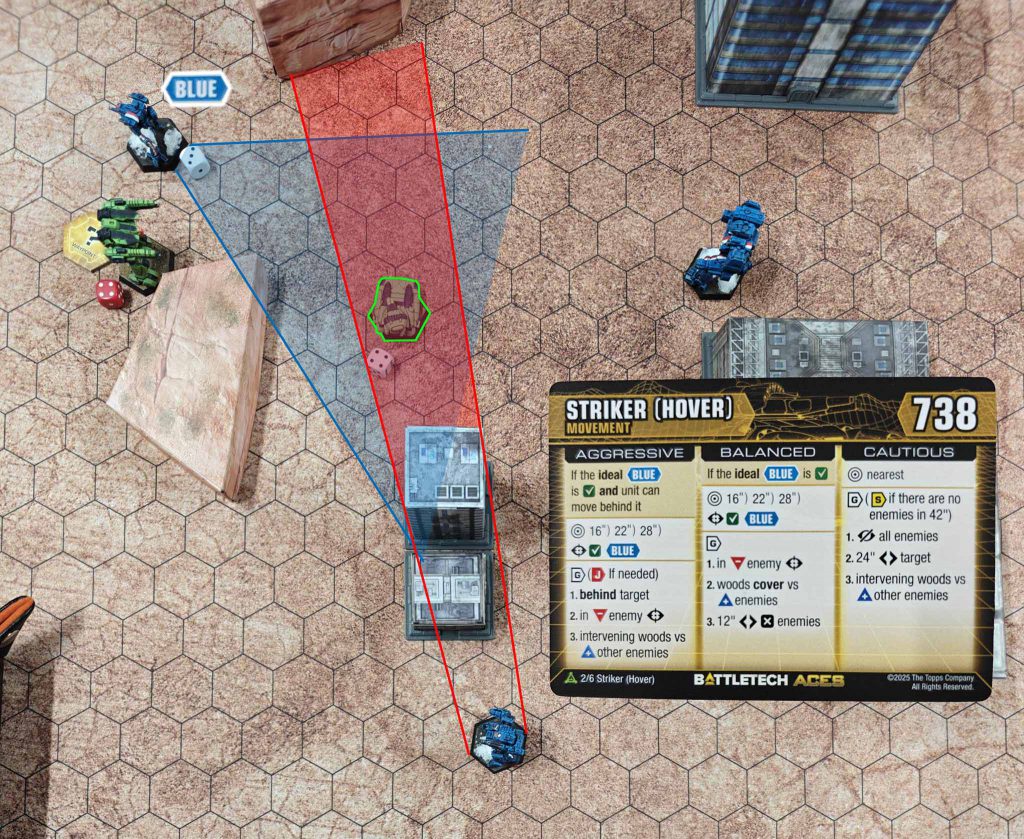
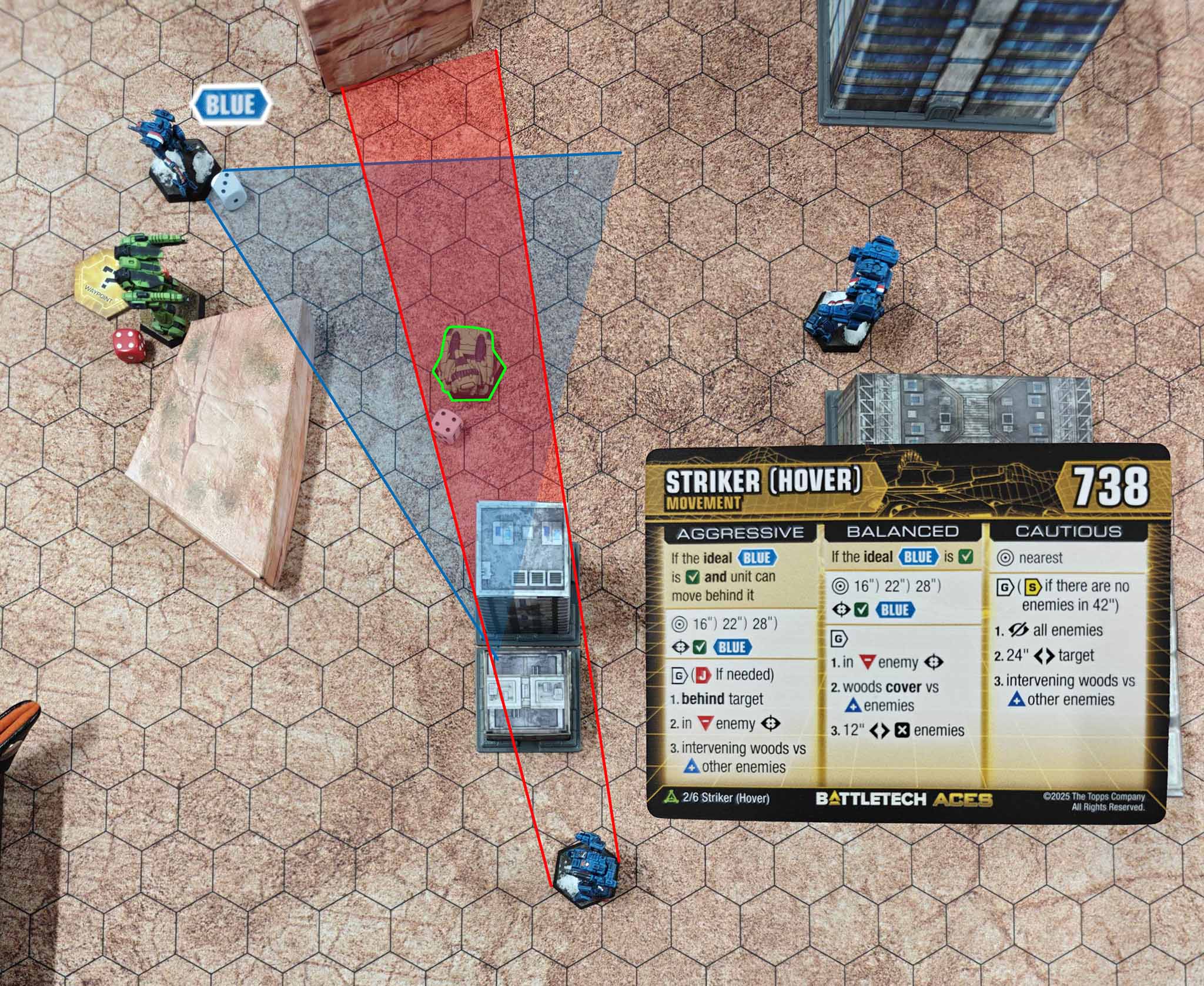
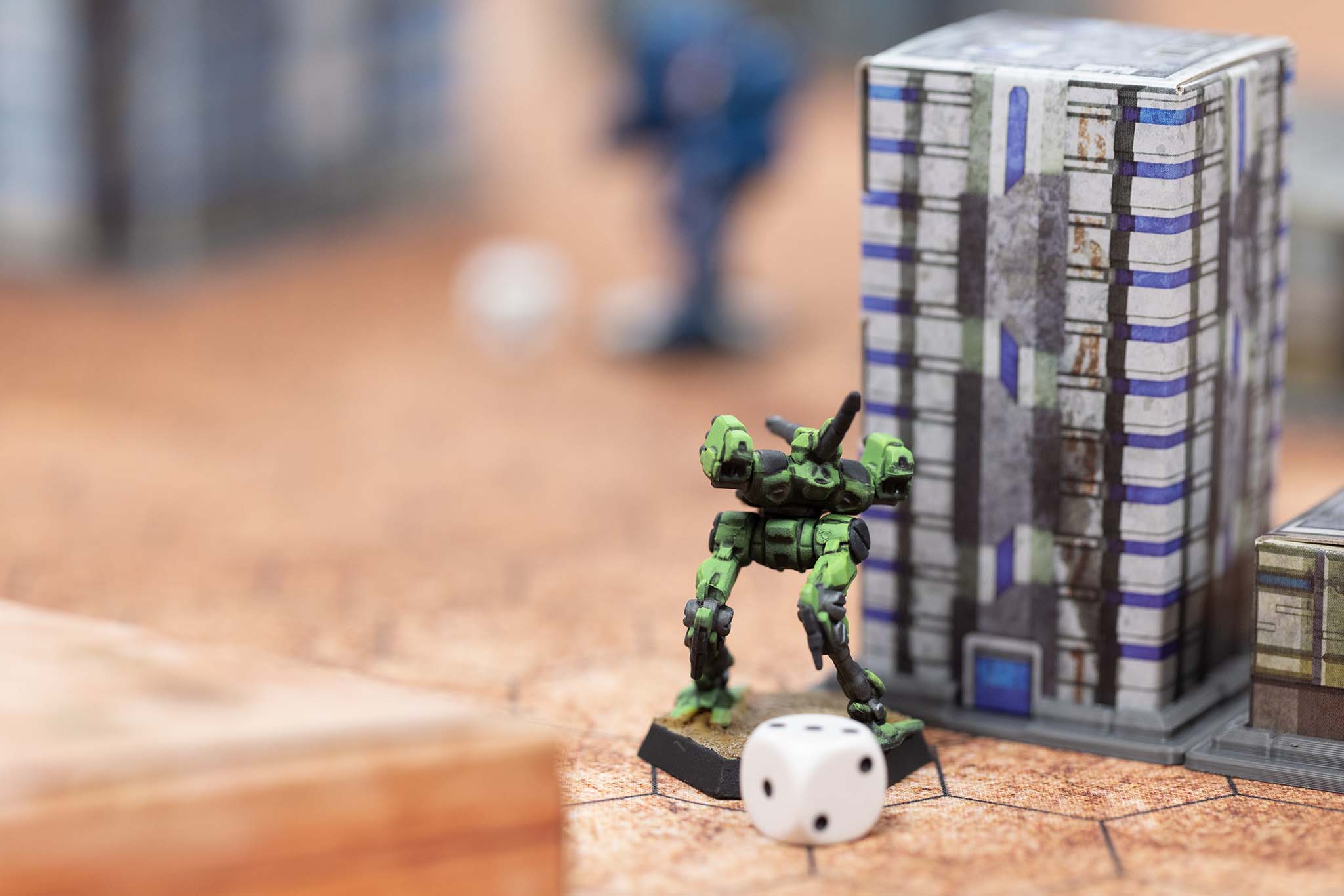
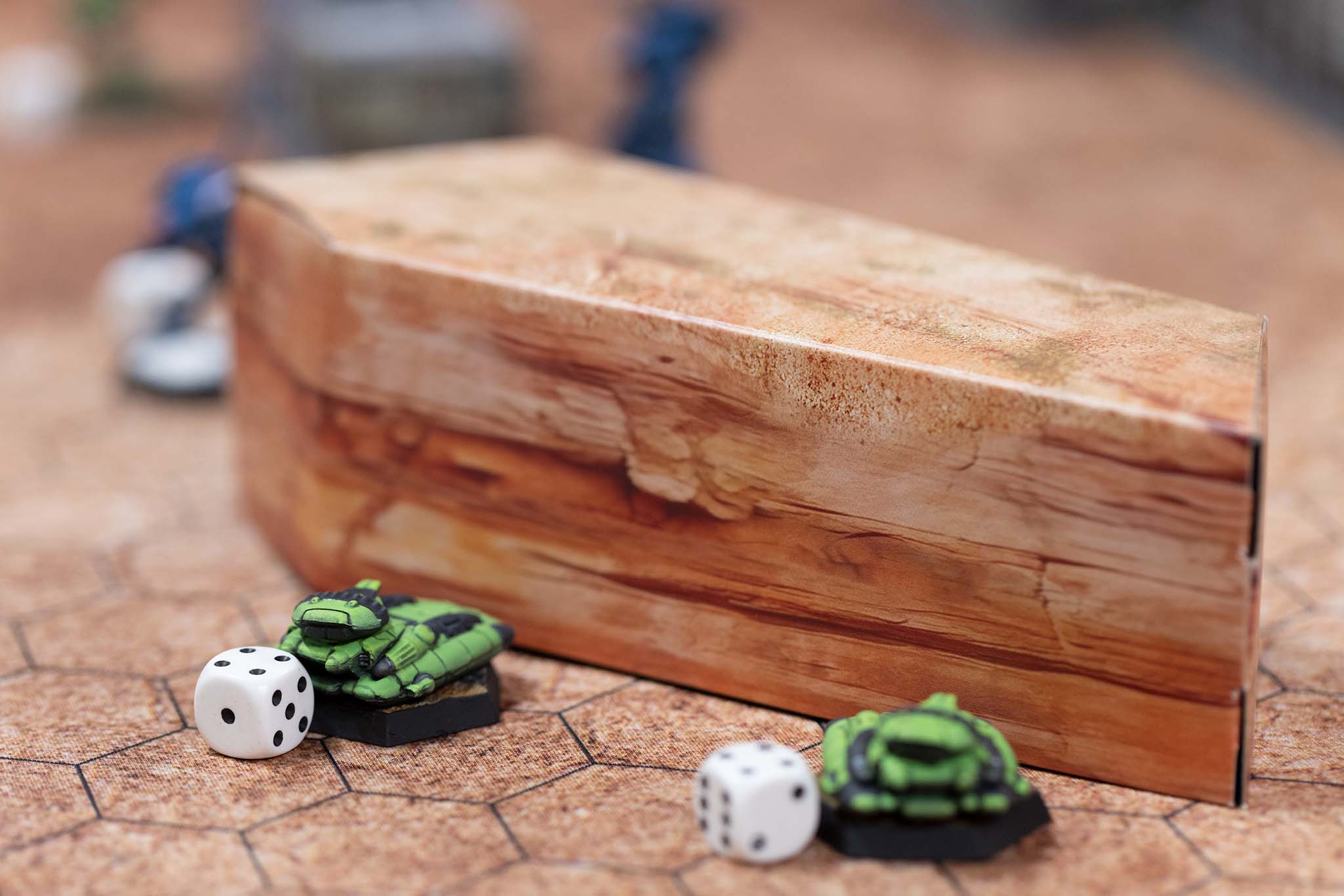
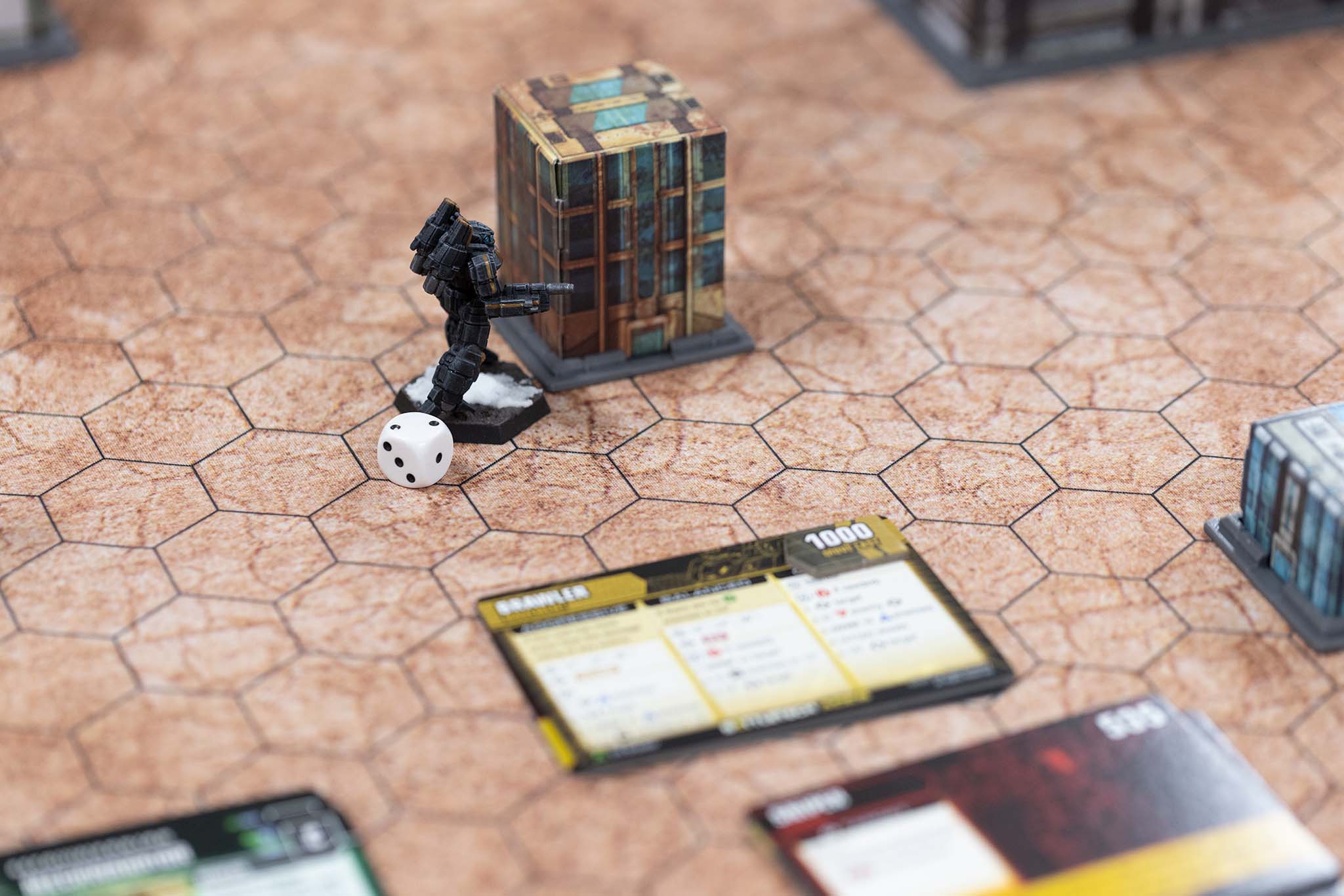
For example, in the above image I’ve activated the fulcrum (highlighted in green) and am following the aggressive behavior. The player locust is determined by the commander card as the ideal blue target and the fulcrum could move behind it, which means anywhere in the blue shaded area. The next filter is to be visible to as few enemy units as possible. The fulcrum doesn’t have the move speed to get behind the regent from where it started, so whatever it does it’ll be visible to it, but anywhere in the shadow of the tall building (the red shaded area) is blocked from the shadow hawk. At that point, lacking further filters, I just needed to pick a point that is within both those areas and seemed to make sense, so I moved the fulcrum to where it would be at short range to the locust.
I found that I had situations like this about as often as not, usually just a small area to select from, but overall the system worked well. Getting the automated unit 95% of the way moved is good enough, as this is a non-competitive dice game and the important part is to have it move somewhere that makes reasonable sense.
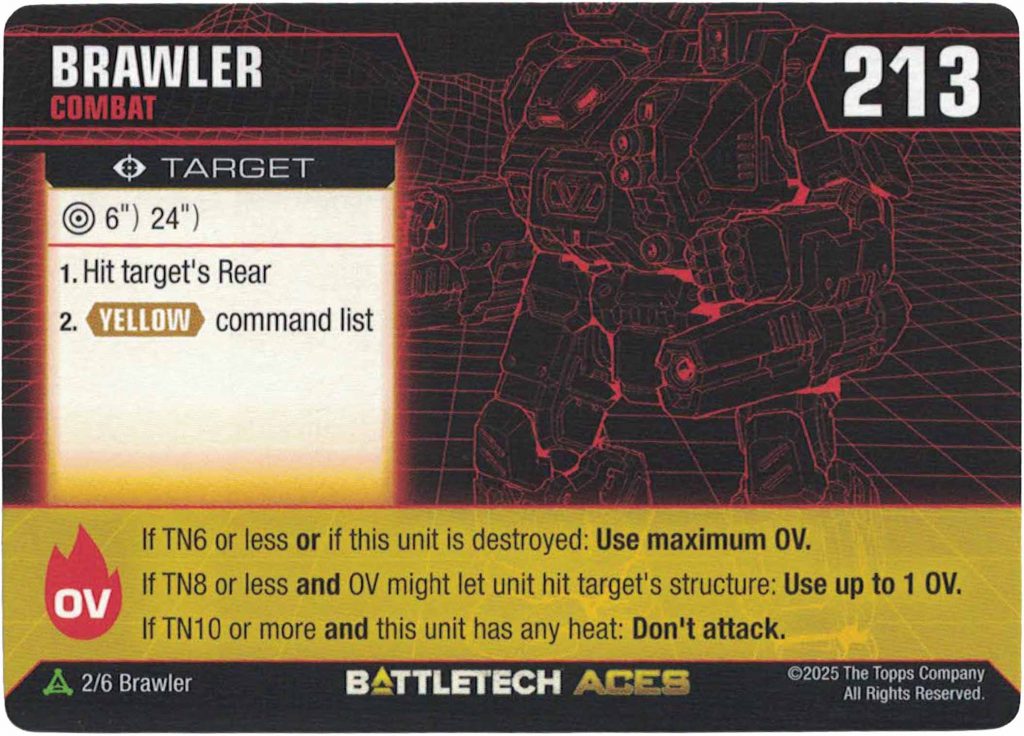
Shooting is much simpler, as you just filter down a target (from only a handful of possibilities, often as not being the closest unit) and then determine if the unit will overheat – I was figuring out where the automated ‘mech would shoot faster than I could make decisions for my player ‘mechs. One thing that'll speed shooting up a lot is using movement dice to mark TMM as units are activated.
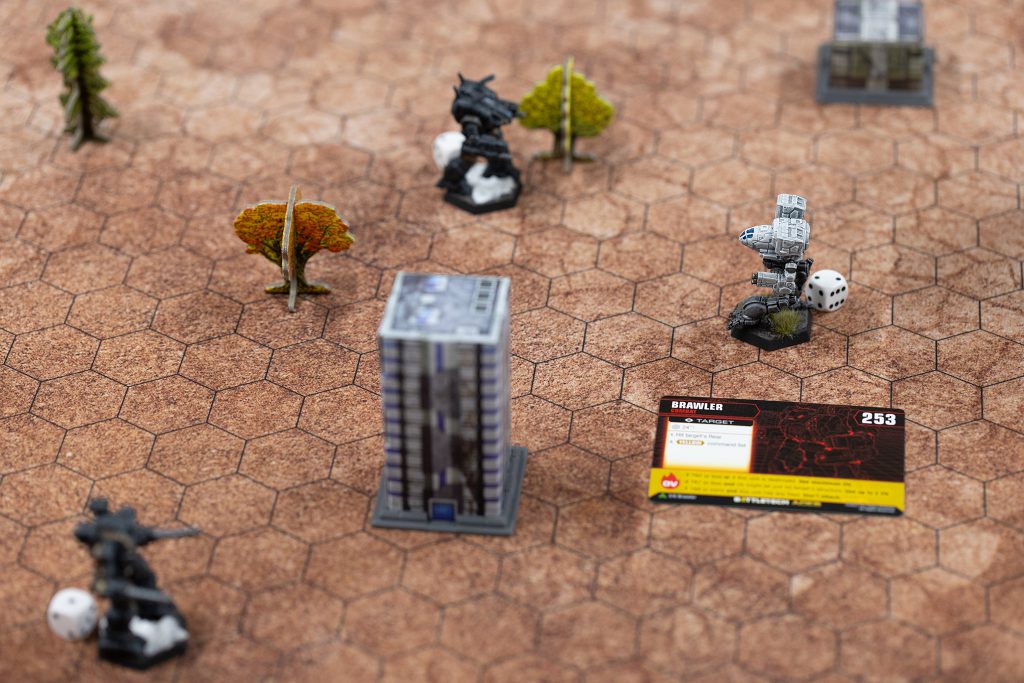
Scouring Sands comes with two training scenarios to get you used to using the aces decks to control automated ‘mechs. The first is completely on rails – using two set forces, each move is specified and the decision making for the automated ‘mechs is walked through step by step. When I played this scenario I did this for turn 1, then on turn 2 I followed the cards myself and then checked against the scenario to see if I’d done it right. I thought this was a great way to teach it, similar to having an experienced player walk you through a game, as there’s immediate feedback on whether you’re doing everything correctly. The second training scenario isn’t on rails, it just has fully set forces. Rather than teaching the basics of the card system for unit control, it focuses on objectives and campaign specific mechanics.
Classic BattleTech
While not designed for classic BattleTech, I do think the Aces cards can be used. It’s not going to work perfectly – you’ll need to convert inches to hexes, and particularly the firing decisions will require a lot more human choice than the Aces cards want. The complicated (and much more choice based) part of the game is the movement phase, not the shooting phase, and I do think the Aces cards will work there – but you will probably want to use them for scenarios with objectives rather than death matches, as some of the cards will make decisions based on objectives.
Scouring Sands
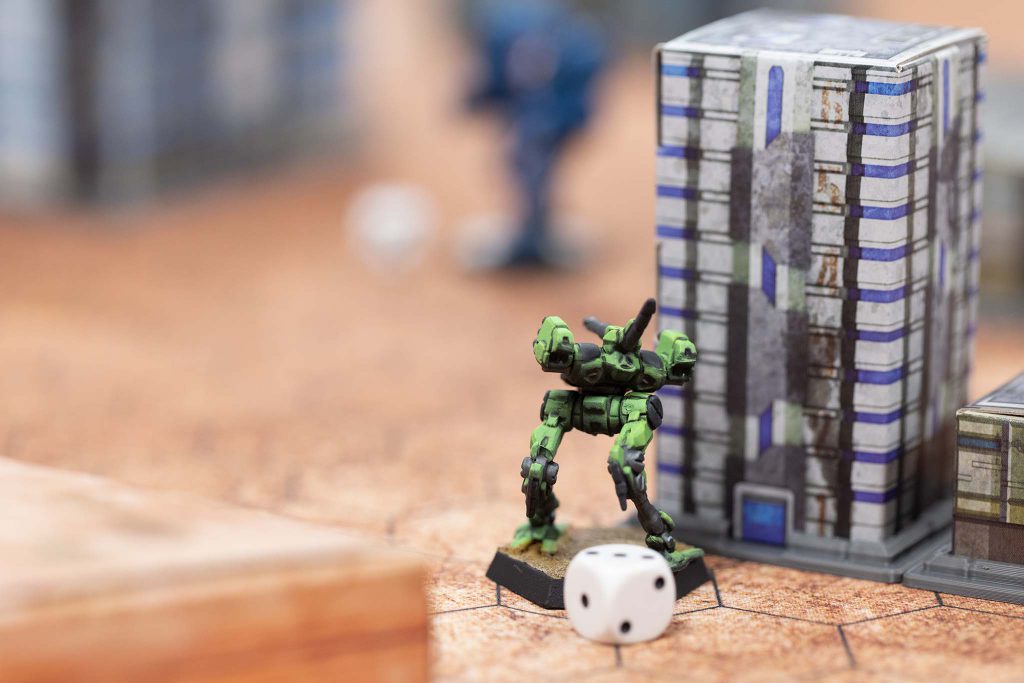
Scouring Sands is the actual campaign in the box. The spiral bound rulebook has 21 potential scenarios, referred to as sorties, though my understanding is that a campaign will typically take you through 8 or so sorties, so there’s good replayability here. Campaign progression is governed by a combination of decisions you make at the end of each sortie and by occurrences in game – successfully securing an ammo depot might give you a choice of which sortie to play next, while failing to protect it forces a different sortie.
First thing to call out here – referring to each game as a sortie is great. It’s clear and unambiguous what you’re referring to, while still providing a bit of character. Previous BattleTech products have called these tracks, which I’ve always found to be an awful name that just creates extra confusion. I hope the use of sortie carries over from the Aces products into future sourcebooks and campaign books.
Campaign Setup
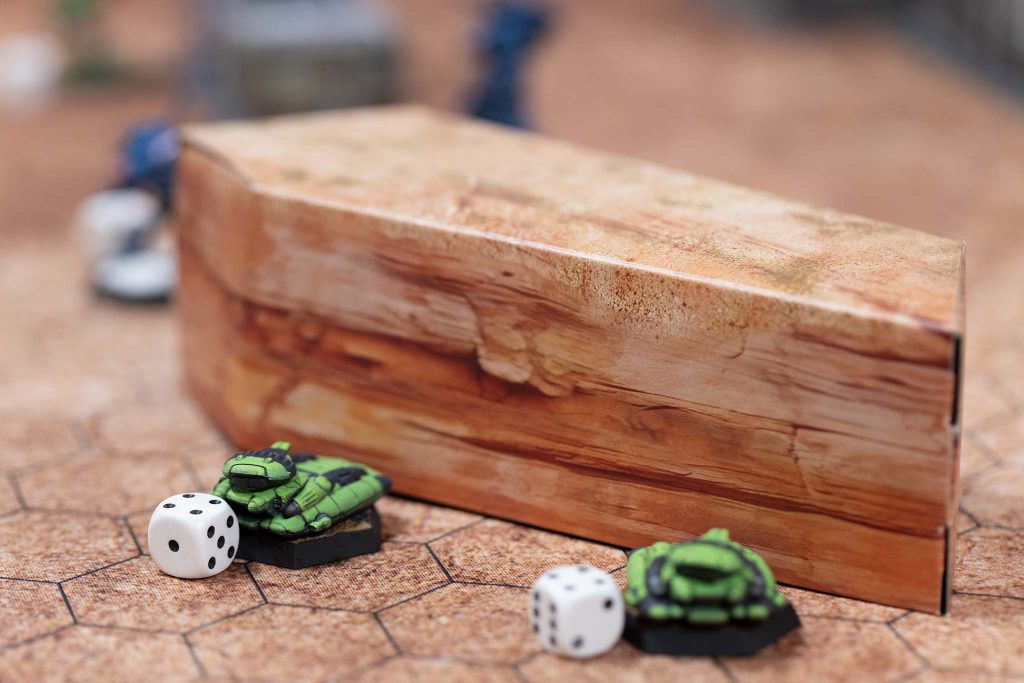
To set up the campaign you’ll build a force of up to 400 PV with at least 8 units. You’ve got a choice in force creation on whether you want to work with thematic restrictions here or not. Basic force creation just has you selecting from any of the printed Alpha Strike cards available in box sets and force packs, with no further restrictions. Advanced force creation has more restrictions – you’re directed to use the ilClan Mercenaries availability list from Master Unit List, which is the first time I’ve seen a specific availability list specified in a print product. Hotspots Hinterlands has a general tip to use it to see faction availability, but doesn’t direct you to a specific one. Given that this is being used, I hope MUL gets an update soon – it hasn’t been touched in a year or so, and there have been a number of new variants released in Shrapnel that haven’t been added yet.
In addition to using the availability list, advanced force creation limits your ability to take duplicate units and gives you some (40) additional starting SP (the campaign currency) for every PV you’re under the 400 limit. I think it’s definitely worth using advanced force creation unless there’s a specific unit you want to play with not available to mercenaries – that extra SP is very valuable, as you only start with 400 SP.
This gives you a pretty substantial number of units to build from. Building from the Alpha Strike box set you're going to need to use both the Inner Sphere and Clan 'mechs. Just using the IS 'mechs leaves you at only 316 PV, even taking the most expensive variants available to the ilClan Mercenaries list. I think you're mostly going to want to build larger forces of less expensive units, as that'll make sure that you have flexibility to fight sorties at any size.
You’re also going to create between 2 and 6 named pilots to act as heroes of your force. Each of these pilots gains experience over the course of the campaign, able to either improve their skill (ability to hit things), edge (which can be spent each game on modifying or re-rolling certain rolls or using an edge ability), and purchasing edge abilities that give them a few powerful actions they can do in game. Pilot experience is measured in SP, the same campaign currency you’ll use for repairs, purchasing new units, and unlocking certain options during each sortie. Each pilot starts with 150 free SP, but creating too many pilots is a risk – each one takes a chunk of SP from your sortie rewards, even if you don’t field them. While it does happen after you pay for repairs, having too many named pilots can make it hard to build up a warchest and purchase replacement units if needed. In my first sortie with 2 named pilots on the field and 2 not I ended up only making a total profit of 40 SP. If I need to replace a ‘mech I’m looking generally at between 1,000 and 2,000 SP.
Campaign Sorties
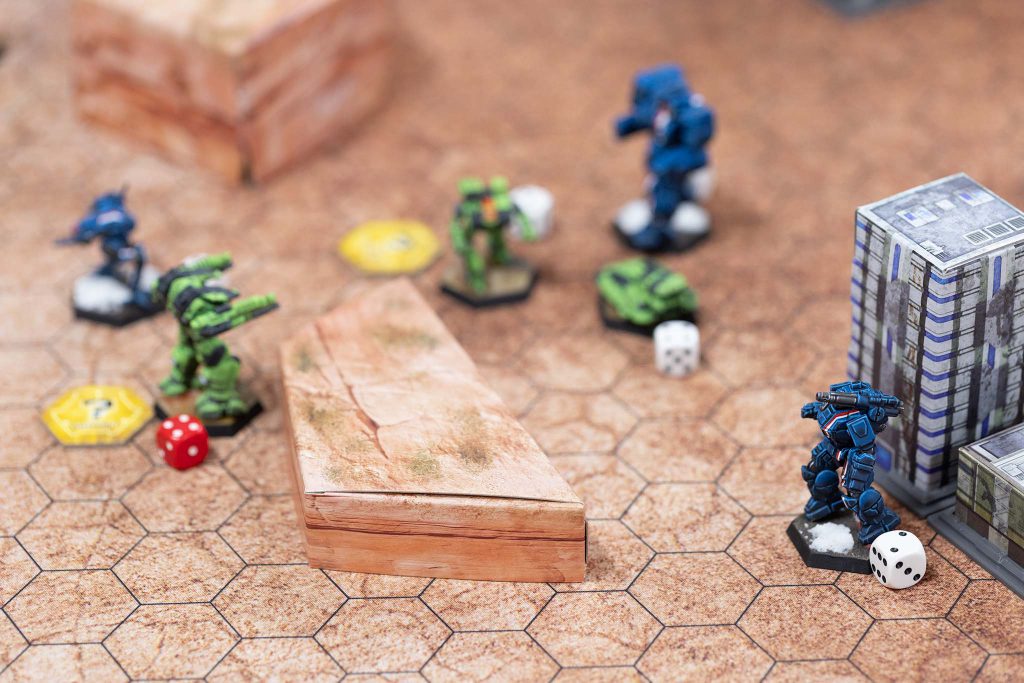
Each sortie has 2 pages of information on how to play it, starting with a short narrative and briefing laying out the story of what’s happening. Some sorties provide an opportunity for reconnaissance, where you can spend some SP to gain certain benefits in that sortie. Your player force will be listed as a specific size, the opposing force listed out with unit, skill, and which aces deck each unit uses. The sortie also describes a couple objectives (along with how many SP you get for completing them), an end condition, and any special rules that are in play. One nice thing that's been done on the opposing forces is to list a total PV amount for the force. If you want to make changes (say this is your second time through and you really think these Jade Falcons should have an Ion Sparrow instead of a Howler) it's easy to keep the forces balanced about correctly for the sortie.
You also have a map indicating locations for terrain, an area the player force deploys in, and specific locations for each automated unit that deploys on the map. The map is divided into a 4” grid, which makes it fairly simple if time consuming to set the terrain up appropriately. I have one complaint with this section, and that’s how trees work – they’re set up in lines or triangles, which I found very hard to effectively see the area of while I’m playing. I would’ve appreciated one more punchboard terrain sheet with some forest bases, as that would both be easier for play and look a lot nicer.
Finally in the sortie setup are Waypoints, which is the system these Aces campaigns use for mid-sortie events. Each one is indicated by a token, and they can be placed on units, on the board, or attached to specific turns. Each waypoint has a letter on it that corresponds to a set of events for each sortie in the back of the rulebook, and whenever one of the tokens gets activated (usually by either scanning it, which requires a unit in proximity, or from reaching a specific turn) you’ll flip to the back of the book, read the waypoint, and resolve any effects. There are many possible effects, including extra damage to an enemy, a critical hit on your mech, revealing hidden units, one of your pilots gaining extra edge, and more – there potentially over a dozen per mission, and I haven’t read nearly all of them.
While I’m not 100% convinced on the name of waypoints, as I associate that pretty specifically with a map location to move to rather than something connected to a unit or turn, I think they work very effectively. Outside of ones that occur on specific turns, most waypoints get shuffled before they’re placed, so replaying a scenario even with the exact same units will give you a different game. My one concern is about the specific implementation in the campaign rather than the system – in my first sortie I scanned a hostile that had a waypoint with my regent, revealing a waypoint that gave me a critical hit. At the end of the sortie my ‘mech had only taken a couple pips of armor damage, which would typically cost 80 SP to repair. Because it had taken the crit, it instead cost 160 SP. Given the amount of profit (40 SP after repairs and named pilots) I was making off that sortie, spending a significant amount of money on random damage like that didn’t feel great, though it’s probably not a balance issue or anything.
At the end of each sortie there’s an outcome step in the same section as each waypoint. It gives you another bit of narrative about the mission, any end results based on events of the game, how many SP your named pilots can earn, and possible options for the next sortie. One of the things that can happen is that your force gains a keyword. You’ll track this on your record sheet, and it’ll come into play in a future sortie, slightly changing how it plays out. It’s a great way to increase replayability of the campaign, next time through you might choose to run a sortie in a different fashion in the hopes of gaining or not gaining that keyword.
Overall Thoughts
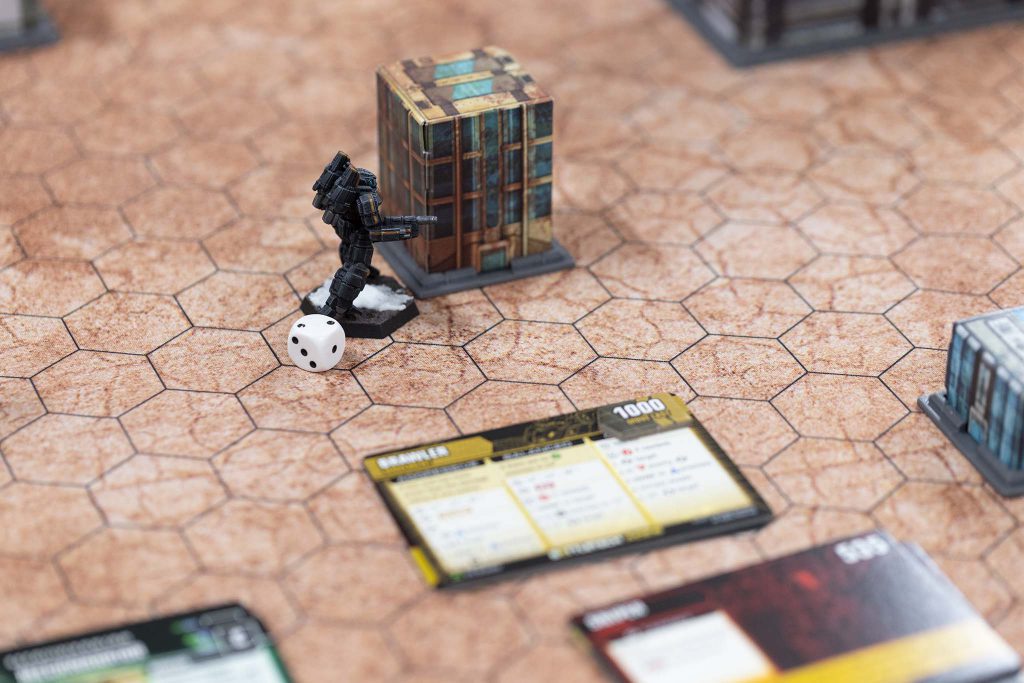
Broadly I think this is a great product. The minis look good, the Aces system plays well from my test games, and the Scouring Sands campaign seems clear and replayable. I’m not seeing any of the editing issues or confusion about how to play missions that I saw in Hotspots Hinterlands, which makes it very easy for me to recommend this. I’ll definitely always prefer to play against another human, but this card system appears to be relatively intelligent and feels like you’re playing against something that responds to what you’re doing, rather than just working through a rigid set of steps. I only really had two complaints while playing – the first being a bit of imprecision in movement choices that required me to use player judgement for the automated forces, and the second being that shuffling a 6-card deck is extremely difficult. That second complaint should be alleviated some as further Aces boxes release, you should be able to combine multiple decks for the same unit type to get additional variety. The rulebook mentions combining decks, but recommends you still only use 6 cards. I’m not sure why you’d only use 6 cards, as once you hit the bottom of a deck you just reshuffle those 6 – having 12 in the deck to start with shouldn’t be any different.
The only other negative I need to call out is the absolutely unforced error of not including a battlefield support card for the fulcrum. They're included for the elemental and emplacement tokens in the box, so it makes absolutely no sense to not also include one for the vehicle.
Thank you for being a friend.
 This website uses cookies. Learn more.

 Jade Falcon Epsilon Galaxy Thunderbolt IIC. Credit: Jack Hunter
 Jade Falcon Epsilon Galaxy Summoner (Thor) H. Credit: Jack Hunter

 Goonhammer App and Patron Updates: April, 2026
 Kill Team Tournament Report: Engage, Party, Repeat's March Madness 2026
 Goonhammer Reviews: Tribal Conquest