500 Worlds marks the newest campaign book for Games Workshop, marking a clear departure from the Crusade-based books we’ve seen throughout ninth and tenth edition so far. Of the three books in the supplement, War on the Vespator Front provides players with a framework for a map-based campaign in which players conquer planets, fortify their positions, and attempt to dominate the Vespator Front of the Five Hundred Worlds Campaign. It’s the first general map campaign we’ve seen from GW in some time, and there’s a lot to like about it. In this review, we’ll talk about the campaign, how it works, and whether it’s worth picking up for your play group.
Before we do that, we’d like to thank Games Workshop for providing us with a preview copy of the book for review purposes.
The Vespator Front Campaign
The Vespator Front campaign is a map-based campaign in which players fight over a series of planets they create with various attributes. You know all of those “create a planet” mechanics from the Crusade rules? Imagine those applied to a whole campaign with multiple planets. The campaign is recommended for three to twelve players, played over a four to six month period. GW recommends/hope you can find time to play two to three games each over six campaign phases. They suggest doing this over four to six months but they’ve included plenty of levers and switches to speed up or slow this down as your group prefers.
Beanith: This campaign is amazing; it really feels like a grand scale campaign as you duke it out over multiple fronts capturing territory and raising mighty edifices granting your Alliance powerful abilities to try and push your foe out of the system as you bring more of it under your sway.
In typical GW campaign fashion, they recommend dividing players into one of three alliances for the campaign, with the usual semi-story based tranches of Imperium/Chaos/Xenos. However we’re sure you can be more creative than that, and we’ll be addressing how to create player teams for campaigns in an upcoming article. If your pool of players is smaller, the system can function just fine with only two factions/alliances. The campaign book has guidance for how many players/fleets you should have in each alliance. Fleets represent a player’s forces on the map and essentially control when and how they can fight battles. Most of the time a player will have multiple fleets.
Beanith: We’re sure you can come up with a reason why the Dark Angel player is teaming up with the Genestealer Cult in order to conquer the Vespator Front. Maybe that Patriarch has a really convincing fake moustache and besides, this way they can pick a fight with the Space Corgis player.
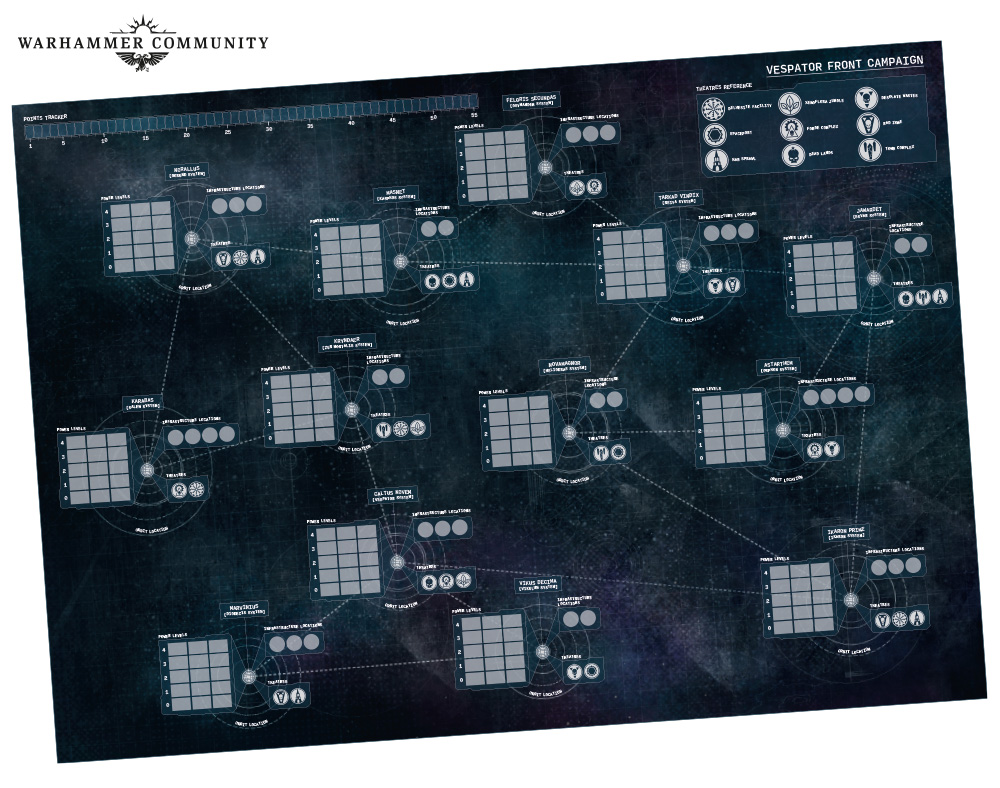
You're certainly going to want some poor chump to help keep track of everything and do all the paperwork required to run the campaign. This campaign role is called the Warmaster, and if you’re wondering if we’ll be supporting this campaign structure in Administratum, the answer is “yes” - look for that update to drop in about a month. The book comes with a large, fold-out campaign map and a series of stickers used to mark the location of fleets and control of planets during the campaign.
Rob: Depending on what kind of psycho you are you either just said “hell yeah” out loud or recoiled in horror at the idea of putting permanent stickers on your shiny campaign map. For the record, I’m the latter.
Where’s Crusade?
Crusade isn’t part of these rules. You can run this campaign with or without those rules. They largely seem like they’ll work just fine with Crusade added on top, with one exception and that’s Boarding Actions, which never quite meshed with the Crusade rules. If you’re going this route you may want to work out some characteristics for each of the existing planets in the campaign for armies like Tyranids and T’au to manage for their Crusade campaigns.
Alliances, Planets, and Fleets (Oh My)
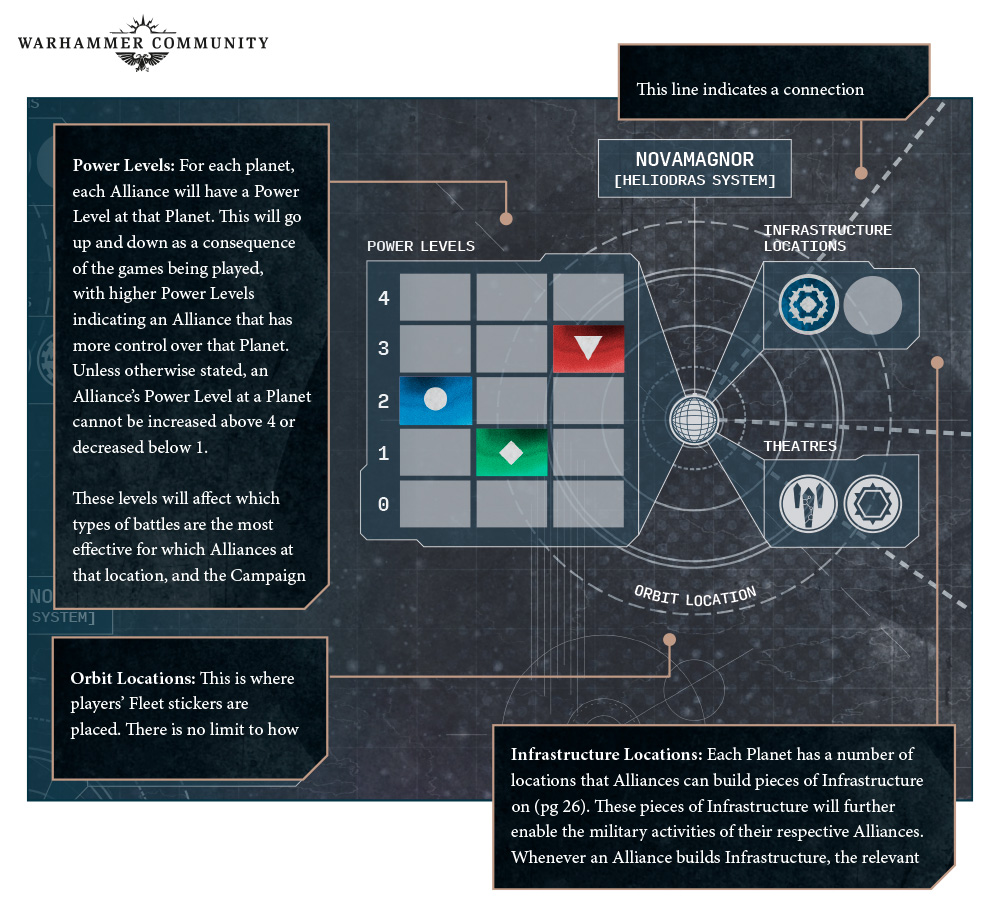
The general setup for the campaign is this: You have a campaign map with a number of planets. Each planet has a number of theaters and infrastructure locations. Planets are connected by lines (this controls how you move between them) and have orbits, which represent the current location of a player’s fleet in orbit around that planet (there’s no limit to how many fleets can orbit a planet, this is just a parking spot space). Each planet has a Power Level characteristic corresponding to each alliance (think of this as a control number), which determines how effective battles are for that alliance at that location.
Each round, players will decide on a course of action by choosing an Operation - usually a battle - play that action out, then resolve the action, move their fleets, and build infrastructure. There are five basic Operations, the most common of which is going to be “Battle Operation,” which has you play a game. The rest do things like move Fleets around or affect planetary control.
Campaign Set-up
Once you’ve determined your player counts and alliances, picked your Warmaster, and determined how long your campaign is going to run, your Alliances will then generate their fleets. If you follow the recommended setup, each player will have one fleet with maybe one or two spare to hand to the players who have a little bit more free time than the others to knock out a few more games. It’s worth noting that the Vespator Front map is fixed - the planets on it are all named and ready to go, mapped out before you start. This is a specific location in the 40k galaxy.
Once you’ve figured out the Fleet situation, each alliance will then get together and secretly decide which planet to build their Stronghold which will take up one of the Infrastructure locations on that planet plus set their Power Level of four. Next up is deciding which three planets will get a Power Level three, four more planets at Power Level two and the last two planets will have a Power Level of one. The Power Level of each planet is used for various things throughout the campaign dictating the order in which some actions are generated or mission outcomes and rewards for games played.
Once Alliances set up, they build three pieces of additional, non-Stronghold infrastructure. Infrastructure comes in four types: Strongholds, Support Facilities, Staging Grounds, and Fortification Lines. Each of these has some effect for a player, from helping you move to or from that planet to changing its power level. With the Infrastructure installed, the Alliances deploy their fleets. This will determine where they’re going to launch their initial attacks. The campaign set-up instructions recommend deploying where you want to expand in the campaign’s first few phases - you can only pick the Battle Operation for a planet your Fleet is either in orbit around or a connected planet to one you’re orbiting.
The Campaign Phase
The Vespator Front campaign takes place over large turns called Campaign Phases. Each of these are broken up into five steps in which you deploy kill teams, move your fleets, raise edifices and occasionally play games of Warhammer 40k.
Your first step each round is Select Operations. Each player selects one Campaign Operation for each of their Fleets to perform for this phase. Ideally you will work with other members of your Alliance to form an actual plan of attack, but it’s worth noting that not all of these actually involve playing a game of Warhammer - more on that in a bit. Note that this is one operation per fleet so it’s entirely possible you could end up playing multiple games in a round if you have multiple fleets.
That said, Battle Operation is going to be your most common operation. This is where a player selects one of the six Vespator Front Missions and then targets either the planet the fleet is currently over or another connected planet. They will then nominate which opposing Alliance to have a scrap with as the Attacker, and that Alliance will pick which of its players is going to step up and defend. Each of the missions has a different outcome and the deployment zones will probably heavily influence your decision as well;
- Seize Power Base has you trying to tear down the enemy Infrastructure and rebuild it with your own.
- Purge and Burn raises and lowers the Power Level of the planet for the competing Alliances.
- Orbital Invasion also raises and lowers the Power Level of the planet but only if the Attacker wins; should the Defender win, they get to swap out their existing Infrastructure on this planet.
- Planetary Bombardment is for the attacker that’s keen to send a message by destroying a planet’s Infrastructure location.
- Supply Base Raid also raises and lowers the Power Level of the planet for the competing Alliances but its Dawn of War deployment which we all know and love.
- Boarding Action kicks off a Boarding Action mission (awesome). The missions here are outlined in the Dread Incursions book, and they’re pretty cool.
The other four operations are handy and help to advance the Alliance's goals beyond the battlefield. These don’t result in a game directly, and can be helpful if you’re going to be unavailable for a length of time.
- Void Leap Operation moves your Fleet to another planet - one that need not be connected.
- Raise Edifices Operation lets you build an Edifice on the planet (assuming there’s space available).
- Logistical Auxilia Operation is recommended as the default option for a player’s Fleet if they are unable to play any games during this phase of the Campaign. It lets the Alliance choose which Theatre is used when they or a neighbouring planet is targeted by an attacking Alliance. Basically gives up your turn to help out a teammate.
- Deploy Kill Teams Operations is another decent option for players unable to get a game in - this one is just the Warmaster rolling a d6 and decreasing the enemy Alliance's Power Level by 1 on that planet if they hit a certain result.
Once Operations have been picked, you carry them out. The Warmaster reveals which operations each Alliance chose in the previous step and which Alliance was chosen as a Battle Operations target.
Fleets which chose to forgo battle and instead Raise Edifices will now do so. At each Infrastructure Location selected, the Warmaster will begin to place the Infrastructures. Should multiple Alliance compete for the same location, the Warmaster will start with the Alliance with the highest Power Level on that planet and work down from there (ties decided by a roll-off). Should a planet run out of Infrastructure Locations, all remaining Raise Edifices Operation for that planet are cancelled.
Now it’s time to play games and resolve all those Battle Operations. Once the games are done, the Warmaster will resolve the changes that result from those games, adjusting Power Levels, adding or removing Infrastructures, or even destroying Infrastructure Locations.
Finally, Fleet movement is resolved and the Warmaster resolves any Deploy Kill Teams Operations.
At the end of the phase the Warmaster tallies up the score and updates the Campaign Points Tracker on the map. Fleets are now given the option to move their fleets around again and each Alliance may choose any planet that has one of their fleets in orbit and then, starting with the Alliance in the lead and going down the score board, they can build one additional Infrastructure.
That wraps up a campaign turn and you’ll notice that actually playing battles is entirely optional here. That’s a bit weird - it certainly helps if you can’t have someone show up to game, but ideally your group are all trying to play every round. There’s also some lop-sidedness to this; it’s very possible one player could end up having to play 4+ games in around as attacker and defender while another player has zero. As a Warmaster you’ll probably want to set limits or guidelines on how to nominate players and limit their exposure so that everyone gets a chance to play, even if they don’t choose to attack. Someone could do multiple build or move actions but still be called on to play defender, for example.
Campaign Points
As you win games and conquer planets, you’ll score Campaign Points. These are used to determine the campaign victor at the end.
Vespator Front Events
After each Campaign phase, the Warmaster can generate additional events based on how well an alliance is performing. These are designed to help balance the campaign a bit if one team gets too far ahead, or just to make things interesting.
First up the Warmaster will see if any of the Alliances are more than five Campaign Points ahead of the other Alliances on the Points Tracker. These cheeky chaps will now be known dominating Alliance for the next phase and if the Warmaster manages to roll a 4+, their Alliance is hit with a Perils of Power Event which are three slight handicaps for the Alliance doing a little too well.
- Cult Uprisings will target a planet that the dominating Alliance has its highest Power Level on (excluding the Stronghold) and on a 3+ for each existing Infrastructure almost certainly destroy them and possibly the location itself on a 6+. The Warmaster rubs salt in the wound by rolling a D6 for each Power Level the alliance has on the planet and reduces it by one for each 4+.
- Coordinated Opposition lets opposing Alliances treat their Power Level as one higher or lower for the purpose of the battle’s Mission Rules and Outcomes.
- An Open Tome makes the dominating Alliance reveal all of their Fleet Operations in the next phase before the other Alliances have chosen anything.
For the Alliance running dead last (Beanith: Hello Admech and Imperial Agents enjoyers) and having more than five Campaign Points less than the other Alliances, they are to be known as the Trailing Alliance. These scrappy underdogs may have the chance to benefit from one of three Desperate Measures Events.
- A Costly Bargain lets the losers select a planet and switch Power Levels with another Alliance on there assuming it isn’t the one with their Stronghold on it.
- Defiant Zeal gives the Alliance a bonus Campaign Operation in the next campaign phase.
- Smuggled Assets lets the losers shuffle around their Infrastructures around the map and build a bonus for free on any planet.
Rounding out this section for the Warmaster is the Fortunes of War event table. On a 4+ (or a 3+ for the fourth campaign phase and beyond) the Warmaster will then roll again to generate an event from one of nine results. They all add a bit of randomness to the next section of the campaign with results restricting various operations, reducing Power Levels. One such example is Void Piracy which prevents the use of Void Operations or the use of Support Facility Infrastructures.
Beanith: My favorite of the bunch is Xenobeast Migration which forces every fleet to be moved into a new location that can’t be connected to the same planet you just left. Right at the bottom of the barrel for me is Machinations of Fate which lets players switch teams should they choose to do so… on second thoughts it may be the only chance for my Imperial Agents to be on the winning team for a change.
Building Infrastructure
As players conquer planets, they can also build Infrastructure. There are four kinds of Infrastructure you can build: Strongholds (one per alliance), Support Facilities (3), Staging Grounds (3), and Fortification lines (5). Each planet has a number of Infrastructure locations associated with it, which give players spots to build on. Each round players will build Infrastructure and destroy their opponents’. When you destroy a piece of Infrastructure, that’s it - you can’t build anything over it, and when a planet loses all of its infrastructure locations to destruction, the planet itself is considered uninhabitable and destroyed.
Infrastructure gives you minor bonuses. Strongholds increase your power level when you fight on your home planet. Staging Grounds give you a higher power level as well when you fight on that planet or a connected one. Support Facilities let you count further planets as connected, and Fortifications increase a planet’s minimum Power Level. These mostly affect how control over a planet changes between games. They’re fine, but they’re a relatively minor piece of these rules and less exciting than we’d expect. There aren’t any guidelines for incorporating them into your games but coming up with a few of them is pretty easy.
Theatres of the Five Hundred Worlds
Each planet on the Vesperator Front has two to three theaters. These are kind of like battlezones or settings for the battles to take place; they have recommended terrain and can provide unique twists to the games. When an Attacker starts the Attack sequence they pick a Theatre from the planet they’re fighting over as the setting of their game, then they generate a twist for the battle. Regardless of which Theatre you generate, the twists are the kinds of things you’d expect from any Twist deck or Warzone table - things like units gaining [ASSAULT], getting re-rolls to Advance/Charge rolls, taking negative modifiers to Leadership, etc. None of them particularly stood out to us but they’re fine when it comes to “adding a single rule to your games for this warzone,” which is about the limit of what you can get away with when it comes to rules like these. You’re really counting on missions to do most of the work and if you try and tack on more than one theatre rule players are just likely to forget the rule.
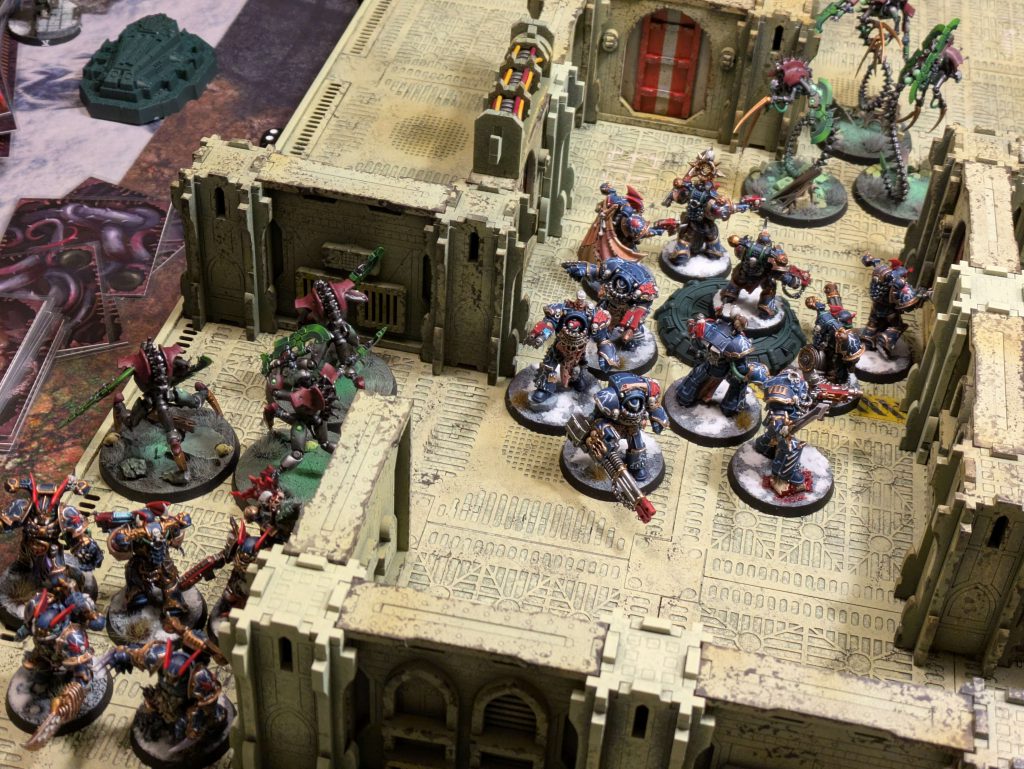
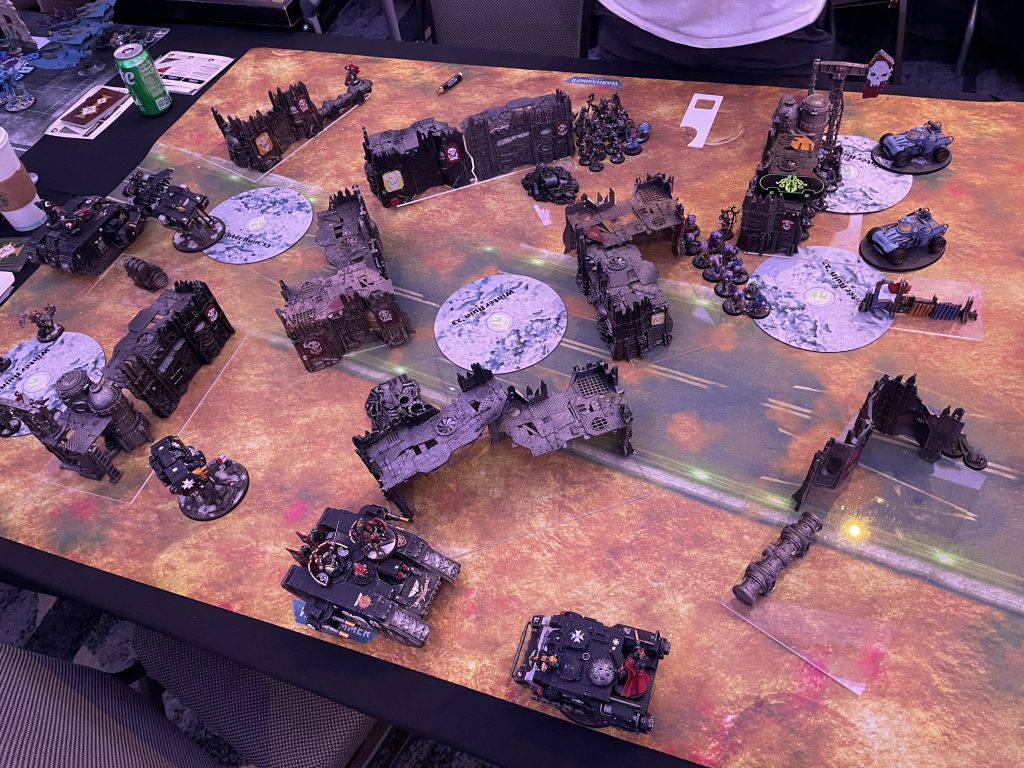 Black Templars vs. Genestealer Cults. Credit: SRM and Justin
Vespator Front Missions
Vespator Front offers five new missions keyed to the various actions in the campaign and thematically set up to represent the types of missions they evoke - Orbital Invasion for example has the Attacker give additional units the Deep Strike rule and set up in the middle of the table, surrounded by Defenders. Their job is to break out and control objectives late, while the Defender is trying to stymie their Incursion assault by holding ground and beating them back. There’s a “sixth” mission in the book - Boarding Action - but this just refers you to one of the Boarding Action missions in 500 Worlds: Dread Incursions missions.
These missions are all solid. They’re asymmetrical and interesting enough on their own. There’s a bit of a danger to only having five and tying them to actions, and that danger is that you can end up playing the same mission over and over if you keep trying to get the same benefit. We’d have liked to see a smaller pool of potential missions for each operation (say, three), but if you have some older supplements like Crusade: Containment you can borrow or repurpose those missions for this as well. There are a lot of opportunities to get creative with it and mix and match.
Final Thoughts
Beanith: Straight up fire, one of the best Campaign books I have read in years. I can not wait to get a chance to play this with my group of friends. The nine different Theatres, each with three associated Twists just kick ass and would have to be the best part of the campaign book for me.
Not going to lie, I am slightly disappointed by the lack of Crusade nonsense but more than pleased with all the cool missions and operations. The Vespator Front Events is an interesting handicap system which may see a fair bit of tweaking for my group. I’d probably just drop the d6 test and give the winner/loser the event to help level the playing field. Maybe slip the Imperial Agent an Imperial Knight or three.
Rob: I like this book a lot. There are some very cool ideas here, and I’m already thinking about how we can make this work in Administratum. And not just for Vespator Front, but making your own little systems with their own planets, already keyed to the Crusade rules for various factions. There’s a lot of interesting things we can do with this, and I think it’s worth revisiting the missions for each operation and figuring out how to do more with those and add new theatres for planets. I mentioned on last week’s podcast that GW needs to do fewer “campaign books” and more “sourcebooks for campaigns” and this is much closer to the latter than the former. We’re very close and I think we can get these rules the rest of the way there. This is a very strong start for 500 Worlds and I’m looking forward to the next campaign book they release, whether that’s Maelstrom or something else they haven’t previewed yet.
That said, I don't know if I'd run it more than once as-is. The lack of Crusade integration is also a bummer, as most of the people I know who want to run a campaign would like to at least have *some* Crusade integration and if you're making a bunch of planets at least put in the hooks there for the existing campaign books. Still, it's a very strong effort from GW.
Have any questions or feedback? Drop us a note in the comments below or email us at contact@goonhammer.com. Want articles like this linked in your inbox every Monday morning? Sign up for our newsletter. And don’t forget that you can support us on Patreon for backer rewards like early video content, Administratum access, an ad-free experience on our website and more.
Thank you for being a friend.
 This website uses cookies. Learn more.


 Goonhammer App and Patron Updates: April, 2026
 Kill Team Tournament Report: Engage, Party, Repeat's March Madness 2026
 Goonhammer Reviews: Tribal Conquest