It is the year 999.M41, and the Doomsday Clock stands at one second to midnight. On the Throneworld the masses gather for the ecstatic celebration of Sanguinalia, and Interrogator Spinoza is sent to a new Master on a very Old World. It's time we dived into the Vaults of Terra series, because it's now out in Omnibus Edition and - long story short - it's bloody good.
The
Vaults of Terra Omnibus collects the three novels and three short stories that form the Vaults of Terra Series, the record of Inquisitor Cowl and Interrogator Spinoza's tangling with a far reaching and earth-shattering conspiracy as the status quo of the 41st millennium comes to a crashing end. The first release -
The Carrion Throne - accompanied Games Workshop's big move to shift the timeline of 40k forward all the way back in 2017 (incredible that ten years later people are still complaining about Primaris, isn't it?), and was the first good novel to come out of the Gathering Storm.
Chris Wraight had produced a fair few 40k novels before, but it was
Carrion Throne that really put him on the map.
As a result I'm mainly going to talk about that one book, because while this is three novels and three short stories in one, everything in here that I love or like is done best, strongest and cleanest in
The Carrion Throne. There's an ever so slight diminishing return going on in
The Hollow Mountain and then
The Dark City takes that process a little further. All three are among the best Black Library has to offer, and firmly, irrevocably, cement Wraight as the third leg of the
Abnett and
Demski-Bowden trifecta.
The Carrion Throne, though, punches up - I think,
Echoes of Eternity aside, it's the best book written about 40k.
"It Makes No Sense! Compels Me Though."
It works because it's a mystery worth the search. That's not always the case, as the universe of 40k is almost literally drowning in McGuffins. Everyone has one, everyone wants another, finding yet another one just isn't that big of a deal. To create and sustain mystery over three books, Wraight strikes at the heart - literally and metaphorically - of 40k. Terra, The Throne, The Body of the Emperor. It's a mystery carved out of universal 40k knowledge, the stuff that even the lightest touch of the - no, I can't bring myself to call it "lore" - fluff will pick up. When you place something on Terra it matters, and we know it matters. What happens here shakes the foundations of empire, and we as readers are primed to bestow it with significance.
They have all the great elements of a murder mystery, except this is 40k so it is, of course, several hundred murderers. Something is stalking the inhabitants of Terra’s vast and ungainly Underhives. The protagonists aim to stop it, uncovering conspiracy, lead and mislead, dead-ends and dead informants. It’s one very tied to a place, that goes above and beyond layering the tropes of the genre onto a 40k skeleton - crimes that only make sense within the universe, solutions and culprits that are decidedly 40k, and methods of investigation (turn up with a big hammer) that suit the setting. I tend to enjoy “it’s X but in 40k” anyway, regardless of quality, but The Carrion Throne and Hollow Mountain lift a lot of conspiracy/thriller/mystery elements and use them to tease apart some of the foundational building blocks of the 40k world, as well as giving us another, much welcome, look at the Puritan/Radical spectrum.
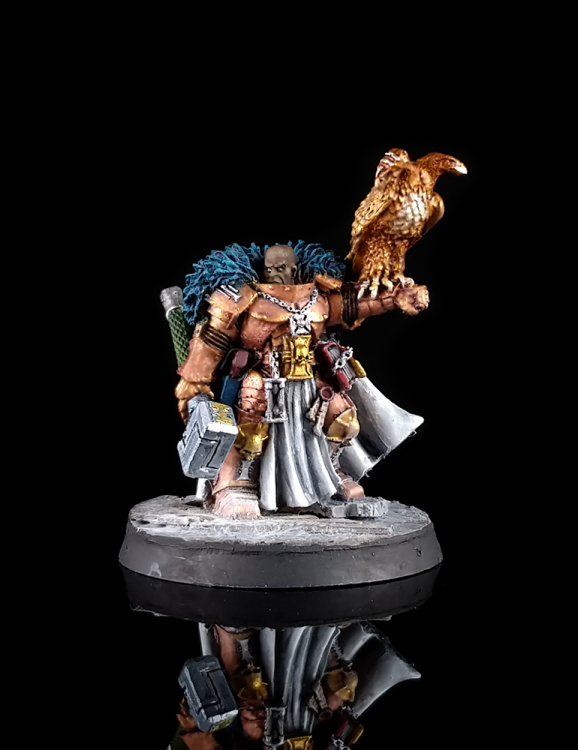 Inquisitor Coteaz Credits: That Gobbo
The fact that this is spun out of a single line in an old edition of 40k - 999.M41 The Adeptus Mechanicus discovers faults in the Golden Throne far beyond their ability to repair (or words to that effect) - makes it even more of an achievement. There are dozens, if not hundreds, of books in the Black Library that extrapolate a single throwaway line of fluff from a rulebook into a full length novel, and this is one that doesn’t feel stretched out to fit. It’s a single line drawn out into three books without the thread snapping - a great bit of world and plot building that centres about 15 words and then asks “what happens next?” and answers it satisfyingly. Everything that happens from the very first page plays out naturally, spinning an ever increasing web of loyalties, conspiracies and skulduggeries (ok, fine, I just wanted three -ies words) without plot contrivances that would take you out of the unfolding drama.
That is, right up until the very end. It’s always hard to write about endings without spoilers, but all our action, character and rising terror channels itself into the webway, takes a short break to discuss and deal out some exposition and then hurries to a conclusion. The end leaves just enough of a dangling thread to allow for a followup if Imperial Civil War is the direction GW want to go in for 11th and 12th edition, but otherwise ends up in that Grand Tradition of 40k fiction: big questions, unresolved answers. The substance of the end is perfect, providing a final stop to the story that we all too often lack in the hunt for the next book in a well-selling series, but the fallout never comes. That’s more than usually disappointing - anyone remember the Storm of Chaos? - because this is a series that promises change and action arising from the actions of the protagonists.
Instead, the world changes around them, which is good, but leaves their changes flapping in the wind, which is less good. The investigation - and later revelation - at the heart of the series is a world shaking one, but the clock resets at one minute to midnight, and then ticks past into the Era Indomitus. Everything that happened is still happening - but now noone seems to have noticed for a couple of hundred years of in-universe time. Ah well. Emperors be emperor-ing.
Inquisitor Coteaz Credits: That Gobbo
The fact that this is spun out of a single line in an old edition of 40k - 999.M41 The Adeptus Mechanicus discovers faults in the Golden Throne far beyond their ability to repair (or words to that effect) - makes it even more of an achievement. There are dozens, if not hundreds, of books in the Black Library that extrapolate a single throwaway line of fluff from a rulebook into a full length novel, and this is one that doesn’t feel stretched out to fit. It’s a single line drawn out into three books without the thread snapping - a great bit of world and plot building that centres about 15 words and then asks “what happens next?” and answers it satisfyingly. Everything that happens from the very first page plays out naturally, spinning an ever increasing web of loyalties, conspiracies and skulduggeries (ok, fine, I just wanted three -ies words) without plot contrivances that would take you out of the unfolding drama.
That is, right up until the very end. It’s always hard to write about endings without spoilers, but all our action, character and rising terror channels itself into the webway, takes a short break to discuss and deal out some exposition and then hurries to a conclusion. The end leaves just enough of a dangling thread to allow for a followup if Imperial Civil War is the direction GW want to go in for 11th and 12th edition, but otherwise ends up in that Grand Tradition of 40k fiction: big questions, unresolved answers. The substance of the end is perfect, providing a final stop to the story that we all too often lack in the hunt for the next book in a well-selling series, but the fallout never comes. That’s more than usually disappointing - anyone remember the Storm of Chaos? - because this is a series that promises change and action arising from the actions of the protagonists.
Instead, the world changes around them, which is good, but leaves their changes flapping in the wind, which is less good. The investigation - and later revelation - at the heart of the series is a world shaking one, but the clock resets at one minute to midnight, and then ticks past into the Era Indomitus. Everything that happened is still happening - but now noone seems to have noticed for a couple of hundred years of in-universe time. Ah well. Emperors be emperor-ing.
Spinoza
While the supporting cast are all good-to-great, the star of the show here is Interrogator Spinoza and Wraight does a bloody good job of making one of 40k's perennial difficult-to-like characters, the religious-fanatical puritan Inquisitor, into an interesting and three dimensional character. She comes to Terra full of the metaphorical piss and vinegar, learns lessons, is physically and emotionally changed by them and acts accordingly. She's very much grounded in her own character, and I can't think of a moment in the series when she acts any other way than how she would.
That seems like a very simple statement, but it's a surprisingly difficult one to pull off if you've ever tried to write fiction. "What does this character do in this situation" gets pushed and pulled by the vagaries of plot and pacing. Perhaps someone needs to act quicker, push themselves further, take on superhuman attributes (or lose them) temporarily in order to get the whole book where it's supposed to be going. Spinoza doesn't, and in a murder-mystery/intricate thriller that is quite an achievement. She remains herself - her changing self - throughout, and as you develop your knowledge of her character, the choices she makes become more obvious, inevitable, even when the Spinoza of several hundred pages before would have decided utterly differently.
I thought about this in terms of the often used Ur-example of the changing Inquisitor - Eisenhorn. Over three books, Spinoza goes from hardline puritan to slightly less hardline puritan, and her actions, methods and ways of speaking change as a result. Eisenhorn takes three books to go from puritan to radical, but he doesn't change all that much until right at the very end. We're told, while Wraight shows - a subtle, and very well done, bit of character development.
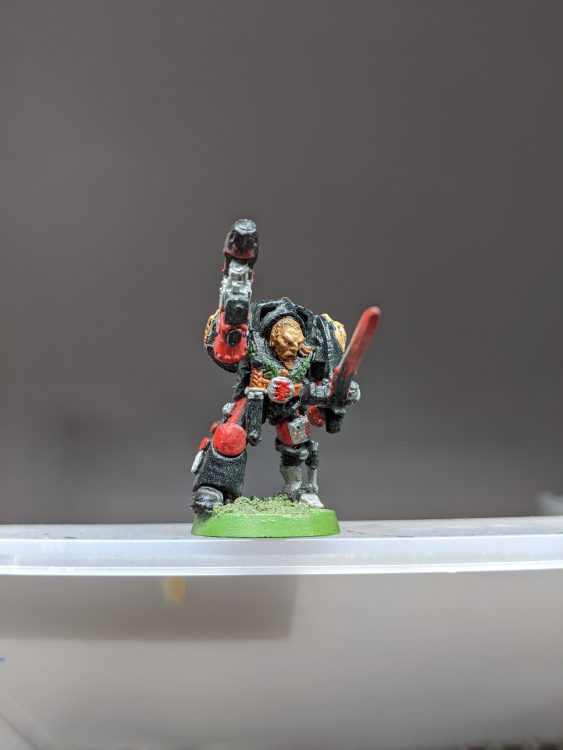 2nd Edition Inquisitor Lord. Credit: Kevin Genson
Spinoza also provides one of my favourite things in a Black Library novel, the nod to real world history that makes me, personally, feel clever for remembering a scrap of my A-Levels. Spinoza, the philosopher, had some interesting ideas on immortality, the divine, and thought - some of which find reference in Spinoza (the character)'s thoughts on the Emperor. Further into that, the nature of the Emperor and the Throne - alive, dead, trapped in some superposition between the two - and how this interacts with the beginning of the Dark Imperium can be explored through Spinoza's ideas of the immortality of adequate ideas, of knowledge of the divine and the Deus Natura, nature-as-god (and vice versa) just as Emperor-is-Imperium. Fun bit of work that.
A Tourist's Guide to Terra
There's a lot of good stuff there but what elevates
The Carrion Throne - and at least the first half of
The Hollow Mountain - is immersion in the psychotic geography of Terra itself. There's little I like more than description so thick it oozes off the page, and that is the overriding theme of
The Carrion Throne at the very least.
The plot, when distilled down to its essentials is very simple - Spinoza investigates some murders, she finds the murderers, everyone runs around underground for the rest of the book. That's all very good stuff, but where
The Carrion Throne shines is that it's a relatively small slice of the total wordcount. The rest, far and away the best bits of the series, is descriptions of Terra - details that add weighty texture to a world we know very little of in the 41st millennium. These sections, detailing hives, fortresses, spires, the approaches to the throne room and the underverse of our history, are flat-out brilliant, and steal focus - rightly so! - away from the plot. We're immersed in Terra through the handy narrative device of Spinoza being new to the planet. The places, people, customs that are all new to her, receive such loving treatment by Wraight that you get caught up in them.
While there's murders happening and madness unspooling, of course, the bit you really want to read is the architectural and economic details of this hell world - how the dead are rendered down into fuel, and their hair taken to stuff sacks, or how a far-future Corbusier designed hives to drive the sanest mad. It reminds me, impressively, of the first tranche of Bond books. There, a nominal and often pretty thin spy plot is really a reason to write travel fiction - Bond goes to places that were exotic for Brits in the 1950s, eats and drinks lavishly, and then goes to somewhere else to do the same thing. Some people get shot, some women are treated awfully, but the main point of the books is to talk about food and drink, and Fleming luxuriates in that.
The Carrion Throne is similar. The plot is interesting and gripping, the characters are great, Wraight's prose is really pleasant to read but the important thing is the world-city, and doesn't it show?
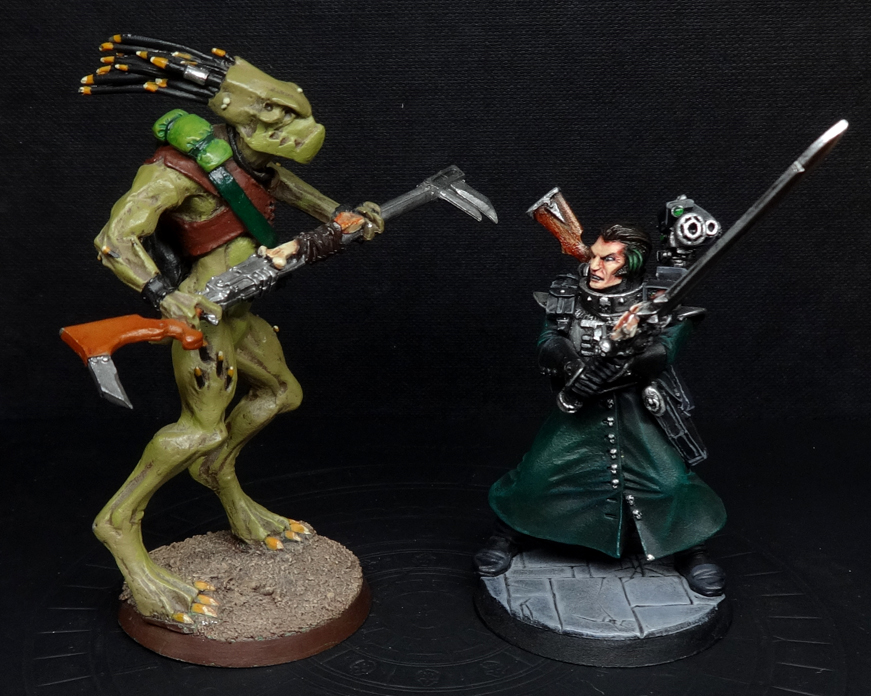 54mm scale kroot are tall. Credit: Charlie Brassley
Spiraling out of the paragraphs lavished on Terra-as-will-be are the second charming bit of the series, the digressions. While Spinoza is new to Terra, Cowl is not, and his thoughts on the places and people he travels through occasionally bloom into fantastic digressions which advance the plot - or our understanding of it - minimally, but draw the characters into the wider 40k universe. The stand out one is in Book 2, where Cowl spends some serious time thinking about Merchant Navy scheduling during what should otherwise be an extremely tense infiltration. There's an ease to the digression sections that picks up some of the qualities of great creative non-fiction, prompting another surprising comparison -
Les Miserables.
Victor Hugo goes to immense lengths to give us context to his epic, with occasionally only very tangential relationship to plot, but they're what makes
Les Mis one of the all-time-great novels. It's a gamble, and your mileage may vary here, but when it pays off - in both novels - it really pays off. I do want to hear Cowl's thoughts about the Ordo Xenos, or the nature of Bach. These are characters with interests and thoughts beyond the immediately plot relevant.
It makes for a slightly meandering, questioning start to the Omnibus, which makes the slow replacement of non-plot by plot in
The Dark City a bit of a shame. The thickness of all that description starts to die away half way through book two - possibly as Wraight realises he's got to cram some of the Gathering Storm stuff in here too - and then is largely absent in
The Dark City. Instead, the third in the trilogy forms a good 40k novel: lots of intrigue, skullduggery, shooting and flying about, where most pages have some kind of ultraviolence or exposition - very much what I'd think of as a standard (but still very good!) Black Library offer. The calmer pace of
The Carrion Throne and first half of
The Hollow Mountain feels different - and all the better for it.
The Short Stories
I’ll be fully honest here that I read the three novels, then put down my kindle and thought ok time to write about them. They’re a nice, self contained story with a clear arc. The omnibus edition includes three short stories, that can more or less be described as “how they got their weapons”, because that’s what they cover. Spinoza gets her Crozius, Cowl gets his gun, Khazad gets her sword. These stories certainly exist, and they're not at all bad - just a bit unnecessary.
The Khazad and Cowl stories are a nice bit of background, but the Spinoza story is clearly a first go at a character that gets better later. The connection between Spinoza, the Imperial Fists and her lovely Crozius Arcanum hints, throughout the novels, at some grand and wonderful deed, of perhaps a long history fighting alongside the Angels of Death. If you don't read the short story (which came first!), then it will remain so.
Unfortunately, in compressing this into a short story, the association becomes fleeting and less heroic - Spinoza accomplishes a deed, but is it enough for the Fists to give up a prize relic? It's one of those bits of additional exposition that just makes everyone involved look like they're acting in service of the story - how Spinoza Got Her Groove Back is just better in the imagination than on the page. That's all well and good to say in retrospect and I feel a little mean saying it, but with the omnibus edition release I'd probably have cut Argent out altogether.
Vaults and Watchers
I really like the Vaults series, I think it's a cracking bit of 40k fiction and the first book in particular does something really interesting in it's strange, twisted, travelogue form. On its own, the omnibus is great value - three excellent novels for the price of two - but it's still incomplete. The Vaults series isn't really a trilogy that stands alone, and the companion piece, the Watchers of the Throne series, interacts and intersects with it in a couple of key places without either set of characters really knowing. The machinations playing out quite literally under the Throne are matched by those around, above and beyond, and the unravelling of Terra in the early days of the Dark Imperium plays out in parallel across both books, with elements from one explaining the other.
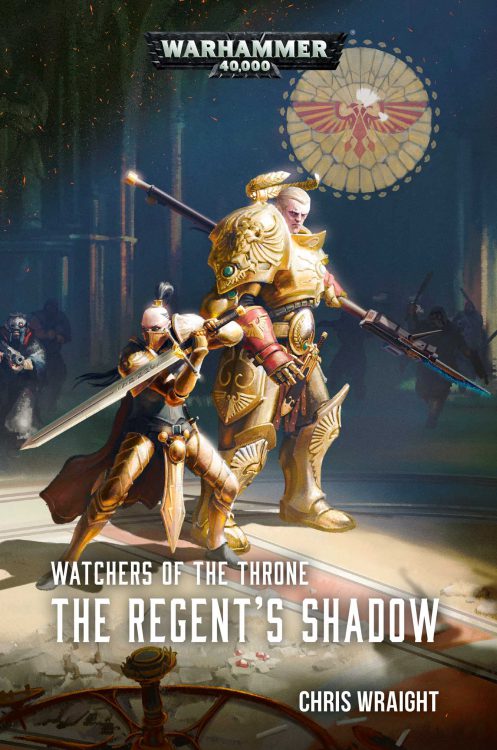 The Regent's Shadow Cover Credit Games Workshop
It's by no means essential to read both alongside each other, but everything about them is complimentary. Watchers inverts the Cowl/Spinoza relationship in Aleya and Valerian, language - and conflict - is cleaner, befitting the rarefied world of the Custodes, and we visit Luna in a substantially different way, explaining what mere mortals are mystified by in
The Dark City. I think, if I did it all over again for the first time, I'd probably interleave them -
Carrion Throne, Hollow Mountain, Emperor's Legion, Dark City and
Regent's Shadow - to see what I could get out of the series as a quintet.
Into the Vaults
If you haven't picked these up yet, the Omnibus provides the perfect opportunity to dive right in. While they were, perhaps, a little more impactful in the old days of 2017 when it seemed like all plots were possible and the world was never going to be the same again, this is still one of the gems of Black Library fiction. You could stop at
The Carrion Throne and be satisfied, but for all that the second and third book don't hit quite as hard, it's a fantastic collection of three very solid novels. While I'm keening for a third Watchers of the Throne novel to round the bad shit happens on Terra sextology, I'm glad that the Omnibus provides every word on Spinoza and Cowl. Some stories come to an end when they should - this is war, and people die, no matter how much their namesake wrote on the immortality of ideas.
Have any questions or feedback? Drop us a note in the comments below or email us at contact@goonhammer.com. Want articles like this linked in your inbox every Monday morning? Sign up for our newsletter. And don't forget that you can support us on Patreon for backer rewards like early video content, Administratum access, an ad-free experience on our website, and subscriber-only content covering competitive Warhammer 40K!Thank you for being a friend.
 This website uses cookies. Learn more.


 Goonhammer App and Patron Updates: April, 2026
 Kill Team Tournament Report: Engage, Party, Repeat's March Madness 2026
 Goonhammer Reviews: Tribal Conquest