Disclaimer: The designers of Flag Rascals provided us access to the TTS version of the game to preview during their Kickstarter. In the process of reviewing it, we learned one of their team members is a Goonhammer Patron; this had no influence on our interest in covering the game, but is noted for transparency.
For a game mode so ubiquitous that it transcends real life sport into video games, I’ve often marveled at the fact that Capture the Flag has never really made for a compelling board gaming experience. I can certainly understand the reasons and see why, but I’m also sometimes surprised that there really are not that many attempts at it either, as if people had given up on the idea from the get go. Recently, the team behind Flag Rascals reached out to us and asked if we’d like to take a look at their board game, which, lo and behold, was exactly that: a capture the flag game for 2-4 players.
Playground Rules
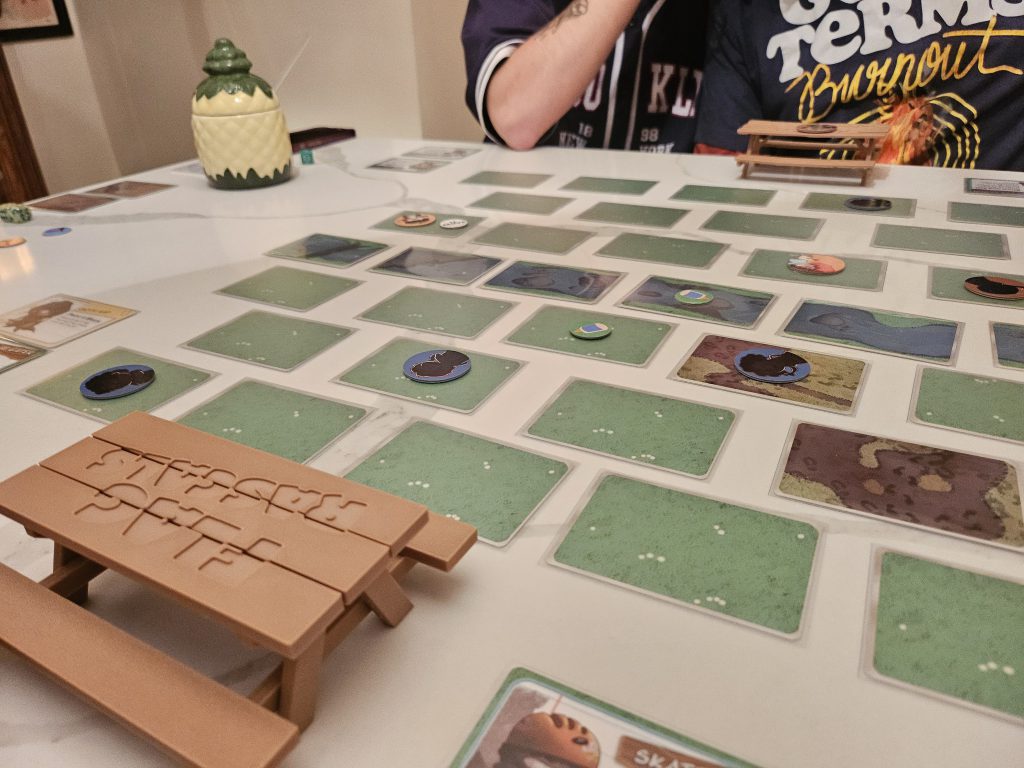 A physical demo, photo provided to us by the team as I was only able to try it via TTS.
In Flag Rascals, players assume command of a group of rascals, with a captain and then a few other children underneath their command, who are trying to steal the other team’s flag and return it to the middle of the board, known as the Creek. What immediately grabbed my attention about this setup is that players are forced to keep track of both sides of the map, rather than one player “attacking” and the other “defending”; instead, both players are required to manage offense and defense, because capturing the opponent’s flag is the name of both player’s game. Whereas many games often rely on an asymmetrical setup in which one player has to defend the base while the other storms it and then reverse, Flag Rascals instead has players moving the rascals both aggressively and defensively and judging the risks for doing so. Do you only send one kid across the creek to get at the flag, or do you try a broader approach that may leave your own side defended only by one person? There’s a lot of risk/reward there, and it was one of the first things I really noted that stood out to me with the concept.
The kids also have various abilities, and each Rascal has an ability as both the Team Captain or team member; for example, as captains, the Teacher’s Pet has an ability called “Sore Loser” that allows them to place a benched teammate next to another teammate, while the Journalist can Flip a tile adjacent to a teammate, and even opt to Flip the tile back over at the end of your turn. As a teammate, the Teacher’s Pet instead allows you to Peek at the adjacent tile and then move two spaces, while the Journalist allows you to swap two face down tiles that are on the same side of the creek as they are. There’s 16 in total, and each time you play you’ll select a captain and draft two more rascals, so there’s a lot of variety in team composition too.
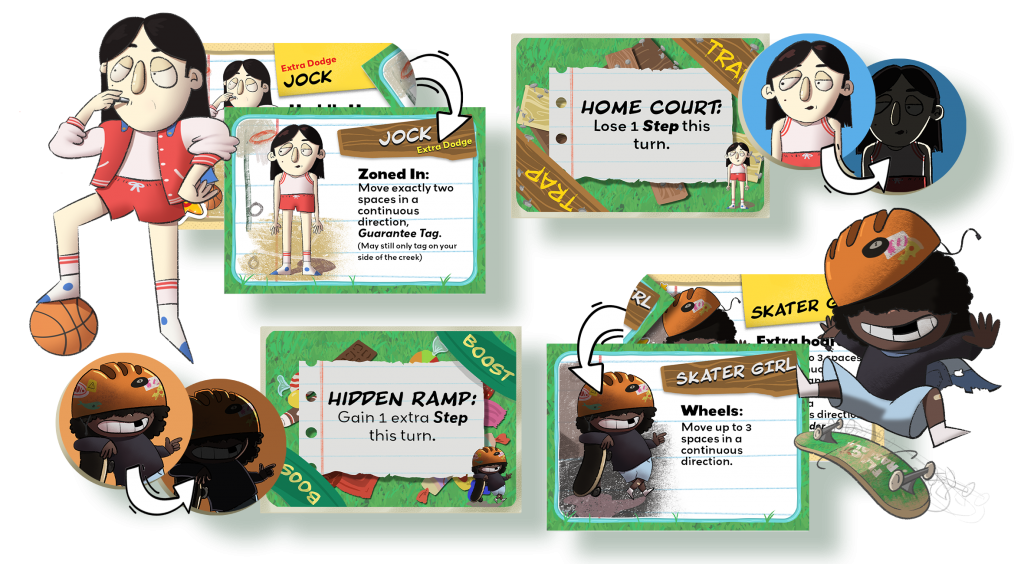 The characters are all visually distinct, easy to parse, and the overall art design on the game is fantastic.
I loved the art on the cards and the various tokens, and while I was only able to play the game in TTS, from seeing the physical models shown off at PAX, I feel like the game will visually pop off the board at home too. The best part is that things are easy to read and iconographic, which also makes it easy to track which token belongs to whom, and which rascal is represented on the board. There’s a lot of fun flavor in the character designs too, and honestly almost all of the charm in the game comes from the various rascals designs and how their character archetype manifests in the game, so I was very pleased with how easy it was to start remembering what each character did after only a few games.
Quick, Fun, And Easy to Learn
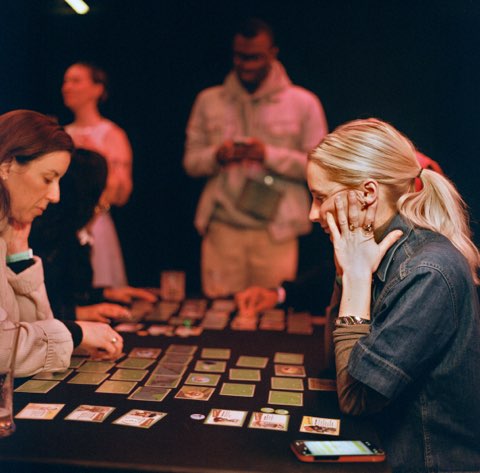
Although I feel like many games try to tout themselves as quick, fun, and easy to learn, in practice I often find that most games are actually only some combination of these things. They may be quick and easy to learn, but not that fun to play, or quick and fun, but not actually as clear as one might expect. So I’ll give kudos to Flag Rascals for managing to nail all three of these things, because the rulebook provided in the TTS demo was simple to follow and helped mimic a mock game, which then made playing through a demo game and picking up the game exceptionally easy.
My general play partners all tend to be the “learn by doing” type of board game players, so there is always a little hesitation for me to ensure that I know every possible rule in order to answer any questions that arise, which can become pretty tiring. Thankfully, the rules were clear, and we also didn’t have many questions at all during our first few plays of the game. About the only question we did have come up was that about “Pushing”, which is essentially the combat of the game, in which Rascals can attempt to Push other Rascals, primarily to try and stop them from capturing the flag, and even those questions were solved by just playing out the scenario and understanding the way things properly worked.
We had a lot of success with the games being fast, too, which was a selling point for the game; our longest round of Flag Rascals took around 45 minutes, and that was primarily our first game in which we set up everything, read every card, and took each turn exceptionally slowly so that we understood what was happening. Once we had that game under our wing, we found that games hewed closer to the 20 minutes advertised in the campaign, and even had a few games start to get under that number the more we played. Since winning is a single step requirement (bring the Flag of your opponent to the Creek), we did end up finding the game worked best as a two out of three style competition between players.
More Friends, Less Problems
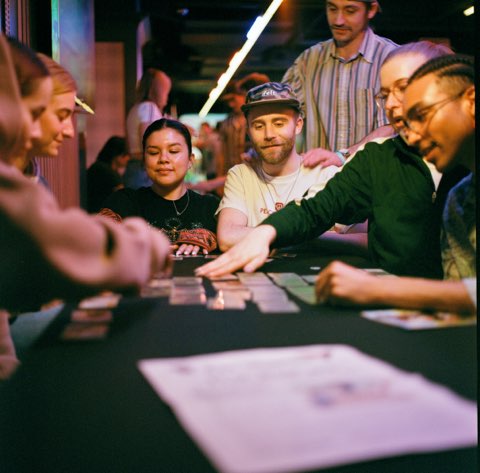
The game also advertised a 2-4 player count, so we did also try the three and four player variants. These create “teams” in which two players face off against either one or two other players, and each team selects four Rascals instead of the three from the base game. The quirk to this is that each player on a team selects two Rascals, and they decide which of their Rascals to activate on their given turn, meaning that one player cannot take all the actions of a teams turn. This was perhaps the first part the rules was not inherently clear about, but my players and I figured out that is what was meant after reading and then thinking about the rules for a moment. There’s also a different play area for 3-4 players that makes the board slightly bigger, and that did help address the crowding of two extra Rascals on the board.
The three player variant simply gives one player control of an entire team, which also made the above rule a little muddier; since only one player is controlling four rascals, there’s no need to ensure that players are taking turns fairly or one person isn’t just chain activating the same two people every turn, but it ends up playing the same as the single player still has to exhaust the four individual Rascals themselves. Obviously, you probably won’t be surprised to hear this, but the four player variant was fun, while the three player one was just okay. If I only ever had three people at the table, I’d likely look to play something else, or have players take turns in 1v1 games to have some sort of final stand off game.
No Flag Fouls Here
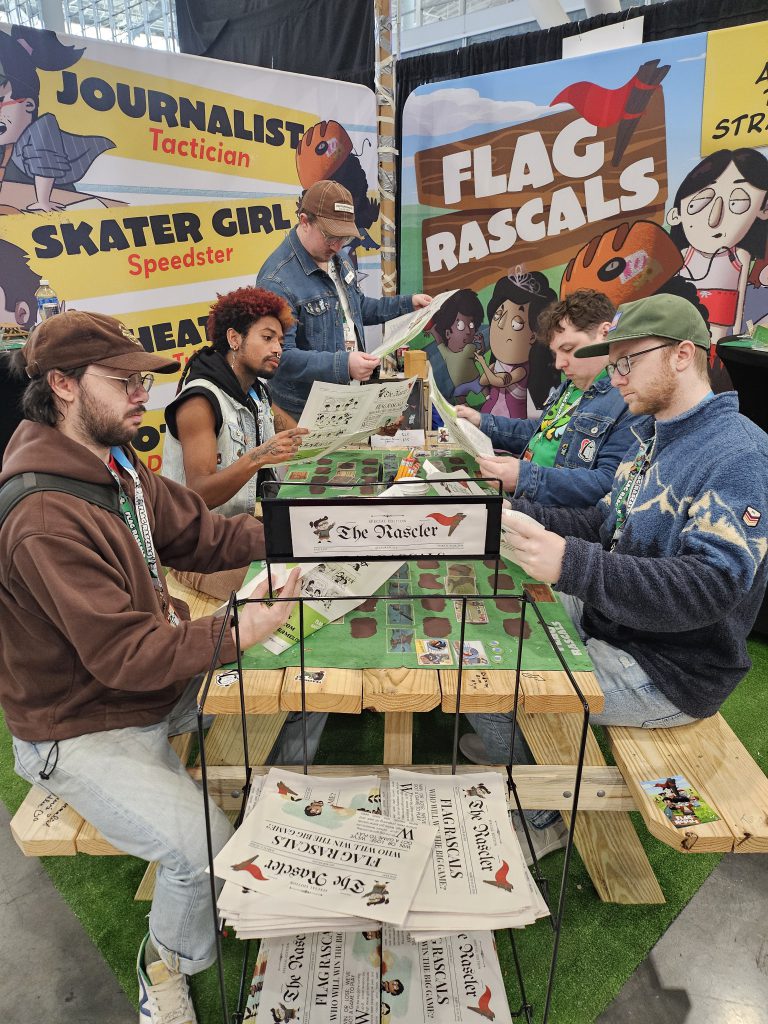 Thanks to the Flag Rascals team for letting us try out your game; I couldn't pass on this cute shot they included.
I really enjoyed my time with Flag Rascals, and so I will say that if the game seems interesting to you, consider checking out the
Kickstarter for the game that is currently live for roughly the next 20 days or so. I think the game plays excellently at two and was pretty fun at four, and I also think that while all of my experiences with the game was with other adults, this could make for a fairly easy family game with a little patience to help younger players understand what it is their rascals can do and see how they piece together a strategy. The nostalgia factor of “playing outside after school” certainly seems to be a big part of the game, though, and it did make my play group talk a bit about random antics we used to get up to after school. Given the way things have changed since then, I wonder if that theme is as relevant or attractive to younger gaming groups that may pick up the game to try, but I suppose that’s a very different article!
Overall, if you’re looking for a fun, tight, and surprisingly dynamic 2v2 game, then Flag Rascals is a great time that doesn’t overstay its welcome on the table and presents enough variety to remain fresh even after playing it a few times back to back. The selection of captains and drafting teams really helps avoid a sense of sameness to the game, and I am curious to see if the success of the game reaching its goal will result in some extra stretch goals or content for the game (and how those will manifest in, say, retail versions). I’m a big fan of quick and easy to teach games that don’t hang around on the table too long, and for my group, Flag Rascals is a perfect fit for a fun and competitive two player experience that doesn’t feel too mean or swingy; if that sounds like your jam, consider
backing it over on Kickstarter!
Have any questions or feedback? Drop us a note in the comments below or email us at contact@goonhammer.com. Want articles like this linked in your inbox every Monday morning? Sign up for our newsletter. And don't forget that you can support us on Patreon for backer rewards like early video content, Administratum access, an ad-free experience on our website, and subscriber-only content covering competitive Warhammer 40K!
Thank you for being a friend.
 This website uses cookies. Learn more.


 Goonhammer App and Patron Updates: April, 2026
 Kill Team Tournament Report: Engage, Party, Repeat's March Madness 2026
 Goonhammer Reviews: Tribal Conquest