To check out the previous chapters in Marquis' Road from Moscow, read up
here and
here.
A Hobby Hiatus
Well, reader, it’s been a long year. I’ve been on a little bit of a hiatus from pretty much all versions of toy soldiers, because, frankly, my life has fallen apart in the most spectacular kind of way.
 The kind of warm support you can get by becoming a patron and joining our Discord server
On the bright side, it’s given me the opportunity to re-examine my priorities! I’ve been focused on establishing a strong social support system in the meat world, so I haven’t really had as much time to paint, model, write, and play games as I did before. And you know what, reader? That’s okay! Things will wax and wane in their importance in our lives, and the most important thing to remember is that if it’s not fun, you don’t have to force yourself into it. As I’ve gotten more comfortable in my real life connections, I’ve felt less need to seek out new socialization, and I’m drifting back into toy soldiers.
Of course, Blood Bowl is my first love when it comes to tabletop gaming! After the Year of the Wood Elf in 2024), 2025 has been the Year of the Vampire - coinciding neatly with our Century of the Vampire series of media reviews. The sum total of my hobby progress in the last year has been to paint a Vampire team (15 models), and even that’s taken nearly a full 12 months to complete, working on them as inspiration came in drips and drabs.
The kind of warm support you can get by becoming a patron and joining our Discord server
On the bright side, it’s given me the opportunity to re-examine my priorities! I’ve been focused on establishing a strong social support system in the meat world, so I haven’t really had as much time to paint, model, write, and play games as I did before. And you know what, reader? That’s okay! Things will wax and wane in their importance in our lives, and the most important thing to remember is that if it’s not fun, you don’t have to force yourself into it. As I’ve gotten more comfortable in my real life connections, I’ve felt less need to seek out new socialization, and I’m drifting back into toy soldiers.
Of course, Blood Bowl is my first love when it comes to tabletop gaming! After the Year of the Wood Elf in 2024), 2025 has been the Year of the Vampire - coinciding neatly with our Century of the Vampire series of media reviews. The sum total of my hobby progress in the last year has been to paint a Vampire team (15 models), and even that’s taken nearly a full 12 months to complete, working on them as inspiration came in drips and drabs.
Where I’ve Been
Luckily, in between the publication of the last article and my life collapsing like a French column in a Russian winter, I managed to get more than a little work on this Russian project finished! Last time out, I had picked the broad recipe for my uniforms, including a range of a few different recipes for the greatcoats.
The next step was to dial in a paint scheme, which also meant answering some questions about the composition of my force. I wanted a decent mix of troops for a variety of game systems - both multi-based, large-scale games like Blucher and games like Sharp Practice that require individual model removal. Knowing this also gave me an idea of how many models I would need: my demo game of Blucher had ~25 bases of infantry and half a dozen bases of cavalry per side, and Sharp Practice generally takes 50-80 minis. I also wanted a unit of the famous Pavlovski grenadiers, with their great bronze-faced miter hats*. A sprinkling of cavalry would be useful in most game systems, and I’ll consider another cannon or two as my collection expands.
With my greatcoated North Star metals in hand, I ordered the above from the Perry website. You can hunt down the specific item numbers if you’d like, but the goal was basically this: to get a decent spread of greatcoats, to help emphasize the wintry nature of my army; and standard uniforms**, to get enough green on the table to remind everyone that I was, in fact, playing Russians. Other than the 40-count infantry box and the command sprues, all of the above are metal.
As a final purchase, inspired by our ongoing (and excellent!) Silver Bayonet coverage, I also picked up The Russian Unit, intending to scatter them throughout my various regiments as fun little bonuses to draw the eye.
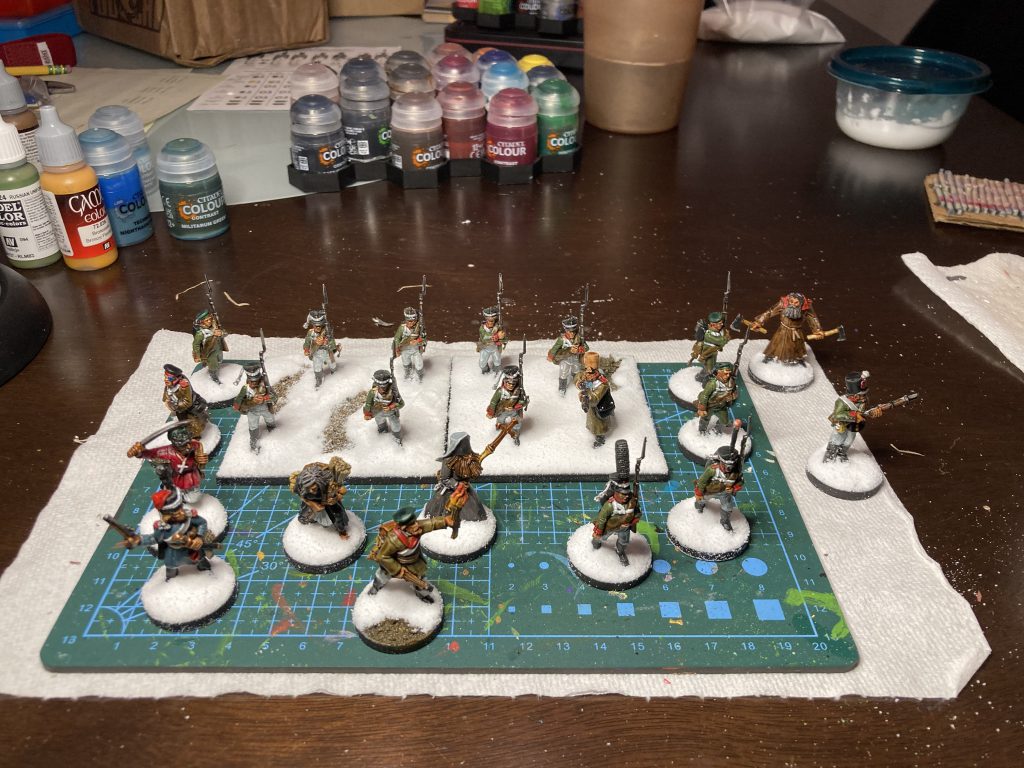 I also got very excited about painting them before I got into the meat of the project… whoops. Credit: Marquis_of_Peaches
All told, my collection stands at 108 infantrymen, with head swaps delineating Musketeers, Grenadiers, Jaegers, and the famed Pavlovski Grenadiers. My standard base size will be 3”x3”, to match the bases that my local grogs use. All of my infantry will be divided into battalions of 12 figures, with Jaegers three to a base and line infantry four to a base. Each battalion of Musketeers and Grenadiers will have a command base with an officer, drummer, and standard bearer. The Musketeer battalions will have a normal guy as well, presumably representing the sergeant(s) tasked with defending the colors, while the Grenadiers will get an extra standard to help them stand out even further on the table. The infantry will be my main focus for now - I’ve got the cannon painted, and I have cavalry in boxes, but the plan is to get into a good rhythm painting infantry before I disrupt it with horses.
Now, the real question: what units will my force represent? For this, I turned to the excellent Et Sans Resultat! Master of the World book, a campaign book about Napoleon’s 1812 invasion. This book details scenarios representing fifteen major battles of the invasion, concluding in Borodino - the largest meeting of the French and Russian armies and the last major battle before the Usurper captured Moscow - and more importantly provides complete force lists, from the commanding general of each Division down to the strength of each battalion, for each of the combatants. These lists are huge, and I’m obviously completely unable to represent nearly the full strength of the Russian army.
For no reason in particular, I settled on the command of Lieutenant-General Tuchkov, leading the 3rd Corps of the great General Bagration. From this force list, I could pick and choose battalions for my models to represent.
I also got very excited about painting them before I got into the meat of the project… whoops. Credit: Marquis_of_Peaches
All told, my collection stands at 108 infantrymen, with head swaps delineating Musketeers, Grenadiers, Jaegers, and the famed Pavlovski Grenadiers. My standard base size will be 3”x3”, to match the bases that my local grogs use. All of my infantry will be divided into battalions of 12 figures, with Jaegers three to a base and line infantry four to a base. Each battalion of Musketeers and Grenadiers will have a command base with an officer, drummer, and standard bearer. The Musketeer battalions will have a normal guy as well, presumably representing the sergeant(s) tasked with defending the colors, while the Grenadiers will get an extra standard to help them stand out even further on the table. The infantry will be my main focus for now - I’ve got the cannon painted, and I have cavalry in boxes, but the plan is to get into a good rhythm painting infantry before I disrupt it with horses.
Now, the real question: what units will my force represent? For this, I turned to the excellent Et Sans Resultat! Master of the World book, a campaign book about Napoleon’s 1812 invasion. This book details scenarios representing fifteen major battles of the invasion, concluding in Borodino - the largest meeting of the French and Russian armies and the last major battle before the Usurper captured Moscow - and more importantly provides complete force lists, from the commanding general of each Division down to the strength of each battalion, for each of the combatants. These lists are huge, and I’m obviously completely unable to represent nearly the full strength of the Russian army.
For no reason in particular, I settled on the command of Lieutenant-General Tuchkov, leading the 3rd Corps of the great General Bagration. From this force list, I could pick and choose battalions for my models to represent.
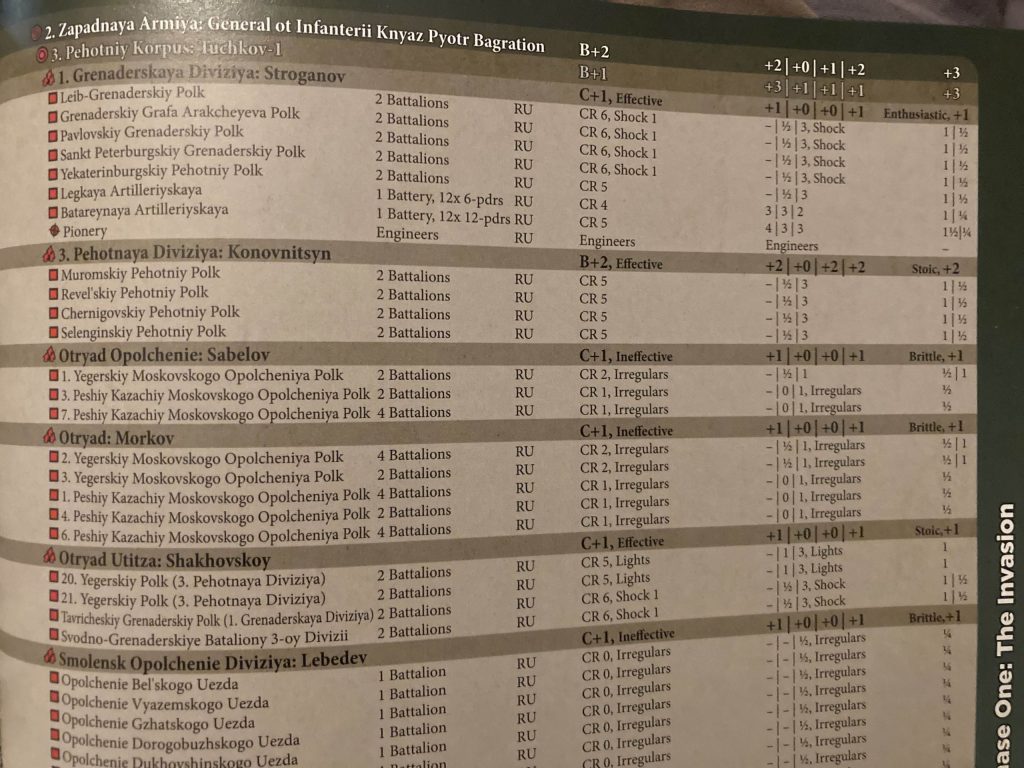 The introduction to the book describes these pages as “easy reference”. Credit: The Wargaming Company
Russian Regiments were largely named after the major cities from which they were raised, and designated by their facings and crossbelt cover (effectively an epaulet). The crossbelt cover would be embroidered with a Division number, and the cover and cuffs would be colored according to the Regiment’s seniority in the Division. I’ll probably forgo the numbers for now, frankly because I can’t be bothered to mess with such a small detail (Ed.: YET!!).
The introduction to the book describes these pages as “easy reference”. Credit: The Wargaming Company
Russian Regiments were largely named after the major cities from which they were raised, and designated by their facings and crossbelt cover (effectively an epaulet). The crossbelt cover would be embroidered with a Division number, and the cover and cuffs would be colored according to the Regiment’s seniority in the Division. I’ll probably forgo the numbers for now, frankly because I can’t be bothered to mess with such a small detail (Ed.: YET!!).
*
the drip is the main reason to play historical games - you know it, I know it, we all know it
**
Even without their greatcoats, the Russian winter “uniform” had a significant modification to differentiate winter soldiers from their summer counterparts: black gaiters covering their white trousers from the boot to the knee.
Luckily, this is a simple modification to make - the painting guide that I used here just gets an extra run of Black Templar Contrast paint up to the knee, rather than leaving it at the toe of the boots.
My Nikolay Tuchkov’s Dudes
After a couple afternoons frantically cross-referencing Et Sans Resultat! and the Osprey guide (truly a lifesaver for any historicals player interested in some level of accuracy), I had done the hard work of selecting and researching my force.
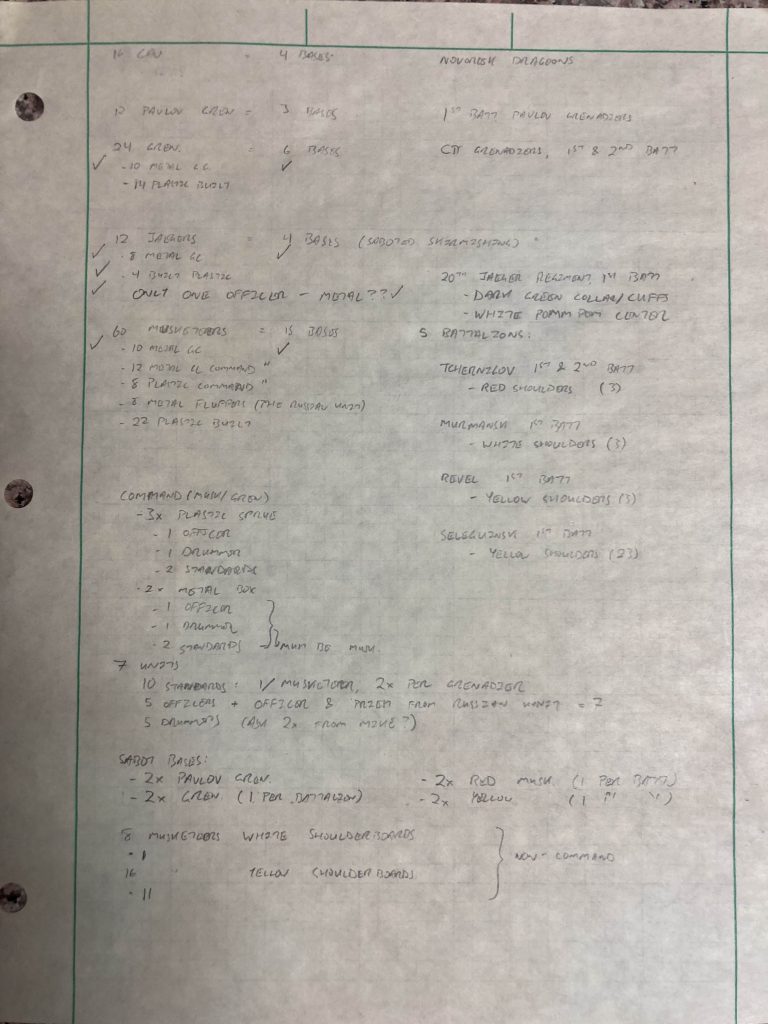 A correlation between engineers and historicals?? Seems unlikely. Credit: Marquis_of_Peaches
For those of you who have trouble reading chicken scratch, that’s 9 Battalions:
A correlation between engineers and historicals?? Seems unlikely. Credit: Marquis_of_Peaches
For those of you who have trouble reading chicken scratch, that’s 9 Battalions:
- 1st Battalion, Pavlovski Grenadiers
- 1st & 2nd Battalions, Saint Petersburg Grenadiers
- 1st Battalion, 20th Jaeger Regiment
- 1st & 2nd Battalion, Tchernigov Musketeers
- 1st Battalion, Murmansk Musketeers
- 1st Battaltion, Revelski Musketeers
- 1st Battalion, Seleguinsk Musketeers
Each of these battalions will be made up of 12 models. Musketeers and Grenadiers will have 3 bases per battalion, while the Jaeger battalion, in their looser skirmishing formation, will have 4 bases. This gives me a total of 28 bases of infantry, which should be a perfect start to a Blucher army! At some point, I'll also add a few bases of cavalry (which I've already purchased) and another gun or two. Russian artillery is fearsome in the game, and I'd be remiss to leave them at home.
Painting - for Real this Time!
Now, at last, with a solid plan in place, it was time to get painting. I started with the first round of metals I bought, mostly because it was an excuse to test out how the variation in greatcoat colors would look. I also made my first attempt at snowy bases - more on this in the next article!
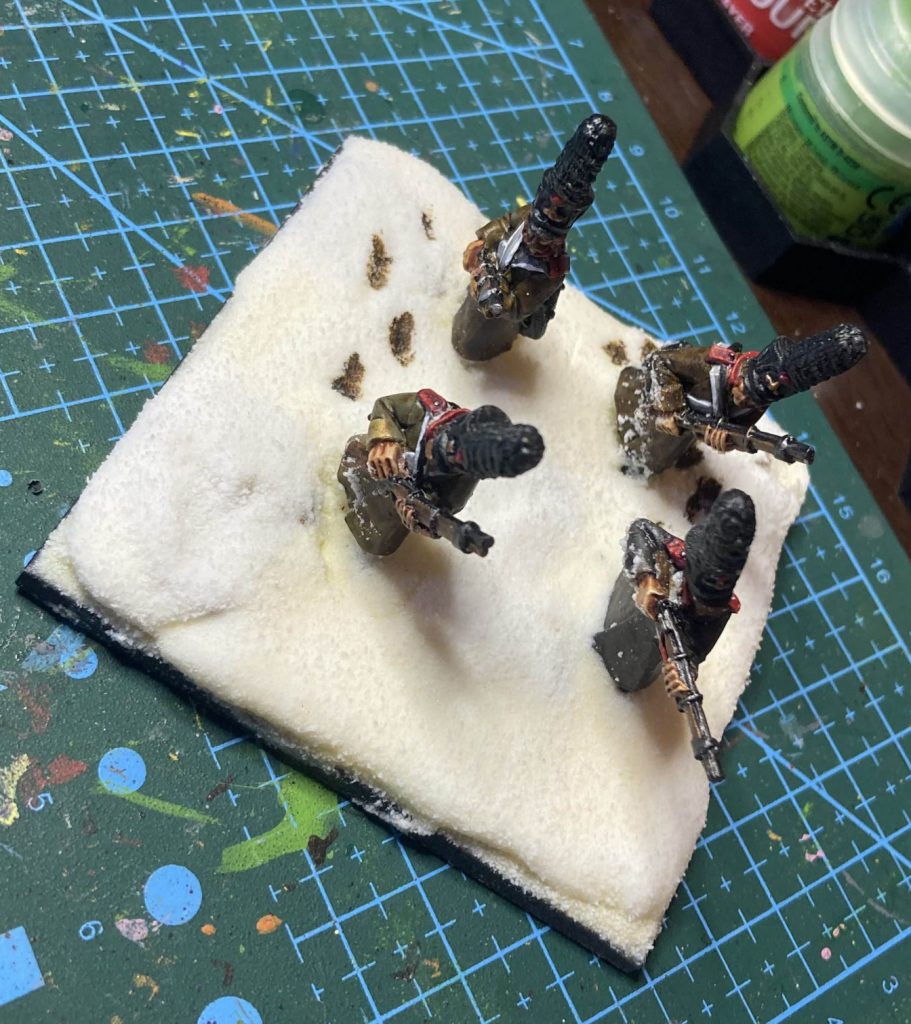 Proof of concept - unfortunately, the concept looks a lot like these guys made the yellow snow. Credit: Marquis_of_Peaches
With these out of the way, I could get down to the nitty gritty of dialing in my plastic musketeers. I had already learned an important lesson from the artillery crew I painted - stick them to the painting handle all facing the same direction! It makes painting a batch much easier and more intuitive, since you’re just moving down the line instead of turning the whole bunch this way and that to get to the same part of each model. This is so obvious in hindsight that I have no idea how I missed it on my first go.
I won’t get too far into assembly on the Perry plastics, because it’s ridiculously easy. In keeping with my manifesto from the last article, I’m not making much of an effort to get the hats right for the Musketeers - the sprue has both cylindrical and concave options, and I’ll mix them semi-randomly. Same goes for the plumes on the Grenadiers - there’s a massive plume option and a skinnier one, and the big one just looks cooler, so more of those, please!
Proof of concept - unfortunately, the concept looks a lot like these guys made the yellow snow. Credit: Marquis_of_Peaches
With these out of the way, I could get down to the nitty gritty of dialing in my plastic musketeers. I had already learned an important lesson from the artillery crew I painted - stick them to the painting handle all facing the same direction! It makes painting a batch much easier and more intuitive, since you’re just moving down the line instead of turning the whole bunch this way and that to get to the same part of each model. This is so obvious in hindsight that I have no idea how I missed it on my first go.
I won’t get too far into assembly on the Perry plastics, because it’s ridiculously easy. In keeping with my manifesto from the last article, I’m not making much of an effort to get the hats right for the Musketeers - the sprue has both cylindrical and concave options, and I’ll mix them semi-randomly. Same goes for the plumes on the Grenadiers - there’s a massive plume option and a skinnier one, and the big one just looks cooler, so more of those, please!
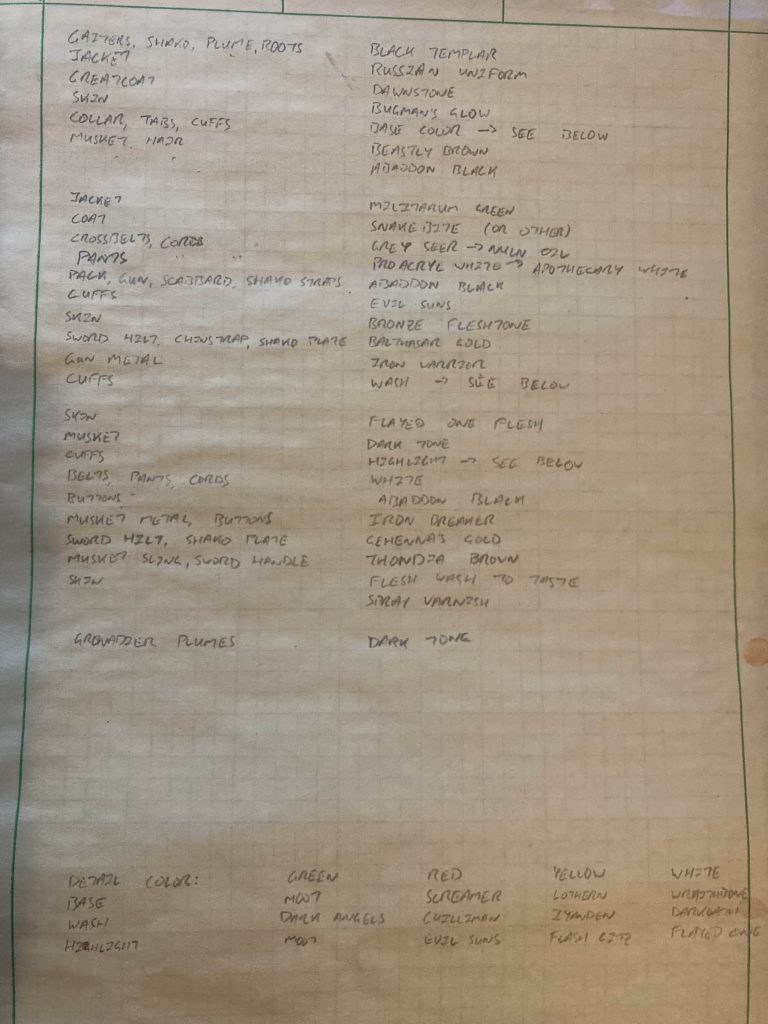 My personal painting guide. Pro tip: write stuff down, so that when you come back to a project after a year, you can still repeat the recipe! Credit: Marquis_of_Peaches Ed's Note: Put it in Word then save it as a PDF on your Google Drive so you don't lose it!
The Boring Middle
As I mentioned above, once I decided to migrate to the plastics, I got distracted by our Silver Bayonet coverage and immediately bought and painted The Russian Unit from my LGS. This is a bunch of one-off models, neither uniform nor, largely, even military. This matters not one whit to me, because I think they look cool as hell!
Reader, I am fully in the Boring Middle of this project. The first few models for a project are exciting - you’re figuring things out! Trying new techniques! The last few (I imagine) are the home stretch - the end is in sight and you know there’s only three more models standing between you and a full army! But right now, where I am in this project, there’s neither the beginning or end in sight. The vast majority of the painting is still ahead of me, and it’s pretty much all variations on the exact same uniform to go. It’s no surprise that I was distracted - first, by the Russian Unit, and then by the cold hard service of divorce papers yet another Blood Bowl team to paint.
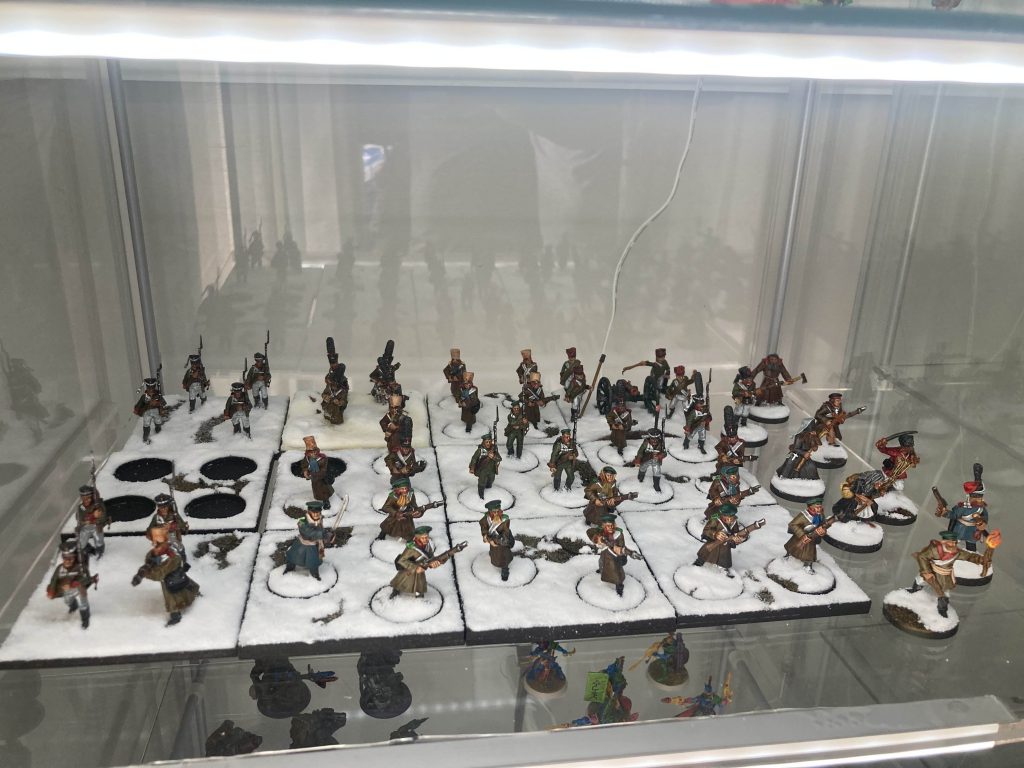 But for now, I have a respectable little force, with a delightful theme! Credit: Marquis_of_Peaches
Book Recommendation
This month's book is
Into Siberia, by Gregory Wallance. This is a relatively light non-fiction read about a journalist who, in the late 19th century, decided to explore the Siberian exile system that the Russian state used to suppress political enemies and exploit the country's vast natural resources. George Kennan, the American who made the trip, initially believed the system to be a relatively humane version of handling political dissidents - which is may have been, compared to summary execution - but returned home to give a years-long lecture circuit about the hellish conditions of the camps.
The book was overall enjoyable, but I felt the focus was misplaced. Nearly half of it was about George Kennan, which felt to me like a complete waste of time compared to what I was interested in - the labor camps themselves. Still, it made for good background noise while painted, and there were some gems at least. Tolstoy, who was exiled during Kennan's trip and hosted him for a night, later described Kennan as "an agreeable and sincere man, although one with partitions separating his soul from his head - partitions of which we Russians have no understanding, and I am always perplexed upon encountering them." To me, this sums up the cultural differences that I find so intriguing between myself and the Russian people - in as harsh an environment as Siberia, there is no time for walls between emotion and thought.
Where Am I Going
Next time, I’ll talk a little bit more about the details of basing the models you’ve seen so far, as well as any other shenanigans I get into. Hopefully, it’ll be less than a year between now and then! I’ve been working up the motivation to paint again, and getting this article live will help push my efforts back towards Moscow. On top of what I’ve finished so far, there are some 6mm figures calling my name….
Have any questions or feedback? Drop us a note in the comments below or email us at contact@goonhammer.com. Want articles like this linked in your inbox every Monday morning? Sign up for our newsletter. And don’t forget that you can support us on Patreon for backer rewards like early video content, Administratum access, an ad-free experience on our website and more.Thank you for being a friend.
 This website uses cookies. Learn more.

 Goonhammer App and Patron Updates: April, 2026
 Kill Team Tournament Report: Engage, Party, Repeat's March Madness 2026
 Goonhammer Reviews: Tribal Conquest