Mentioned briefly in our recent Historicals 3D Printing Round-up, this week we take a more in-depth look at Turner Miniatures' Salt & Shot: Blood on the Main! This Kickstarter campaign is now live, so be sure to check it out here.
As any of our regular readers will know, we here at Goonhammer Historicals are huge fans of Firelock Games'
Blood & Plunder and
Port Royal games (the latter of which we reviewed
here), both of which are set in the Caribbean during the Age of Sail. These games have given us loads of fun and are really the only games delivering pirate action in 28mm on the market right now. We highly recommend them both!
But as 3D printing reshapes the wargaming space it was sort of inevitable that someone would throw their hat into the ring when it comes to miniatures, bending the technology to their will to make a go of it in this space, and Henry Turner of Turner Miniatures has done so. Henry has a long history of work in the Age of Sail realm, having previously done a lot of work for ships in the 1/600 to 1/1200 scales (suitable for a number of games like Warlord Games' Black Seas, which plays at 1/700). In particular he has done a great job of making his Blender files available to computer modeling enthusiasts who want to engage in a little customization or digital kit-bashing prior to cranking up their printers. We previously reviewed his very successful Blitzkrieg WW2 Kickstarter campaign
here.
This new campaign has several main components: the Ships Pack, the Figures Pack, and the Land Pack. You can back them in any combination as part of your pledge, meaning you're only paying for the bits you want. This flexibility is nice, and I wish more Kickstarters did this (as opposed to spreading them out as separate campaigns or arbitrarily locking stuff behind stretch goals). Let's take a closer look at each of these packs.
The Ships
This is the section that's probably going to grab the most attention, as the ability to print your own ships in 28mm scale is kind of a game-changer for Blood & Plunder enthusiasts. Firelock Games' ship models are fantastic, but most of the hulls are large, solid chunks of poured resin and as such can be a little pricey.
The trade-off, of course, is in time and effort. When you purchase a ship kit from Firelock, everything is there. Quality control has been done and absent relatively small details like gunport covers, the whole hull is one piece. The masts and such need to be assembled, but the dowels and connections are all pre-cut and ready to go, with clear, easy-to-follow directions.
But in the 3D printing world, you're looking at printing stuff in pieces - sometimes
many pieces - and putting it all together yourself. The free sloop available for download at the Kickstarter as a sample was 8-12 pieces depending on whether you printed it on an FDM or resin printer and whether you chose to use all of the available deck furniture. And that's before you get to any gun shields or rigging.
Lest it get easily overlooked, it's important to point out that this pack includes STL files designed for both FDM
and resin printing. This is a big deal, because the different nature of how these technologies work leads to some interesting (and sometimes problematic) design choices.
For the large pieces, the difference is largely academic. Big, chonky pieces of hull and planking will generally work well in either case, and the tests we did in both FDM and resin were essentially identical in finish and quality. The STLs come pre-supported, and in both cases no changes or alterations were necessary to get stuff to print - the supports worked fine right out of the gate. In the case of the FDM hull segments, however, we found they were almost
over-supported, which led to a lengthy clean-up process. A razor saw and a good pair of flush cutters will help tremendously, but it was still a lot of work. By comparison, the resin pieces were well in the Goldilocks zone, being both appropriately supported for printing yet easy to separate from their support cradle. Ironically, this situation was reversed for the flat deck plates, which don't require support at all when printed in FDM but which were probably supported in excess in the resin STL versions.
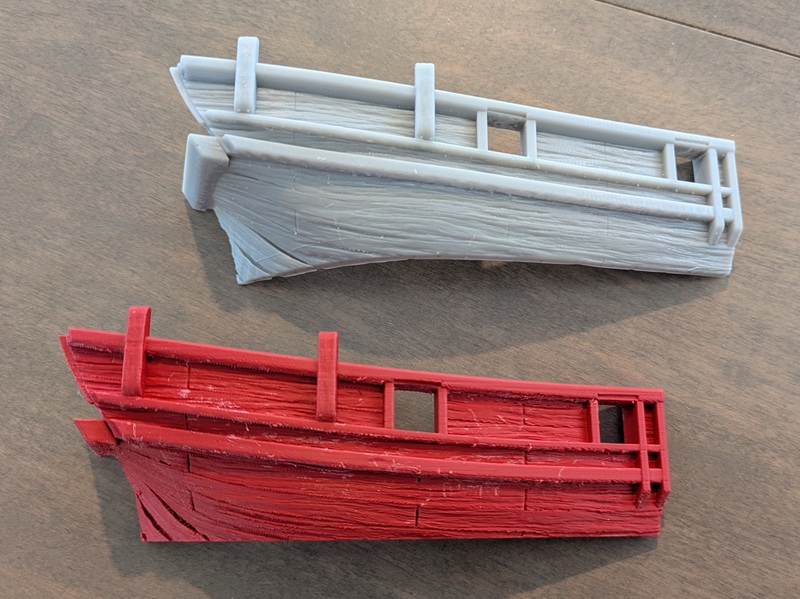 Starboard aft hull quarters from the sample Sloop, printed in ABS-like resin (top, grey) and PLA (bottom, red). The resin was done on my Anycubic Phtono Mono X and and PLA print was done on a Bambu Labs P2S FDM printer. Even after priming (let alone painting), you'd be hard-pressed to tell them apart, especially at tabletop distance. (credit: Ilor)
One of the details I really liked about these prints is that they had mount points for swivel guns designed in from the get-go. The printable swivel guns in the pack come with appropriately sized mounting pegs for easy use. My swivel guns are already magnetized, but the presence of these holes in the STLs means I already have guide holes to drill out to add magnets such that all of my ships can use the same swivel guns I already have. Convenient!
What was not present was keying to line up the pieces of the hull for assembly. This was something I raised with Henry after working with our preview copy and something I believe is fixed in the final version, but is indicative of the kind of stuff you often run into with pre-made STLs - it's easy to overlook the little details.
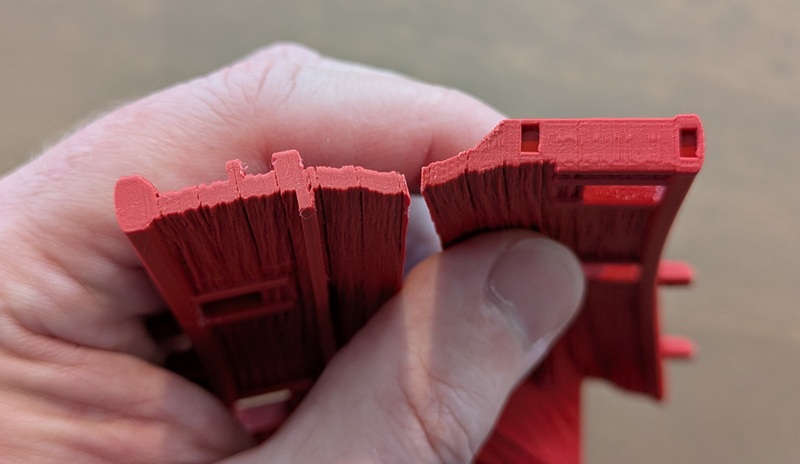 "Insert Tab A into Slot B" Aw, crap. (credit: Ilor)
As mentioned, the different mechanisms behind resin and FDM printing leads to some oddities. For instance, FDM printers are fabulous for anything that's flat on the bottom but struggle for things that have all-round texture. This limitation led to one of the craziest elements of this project, which are the FDM masts - many of which are actually printed in two pieces like so:
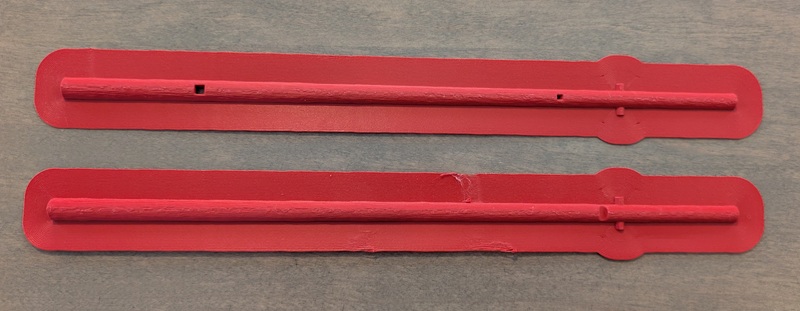 Just because it's a necessary nod to the limitations of FDM printing doesn't mean this isn't violence. (credit: Ilor)
So yeah, that's the two halves of the sloop's mainmast, which you will need to glue together. And since the backside is flat, there's no keying or indexing to get it all aligned, you're just going to have to be careful about it. Thankfully, the holes in the top bit are where the booms for the spanker rig attach, and those parts
are keyed.
And here we get into another vagary of the FDM printing world, which is whether your base plate is perfectly flat or textured. The tolerances on some of the pieces are pretty tight, and in the case of the rudder (which is textured on both sides and thus also split into two halves), that little bit of plate-induced texture on each half made the rudder too wide to fit properly into the slot between the aft halves of the hull beneath the transom, necessitating a little bit of trimming/filing of the inside of that gap.
This two-piece approach for various components in the FDM versions even led to the gun-port covers - tiny squares about 1cm across - being printed in two thin halves. Gluing those together takes some care.
And it is here that resin printing leaps to the fore. The resin gun port covers are a single piece that printed great in one go. And while I am always a little hesitant to print big, heavy pieces like the hull bits in resin (where failed prints can be catastrophic), for smaller stuff like these bits the resin printer is perfect. Similarly, the masts and spars are all designed as single pieces in the resin versions of the STLs. Ideally, if you really wanted to get the best performance out of this pack you'd print the hulls and decks on an FDM printer and the masts and small, double-sided texture bits in resin. If you have access to both modalities you can get away with this, but if you are limited to one or the other just know that the very nature of complicated ship hulls is going to leave you with a couple of challenges.
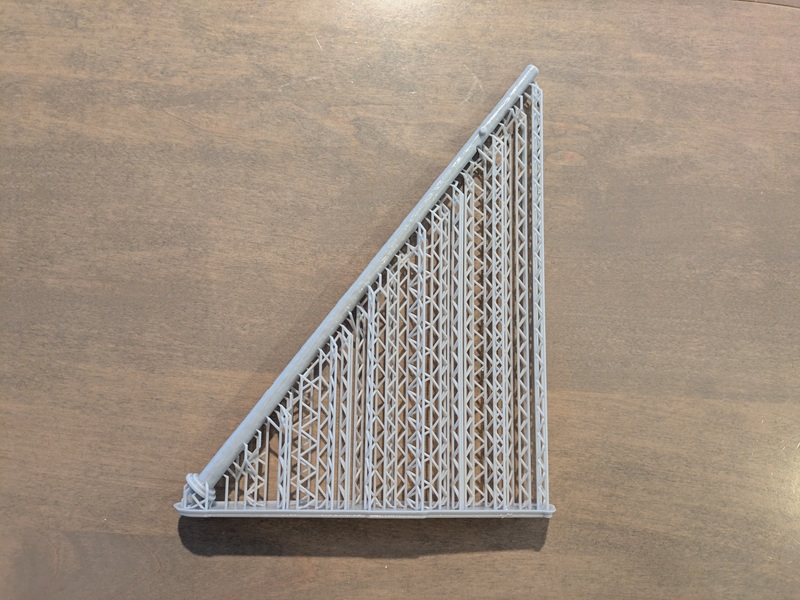 The resin mainmast in all its single-piece glory. This also includes the mounting lug at the base (which plugs into a hole in the deck), which was actually a separate piece in the FDM set. The print came out perfectly and is adequately supported without going overboard (credit: Ilor)
But in either case, one of the elements that's worth addressing is the issue of scale. For the most part, the masts are designed with scale model proportions in mind, and this means that the resulting masts and spars are actually kind of fine/narrow/small in terms of thickness/diameter. Both PLA and cured resin can be kind of brittle, and I worry that the desire for scale accuracy might result in breakage in what are (at the end of the day) designed to be game pieces. This is where the wooden dowels that you get with the Firelock kits excel - those things are nigh unto indestructible.
That said, one of the stretch goals that is almost unlocked are yardarms with furled sails attached, and that's something the I have long wanted. As with anything, there are trade-offs.
But at the end of the day, the Ships pack includes a long-boat, a piragua, two types of sloop, a corvette, and a galleon. Extra hulls available as stretch goals already unlocked as of this writing add on hull plans for the light frigate, 6th rate frigate, canoe, and fluyt. The brigantine is close to being unlocked as well. And at a cost of just £49 for the pack, that is a crazy-good deal. Like,
insanely good. Even with the limitations of 3D printing in either modality, it's tough to argue with the ability to print off a veritable
armada of ships on demand. And if you have access to both resin and FDM and can take advantage of the best of both worlds, it's almost a no-brainer.
And I would be remiss if I didn't mention the Figureheads and Decorations add-on, a separate pack of STLs (that can be added to any pledge level) that includes a bunch of different figureheads and transom details to customize and individualize your various ship hulls. It's a few extra dollars and has some cute details that let you go the extra mile to really make your ship look like a Spanish ship-of-the-line or French privateer (for instance).
The Figures
In order to crew your miniature flotilla, you will need miniature sailors, and here the Figure Pack has you covered - and with crazy variety. There are something like 50 sets of legs and two dozen torsos, not to mention like three dozen combined legs+torso sets for figures wearing longer coats or vests that would make separation at the waist impractical. Dozens of heads and a bunch of different hats mean you could make literally millions of unique figures, and that's before you get to the various arms and armaments.
And when it comes to the arms, these STLs include one of the cleverest elements I've seen in a multi-part kit, which is that the arms all have a number etched into the flat face that attaches to the torso. This means that you can always make sure your arms match each other - no more sailors with one sleeve ruffled and the other collared (a mistake I made more than once with the Firelock plastic sailors, much to my chagrin). This little detail is very cool and is a quality-of-life improvement I'd like to see more designers adopt.
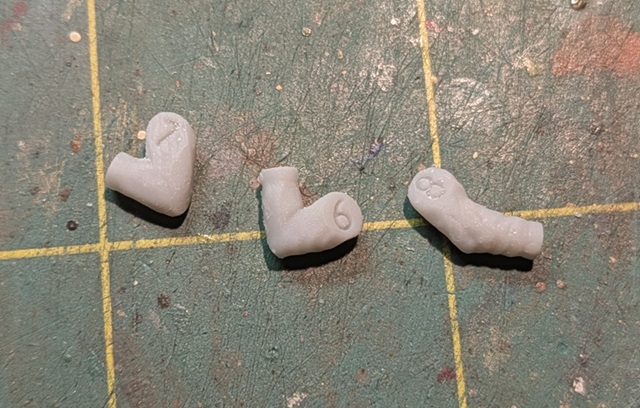 Hell yeah! Gone are the days of separating something from the sprue and being like, "Crap, which arms go together again?" These arms are comparatively tiny but the numbers are clearly visible right up until the point they are glued onto a torso. Other manufacturers could take note (looking at you, Victrix). (credit: Ilor)
The clothing has good texture and will take to things like a quick dry-brush or contrast paints really well. Like the ships, these models can be printed in both resin or FDM, though I think if you're doing FDM you'll want to assemble the constituent pieces in your slicer before sending it off to your printer as single piece minis are likely going to work better in FDM.
A word of caution with resin - I had some difficulties with the test print sailors included in the free sample files. My first go of the sample sailor pack (three sailor bodies with a bunch of different heads, arms, and weapons) had roughly 50% of the bits detach from their supports (and subsequently weld themselves to my FEP). I think most of this had less to do with the design and more with the conditions. My Mono X lives in my basement and I was doing my test prints in January, when it was bitterly cold outside and the basement temperature was chillier than normal. Cold temperatures lead to higher viscosity in the resin, which in turn leads to a higher "pull pressure" on the parts as they are raised away from the exposure surface/FEP. Additionally, some of the parts are pretty small and have small supports. Turning off high-detail anti-aliasing, reducing the layer thickness, and slowing down the pull speed of the build plate addressed these issues. The prints took longer, but came out much better. I include this caveat not so much as a criticism of the designs themselves, but more to illustrate the notion that 3D printing is as much art as science and you might need to tinker a bit to get things to work for your specific circumstances.
In terms of the models themselves, it should be noted that they are very much "heroic" in their proportions, with blocky hands and feet. Further, the faces are essentially scaled-up versions of the same types as those in the earlier WW2 Kickstarter (though of course with some obligatory scars and eye-patches to fit the period). But while those facial proportions are needed to convey expression at smaller scales (the WW2 minis were designed for 6mm-15mm), at 28mm they end up looking somewhat cartoonish. Another thing that struck me was that the tops of the shoulders on the various arms are quite rounded, which when attached to the torsos gives the miniatures a very "burly" silhouette. At tabletop height it probably doesn't matter, but it's worth mentioning.
My one reservation here is that like most poseable multi-part kits (of any type, in any material, by virtually any manufacturer), there is a trade-off. Yes, you have wondrous variety, but at the end of the day a lot of the poses can end up looking very...static. I noticed this with the Firelock multi-part plastic sailors in comparison to the original metal sculpts. Say what you will about the limited number of sculpts in the first range of Blood & Plunder metal minis, but so many of those little guys had
character. From the militiaman blowing on the match of his matchlock rifle (little cheeks puffed out adorably) to the Forlorn Hope trooper swinging his rifle like a club to the crouching, dual-wielding French sailor with the "come at me" expression on his face, those sculpts had a dynamism and panache that is
extremely tough to capture in a multi-part kit.
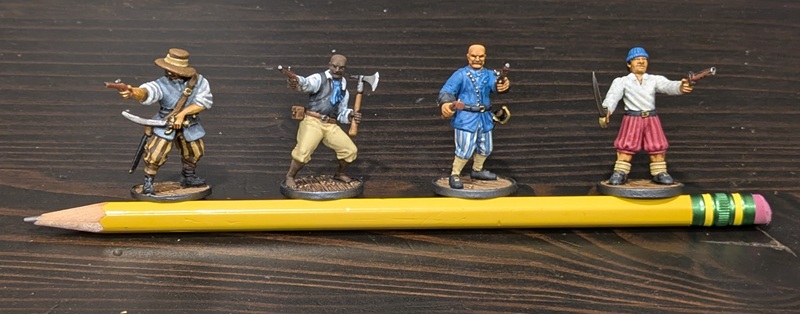 A comparison shot with an original Firelock Games metal sailor on the left, two examples of the Firelock plastic sailors in the middle, and the new Turner Miniatures sailor on the right. Figure #1 is one of my favorite scupts in the old metal line because of the dynamic pose - the cross-body sword as he pauses fighting to blast someone is perfect. The next figure was about the most dynamic I could make out of the plastic kit, still very much looks like he's fighting. The rest of them come out looking more or less like the third guy. Size-wise the Turner Miniatures guy scales well and is of comparable size, but up close you can see the heroic proportions at work, especially in his head, legs/feet, and hands. This shot also illustrates the burliness of the shoulder silhouette mentioned above. (credit: Ilor)
Conversely, it's tough to argue with £24 for a nearly infinite variety of figures. And as always, Henry is making the Blender files used to create the STLs as an add-on, so if digital kit-bashing is your thing, the piratical world is your oyster.
The Land Pack
Pirates spent as much time raiding on land as they did at sea, and Blood & Plunder reflects this. Every single scenario in that game has variations for Land, Sea, and Amphibious terrain set-ups, so giving some thought to land-based terrain is important. The Land Pack associated with this campaign hits the biggest elements you'll want - modular fences and docks, scatter/objective terrain like crates and barrels, wheeled cannons, and a couple of building options (a small farm house and a Spanich chapel). I love the look of the Spanish chapel in particular and think it would make a great centerpiece on a table. These elements are universally useful if you're looking to deck out a table for a daring buccaneer raid.
The Land Pack is an add-on that can be selected with any pledge level. If you're new to gaming this historical period and don't already have terrain on-hand, this set of STLs is definitely worth a look.
Stretch Goals
This campaign has a bunch of stretch goals, for both ships and crew. A significant number of these have been unlocked already, with a few more still on the cusp. I've already talked about the additional ship models, but the stretch goal figure packs include specific characters like Henry Morgan and Captain Kidd, as well as additional STL sets for musketeers and pikemen. Depending on the exchange rate, the bare-chested sailor parts might already be unlocked and sailor arms with rolled sleeves are within striking distance. Special characters like surgeons and carpenters, as well as militia cavalry are more distant stretch goals, so if these interest you, pledge now!
Recommendations
Due to the somewhat technical nature of 3D printing, we would be remiss if we didn't encourage caution when it comes to jumping into this pool. While Henry has applied his usual care and attention to detail to this project, the caveats and limitations associated with 3D printing are such that this is maybe not a "beginner-friendly" set of STLs. If you are not looking to fit out an entire flotilla and just want one or two specific ships, you're probably better served just buying the ship you want from Firelock directly - it will come as a complete kit, be less hassle, and give you exactly what you're looking for.
Further, as mentioned above some of the segments (hull pieces, deck plates, deck furniture) are extremely well suited to FDM printing, but others (gun shields, guns, tillers, and masts) really benefit from being printed in a single pass in resin. This means that for best results you should probably have access to both printing modalities to really get the most out of the Ships Pack portion of this Kickstarter. But if you do have access to both? Boy-howdy are you going to be able to print off a whole armada of ships inexpensively!
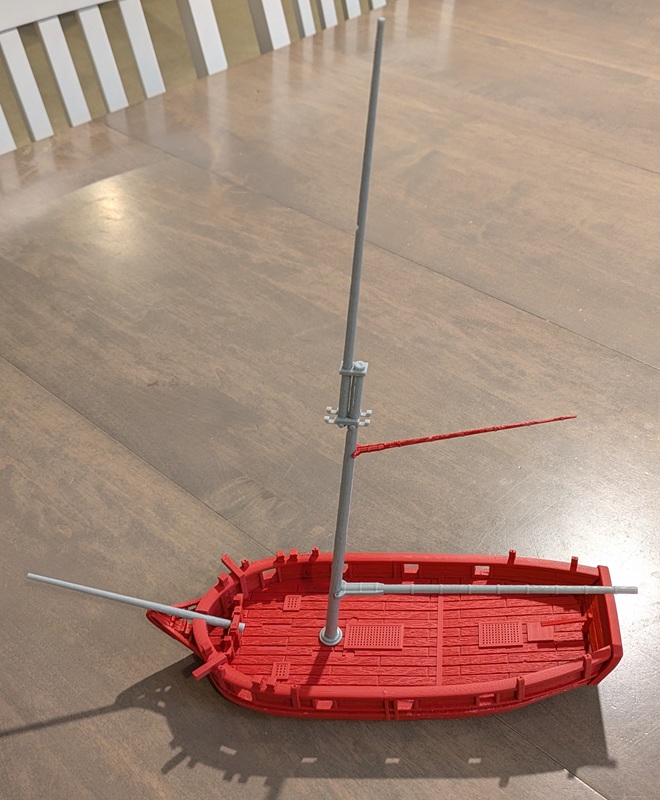 A hybrid Sloop result, with the hull and deck printed in PLA and (most of) the masts done in ABS-like resin. This is the best of both worlds, and likely how I will do the rest of the vessels as well (because yes, I windmill-smashed the button to back the Ships Pack). (credit: Ilor)
When it comes to the figures, I feel like this is purely a case of style and aesthetic. It's tough to argue with the massive number of choices Henry offers in this Kickstarter, and the options you get certainly provide even more customizability than Firelock's own plastic Sailors kit (which itself is pretty damn good!). You could go a long way to tailoring different forces (e.g. putting all your French in pantaloons or all your English in full-length pants) even before you get to using different color palettes to distinguish them. If you want to build out a large force and if the heroic proportions are your jam, warm up your printer and go nuts - the Figure Pack portion of this campaign is going to be right up your alley.
For the Land Pack, I'd say if you have access to an FDM printer you're probably going to get the best bang for your buck here.
This campaign is ongoing until 10 February 2026, so if you are at all interested in the playing pirate games set during the age of sail, be sure to
check it out!
Want more Kickstarter reviews or articles related to 3D printing for historical wargames? Have any thoughts or stories about your own successes - or failures - with 3D printing? Leave a comment below or email us at contact@goonhammer.com. Want articles like this linked in your inbox every Monday morning? Sign up for our newsletter. And don’t forget that you can support us on Patreon for backer rewards like early video content, Administratum access, an ad-free experience on our website and more.
Thank you for being a friend.
 This website uses cookies. Learn more.

 Goonhammer App and Patron Updates: April, 2026
 Kill Team Tournament Report: Engage, Party, Repeat's March Madness 2026
 Goonhammer Reviews: Tribal Conquest