I’ve been thinking a lot recently about how to keep engaged in the hobby despite my ability to go out and do things evaporating over recent years. I’m getting older, everything’s more expensive but I’m not getting paid any more, swanning off for multiple full weekends a year and dumping the kids on my partner starts to feel like a piss-take. I’ve tried to brute force it: making myself paint armies that barely see the table, getting people to travel to my gaff for face to face games. Seeing people is always lovely but again, there’s that sense of guilt at making them travel. I’m burned out on painting for the sake of painting.
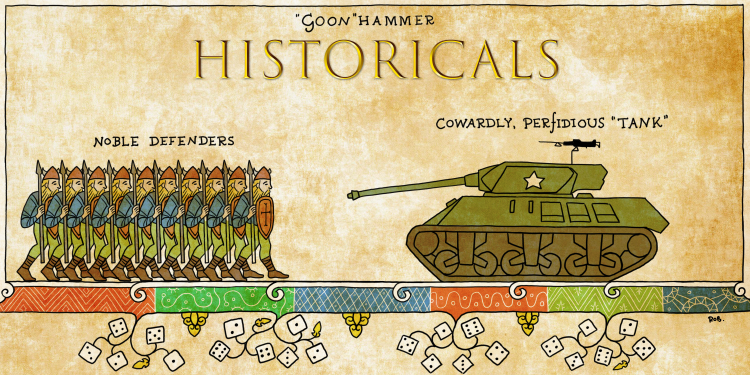
How it feels to get people to travel to you. Credit: Rich 'Cronch' Nutter
The obvious thing to do would be Tabletop Simulator. I’m mostly a Warhammer guy, the offerings for that are pretty high quality. But, y’know, I miniature wargame because I enjoy the spectacle and physicality of it, and TTS gets you neither. Then there’s organising. People will happily plop down for hours of videogames in an evening, but once you suggest TTS it becomes a whole thing: you have to get the diaries out, make plans, sorry but dinner overran I’ll be like 20 mins. I love hanging out with pals, obviously, but it’s a shadow of the real thing.
During lockdown there were similar issues with getting games in, and back then I elected to DM a campaign of Dungeons & Dragons (4th edition, the best version, mentioned only to annoy the sort of person I’d want to annoy with that) over Roll20. You’ve almost certainly heard of it already but just in case: it’s an online gaming table for groups playing TRPGs. It’s kind of fiddly but it’s fine.
At some point last year I happened to watch a video of the Little Wars TV guys playing Kriegsspiel. It looked like a lot of fun. There’s something about hunching over a proper map and drawing lines on it that lurks in the dark heart of all wargamers.
What is Kriegsspiel
Georg von Reisswitz, OG gamer son.
If you know anything about the game you probably know that it’s a wargame developed by the Prussian army in the 19th century as an officer training tool. It’s a multi-player game, so two teams of players (typically) each in control of an army. A key concept, and really Kriegsspiel’s USP in the modern gaming landscape, is that it’s played blind with an umpire (or a whole team of umpires, depending on the size of the game).
What this means is that despite being a wargame, the play experience revolves mostly around dealing with limited information and issuing written orders, rather than the way of playing that we’re used to - directly pushing models around a table in direct view of your opponent. It rewires how you think about the game, and I could really see that playing out in the early game with players unused to the system and imperfect knowledge feeling their way around the battlefield.
Another key aspect of the game that is wholly unique to my experience of wargaming is the debrief at the end. Because only the umpires have perfect knowledge of the game at any given time, being able to all come together at the end and have the umpire explain what happened, and how the decisions you made actually played out is a really interesting experience. Sure, I’ve had games at tournaments where I’ve talked with my opponent at the end about what we could have done differently, but this coming together at the end of a Kriegsspiel is more of an event, and got people talking about their thinking and reasoning behind the decisions that they made.
How Does It Play?
What made Kriegsspiel such a great sell for me was this: There’s no requirement for the players to know any rules. Selling new games to people can be hard, there’s typically a huge amount of learning frontloaded. With Kriegsspiel basically all of the mechanical work is done by the umpire, away from the prying eyes of players. From a player perspective the gameplay loop is really simple: you send out your orders to the umpire, wait a bit and then the umpire tells you what happened. Rinse and repeat until the game ends. You send messages to other players as well, but that all goes through the umpire.
That’s obviously a dream for getting people on board to play your game, but it kind of sounds like that’s a lot of work for the umpire? Well, that’s because it is. There isn’t really any way around this. As the umpire I built the scenario, decided on the mechanics of the game, set everything up ready for the players (more on that later), and then had to do all of the map work and conflict resolution for the game and then relay the results back to the players. This was a fairly substantial amount of work, and processing any given turn would take me an hour or two depending on how complicated it all was. Still, given that we played asynchronously, committing a few hours every week wasn’t too onerous. It’s also, and I cannot stress this enough, utterly fascinating and fabulously rewarding. Being able to see the plans being built and delivering all of the messages between players is delightfully voyeuristic, and on top of that watching the game play out in front of you and the reactions of all the players is wonderful. You’ve gotta have that freak in you to run Kriegsspiel, but if you do then I highly recommend it.
Average Kriegsspiel player experience.
As an old game, and a sometimes vague game, there’s also a few rulesets kicking about at this point. There’s variation in how crunchy the mechanics can get (or how fundamentally dry the game is, going back to the Prussian military versions), or the conflicts that the authors are trying to emulate. If you’re looking to run a game, it’s well worth having a little dig for the right ruleset for you and your players.
How Do You Play It… Online?
How I laid out a simple discord server.
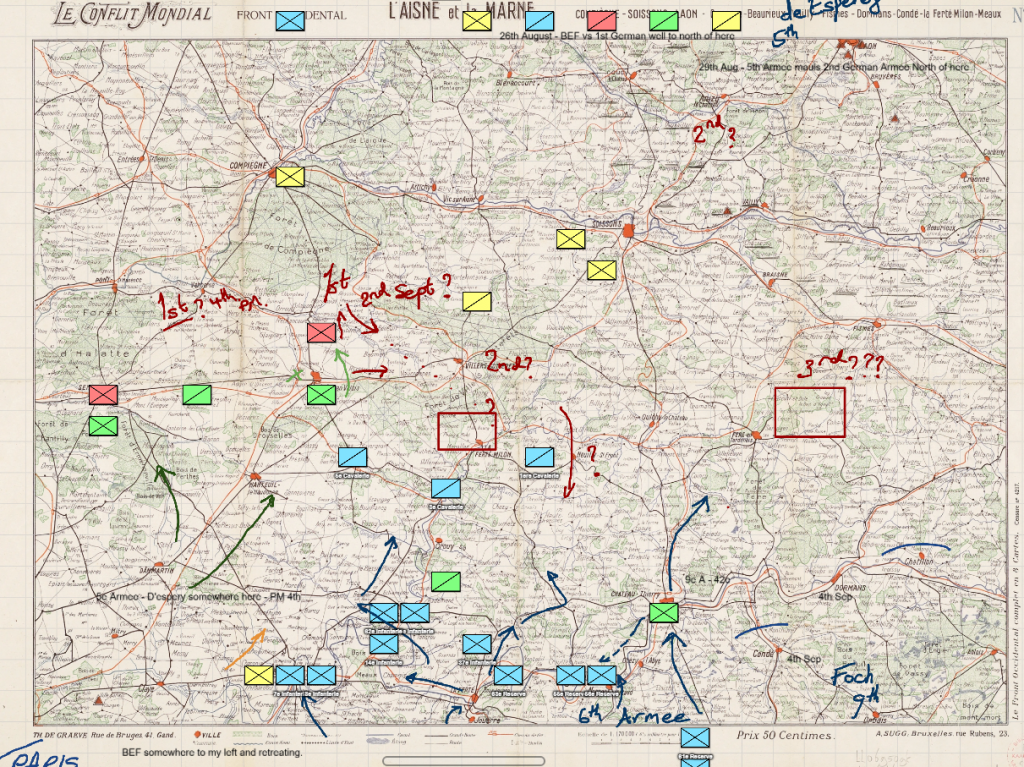
The International Kriegsspiel Society play over discord and TTS. But they seem to play live games, and I wanted something that didn’t require everyone to be in the room at the same time. Discord is fine enough for managing the teams. I had a general chat channel for pinging everyone, a channel where I included additional background material around the battle, and then channels for each team. Discord roles let you section players off from each other to prevent any temptation. For the map I went with Roll20 and it worked surprisingly well, but took a bit of effort to set up. I grabbed the map off of Old Maps Online which is a very handy resource for this kinda thing, though you could very easily screen grab a modern map for free. In Roll20 I set up a main map for myself and then a copy of it for each player. As each player joined the game I moved them to their own map page for the entirety of the game and it was up to them to fill it in (or not) as the game progressed. Divisional symbols are super easy to use as tokens, and Roll20’s grid let me scale their movement to the grid rather than faffing around with highly specific movement rates.
The other half of the play experience - drawing on maps.
This setup just fundamentally worked. People were free to engage as much or as little with the details as they wanted, everything was in secret and ran pretty smoothly. I tried to run a schedule of two turns a week. I find that with this sort of asynchronous play if you don’t keep to some kind of schedule it’s very easy for things to just fizzle out. It does turn you into a bit of a nag to @ people to remind them to send their orders, but in general this worked. Some weeks we ripped through turns pretty quickly, some weeks were more difficult, but that’s life. You can definitely also experience some enthusiasm-wane as the outcome of a battle begins to become obvious but hasn’t reached an obvious conclusion yet. When setting up the game we played, I laid out the number of turns I’d consider the limit, but with a clear expectation that I wouldn’t be strict to that if the situation demanded otherwise. This meant that I could draw things to an end once we’d hit what I felt was a natural conclusion, even if that was not necessarily obvious to all the players in the moment.
Miracle on the Marne
Kriegsspiel is traditionally used to play out the Napoleonic wars, or other 19th century conflicts. That’s what it was designed for. I’m more of a 20th century guy, and whilst there are hacks available for doing WW2 and the like they all felt like they had more complex mechanics than I wanted for an introductory game. I’d been reading The Guns of August at the time and so 1914 was at the forefront of my thinking. The first battle of the Marne felt like a good fit, the last gasp of that 19th century war of manoeuvre, with the whole bloody 20th century stretching out ahead of it. It’s the battle that effectively ended the threat to Paris and precipitated the “race to the sea” that ends with the trench warfare that defined the western front for the rest of the war.
It also lets me introduce some interesting little twists for each team. For the French side there’s a potentially unreliable ally in the British Expeditionary Force, who start the game “off map” and out of contact after a long retreat, without clear orders to re-engage. For the Germans I introduced difficulties with communication between the players, scrambling any attempted wireless messages. For the player taking the role of Alexander von Kluck commanding the German first army I had an extra wrinkle - a message that Paris was right there for the taking, but also orders from high command to turn away and link up with the second army to their east. This gave them a similar dilemma to the historical figure - whether to take the risk to try and win the war there and then.
In terms of the actual mechanics of the game I tweaked the Southern California Kriegsspiel System, a nice and simple ruleset, to best match my needs. Single d6 rolls to work out combat results and an easy way for me to work out how beat up individual divisions are. As a multi-day battle, I let the players know that each game turn would cover half a day of combat, and how far they could expect their divisions to move over the course of a turn. There really wasn’t much need to explain more than that, all of the dice rolls and combat resolution would be done behind the scenes by me, with the conclusion of each turn being narrated by me to each general.
Joyously, my General Michel-Joseph Maunoury player decided to keep an in-character diary during the game, so I’ll sprinkle some of that in the AAR.
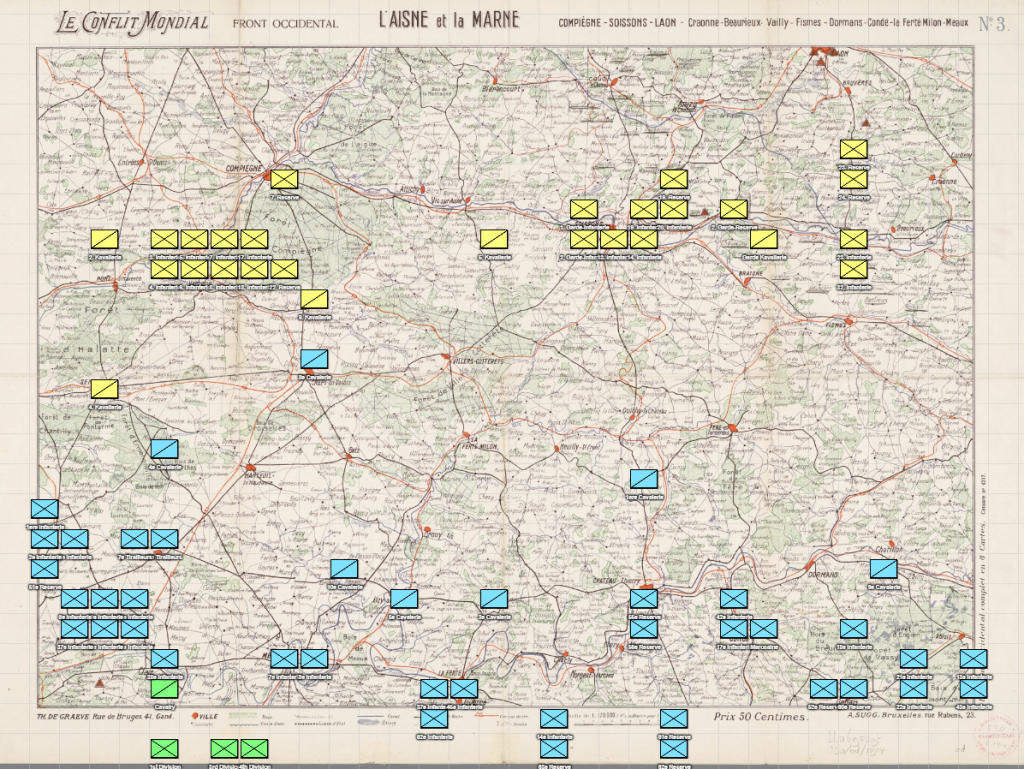
4th September, 1914
“If we do not encounter the enemy by the end of today they were much further North than I had expected.” -- Maunoury’s diary
A key feature of this game was that it came at the end of a screaming, headlong retreat. Because of this, each commander was in the dark as to where any other army was on the map. This was a good opportunity for the German players, whose armies started in more coherent positions but were ultimately outnumbered, to establish communications with each other and make a concentrated effort whilst the French were scattered.
This was also where our von Kluck would make his fateful decision - he would ignore orders, and march due south to Paris.
The French had another advantage going in here: rail. Infantry can only march so fast, but trains can move a lot of men quite far very quickly. So of course, Maunoury in the centre demands all of the available rolling stock be sent to him.
To the south, the BEF (whose general is, extremely helpfully, called French) decide to rush back north to join their allies, only to find that all of the trains have vanished.
5th September, 1914
“I fear D’esperey may stick his nose out too far, but he is the only one of us to have encountered the enemy. I wish him luck.” -- Maunoury’s diary
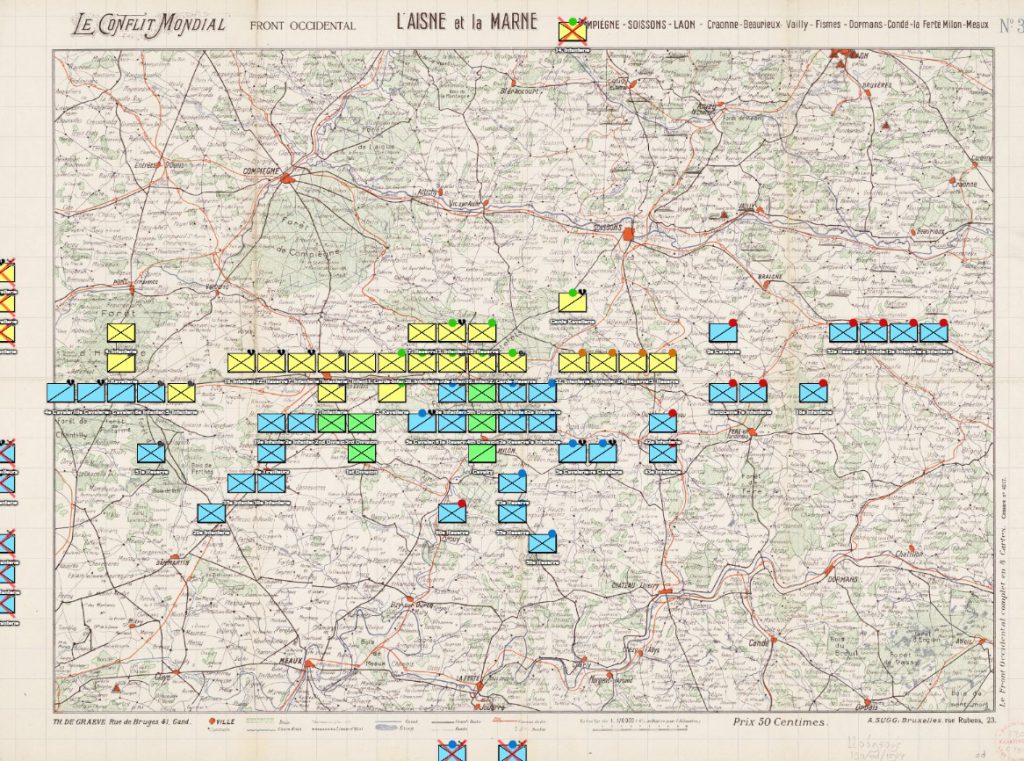
A few turns in and a couple of important things had happened. The French had managed to establish communications with each other and the BEF (after spending an agonising amount of time all telling each other that the Germans were definitely in a town at the bottom of the map… held by the French). The Germans… the Germans hadn’t done that. 1st Army boldly strode on to Paris whilst 2nd and 3rd Army followed orders and headed east. Woops.
General Louis Félix Marie François Franchet d'Esperey had made a bold gamble - railing up some light Tirailleurs to the sleepy commune of Crépy-en-Valois. He did not know it, but as the Germans also advanced exactly here the stage was set for what ended up being the bloodiest fight of the battle.
6th September, 1914
“I pray that the BEF and D’esperey are in position to support me or I will not have the forces to guard my flank.” -- Maunoury’s diary
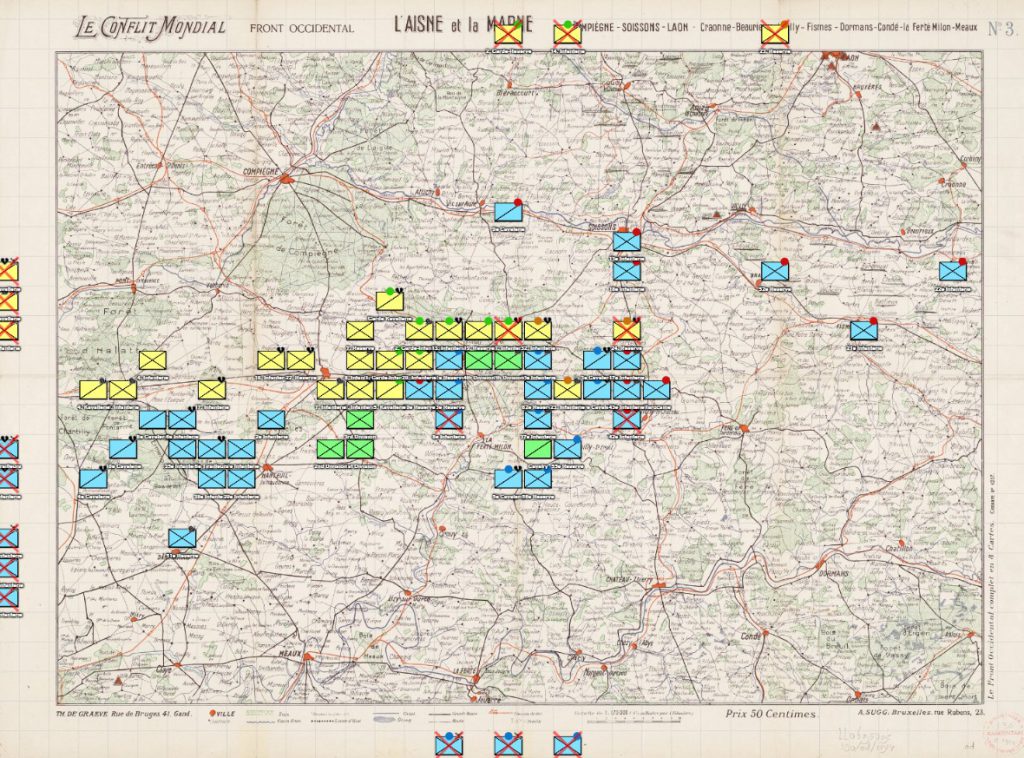
By the 6th, some garbled communications had the German 2nd and 3rd armies screaming back west, desperate to link up with the 1st army, but instead were hit by Maunoury’s army going on the offensive. Goonhammer’s own Bair, in command as 2nd army’s Karl von Bulow, had at this point fully given up on his own map and was utterly lost, vibe commanding on instinct whenever French divisions popped up. To his east, the army he was supposed to link up with was about to get gobbled up by an ahistorically cautious Ferdinand Foch.
By this point, that village of Crépy had seen a shocking amount of combat - have a look at the left hand side of the map there for the ‘dead pile’ of divisions that had been fed into those few squares of map that were no longer combat effective. Both von Kluck and d’Esperey had pulled forces off of the line here, shocked at the speed of the bloodshed, and were searching for a way around each other.
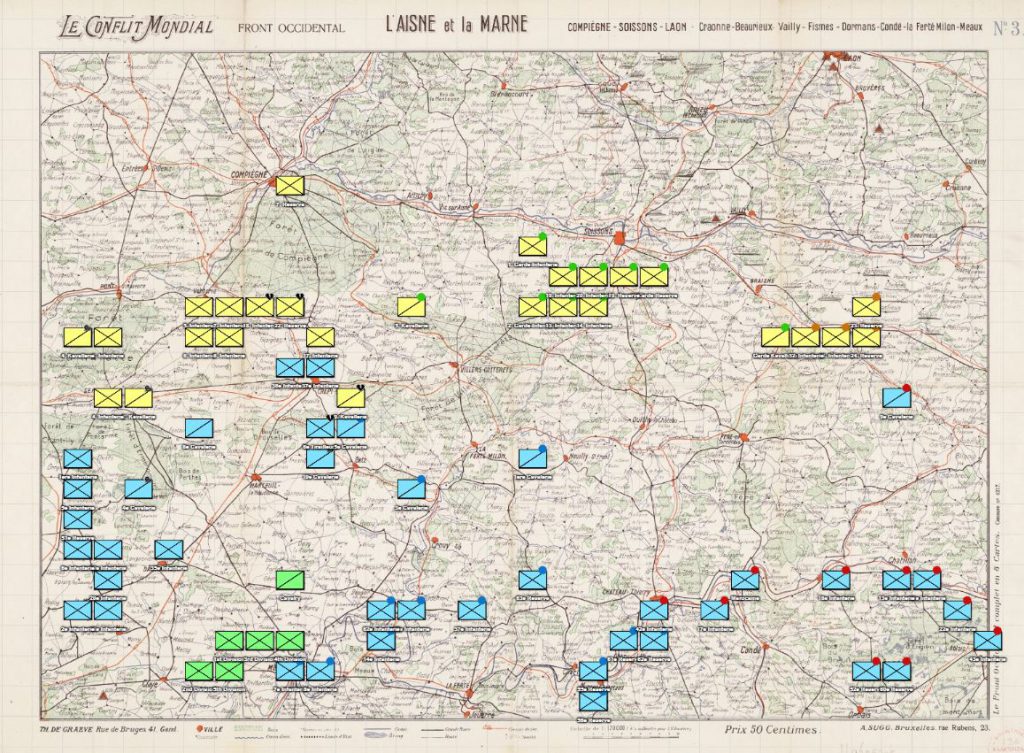
7th September, 1914
“Never have I been happier to see an Englishman.” Maunoury’s diary.
Look at this lovely line the German players made. Complete accident. None of them had any idea what was happening beyond the fight immediately in front of them. With an entire French army slowly, slowly, slowly working their way around the flank, this was inviting disaster.
Not content with one charnel house on the map, the commune of Villers-Cotterêts was the scene of vicious back and forth fighting, with French attacks suffering at the hands of my dice rolling as much as the Germans. At this point the fighting had been going pretty decently for the Germans, who thought they were in a good position - and they were! If only they could have used it.
8th September, 1914
“We are being bled, I have no information on the cost to the enemy. I can only hope he bleeds likewise but I fear it is not so.” -- Maunoury’s diary
Reality bit hard by the end of the 8th - Foch had finally committed his army to combat and worse still had started cutting supply lines to the Germans. With the BEF reinforcing their centre, the Entente forces were starting to push the Germans out of Villers-Cotterêts.
In the West, the French forces had fallen back to regroup and had come up with a plan: send out some fake orders saying that they would loop round on the extreme western flank, but actually cut east in between the two groups of German units.
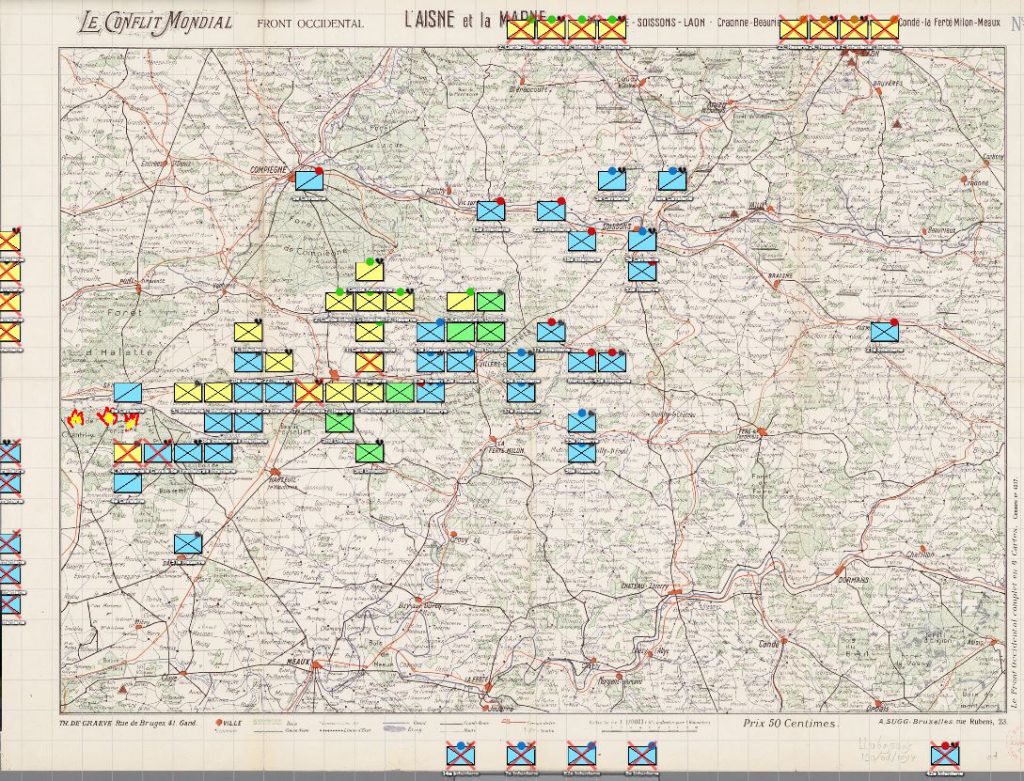
This plan sort of worked. Our von Kluck player realised this was probably a ruse, and came up with an unusual response: he was going to use a bunch of his supplies to set a massive forest fire in front of his army.
9th September, 1914
“Onward to victory.” -- Maunoury’s diary
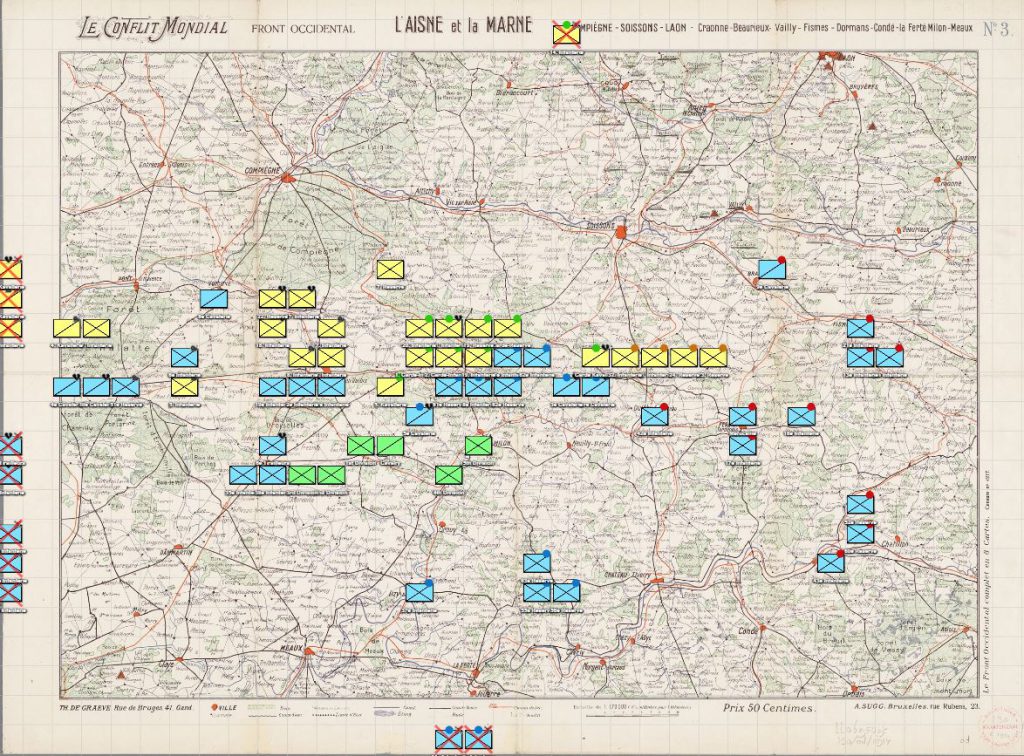
On the left you can see the start of the big fire. The effect of which was to effectively cut off the German’s own ability to flank and instead fed their divisions piecemeal into the French offensive. Ah.
At this point, Bair’s army in the centre had collapsed. No supplies and a weight of numbers advantage had him pulling back towards the 1st army. The plan was one last throw of the dice, one last attack south to break through to Paris.
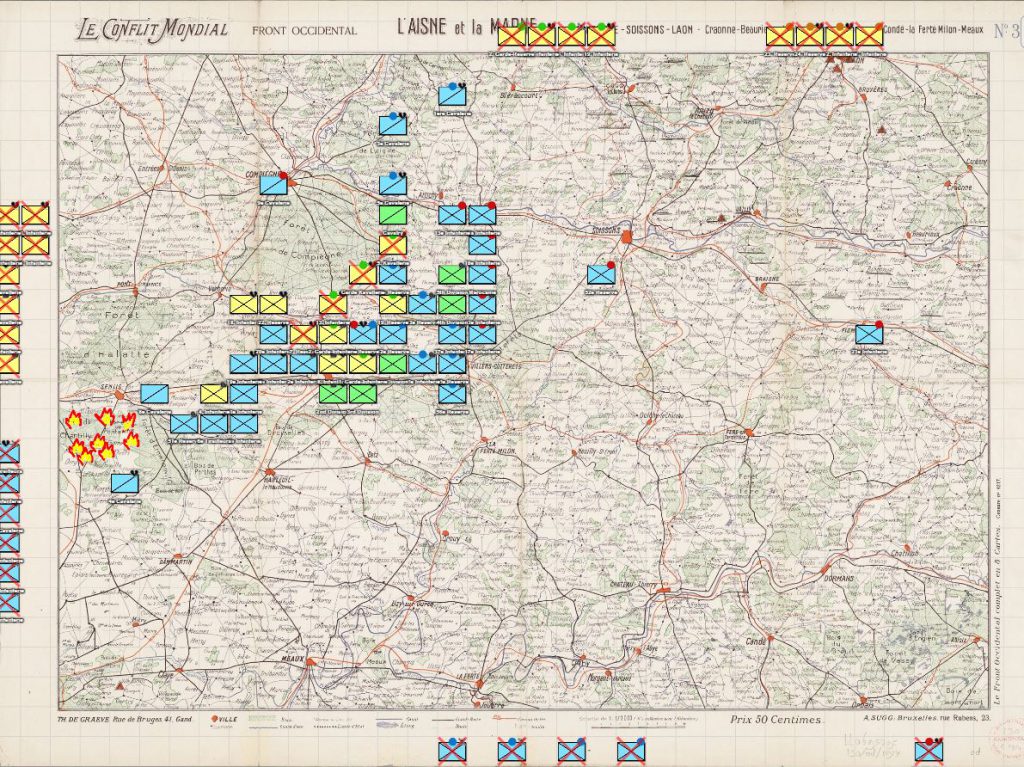
10th September, 1914
“All forces advancing towards Compiegne. Expect enemy to attempt to hold the town or forest to protect the last line of retreat.” -- Maunoury’s diary
I mentioned earlier that I’d set an expectation of a number of turns of play, but with an ability to draw it to a close earlier if the situation demanded. I’d initially planned for the 12th of September to be the final day of the game, but by the end of the 10th I felt it was time to bring the fighting to a close. The small detachment from the German 3rd army had been effectively gone for a few turns, 2nd army was being picked apart almost to destruction and 1st army was one offensive away from total encirclement.
On our timeline, not only does the German offensive fail, but their decision to push on rather than retreat to the Aisne once the French counter-attack results in their effective total destruction. There’s no race to the sea, and the combined Franco-British forces still have enough mass to start rolling up the German western flank. An early German surrender means no trench warfare, no Russian collapse, no Austro-Hungarian collapse, no Ottoman collapse, a United States content in its isolation. The whole bloody twentieth century unfolds in a different, bloody, way.
Cut to the Kriegsfeeling
It’s easy to write about Kriegsspiel, because as a ‘system’ in the modern wargaming environment it’s so damn interesting. Hopefully I got that across, and gave you the tools you might need to have a crack yourself. Truth be told, you probably knew if you were interested or not by how excited you got over pictures of maps with lines drawn on them. If that awakened something within you, if the idea of playing in this way sounds remotely interesting, I urge you to give it a go. You don’t need loads and loads of players to have an interesting game, you don’t need complicated rules or have to navigate weird software (I can only imagine how good the experience is in person, and I’m desperate to do it some time). I’ve never had a wargaming experience like it.
Have any questions or feedback? Drop us a note in the comments below or email us at contact@goonhammer.com. Want articles like this linked in your inbox every Monday morning? Sign up for our newsletter. And don't forget that you can support us on Patreon for backer rewards like early video content, Administratum access, an ad-free experience on our website, and subscriber-only content covering competitive Warhammer 40K!
 This website uses cookies. Learn more.
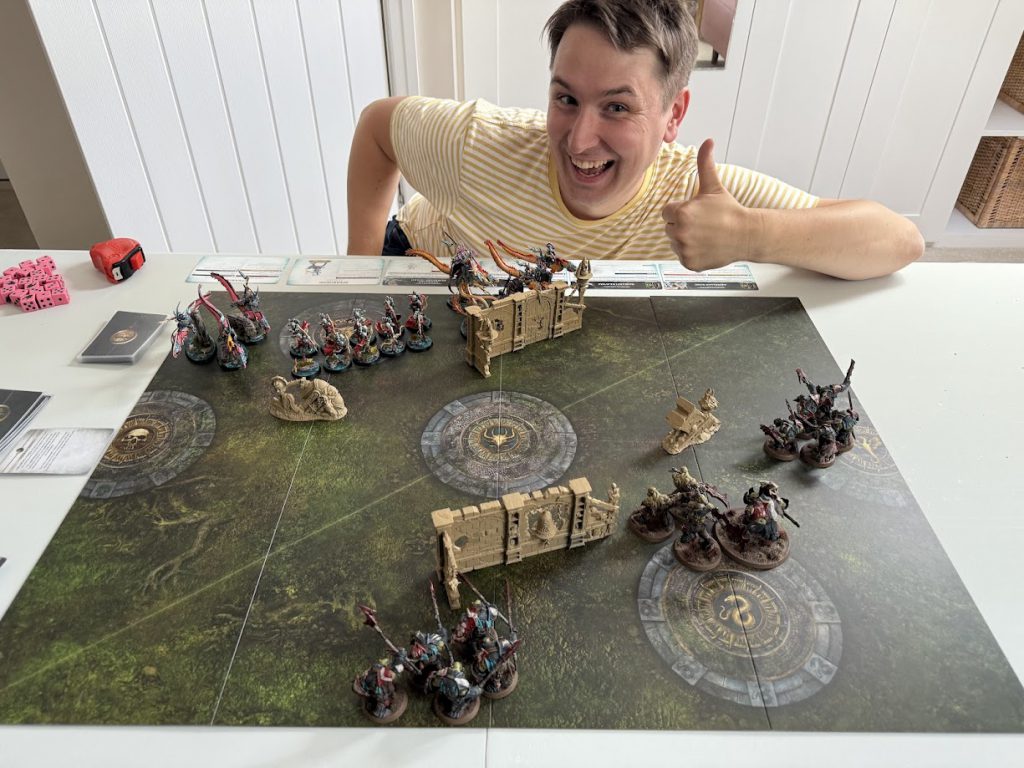 How it feels to get people to travel to you. Credit: Rich 'Cronch' Nutter
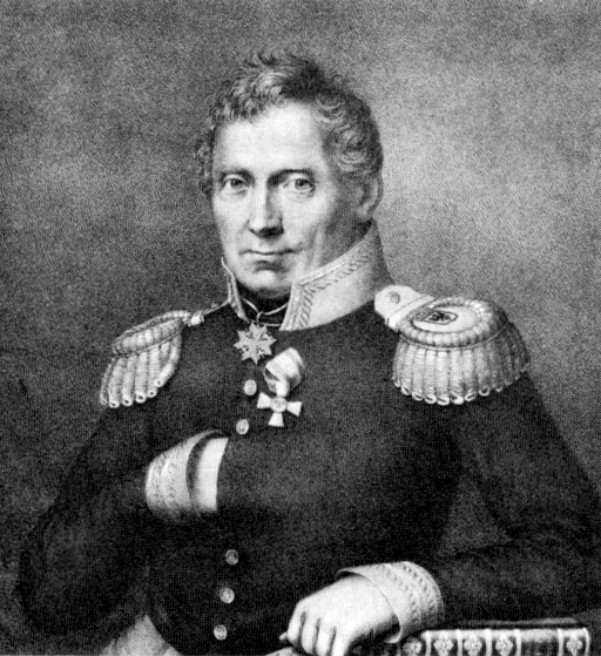 Georg von Reisswitz, OG gamer son.
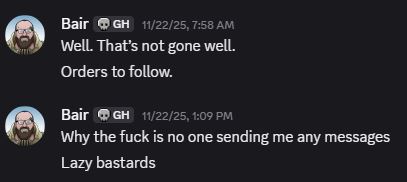 Average Kriegsspiel player experience.
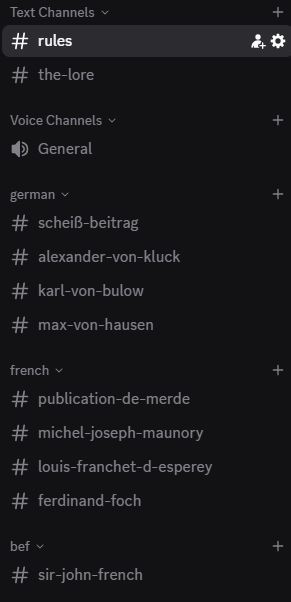 How I laid out a simple discord server.
 The other half of the play experience - drawing on maps.

 Goonhammer App and Patron Updates: April, 2026
 Kill Team Tournament Report: Engage, Party, Repeat's March Madness 2026
 Goonhammer Reviews: Tribal Conquest