Join Marc "Ilor" Renouf as he descends into madness by launching an ambitious project into an entirely new (to him) historical era! This series will delve into the entire process, from planning and progress to (hopefully) completion.
Inspired by Colin Ward's
"Oops, All Hoplites!" project, I decided to take the plunge and get into a new historical era. It is often said that the journey of a thousand miles begins with a single step. And so it is as I embark on my first foray into the Ancients period, specifically a project to begin collecting, modeling, painting, and playing games in which the forces of the Roman Empire figure prominently.
But Why?
Even as an avid historicals player, I have thus far steadfastly avoided delving into the Ancients Era, which is generally accepted as that period of antiquity starting in the Bronze Age and going more or less until the fall of the Western Roman Empire in 476 CE. Why? Well, mostly because it's
a lot, friends. Babylonians, Assyrians, Egyptians, Greeks, Macedonians, Achaemenid Persians, Romans. Elephants, chariots, biremes and triremes. You could go mad trying to do it all, so I have decided to focus on just one of these themes. But even narrowing it down this much still leaves a lot, as just the term "Roman" is so loaded as to be like grappling with an octopus.
Inheriting much from their precursors the Etruscans, Roman power began to rise in central Italy in the early fifth century BCE. By 300 BCE Rome was a growing regional power and was well into its "Republican" era. The early Republic worked to solidify its hold on all of Italy (though this wouldn't truly be accomplished for a shockingly long time) while at the same time facing off against enemies like Carthage and the various Greek colonies around the Mediterranean. During this period, how the Roman military was organized and fought went through a series of changes. Though there is rigorous debate in academic circles about whether the so-called "Marian Reforms" of the end of the second century BCE (which outlined the "legion" structure which would catapult Rome to a major power) were a sudden change or an evolutionary adaptation, the fact of the matter is that by the time Julius Caesar arrived on the scene and got himself named "dictator for life" in 49 BCE, the Roman military looked very different than it had in the First Punic War. Different weapons, different tactics, different organization.
Throughout the early Imperial period, the Roman legions would extend the borders of the Empire across the Mediterranean, including territory in North Africa, Egypt, the Levant, Asia Minor, Greece, the Balkans, Eastern Europe, Germania, Gaul, the Iberian Peninsula, and the British Isles, reaching the height of its power under the emperor Trajan in 117 CE. But by the beginning of the 5th century CE, the wheels were really starting to come off. Due to the difficulties of administering (and defending!) the sprawling empire, it had essentially split in two, with the Western Empire continuing to be centered about Rome while the Eastern Empire was run from the city of Constantinople. The two were ostensibly united, but in actual practice they pursued their own separate interests and sometimes even fought each other.
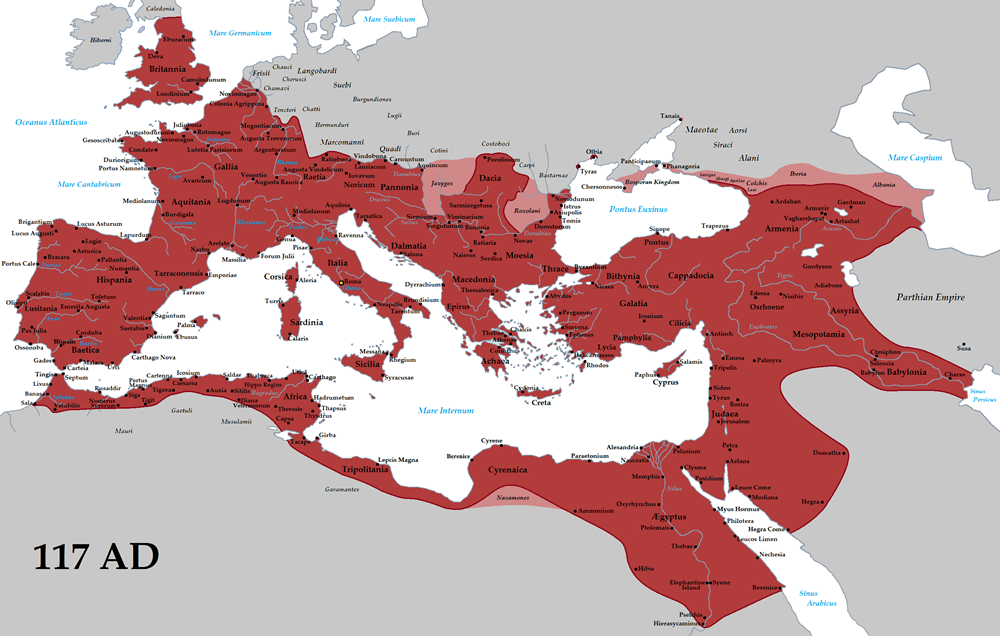 The extent of the Roman Empire under the emperor Trajan. At its peak, the Roman Empire dominated the Mediterranean and Black Seas, spreading their cultural influence throughout the region. (credit: Wikipedia)
Further, migration pressure from Huns marauding into Eastern Europe forced the people in those lands - Ostrogoths, Visigoths, Alans, Sarmatians, and more - west into lands claimed by the Roman Empire. Many of these "barbarian" groups would be offered land in the Empire in exchange for military service. Though the combined force of the Romans and their new allies would eventually halt the advance of the Huns, the empire was ill-equipped to deal with these mass migrations and as a result trouble started almost immediately. In 408 the Visigoths - who had been accepted into the Empire as
foederati - turned on their "hosts" and attacked. In 410, Visigoths sacked the city of Rome itself, the first time that had happened in almost eight centuries (since the Gauls had last done it in 387 BCE). This was the beginning of the end for the Western Roman Empire.
This in turn set off a relatively rapid decline, where forces of the Western Roman Empire (now increasingly comprised of more foreign tribes exchanging military service for land - which brought with it a whole
new set of weapons and tactics) would withdraw ever inward as more and more former allies saw their chance for a bigger slice of the pie. Many of these acted as kingmakers, putting puppet emperors on the throne in Rome - though these tended to be short-lived as the various groups jockeyed for dominance. The downward spiral finally ended in 476 AD, when Sciri chieftain (and Roman military officer) Odoacer dethroned emperor Romulus Augustulus (himself only 16 years old at the time) and didn't even bother to name a puppet successor, instead declaring himself King of Italy.
But wait, there's more! The Eastern Roman Empire would weather this chaos and continue to be a force (at least in the east) for another thousand years until finally succumbing to the forces of the Ottoman Turks in 1453 CE. And you'd better
believe that there was a whole lot of military innovation in that millennium.
There's a
ton of history there, and like all history it's absolute catnip to me.
So... Which "Rome?"
In order to keep myself from going well and truly insane, I am choosing to focus on the Imperial Era of the Western Roman Empire, from about the invasion of Britain in the early 1st century CE to roughly the withdrawal of Roman power there in the early 4th century CE. This 300 year period saw a lot of change to be sure, but it helps keep the project focused.
It also corresponds to some of the games I want to play, and that's the whole point of a project like this - to grow one's collection of miniatures to enable games!
And which games might those be? Well, to start with:
Gangs of Rome. I backed the Kickstarter for the 2nd Edition of this game, which fulfilled back in early 2024. This left me with a bunch of minis for various Roman civilians and ne'er-do-wells, and despite loving the theme and the rules, I have yet to actually get it to the table. Part of the motivation for this project is to change that!
Gangs of Rome is what I'd call a "warband scale" game, where each player's force is on the order of 5-10 minis. It uses a fantastic "push your luck" action economy and has some really novel mechanics to reflect the role of crowded urban streets in a way that doesn't require you to paint hundreds of bystanders.
Next up is
Pillage. Though the base game is set during the Viking Era (from the sack of Lindisfarne in 793 to the Battle of Hastings in 1066), the game's publisher recently released a "
Fall of Rome" expansion. This free (!) supplement is meant to extend the game's reach to the time period between the 3rd and 7th centuries CE. This gives some nice overlap with my chosen era. Pillage is also a warband game, though one that can extend to slightly bigger forces. You're still activating your warriors individually, though, so there's a practical limit to how big you want to go with this.
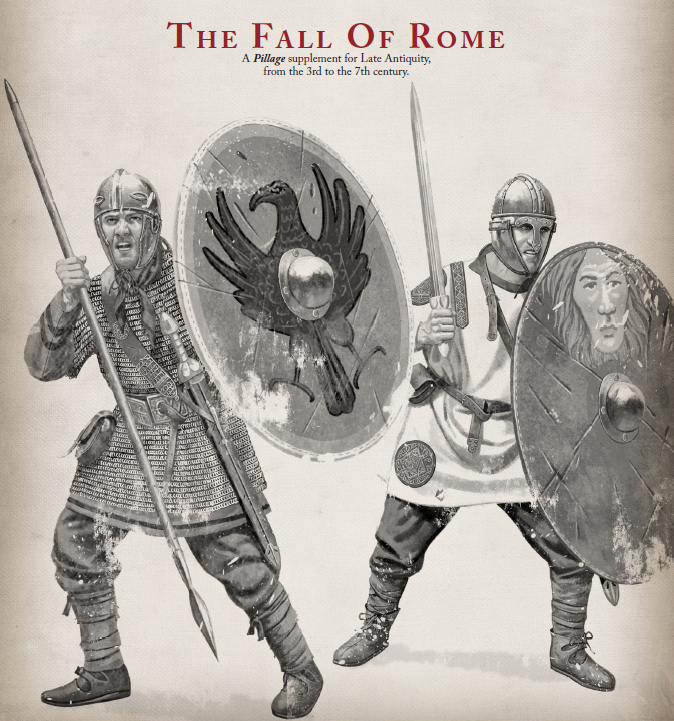 The Fall of Rome expansion for Pillage was recently released, expanding the era covered by that game substantially. I was really excited to see this and can't wait to get it to the table. (credit: Victrix Limited and Triskell Interactive)
By the time we get to
SAGA, we're squarely into "skirmish" territory (though fellow author Ne Cede Malis calls it "warband" in his review, I think we're working on different definitions), with forces ranging in the 40-60 figure range. The Age of Invasions set for SAGA covers roughly the same era as the Fall of Rome supplement for Pillage, so miniatures used in one can easily be used in the other. Here, however, we're now grouping our models into distinct units, so we can play bigger games without it taking forever.
SAGA: Age of Invasions also has the "Limes" campaign system, which is a clever way of linking your games together to give more narrative weight to the action on the tabletop. It is intended to model a far-flung Roman outpost holding out against a growing tide of barbarian attackers, and I think will be a ton of fun to play. It's relatively short (no more than 6 games), which increases the likelihood of making it to the end. It also has sufficient options that I think the replayability factor on it is pretty high.
Moving along,
Infamy, Infamy is the game that really inspired this entire project. One of the notable gems from games publishing house Too Fat Lardies, Infamy, Infamy is a fantastic game of
asymmetric warfare between the Roman Legions and the various barbarian nations they were attempting to conquer. This too is a skirmish game of roughly the same size as SAGA, albeit with a different way of organizing the troops into units. It can extend into significantly larger forces, however, and critically has rules for Romans fighting Romans as well as its own campaign system.
Infamy, Infamy uses a card-based activation system similar to that used in Sharp Practice (their black powder era game about which we have written extensively) which I absolutely love. It really brings a lot of friction and uncertainty to the game, and makes battles feel tense and chaotic without making everything too random.
The capstone in this project is
Dux Britanniarum, another Too Fat Lardies game. One of their older titles, this one is actually just outside the chosen period, and will represent the end of this project and the transition to the next. Set after the Roman withdrawal from Britain, it features the Romano-British remnant trying to hold on to the vestiges of their romanized culture from a series of invading peoples (mainly Saxons, but also Picts, Scotti, and Irish).
Honorable mention goes to
Midgard. A very interesting rank-and-flank game, Midgard has the customization to be able to handle battles in this era (as well as many others) well. It is designed for larger forces, however, so in some sense it is aspirational. I'm not sure if any of my forces will rise to the level of a well-rounded Midgard force, but it certainly positions me well to be able to expand should I want to in the future. This project is all about building up slowly and achieving reachable goals along the way.
The Plan
Starting with miniatures I already have, I'll first be working on Gangs of Rome. Backing the Kickstarter netted me 60 miniatures - 30 of Footsore Miniatures' fantastic metal minis as well as an entire box of Wargames Atlantic's "Citizens of Rome" plastics (another 30). This is way more than you need to play any single game of Gangs of Rome, but importantly it gives me loads of customization options (which can be important because the game itself has loads of options).
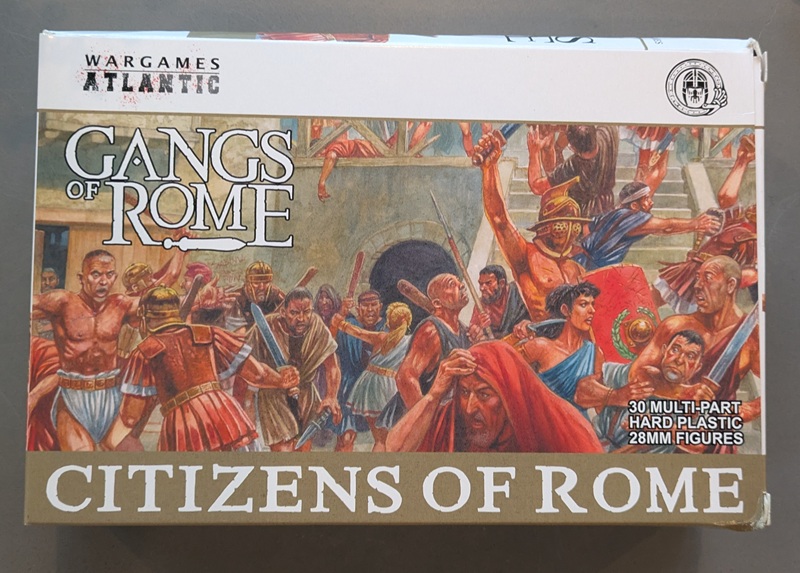 Designed by WGA to coincide with the release of the 2nd edition of Gangs of Rome, this plastic kit is great, giving options for both gang fighters and civilians. It was a pledge add-on, and is now available directly from WGA. (credit: Ilor)
One of the key elements of Gangs of Rome is "The Mob," i.e. the ordinary civilians wandering around the streets while the gangs are getting up to no good. These civilians are an important and interactable part of the game, and in most games you'll likely have more Mob minis on the table than gang fighters. Each Mob is comprised of 5 individually-based figures on a roughly 3.5" sabot base. Crucially, these individual civilian miniatures can be used as objectives in other games, which means that effort put in here can pay off later on in the project.
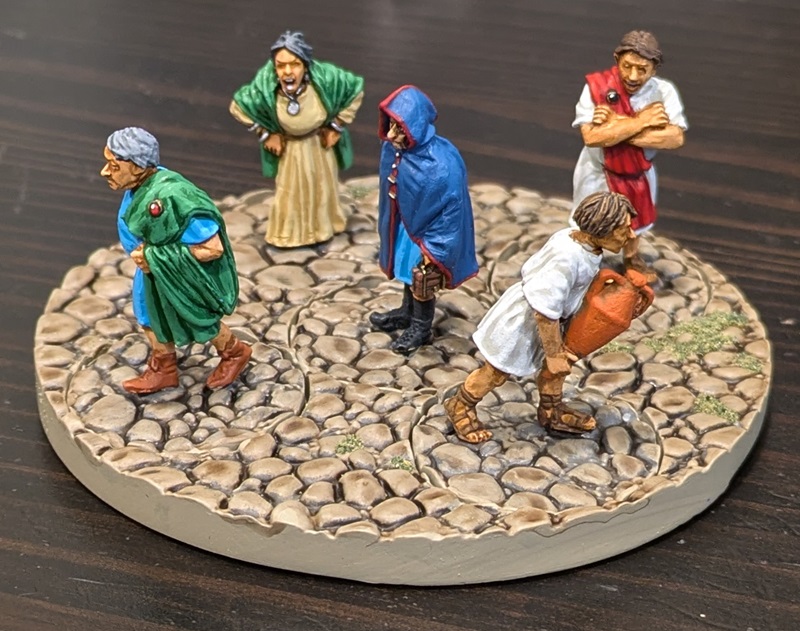 A "Mob" in Gangs of Rome acts as mobile terrain that can be interacted with in a variety of ways. Be careful, though - the mob is a fickle beast, sometimes helping and sometimes hindering your aims! (credit: Ilor)
Another thing that can pay off down the road is terrain. Gangs of Rome really benefits from fairly lavish terrain, especially multi-level urban terrain. As part of this project, I finally bit the bullet and ordered a bunch of laser-cut MDF terrain from Sarissa Precision's "Streets of Rome" line (which was created to support Gangs of Rome). But Roman style buildings don't need to be limited to the city of Rome itself - Roman architecture proliferated throughout the empire, and a building that serves as a shop or a residence in Rome could just as easily serve as a shop or residence in Londinium. Or a villa or outbuilding in a more remote settlement.
Another aspect of Gangs of Rome are the "vigiles urbani," who were the city of Rome's night watchmen and fire brigade. These are the guys who come to pummel you into submission if your gang fighters are getting too frisky. While Footsore makes several sets of vigiles as part of the line, these dudes look for all the world like ordinary soldiers, using the same armor and helmets. I have two sets of metal vigiles, but for the rest I plan to use standard early Imperial legionaries. This is how I will ease my way into painting Roman soldiers to be used in the other games.
And speaking of Roman soldiers, I may have gone a little overboard during Victrix' last Black Friday sale. In one fell swoop I've picked up one bag each of Early Imperial infantry, cavalry, and auxilia. This is a total of 65 more figures (including command, standard bearers, musicians, and others). This is a solid core that will give me more than enough troops for Pillage and get me pretty close to a workable force for SAGA. At some point I am likely to spring for another bag of infantry and a bag of Imperial Roman archers. This will put me well into the realm of being able to field a sizeable force for Infamy, Infamy, one with enough variety to handle loads of different scenarios.
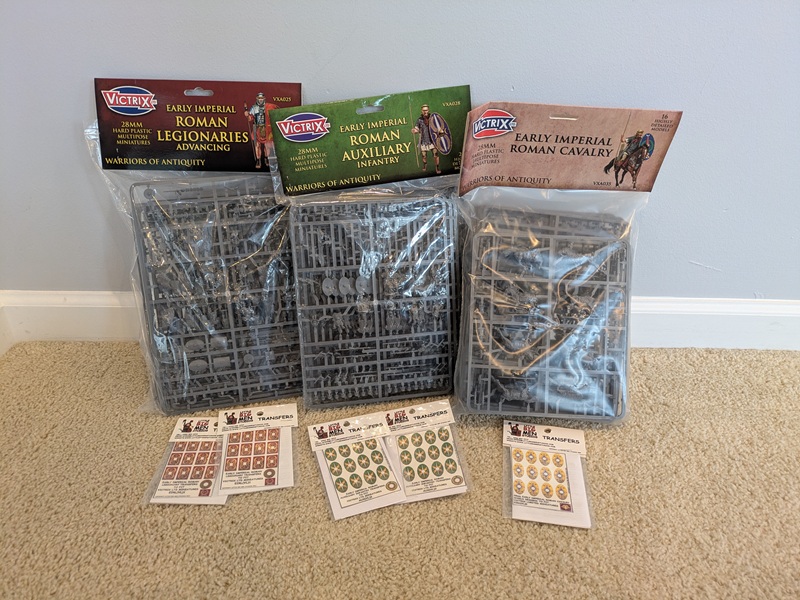 My Black Friday haul from Victrix. Sadly, I ordered these not too long before they resumed the pre-punched shield transfers (cue sad trombones). Still, this should get me well on my way to having forces for severeal different games. (credit: Ilor)
These Victrix figures will also give me options to fight some "Rome on Rome" battles, such as those that transpired during the "Year of Four Emperors." And with all the Gangs of Rome terrain in hand, I'll have the option of doing battles in either rural or urban settings. But aside from hot Roman-on-Roman action, who is this growing body of imperial legionaries going to fight?
Victrix recently answered this one for me with their recent release of several sets for the Picts. A loose confederation of tribes inhabiting what is now Scotland, it was the incursions and raids of the Picts that caused the Romans to construct Hadrian's Wall. Pictish forces are well represented in both Pillage: Fall of Rome and SAGA: Age of Invasions. And in Infamy, Infamy, they are represented using the rules for the Britons.
Crucially, the Victrix Pictish Archers set includes both bows and crossbows, the latter of which the Picts were early adopters of. Though sources are scarce, the Picts continued to use crossbows into the Viking Age. As such, I can stretch the era in which my Picts will be fielded.
And that gets me to the end-state of the project, as the Picts are also one of the forces detailed in Dux Britanniarum. Once I have a fully-fledged Pictish host, I can transition to a new era, all while still playing many of the games I like (Pictish forces in various configurations are available in Pillage in both the Fall of Rome set and the base Middle Ages era, for instance). And the Pictish battle board for SAGA: Age of Invasions is straight-up
mean.
All told I'm looking at painting roughly 200 figures for this project from beginning to end, along with accompanying terrain. Most of these I already own, so in addition to getting to paint cool minis and play cool games, it helps me whittle down my backlog. It is an ambitious project to be sure, but one which has measurable goals and game-worthy milestones along the way. And of course writing about it all as I go will hopefully keep me motivated. Wish me luck and watch this space!
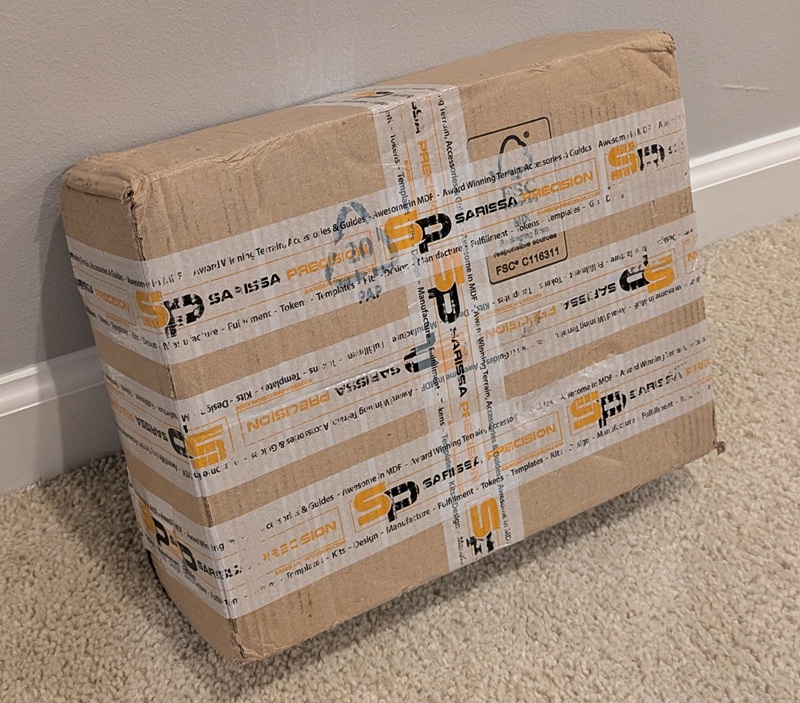 According to the shipping label, this package clocks in at nearly 4 kilos. That's, uh... that's a lotta MDF! (credit: Ilor)
Have any questions or feedback? Drop us a note in the comments below or email us at contact@goonhammer.com. Want articles like this linked in your inbox every Monday morning? Sign up for our newsletter. And don't forget that you can support us on Patreon for backer rewards like early video content, Administratum access, an ad-free experience on our website, and subscriber-only content covering competitive Warhammer 40K!
According to the shipping label, this package clocks in at nearly 4 kilos. That's, uh... that's a lotta MDF! (credit: Ilor)
Have any questions or feedback? Drop us a note in the comments below or email us at contact@goonhammer.com. Want articles like this linked in your inbox every Monday morning? Sign up for our newsletter. And don't forget that you can support us on Patreon for backer rewards like early video content, Administratum access, an ad-free experience on our website, and subscriber-only content covering competitive Warhammer 40K!
Thank you for being a friend.
 This website uses cookies. Learn more.
 Goonhammer Historicals: All Roads Lead To Rome - The First Step