 This website uses cookies. Learn more.
This website uses cookies. Learn more.
This website uses cookies. Learn more.

One of the biggest tear-jerking moments in the Stranger Things finale wasn’t in the hour-long denouement. Sure, some of the needle drops and goodbyes had me sobbing, but there was another bit in an earlier season 5 episode that really got me: During a pivotal moment, Will Byars reflects on his friendship with Mike Wheeler through a montage of home movie-like footage. And in one of these pieces, we see the boys excitedly opening up a copy of Dungeon!, a TSR board game designed by David R. Megarry – one of the folks that was playing in David Arneson’s legendary Blackmoor group from which the earliest versions of Dungeons & Dragons originated. And I noted that the copy they were shown with was precisely the copy I had when I was about their age. And it was around 1982 or 1983, so it was all right on the money.
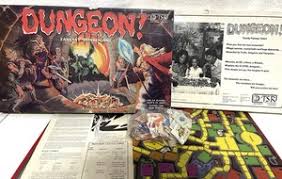
I have a special fondness for this Game From The Crypt because it is, in fact, the very first hobby board game I ever had. My family went to one of those ghastly timeshare sales vacations that they used to have in the 80s, where you get a free trip somewhere in exchange for a high-pressure sales pitch. We went with another family, and I was friends with their kids Kim and Eric. We somehow wound up at this game shop, and wanted to buy a game to play at the hotel. I picked out Dungeon!, which in retrospect was probably a terrible idea as Kim and Eric’s folks were evangelical Christians that in a couple of years would be in the throes of Satanic Panic.
I still recall opening that box up and looking through all of the monsters, traps and treasure cards. And why was this knight called a “Super Hero”? Black Puddings? Purple Worms? What the hell is a "coffer"? It was all wild, alien, and exciting. And it was the first time I encountered the concept of fantasy game and role-playing. I still keep a more recent copy around, and hidden deep in my vaults is a copy of that 1983 edition that I found, sealed, at an antique store some years ago. I’ll never let it go – it’s priceless, and to see Mike and Will playing it as their friendship grows turned on the waterworks.
Dungeon! is especially interesting because it was first published in 1975- ironically, the year of my birth although its origins go back to 1972, when Megarry wanted to create a role-playing experience in a simpler, easier to manage board game format. This is still a chief design impetus in hobby gaming today, but here is to my knowledge the first example of “what if RPG but board game” in existence. The original version was called The Dungeons of Pasha Cada but after a meeting with Gary Gygax and some further development (along with a few rejections from game makers at the time) it eventually was printed by TSR.
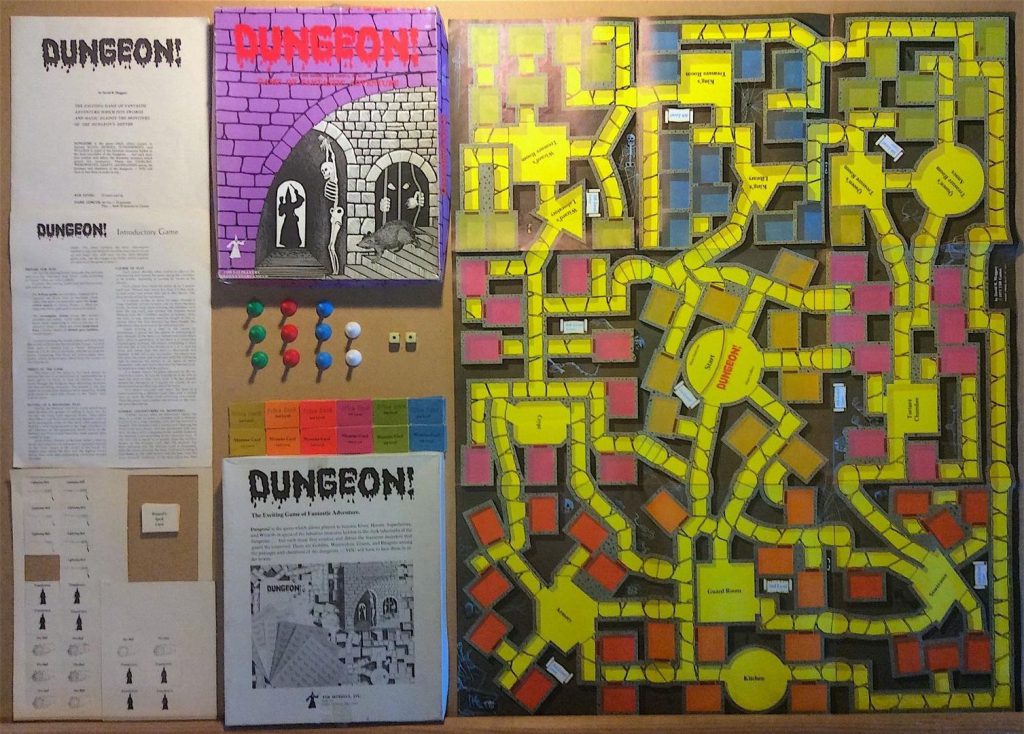
The design is ultra simple, and in fact more recent versions have been marketed more specifically to kids and families. You take on the role of a character- originally the aforementioned Super Hero, Hero, Wizard, and Elf but expanded to include other D&D classes- and the goal is to raid a multi-level dungeon in that timeless rondelet of killing monsters to take their stuff. It’s pure hack-and-slash, and the winner is simply the player that gets back to the entrance with their required amount of loot.
Most gamers today would turn their noses up at how utterly basic this game seems today but for 1975, let alone 1972, there were some brilliant and innovative design elements. One is this whole multi-floor dungeon business. It’s obviously a 2D board with no miniatures (the original game had generic pawns for the players), but the six “levels” are indicated by colors. And each of these colors has a separate stack of monster cards for each of the rooms so that as you go “deeper”, the monsters get harder to beat and the treasure cards get more valuable. There’s no limitation on where players can move other than die rolls (yes, roll and move) so players that happen upon a magic sword or other advantage are more than welcome to delve deeper. It all creates a sense of progression and improvement over the the course of the game, which is one of the key principles of role-playing games.
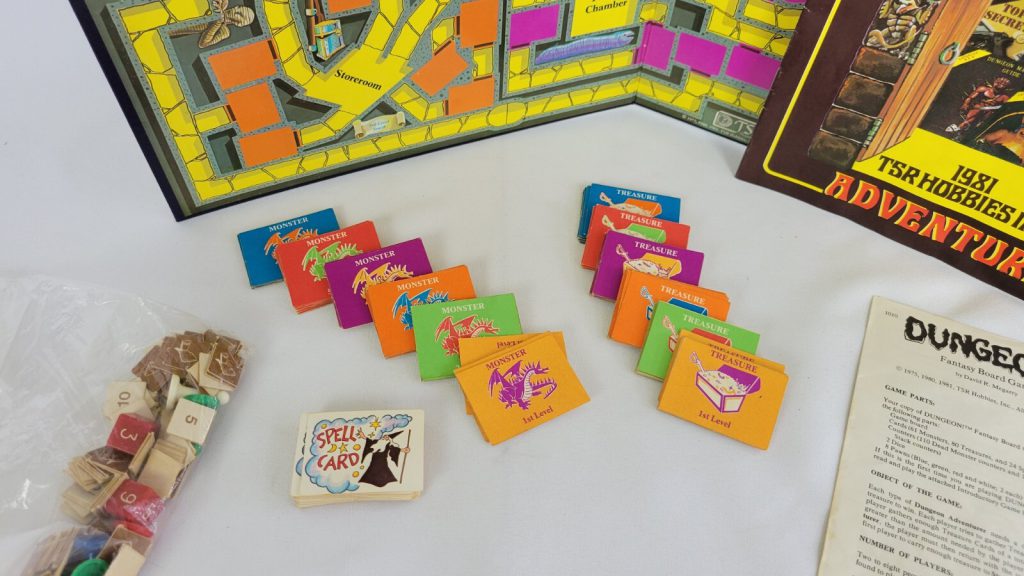
The differences between each of the classes were another novel idea ported over from RPGs, and one of the first instances outside of wargames where asymmetry was a design factor. It’s still very simple- different characters need different rolls to defeat each monster, as presented in a simple CRT (combat resolution table) on each card that accounts for monsters being weaker or more vulnerable to might or magic. And each class has a different gold piece value to win, which serves to even out the bad luck a Wizard might run into early on or the simple fact that the Hero is just a plain old Hero with no advantages or disadvantages. What’s more, the Wizard gets a couple of spells including the classic Fireball, which you’ll usually pop off before even going into a room, and the Elf gets to use their Elf eyes to get a better roll to find secret doors.
The combat mechanism is just throwing 2D6 against a target number, but another clever idea was having variable outcomes for when a player loses a fight. Losers have to roll on another results table that tells what happens when a player can’t beat the Green Slime or whatever. This adds a tiny bit of specific narrative detail to the gameplay, explaining how a character gets injured and drops all their stuff, has to spend a turn resting, or is outright killed. Early Games Workshop design was heavily influenced by these kinds of “how screwed are you” D6 tables. It’s another example of how the specificity of wargaming was a major factor in the origin of hobby gaming across other subject matter.
These days that all sounds pretty quaint especially compared to something like Gloomhaven or even HeroQuest (a previous Game from The Crypt), but there again for the time this was actually quite maverick stuff. Nobody was doing anything like this, and it really wouldn’t be until 1978-1979 that games like Sorcerer's Cave and Richard Hamblen’s monolithic Magic Realm would take some of the core concepts of Dungeon! much further. Both of those games will be exhumed from the Game Crypt in the future, of course.
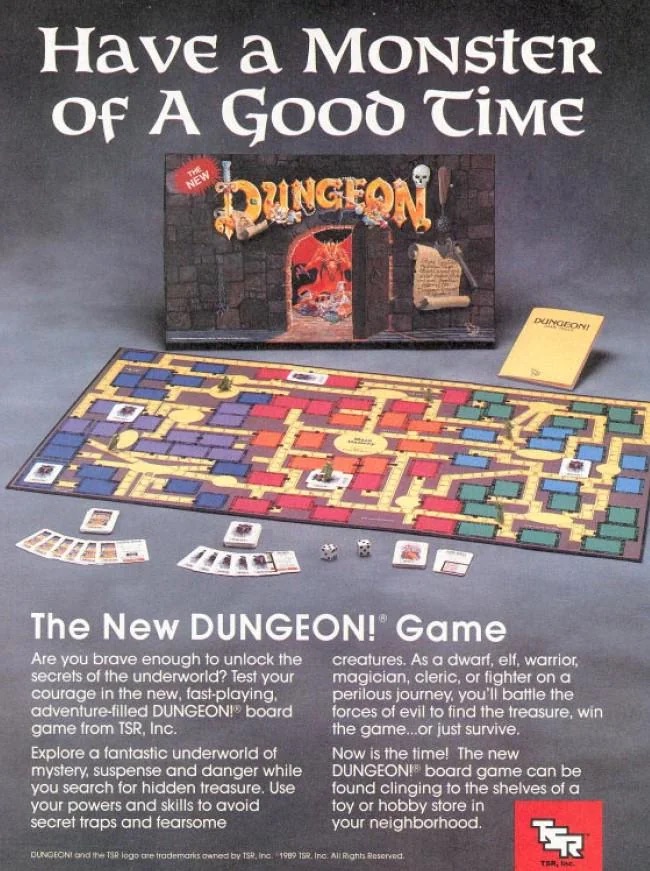
There have been several version of Dungeon! over the years with the most recent 2014 version released as part of the 5e push. It has a few changes, but it’s really the same game it’s always been aside from a couple of “wilderness years” editions in the late 80s and 90s where they messed around with it a little more with more characters and in the 1992 edition a goofy misprint where two level got the same color cards. As for playing it today, it’s unlikely anyone is going to reach for the 1982 digital version unless they have a working Apple IIe- I’ve never even seen it.
I don’t know that many gamers today will appreciate it the same way that I did when I was 8 or that Mike and Will apparently did. I think many modern gamers will react with either “is that it” or “I’m actively annoyed and hate this game”. But they would be missing a historically important, innovative piece of gaming’s history. This is the kind of game that Games From the Crypt is all about- the forgotten, neglected story of how the medium of hobby games became what it is today. To that end, Dungeon! remains essential playing for anyone interested in game design history even if it does absolutely suck to play for an hour and lose everything because you didn’t use the Crystal Ball to check the room before you sauntered into the Vampire’s lair.
Have any questions or feedback? Drop us a note in the comments below or email us at contact@goonhammer.com. Want articles like this linked in your inbox every Monday morning? Sign up for our newsletter. And don't forget that you can support us on Patreon for backer rewards like early video content, Administratum access, an ad-free experience on our website and more.Tags: history | board games | Dungeons and Dragons | games from the crypt

Thank you for being a friend.
 Goonhammer App and Patron Updates: April, 2026
 Kill Team Tournament Report: Engage, Party, Repeat's March Madness 2026
 Goonhammer Reviews: Tribal Conquest
Support us on Patreon to get access to our Discord and exclusive App features.
Thank you for being a friend.
Already a Patron? Login with Patreon.
Visit our incredibly official store on RedBubble.
Support us on Patreon to get access to our Discord and exclusive App features.
Thank you for being a friend.