 This website uses cookies. Learn more.
This website uses cookies. Learn more.
This website uses cookies. Learn more.

There was a period when my regular online gaming group- friends I’ve had for well over 20 years, going back to when I was running my game shop- was playing almost nothing but the classic Sid Sackson game Can’t Stop. It got to be almost a little ridiculous how often we were playing this minimalist design that many modern gamers might dismiss as a shallow dice-rolling affair. We began to develop our own specific language about the game- slang slung at each other in gloriously goading trash tralk. We came up with unwritten house rules and admonitions against “cowardly” play. The game’s goal- to complete three columns of numbers- suddenly became not good enough and True Champions were expected to complete four. I felt like an Ultimate True Champion when I won a game by completing five in an epic turn.
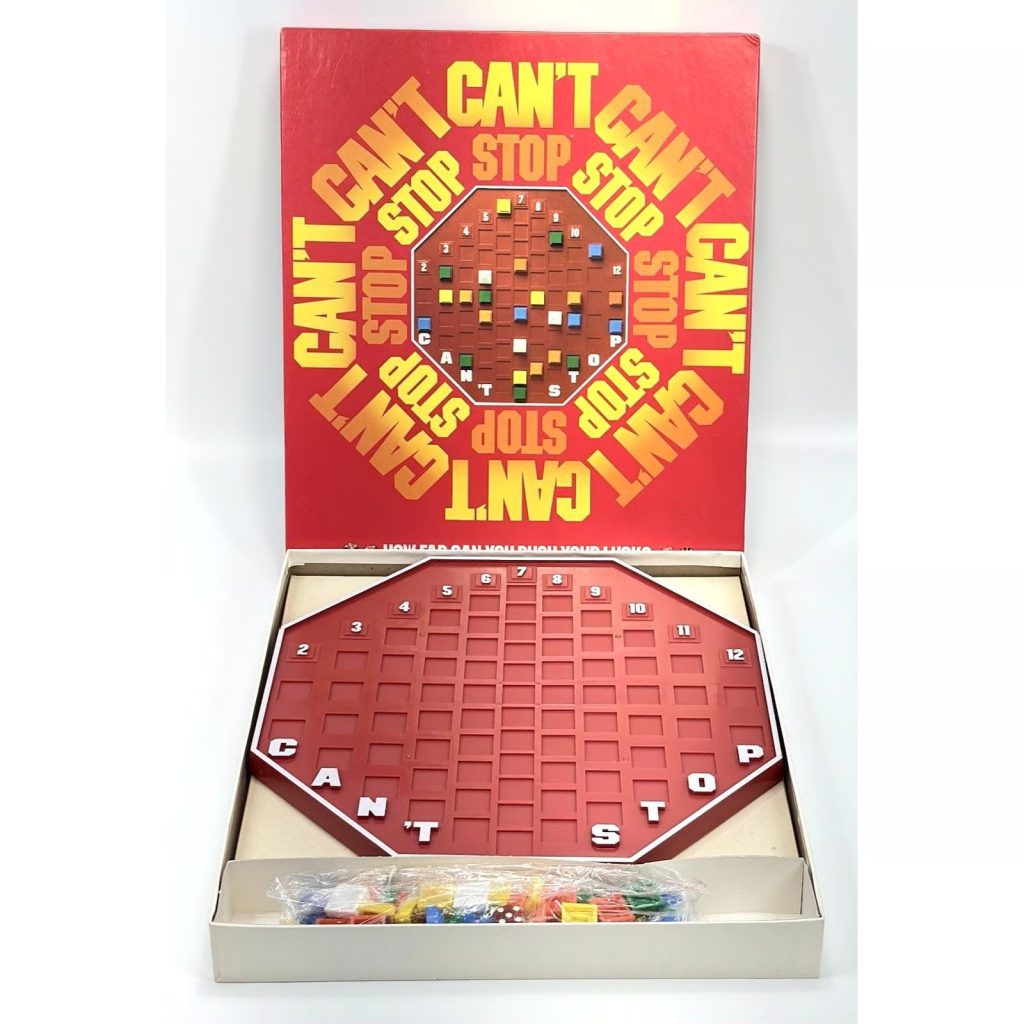
Can’t Stop is a magical game, one of the best games ever published and indeed on my shortlist for favorite games of all time. It’s almost Ramones-like both in its leanness and its genius, the kind of thing where a casual observer might think it’s pretty dumb but it’s actually pretty brilliant. It’s a game where the rules and decisions aren’t very complicated, but the psycho-social dynamic of its quintessential push-your-luck mechanism drives it into remarkable gamic territory – if you dig into it and let it do its thing.
Sid Sackson (1920-2002) remains one of the greatest of all game designers because of designs like Can’t Stop, and if there is such a thing as a Patron Saint of Games from the Crypt he’s a leading candidate along with Knizia, Hamblen, and the Future Pastimes gang. A somewhat eccentric collector of board games from a time when KALLAXs and online databases were not a thing, Sackson understood perhaps better than any designer since that player agency and interaction not only with the rules but also other players is what generated the Holy and Sacrosanct GAME. In an era when flavor text, miniatures, and the burden of empty content define many games, his work feels almost skeletal.

And so it is with Can’t Stop, first published in 1980 and subsequently across several editions including a currently in-print version from Eagle-Gryphon and an excellent online implementation at Boardgamearena.com, which has probably logged more plays over the past five years than have ever been played with physical copies of the game. The most familiar edition is the Parker Brothers one with the plastic red stop sign board. But the truth is, you can draw the board on a sheet of paper and play it with just four dice and some makeshift player markers.
There are 10 columns, numbered 2-12. The concept is that the more ways there are to roll a number on 2 D6s, the more spaces there are in the column. Thus, 2 and 12 only have one possible combination and only 3 spaces. The middle is 7, which has the most possible combinations and thus the longest path. Each turn, a player rolls four dice and pairs them up, placing a marker (sometimes called a runner) on one of the columns. There are three of these neutral markers, which lock you into those numbers for your turn. On subsequent rolls, you are faced with a choice- continue rolling (hence Can’t Stop) or lock in your positions on the columns you’ve already achieved for the turn. If you don’t roll one of the three numbers you’ve chosen for the turn, you lose all the progress you’ve made. But if you lock in, you start future turns on those positions. Whoever gets three of their colored markers to the top of three different columns wins. If you’re an amateur and don’t go for the five column flex like I did.
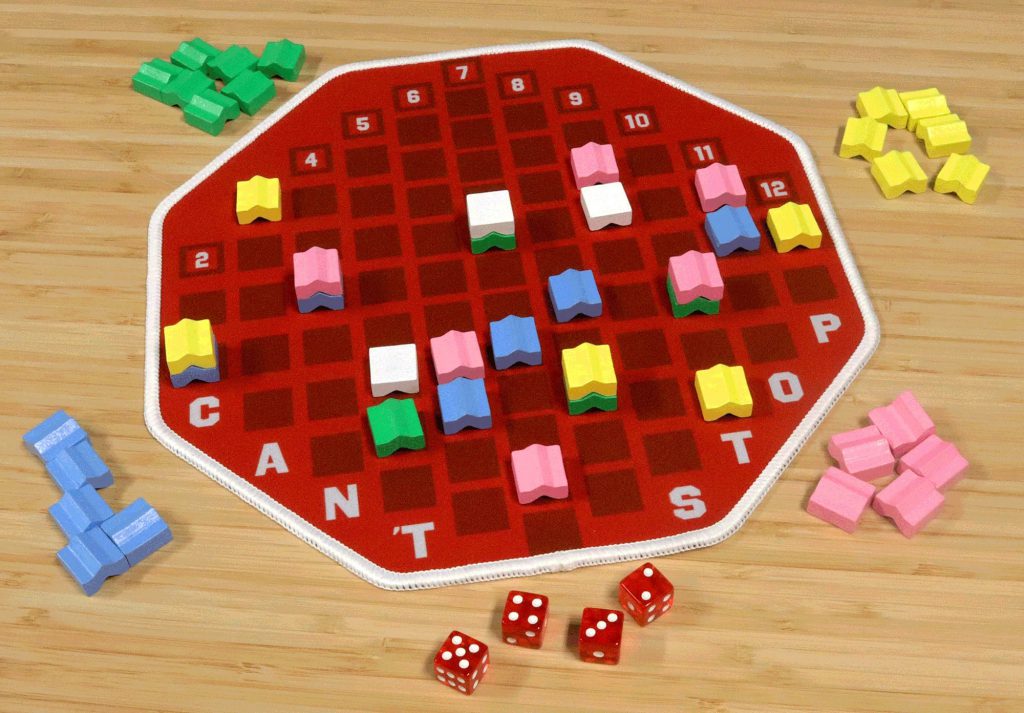
That’s all there is to it, on paper. It’s kind of a Craps-inspired thing really with the extreme numbers representing the “hard ways” and the safe bets on the 6-7-8. It’s really a light gambling game, but the stake is progress rather than money. Technically, it’s also a roll-and-move game, which rubs a lot of hobby gamers the wrong way. And it is really just a dice game when you break it all down.
However, there are so many nuances to this game that are not immediately apparent even after 5, 10 plays. It isn’t just an RNG-fest, there is subtle strategy in picking which numbers to go for. The 7 is the safest play, so we call it an anchor drop. With a 7 out, you are safer playing on the shorter 2, 3, 11, and 12 paths. It’s possible to go guns out and win the game in one turn if you’ve got the brass for it. Or you can take your time and spread out your markers so that you can guarantee at least some progress in future turns.
And then there’s the psychological angle- it’s right there in the title. The temptation to keep rolling is immense, as is the drama of failure when you bust. Going back to the numbers- and the insane metagame my gang developed around this game- there’s also the shame of winning a game with the “easy” 6-7-8 “Coward’s Path” (which we do not regard as a legitimate win) and the absolute triumph of hitting the 2 and 12, which can be enough to validate a win that includes an otherwise frowned-upon completed 7. But it’s also the Coward’s Path. The trash talk is insane- friends goading you to take one more roll because come on, you got this. You can’t stop now. You’ve pushed that marker up six spaces this turn, how are you gonna quit now?
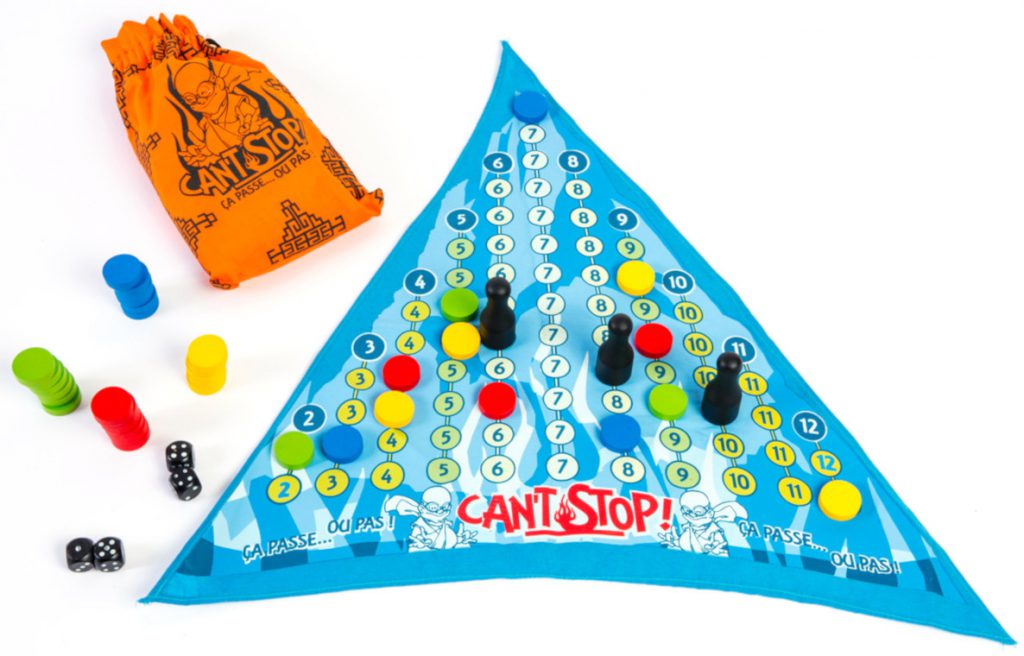
I've almost broken into a sweat, cursor hovering over the roll again button, friends whispering their Luciferian encouragement to reach for more, achieve more, win the game. And the sheer profanity that I’ve heard over discord over busted rolls…this is a game meant for playing with your closest friends and family, those who know how to push your buttons and dig into your psyche. Much like Poker, it’s a game that comes alive when the high stakes and drama are paired up with deep interaction This is an element I think is missing from a lot of games of Can’t Stop that I’ve played out at conventions, game shops, and with strangers. Many have played the game under these circumstances have walked away unimpressed by it. Could it be that without this deep social element maybe Can’t Stop isn’t as great as it seems?
Answer- no. Can’t Stop is, stated bluntly, one of the purest distillations of what makes gaming great ever to be published. It’s about playing with other people and using the rules and materials as a social medium to connect and compete. This is more important than all the rules, “strategic depth”, and phony complexity in the world. Aside from its monolithic status, at least in my eyes, it is also a tremendously influential design simply because it is, to my knowledge, the first game to feature dice selection and strategic rerolls. Sure, “roll again” was a space on many archaic roll-and-moves and some wargames prior to 1980 had rerolls, but I believe that Can’t Stop is where the whole notion of choosing to roll again with potentially negative consequences originates. Yes, this means that Can’t Stop likely influenced all those Plasma rerolls and self-immolated Guardsmen in 40k.

Tags: history | board games | games from the crypt

Thank you for being a friend.
 Goonhammer App and Patron Updates: April, 2026
 Kill Team Tournament Report: Engage, Party, Repeat's March Madness 2026
 Goonhammer Reviews: Tribal Conquest
Support us on Patreon to get access to our Discord and exclusive App features.
Thank you for being a friend.
Already a Patron? Login with Patreon.
Visit our incredibly official store on RedBubble.

Support us on Patreon to get access to our Discord and exclusive App features.
Thank you for being a friend.