Northern Wind is the first major expansion for
Eldfall Chronicles, and it's a doozy. It's not just an expansion with new models for every faction and two entirely new factions; it's an entirely new way to play the game. Northern Wind is an episodic dungeon-crawler board game featuring an extensive story campaign. Players will take on the personas of four great heroes, sent to investigate the Oni threat from icy Mount Byodo. What they stumble on is nothing less than a cosmic threat to all of Calad, and with the Blood Moon just thirteen nights away, they must race against time (not to mention frigid weather, ravenous Oni, and the unquiet dead) to uncover and destroy the secret evil behind the Oni.
Before we start, a big thank you to Freecompany for providing a review copy of the game and its various expansions.
Opening the Box
Northern Wind is a
hefty box, and it's packed to the gills. Inside, you'll find:
- Fifteen models: our four heroes, four brutish Oni, six shambling undead, and one deadly but stylish oni sorceress.
- Three rulebooks: the core rules, a spellbook containing all of the various casters' arcane arsenals, and a massive spiral-bound quest log that contains the lore, the missions, and a massive pile of special events to read at the appropriate time.
- A quick reference sheet for use during games, covering most common gameplay mechanics.
- Save envelopes to store your stuff in in between game sessions
- Some standees and punch-outs to represent NPCs who do not get models in the box (though, you should note, all of these characters have models you can use, if you buy them).
- A couple of pieces of scenery you can punch out and assemble.
- A lovely Moon Dial you can punch out and assemble, which tracks the nights until the Blood Moon rises and the ritual commences.
- Stat cards for all of the models (including several different versions of the heroes and some of their foes, to represent them growing stronger as the campaign goes on). Most of these cards come with alternate versions for use in the wargame, as the models are all cross-compatible.
- Hostile Behavior cards that explain how the monsters behave.
- Two stacks of upgrade cards: one representing equipment your heroes find along the way, one representing special synergy-powered abilities you can unlock by achieving specific goals within the missions themselves.
- Event cards representing special random events that occur between missions and affect the progression of the campaign.
- Chaos cards that are drawn during battle to add a random twist that can help or harm.
- A stack of glossy cardboard pieces that together form the various environments that the heroes will battle through as they ascend Mount Byodo. These are all two-sided, allowing for even more variety in location, and come in several sizes. There are also three cards, the same size as the stat cards, that represent secret locations you might uncover during play.
- Four D20s in the four heroes' colors.
- A lovely map of Mount Byodo and environs, showing the various mission locations. And finally...
- A gigantic pile of tokens for tracking everything from conditions on models to items on the board to the outcomes of special events.
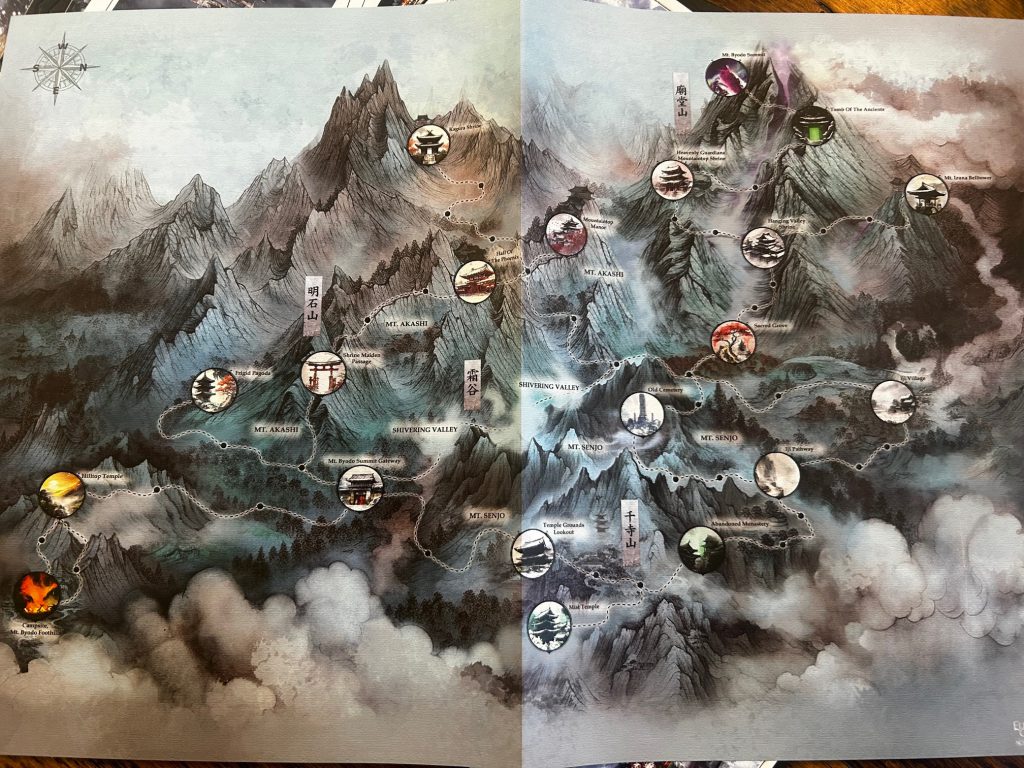 The mystical Mount Byodo and its majestic foothills. Credit: Freecompany
This is a lot of stuff, and I think the box would benefit from better internal dividers. The terrain especially is a bit awkward to put away once you've punched it out. The models themselves come in pieces in little plastic baggies, stored within smaller boxes, so you won't be keeping them in this box once you've built and painted them - you'll have to work out a separate storage solution for that.
That said, the quality here is very high. I will especially call out the board pieces, which are lovely, sturdy cardboard and well-marked; it's easy to find the one you need, and the boards all have critical information marked on them where appropriate. Most of the cards are normal-sized and will sleeve easily, though the stat cards are a bit larger - I am not sure if tarot sleeves will work, but they look about the right size.
The Models
The models themselves are made of the same resiny plastic as the base Eldfall models, and come in pieces (usually 2-4). They will need a bit of cleaning, and some narrow hafts and swords may need to be bent back into shape with warm water, but I didn't run into any significant challenges with that. They're not push-fit, but they do have large tabs that slot pretty logically into place. I found Na'ra the cat-lady was a bit tricky to assemble, as regardless of whether you attach her tail or her cloaked upper body first, it will get in the way of the other piece somewhat, but nothing too challenging.
Once assembled, the models look great, with a lot of crisp, clean detail. You may want to shave the tabs down a bit to make sure you can get some clean joins with no gaps - the gaps I saw were very small, but if you're a perfectionist, they may bother you.
I want to especially call out the undead models as having some of the nicest spooky lil skeletons I've ever had the pleasure of building. There are only two, but Harryhausen would be proud of these dead lad(ie)s.
Freecompany sent us the core box as well as several expansions: Kogetsu the Cursed Monk, two Oni Yaksha, an Oni Pariah, a Nekomata and Komainu, the Goblin Wartribes starter box, and the Blighted Riftspawn expansion. This last is a big bastard, with a delightfully creepy Dark Souls-y aesthetic well befitting his beefy stat card. You do not want to mess with this guy.
Some of the female models are a bit cheesecakey; I am thinking specifically of Chanra the Goblin Shaman, who appears to be wearing artfully draped beads as a top, and Na'ra the catgirl, who evidently doesn't mind the cold nearly as much as
my cat does. The Oni also have the classic Demonic Sexual Dimorphism thing going on, where the men are all massively ripped horned monsters while the women are, basically, red-skinned supermodels (with, it must be said, sharp horns and abs you could stone-wash jeans on).
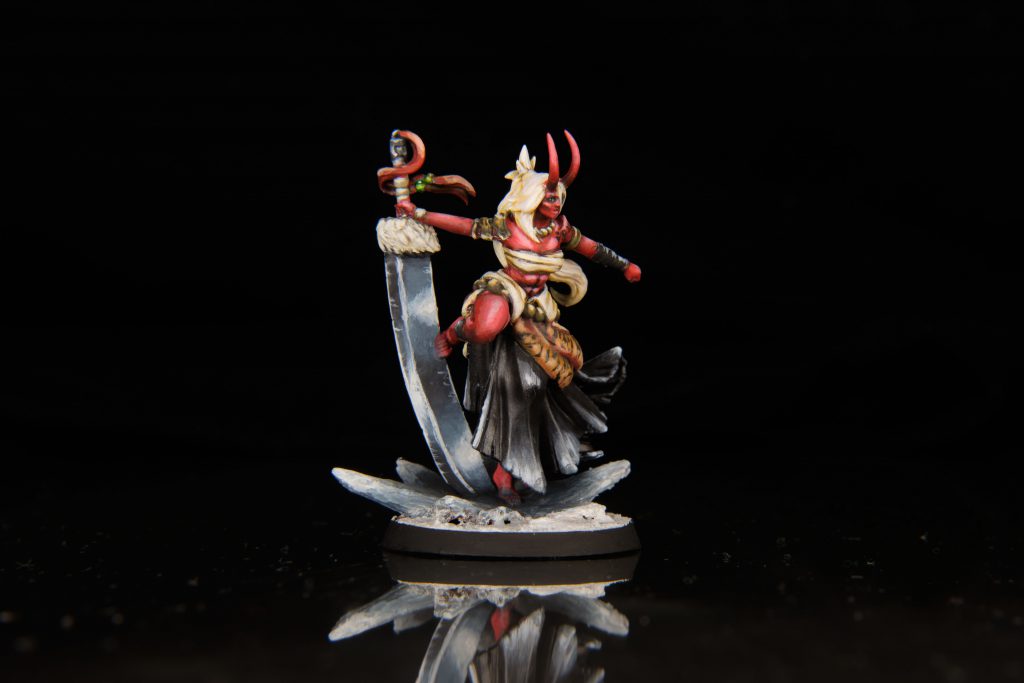 i would allow her to split my body in half with her giant sword, killing me instantly, if she wanted to. Credit: Keewa
I wouldn't say they're pin-up models like some others we've seen, but it's definitely something I noticed while putting them together.
The Core Rules
The core rules of a Northern Chronicles campaign are very much like the skirmish game rules. The core resolution mechanic is a d20; you are looking to roll equal to or under a target number, whether it's your offensive stat when rolling to hit or your POW minus the target's armor when rolling to wound.
There are, of course, some adjustments when moving to a board game from a free-form skirmish game. All distances, including range and movement, are measured in squares now, and many attacks require you to be in the same square. Models are only "aware" of things happening within three squares of them, and many things trigger off of that "awareness." You can opt to use "true line of sight" which involves model facing - and models' bases helpfully come with tabs marking out a 180 degree field of vision to assist with this - but you can also use a simplified version where line of sight is drawn between squares using points on the squares themselves as a base.
The biggest difference is in the purely PVE nature of the game. A game round is divided into turns: first a player turn, then a monster turn, and back and forth. During your turn, you are the Active side and the other is Reactive. All heroes and monsters get a certain number of AP filled up at the start of a turn; Active characters can spend an AP to activate, which means they can move and then take an action, while Reactive characters can spend an AP to React, letting them take an action. Actions include the standard Attack, Run (move again, basically), Dodge (a small movement that can, on a successful test, no-sell non-critical hits), Assist, Disengage, and Trade (all of which do what they sound like). Deathblow lets you take an Incapacitated foe entirely out of action. The other actions are special for the campaign: Interact is a catch-all action that the quest book will sometimes ask you to take to, for example, remove obstacles or cleanse profaned incense burners. Perceive lets you reveal shrouded foes but also interact with Intrigue tokens, which trigger various special events. And Ritual both allows you to cast certain spells but also complete special campaign actions.
A character that uses magic can also pass an activation to generate a Mana, which is used to fuel the most powerful spells (chiefly summons).
When a Reacting character makes a melee Attack against a character Attacking them, you end up in a Confrontation, where each player's
successful attack rolls cancel all of their opponent's attack rolls of a lesser value. For example, if my skill is 13 and I roll a 13 and a 17, and my opponent (skill 15) rolls a 4 and an 8, I will score one hit on him with my 13, and he will score nothing on me, as his hits are both cancelled by my 13. If I had rolled a 13 and a 2, then I would still only score one hit, as my 2 (despite being a success) is cancelled by his 4 and 8.
Models that are hit but not wounded gain a Weak Point, which can be exploited later - heroes can exploit a Weak Point to bypass opponents' armor, while some monsters have specific ways to exploit them. Weak Points persist, even between missions, until removed.
All monsters come with a Hostile Behavior card to sets out their hierarchy of actions, both while Acting and Reacting. For example, when Active, a Forgotten Hero (an undead samurai) will target the closest enemy and walk into the same square as that enemy if that enemy has them in melee range; if it can see the heroes but is not engaged, it will hold still and aim with its Marksman ability; if it cannot see the heroes it will walk until it can. Then, if it has an enemy in the same square, it will hit them with its sword, otherwise it will shoot them with its bow.
When Reacting, the Forgotten Hero will, if possible, make a melee attack on the enemy that triggered the action; if it is attacked in melee from outside of its own range, it will attempt to Dodge into the attacker's square; if it is not engaged but has line of sight to the acting hero, it will shoot them with its bow.
Note that, as models can only react to the specific model acting, you can exploit this behavior; engage a Forgotten Hero in melee and it can no longer shoot, letting you run around it without worry about being pelted with arrows.
The system is extremely smooth and flows easily, and we quickly found ourselves speeding through monster turns. The targeting is not hugely granular, and in particular, most enemies have a "Closest Enemy" target priority; because the heroes choose which outcome occurs when there are multiple possibilities, that means they can effectively channel all attacks onto the toughest heroes and spare the fragile ones. This is probably a feature, not a bug; this game can be a bit "rocket-tag" and, with most of the heroes starting with one wound, a couple of unlucky rolls can end a mission in a hurry.
The boards can be modified by tokens in a variety of ways; for example, you can set up environmental effects to show that a few tiles are on fire, or covered in profane energy. There are also Events, which trigger when you step on them, and Intrigues, which require you to pass a roll to Perceive them first. These can change the board, add objectives, spawn monsters, or do all kinds of other things, all dictated by the quest book. Of course, there's plenty of loot, both Common and Superior, for the taking - some of which you'll have to kill its former owners to retrieve.
Playing the Campaign
The campaign plays in a cycle that will be familiar to anyone who has played this sort of game: you set up a mission according to the quest book, populate the map with enemies and tokens, and then set out to achieve your objective. Once you've triggered the end condition, you move into a "journey" phase in which you can rest and move on. Random events occur between battles, some of which can send you down side-quest chains or otherwise modify the campaign structure. You are on a timer: thirteen days after you set off, the Blood Moon will rise and the dark ritual being conducted on the summit of Mount Byodo will reach its climax. Better hope you're there to stop it! You have some time - there are four "units" of time in a day - but not
that much, especially if you must stop to rest and recover.
You start with four heroes, each of whom conveniently represents one of the core four Eldfall Chronicles factions (and each of whom comes with an alternate stat card for use in that faction's warbands):
- Seigen of the Keshobarai, a defensive melee hero from the Empire of Soga;
- Anari, Erudite Prodigy, a spell-slinging mage from the Helian League;
- Tharos, One-Eyed Wolf, a crossbow-wielding hunter from the Coalition of Thenion; and
- Na'ra, Veil Watcher, an, uh, necromancer catgirl (?) from the Sand Kingdoms.
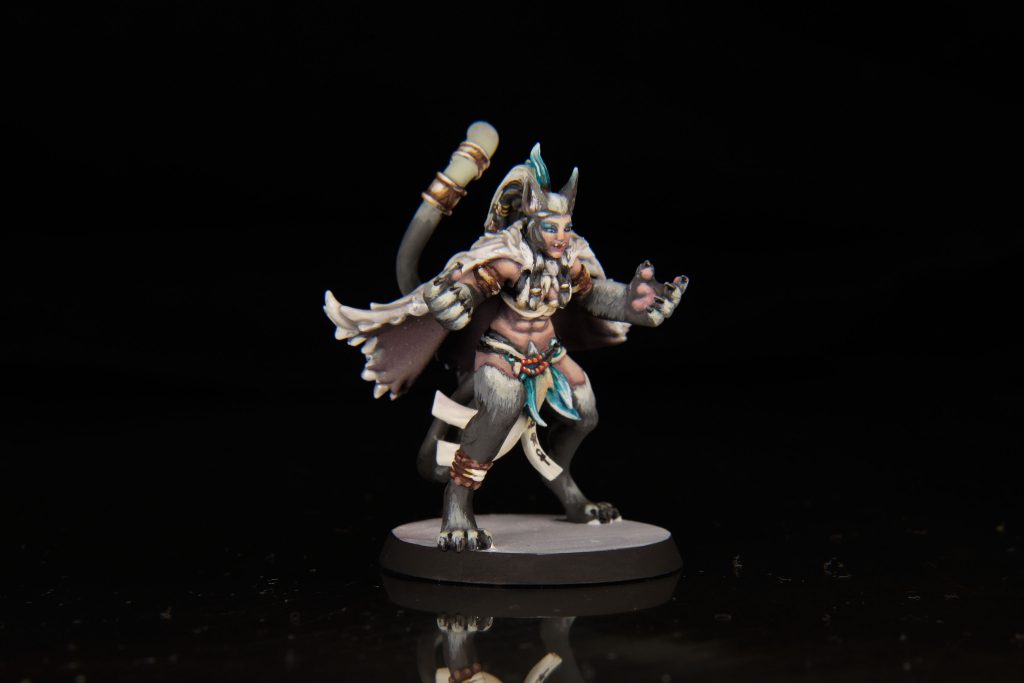 likes: napping in the sunlight, batting your feet, speaking with the unquiet dead. Credit: Keewa
Each of the four starts with some basic powers and levels up as the campaign goes on. They all come with three ranks, plus further Light and Dark promotions which can be earned by amassing Paragon and Renegade points, or at least their Eldfall equivalent. There are two more heroes: Tomoe, a weather mage crossing over from Axis Mundi's Sankokushin: Five Sacrifices (which is apparently delayed indefinitely, from what I can tell), and Chanra, a goblin queen, available in the Goblin Wartribes starter box (where she plays the role of Goblin Shaman). You can also create a custom hero based on an existing Eldfall Chronicles model, in case you wanted to bring in your beautifully painted Spelldancer or Slayer Dragoon.
The first few missions of the campaign are effectively a tutorial; for example, you start with all of your magic shut down, and the enemies in the first level start off Distracted and thus unaware of you unless you are unwise enough to poke them. After completing that level, you temporarily split your party, with the girls going to reset the magic breaker box while the boys figure out where your hosts keep all the pointy stuff. With the two mini-missions complete, you reunite and set off for the summit through one of three paths to the thrilling finale.
Veterans of this genre will be familiar with the way that certain events early on can have an impact later, and Northern Winds makes
extensive use of this through the mechanism of Fate Tokens. Many, many, many things give you a Fate Token, which are all color coded (purple, teal and red) and lettered A-Z. On their own, these do nothing, but you will frequently be asked if you possess a given Fate Token, and if you do, told to do something special. For example, rescuing your party's commander from rubble in Mission 1 gives you a Fate Token; if you have it in Mission 4 he will be alive among the Oni's captives and will be able to help you. There are bad Fate Tokens, too, earned from failure, but even these can be helpful in the right situations. Over the course of a campaign you will amass a
lot of Fate Tokens, and most missions after a certain point trigger special events off of at least some of them.
The missions themselves also come with a lot of choice; some can be completed multiple ways, and others ask for you to make a choice within the mission itself. Do you break down a locked door, call out to the person on the other side, or bar it and set the building on fire? Will you accept the Oni Yaksha's bargain or refuse it? Sometimes these choices have immediate consequences, sometimes you won't know until later.
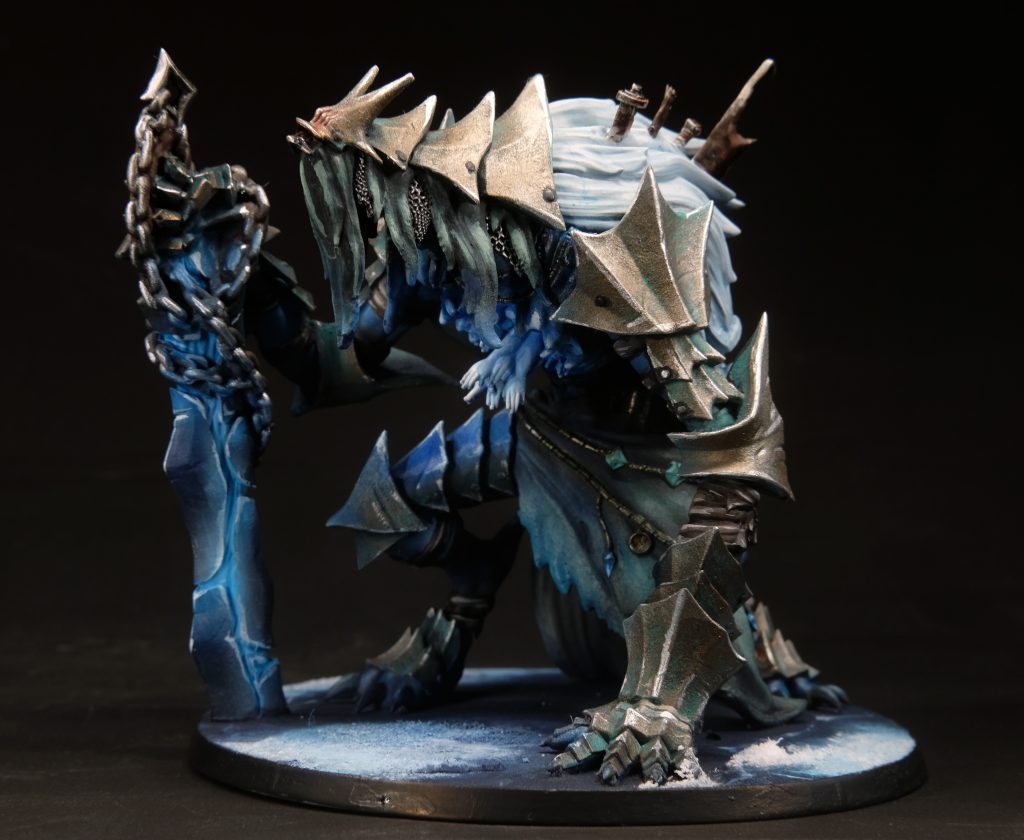 "uh, guys? does anyone have fate Red J? no big deal if not, it just says that this guy uses Infinite Death Explosion if we don't have it." Credit: Keewa
We played the first few missions of the Arc I "tutorial." Despite being the tutorial, we were struck by how difficult they can be, especially the "split the party" missions. Playing as Na'ra and Anari, we were happily mowing down spirits and flipping arcane switches until I missed one key roll against a Forgotten Hero; he instantly gibbed me, and while Anari was getting me back up, an Oni Marauder lumbered up and casually squashed us both. Fortunately, the game specifies what happens when this occurs - you re-rack and try again - but it's up to you if you want to house rule an additional wound onto your heroes, at least early on.
Final Thoughts
This type of campaign-based dungeon crawler is a known quantity at this point, but Northern Wind is a high-quality example of the breed. Its complexity is at the higher end, but there is definitely an audience for that sort of thing. You will know if you like this game based on your reaction to the following sentence: each hero's inventory must be individually tracked, both in terms of how many items they are carrying and in how much total weight those items have, lest you become overencumbered.
Does that make your eyes light up? Then Northern Wind may be for you. It's certainly replayable enough, and Freecompany has taken pains to make it cross-compatible with their skirmish wargame, so if you play Eldfall Chronicles already, you'll want to pick this up. For everyone else, if you like how the campaign plays out, check out the wargame: it's quick, brutal, and fun as heck.
Have any questions or feedback? Drop us a note in the comments below or email us at contact@goonhammer.com. Want articles like this linked in your inbox every Monday morning? Sign up for our newsletter. And don't forget that you can support us on Patreon for backer rewards like early video content, Administratum access, an ad-free experience on our website and more.
Thank you for being a friend.
 This website uses cookies. Learn more.


 Goonhammer App and Patron Updates: April, 2026
 Kill Team Tournament Report: Engage, Party, Repeat's March Madness 2026
 Goonhammer Reviews: Tribal Conquest