“
You’re a great help to us! You’re a natural leader!”
If there is any character in the
Star Wars saga who needs no introduction, it’s Han Solo. More than anyone else he defines the mass appeal of Star Wars, and he launched Harrison Ford into one of the most successful careers in Hollywood history. He’s so important that the entire first act of
Return of the Jedi was spent saving him from being a piece of modern sculpture, and you could argue that his presence in
The Force Awakens is what started the modern era of Star Wars off with such a resounding bang.
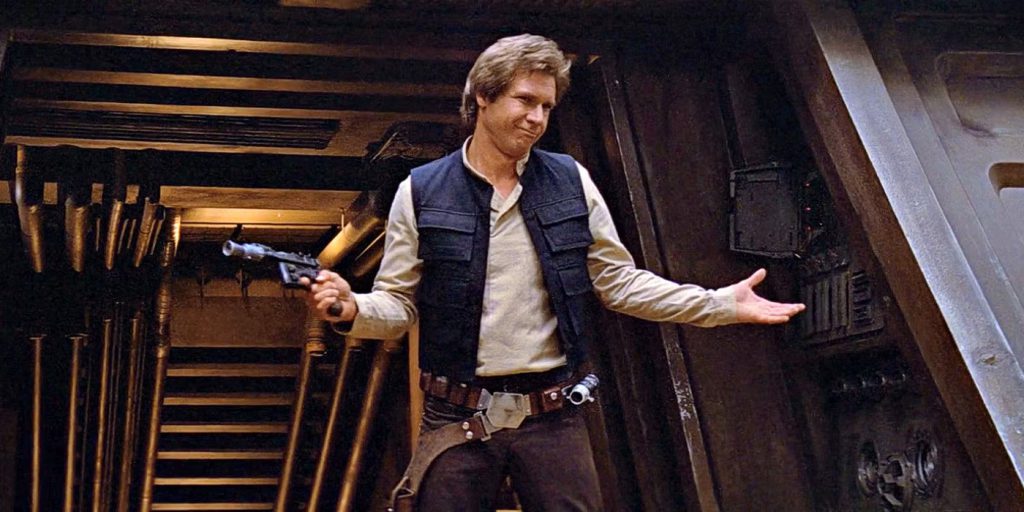
It’s only fitting that Solo made his first appearance in Shatterpoint as a Primary unit, and it’s equally fitting that it’s General Solo as seen in the Endor ground battle from
Return of the Jedi, when he proves Leia’s assessment that he’s a natural leader. His Shatterpoint stat card certainly backs that up. This isn’t Han Solo the grandstanding smuggler who has to be convinced that rescuing Princess Leia from the Death Star is worth his while; this is a general leading soldiers into battle.
How He Plays
“
I wonder who they found to pull that off?”
With the right squad backing him up, General Solo is great at moving his squadmates into position and then keeping them alive long enough to control objectives. He’s got a lot of healing in his combat tree and a couple of revenge triggers that will have his opponent thinking twice about whether they really want to be dealing out wounds. Ideally, Solo’s squad will be nimble enough to bounce between active objectives as they change, and Solo will be able to control the amount of damage they’re carrying so he can make sure he’s in a good position to use his revenge triggers when the time comes.
Solo himself has an average Stamina of 9, but all the healing in his combat tree should be able to keep a handle on the amount of damage he’s taking, and his Durability of 3 means it’s unlikely he’ll be defeated during the game. His 3 force points are fairly standard and should be enough to get a fair amount of use out of his squad’s costed abilities. He has 8 squad points, which offers some leeway to try him out with different secondaries and support units.
Stances
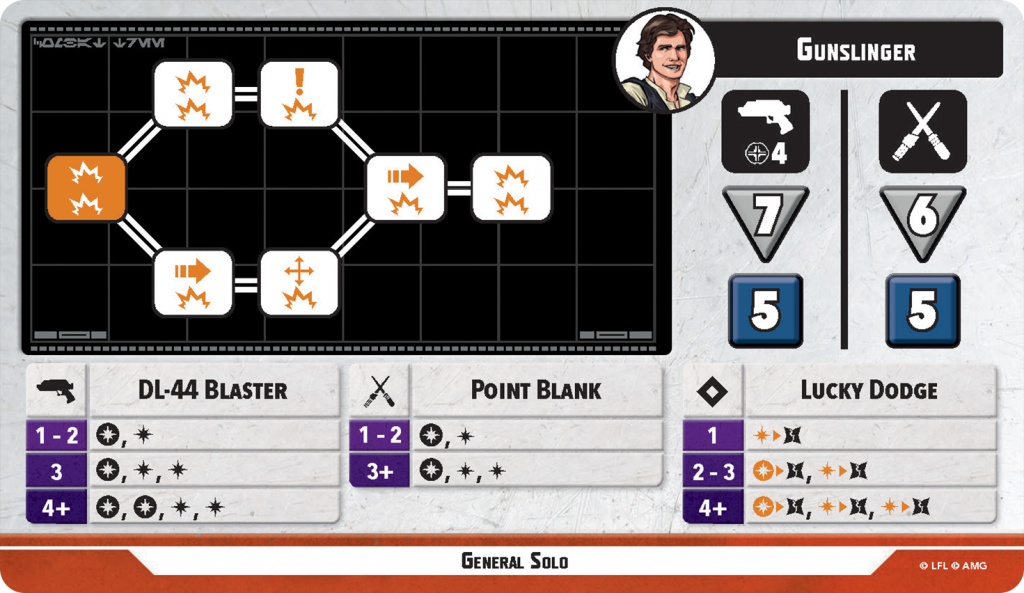 General Solo stance card for Star Wars: Shatterpoint. Image © Lucasfilm © Atomic Mass Games
Like most primaries, General Solo’s choice of stances can be split roughly into “offensive” and “defensive.”
Gunslinger, his offensive stance, gives him 7 dice for ranged attacks, 6 for melee, and 5 for defense on either. The expertise tables are solid, with the attacks adding extra crits and regular hits, and the defense canceling his attacker’s hits and crits. The combat tree is heavily focused on damage, with a couple of shoves and either a reposition or an exposed depending on which way you want to go.
 General Solo stance card for Star Wars: Shatterpoint. Image © Lucasfilm © Atomic Mass Games
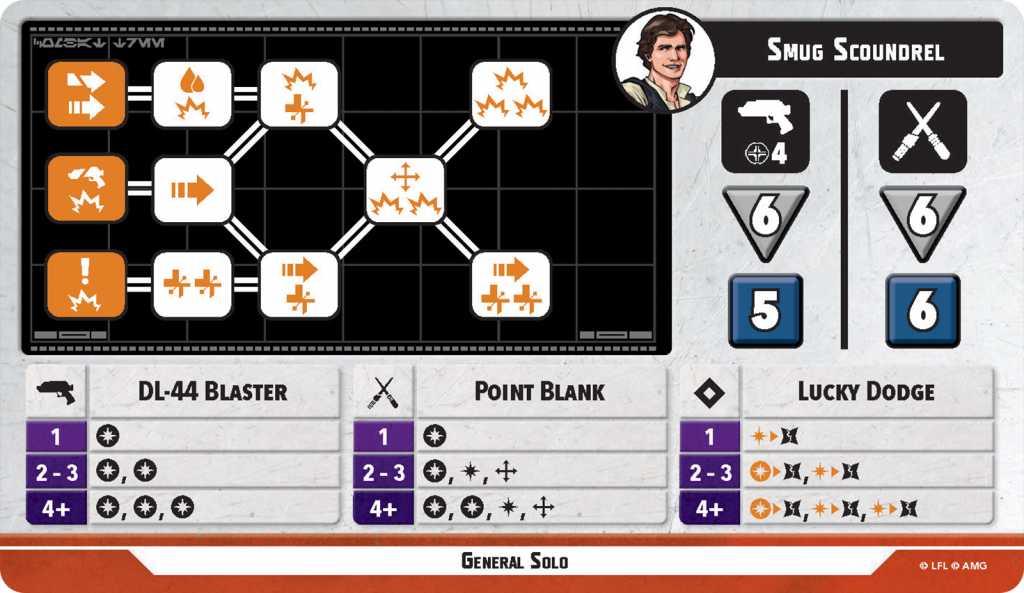
Smug Scoundrel
General Solo stance card for Star Wars: Shatterpoint. Image © Lucasfilm © Atomic Mass Games
Smug Scoundrel is his defensive stance, and although his ranged attack drops to 6 and the expertise tables aren’t quite as good, I think he gains a lot more than he loses. The combat tree is a lot more versatile, with better options to inflict negative conditions on his target while still having the potential to deal a fair amount of damage. More importantly, he has the potential to score up to 5 heal results while still inflicting shoves and even a little damage, which is critical to a “dig in and hold the objectives” strategy.
Abilities
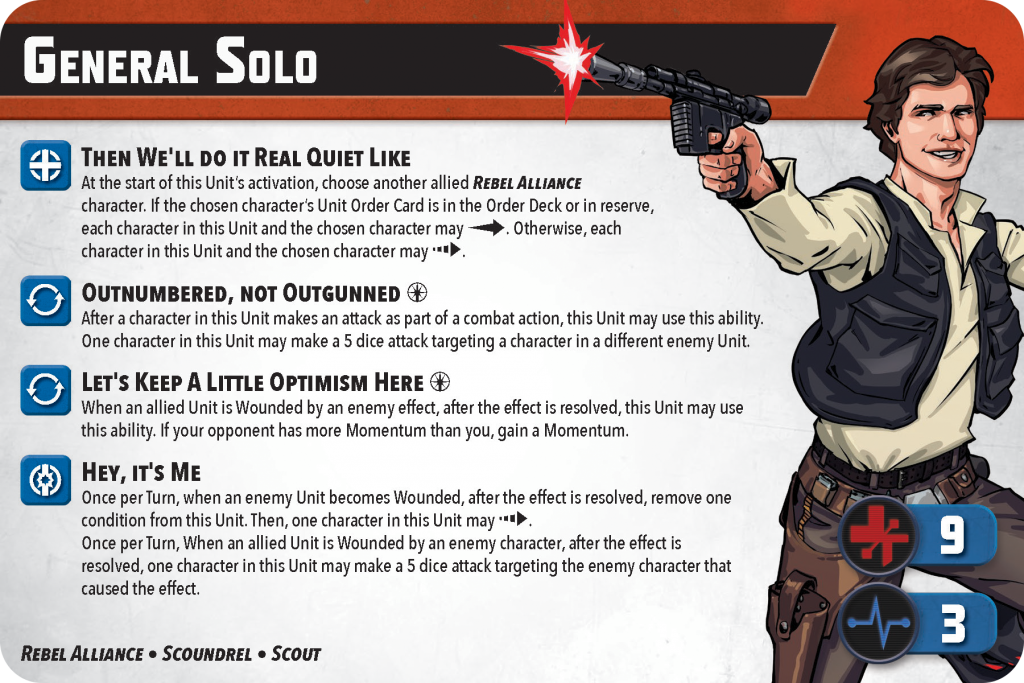
General Solo’s four abilities offer a good mix of active and passive effects, most of which focus on gaining free attacks and keeping his teammates moving.
 General Solo unit card for Star Wars: Shatterpoint. Image © Lucasfilm © Atomic Mass Games
Tactic: Then We’ll Do It Real Quiet Like
At the start of General Solo’s activation he gives another Rebel Alliance unit a free Advance, or Dash if their order card is in the discard pile. Free moves are never a bad thing, and this ability is especially versatile as it doesn’t require Solo to be in range of the unit he wants to move. Ideally you want to use this ability early in the game, before you’ve activated too many of your other units, or right after you’ve reshuffled your Order deck.
It’s a huge help in that mad dash to control objectives at the start of the game or when a new Struggle starts, and even later on when the priority objectives start moving around. It’s also useful for making sure that General Solo and your other units are always in a good position to take advantage of their revenge triggers and other passive abilities.
Reactive: Outnumbered, Not Outgunned
For one Force, General Solo can make a 5 dice attack against a different target after he’s completed a combat action attack. Two attacks for the price of one is great, but in order to take full advantage of this ability you will want to be sure Solo is always within reach of two different enemy units. Of course, this can be tricky since that means two enemy units will be in range of him as well. Ideally General Solo will be able to combine this ability with
Hey, it’s Me (see below).
Reactive: Let’s Keep a Little Optimism Here
When one of your units is wounded, if your opponents has more Momentum than you, you gain a Momentum. This is a great passive ability that will hopefully help defend against opponents who are heavily focused on gaining Momentum through wounding your units. It’s certainly a valid path to victory, and one you need to watch out for, but you should be able to mitigate the advantage your opponent is gaining by matching their Momentum gain. If nothing else it should be a useful catch-up mechanism, and you should be able to exert at least a little control over when your units are wounded with healing from Solo’s Smug Scoundrel combat tree. Even more so if you have
Chewie in the squad.
Identity: Hey, it’s Me
Once per turn: when an enemy unit is wounded, General Solo gets to remove a condition and make a Dash move, and when an allied unit is wounded, Solo gets to make a 5 dice attack against the enemy that caused the wound. The first part of this ability is fine, but probably won’t see a lot of use since Solo’s strategy and tactics don’t really involve a lot of wounding.
The second part should prove very useful, even if it just serves as a deterrent to make your opponent reluctant to inflict wounds on your units. You just need to be sure that Solo is always in a position to make use of this ability, be keeping him near your damaged units and using healing to help manage which units are in danger of being wounded.
Building a Strike Team Around General Solo
“
General Solo, is your strike team assembled?”
Honestly, there aren’t too many compelling reasons to stray from the
Real Quiet Like Squad Pack for General Solo’s squad.
It just seems mean to separate the General from his loyal Wookiee companion, and in any case
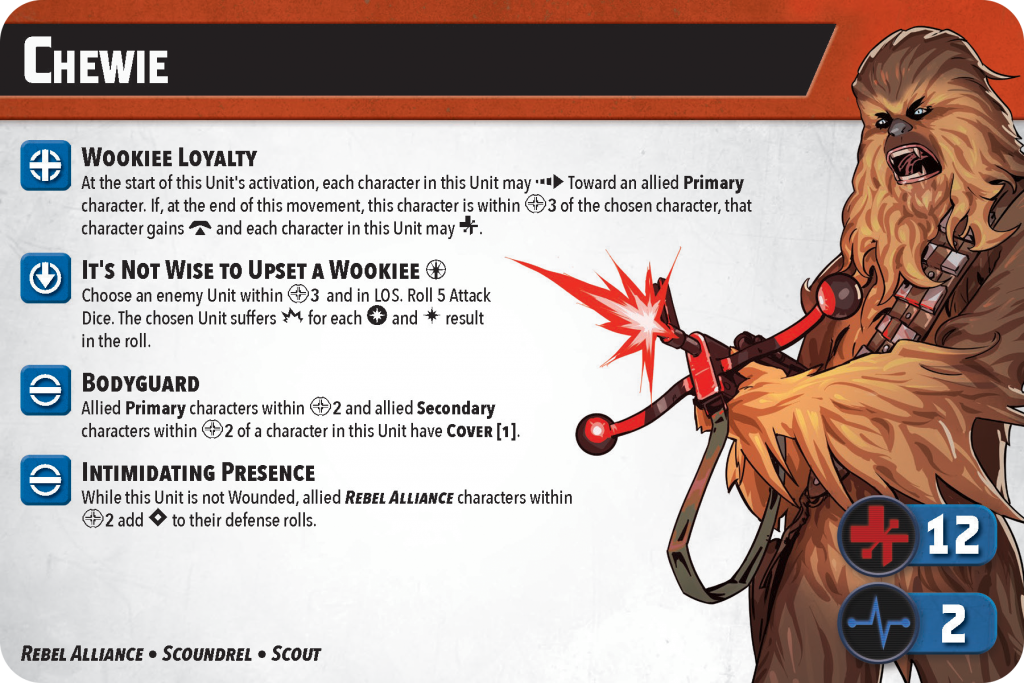
Chewie’s abilities will provide Solo with some useful backup.
Wookiee Loyalty will keep damage off of Chewie and keep him near General Solo.
It’s Not Wise to Upset a Wookiee should pick up some of the slack with regard to dealing damage, as will Chewie’s reasonably impressive Combat Tree and Expertise tables, especially if you can get him in for some melee attacks. Meanwhile,
Bodyguard and
Intimidating Presence will help protect your other units from attacks. It is important to remember, though, that all of Chewie’s abilities require him to be within range 2 or 3 of whoever he’s targeting, so you will need to make sure he stays in the thick of the action.
 Chewie unit card for Star Wars: Shatterpoint. Image © Lucasfilm © Atomic Mass Games
While Chewie is the most on-theme, and probably the most synergistic, choice, I was intrigued to note that the player who took fourth place at the Duel of the Fates Grand Tournament in Australia (see
Goonhammer’s coverage of the event) swapped out Chewie for
Agent Kallus, Inside Man. I imagine the idea was to back up General Solo with a more aggressive Secondary, and Kallus’ stance and abilities certainly bear that out.
Prepared for Any Encounter gives him a free focus action plus Sharpshooter [2] and Impact [2], giving him a devastating 9 dice attack, and
Imperial Intelligence has him giving his squad-mates a re-roll for each tag he shares with them, which would be
Rebel Alliance and
Scoundrel in this case. Plus his combat tree can dish out a fair amount of damage, but still has some healing to support Solo’s overall strategy.
Meanwhile,
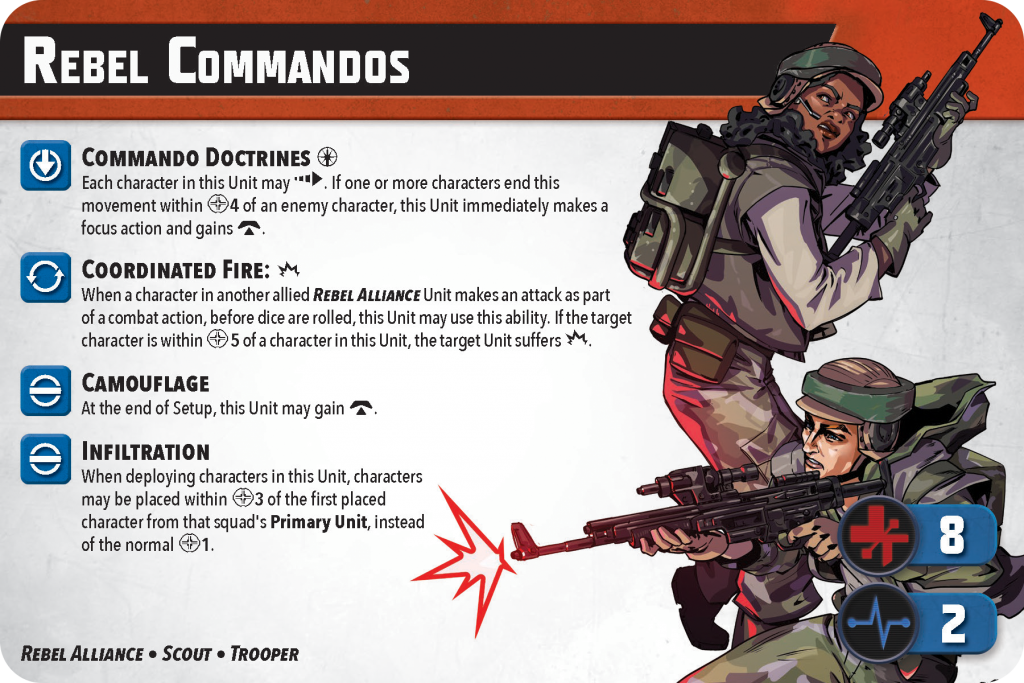
Rebel Commandos are the only clear choice for General Solo’s Support unit. They are arguably the most favored Rebel Alliance Support unit in the game, and with very good reason.
Infiltration lets them start the game at range 3 from their Primary instead of the usual one, giving them a massive head start on controlling objectives in the early game.
Camouflage starts them off with a Hunker token for added defense as they dig in, and
Commando Doctrines keeps them moving as long as you have Force to spend, and also gives them a free focus and Hunker token, boosting their ability to both attack and defend themselves. Finally,
Coordinated Fire will boost the attacks of your other Rebel Alliance units. It comes at the cost of 1 damage to the Rebel Commandos, but that’s easily mitigated by all the healing in General Solo and Chewie’s combat trees.
 Rebel Commandos unit card for Star Wars: Shatterpoint. Image © Lucasfilm © Atomic Mass Games
“
My team’s ready, I don’t have a command crew for the shuttle...”
There is no shortage of viable Rebel Alliance Primaries to team General Solo with.
Jason Le-Pine Williams makes excellent cases for
Leia Organa, Freedom Fighter and
Kanan Jarrus, Spectre-1 in Goonhammer’s
Real Quiet Like Squad Pack review, and these suggestions have the advantage of being out-of-the-box squads that wouldn’t require much investment.
Captain Cassian Andor and
Jyn Erso, Stardust are newer units that seem to be taking the
rankings by storm, and they both provide some interesting possibilities for a team-up with General Solo. Cassian is generally more geared towards dealing damage, which can make up for General Solo’s shortcomings in that area, plus his All the Way combat tree still sneaks in a heal result. Additionally, he and his most likely Secondary unit
K-2SO have a variety of “when wounded” triggers that can fit in with the strategy of using healing to manipulate when those triggers happen (or using them as a deterrent).
The other
Rogue One Primary unit, Jyn Erso, is also focused more on dealing out damage (I’m sensing a theme here). But her
The Time to Fight is Now Identity ability, which allows allied Rebel Alliance units to spend Momentum instead of Force to activate abilities, could really help out – it’s likely that at least some of your units are going to be carrying wounds by mid-game, making their active and reactive abilities cost more Force to use. Plus General Solo’s Let’s Keep a Little Optimism Here should prevent you from falling too far behind on Momentum.
Bodhi Rook’s
I Just Need an Open Line ability will also help you keep the Momentum even, forcing your opponent to spend Momentum to prevent you from gaining it.
Missions
"Chewie and me got into a lot of places more heavily guarded than this..."
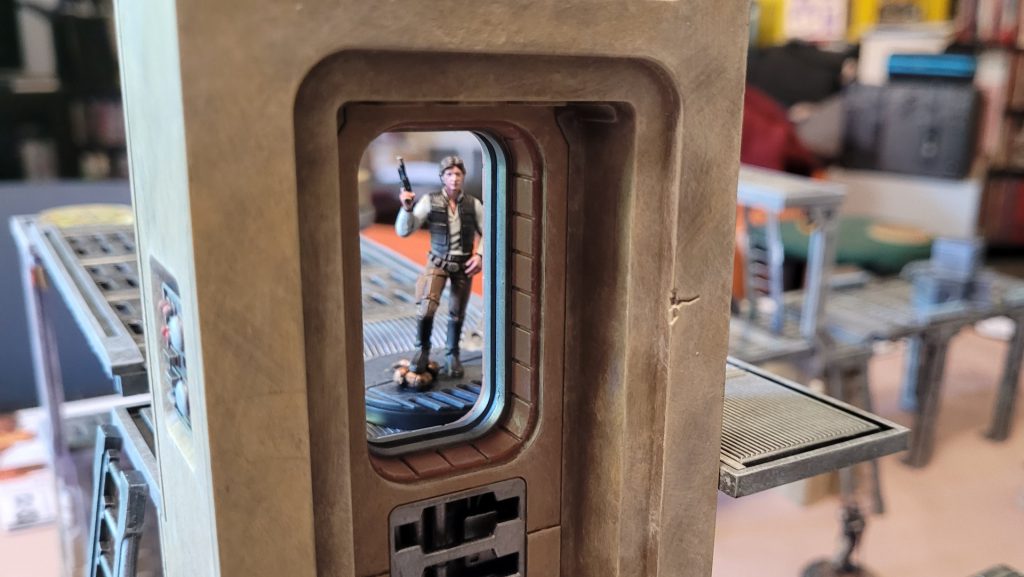 General Solo prepares to hold the tower at any cost. Painting and photo by Jefferson Powers.
Sabotage Showdown
General Solo prepares to hold the tower at any cost. Painting and photo by Jefferson Powers.
Sabotage Showdown is probably the best Mission Set for General Solo. His squad will benefit greatly from the struggle card abilities (removing damage, refreshing force, and free movement), and it shouldn’t matter too much when your opponent uses them since you’re not really trying to win by dealing damage – you just want to dig in and wait it out.
First Contact offers some intriguing possibilities as well. Your units should be nimble enough to handle the moving objectives, and it might be a good way to shift the tide of the game if you’re having trouble dislodging your opponent’s units from active objectives.
Ironically,
Never Tell Me the Odds is probably the worst mission set for General Solo, since (unless you have a more aggressive second squad) you’re not really focused on wounding your opponent’s units. It may require a change in focus, keeping Solo on his Gunslinger stance and making good use of Chewie’s powerful melee attacks.
Hobby Tips
General Solo is straight out of the films so there isn’t a whole lot of wiggle room with regard to paint schemes, but do note that the sculpt and the card artwork are based on his outfit from
A New Hope. The main sculptural difference is in the neckline of his shirt, but also note that his pants are dark blue with a red stripe in
A New Hope, and brown with a yellow stripe in
Return of the Jedi. If you’re a good sculptor (or feeling really brave), you could try adding the camouflage overcoat...
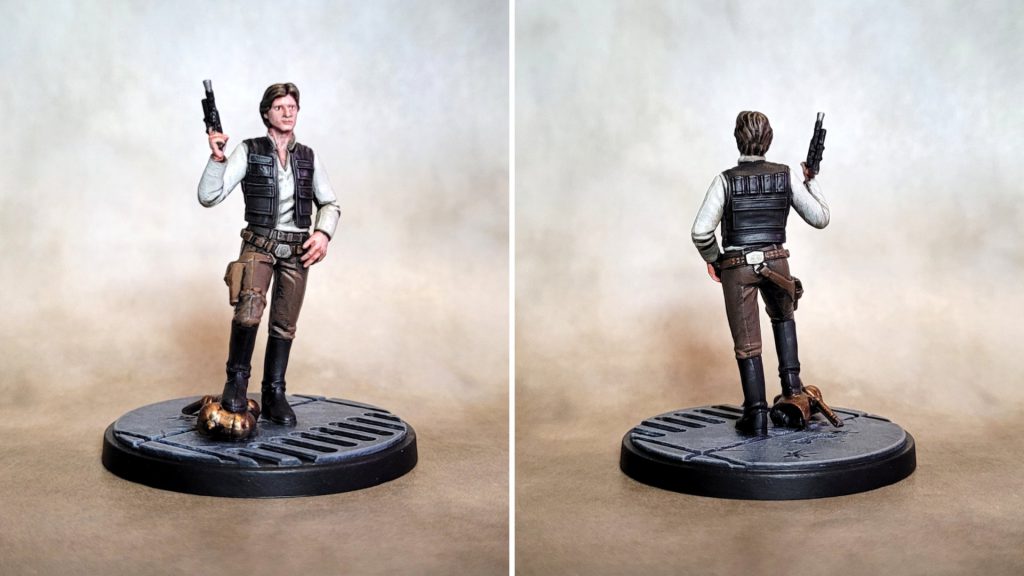 General Solo painted for Star Wars: Shatterpoint by Jefferson Powers.
Goonhammer has published a helpful
How to Paint Everything guide for the Real Quiet Like Squad Pack (written by yours truly).
Final Thoughts
I think General Solo is a solid Primary unit for new and experienced players alike. The more defensive strategy that his stances and abilities seem to suggest is a great way to get to grips with the things that make Shatterpoint so different from other skirmish games. Understanding the way your units interact with each other is critical to playing the game well – Solo has some solid abilities that provide a good introduction to that concept. The rest of the Real Quiet Like squad supports a consistent strategy right out of the box, and can pair up with just about any of the other Rebel Alliance boxes to great effect.
Have any questions or feedback? Drop us a note in the comments below or email us at contact@goonhammer.com. Want articles like this linked in your inbox every Monday morning? Sign up for our newsletter. And don't forget that you can support us on Patreon for backer rewards like early video content, Administratum access, an ad-free experience on our website and more.Thank you for being a friend.
 This website uses cookies. Learn more.


 Goonhammer App and Patron Updates: April, 2026
 Kill Team Tournament Report: Engage, Party, Repeat's March Madness 2026
 Goonhammer Reviews: Tribal Conquest