Wargaming lore ultimately exists for a singular purpose: To justify why any faction might be currently fighting any other faction, including itself. This means a well-designed faction is mobile, contentious, and unambitious. Mobility and contentiousness are self-evident - the desire to go anywhere and fight anyone is the bare minimum - but it’s a lack of ambition that allows a faction to get wins.
If a faction has clear, achievable, and ambitious political objectives then definitionally the faction can never get its win because it would bring about the end of the setting’s status quo. Chaos in Warhammer has always had this problem. They fight for the total destruction of reality; obtaining control of a planet usually means dropping the planet into literal hell five minutes later. As a result of this they are a faction that must be continuously thwarted, always building power but with the understanding that they can never, will never, get that final win no matter how close they come. Inevitably, it makes them comedic; an element of frustrated perpetual failure breeds in literature discussing the faction. Though, admittedly, one time that dog caught that car...
The Yoroni, by comparison, are perfect. They can appear anywhere spiritually relevant, they are gigantic monsters who will probably be attacked on sight by any local military regardless of their intentions or personal moral code, and their ambitions broadly amount to ‘create the conditions for literalized Shintoism’. They’re almost like a colonizing folklore; if the Yoroni win this campaign then a bunch of sailor's legends come true. Ghost ships filled with monsters begin to sail the seas. Elsewhere, under different leadership, a Yoroni strategic victory might mean that the people of a region suddenly need to construct some big shrines for them to live in, or that they get strange daemonic local divinities who watch over them and protect them from harm. But put a pin in that - we’ll come back to the downside of this.
 Vale of Tears opens with a three page recap of both the W'adrhŭn and Yoroni factions and their origins. This is appreciated - while this material is available elsewhere, this is a pretty esoteric conflict between two nonhuman groups over a magical lake full of monsters, so taking the time to bring everyone up to speed is a good idea. Afterwards, we are introduced to our two protagonists - and they’re the most interesting pair in one of these campaign sets so far.
Both figures are clearly defined, charismatic - and in an excellent move, have similar internal themes going on. They are each, by the standards of their very strange societies, transgressive, existing apart from and in conflict with the value set that their faction believes in while still being deeply bound to those values.
Vale of Tears opens with a three page recap of both the W'adrhŭn and Yoroni factions and their origins. This is appreciated - while this material is available elsewhere, this is a pretty esoteric conflict between two nonhuman groups over a magical lake full of monsters, so taking the time to bring everyone up to speed is a good idea. Afterwards, we are introduced to our two protagonists - and they’re the most interesting pair in one of these campaign sets so far.
Both figures are clearly defined, charismatic - and in an excellent move, have similar internal themes going on. They are each, by the standards of their very strange societies, transgressive, existing apart from and in conflict with the value set that their faction believes in while still being deeply bound to those values.
The Yoroni
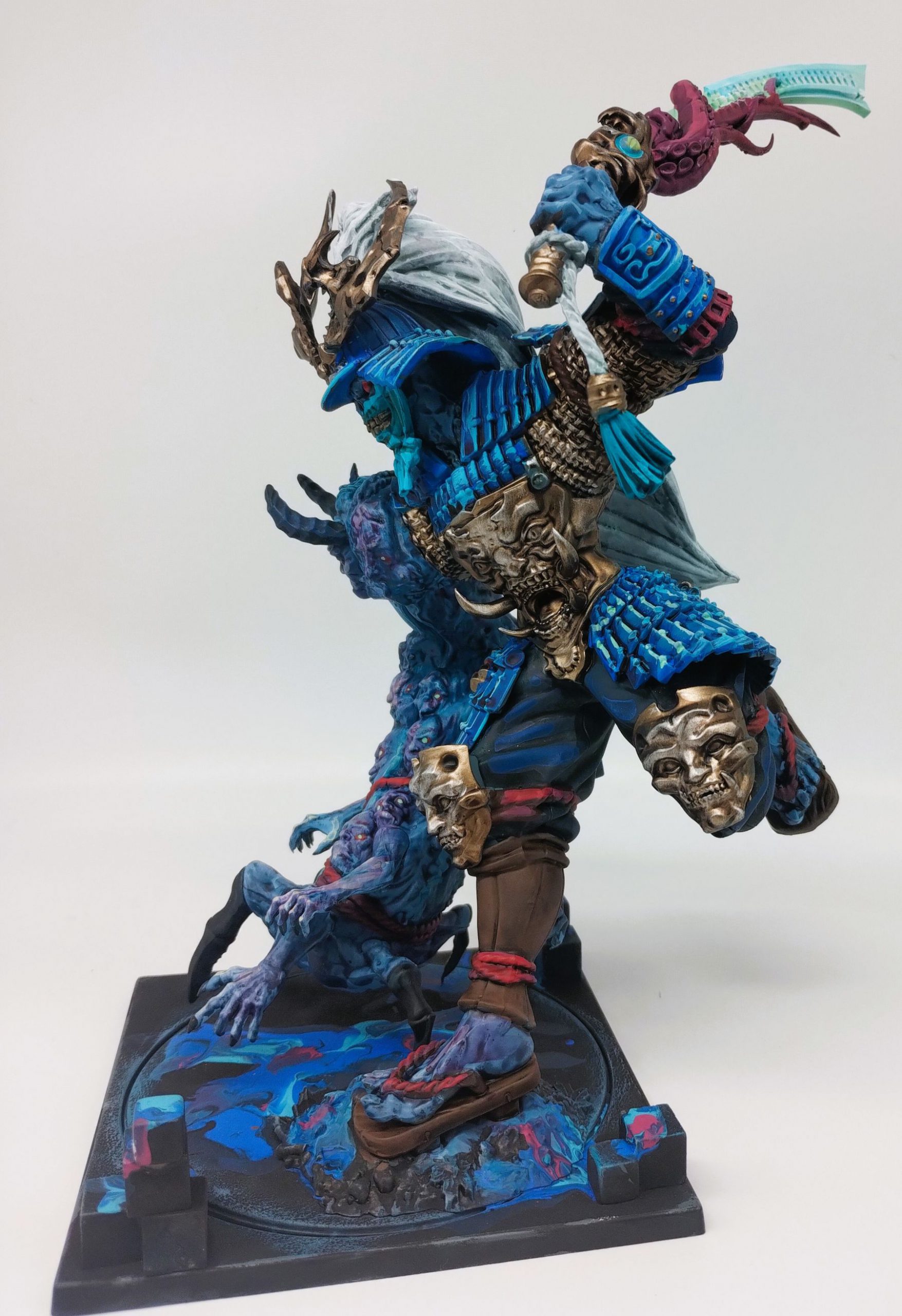
Murakame Wako has rejected the Yoroni’s path of enlightenment and spiritual cultivation in favour of building a boat so fuckin’ rad that it can sail out of hell the hard way. He is joined by a Kitsune, Tidemistress Mariko - Kitsune in Yoroni society are something like scientists of enlightenment, trying to figure out and formalize karma-maximizing lifehacks. Mariko is driven by compassion - she’s on this boat because she wants to help the Yoroni who are too mid for Enlightenment to get out of the hell dimension, even if they don't deserve it and immediately start terrorizing mortals. Finally, Yugure of the Broken Thread, Wako’s giant spider GF (and yes, it is called out directly that his loving stares are directed into the eyes of the giant monster spider and not the three puppets on top), came in with Mariko but has completely shifted allegiance to Wako, even at the expense of the bigger mission. This change of loyalty doesn’t come up in the rest of this campaign book - they are too busy getting attacked by dinosaurs to really go into it - but it adds a really cool edge to the dynamic.
The overall effect is that these are good characters. Not just individually, but as a group; the triangle dynamic between them is very strong, very unstable, very compelling. This is the first set of campaign characters that has really commanded my imagination in this way, and I would love to read a full novel about them and their pirate adventures.
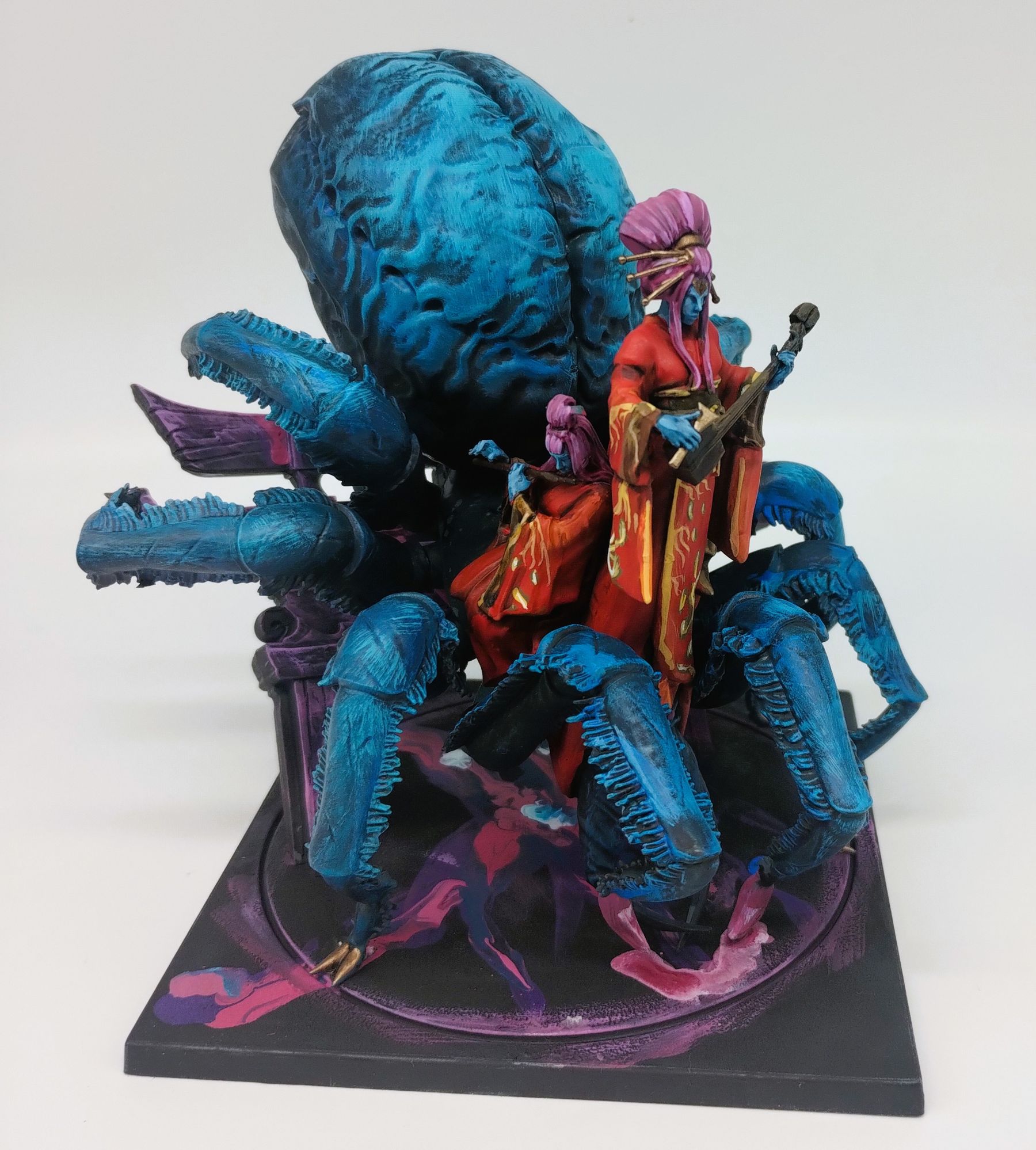
Murakame Wako Model Review
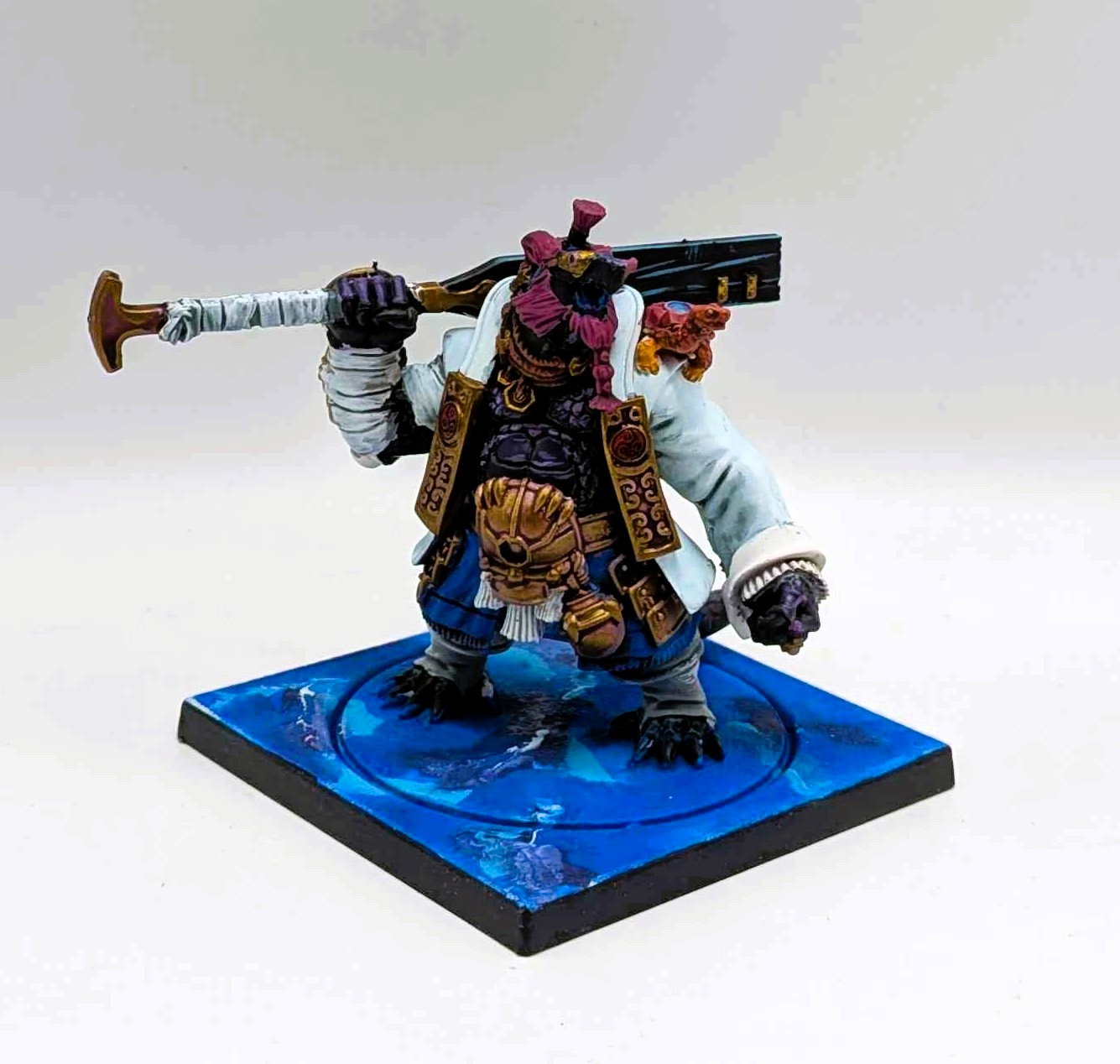
So I decided to do an ultra-high contrast black-purple scales with blue-white coat effect and it did
not photograph right around the face, no matter how I fiddled with it. Still, fairly happy with the effect in person; I think I'd need to mute down the pink hair into a pale grey to make the face more legible, but I'm out of time for further tweaks.
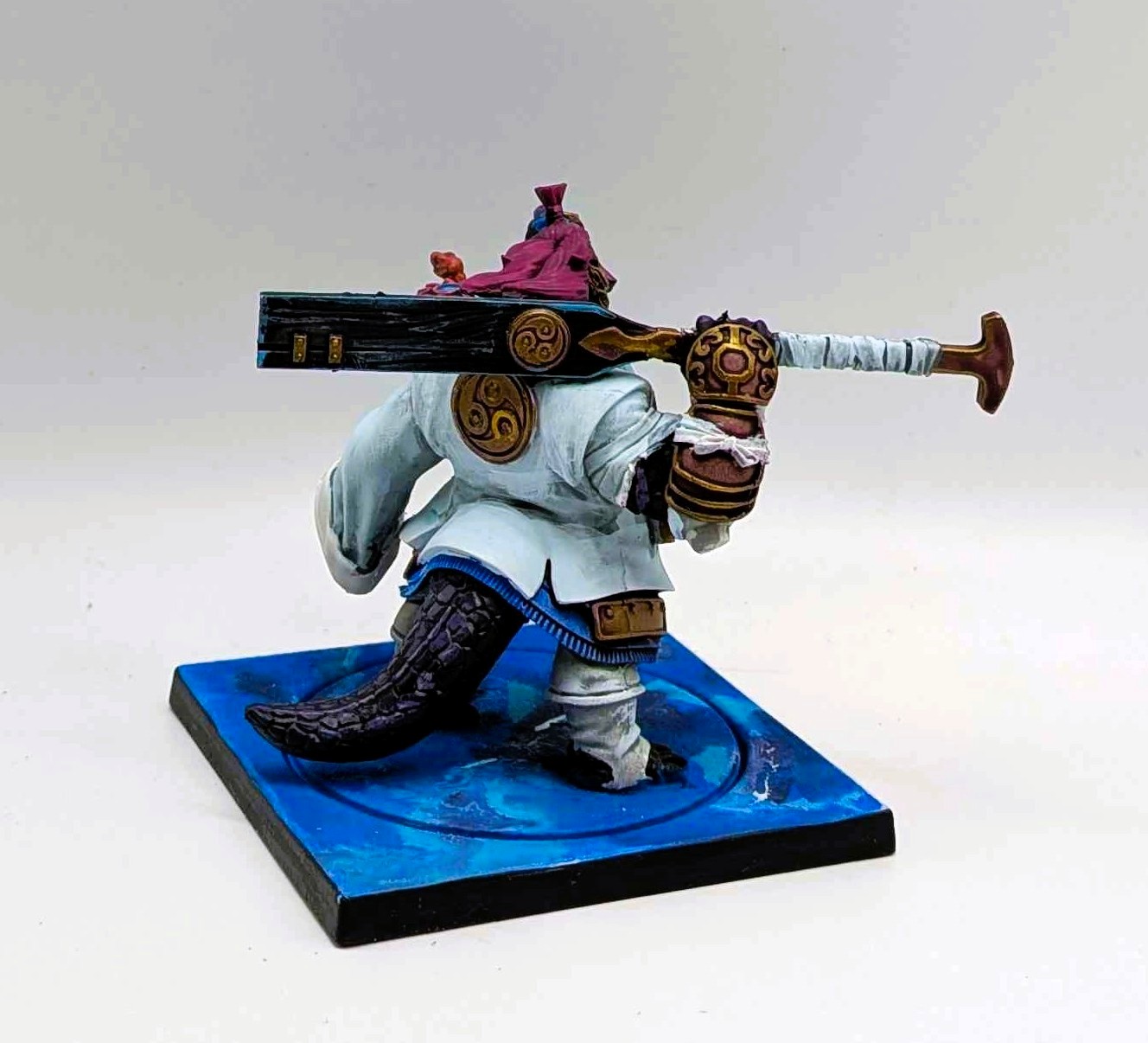
The model is extremely straightforward and painless, lots of large, flat spaces to make it as intricate or as simple as your personal tastes allow. But let me talk about something that I really appreciate on a model like this: Materials balance.
Materials balance is something I don't think enough miniatures designers think about. A model will usually have a combination of metal, cloth and skin minimum, with additional options for wood, hair, leather, gemstones, parchment and tassels. Each material requires another colour and another painting technique, which means a whole additional step in the painting process. A harmonious sculpt, like this one, provides not just a well balanced arrangement of materials but a balanced arrangement of materials
from different angles. As you can see, front and back both have very similar proportions of scales, cloth, metal and wood, which makes the model feel very stable and balanced. It's a joy to work with and see it from different angles.
A big point where sculptors mess up with materials balance is either adding too many disparate materials, or adding materials that are not common across the entire force. Once I was working on an Infinity Combined Army project based around the careful balance of blue skin and bronze metals and got completely trashed by a unit of robots that were 100% armour with no fabric, skin or other materials. I couldn't figure out how to solve it! So I just wanted to appreciate this model on those grounds.
Notable is his little kappa turtle shoulder pet; if you've got a place for it on a different model you'll need to fill in a little gap but that's an otherwise painless step.
The W'adrhŭn
On the W’adrhun side, Nangenyua, The Shadow Who Walks is a counterpoint to the mythos of the Ukenfazane. The Ukenfazane is the avatar of Conquest, a living goddess who directly controls and shapes every aspect of W'adrhŭn society. W'adrhŭn lore so far has considered the Living Goddess and W'adrhŭn society synonymous, her authority absolute and her social reforms accepted on a fundamental level. Nangenyua’s story shines a light on what that means - specifically, it means the annihilation of his entire tribe in order to enforce Conquest's vision of cultural unity. Out of what might have been guilt, the Ukenfazane raised the young Nangenyua as her own son, but in the end he rejected her once he learned the truth - but only as a mother. He still obeys her as the goddess. He is followed by Matriarch Queen Indilla, who seems to outright hate Nangenyua as an ungrateful blasphemer who had everything she ever wanted and threw it away - but she isn’t going to let her personal resentment get in the way of her duty.
This story is bigger, has more pathos - much more Main Plot than Wako-San’s quest to find the One Piece. In the context of this campaign booklet it means that his is the weaker side. Wako cruises out of the mist with his boat and his ambitions and a bunch of things he wants to have happen. Nangenyua just so happens to be hanging out on site when a weird turtle guy shows up on his turf, so he ambushes him out of principle. He decides the Yoroni are demons the second he sees them and moves to attack without hesitation - which is fair enough, they are literal demons - but the result is he’s not really emotionally invested in anything that’s happening.
And that’s kind of the narrative problem that runs through the heart of this sequence. These factions don’t know each other. They don’t have any grudges or opinions about each other, there’s no history or understanding or temptation or dialogue. The W'adrhŭn think they’re up against generic demons, the Yoroni just want to drive their boats out to sea. Wako and Nangenyua don’t so much as exchange a single word or interaction; the closest they come is that Nangenyua shoots an arrow at Wako and misses. Both of their stories are entirely self-contained within their own faction, for all that they’re mirrors of each other as social reformers nothing gets done with that. The overall vibe of this is that this is a random encounter for both factions.
I always thought that when the Chaos Space Marine starts going off on their Saturday morning villain speech that it was a bit pat - but I miss its absence.
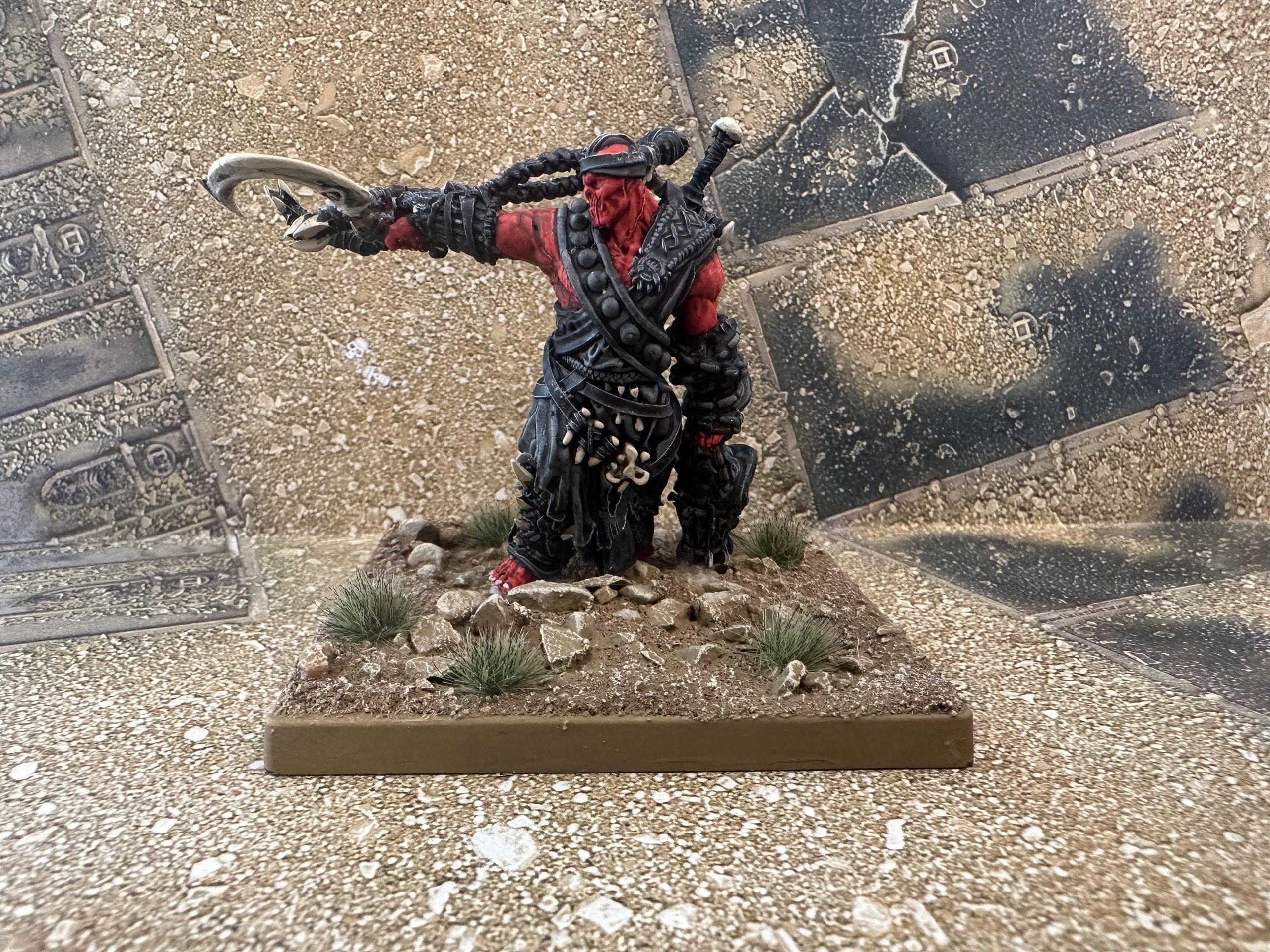
Nangenyua Model Review
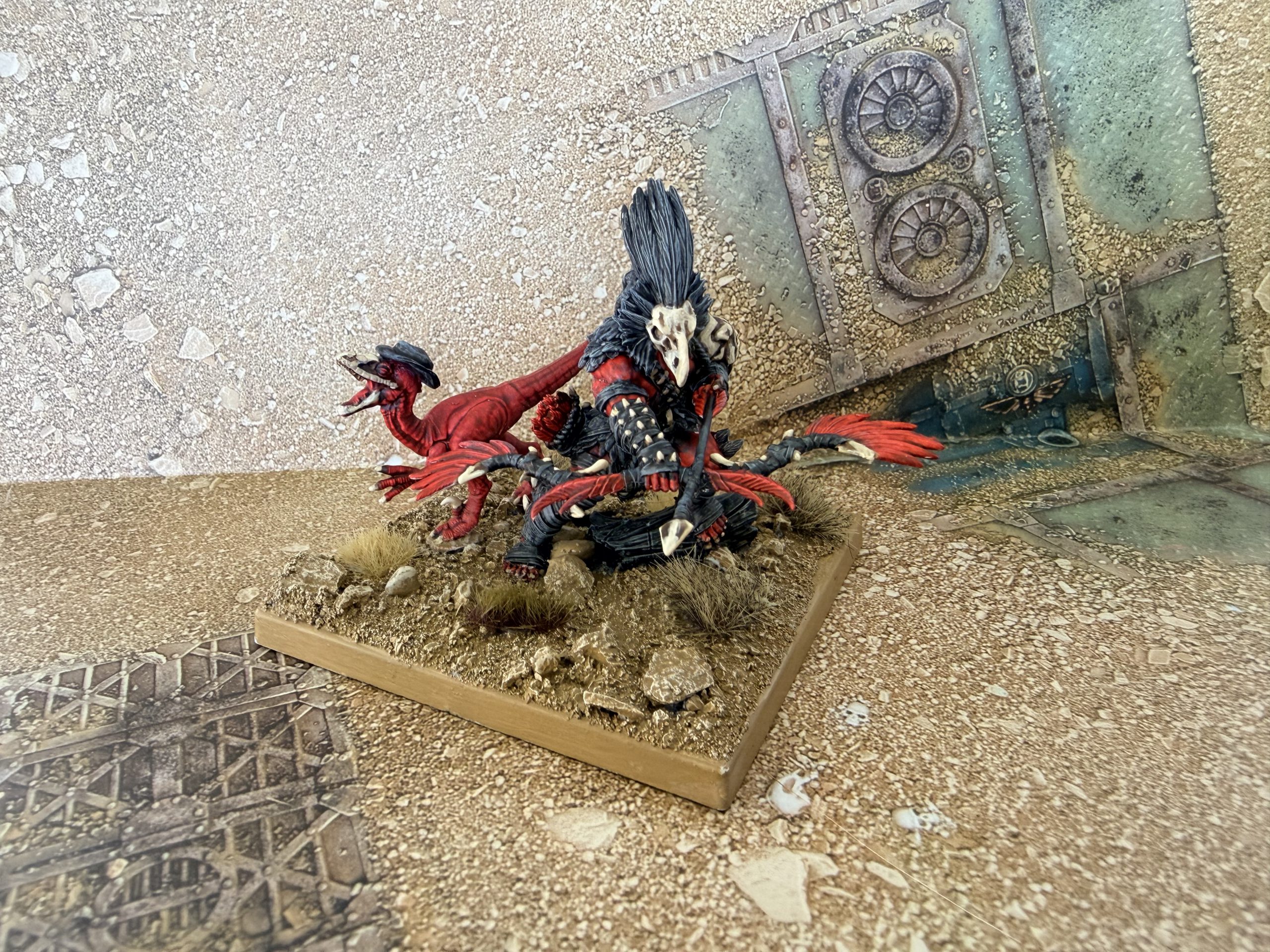 Magos Sockbert:
 Some models, you just stop and stare. Others, you gawp at and gossip excitedly with your friends. Some your eyes just move across without pause and some, like this goddamn monster, you swear at repeatedly. Design wise, the model is… fine. It’s a Predator. If you play W’adrhŭn, you probably have a bunch of the plastic model, and it’s a good model! It’s fun to paint, good scale, variety of textures, and it tells its own story. The story this guy tells is “if you pick the non-skull head version you are a coward, and also you should never, ever touch this model once it’s completed”.
There is a reason that most models with bows don’t have arrows, and that’s doubly true for resin models, which don’t have the flex of plastic. You will break the arrow here as your sleeve catches it on the painting table or as you game. It will go flying across the room. You will have to fight a cat for it. Para Bellum makes beautiful models, but it’s very clear they’re designed for aesthetics first, practicality second. This is definitely a model you should put on it’s own base; having him in the front rank of a normal base will turn that arrow snap from a probably to a definitely. Changing the two heads really does change the vibe of the model. To me, the head dress with the bone-dreads makes the model top heavy, while the skull mask looks predatory and threatening. There’s enough nebulously defined texture that you can paint the whole piece as a skull, but also you can get into the recesses to paint flesh if you’d like.
Where
the other campaign models usually tell a story, Nangenyua does not. He’s just another Predator, and we have enough of those in the world.
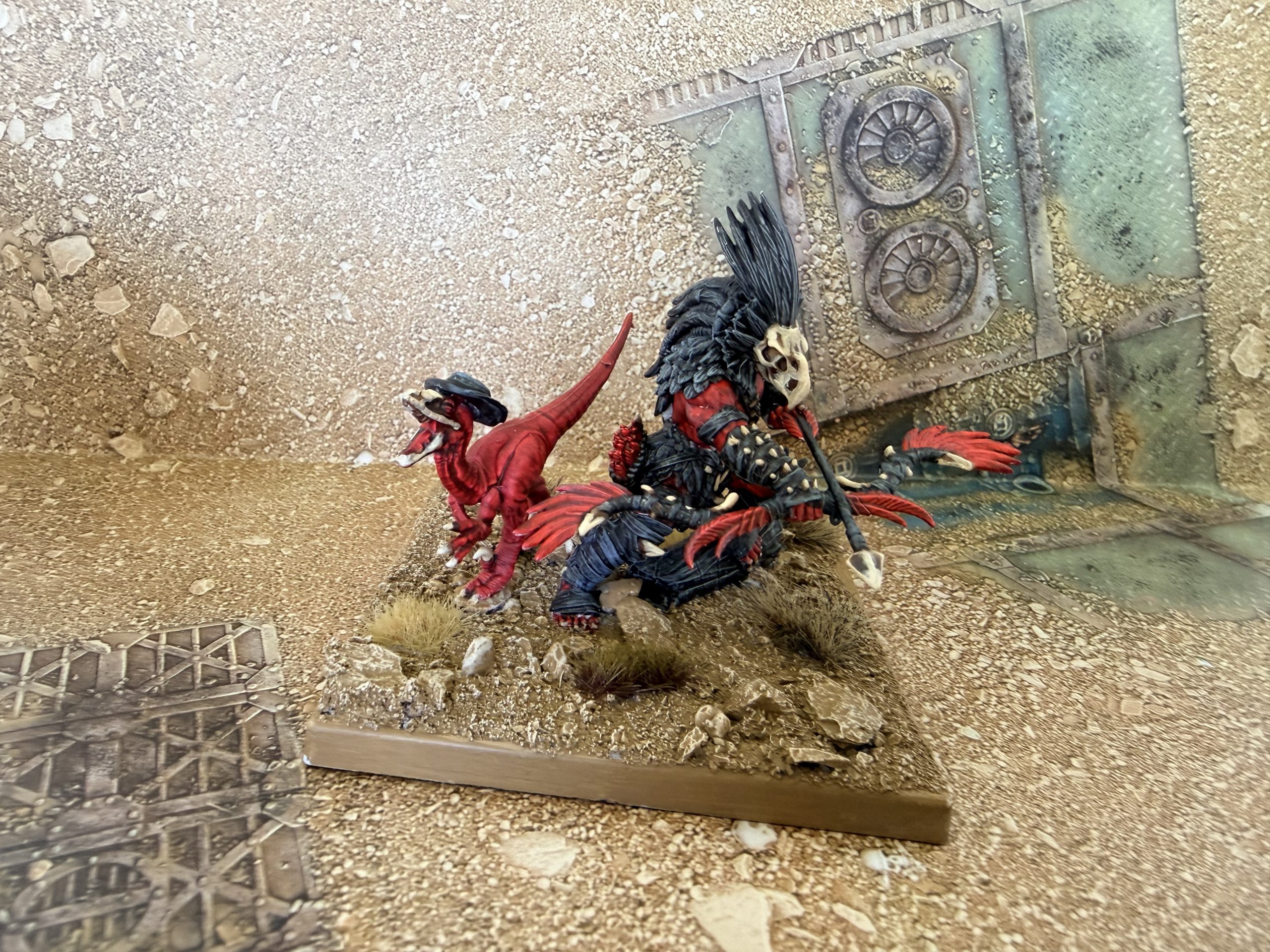 Disclaimer: Raptor hat donated from the Hundred Kingdoms Hunter Cadre kit
Storied Regiments
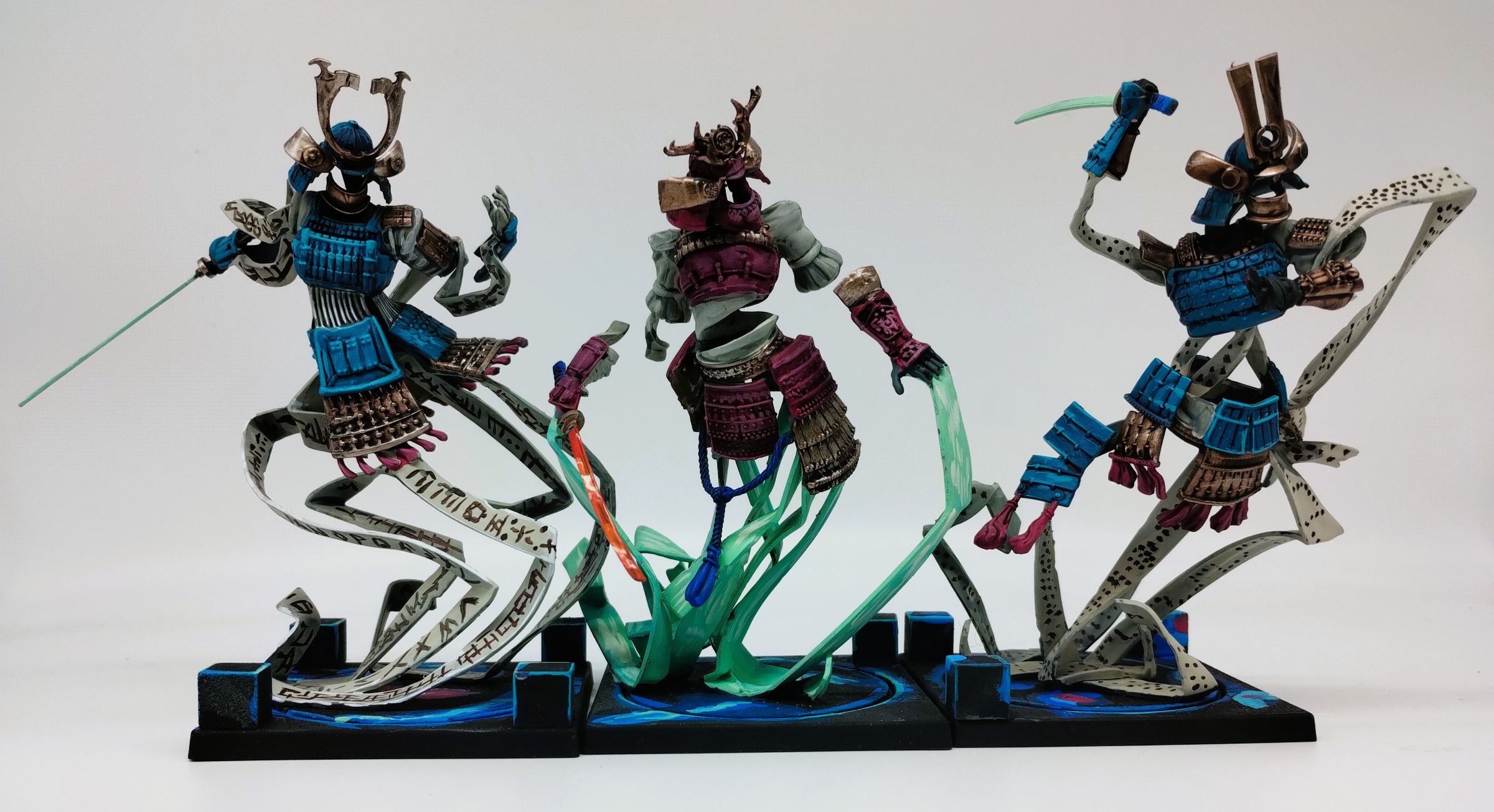 There are only five this time around, and as usual there is not a lot happening. The Unforgotten are the ones who get the callout this time because despite having the longest entry it does not call out a single thing that differentiates them from standard issue Domaru Damashi. Suits of armour looking to shortcut the reincarnation process by posthumously gathering karma is the default situation already, there’s no twist or flourish here. After that, the rest of the regiments summarize as ‘protagonist’s bodyguards’, ‘protagonist’s pets’ and ‘white t-rex’.
What I want from a storied regiment is A) a modelling/painting/converting challenge, B) some additional worldbuilding. I like Conquest’s lore a lot, but there seems to be a strange resistance to providing this kind of suggestion. In other wargaming books there tends to be a page of the same model painted in a half-dozen different colour schemes, often with some name or brief description attached, as a foundation for people to set their feet and buy into a ‘canon’ faction. Hearing that Infinity’s Varuna Immediate Reaction Division operate on an oceanic planet, and so all their operators wear scuba gear and train on tropical islands, is great. That’s an invitation and inspiration to do something cool. I initially thought that this lack of creative direction was a limitation of studio resources, now I'm starting to wonder if it is deliberate.
There are only five this time around, and as usual there is not a lot happening. The Unforgotten are the ones who get the callout this time because despite having the longest entry it does not call out a single thing that differentiates them from standard issue Domaru Damashi. Suits of armour looking to shortcut the reincarnation process by posthumously gathering karma is the default situation already, there’s no twist or flourish here. After that, the rest of the regiments summarize as ‘protagonist’s bodyguards’, ‘protagonist’s pets’ and ‘white t-rex’.
What I want from a storied regiment is A) a modelling/painting/converting challenge, B) some additional worldbuilding. I like Conquest’s lore a lot, but there seems to be a strange resistance to providing this kind of suggestion. In other wargaming books there tends to be a page of the same model painted in a half-dozen different colour schemes, often with some name or brief description attached, as a foundation for people to set their feet and buy into a ‘canon’ faction. Hearing that Infinity’s Varuna Immediate Reaction Division operate on an oceanic planet, and so all their operators wear scuba gear and train on tropical islands, is great. That’s an invitation and inspiration to do something cool. I initially thought that this lack of creative direction was a limitation of studio resources, now I'm starting to wonder if it is deliberate.
The Battles
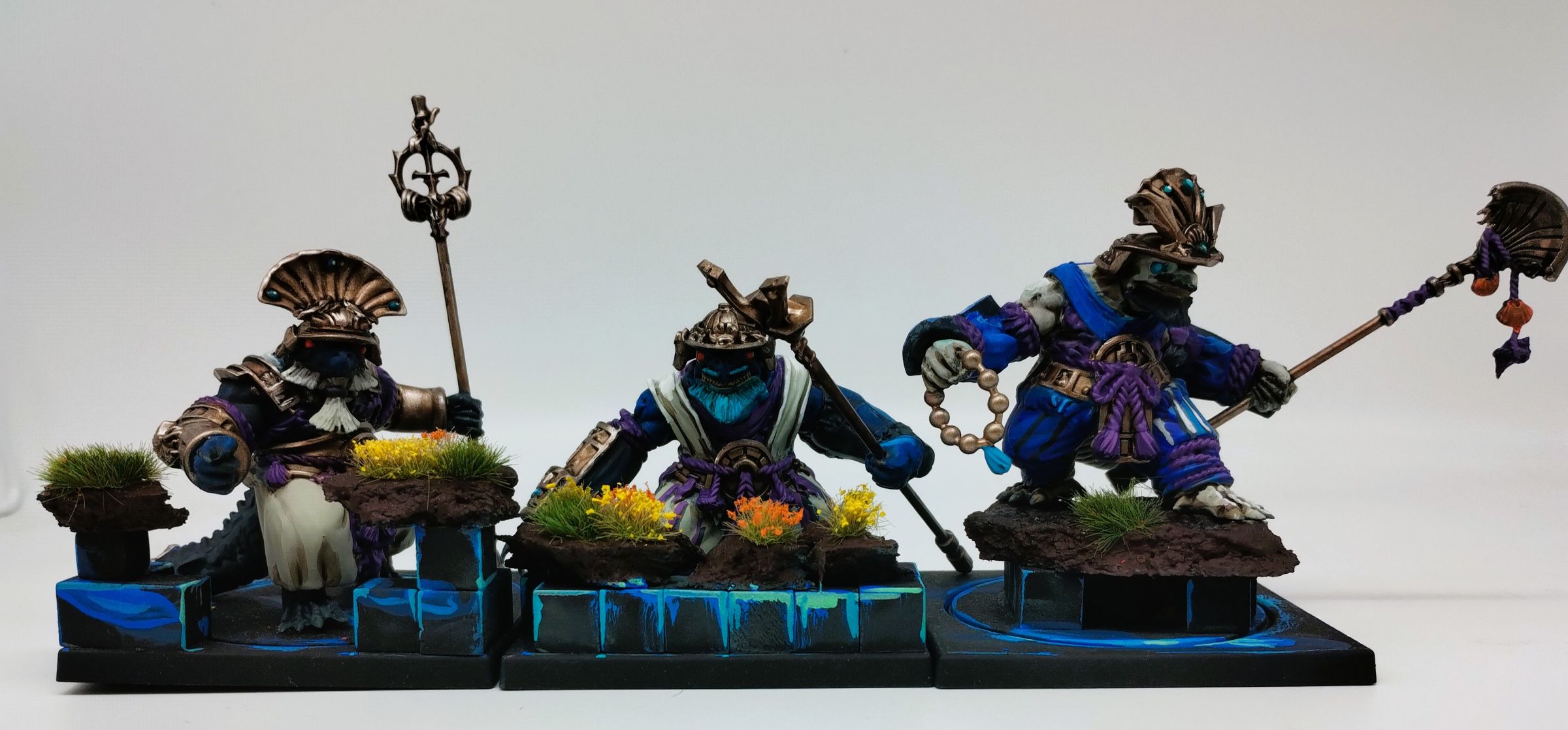 Only three this time around. It takes a while for them to mention it, but all of these are playing for score - the Yoroni start with 72 hours, lose 12 if they are defeated in scenario 1 and lose a variable amount in scenario 2. The final numbers determine which player gets to set up the terrain in the final scenario. I like this structure, it’s simple and effective, doesn’t throw balance to the wind or require multiple additional mechanics.
The structure of this is even more condensed than the dungeon raid last time around; It’s all one big battle, just taking place over the course of a sequence of ambushes and rituals. Nobody moves anywhere from the magical lake, no additional forces join or leave the battle, there are no shocking betrayals or developments of any kind, it’s just a fight in three parts.
The other thing worth noting is that there is now no longer an optionally skippable First Blood scenario. While this is probably due to the impending release of the new First Blood rules, I choose to believe that this is because I have successfully bullied it out of the format.
Only three this time around. It takes a while for them to mention it, but all of these are playing for score - the Yoroni start with 72 hours, lose 12 if they are defeated in scenario 1 and lose a variable amount in scenario 2. The final numbers determine which player gets to set up the terrain in the final scenario. I like this structure, it’s simple and effective, doesn’t throw balance to the wind or require multiple additional mechanics.
The structure of this is even more condensed than the dungeon raid last time around; It’s all one big battle, just taking place over the course of a sequence of ambushes and rituals. Nobody moves anywhere from the magical lake, no additional forces join or leave the battle, there are no shocking betrayals or developments of any kind, it’s just a fight in three parts.
The other thing worth noting is that there is now no longer an optionally skippable First Blood scenario. While this is probably due to the impending release of the new First Blood rules, I choose to believe that this is because I have successfully bullied it out of the format.
Scenario One: The Fog of War
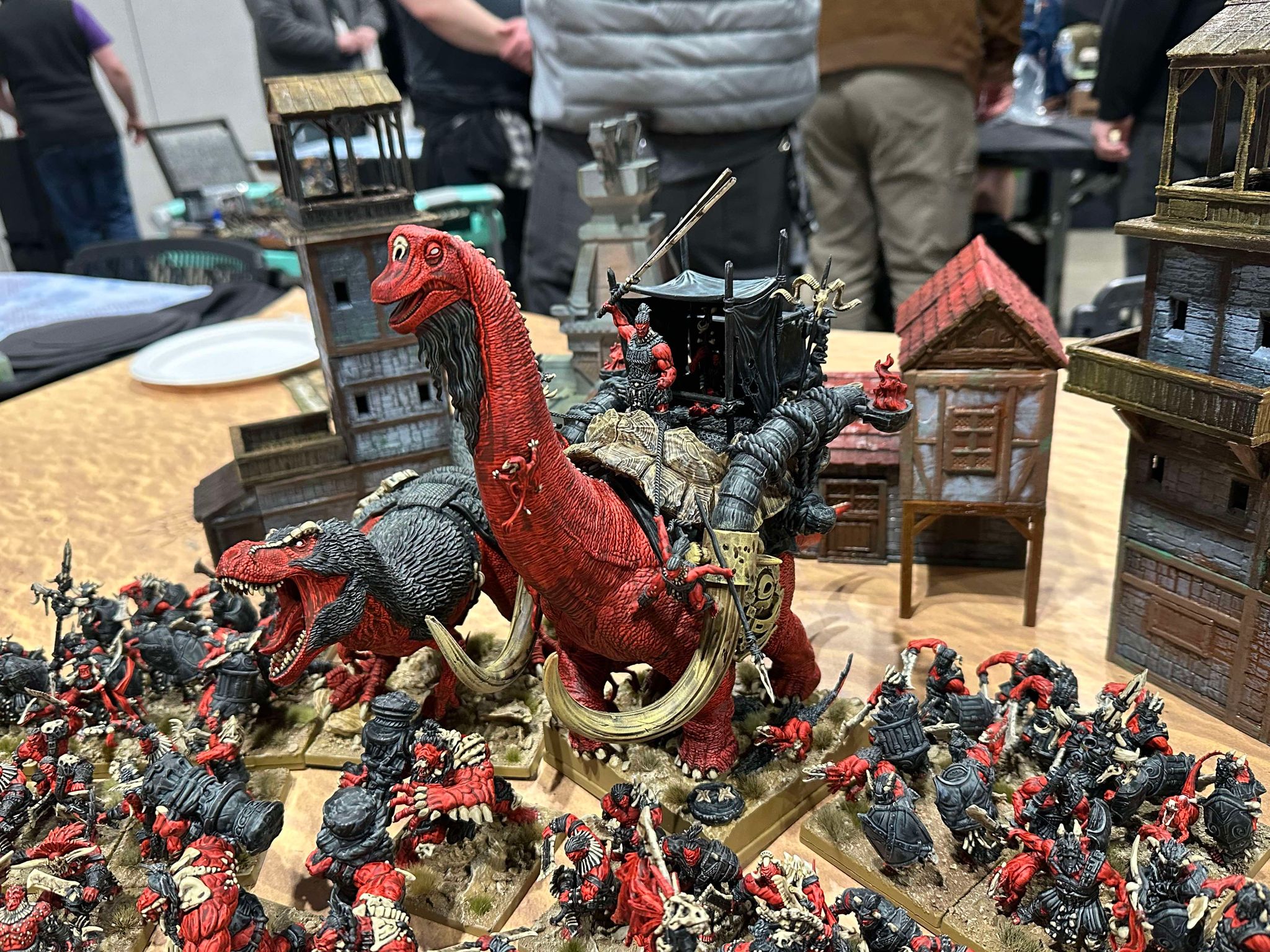 This is one of the regularly featuring Traditional Deployment scenarios - where players alternate placing regiments in lieu of a reinforcement phase - with a neat twist. When you’re placing regiments you’re placing command cards face down until both players have emptied their decks. Then they alternate revealing the cards, deploying the matching regiment within 2” of the card. That’s not entirely within 2”, meaning that there’s actually quite a significant range of placements that can come from each card as it snaps to the extreme of either alignment. I like this a lot. It’s a fun twist on Conquest’s normal counter-deployment process.
There are a couple of other twists. The sight lines limited to 12’ is a minor problem for two factions that want to be close up anyway. As a compensation to ranged units, if a unit is broken it can be forced to perform an out of sequence reform - not combat reform - which can potentially stunlock a unit in a critical moment. It’s actually an important thing to add because this is an Annihilation scenario, and the traditional problem with Annihilation scenarios is that players are not incentivized to attack each other at all. This turns ranged pressure into a potentially catastrophic threat, meaning that the player with ranged superiority is incentivized to be more aggressive than they otherwise might.
Overall, the scenario is almost guaranteed to be an unbalanced disaster - but for two armies blundering into each other in the fog, that actually feels appropriate and thematic. It’s exactly the sort of thing that’s perfect for a narrative scenario.
This is one of the regularly featuring Traditional Deployment scenarios - where players alternate placing regiments in lieu of a reinforcement phase - with a neat twist. When you’re placing regiments you’re placing command cards face down until both players have emptied their decks. Then they alternate revealing the cards, deploying the matching regiment within 2” of the card. That’s not entirely within 2”, meaning that there’s actually quite a significant range of placements that can come from each card as it snaps to the extreme of either alignment. I like this a lot. It’s a fun twist on Conquest’s normal counter-deployment process.
There are a couple of other twists. The sight lines limited to 12’ is a minor problem for two factions that want to be close up anyway. As a compensation to ranged units, if a unit is broken it can be forced to perform an out of sequence reform - not combat reform - which can potentially stunlock a unit in a critical moment. It’s actually an important thing to add because this is an Annihilation scenario, and the traditional problem with Annihilation scenarios is that players are not incentivized to attack each other at all. This turns ranged pressure into a potentially catastrophic threat, meaning that the player with ranged superiority is incentivized to be more aggressive than they otherwise might.
Overall, the scenario is almost guaranteed to be an unbalanced disaster - but for two armies blundering into each other in the fog, that actually feels appropriate and thematic. It’s exactly the sort of thing that’s perfect for a narrative scenario.
Scenario Two: The Unseen Hollow
 Nangenyua and Indilla have an extremely bad working relationship. Their pre-battle dialogue follows this sequence:
Indilla: Do you have useful information?
Nangenyua: Here is some useful information.
Indilla: Enough riddles! Provide me with useful information!
Nangenya: No! Fighting now!
They both come out of it looking childish, abruptly escalating a conversation into mutual insults despite both of them providing and requesting completely reasonable things. I am definitely rooting for these kids to lose. Meanwhile across the way, the mob of undisciplined pirates are operating in perfect harmony, empowered by spider romance.
This one is a long table siege match. This has the following twists:
Nangenyua and Indilla have an extremely bad working relationship. Their pre-battle dialogue follows this sequence:
Indilla: Do you have useful information?
Nangenyua: Here is some useful information.
Indilla: Enough riddles! Provide me with useful information!
Nangenya: No! Fighting now!
They both come out of it looking childish, abruptly escalating a conversation into mutual insults despite both of them providing and requesting completely reasonable things. I am definitely rooting for these kids to lose. Meanwhile across the way, the mob of undisciplined pirates are operating in perfect harmony, empowered by spider romance.
This one is a long table siege match. This has the following twists:
- The Yoroni are the defenders and set up all the terrain - and blessedly, they have a specific list of terrain pieces to draw from with only two impassable pieces available. All the objective zones are on their side.
- The W'adrhŭn player get an extra 1000 points of reinforcements, which they can only deploy in the case of a regiment being wiped out.
- The fog effect from the last scenario still applies.
The expectation is clearly that the W'adrhŭn will win, but the point isn’t just to win, it’s to run up the score. Each point scored gives the W'adrhŭn 4 hours on the ritual clock and they need to get it from 72 to 24 to have the strongest advantage. This is another good scenario, there’s not too much to keep track of once deployment starts.
Scenario 3: The Ritual Unfolds
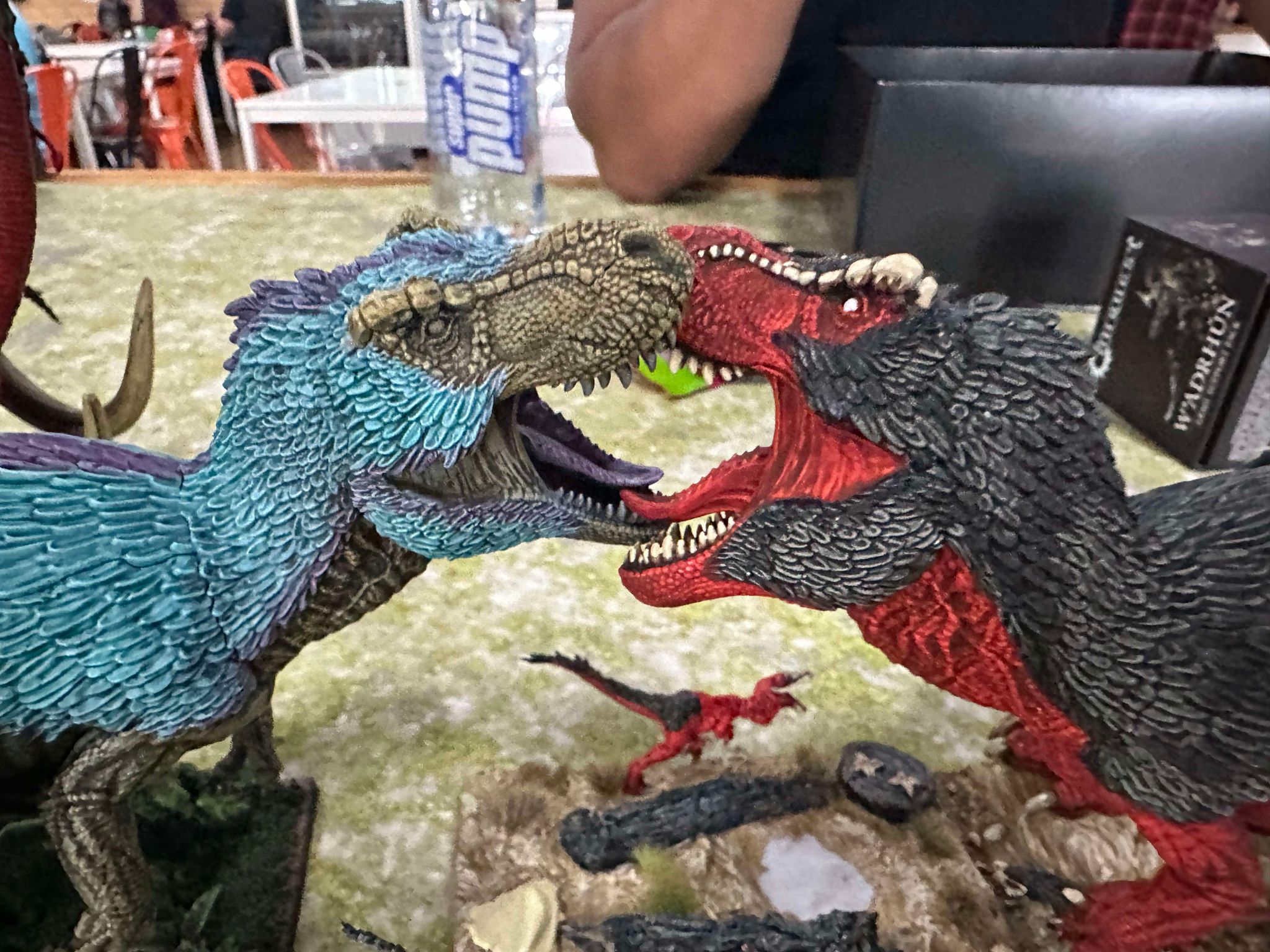 I love this one; this is a full Scenario like you might find at the end of a Warcraft 3 campaign.
If one of the players has built a significant time advantage in the earlier rounds, they get the benefit of getting to place all the terrain to their advantage. It has the same traditional deployment/fog effect rules as scenario 1, but now there's a big ritual circle on the Yoroni side of the table. The W'adrhŭn have two paths to victory: Kill both Mariko and Yugure, or capture the objective zone for two consecutive turns. If the Yoroni can prevent this for eight turns then they win.
Other than that, and full access to the storied regiments, there aren't any other twists. This is a relief, and good design: the twist rules are the same ones we've been practicing with throughout the entire campaign which means we've built familiarity, and the scenario is very clear and straightforward which further reduces mental overhead. Narrative scenarios can bloat rules on top of an already complex game so keeping this side of things nice and restrained does a lot to make this a satisfying engagement.
The Ending
The Yoroni victory page, unlike some of the other versions of this which go into epilogue and talk about strategic implications and the rise and fall of cities, is just a narrative description of the battle that you just played, followed by a giant explosion. Following from that, Wako achieves his ambition of sailing around plundering things on his magic ghost pirate ship. Good on him, honestly. In the event he loses... he also achieves his ambition of sailing around plundering things on his magic ghost pirate ship, but this time he doesn't get to bring the full fleet through with him. However it goes, I'm glad he's out there living his best life.
This is also what I meant when I said a lack of ambition is what helps a faction get wins. To the Yoroni, simply being incarnated for another day on the material plane is a win, given their default state is hanging out in literal hell.
For all that, it's clear that the W'adrhŭn are the real protagonists here and they get the ending that sets up for a future event. Specifically, Conquest herself rolls into the aftermath, identifies the wreckage of the shattered Lake as a collapsed planar gateway, and steps through it to explore. It's an interesting cliffhanger - the world of Eä is so unmapped that I have no conception as to what might be on the other side.
As always if you want to get 10% off and support Goonhammer you can make your Conquest purchase by clicking here for US/Canada or here for EU/rest of world. You’ll also need to enter code “goonhammer” at checkout.
Have any questions or feedback? Drop us a note in the comments below or email us at contact@goonhammer.com. Want articles like this linked in your inbox every Monday morning? Sign up for our newsletter. And don’t forget that you can support us on Patreon for backer rewards like early video content, Administratum access, an ad-free experience on our website and more.
Thank you for being a friend.
 This website uses cookies. Learn more.


 Goonhammer App and Patron Updates: April, 2026
 Kill Team Tournament Report: Engage, Party, Repeat's March Madness 2026
 Goonhammer Reviews: Tribal Conquest