I'll not be so patronizing as to compare the creation of a Commander deck to actual art, but many of the same feelings are evoked. Every deck is going to have a personal touch, that
je ne sais quoi of being unmistakably by ones' hand like pet cards or specific gameplans, or colors. It's a format that is deeply personal, and indeed Commander is sold in part as a means of personal expression—when I go to conventions, whether for work, pleasure, or nerding out, there's a social expectation I arrive with a Magic deck. It's a bit like a business card in some circles, or an outfit, and for that reason creating a deck
for someone is a knife's edge between their expectations, and your ability to uniquely deliver on that aesthetic or mechanical fantasy. When someone very special asks you build a deck, however, there's no refusal of the call. I was tasked to build a list with Azorius colors, a low-cost Commander, and the mechanical...eccentricity that I often arrive to a Commander Night with, complete with a ton of "little guys". I intended to deliver, and in the process, stumbled upon one of the coolest sleeper hit Commanders in a set rife with them:
Krile Baldesion. Let's talk about this gift of a deck, and the sickest Blue-White Commander I guarantee you're not playing yet.
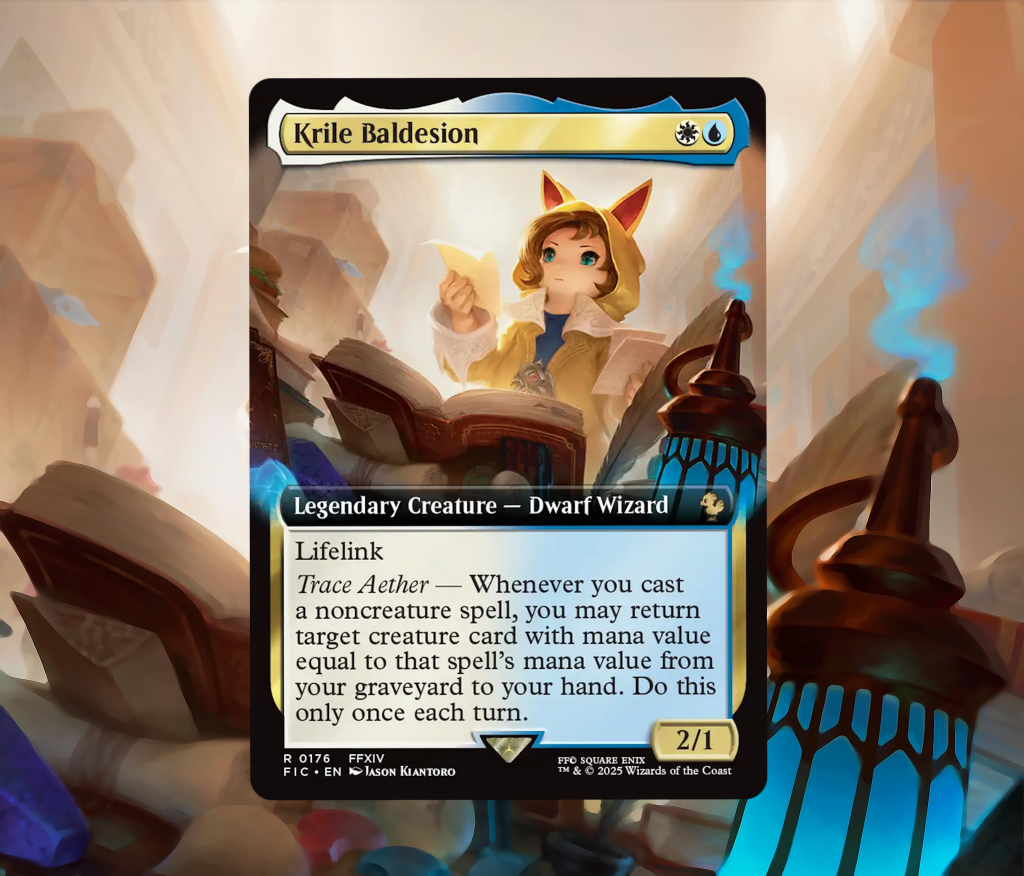
"With Mana Value Equal to That Spell's Mana Value"
Krile, pronounced like it rhymes with 'file', is not an immediately exciting card—indeed, this is why she has a mere ~250 decks on EDHREC. I would also argue she has a design which defies the ability to be conveniently summarized via that website, because Krile asks you to pick a lane and stay in it. Her ability incentivizes you to dedicate a huge chunk of your deck to a specific mana cost, as the higher density with which you pack the Library with goodies, the more consistently she'll add cards back from graveyard to hand. EDHREC, without substantial filtering, has issues displaying helpful inclusions for decks with divergent build paths. This takes me back to my childhood, and a terminology which hopefully jogs the minds of at least a few readers: Fire Fist, and the Axis system. In Yu-Gi-Oh (apologies to my editor), that famous deck emerged with such potency that the community was not divided as to whether it was strong or not, but which Level of monster a player ought to focus on. There'd be some shared tools, sure, but in looking for articles or videos on the deck you'd come away with two entirely separate lists depending on whether it was 3, 4, or 'Mixed' Axis. I take this tangent because this article doesn't cover Krile in all her possible permutations, but instead Krile as a '1-Axis' deck, honing in on a huge chunk of mana value 1 cards as its core. I believe it's the strongest version, yes, but it's far from the only one.
40-ish of the cards in this list are mana value 1, and the average adjusted mana value comes out to ~1.51, the lowest of any Commander Focus I've yet covered—it's lean, fast, and threatens to run out of gas were it not for our Commander replenishing our hand dozens of times over the course of a game. Of note, Krile cares about the printed mana value on a card on the stack, and not the mana spent to cast it (except in the case of X-Cost spells), so there's a few oddball interactions worth covering that I'll call out later on in the article. The general gameplan surrounds a bevy of 1-mana Creatures with the ability to sacrifice themselves, or otherwise put cards in the graveyard, such as the fantastic
Hope of Ghirapur, and using Krile's ability 2-4 times per turn cycle via our hefty Instant package to then turn that tempo gain into an advantage gain. If you squint, our Commander allows a lot of these weird 1-mana spells to just functionally cantrip, and being a 2-mana Commander, she's rarely painful to cast again after removal. With all that in mind, let's talk about our coterie of annoying, charming little guys.
One Isn't So Lonely
 Going to teach you how to be mill-ains.
First, there's the disruptive pieces. Three mostly-identical cards are
Cursecatcher,
Judge's Familiar, &
Mausoleum Wanderer, the latter of which still gives me night terrors from Modern Spirits. These cards are each an Instant/Sorcery specific
Force Spike, and while they very rarely actually counter cards, their actual purpose is to dissuade opponents from tapping out. The 'correct' way to play against an effect like this is to just hold until you have mana to pay for a potential tax, at which point we can decline to sacrifice, effectively being a tax on board for no cost! The threat of activation is the beauty here, not unlike
Kami of False Hope, which serves a role akin to
Spore Frog of repeated fogs. Then, there's
Hope of Ghirapur, a frankly rude card which can shelve Storm & Artifact players alike for a turn...or multiple, if we sacrifice it and immediately recur+cast it with Krile. Finally on the disruptive front, there's the brand-new
Curious Farm Animals. I'm going to be honest, I don't love the {2} cost of activation, but it's the broadest tool available at this mana value for the role, and does nicely when there's something annoying onboard.
Then there's protection, which is a more modest assortment of cards given Krile's both low impact at face value, and cheap enough to recast. Between
Selfless Savior &
Siren Stormtamer (lot of 'S's there), we can protect against everything but a
Farewell, and I'd also lump recursion into this bucket.
Rootwater Diver is here for Artifacts, but its sister card in
Tragic Poet is not, lacking endgame-necessary components to recur. I will say, it's a tough thing to nail down the exact suite of 1-cost toolbox Creatures to play here, given you could in theory see any given card 1-4 times a game. If confronted with reanimator or blink in your pod, you could easily add a
Mistcaller, or perhaps a
Serra Ascendant to fight back against the tide of aggro decks. As with any toolbox deck, you'll have access to a lot of your options, a lot of the time, so the proverbial wrenches available in your kit matter immensely. In order to ensure we see these options, however, they somehow must end up in the graveyard, which is where the third of our buckets comes in: Self-Mill.
Mezzani alla Mill-anese
Krile does nothing without a mile-high graveyard pile, and requires a legal target for her ability as soon as a Spell enters the stack. Therefore, while she is a mere 2 mana, it's often that we don't play her on 2 if there's the ability to mill
first, so the moment she enters the battlefield we can start the advantage machine. On that note, let's talk about the cards that might allow for a turn 2 Krile, our low-cost millers: For Creatures, that's
Hedron Crab,
Merfolk Secretkeeper//
Venture Deeper,
Minister of Inquiries, &
Zulaport Duelist. These all mill ourselves in different ways, with the Crab asking for Landfall triggers (making fetchlands ideal), Minister some time to tap, and Duelist doing so on Enters...often targeting himself. Secretkeeper is a special case, though, as
both a 1-cost Creature & noncreature, a phenomenal spot to be for this list. You'll be able to cycle through these effects over and over, given their typeline, and all but Crab are potential parts of an endgame. They're important to the extent that I considered playing
Drowner Initiate at one point, so keep these in mind when looking at an opening hand!
There's of course plenty of noncreatures that mill us as well, though, from cantrips like
Thought Scour &
Mental Note, to dedicated mill Spells with Flashback like
Dream Twist &
Otherworldly Gaze. Normally, these cards are either neutral or minus on card advantage, but with Krile's help, they feel quite a bit better to play. That being said, we aren't just loading up the graveyard for our Commander, as there's plenty of reasons Azorius would want a stocked bin; cards like
Patch Up can toss up to 3 Creatures directly onto the battlefield, and from the yard itself we can enjoy card advantage by way of
Winternight Stories, or
Sevinne's Reclamation. This is fundamentally a graveyard-first strategy, even if much of what we're doing is...getting things out of it.
Letter of the Law
 Technically not an En-ters trigger.
When I mentioned Dream Twist in the section above, the eagle-eyed among you will have noticed it has Flashback {1}{U}, not just {U}; it's at this point where a familiarity with the rules is important, because Krile follows them very literally. No matter what cost is paid for a non-X-Spell, Krile looks at the printed mana cost in the top right corner...most of the time. See, we're playing
Failure//
Comply, and the card with Aftermath, Comply, is
technically a different card for those purposes. The same is true for Split cards or Rooms, whose mana value is the combined amount aside from the stack (and in the case of rooms, the total value of opened Rooms on the battlefield). So, Comply is 1 mana, and Failure is 2, but what about Spree? Spree allows you to add additional costs of your choice to the Spell as it's cast, such as with
Final Showdown, and these Spells
can cost up to 8+ mana after choosing your modes! That being said, Krile's still only looking for the printed cost, being a cool, singular White pip. When in doubt, it's probably the most literal interpretation possible of a given scenario.
The coolest part of this is that you can use it to your advantage, in terms of what you're getting back! There's, at time of writing, not a single 2 mana Creature in the deck (that isn't an MDFC), but we've got 3s, 4s, and a couple at substantially higher cost. Once you've milled a huge chunk of cards, you can use something like
Deep Analysis to get back your
Displacer Kitten, or flex an
As Foretold to more readily cast 4 Instants per turn cycle, paying 0 to get back your relevant 1 drops. There are of course times you're able to get far more than just one per turn back, because while Krile's ability
says it's limited in scope, that's only once per Krile. If you, for example, target the Dwarf with an
Ephemerate, her trigger goes on the stack to get a 1-cost back, before she's exiled and returned, freshly able to get another back on the next noncreature cast. This is because, as soon as a card moves to a different zone (here exile) it becomes a new game object, resetting nearly any limitation it might have. Remember that Displacer Kitten we got back? Well, that can in theory flicker Krile—or any nonland—once per relevant Spell. That brings us to the intended win conditions.
Cat Out of the Bag
One of the major benefits of Krile is that you get to see a substantial portion of your deck, fairly quickly; with the amount of mill going on, you'll add cards to both your hand and graveyard at a steady clip through the midgame. Cards to look out for, when doing so, are the aforementioned Displacer Kitten, but also
Hullbreaker Horror, and either of your mana-positive Artifacts in
Mox Amber &
Sol Ring. Kitten & Hullbreaker seem a bit hard to get back once milled, but remember that we're on several cards with printed costs of 4 & 7.
Deep Analysis is likely to be milled alongside your other cards, and for HBH, your two MDFC Sorceries are that pivotal 7 mana value. That being said, there's one particular card that fills such a sweet niche for getting
either back with Krile:
Restricted Office//
Lecture Hall. See, as I stated in the previous section, Rooms are their individual cost while on the stack, so whether you're casting the Office or Hall, it can be 4 or 7 mana as-needed (on top of being a pretty solid card in a 'little guys' deck).
 Frankly I think Blue needs more cats in the color.
Hullbreaker Horror is fairly easy to grasp as a win condition: You play Spells, and bounce things, sometimes a Sol Ring and/or Mox Amber and any other free or 1-cost card, to generate infinite mana and/or Storm count. For the Kitten, however, that starts to reach a combo when combined with
Teferi, Time Raveler, able to bounce the mana-positive rock, which when cast causes Kitten to flicker Teferi, drawing your deck and generating 1 mana per card left to draw. Teferi here cannot be infinite, as we're not on a
Laboratory Maniac-style effect, but once you have mana, pivoting it to flickering a mill piece ~50 times will often end the game as well, or allow you to then just jam HBH. These aren't the most outrageous combos, but they hardly need to be, given how rife the deck is with recursion and protection, ensuring you can take your time and fully insulate a win once reached. Hell, we're even on
Pull From Eternity as a 1-mana Instant that either resets a Flashback Spell, or grabs an exiled combo piece. Your graveyard deck will
not be losing to a single
Bojuka Bog. Once you have the necessary Storm count, you can also just
Brain Freeze—good both as a way of milling ourselves in the midgame, but also our opponents in the endgame.
Example Decklist: Krile Baldesion Plays Uno
I think with a gifted deck it's important to have at least a few cards included primarily to evoke a sense of 'Oh, that's neat'. The deep cuts, the pet cards that show you've either spent far too much time trawling through Scryfall, or which provide you with the same sensation in your decks. For me, a big one here is
Curse of Silence. Curses see a good chunk of play in Curse-themed decks, but little beyond that; Silence however is frankly a card you could play in nearly
any deck and have it feel good. At worst, it's a 1 mana cantrip that forces an opponent to pay additional 'Command Tax'-lite, but at best it can even turn off combos! Similarly,
Scout's Warning could honestly just see a slot in more Monowhite period, able to chuck out an unexpected hatebear or combo piece, and at worst go card-neutral. In Krile, it's even better, given you're basically guaranteed to get back something to Flash in! Choosing these cards over things like
Ponder/
Preordain is like adding a bit of gochujang to ketchup—quietly a standout.
I'm also pleased with the fact that a Battle fits nicely here; when people ask me what card I've tried (and failed) to make work the most, it may very well be
Invasion of Segovia/
Caetus, Sea Tyrant of Segovia. See, once you get this flipped Caetus allows all your 1-mana Creatures to tap for your 1-mana Spells, greatly increasing your potential pace of play, but flipping the actual Battle isn't the easiest. There are, however, just enough Creatures with Flying here to justify it, and sometimes you just flicker the darn thing until you've enough little Krakens to overwhelm blockers. Remember, while you choose an opponent to protect a Battle, it's still under your control (like Curses). In a similar vein,
Founding the Third Path is a card I played a substantial number of times in Standard, but haven't ever seen in Commander. It's fairly mana-efficient, especially if you're casting something with that first chapter, if you flicker it the mill on that second chapter adds up fast! Finally, being a psuedo-
Snapcaster Mage on the final chapter is great, and later on it turns
Sevinne's Reclamation into the very same, if you need that. The flexibility is great, and more decks likely want it than currently play the Saga. Test it out! On a similar note, wow can we get an obscene amount of value from
Hourglass of the Lost. This 3 mana rock hasn't been amazing in any deck I've played it in, thus far, but as it turns out having more than a third of your list be MV1 ensures success when it pops.
Decklists are kept updated, and may change with set releases.
The list here is essentially a Game Changer-less Bracket 3, but I think with some tweaking it could either be pushed all the way to Bracket 4, or down to 2. Krile is defined by what she's getting back, and whether that's more beaters like
Serra Ascendant or the combo pieces for Cephalid Breakfast, the deck is as slow or fast as one wants. I've provided what is essentially a skeleton, but I fully expect the specific toolbox cards used to be swapped around once the list gets passed off. More protection? More card cycling? There's enough flex slots in the Creature base to justify swapping things around, and Krile is broad enough even at 1-Axis to feel different if she gives you access to different answers. After all, a lot of the best interaction is at that very same, very low cost.
Will Win, Have One

As I said, this is merely a deep dive into one potential path for Krile, and builds based on 2, 3, or 4 mana Creatures would look almost entirely different. At 2, you have access to the Cephalid Breakfast line for self-mill, at 3 there's a ton of high quality blink spells, and at 4 you could dive even deeper into Kitten lines; the world is your oyster, and for an niche Commander, your individual Axis might be itself one niche
further. In spite of having spent ample time building, testing, and now writing about Krile, it feels as though I've only scratched the surface of what she has to offer. And yet, she has a mere 250 decks to her name, myself never having seen the Dwarf sitting across from me in the Command Zone. In short, she's a perfect choice for a unique, highly personalized gift.
A lot of the time I cover decks more as thought experiments than things I intend to build in paper, for while I'd stand by and endorse essentially all of them as lists you could pick up & play, my ability to tune owned decks is time-limited. If I can only play 3 games at an FNM, I want those games to be for decks that excite me constantly, and I'm not always the right person to pilot a typal strategy, or something with multiple colors. In the case of Krile, not only have I managed the rare event of falling in love with a 2-color list, but I have the distinct pleasure of knowing its eventual pilot will have that same ability to customize and evolve the strategy once it leaves my hands. I get to see this piece of not-quite-art evolve and grow before my eyes, alongside the very person & player shuffling up beside me. Giving a deck as a gift
is like art in that aspect, its interpretation and alteration much like the lifecycle of some beautiful cabinet; it will be changed, re-contextualized, and enjoyed in ways you never thought about while the chisel was in your hands. That's the beauty of anything made by a human, for another human.
Until next time, you are number one.
Have any questions or feedback? Drop us a note in the comments below or email us at contact@goonhammer.com. Want articles like this linked in your inbox every Monday morning? Sign up for our newsletter. And don't forget that you can support us on Patreon for backer rewards like early video content, Administratum access, an ad-free experience on our website and more.Thank you for being a friend.
 This website uses cookies. Learn more.


 Goonhammer App and Patron Updates: April, 2026
 Kill Team Tournament Report: Engage, Party, Repeat's March Madness 2026
 Goonhammer Reviews: Tribal Conquest