King Midas. The Djinn. Goosebumps. The story of a wish gone bad has provided delicious satisfaction for audiences since as early as the post-Phrygian Greeks, and even now has morphed into a simple phrase: "Be careful what you wish for". The catharsis of these stories arrive in the cleverness of their inversions, where a seemingly perfect fate is turned sour, and we're able to revel in the fact we'd
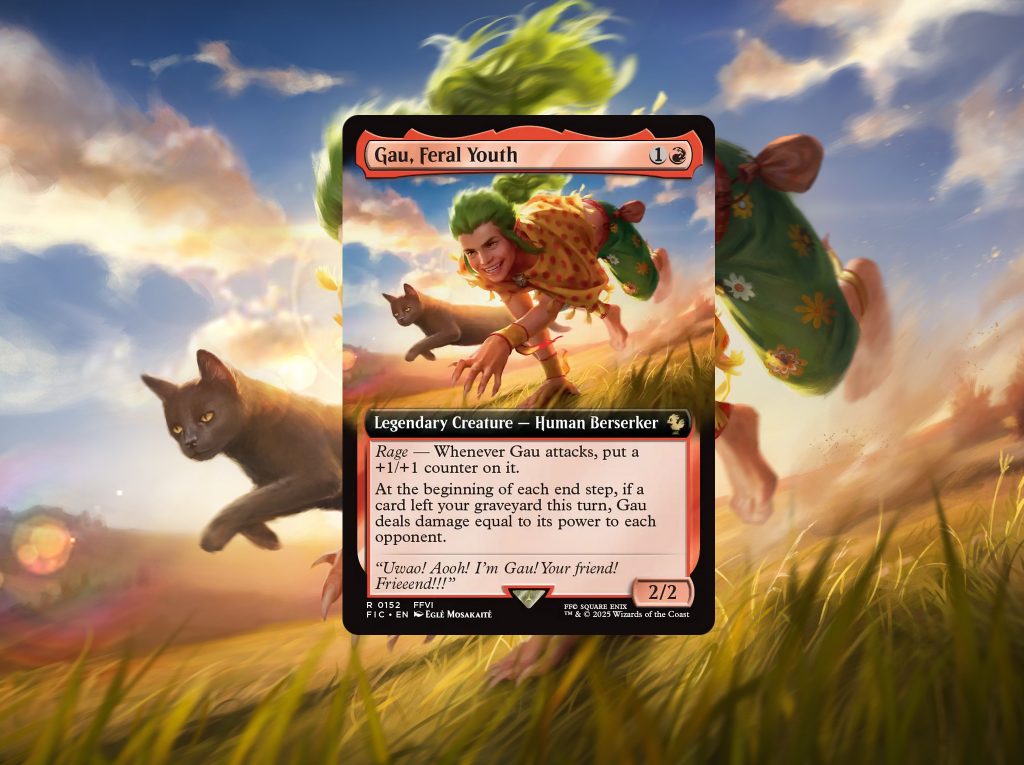
never make such a silly mistake. On a related note, Gau, Feral Youth is our Commander for today, a card spun from the same wool of
Tersa Lightshatter, who was the focus of one of my earliest articles. Both of these Commanders ask you to pick away at your graveyard—Tersa less directly—and supplement an aggressive gameplan with consistent access to cards and/or damage. The thing is, with Tersa I had reverse engineered this gameplan, borrowing a path of play from my favorite Standard deck,
Capricious Hellkite Combo. Pruning our own yard to only the best 7 possible hits was a great challenge, and led to a shockingly competent Bracket 4 list I have in paper to this day. Still, Tersa wasn't perfect. Gau seems, therefore, a perfect option to replace Tersa, supplanting subtext about messing with your graveyard, with a direct cause-and-effect. I was given a perfect Commander for a gameplan so niche that it seemed too good to be true, my wish granted to play Monored self-grave-hate in a more real capacity. And then
Secrets of Strixhaven reinforced it, with Lorehold's identity. How'd it work out for Midas, again?
"If a Card Left Your Graveyard This Turn"
Gau is ostensibly a 'group slug' Commander, spreading the damage around turn after turn, so long as you fiddle with your graveyard once per turn. Speaking as a notorious graveyard-fiddler, that's become remarkably easy to do in the past few years, with incidental grave-hate being stapled to a number of powerful cards like
Agatha's Soul Cauldron & the brand-new
The Ooze. Turning these effects inward, Gau staples an extra line of text onto their activated abilities: "During the End Step, deal ~2-5 damage to each opponent". While you can only spread that damage once per turn, the vast majority of cards which peel away pieces from your graveyard available to Red are repeatable, anyway. Instead of rushing down opponents with blistering aggro, this places Gau in the realm of midrange, needing to prop up a value engine that goes long, but not
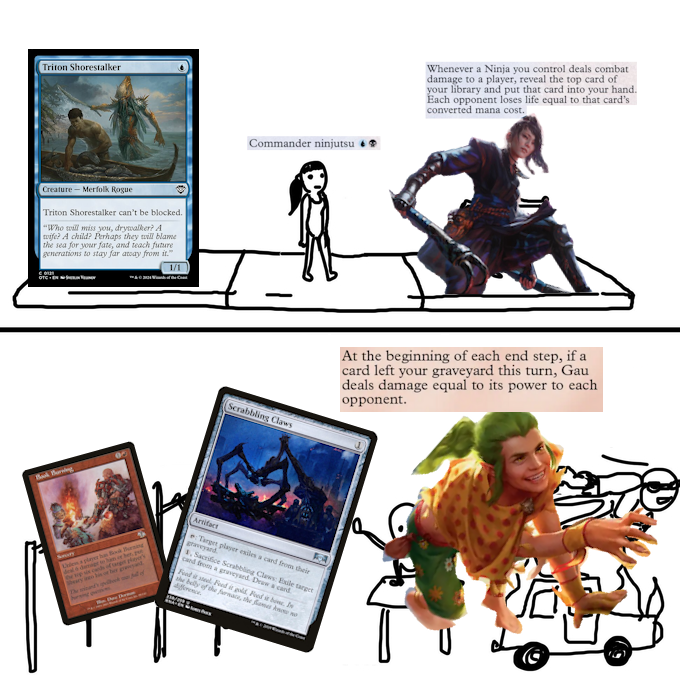
control deck long. Overall, it's a fairly sweet deal, calling to mind another (functionally) 2-mana Commander that staples damage onto already-good effects:
Yuriko, the Tiger's Shadow.
 The card too popular to errata.
Let's not be naïve though, because Yuriko's a bit of an unfair comparison, being one of the independently-strongest Commanders of all time and all. I get that she's no Blue Farm, but in circles a hair below cEDH, there's few strategies more consistently lethal than pivoting between unblockable 1-drops and untaxable tempo. While Gau starts at 2 mana, Gau is only 2 mana
once, and while the damage does scale, it's less volatile than Yuriko; that damage arrives in instances of 2-5 rather than 0-7. I say this not to compare Gau to Yuriko, but instead to put emphasis on the fact that their play patterns tend to garner removal spells, and that hits the former rather hard. Gau, if removed, resets his damage clock to 2 (his base Power), on top of now doubling in cost, so the moment he's annoying enough to at least one player that death warrant is signed. Therefore, we're encouraged to run enough protection, redirection, and acceleration to ensure our entire gameplan doesn't stop the moment Gau dies. This was quite a bit harder a week ago, but thanks to the new support in
Secrets of Strixhaven, more tools now exist for our secondary gameplan of self-grave-hate. We'll talk about how much Lorehold's new pieces serve Gau's interest, but it's worth keeping in mind that, while similar on the surface to Tersa, Gau's not remotely the same in terms of play pattern; this kid is an engine, not an aggro payoff.
A Bit of a Picky Eater
With all my couching out of the way, let's actually talk about what's moving cards out of our graveyard, before talking about what else is putting things in. Gau gets to make use of a bevy of card designed for Limited, or that are otherwise niche, precisely because he allows them to have that added line of text. You won't see
Jack-o'-Lantern in many EDH lists, but here it's free damage from the yard.
Scrabbling Claws represents a ton of turn-over-turn damage, and
Relic of Progenitus is in the same vein...though it's the less-likely card to activate that second ability of the two. We don't want to get rid of all graveyards, unless something's gone horribly wrong, or you're a turn away from lethal damage. Finally in this suite of raw self-hatred is
Phyrexian Furnace, a great reminder that the graveyard is technically an ordered pile, and unfortunately you'll need to remind opponents not to shuffle theirs while piloting Gau. Deeply funny, mildly annoying. Cards like these need a specific density in the deck to really sing, because on their face, each only provides their damage once per turn cycle.
One step up, and we have cards that don't just pick away a card with no other upside, and instead reward you for the effort. We've mentioned Agatha's & Ooze, both of which also have some uses for combos & recursion, respectively, but what about
Ghost Vacuum? If you're looking for lategame in a box, it's a pretty good option! Furthermore,
Cryptex is a card that's been a standout in Tersa since her inception, with the Collect Evidence mechanic there used to clean up Lands from the yard; instead, here it's just a 2 mana rock that exiles at least one card out of the yard, a fine enough piece for what we aim to do. Once you start getting to the point where you're willing to actually spend mana to move cards out of your graveyard, however, things get good. There was a time when
Grim Lavamancer was one of Legacy's most brutal openers. With the ability to kill an unflipped Delver or dork, among other things, this was a tempo piece fueled by fetches and best-in-slot cantrips. Now, though, he's old news. Gau recontextualizes his ability though, not as an early board control piece, but a repeatable means to pick away the yard—alongside its recent contemporary,
Rust Harvester, cards like these are huge here. There's even Lands which pull cards out of the yard, such as
Mines of Moria,
Pit of Offerings, &
Hostile Desert, who have such a low individual opportunity cost that it's difficult
not to slot them in!
What Comes Out, Must Go In
We do need to get cards into the Graveyard before we get them exiled, shuffled, and more however, and Red isn't exactly known for self-mill. While your ideal minimum is 4 cards in, 4 cards out (per turn cycle), we'd in an ideal world want even more because there's some cards that aren't meant to just be tossed away. Things like Anger, Shenanigans, or Faithless Looting all have reasons to remain in the yard, so between casting spells and churning through our Library, I'd like to mark an ambitious 6 cards per turn cycle to enter our Graveyard. Let's talk about meeting that benchmark. There's a bit of a subtheme of 1-mana Artifacts in this list, given so many of the Limited-intended grave hate costs that much, and
Shriekhorn follows suit. Those cards can be found via
Tezzeret, Cruel Captain, and once we're done, deposited into the yard via
Goblin Engineer &
Goblin Welder. Tezzy can even untap them, and while we could play more tap-to-mill pieces, like
Throne of the Grim Captain, alongside untappers like
Voltaic Key, they missed the final cut due to a lack of impact. The one which has remained is
Perpetual Timepiece, primarily because even while tapped, it offers a Gau trigger for 2 mana. Beyond that though, let's once again look to our Lands:
Valakut Exploration doesn't read as a mill piece, but it's at minimum one extra card per turn, and those we don't play go to the yard and result in damage. If we have a Fetchland, not only does it go to the yard when searching for a Mountain, but that's an extra card for what is functionally free.
There's a few instances of one-time mill which also see a slot here, and the best example is
Book Burning. Book Burning requires a bit of political finesse, but so long as you're guaranteeing the person who takes damage from it
will be aggro-ed down by you until death, players won't raise their hand so easily. 2 mana for 6 cards is a steal though, as loading the yard isn't always free in our color. On a similarly political note, there's
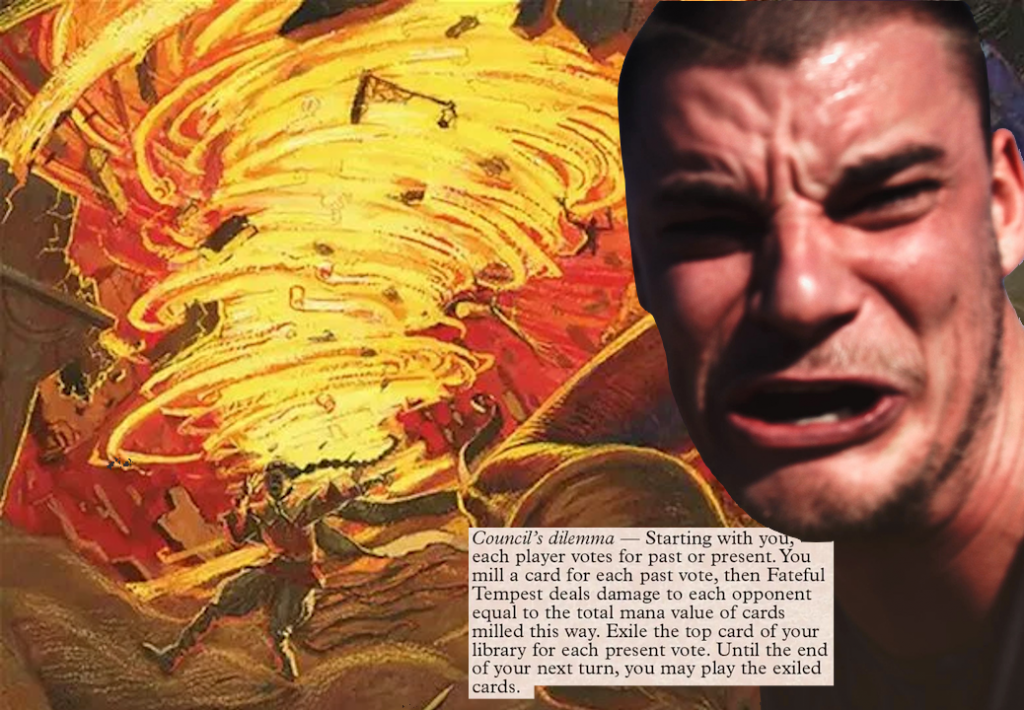
Fateful Tempest, which either translates into a ton of advantage, or mill+damage. Much like Book Burning, the ideal here is all mill, assisting in our fueling of the yard and supplementing Gau's group slug. On the topic of cards from the new set, though...
 Famous Lorehold alum, Gau.
Unlike so many Commanders whose mechanics excite me, Gau is one I've sat with since his release, but only felt worthwhile to cover now. It's the epitome of a card that's aged like fine wine, and we have
Secrets of Strixhaven to thank for that; Red-specific cards that cared about cards leaving (or having left) your graveyard before the set numbered only two, so having those payoffs tripled in density overnight certainly helps. Greatest among them is
Relic Retriever, which operates as a
Bender's Waterskin on a body, providing just enough mana turn-over-turn to fuel our small synergies, like
Grim Lavamancer.
Spirit of Resilience gets massive, and even has the opportunity to copy cards we exile for a turn, in a weird sort-of reanimation that provides this list with unprecedented access to Creature "recursion" in Monored. The crown jewel, though, is
Advanced Reconstruction, one of a couple Classes we're playing (and the best among them). It guarantees a Gau trigger during your turn while onboard, and quickly gets out of hand in terms of its burn once you Level it to 2. There's a few other
Secrets cards we're on like Fateful Tempest, and consideration given to Flashback, but suffice to say the set puts Gau on the map. If you want to do the Lorehold 'thing' in Red, he's your boy.
Gau-ing for the Win
The two main schools of thought for Gau are defined by building up to a single turn of massive damage, or attempting to eke out small chunks over the four-player turn cycle of Commander. I think a list can be built to do either, and some cards crossover with both, but that philosophical divide is worth noting going in. Whether a card like
Bulk Up is especially good depends on your ethos: For 2 or 6 mana, are you happy to deal 3 more to each opponent? What number is enough, for a card like this to be worthwhile? The more I thought about it, the more it struck me that building for smaller chunks of damage over time made more sense, being less threatening in a single play, and less likely to be blown out by a single removal Spell. Ergo, this article has covered a version of Gau that wants to end the game via a thousand cuts, but know either variant can make sense. Powering Gau up enough to be threatening, but not kill-on-sight, is best displayed by a few of our Equipment:
Commander's Plate,
Improvised Arsenal, &
Chainsaw. These each do something beyond mere Power increases, or are cheap enough to scale up into the lategame. Then there's
Grafted Exoskeleton, which usually only needs two turns, not even an entire rotation, to present lethal via Poison counters.
 Here it comes. And by 'it', I mean, 7-10 damage.
That being said, this isn't really a combo deck, as including a combo that we build towards defeats the purpose of Gau: Stacking, repeatable damage. If we just did an LED+Breach line, would that be good in Gau? Sure, but part of selecting your Commander is understanding both the concessions & opportunities one makes in playing them. Here, Gau allows us to be 'honest', and give opponents a rough idea of the clock they're on...until we ramp things up. Suddenly there's two Gaus with
Gogo, Mysterious Mime, or maybe they forgot the
Secluded Starforge you have, and it's presenting a 12 power Gau. Existing in an 'honest', non-combo space for B3 is a great spot to be in when you're playing with folks who are shy of games ending out of nowhere. The actual
feel of this Commander is slowly-winching gears, tightening around life totals, and to that end it's a compelling mean-but-not-too-mean list.
Example Decklist: Gau Sicko Mode
Part of what enchants me about Commanders like Gau is that you need to think creatively to squeeze out the necessary trigger density for such a specific effect. Case in point, who's heard of
Icefall? Icefall uses the Recover mechanic, an odd sort of mandatory trigger when one of your Creatures die; you're given a choice to either exile it from your graveyard, or pay the cost and add it back to hand. No matter what, this moves a card out of our graveyard for Gau, and what's more, sees play in only ~1,000 of the 4
million potential decks it could appear in. I'm not saying the card is objectively good, but the beauty of Commander is that the lowliest, most niche effect can be contextually great! There's also the only Red card with Dredge,
Shenanigans, and the color's only option with Delve,
Magmatic Sinkhole. I imagine all three of these cards might find new homes, with Lorehold's prominence, so it seems well worth shedding a spotlight on them. The number of little ways this deck has of propping its synergy package up are vast, and it's awesome to see it in motion once you've started rolling.
Ensuring you have a good opening is paramount for Gau, however, and we try to smooth things out by way of rituals & Haste enablers. Functionally identical are Reckless Charge & Wild Ride, both also providing their bonus from the yard, and in worlds where you need to jam Gau after taplands or a board wipe, they get things kicked off painlessly. On the flipside, Gau is a huge beneficiary of both Witch's Clinic (which debuted in the original Strixhaven) and Hidden Hideout, which basically stop your opponents from outracing you. Between his actual swing, and the End Step trigger, you're looking at gaining 4x the boy's Power in terms of life, and that's 10+ on even a bad day.
Decklists are kept updated, and may change with set releases.
In terms of Bracket, this is a list with clear benefits skewing higher, namely more fast mana & mana denial. Gau wants the game to go long, and as a 2-mana Commander, wants to come down on turn 1. Cards like
Chrome Mox/
Mox Diamond as additional Game Changers are great at increasing the consistency of this opening, but the real treat is in the form of
Blood Moon &
Winter Orb effects. Part of the reason going long benefits a Gau player comes down to the impact of each available piece. To increase the impact of 2-4 triggers of ~2-5 damage each turn cycle, you need to allow yourself time to have more turn cycles...meaning stax is paramount for this little scamp. That's not likely to win you many friends, but is fundamentally one of Monored's biggest strengths at higher power (and part of why it feels
rough at B3 in particular). At B2, Gau would likewise feel just about as good as he does at B3, but might be too much of a bully. In short, it's a bunny hop from B2 to B3, and a giant leap for Red-kind once you can slam turn 2 Blood Moons in B4 (which is also why Tersa was built to be B4 in the first place). If you want that experience, try jamming a
Tangle Wire in B3 and see how it feels.
The Gau Agenda
 Gau was Eglė Mosakaitė's first artwork for Magic, and it's a great debut!
"It's not as though Gau is as bad as turning my beloveds into unliving gold, or becoming a mud monster via middle school hijinks (thanks R.L. Stine), but that he represents the pitfall of every mechanical niche now having a Commander. Where Tersa, who in her own right guided me towards Monored self-grave-hate, was independently pretty solid from a filtering and aggro perspective, Gau centers the strategy solely on himself and maximizing his trigger. In doing so, if he gets removed twice or more, your gameplan's often a wash. He's *too* good at what he does, and weighs too heavily on the scale, tilting too much of your 99 towards hitting that damage as often as possible."
That whole section is in quotes because it was written some time ago, prior to the release of
Secrets of Strixhaven. I've had Gau on the brain since his reveal, almost a year ago when
Final Fantasy was spoiled, but the reason I'm talking about Gau
now stems from the fact that he's the single-biggest Monored beneficiary of the Lorehold identity, which shifts Boros' gameplan from strictly aggro into grindier, grave-reliant midrange. His mechanical niche now has far fewer pitfalls, because while Gau's gameplan still centers on resolving his trigger, there's backup enough to keep the churn going without him.
I want to stress that when Gau is allowed to pop off (which happens frequently, given how under-the-radar he tends to fly) the deck plays like nothing else. It's an assembly line of twiddling weird uncommons to and fro, picking apart and likewise refilling the yard with cards nobody's seen before. In being so specific, and that specificity rewarded with Lorehold's new tools, he manages to be the best representative from a school from a different universe, a year after the fact. He sparks this rich, creative play pattern in Red like few else. Sure, the endpoint is damage, but getting there's a peculiar thing as far as group slug is concerned. It placed me at an impasse, when I was hand-wringing over whether Gau was worth covering, between a desire for resilient, low-ceiling Commanders like Tersa, or those with wildly out-there gameplans and absurd endpoints like Gau. Now, however, each exists in their own fully-realized context, going from a wish-gone-wrong, to the eventuality of every single weird off-color mechanic: Redundancy. Choosing which Red self-gravehate deck to build in paper
was a hard choice—and the answer may just be that I build...
both. Call it hubris, call it midasian, but when it comes to Red you can't have too much of a good thing, right? Like gold, wishes, or being turned into a bee.
Until next time, that boy ain't right.
Have any questions or feedback? Drop us a note in the comments below or email us at contact@goonhammer.com. Want articles like this linked in your inbox every Monday morning? Sign up for our newsletter. And don't forget that you can support us on Patreon for backer rewards like early video content, Administratum access, an ad-free experience on our website, and subscriber-only content covering competitive Warhammer 40K!Thank you for being a friend.
 This website uses cookies. Learn more.
 Commander Focus: Lorehold, Midas, & Gau, Feral Youth