Welcome to the Century of the Vampire, an ongoing weekly feature where Goonhammer managing editor Jonathan Bernhardt watches some piece of vampire media, probably a movie but maybe eventually television will get a spot in here too, and talks about it at some length in the context of both its own value as a piece of art and as a representation of the weird undead guys that dominate western pop culture who aren’t (usually) zombies.
Last time, Bernhardt reviewed the 2007 David Slade movie, 30 Days of Night. Today, he looks at the 2009 Park Chan-wook movie Thirst. This article will contain spoilers.
You gotta love a horror movie where the audience gets to have a good time, even if -- perhaps even especially because -- absolutely no one on the screen is.
This is Park Chan-wook’s thirteenth feature film as either writer or director, eighth as both, and third where he was finally established enough to also be producer; his most famous film in the west is still Oldboy (2003), but you may have heard of Joint Security Area (2000), The Handmaiden (2016), or this year’s No Other Choice (2025), which I haven’t gotten a chance to see yet. He also produced Snowpiercer (2013), which is more notable for being Bong Joon Ho’s breakout film in the west (The Host was good; no one’s saying The Host wasn’t good).
It’s an oversimplification to say Park likes to do long, involved thrillers (sometimes action, sometimes not) that generally focus on family ties, sex, class and social position, and how all three of those things intertwine, featuring a lot of messed up and visually shocking stuff, but that does describe Thirst. It goes a bit heavier on the family ties and the sex than the class and social position stuff, though that is in there; the explanation for why our protagonists descend into violent barbarism and operatic bloodletting has less to do with any material analysis or the psycho-dramatic impact of trauma, however, and more to do with them being vampires.
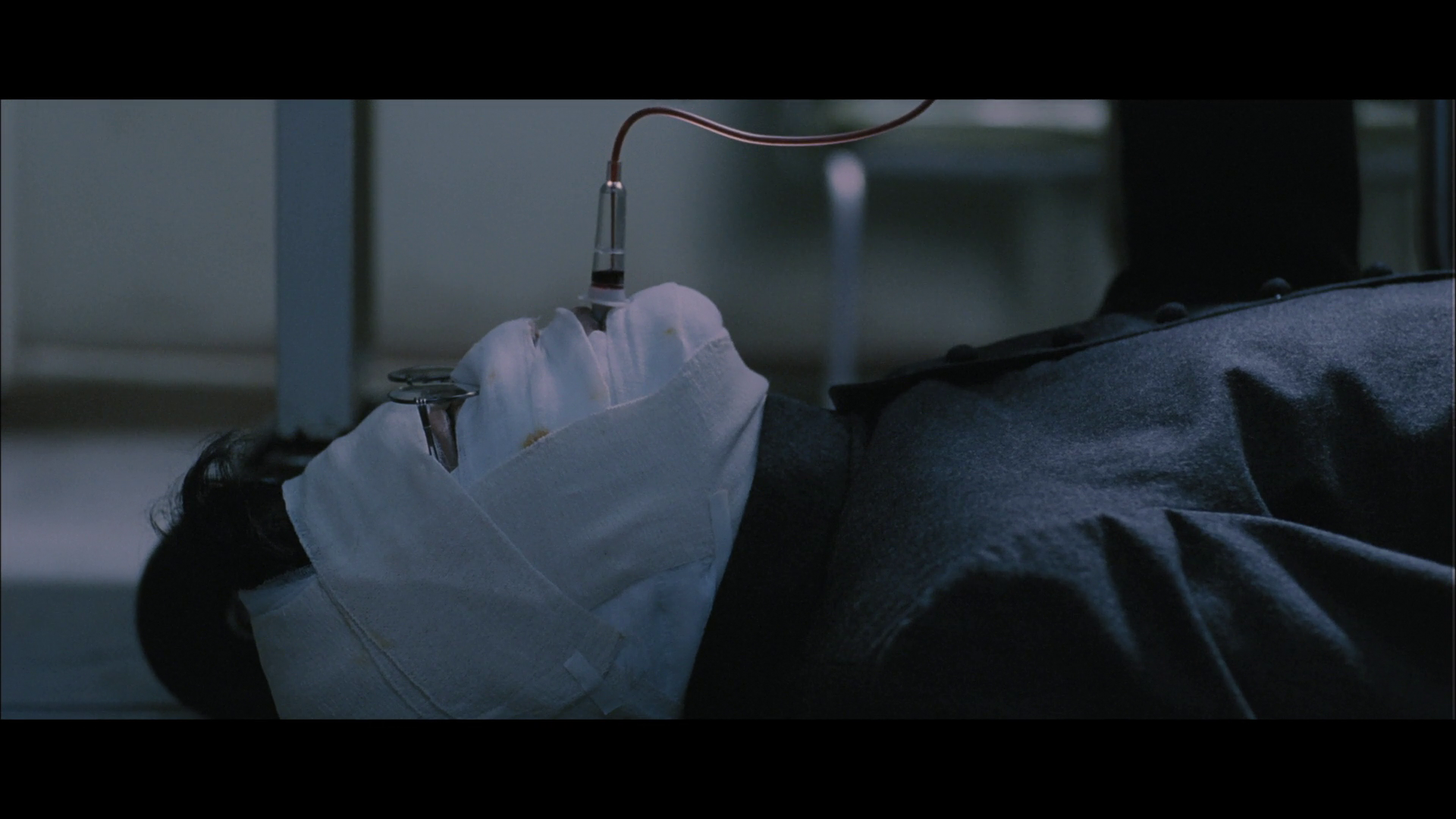
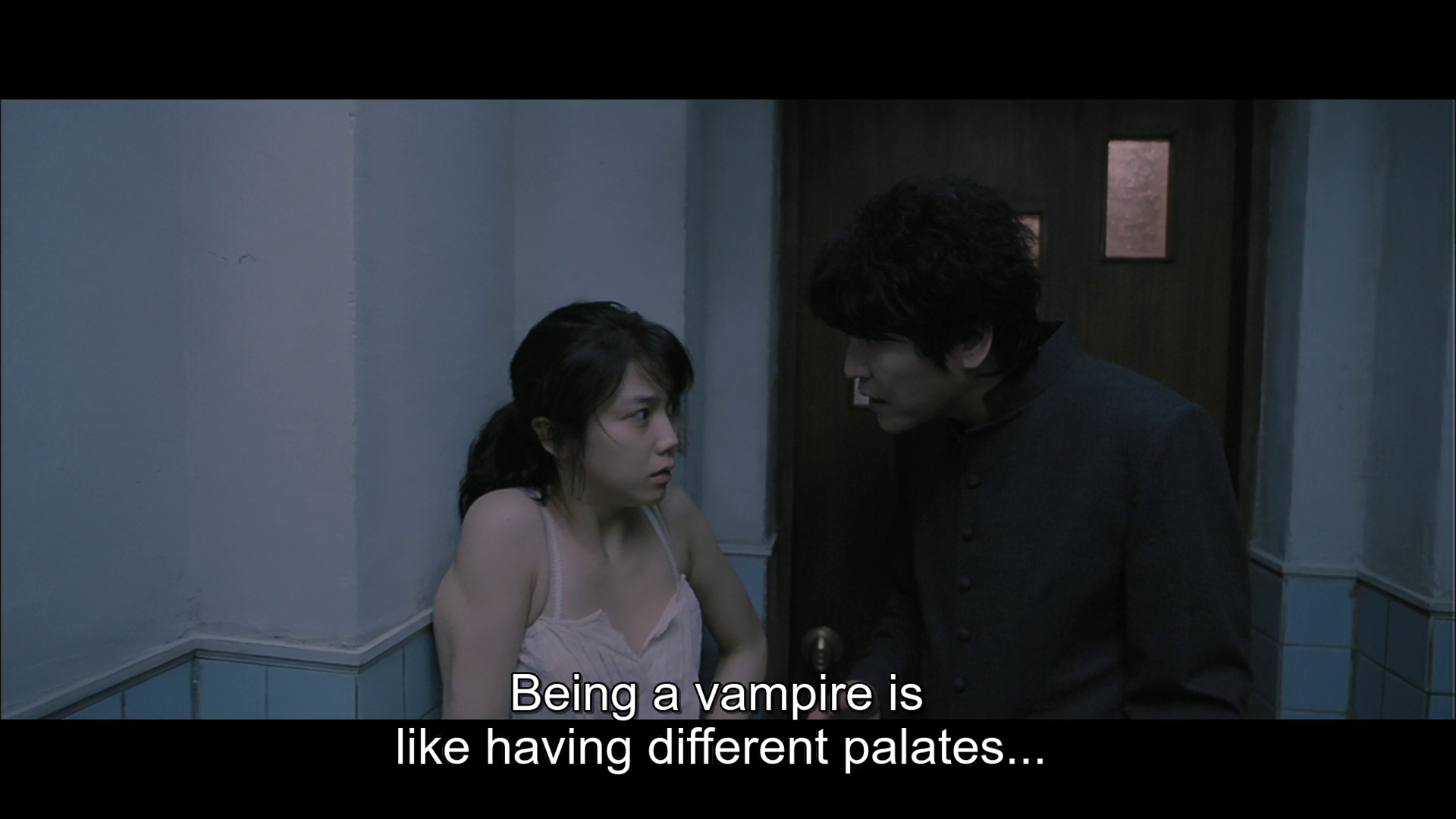
Thirst runs 148 minutes in the Director’s Cut, which is the version I had access to; it’s a very good film, but there’s a lot of it, far too much to break down scene by scene with any usefulness. The broad outline is this: Sang-hyun (Song Kang-ho) is a Catholic priest who volunteers to undergo an experimental treatment for a rare African blood disease in pursuit of a cure. It kills him. Blood transfused into him after his death brings him back to life. He returns to Korea and his flock, who now revere him as a faith healer Lazarus; through them, he reunites with the family of Kang-woo, a childhood friend, and finds them all disgusting save for Kang-woo’s wife Tae-ju (Kim Ok-vin), who was raised from childhood under the thumb of Kang-woo’s mother as a servant and eventual bride for her son. Meanwhile, vampirism begins to manifest in the priest, leading him to feed off the blood of comatose patients at the Catholic hospital, attempting suicide and learning he can no longer be killed. Sang-hyun becomes sensitive and then wounded by sunlight, and unable to control both his senses of hearing and smell or his baser instincts and impulses.
He pursues an affair with Tae-ju, and eventually kills Kang-woo with her help so they can be together, justifying it because Tae-ju says that he beats her. A police investigation ensues; Kang-woo’s mother slips deeper and deeper into a fugue, eventually having a stroke that fully paralyzes her but keeps her aware of the world. Tae-ju confesses that she lied about Kang-woo being abusive in order to manipulate Sang-hyun into killing him; in a rage -- he’s having more and more of those, and becoming more and more physically abusive of her and everyone around him -- he kills her. Regretting it, he drains her blood, and then pours his own into her, turning Tae-ju into a vampire.
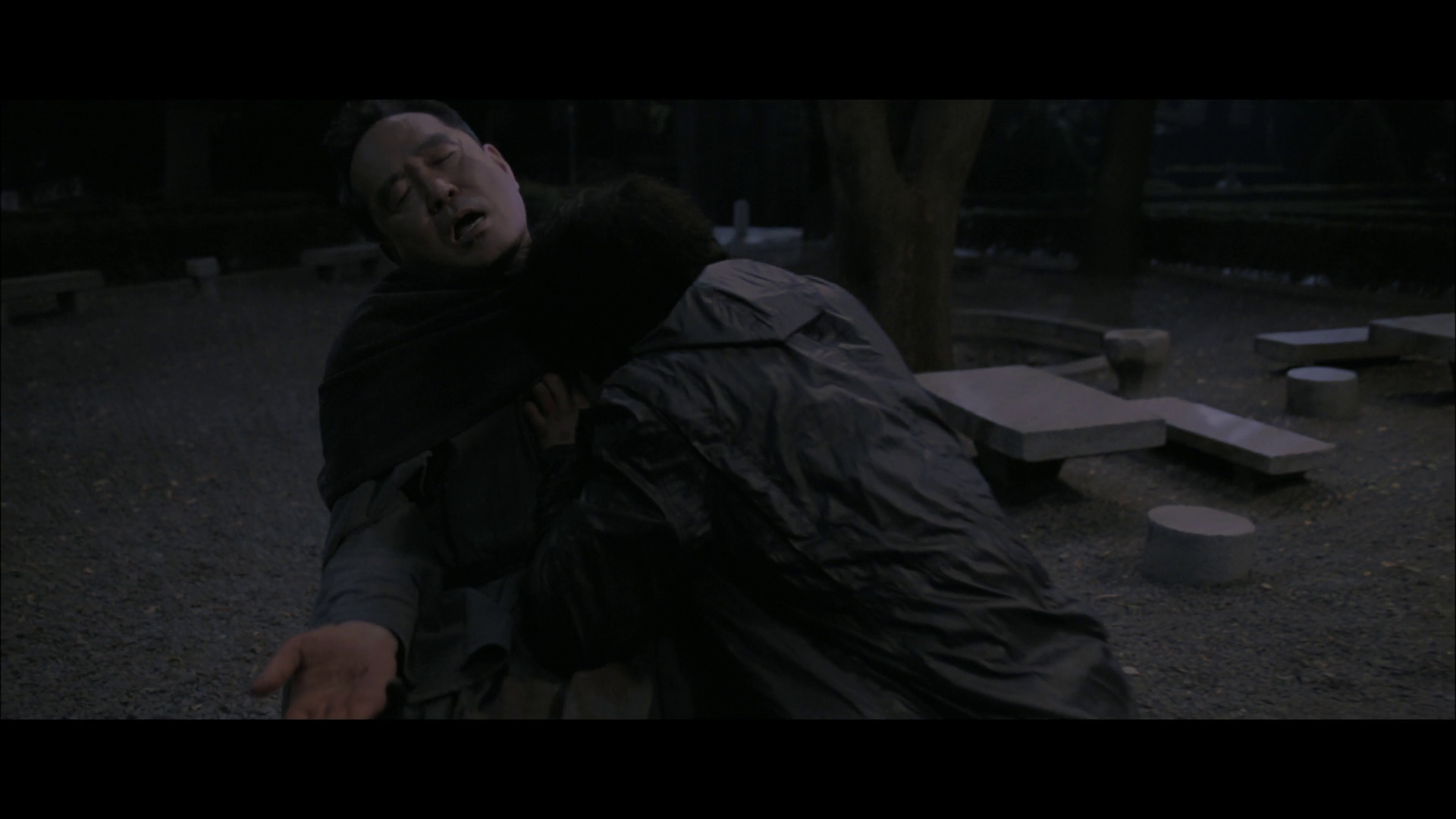
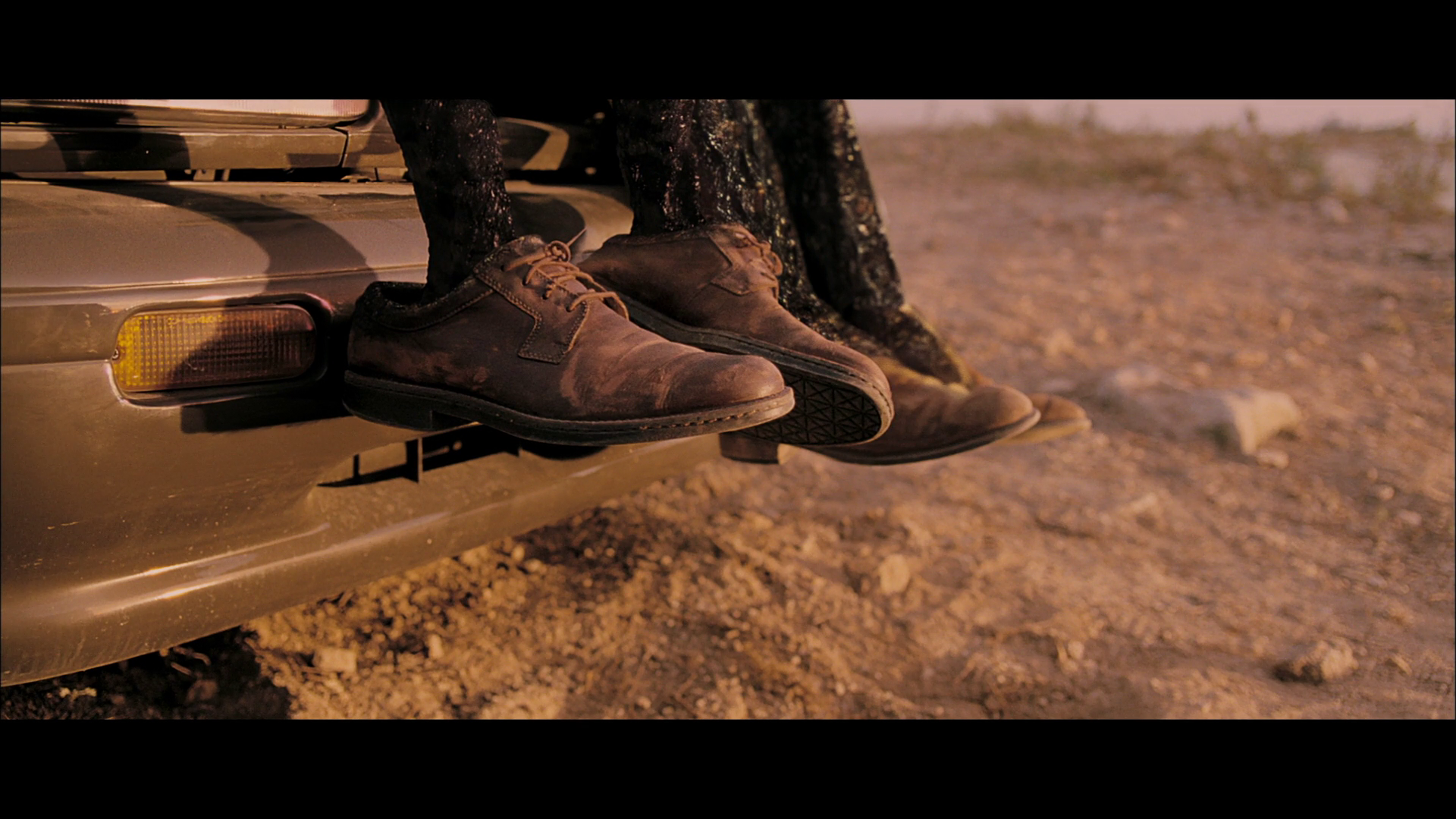
This is a mistake. Whereas the priest clings to his own imagined virtue and tries his best not to kill too much or too often, Tae-ju revels in the power of being a vampire, and goes on a killing spree; Sang-hyun reluctantly remains with her, attempting to temper her bloodlust. They hold a house party in the anti-septic, stripped down apartment where Kang-woo and his parents used to live, and this time Tae-ju kills her father-in-law and both friends who came over, one of whom had previously raped her. Sang-hyun realizes they have to put an end to this, and drives them out to the coast where he strands the car and removes all hiding places from sunlight to force Tae-ju to accept that they both have to die. The paralyzed mother-in-law, in the backseat, is the only survivor (except for one of the friends, who wakes up in the now-empty apartment and finds herself to be a vampire as well), watching mutely but perhaps smiling as the lovers burn in the sunrise.
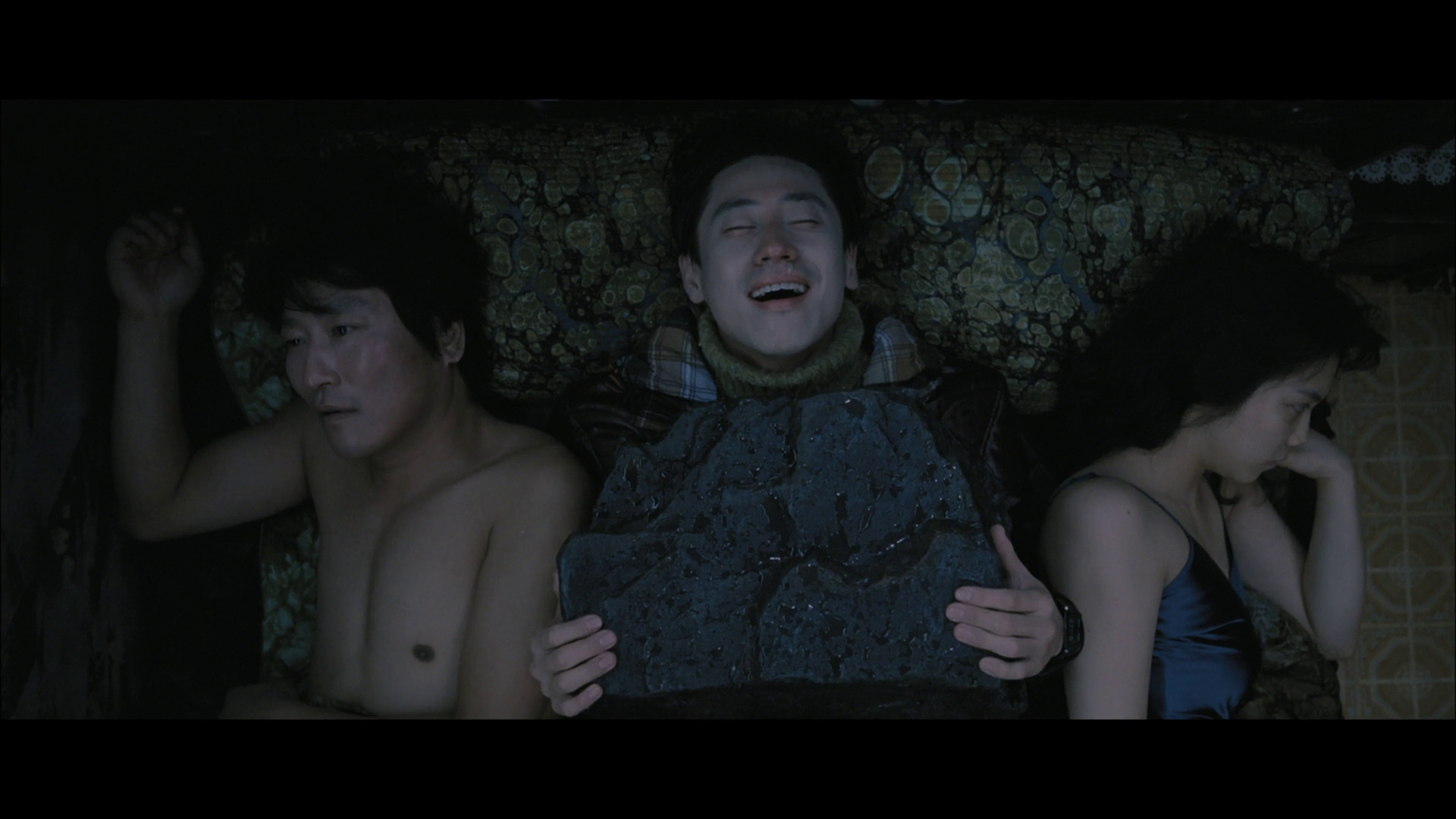
It’s beautifully shot, and the way the script flips as it progresses from sympathy for the vampires to sympathy for those they destroyed -- previously, in Tae-ju’s case, the ones who abused her -- is very well done. The repeated ghostly apparition of Kang-woo, murdered with his body stashed at the bottom of a lake, weighed down with a rock so it never floats to the surface, in scenes with Sang-hyun and Tae-ju -- in one memorable instance directly interposed between the two naked and thrusting lovers, smiling his manchild smile, perhaps more forgivable in death as the boy who never grew up than he was in contemptible life -- haunts through to the end of the film, as the mute and paralyzed Mrs. Ra bears witness to the vampires falling out and falling apart. It’s an incredibly sensual movie; there’s about a half-dozen sex scenes in here, including the one with the ghost of the dead husband, and they pass the “why is this in the film??” test pretty easily. The reason for the one previously described is obvious -- we killed your husband so we could be together, but the act of doing so haunts and colors our relationship in unforgivable ways -- but they are all deployed to depict two people throwing aside boundaries and conventional moralities, either of the frock or of marriage, for passionate and physical reasons, as a prologue to when those appetites run violent and sour. There are also two rape scenes, distinct from sex scenes (as all rape scenes are), and they occur in the back half of the film, when the passions have turned to carnage and violence. (One is also, in the fiction, a weird fake simulated rape that the priest does to discredit himself with his “believers,” which I rolled my eyes at, but our male lead at least does full frontal to match his co-star.)
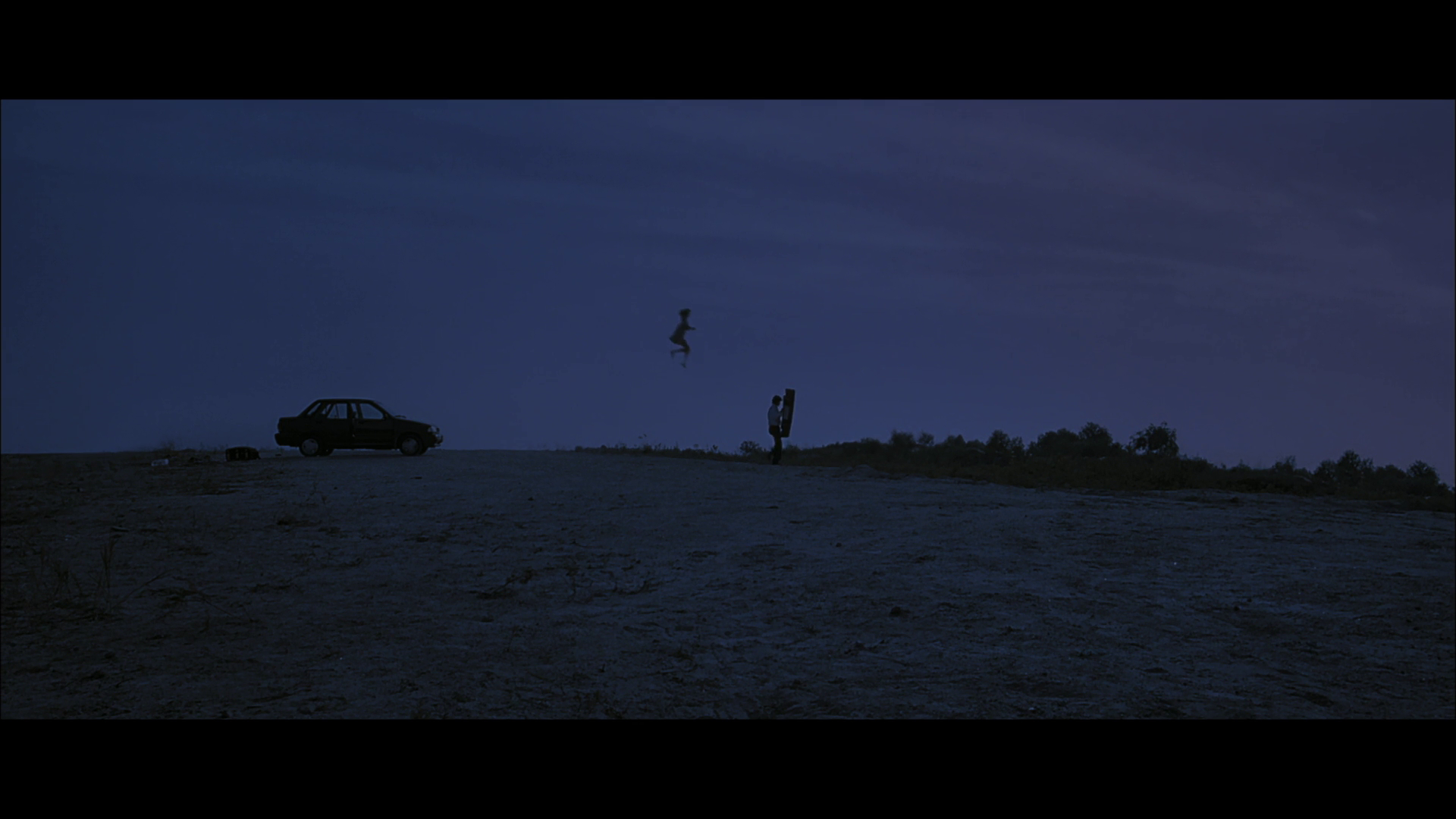
The movie is also just incredibly funny in ways that text can’t convey. For the middle act of the film, as he comes to grips with his vampirism, Sang-hyun is a Looney Tunes character, and the very matter-of-fact way that Park shoots him discovering his superpowers makes any display of them comedic. After discovering his vampirism and drinking from a comatose patient, without saying a word, the priest throws himself through the room’s window down to the parking lot below, attempting to take his own life. He faceplants through a car windshield, flops down onto the hood, discovers he yet lives, discovers he’s stuck, and has to extract himself by force, taking the windshield off with him as he does, still around his neck. He throws it aside and walks out of the parking lot without saying the word, nothing so much as he is a cat who just recovered from a bad fall and is pretending it never happened. He learns to jump high enough and glide far enough that it’s essentially wire-fu flying; he punches a light pole so hard it collapses, but it’s shot in such a way that makes him look like a goofus dork instead of a man of terrifying power. There’s a lot of gross stuff in this movie, but it’s usually shot without many cuts and without imposed directorial tension or tricks (on the camera side; the movie has very good use of practical and digital effects), so when Tae-ju breaks her father-in-law’s neck with a knife-edge chop you get to watch that head bounce around a bit before he falls over.
Again, the only possible problem with this movie is that it’s so long; the third Knives Out film comes out this weekend, Rian Johnson’s most indulgent mystery romp yet, and it clocks in a minute or two shorter than the director’s cut of Thirst. The theatrical cut is a mere ten minutes shorter, so it’s not like Park’s cut adds so much more to the plate. It’s well done, but there’s fat to be trimmed in the first two acts if you want to spend a little bit less time with the tragedy of Tae-ju’s upbringing and how repulsive Kang-woo and his family are. Still, Park has earned his discretion; if he wants the movie this long, then the movie is this long. And every minute spent zigging the one way with the family dynamics in the front half of the movie increases the impact of Tae-ju zagging in the second half. Kim Ok-vin isn’t the star of the show per se; Song Kang-ho’s Sang-hyun still gets the majority of the weight, and he turns in a great performance. But Kim is the main attraction from about the midpoint on. While I wouldn’t call Tae-ju sympathetic, necessarily, not by the end -- relatable works. It’s not like the world taught her it worked any other way than “have power, use it.”
We stay international next time, with Let the Right One In.
Have any questions or feedback? Drop us a note in the comments below or email us at contact@goonhammer.com. Want articles like this linked in your inbox every Monday morning? Sign up for our newsletter. And don't forget that you can support us on Patreon for backer rewards like early video content, Administratum access, an ad-free experience on our website and more.
 This website uses cookies. Learn more.


 Goonhammer App and Patron Updates: April, 2026
 Kill Team Tournament Report: Engage, Party, Repeat's March Madness 2026
 Goonhammer Reviews: Tribal Conquest