Welcome to the Century of the Vampire, an ongoing weekly feature where Goonhammer managing editor Jonathan Bernhardt watches some piece of vampire media, probably a movie but maybe eventually television will get a spot in here too, and talks about it at some length in the context of both its own value as a piece of art and as a representation of the weird undead guys that dominate western pop culture who aren’t (usually) zombies.
Last time, Bernhardt reviewed the 2010 Matt Reeves movie, Let Me In. Today, he looks at the 2009 Peter and Michael Spierig movie Daybreakers. This article will contain spoilers.
This is a fun one. This is the kind of bad movie I wanted this entire series to be about (when it wasn’t about good movies). With a hundred bad movies like this, I could conquer an entire mid-2010s cable station’s rerun schedule.
Daybreakers is a classic of the same amorphous genre of sci-fi dumb guy near-future action movie with A Political Message as Equilibrium (2002), V for Vendetta (2005), and previous entry in this series Underworld Awakening (2012). Minority Report (2002) is probably the best film in this genre from this general time frame; Aeon Flux (2005) might be the worst (though the film adaptation of V for Vendetta gets special mention just for the size of the delta between the quality of the adaptation and the quality of the source material). Like so many films, these are all children of The Matrix, taking inspiration from it without ever coming close to reaching its heights; part of the reason there is that the Wachowskis had a complicated set of both public and personal political issues they were working through in their 1999 mega-hit, and to put it lightly, most of the rest of these do not. It’s entirely possible that German-Australian director duo brothers Michael and Peter Spierig understood they were making a political movie the same way Kurt Wimmer understood that fact, which is to say, they didn’t, really; there weren’t any Republicans or Democrats and no one was running for president, and that’s what politics are. These movies are just about overthrowing the government and the broad particulars of the world economy.
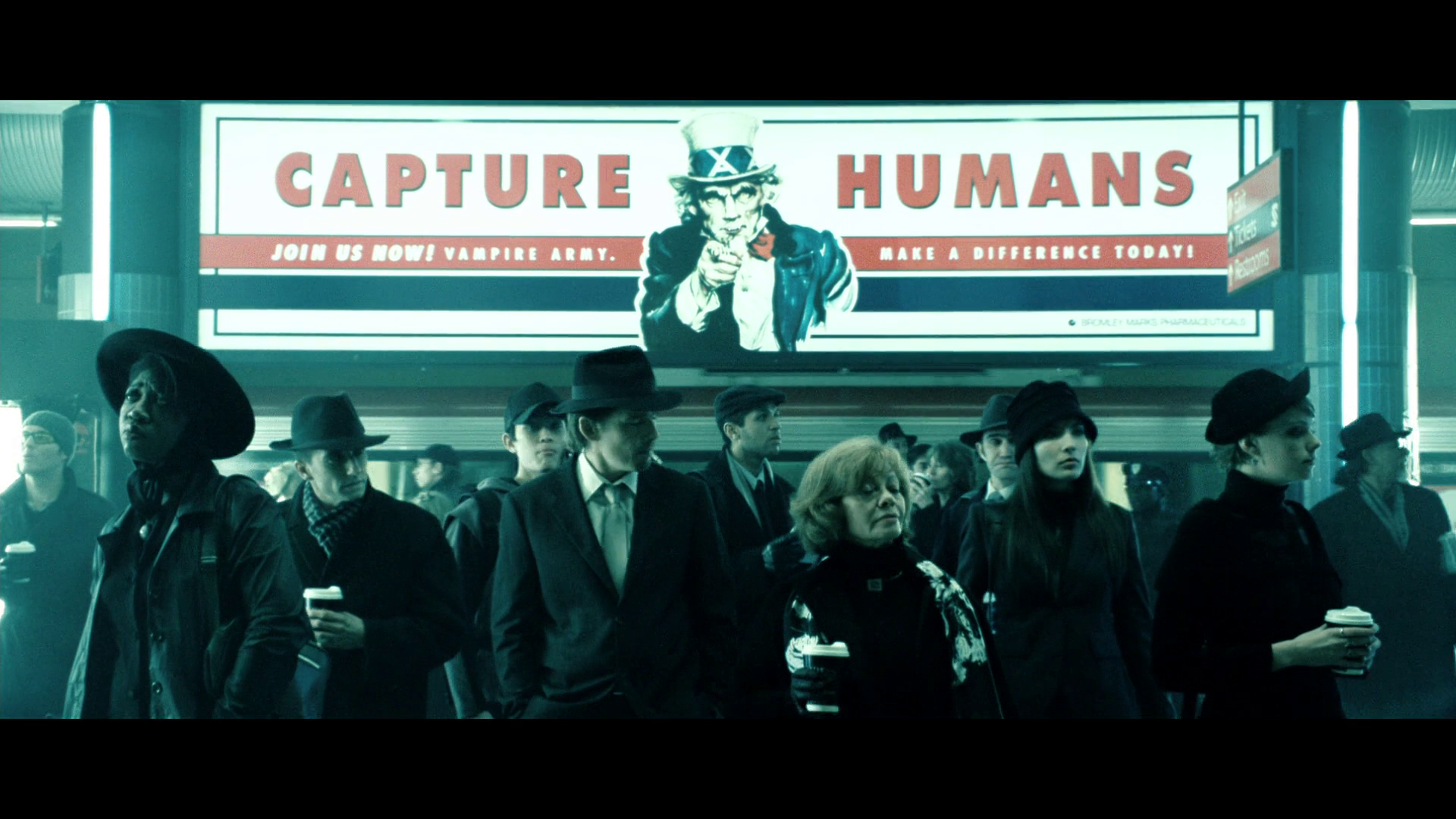
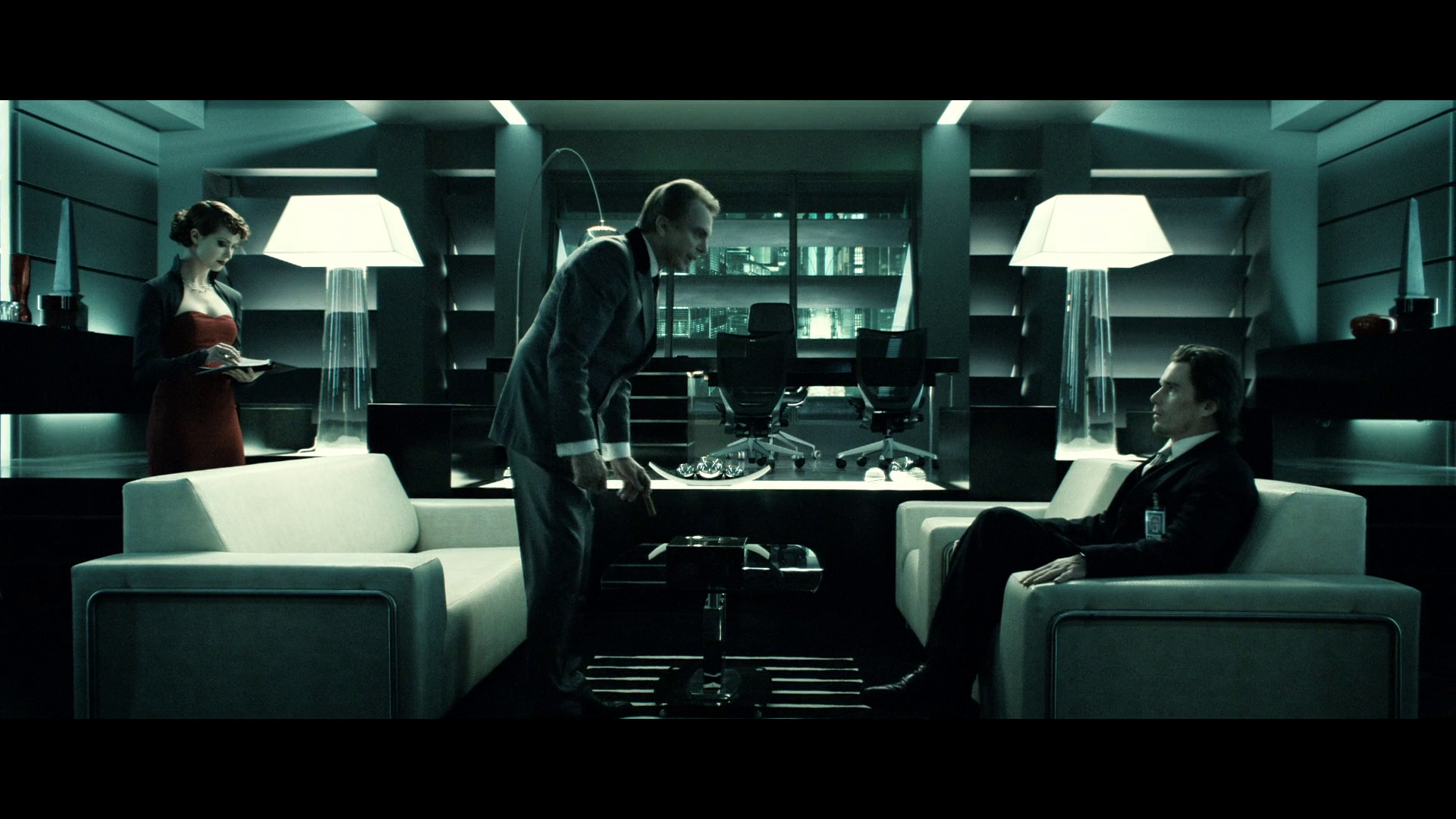
The plot of the movie is pretty barebones: In 2019, ten years in this movie’s future, vampires have taken over the world and account for the entirety of the social population that matters. As in Equilibrium, what this means in practice is that there’s The City where everything is color-graded to steely blues and the dystopian bad guys rule, and there is The Other Space where humanity and rebellion flourish, which is color-graded with warm and natural oranges; in Equilibrium this was The Underground, and here it’s The Countryside. Our hero is Edward (Ethan Hawke), who is the Top Science Guy and Most Important Vampire for evil CEO Charles Bromley (Sam O’Neill) and his pharmaceutical company which is trying to make synthetic blood, so he can keep the dwindling supply of real human blood for himself. The company is of course bodyfarming every human they’ve managed to capture alive for their blood in a very clumsy and lower-budget recapitulation of The Matrix’s pod-battery set up.
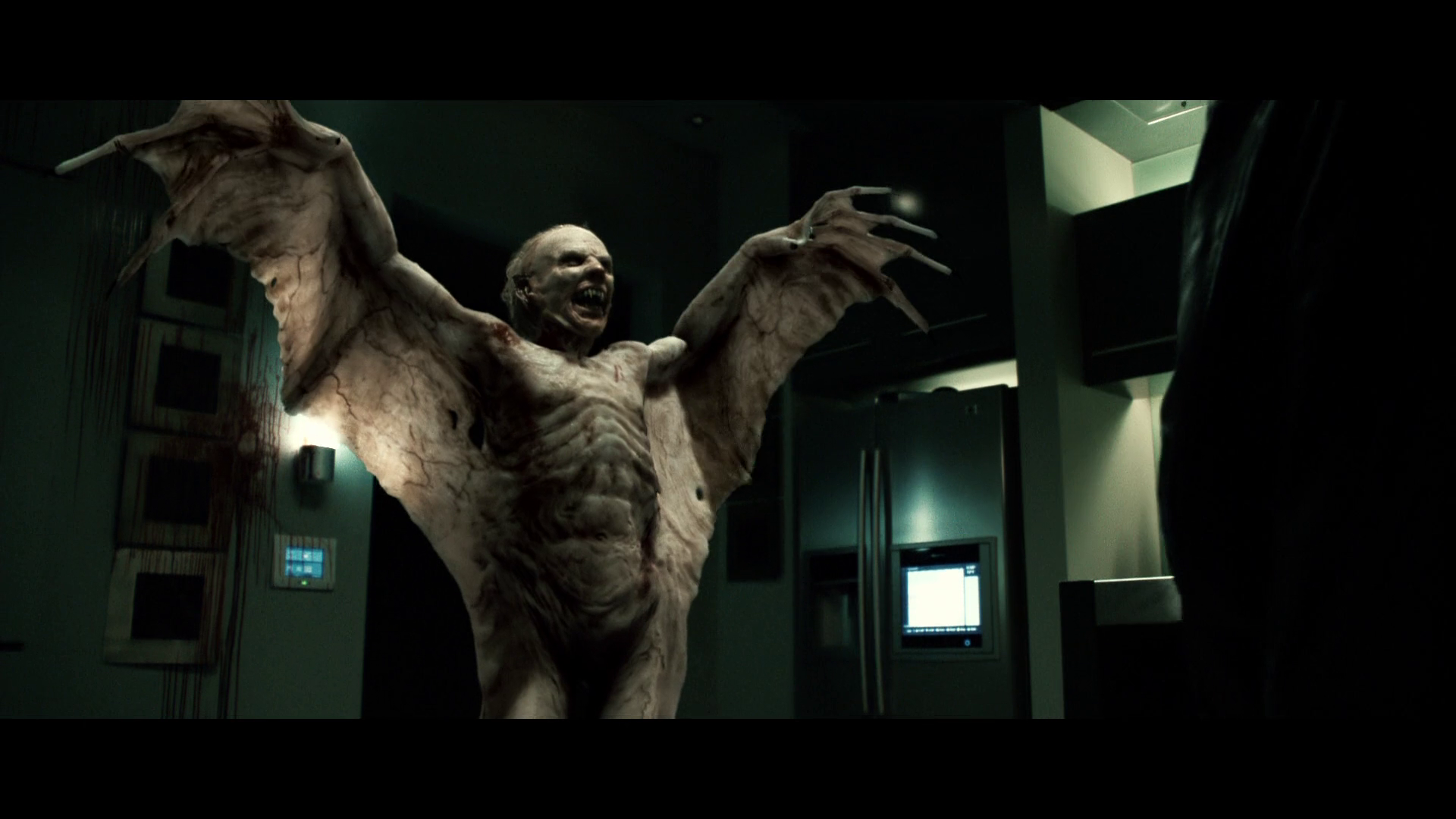
The world of Daybreakers posits a dracula to nosferatu continuum with its vampires, which is of course heavily class-inflected: So long as you are able to keep your diet of human blood up, you stay a cultured, hot young thing with cool glowing eyes and high-class tailored clothes forever. You can even blast cigs; so much of this movie has Ethan Hawke doing cool guy cig-blasting with pinpoint of light at the end of his lit cig counterpoint his cool glowing vampire eyes. But if you stop getting your diet of human blood, you become a nosferatu, and turn into a bald screaming animal berserker with superstrength and bat wings who lives in the sewer. Edward comes home from his unfulfilling job as the most evil scientist in the world to find his little bro Frankie (Michael Dalton), a vampire special forces operator who was just over in vampire Iraq, at his apartment. They have a big argument about the nature of vampirism, which is interrupted by being attacked in their house by one of these screaming homeless nosferatu zombie-monsters.
You can see where the plot of this is going. Ed runs into a bunch of humans out on the road when driving home and puts them in his car to protect them; one of them is the female lead, Lisa (Harriet Minto-Day) who brings him into the Resistance officially, taking him out to meet their de facto leader and true gem of the film, Lionel ‘Elvis’ Cormac (Willem Dafoe). In true dumb guy scriptwriting fashion, the Elvis nickname exists in the script solely so we can get Dafoe singing a few lines from Presley’s Burning Love about his heart beating and temperature rising, because Cormac has figured out how to transform vampires back into humans. He offers Ed a way out of the vampire apocalypse, because the blood is running out. Then a vampire SWAT team led by Frankie, who has sold out to Bromley and now leads his forces, swoops in to start an action sequence.
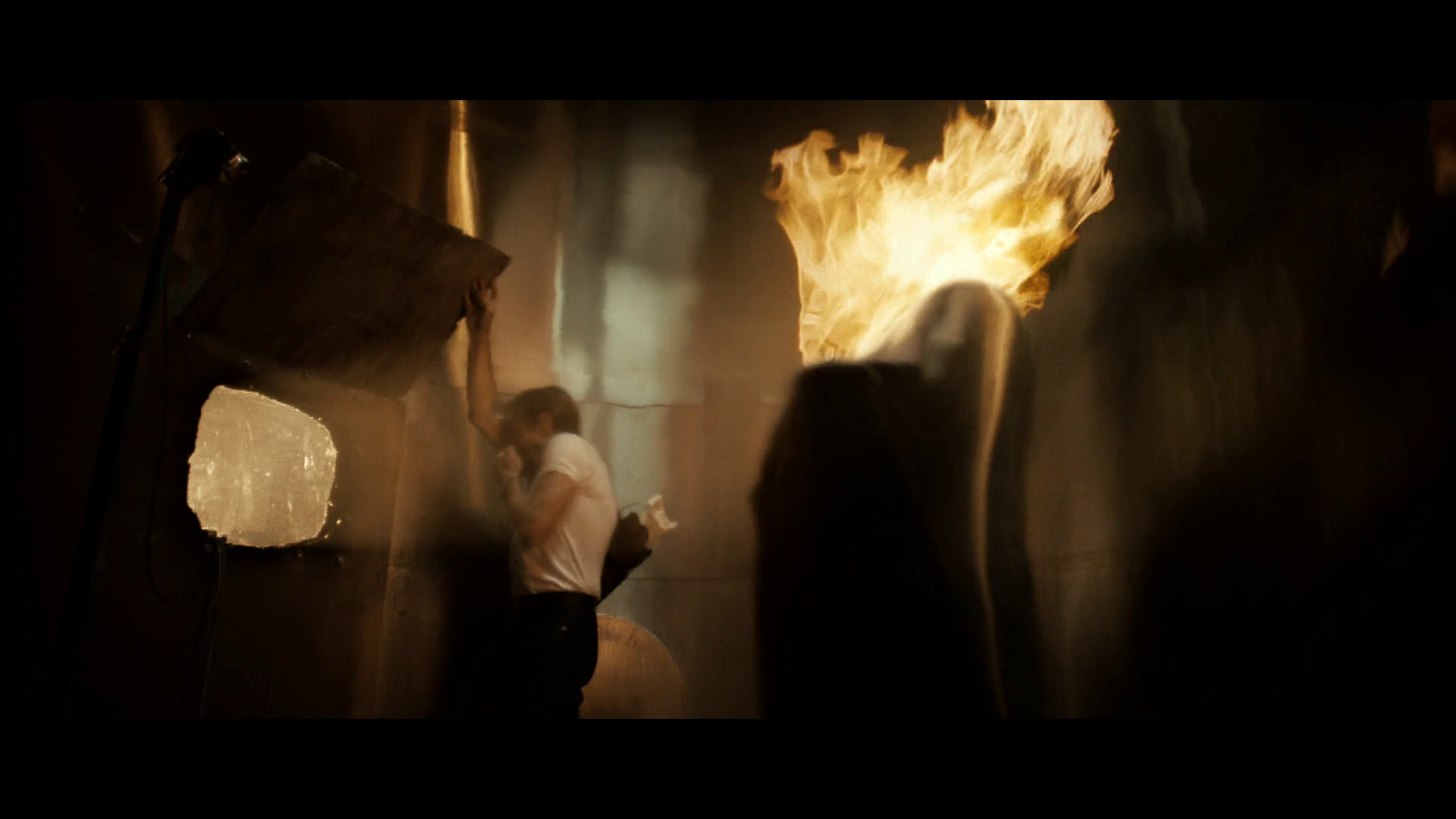
The blood’s going to run out, the synthetic blood isn’t working, Cormac has a harrowing and extremely personal way of transforming vampires back into humans that involves blood transfusion and simultaneous exposure to sunlight, which they do in a cool set done up to look like the inside of a huge winery vat. We’re headed to a very neat and tidy finish here, which is that there’s gonna be a cure, and it’s going to work in a somewhat confusing but convenient way, which is that once you’ve got a cured vampire The Hard Way, their blood itself is a cure and the newly human vampire is immune to further bouts of vampirism. (You could ask why Cormac didn't figure this out earlier about himself, but as far as I can recollect the answer to that is, "Because then we don't have a movie, you idiot.") Convenient -- when the nosferatu zombie vampires attack cured vampires now, they themselves become cured, creating a chain reaction that will burn vampirism out quite quickly. The cure will save humanity. Note that this is a distinct outcome from saving all the humans; vampires who have been turned human can still die from, for instance, being torn apart by nosferatu zombie vampires, which is what happens to the CEO Bromley. The movie ends before we have to see the repercussions of this -- our heroes ride off into the sunrise with the cure in their possession, and that’s where the credits roll.
This is not a masterpiece; the biggest fun here is in seeing vampires get exploded, cool muscle cars with blacked out windows drive around in the sun doing car chases, and watching Ethan Hawke, Willem Dafoe, and Sam O’Neill ply their trades. Probably the best bit that doesn’t involve those three directly is the vampire Starbucks; remember, the conceit of this 2009 film is that in the next ten years, a vampire apocalypse hits the entire world and everyone turns into the bloodthirsty living dead, but by 2019 society more or less looks the same as it does now but you put “vampire” or “blood” in front of everything. So of course there’s a vampire coffee shop with a vampire barista that sells you blood coffee that the vampire desk workers literally, instead of metaphorically, need to start their day before hopping on the vampire subway and heading to the vampire office. And of course, because this is a dumb guy action movie, when society starts breaking down and the office workers try to jump the counter to get their fix of blood and caffeine, the vampire Starbucks turns out to have emergency shutters and guys with machine guns. If I’d seen this when I was 15 there would have been some “whoooaaa, duuude” moments there. Not so much all these years later, but I still appreciate a good dumb surface level “bro, what if the WORLD is a vampire?” I’d complain that they didn’t license “Bullet with Butterfly Wings” just for that line, but the soundtrack has the Placebo cover of Kate Bush’s “Running Up That Hill,” so I’m satisfied on that front.
Big recommend for this one; if more of the big studio films from the 2000s on this list were like Daybreakers, this exercise would have been a lot less painful. Looking at you, Underworld franchise, and Ultraviolet, and so on. Not sure what’s up next; eventually, the answer to that question will be 2014’s Dracula Untold.
Have any questions or feedback? Drop us a note in the comments below or email us at contact@goonhammer.com. Want articles like this linked in your inbox every Monday morning? Sign up for our newsletter. And don't forget that you can support us on Patreon for backer rewards like early video content, Administratum access, an ad-free experience on our website and more.
 This website uses cookies. Learn more.


 Goonhammer App and Patron Updates: April, 2026
 Kill Team Tournament Report: Engage, Party, Repeat's March Madness 2026
 Goonhammer Reviews: Tribal Conquest