 Anyone who’s read the Black Library for any length of time will naturally have found a few writers whose work resonates with them. Have you ever wondered what they’re up to outside of the Warhammer universe? I certainly have, and in
 Beyond the Black Library
we turn a grimy, grimdark eye towards the fruits of the imagination that our authors have been hunched over their desks creating when they’re not weaving tales of the Imperium or the Mortal Realms.
Tom Hanks won the first of his two Oscars in 1994 for his portrayal of a gay man living with AIDS in the movie
Philadelphia. Inspired in part by a true story, Hanks's character loses his job in his law firm and takes them to court for wrongful termination.
He was critically acclaimed for the role; indeed, he won the first of his two Oscars for it the following year. And yet, if offered the role today he
has said that as a straight man he would turn it down- a fact which speaks to the evolving nature of what
authenticity means in our creative arts.
The written word is hardly immune. Occasional debates break out about the authenticity of a particular point of view in a novel, or appropriate characterization.
For the most part, though, speculative fiction has proven somewhat more insulated from these real-world concerns, largely due to its remove-by-design from the world-that-is. Here, I would posit, authenticity is more of a value-add rather than a foundational requirement. After all, what's "experientially authentic" for a dragon, a goblin, or a Drukhari?
Within the canon of the Black Library- a body of stories overwhelmingly driven by armed conflict- most of its authors have never opportunity to gain lived experience of actual combat and experienced its terrors firsthand (not a deficiency, mind).
While this hardly disqualifies them from writing- the imagination is a vast and wonderful thing- I do at times enjoy seeing a "hard" edge of realism in my speculative fiction. For instance,
Graham McNeill clearly did some homework in exploring the principles in siegecraft when writing
Storm of Iron, and the added details he was able to weave into the story increased its realism and, as a result, deepened my immersion.
By the same token,
Robbie MacNiven is a military historian.
Noah Van Nguyen is a combat veteran, which lent his books like
Godeater's Son and
Elemental Council (
review) a bit more grittiness.
R. S. Wilt, author of the Tempestus Scions novel
Final Deployment (
review) is a retired Army officer.
And that brings us to today's subject,
Richard Fox, a graduate of West Point who served two combat tours in Iraq, along the way being awarded a Presidential Unit Citation and Bronze Star. While known to readers of the Black Library for his Red Corsairs short story
We Were Brothers (released last year during Heretic Astartes Week), Fox's bread and butter is what's known as hard military sci-fi.
In the DNA
Part of Warhammer's genius is how it incorporates as spectrum of different genre types. One week you're reading an Inquisition detective story, then next an Ork comedy. Military sci-fi is in the Black Library's DNA, and this is part of the reason that
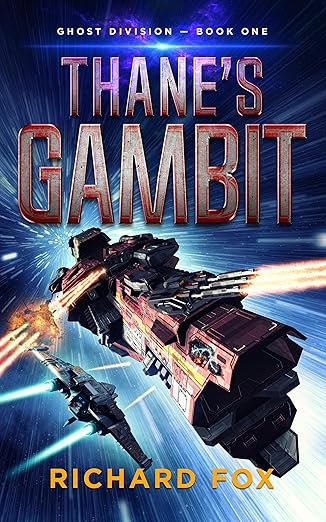
Thane's Gambit felt so comfortable and familiar.
Your run-of-the-mill human soldiers (of the Ghost Division (Imperial Guard) alongside battlesuit-sized mechs inhabited by the remnant consciousness of disembodied warriors (Dreadnoughts) and high-powered supersoldiers (Space Marines), fight for their survival against an all-consuming, all-devouring mindless swarm enemy that converts its enemy's biomass to fuel its war machine (Tyranids).
Now that might sound derivative- particularly for a writer with a Black Library writing credit- but in fairness to Fox it never actually feels that way. Plus- let's be honest- Warhammer has long itself been more of an adopter than an innovator when it comes to genre fiction. Warhammer 40K is a mélange of influences, adaptions, and ideas cobbled together into a whole that has- to its own credit- managed to cohere and evolve into something unique.
In
Thane's Gambit, we find a humanity that has expanded its footprint across the stars and settled new worlds. While there was always the possibility of a first contact with an alien species- however remote- when they encountered the Vorash, what they found was in many ways less a sentient species and more like a virulent disease.
The Vorash kill- and then turn the dead into aggressive, ambulatory vectors for spreading their infection. Entire planets fall, ships turn into silent infection vectors, entire sectors go still. And woven through it all, the strange song of the Vorash chorus.
Director Thane, cyborg commander of the human fleet that houses the Ghost Divison's elite soldiers, quickly learns that fighting the Vorash head-on is a losing game. To win a war against an enemy this unconventional, Thane will need to lead his forces into the unexpected. It's this unexpected- the "gambit" named in the title- that drives much of the story's narrative forward. That puts the story as a race against time as Thane and humanity try to find a vulnerability in their relentless enemy- and exploit it.
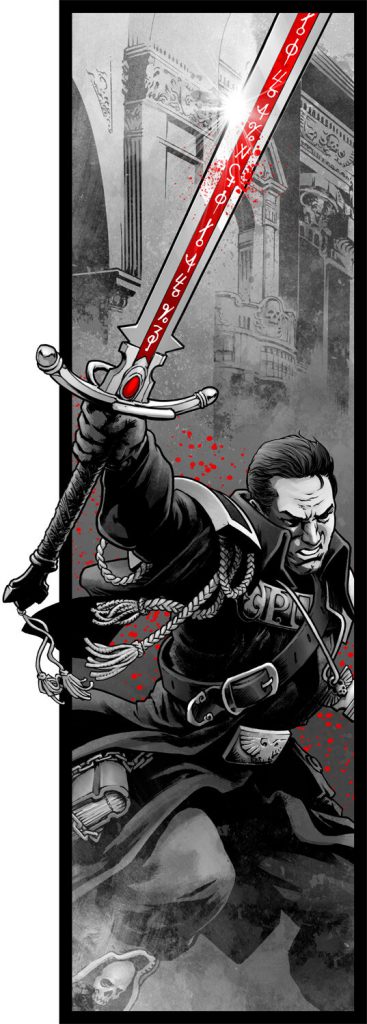 Image credit: Games Workshop
Warcraft vs. Stagecraft
Fox plays well to his strengths here, leaning into a strong military sci-fi presence that not only allows him to craft exciting action scenes, but also help him build fast characterization for his soldiers. As someone whose eyes tend to glaze a little over after around the tenth page of combat in most Black Library story sequences, I was surprised to find that the first fifty or so action-soaked opening pages of
Thane's Gambit still made for compelling reading.
If anything, at times it was a little
too immersive, in that I wasn't entirely familiar with some of the concepts and terms Fox employed in his battle sequences, but- like McNeill's
Storm of Iron siegecraft- I felt like I was learning while being entertained.
Contrast this, say, with
Dan Abnett's depictions of blade-fighting. If Abnett is a trained swordsman he's been rather quiet about it, and his depictions- often climactic- tend to be painted in broader strokes rather than finer details. You'd never confuse them with a depiction of fencing, and indeed remarked upon some of the tradecraft he's employed in the Illustrated and Annotated Edition of
Malleus. There's a line wherein Eisenhorn describes the duel he's having thusly:
"I made a head-height horizontal parry called the uwe sar, and then left and right block strokes, the ulsar and the uin ulsar."
"Dare I say that the decision to have Eisenhorn trained in a particular method and 'art' of swordsmanship," notes Abnett in the marginal annotation, "greatly expands the range of terms that can be used to describe his combats, even if some of those terms are made-up phrases." In other words, this isn't swordplay, it's theater. And there's nothing wrong with that- nobody is confusing this with
Fiore dei Liberi's Fior di Battaglia. This is entertainment, and Abnett certainly
is entertaining.
Similarly, when I read combat sequences in the Black Library, I occasionally find myself wondering how they might read to someone who's actually experienced combat: gritty realism, magical hand-waviness, or something in between. With Fox, you get the former, and it's that sort of genuine you-are-there kind of tactile feel- that
authenticity- that kept this reader engaged.
Band of Brothers
Beyond combat, Fox's slice of life extends to that particular kind of easy camaraderie that grows amongst those whose lives are comprised of, as the expression goes, long periods of boredom punctuated by extreme terror.
Whether it's Sgt. Dorian's squad, station militia Private Matteo Conti, or mech 'pilot' Moose, Fox's cast of grunts is well-drawn and sympathetic. In one of the book's best moments Sgt. Dorian describes their evening's dinner to a server rack filled with the consciousnesses of the battlesuit pilots who have forever left the world of physical sensation. "We don’t get to eat a whole lot on account of us just being brain boxes," laments Moose, "but
sometimes we still like to remember what it’s like to eat something."
The humans are the real strength of the book- the cyborg Thane stands in as an Astartes not just in fighting efficacy but that in that his power makes up a lot of his personality as well. Alas, the antagonists of the book aren't quite their equal.
From a military perspective, the Vorash are plenty scary. They're resistant to many attacks, with soldiers having to find the right "bullet mix" to penetrate their rapidly-adapting biomechanical armor. They're relentless, infect at a scratch, melt down flesh and use the remaining bones as a frame for their zombie-like foot soldiers. All the ingredients are there for a memorable villain, but Fox never quite captures the magic here. You can see what he's going for, but Fox is far more adept at mil sci-fi than horror, and getting the most out of the Vorash really needs a horror-writer's eye.
As a result, the book tells more than shows the stakes. You see them, they drive the story's sense of urgency, but I never quite
felt them. Of course, you can't have it all: a horror writer's warfighting scenes by the same token might not have had the same realism.
Final Thoughts
Overall, I enjoyed
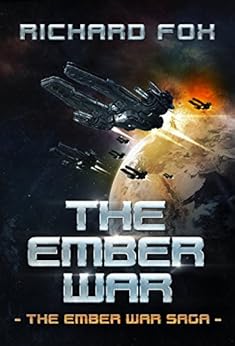
Thane's Gambit and Fox went some interesting directions with it, wisely choosing to leave a lot around the nature of the Vorash still unexplained by the end of the book. He's clearly setting up for a series (he's already done two, Ember War and another), and there was more than enough here for me to consider grabbing the next one once it comes available.
All in all
Thane's Gambit is an easy pickup for fans of Warhammer 40K fiction. It has a lot of the same ingredients, but the DNA of the world is significantly different. The sense of dread is the result of an immediate threat, not an existential fact of daily life baked into the setting's DNA, 40K without the grimdark.
Given Fox's prolific rate of output- his flagship Ember War saga encompasses more than three dozen novels in the last decade- you won't have long to wait.
Have any questions or feedback? Drop us a note in the comments below or email us at contact@goonhammer.com. Want articles like this linked in your inbox every Monday morning? Sign up for our newsletter. And don't forget that you can support us on Patreon for backer rewards like early video content, Administratum access, an ad-free experience on our website, and subscriber-only content covering competitive Warhammer 40K!Thank you for being a friend.
 This website uses cookies. Learn more.


 Goonhammer App and Patron Updates: April, 2026
 Kill Team Tournament Report: Engage, Party, Repeat's March Madness 2026
 Goonhammer Reviews: Tribal Conquest